Slide 2
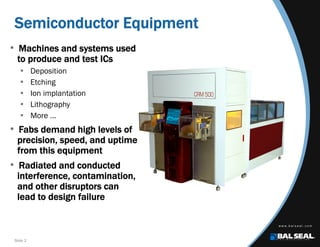
Semiconductor Equipment
• Machines and systems used
to produce and test ICs
 Deposition
 Etching
 Ion implantation
 Lithography
 More …
• Fabs demand high levels of
precision, speed, and uptime
from this equipment
• Radiated and conducted
interference, contamination,
and other disruptors can
lead to design failure
Slide 3
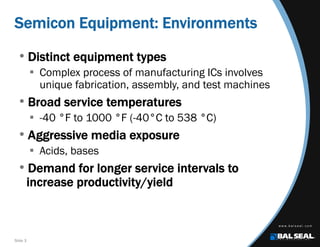
Semicon Equipment: Environments
• Distinct equipment types
 Complex process of manufacturing ICs involves
unique fabrication, assembly, and test machines
• Broad service temperatures
 -40 °F to 1000 °F (-40°C to 538 °C)
• Aggressive media exposure
 Acids, bases
• Demand for longer service intervals to
increase productivity/yield
Slide 4
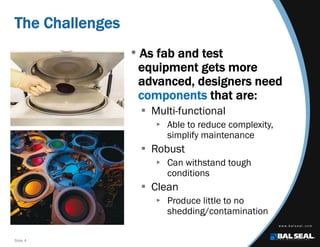
The Challenges
• As fab and test
equipment gets more
advanced, designers need
components that are:
 Multi-functional
 Able to reduce complexity,
simplify maintenance
 Robust
 Can withstand tough
conditions
 Clean
 Produce little to no
shedding/contamination
Slide 5
The Canted Coil Spring
• What is it?
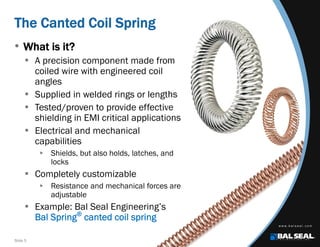
 A precision component made from
coiled wire with engineered coil
angles
 Supplied in welded rings or lengths
 Tested/proven to provide effective
shielding in EMI critical applications
 Electrical and mechanical
capabilities
 Shields, but also holds, latches, and
locks
 Completely customizable
 Resistance and mechanical forces are
adjustable
 Example: Bal Seal Engineering’s
Bal Spring®
canted coil spring
Slide 6
Bal Spring® Connecting Performance
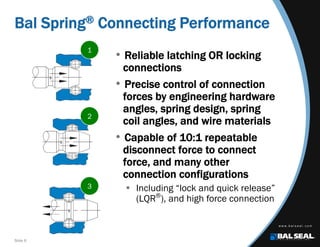
• Reliable latching OR locking
connections
• Precise control of connection
forces by engineering hardware
angles, spring design, spring
coil angles, and wire materials
• Capable of 10:1 repeatable
disconnect force to connect
force, and many other
connection configurations
 Including “lock and quick release”
(LQR®
), and high force connection
1
2
3
Slide 7
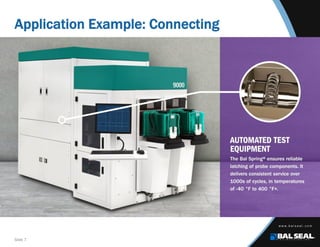
Application Example: Connecting
Slide 8
Bal Spring® EMI Shielding Performance
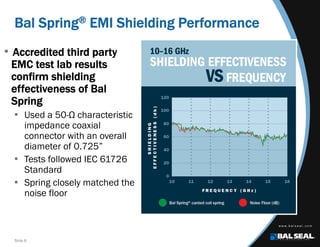
• Accredited third party
EMC test lab results
confirm shielding
effectiveness of Bal
Spring
 Used a 50-Ω characteristic
impedance coaxial
connector with an overall
diameter of 0.725”
 Tests followed IEC 61726
Standard
 Spring closely matched the
noise floor
Slide 9
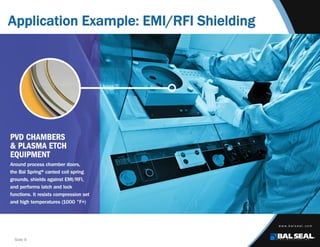
Application Example: EMI/RFI Shielding
Slide 10
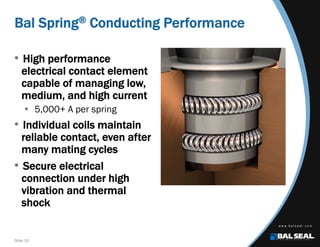
Bal Spring® Conducting Performance
• High performance
electrical contact element
capable of managing low,
medium, and high current
 5,000+ A per spring
• Individual coils maintain
reliable contact, even after
many mating cycles
• Secure electrical
connection under high
vibration and thermal
shock
Slide 11
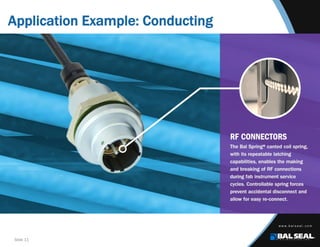
Application Example: Conducting
Slide 12
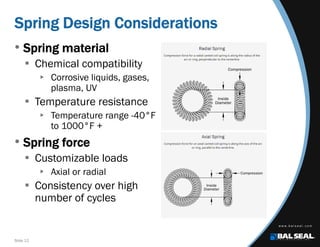
Spring Design Considerations
• Spring material
 Chemical compatibility
 Corrosive liquids, gases,
plasma, UV
 Temperature resistance
 Temperature range -40°F
to 1000°F +
• Spring force
 Customizable loads
 Axial or radial
 Consistency over high
number of cycles
Slide 13
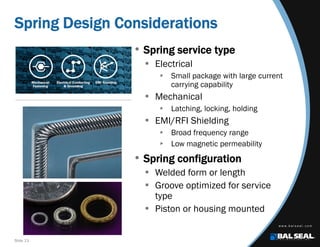
Spring Design Considerations
• Spring service type
 Electrical
 Small package with large current
carrying capability
 Mechanical
 Latching, locking, holding
 EMI/RFI Shielding
 Broad frequency range
 Low magnetic permeability
• Spring configuration
 Welded form or length
 Groove optimized for service
type
 Piston or housing mounted
Slide 14
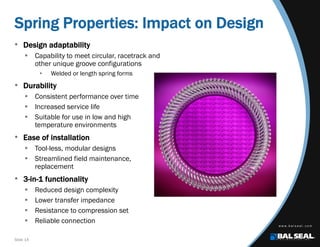
Spring Properties: Impact on Design
• Design adaptability
 Capability to meet circular, racetrack and
other unique groove configurations
 Welded or length spring forms
• Durability
 Consistent performance over time
 Increased service life
 Suitable for use in low and high
temperature environments
• Ease of installation
 Tool-less, modular designs
 Streamlined field maintenance,
replacement
• 3-in-1 functionality
 Reduced design complexity
 Lower transfer impedance
 Resistance to compression set
 Reliable connection
Slide 15
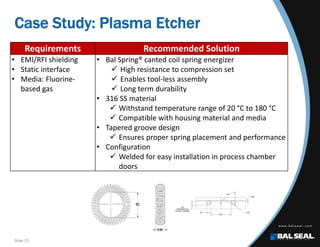
Case Study: Plasma Etcher
Requirements Recommended Solution
• EMI/RFI shielding 
• Static interface
• Media: Fluorine‐
based gas
• Bal Spring® canted coil spring energizer
 High resistance to compression set
 Enables tool‐less assembly
 Long term durability
• 316 SS material
 Withstand temperature range of 20 °C to 180 °C 
 Compatible with housing material and media
• Tapered groove design
 Ensures proper spring placement and performance 
• Configuration 
 Welded for easy installation in process chamber 
doors
Slide 16
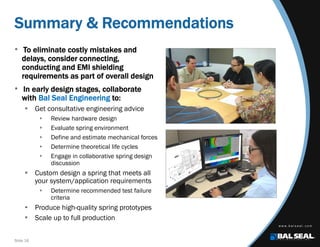
Summary & Recommendations
• To eliminate costly mistakes and
delays, consider connecting,
conducting and EMI shielding
requirements as part of overall design
• In early design stages, collaborate
with Bal Seal Engineering to:
 Get consultative engineering advice
 Review hardware design
 Evaluate spring environment
 Define and estimate mechanical forces
 Determine theoretical life cycles
 Engage in collaborative spring design
discussion
 Custom design a spring that meets all
your system/application requirements
 Determine recommended test failure
criteria
 Produce high-quality spring prototypes
 Scale up to full production
Slide 17
Resources & Contact Information
marketing@balseal.com www.balseal.com +1 949.460.2100 Design request form
Karina Chavez
Global Market Manager
Semiconductor Products
P: 949.460.2118
kchavez@balseal.com
May 19 ©Bal Seal Engineering, Inc. This document contains and/or refers to PROPRIETARY information of Bal Seal Engineering, Inc., and may not be reproduced, copied,
published, or distributed in any form or disclosed to a third party, in whole or in part, without the written authorization of an officer of Bal Seal Engineering, Inc. Products are
the subject of issued or pending United States and foreign patents. Products of Bal Seal Engineering, Inc. and this document are PROPRIETARY and products may not be
manufactured, or caused to be manufactured, by any other party.
Custom components that drive
tomorrow’s technologies®

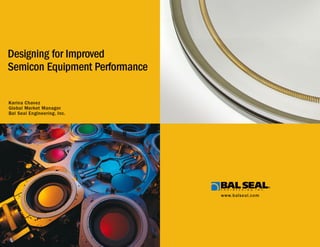
Designing For Improved Semicon Equipment Performance

  • 2.
    Slide 2 Semiconductor Equipment •Machines and systems used to produce and test ICs  Deposition  Etching  Ion implantation  Lithography  More … • Fabs demand high levels of precision, speed, and uptime from this equipment • Radiated and conducted interference, contamination, and other disruptors can lead to design failure
  • 3.
    Slide 3 Semicon Equipment:Environments • Distinct equipment types  Complex process of manufacturing ICs involves unique fabrication, assembly, and test machines • Broad service temperatures  -40 °F to 1000 °F (-40°C to 538 °C) • Aggressive media exposure  Acids, bases • Demand for longer service intervals to increase productivity/yield
  • 4.
    Slide 4 The Challenges •As fab and test equipment gets more advanced, designers need components that are:  Multi-functional  Able to reduce complexity, simplify maintenance  Robust  Can withstand tough conditions  Clean  Produce little to no shedding/contamination
  • 5.
    Slide 5 The CantedCoil Spring • What is it?  A precision component made from coiled wire with engineered coil angles  Supplied in welded rings or lengths  Tested/proven to provide effective shielding in EMI critical applications  Electrical and mechanical capabilities  Shields, but also holds, latches, and locks  Completely customizable  Resistance and mechanical forces are adjustable  Example: Bal Seal Engineering’s Bal Spring® canted coil spring
  • 6.
    Slide 6 Bal Spring®Connecting Performance • Reliable latching OR locking connections • Precise control of connection forces by engineering hardware angles, spring design, spring coil angles, and wire materials • Capable of 10:1 repeatable disconnect force to connect force, and many other connection configurations  Including “lock and quick release” (LQR® ), and high force connection 1 2 3
  • 7.
  • 8.
    Slide 8 Bal Spring®EMI Shielding Performance • Accredited third party EMC test lab results confirm shielding effectiveness of Bal Spring  Used a 50-Ω characteristic impedance coaxial connector with an overall diameter of 0.725”  Tests followed IEC 61726 Standard  Spring closely matched the noise floor
  • 9.
  • 10.
    Slide 10 Bal Spring®Conducting Performance • High performance electrical contact element capable of managing low, medium, and high current  5,000+ A per spring • Individual coils maintain reliable contact, even after many mating cycles • Secure electrical connection under high vibration and thermal shock
  • 11.
  • 12.
    Slide 12 Spring DesignConsiderations • Spring material  Chemical compatibility  Corrosive liquids, gases, plasma, UV  Temperature resistance  Temperature range -40°F to 1000°F + • Spring force  Customizable loads  Axial or radial  Consistency over high number of cycles
  • 13.
    Slide 13 Spring DesignConsiderations • Spring service type  Electrical  Small package with large current carrying capability  Mechanical  Latching, locking, holding  EMI/RFI Shielding  Broad frequency range  Low magnetic permeability • Spring configuration  Welded form or length  Groove optimized for service type  Piston or housing mounted
  • 14.
    Slide 14 Spring Properties:Impact on Design • Design adaptability  Capability to meet circular, racetrack and other unique groove configurations  Welded or length spring forms • Durability  Consistent performance over time  Increased service life  Suitable for use in low and high temperature environments • Ease of installation  Tool-less, modular designs  Streamlined field maintenance, replacement • 3-in-1 functionality  Reduced design complexity  Lower transfer impedance  Resistance to compression set  Reliable connection
  • 15.
    Slide 15 Case Study:Plasma Etcher Requirements Recommended Solution • EMI/RFI shielding  • Static interface • Media: Fluorine‐ based gas • Bal Spring® canted coil spring energizer  High resistance to compression set  Enables tool‐less assembly  Long term durability • 316 SS material  Withstand temperature range of 20 °C to 180 °C   Compatible with housing material and media • Tapered groove design  Ensures proper spring placement and performance  • Configuration   Welded for easy installation in process chamber  doors
  • 16.
    Slide 16 Summary &Recommendations • To eliminate costly mistakes and delays, consider connecting, conducting and EMI shielding requirements as part of overall design • In early design stages, collaborate with Bal Seal Engineering to:  Get consultative engineering advice  Review hardware design  Evaluate spring environment  Define and estimate mechanical forces  Determine theoretical life cycles  Engage in collaborative spring design discussion  Custom design a spring that meets all your system/application requirements  Determine recommended test failure criteria  Produce high-quality spring prototypes  Scale up to full production
  • 17.
    Slide 17 Resources &Contact Information marketing@balseal.com www.balseal.com +1 949.460.2100 Design request form Karina Chavez Global Market Manager Semiconductor Products P: 949.460.2118 kchavez@balseal.com
  • 18.
    May 19 ©BalSeal Engineering, Inc. This document contains and/or refers to PROPRIETARY information of Bal Seal Engineering, Inc., and may not be reproduced, copied, published, or distributed in any form or disclosed to a third party, in whole or in part, without the written authorization of an officer of Bal Seal Engineering, Inc. Products are the subject of issued or pending United States and foreign patents. Products of Bal Seal Engineering, Inc. and this document are PROPRIETARY and products may not be manufactured, or caused to be manufactured, by any other party. Custom components that drive tomorrow’s technologies®