
GLY 807
(ROCK MECHANICS)
BEHAVIOUR
PATTERNS OF
SLOPES TUNNELS
IN DISCONTINOUS
ROCK MEDIA
Presented By:
OMITOGUN SOLOMON T.
189078021
1st AUG.,2019
Outline
 Introduction
 Discontinuities in Rocks
 Description of Slopes Tunnels
 Types of Slopes Tunnels
 Tunnel Geometry
 Geological Conditions that influence Slopes
Tunnels excavation
 How Discontinuities in Rock Media Affects
Slopes Tunnels
 Factors to be considered in slopes tunnelling
 Causes of Failures of Slopes Tunnels in Rocks
 Conclusion
Introduction
 How rocks
mechanically
respond to
excavations,
especially in low
stress environments
as encountered in
slopes, are critically
affected by
discontinuities in the
Discontinuities in Rocks
 A discontinuity in rock is a plane or
surface that marks a change in
physical or chemical characteristics in
a soil or rock mass.
 Discontuinities in rocks affect their
shear strengths
 Discontinuities are either naturally
made or artificially induced.
Discontinuities in Rocks
Examples are:
 Bedding
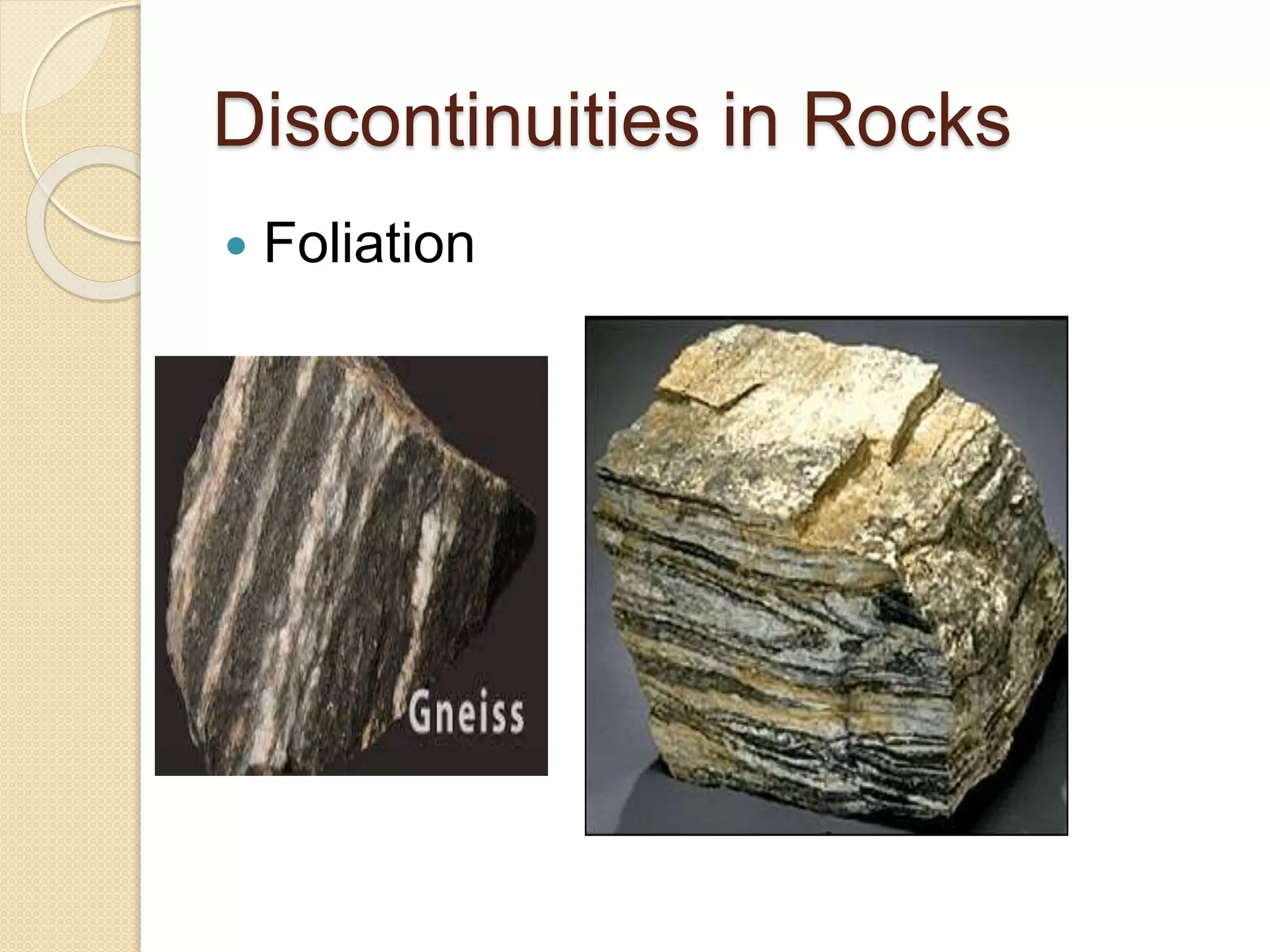
Discontinuities in Rocks
 Foliation
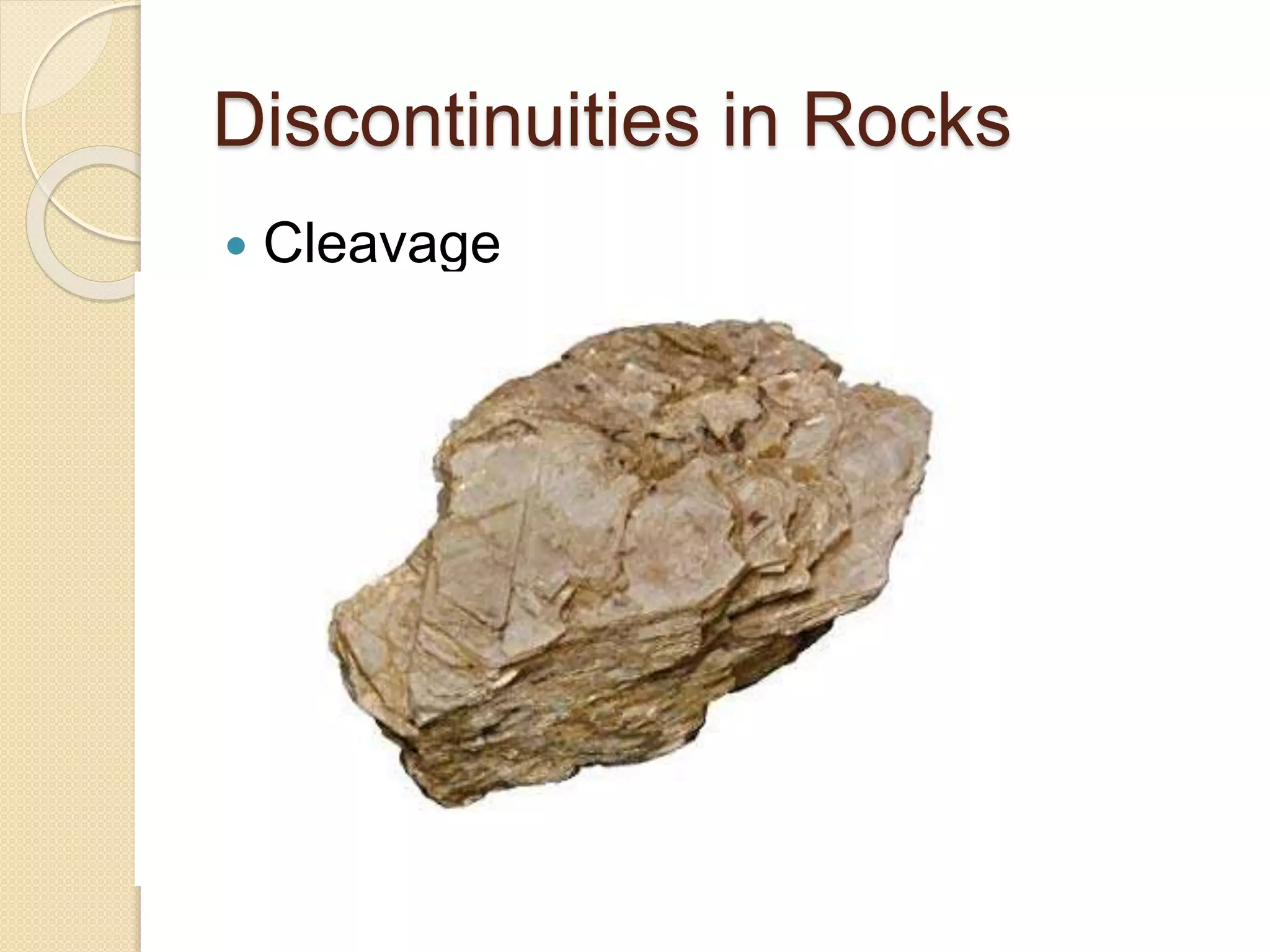
Discontinuities in Rocks
 Cleavage
Discontinuities in Rocks
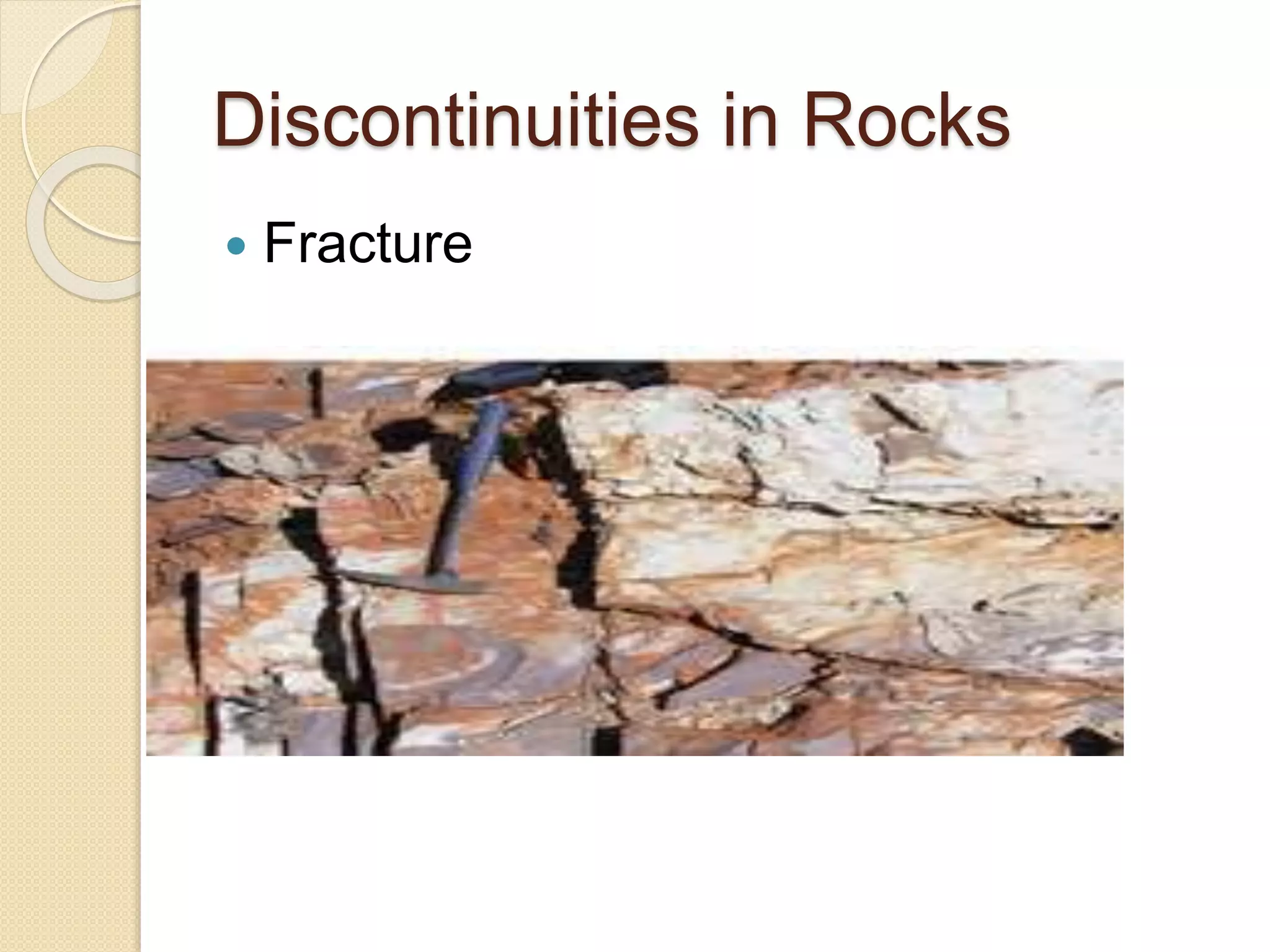
 Fracture
Discontinuities in Rocks
 Joint
Discontinuities in Rocks
 Fault plane
Discontinuities in Rocks
 Fold
Description of Tunnels
 Slope tunnels are tunnels constructed in steep
hills or mountainous areas, for economic and safe
operation .
 Tunnels are dug in types of materials varying from
soft clay to hard rock.
 Tunnel is an artificially constructed underground
passage to by- pass obstacles safely without
disturbing the over burden.
 Tunnels are created by the process of excavation.
 They are made into natural material (rocks)
 Empty inside
 Both ends are open to atmosphere
 Generally horizontal
 Thick walled structure looks like cylinder
Description of Tunnels
Description of
Tunnels(Contd.)
Types of Tunnels
There are three broad categories of
tunnels based on their purposes
 Mining ;
 Public works and
 Transportation.
Types of Tunnels
 Mining:
 Mine tunnels are
used during ore
extraction, enabling
labourers or
equipment to
access mineral and
metal deposits
deep inside
the subsurface.
Types of Tunnels(Contd.)
 Public works
tunnels carry
water, sewage or
gas lines across
great distances.
 The earliest
tunnels in Rome
for instance, were
used to transport
water to, and
sewage away
from, heavily
populated regions.
Types of Tunnels(Contd.)
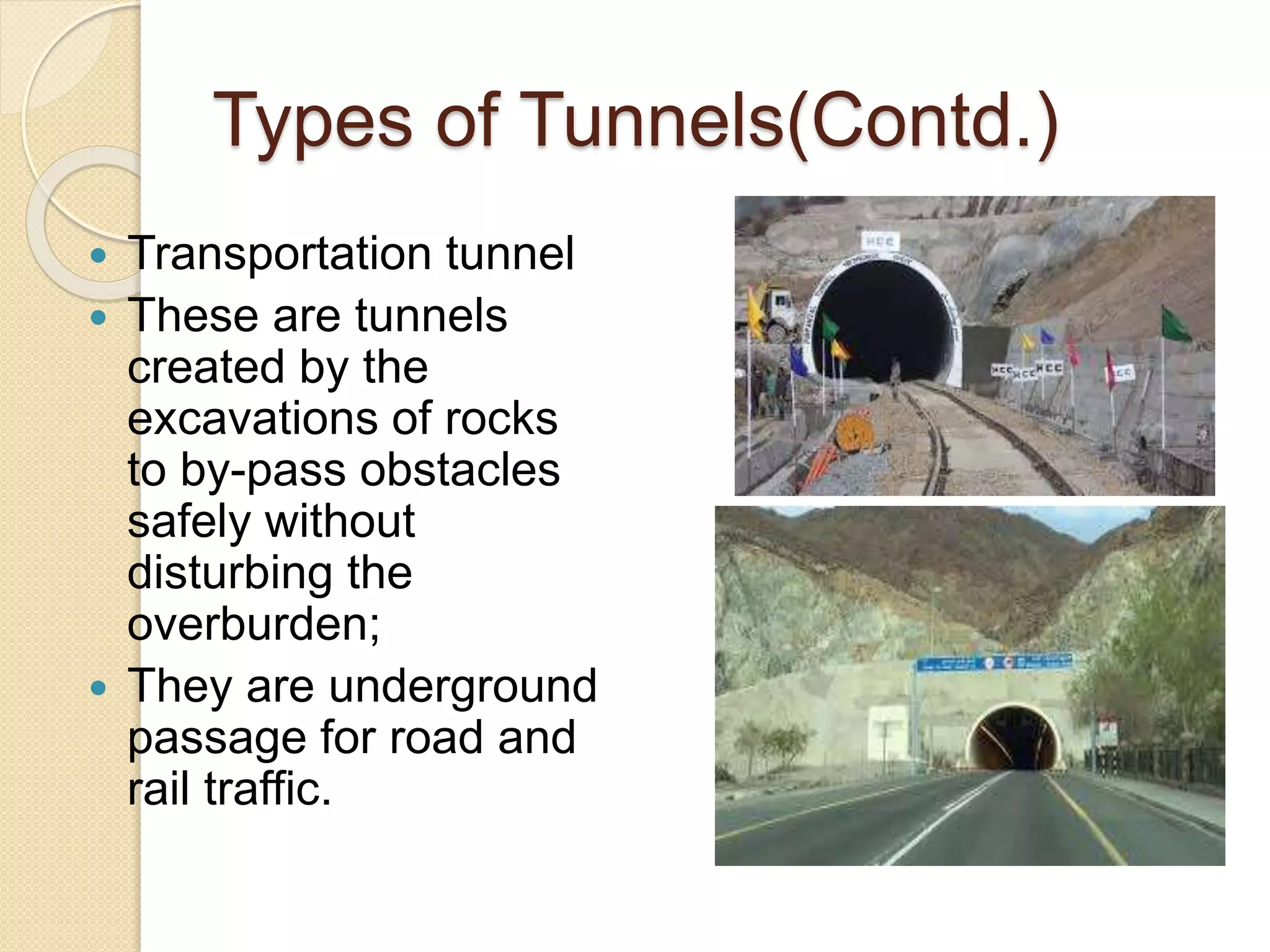
 Transportation tunnel
 These are tunnels
created by the
excavations of rocks
to by-pass obstacles
safely without
disturbing the
overburden;
 They are underground
passage for road and
rail traffic.
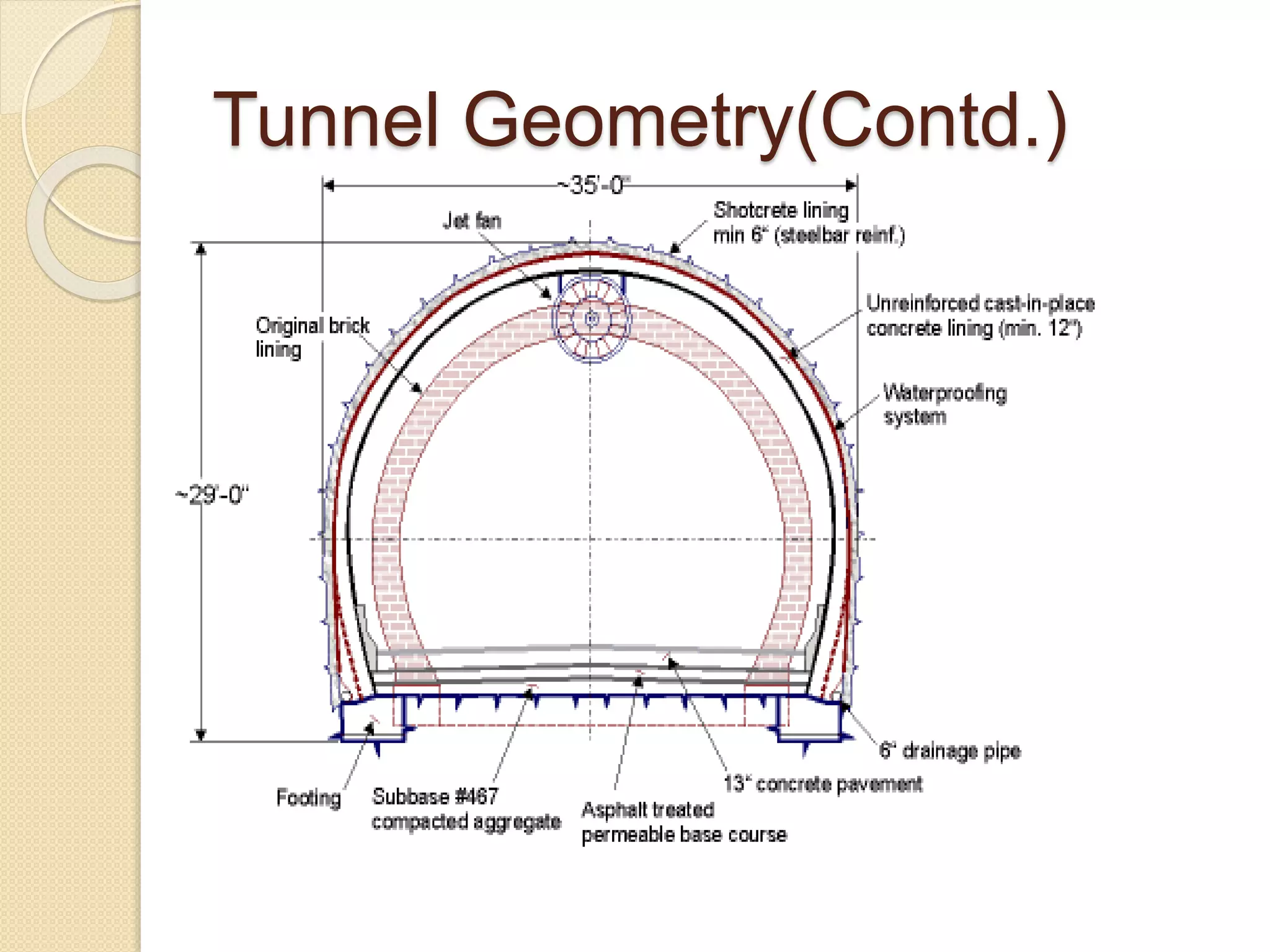
Tunnel Geometry
 In the design of tunnels, designers attempt to
utilize a shape that will prove the most stable.
 Basic mechanics, in conjunction with the rock
mass classification, dictates the most effective
geometry.
 When tunnelling is strongly stratified rock, the
roof is often cut flat, taking advantage of the
rock's natural tendency to break along bedding
planes. By cutting the tunnel along bedding
planes and then supporting the roof, the tunnel
would be less apt to collapse than if a different
geometry were employed which cut across the
bedding of the rock, making it more unstable.
Tunnel Geometry(Contd.)
 The size is also very important. It is
generally considered that the
minimum size for a tunnel that will still
permit reasonable working space is at
least 7 feet (2.15 m) high by 4 feet
(1.2 m) wide, clear of the wall or the
supports, for a walkway. (Wahlstrom,
1973)
 The dimensional need to wider if it is
for vehicle/train traffic
Tunnel Geometry(Contd.)
Geological Conditions that influence
Slopes Tunnels excavation
1. Lithology
-Mineralogy
-Texture
-Structure of Rock
Geological Conditions that
influence Slopes Tunnels
excavation
2. Geological Structures
-Dip/Strike
-Folding
-Fault
-Joints
Geological Conditions that
influence Slopes Tunnels
excavation
3. Groundwater Condition
-Impervious formation
-Above water table
-Below water tabe
How Discontinuities in Rock Media
Affects Slopes Tunnels
 Effect of soil layers: Horizontal, vertical
and inclined layers have different kinds of
loading conditions for tunnels.
How Discontinuities in Rock
Media Affects Slopes Tunnels
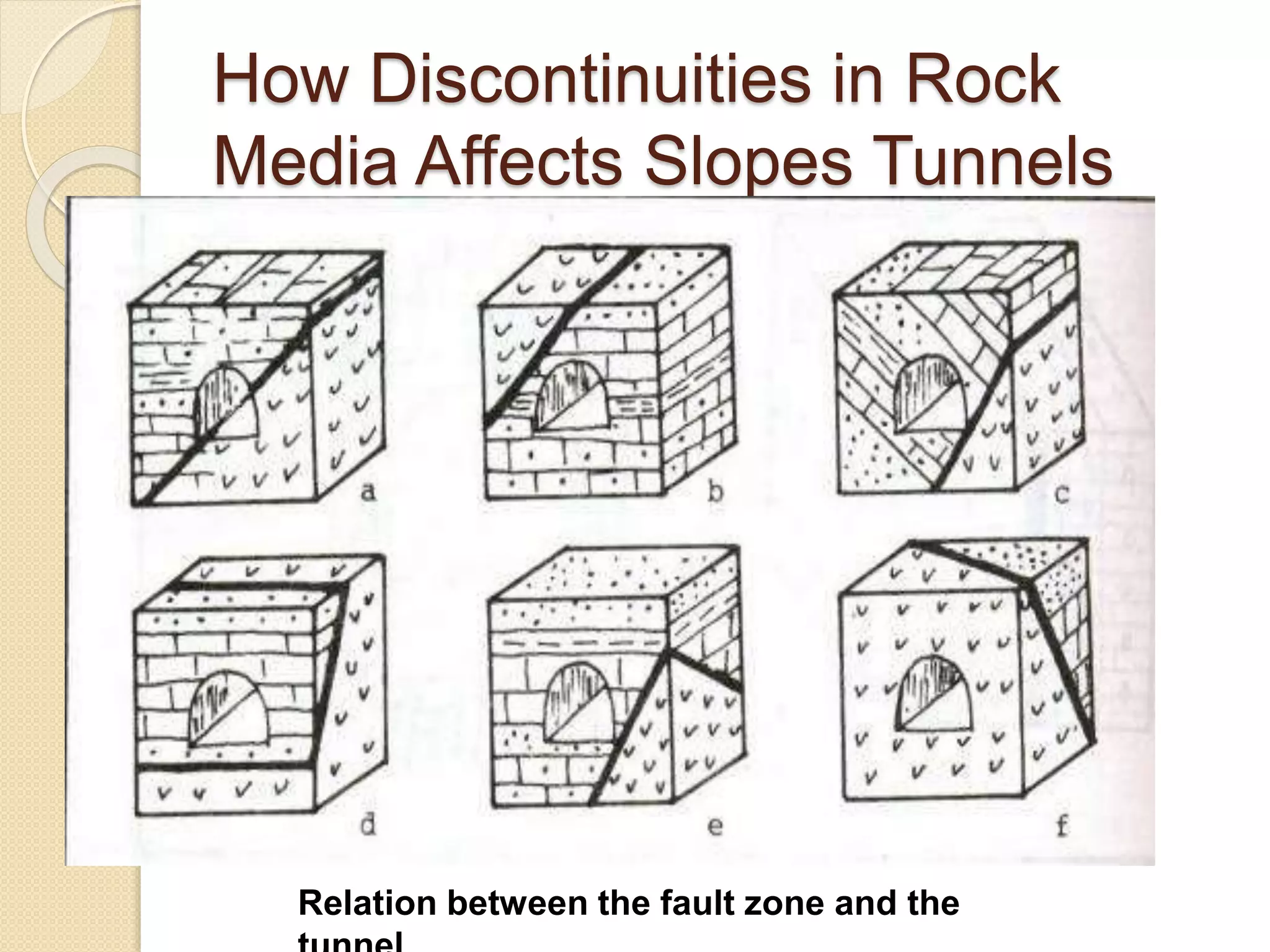
Effect of faults:
Some problems in tunnelling are
caused by:
 The relation between the fault slope
direction and the tunnel direction
 Width of the fault zone
 The hydrostatic pressures in both
sides of the fault are some problems
in the tunnelling.
How Discontinuities in Rock
Media Affects Slopes Tunnels
Relation between the fault zone and the
How Discontinuities in Rock
Media Affects Slopes Tunnels
Tunnel excavations in the slopes:
 The discontinuities (layers, fissures)
inclined inside or outside of the slope
are very important regarding the
stress and strength of the tunnel.
How Discontinuities in Rock
Media Affects Slopes Tunnels
Tunnel excavations in the
How Discontinuities in Rock
Media Affects Slopes Tunnels
Effect of the folds:
 While tunnel is excavated in an area that
contains folded rocks, different stresses and
conditions may occur depending on the fold
type.
Fold axis and the tunnel direction is vertical
Fold axis and the tunnel direction is paral
Factors to be considered in slopes
tunnelling
 Tunnel dimensions,
 - Tunnel geometry
 - Length of tunnel,
 - Total volume to be excavated
 - Geological and rock mechanical
conditions
 - Ground water level and expected water
inflow
 - Vibration restrictions &
 - Allowed ground settlements
Causes of Failures of Slopes
Tunnels in Rocks
Tunnel collapse can happen for a number
of reasons such as:
 Inadequate ground investigation
 Shallow ground conditions
 Inadequate support measures
 Cost optimization
 Inexperienced contractors
 Inadequate supervision
 Delays of excavation and support erection.
Conclusion
 Excavation of tunnels in rock is a
complicated, dangerous, and
expensive process.
 Proper investigation should therefore
be carried out for proper tunnelling
process in discontinuous rock media;
thereby ensuring the excavation of a
safe and stable tunnel.
Thank You!

Behaviour Pattern of Slopes Tunnels in Discontinous Rock Media

  • 1.
    GLY 807 (ROCK MECHANICS) BEHAVIOUR PATTERNSOF SLOPES TUNNELS IN DISCONTINOUS ROCK MEDIA
  • 2.
    Presented By: OMITOGUN SOLOMONT. 189078021 1st AUG.,2019
  • 3.
    Outline  Introduction  Discontinuitiesin Rocks  Description of Slopes Tunnels  Types of Slopes Tunnels  Tunnel Geometry  Geological Conditions that influence Slopes Tunnels excavation  How Discontinuities in Rock Media Affects Slopes Tunnels  Factors to be considered in slopes tunnelling  Causes of Failures of Slopes Tunnels in Rocks  Conclusion
  • 4.
    Introduction  How rocks mechanically respondto excavations, especially in low stress environments as encountered in slopes, are critically affected by discontinuities in the
  • 5.
    Discontinuities in Rocks A discontinuity in rock is a plane or surface that marks a change in physical or chemical characteristics in a soil or rock mass.  Discontuinities in rocks affect their shear strengths  Discontinuities are either naturally made or artificially induced.
  • 6.
  • 7.
  • 8.
  • 9.
  • 10.
  • 11.
  • 12.
  • 13.
    Description of Tunnels Slope tunnels are tunnels constructed in steep hills or mountainous areas, for economic and safe operation .  Tunnels are dug in types of materials varying from soft clay to hard rock.  Tunnel is an artificially constructed underground passage to by- pass obstacles safely without disturbing the over burden.  Tunnels are created by the process of excavation.  They are made into natural material (rocks)  Empty inside  Both ends are open to atmosphere  Generally horizontal  Thick walled structure looks like cylinder
  • 14.
  • 15.
  • 16.
    Types of Tunnels Thereare three broad categories of tunnels based on their purposes  Mining ;  Public works and  Transportation.
  • 17.
    Types of Tunnels Mining:  Mine tunnels are used during ore extraction, enabling labourers or equipment to access mineral and metal deposits deep inside the subsurface.
  • 18.
    Types of Tunnels(Contd.) Public works tunnels carry water, sewage or gas lines across great distances.  The earliest tunnels in Rome for instance, were used to transport water to, and sewage away from, heavily populated regions.
  • 19.
    Types of Tunnels(Contd.) Transportation tunnel  These are tunnels created by the excavations of rocks to by-pass obstacles safely without disturbing the overburden;  They are underground passage for road and rail traffic.
  • 20.
    Tunnel Geometry  Inthe design of tunnels, designers attempt to utilize a shape that will prove the most stable.  Basic mechanics, in conjunction with the rock mass classification, dictates the most effective geometry.  When tunnelling is strongly stratified rock, the roof is often cut flat, taking advantage of the rock's natural tendency to break along bedding planes. By cutting the tunnel along bedding planes and then supporting the roof, the tunnel would be less apt to collapse than if a different geometry were employed which cut across the bedding of the rock, making it more unstable.
  • 21.
    Tunnel Geometry(Contd.)  Thesize is also very important. It is generally considered that the minimum size for a tunnel that will still permit reasonable working space is at least 7 feet (2.15 m) high by 4 feet (1.2 m) wide, clear of the wall or the supports, for a walkway. (Wahlstrom, 1973)  The dimensional need to wider if it is for vehicle/train traffic
  • 22.
  • 23.
    Geological Conditions thatinfluence Slopes Tunnels excavation 1. Lithology -Mineralogy -Texture -Structure of Rock
  • 24.
    Geological Conditions that influenceSlopes Tunnels excavation 2. Geological Structures -Dip/Strike -Folding -Fault -Joints
  • 25.
    Geological Conditions that influenceSlopes Tunnels excavation 3. Groundwater Condition -Impervious formation -Above water table -Below water tabe
  • 26.
    How Discontinuities inRock Media Affects Slopes Tunnels  Effect of soil layers: Horizontal, vertical and inclined layers have different kinds of loading conditions for tunnels.
  • 27.
    How Discontinuities inRock Media Affects Slopes Tunnels Effect of faults: Some problems in tunnelling are caused by:  The relation between the fault slope direction and the tunnel direction  Width of the fault zone  The hydrostatic pressures in both sides of the fault are some problems in the tunnelling.
  • 28.
    How Discontinuities inRock Media Affects Slopes Tunnels Relation between the fault zone and the
  • 29.
    How Discontinuities inRock Media Affects Slopes Tunnels Tunnel excavations in the slopes:  The discontinuities (layers, fissures) inclined inside or outside of the slope are very important regarding the stress and strength of the tunnel.
  • 30.
    How Discontinuities inRock Media Affects Slopes Tunnels Tunnel excavations in the
  • 31.
    How Discontinuities inRock Media Affects Slopes Tunnels Effect of the folds:  While tunnel is excavated in an area that contains folded rocks, different stresses and conditions may occur depending on the fold type. Fold axis and the tunnel direction is vertical Fold axis and the tunnel direction is paral
  • 32.
    Factors to beconsidered in slopes tunnelling  Tunnel dimensions,  - Tunnel geometry  - Length of tunnel,  - Total volume to be excavated  - Geological and rock mechanical conditions  - Ground water level and expected water inflow  - Vibration restrictions &  - Allowed ground settlements
  • 33.
    Causes of Failuresof Slopes Tunnels in Rocks Tunnel collapse can happen for a number of reasons such as:  Inadequate ground investigation  Shallow ground conditions  Inadequate support measures  Cost optimization  Inexperienced contractors  Inadequate supervision  Delays of excavation and support erection.
  • 34.
    Conclusion  Excavation oftunnels in rock is a complicated, dangerous, and expensive process.  Proper investigation should therefore be carried out for proper tunnelling process in discontinuous rock media; thereby ensuring the excavation of a safe and stable tunnel.
  • 35.