Rotary Sealing for Improved
Downhole Equipment Performance
Slide 2
Downhole Tools & Equipment
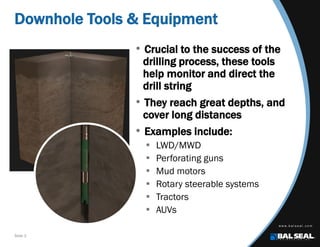
• Crucial to the success of the
drilling process, these tools
help monitor and direct the
drill string
• They reach great depths, and
cover long distances
• Examples include:
 LWD/MWD
 Perforating guns
 Mud motors
 Rotary steerable systems
 Tractors
 AUVs
Slide 3
The Downhole Environment
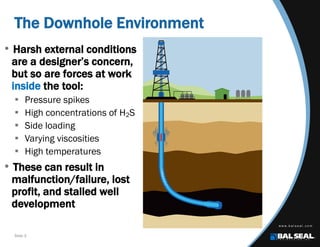
• Harsh external conditions
are a designer’s concern,
but so are forces at work
inside the tool:
 Pressure spikes
 High concentrations of H2S
 Side loading
 Varying viscosities
 High temperatures
• These can result in
malfunction/failure, lost
profit, and stalled well
development
Slide 4
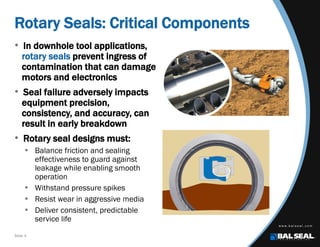
Rotary Seals: Critical Components
• In downhole tool applications,
rotary seals prevent ingress of
contamination that can damage
motors and electronics
• Seal failure adversely impacts
equipment precision,
consistency, and accuracy, can
result in early breakdown
• Rotary seal designs must:
 Balance friction and sealing
effectiveness to guard against
leakage while enabling smooth
operation
 Withstand pressure spikes
 Resist wear in aggressive media
 Deliver consistent, predictable
service life
Slide 5
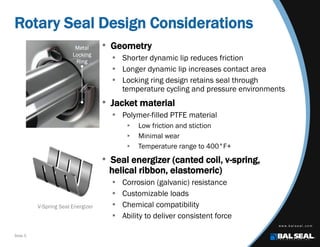
Rotary Seal Design Considerations
• Geometry
 Shorter dynamic lip reduces friction
 Longer dynamic lip increases contact area
 Locking ring design retains seal through
temperature cycling and pressure environments
• Jacket material
 Polymer-filled PTFE material
 Low friction and stiction
 Minimal wear
 Temperature range to 400°F+
• Seal energizer (canted coil, v-spring,
helical ribbon, elastomeric)
 Corrosion (galvanic) resistance
 Customizable loads
 Chemical compatibility
 Ability to deliver consistent force
Metal
Locking
Ring
V-Spring Seal Energizer
Slide 6
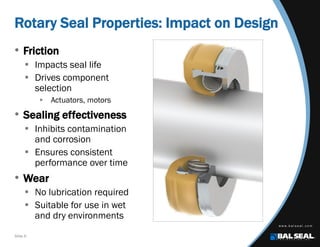
Rotary Seal Properties: Impact on Design
• Friction
 Impacts seal life
 Drives component
selection
 Actuators, motors
• Sealing effectiveness
 Inhibits contamination
and corrosion
 Ensures consistent
performance over time
• Wear
 No lubrication required
 Suitable for use in wet
and dry environments
Slide 7
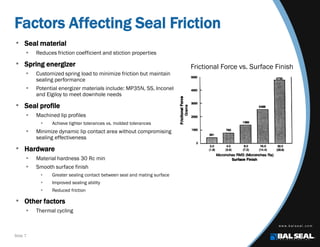
Factors Affecting Seal Friction
• Seal material
 Reduces friction coefficient and stiction properties
• Spring energizer
 Customized spring load to minimize friction but maintain
sealing performance
 Potential energizer materials include: MP35N, SS, Inconel &
and Elgiloy to meet downhole needs
• Seal profile
 Machined lip profiles
 Achieve tighter tolerances vs. molded tolerances
 Minimize dynamic lip contact area without compromising
sealing effectiveness
• Hardware
 Material hardness 30 Rc min
 Smooth surface finish
 Greater sealing contact between seal and mating surface
 Improved sealing ability
 Reduced friction
• Other factors
 Thermal cycling
Frictional Force vs. Surface Finish
Slide 8
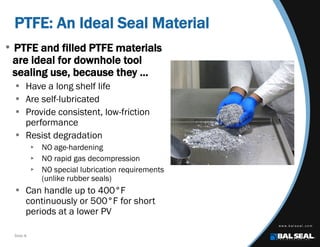
PTFE: An Ideal Seal Material
• PTFE and filled PTFE materials
are ideal for downhole tool
sealing use, because they …
 Have a long shelf life
 Are self-lubricated
 Provide consistent, low-friction
performance
 Resist degradation
 NO age-hardening
 NO rapid gas decompression
 NO special lubrication requirements
(unlike rubber seals)
 Can handle up to 400°F
continuously or 500°F for short
periods at a lower PV
Slide 9
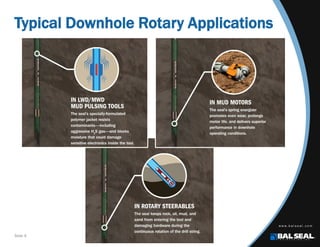
Typical Downhole Rotary Applications
Slide 10
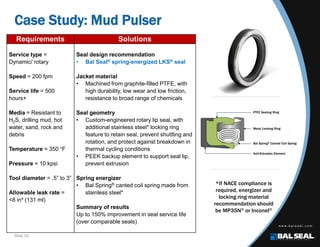
Case Study: Mud Pulser
Requirements Solutions
Service type =
Dynamic/ rotary
Speed = 200 fpm
Service life = 500
hours+
Media = Resistant to
H2S, drilling mud, hot
water, sand, rock and
debris
Temperature = 350 °F
Pressure = 10 kpsi
Tool diameter = .5” to 3”
Allowable leak rate =
<8 in³ (131 ml)
Seal design recommendation
• Bal Seal® spring-energized LKS® seal
Jacket material
• Machined from graphite-filled PTFE, with
high durability, low wear and low friction,
resistance to broad range of chemicals
Seal geometry
• Custom-engineered rotary lip seal, with
additional stainless steel* locking ring
feature to retain seal, prevent shuttling and
rotation, and protect against breakdown in
thermal cycling conditions
• PEEK backup element to support seal lip,
prevent extrusion
Spring energizer
• Bal Spring® canted coil spring made from
stainless steel*
Summary of results
Up to 150% improvement in seal service life
(over comparable seals)
*If NACE compliance is
required, energizer and
locking ring material
recommendation should
be MP35N® or Inconel®
Slide 11
Summary & Recommendations
• To eliminate costly mistakes and
delays, consider rotary sealing
requirements as part of overall
downhole equipment design
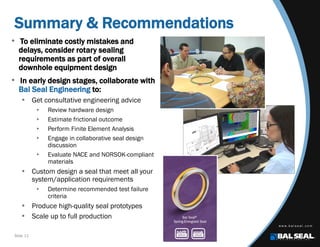
• In early design stages, collaborate with
Bal Seal Engineering to:
 Get consultative engineering advice
 Review hardware design
 Estimate frictional outcome
 Perform Finite Element Analysis
 Engage in collaborative seal design
discussion
 Evaluate NACE and NORSOK-compliant
materials
 Custom design a seal that meet all your
system/application requirements
 Determine recommended test failure
criteria
 Produce high-quality seal prototypes
 Scale up to full production
Slide 12
Resources & Contact Information
marketing@balseal.com www.balseal.com +1 949.460.2100 Design request form
Jim Harty
Global Market Manager - Energy
Bal Seal Engineering, Inc.
+1 713.446.6227
September 19 ©Bal Seal Engineering, Inc. This document contains and/or refers to PROPRIETARY information of Bal Seal Engineering, Inc., and may not be reproduced,
copied, published, or distributed in any form or disclosed to a third party, in whole or in part, without the written authorization of an officer of Bal Seal Engineering, Inc.
Products are the subject of issued or pending United States and foreign patents. Products of Bal Seal Engineering, Inc. and this document are PROPRIETARY and products
may not be manufactured, or caused to be manufactured, by any other party.
Custom components that drive
tomorrow’s technologies®

Rotary Sealing for Improved Downhole Equipment Performance

  • 1.
    Rotary Sealing forImproved Downhole Equipment Performance
  • 2.
    Slide 2 Downhole Tools& Equipment • Crucial to the success of the drilling process, these tools help monitor and direct the drill string • They reach great depths, and cover long distances • Examples include:  LWD/MWD  Perforating guns  Mud motors  Rotary steerable systems  Tractors  AUVs
  • 3.
    Slide 3 The DownholeEnvironment • Harsh external conditions are a designer’s concern, but so are forces at work inside the tool:  Pressure spikes  High concentrations of H2S  Side loading  Varying viscosities  High temperatures • These can result in malfunction/failure, lost profit, and stalled well development
  • 4.
    Slide 4 Rotary Seals:Critical Components • In downhole tool applications, rotary seals prevent ingress of contamination that can damage motors and electronics • Seal failure adversely impacts equipment precision, consistency, and accuracy, can result in early breakdown • Rotary seal designs must:  Balance friction and sealing effectiveness to guard against leakage while enabling smooth operation  Withstand pressure spikes  Resist wear in aggressive media  Deliver consistent, predictable service life
  • 5.
    Slide 5 Rotary SealDesign Considerations • Geometry  Shorter dynamic lip reduces friction  Longer dynamic lip increases contact area  Locking ring design retains seal through temperature cycling and pressure environments • Jacket material  Polymer-filled PTFE material  Low friction and stiction  Minimal wear  Temperature range to 400°F+ • Seal energizer (canted coil, v-spring, helical ribbon, elastomeric)  Corrosion (galvanic) resistance  Customizable loads  Chemical compatibility  Ability to deliver consistent force Metal Locking Ring V-Spring Seal Energizer
  • 6.
    Slide 6 Rotary SealProperties: Impact on Design • Friction  Impacts seal life  Drives component selection  Actuators, motors • Sealing effectiveness  Inhibits contamination and corrosion  Ensures consistent performance over time • Wear  No lubrication required  Suitable for use in wet and dry environments
  • 7.
    Slide 7 Factors AffectingSeal Friction • Seal material  Reduces friction coefficient and stiction properties • Spring energizer  Customized spring load to minimize friction but maintain sealing performance  Potential energizer materials include: MP35N, SS, Inconel & and Elgiloy to meet downhole needs • Seal profile  Machined lip profiles  Achieve tighter tolerances vs. molded tolerances  Minimize dynamic lip contact area without compromising sealing effectiveness • Hardware  Material hardness 30 Rc min  Smooth surface finish  Greater sealing contact between seal and mating surface  Improved sealing ability  Reduced friction • Other factors  Thermal cycling Frictional Force vs. Surface Finish
  • 8.
    Slide 8 PTFE: AnIdeal Seal Material • PTFE and filled PTFE materials are ideal for downhole tool sealing use, because they …  Have a long shelf life  Are self-lubricated  Provide consistent, low-friction performance  Resist degradation  NO age-hardening  NO rapid gas decompression  NO special lubrication requirements (unlike rubber seals)  Can handle up to 400°F continuously or 500°F for short periods at a lower PV
  • 9.
    Slide 9 Typical DownholeRotary Applications
  • 10.
    Slide 10 Case Study:Mud Pulser Requirements Solutions Service type = Dynamic/ rotary Speed = 200 fpm Service life = 500 hours+ Media = Resistant to H2S, drilling mud, hot water, sand, rock and debris Temperature = 350 °F Pressure = 10 kpsi Tool diameter = .5” to 3” Allowable leak rate = <8 in³ (131 ml) Seal design recommendation • Bal Seal® spring-energized LKS® seal Jacket material • Machined from graphite-filled PTFE, with high durability, low wear and low friction, resistance to broad range of chemicals Seal geometry • Custom-engineered rotary lip seal, with additional stainless steel* locking ring feature to retain seal, prevent shuttling and rotation, and protect against breakdown in thermal cycling conditions • PEEK backup element to support seal lip, prevent extrusion Spring energizer • Bal Spring® canted coil spring made from stainless steel* Summary of results Up to 150% improvement in seal service life (over comparable seals) *If NACE compliance is required, energizer and locking ring material recommendation should be MP35N® or Inconel®
  • 11.
    Slide 11 Summary &Recommendations • To eliminate costly mistakes and delays, consider rotary sealing requirements as part of overall downhole equipment design • In early design stages, collaborate with Bal Seal Engineering to:  Get consultative engineering advice  Review hardware design  Estimate frictional outcome  Perform Finite Element Analysis  Engage in collaborative seal design discussion  Evaluate NACE and NORSOK-compliant materials  Custom design a seal that meet all your system/application requirements  Determine recommended test failure criteria  Produce high-quality seal prototypes  Scale up to full production
  • 12.
    Slide 12 Resources &Contact Information marketing@balseal.com www.balseal.com +1 949.460.2100 Design request form Jim Harty Global Market Manager - Energy Bal Seal Engineering, Inc. +1 713.446.6227
  • 13.
    September 19 ©BalSeal Engineering, Inc. This document contains and/or refers to PROPRIETARY information of Bal Seal Engineering, Inc., and may not be reproduced, copied, published, or distributed in any form or disclosed to a third party, in whole or in part, without the written authorization of an officer of Bal Seal Engineering, Inc. Products are the subject of issued or pending United States and foreign patents. Products of Bal Seal Engineering, Inc. and this document are PROPRIETARY and products may not be manufactured, or caused to be manufactured, by any other party. Custom components that drive tomorrow’s technologies®