NORTH WESTERN UNIVERSITY
Computer Science & Engineering
Course Titel: physics-1
Course Code: Phy -1133
Presentation on: Construction & Working
procedure of Optical Fiber
Submitted by:
Name : MD. MONIRUL ISLAM
ID: 20151116010
Submitted to:
Name : Md. Mahmuduzzaman Tawhid
Lecturer
Computer Science & Engineering
North Western University , Khulna
INDEX:
* General Introduction of Optical Fibers.
* What are Optical Fibers?.
* Structure of optical fiber.
* Workings procedure of optical fiber.
* Advantages of optical fiber.
* Disadvantages of optical fiber.
* Applications of Optical fiber.
* Conclusion.
General Introduction of Optical Fibers
Fiber optics, or optical fiber, refers to the medium and the technology associated with the transmission of
information as light pulses along a glass or plastic strand or fiber. Fiber optics is used for long-distance and
high-performance data networking.
Fiber optics is also commonly used in telecommunication services such as internet, television and telephones.
For example, Verizon and Google use fiber optics in their Verizon FIOS and Google Fiber services,
respectively, providing gigabit internet speeds to users.
What are Optical Fibers?
An optical fiber is a hair thin cylindrical fiber of glass or any transparent dielectric
medium.
The fiber which are used for optical communication are wave guides made of transparent
dielectrics.
Its function is to guide visible and infrared light over long distances.
Structure of optical fiber
Fig 01: Optical Fiber
Core – central tube of very thin size made up of optically transparent dielectric
medium and carries the light form transmitter to receiver. The core diameter can vary
from about
5um to 100 um.
Cladding – outer optical material surrounding the core having reflecting index lower
than core. It helps to keep the light within the core throughout the phenomena of total
internal reflection.
Buffer Coating – plastic coating that protects the fiber made of silicon rubber. The
typical diameter of fiber after coating is 250-300 um.
Fig 02: Reflection of Optical Fiber
Fig 03: Image of Optical Fiber
Workings procedure of optical fiber
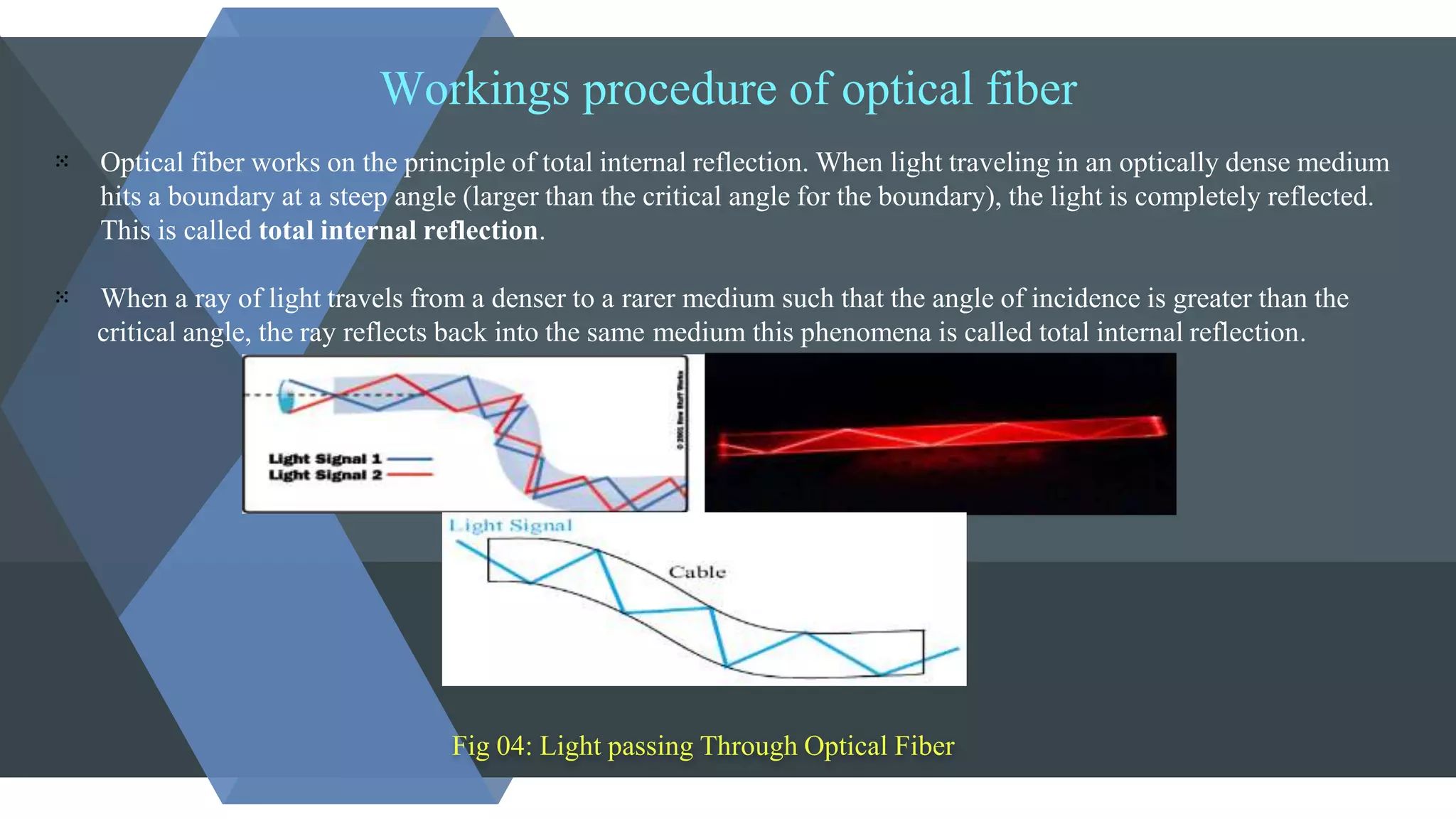
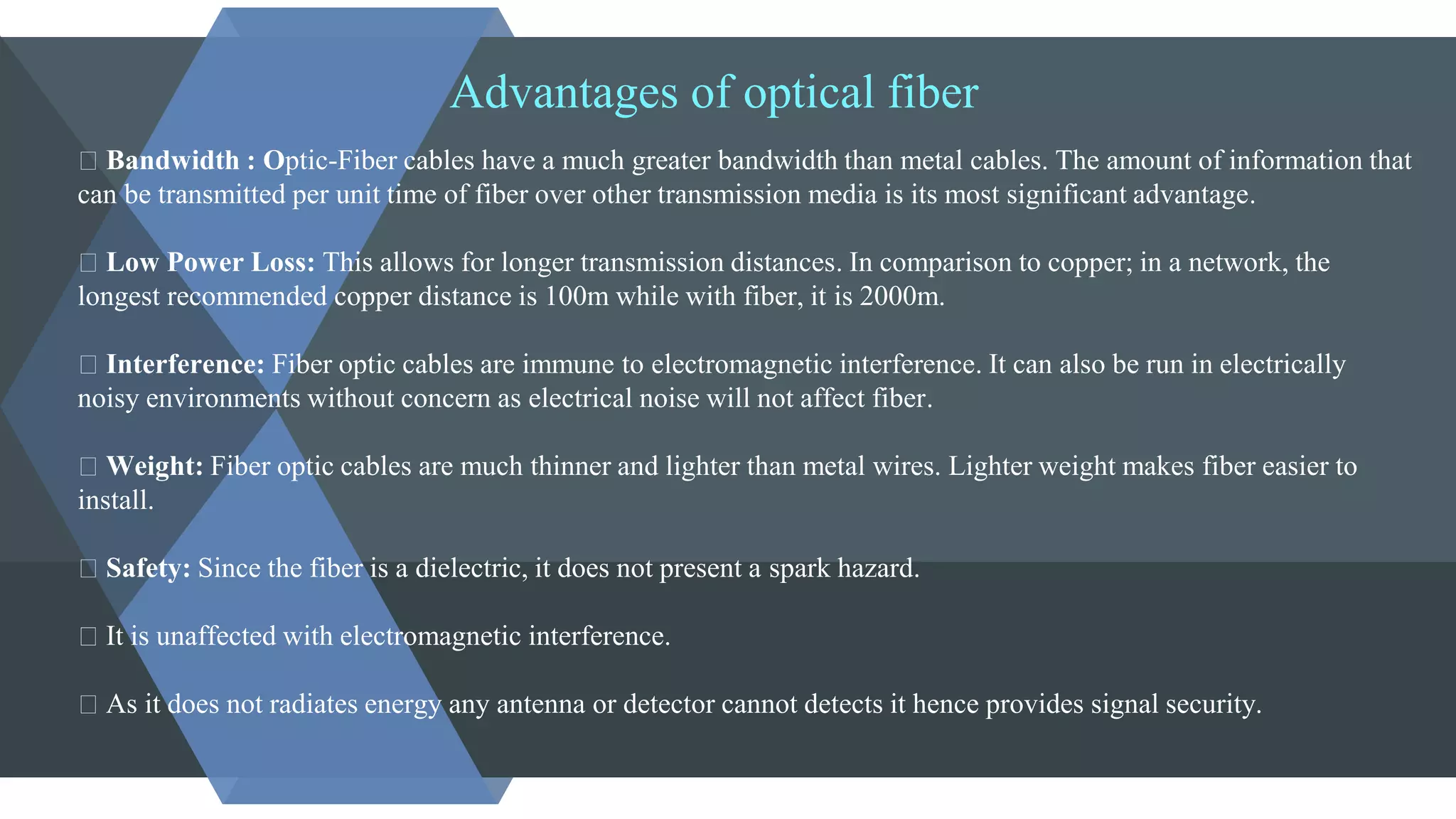
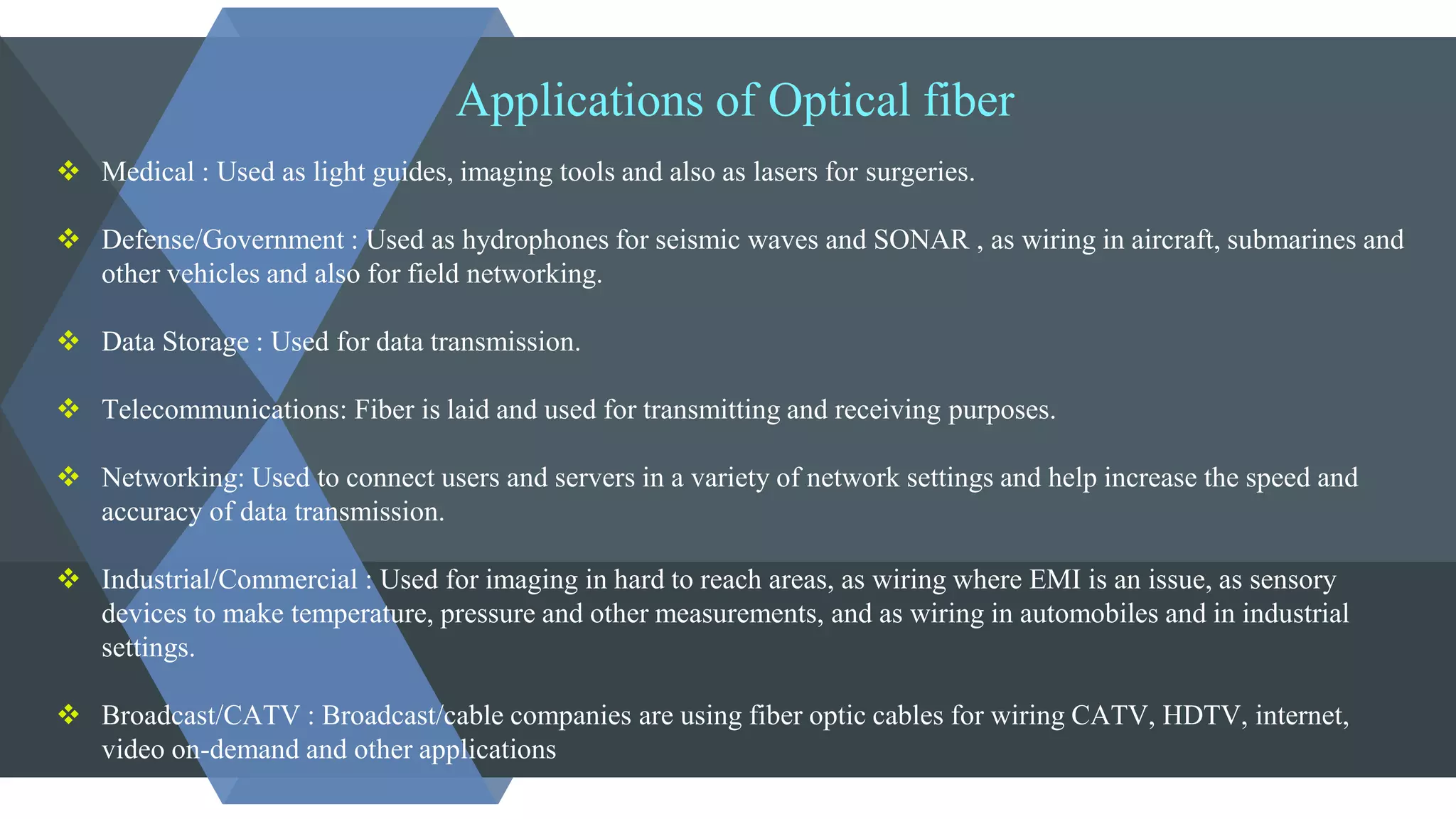
⁙ Optical fiber works on the principle of total internal reflection. When light traveling in an optically dense medium
hits a boundary at a steep angle (larger than the critical angle for the boundary), the light is completely reflected.
This is called total internal reflection.
⁙ When a ray of light travels from a denser to a rarer medium such that the angle of incidence is greater than the
critical angle, the ray reflects back into the same medium this phenomena is called total internal reflection.
Fig 04: Light passing Through Optical Fiber
Advantages of optical fiber
Bandwidth : Optic-Fiber cables have a much greater bandwidth than metal cables. The amount of information that
can be transmitted per unit time of fiber over other transmission media is its most significant advantage.
Low Power Loss: This allows for longer transmission distances. In comparison to copper; in a network, the
longest recommended copper distance is 100m while with fiber, it is 2000m.
Interference: Fiber optic cables are immune to electromagnetic interference. It can also be run in electrically
noisy environments without concern as electrical noise will not affect fiber.
Weight: Fiber optic cables are much thinner and lighter than metal wires. Lighter weight makes fiber easier to
install.
Safety: Since the fiber is a dielectric, it does not present a spark hazard.
It is unaffected with electromagnetic interference.
As it does not radiates energy any antenna or detector cannot detects it hence provides signal security.
Disadvantages of optical fiber
Cost: Cables are expensive to install but last longer than copper cables.
Transmission: transmission on optical fiber requires repeating at distance intervals.
Fragile: Fibers can be broken or have transmission loses when wrapped around curves of only a few centimeters
radius.
Protection: Optical fibers require more protection around the cable compared to copper.
Highly skilled staff would be required for maintenance.
Only point to point working is possible on optical fiber.
Accept unipolar codes only.
Applications of Optical fiber
 Medical : Used as light guides, imaging tools and also as lasers for surgeries.
 Defense/Government : Used as hydrophones for seismic waves and SONAR , as wiring in aircraft, submarines and
other vehicles and also for field networking.
 Data Storage : Used for data transmission.
 Telecommunications: Fiber is laid and used for transmitting and receiving purposes.
 Networking: Used to connect users and servers in a variety of network settings and help increase the speed and
accuracy of data transmission.
 Industrial/Commercial : Used for imaging in hard to reach areas, as wiring where EMI is an issue, as sensory
devices to make temperature, pressure and other measurements, and as wiring in automobiles and in industrial
settings.
 Broadcast/CATV : Broadcast/cable companies are using fiber optic cables for wiring CATV, HDTV, internet,
video on-demand and other applications
Conclusion
Optical fiber technology has been used in many areas of telecommunication, photonics,
medical and engineering. It has attracted many researchers due to its performance, low
loss, no interference, higher bandwidth and its inherently high data-carrying capacity.
THANK YOU

Structure and working procedure of optical fiber

  • 1.
    NORTH WESTERN UNIVERSITY ComputerScience & Engineering Course Titel: physics-1 Course Code: Phy -1133 Presentation on: Construction & Working procedure of Optical Fiber Submitted by: Name : MD. MONIRUL ISLAM ID: 20151116010 Submitted to: Name : Md. Mahmuduzzaman Tawhid Lecturer Computer Science & Engineering North Western University , Khulna
  • 2.
    INDEX: * General Introductionof Optical Fibers. * What are Optical Fibers?. * Structure of optical fiber. * Workings procedure of optical fiber. * Advantages of optical fiber. * Disadvantages of optical fiber. * Applications of Optical fiber. * Conclusion.
  • 3.
    General Introduction ofOptical Fibers Fiber optics, or optical fiber, refers to the medium and the technology associated with the transmission of information as light pulses along a glass or plastic strand or fiber. Fiber optics is used for long-distance and high-performance data networking. Fiber optics is also commonly used in telecommunication services such as internet, television and telephones. For example, Verizon and Google use fiber optics in their Verizon FIOS and Google Fiber services, respectively, providing gigabit internet speeds to users.
  • 4.
    What are OpticalFibers? An optical fiber is a hair thin cylindrical fiber of glass or any transparent dielectric medium. The fiber which are used for optical communication are wave guides made of transparent dielectrics. Its function is to guide visible and infrared light over long distances.
  • 5.
    Structure of opticalfiber Fig 01: Optical Fiber
  • 6.
    Core – centraltube of very thin size made up of optically transparent dielectric medium and carries the light form transmitter to receiver. The core diameter can vary from about 5um to 100 um. Cladding – outer optical material surrounding the core having reflecting index lower than core. It helps to keep the light within the core throughout the phenomena of total internal reflection. Buffer Coating – plastic coating that protects the fiber made of silicon rubber. The typical diameter of fiber after coating is 250-300 um.
  • 7.
    Fig 02: Reflectionof Optical Fiber Fig 03: Image of Optical Fiber
  • 8.
    Workings procedure ofoptical fiber ⁙ Optical fiber works on the principle of total internal reflection. When light traveling in an optically dense medium hits a boundary at a steep angle (larger than the critical angle for the boundary), the light is completely reflected. This is called total internal reflection. ⁙ When a ray of light travels from a denser to a rarer medium such that the angle of incidence is greater than the critical angle, the ray reflects back into the same medium this phenomena is called total internal reflection. Fig 04: Light passing Through Optical Fiber
  • 9.
    Advantages of opticalfiber Bandwidth : Optic-Fiber cables have a much greater bandwidth than metal cables. The amount of information that can be transmitted per unit time of fiber over other transmission media is its most significant advantage. Low Power Loss: This allows for longer transmission distances. In comparison to copper; in a network, the longest recommended copper distance is 100m while with fiber, it is 2000m. Interference: Fiber optic cables are immune to electromagnetic interference. It can also be run in electrically noisy environments without concern as electrical noise will not affect fiber. Weight: Fiber optic cables are much thinner and lighter than metal wires. Lighter weight makes fiber easier to install. Safety: Since the fiber is a dielectric, it does not present a spark hazard. It is unaffected with electromagnetic interference. As it does not radiates energy any antenna or detector cannot detects it hence provides signal security.
  • 10.
    Disadvantages of opticalfiber Cost: Cables are expensive to install but last longer than copper cables. Transmission: transmission on optical fiber requires repeating at distance intervals. Fragile: Fibers can be broken or have transmission loses when wrapped around curves of only a few centimeters radius. Protection: Optical fibers require more protection around the cable compared to copper. Highly skilled staff would be required for maintenance. Only point to point working is possible on optical fiber. Accept unipolar codes only.
  • 11.
    Applications of Opticalfiber  Medical : Used as light guides, imaging tools and also as lasers for surgeries.  Defense/Government : Used as hydrophones for seismic waves and SONAR , as wiring in aircraft, submarines and other vehicles and also for field networking.  Data Storage : Used for data transmission.  Telecommunications: Fiber is laid and used for transmitting and receiving purposes.  Networking: Used to connect users and servers in a variety of network settings and help increase the speed and accuracy of data transmission.  Industrial/Commercial : Used for imaging in hard to reach areas, as wiring where EMI is an issue, as sensory devices to make temperature, pressure and other measurements, and as wiring in automobiles and in industrial settings.  Broadcast/CATV : Broadcast/cable companies are using fiber optic cables for wiring CATV, HDTV, internet, video on-demand and other applications
  • 12.
    Conclusion Optical fiber technologyhas been used in many areas of telecommunication, photonics, medical and engineering. It has attracted many researchers due to its performance, low loss, no interference, higher bandwidth and its inherently high data-carrying capacity.
  • 13.