Fibre Optics
By
Dr. Purva P. Nikam
Department of Basic Science and Humanity,
SITCOE, Yadrav
 Outline:-
 Introduction
 Structure of optical fibre
 Propagation Mechanism
 Advantages and disadvantages
of optical fibre
Application of optical fibre
Optical Fibre
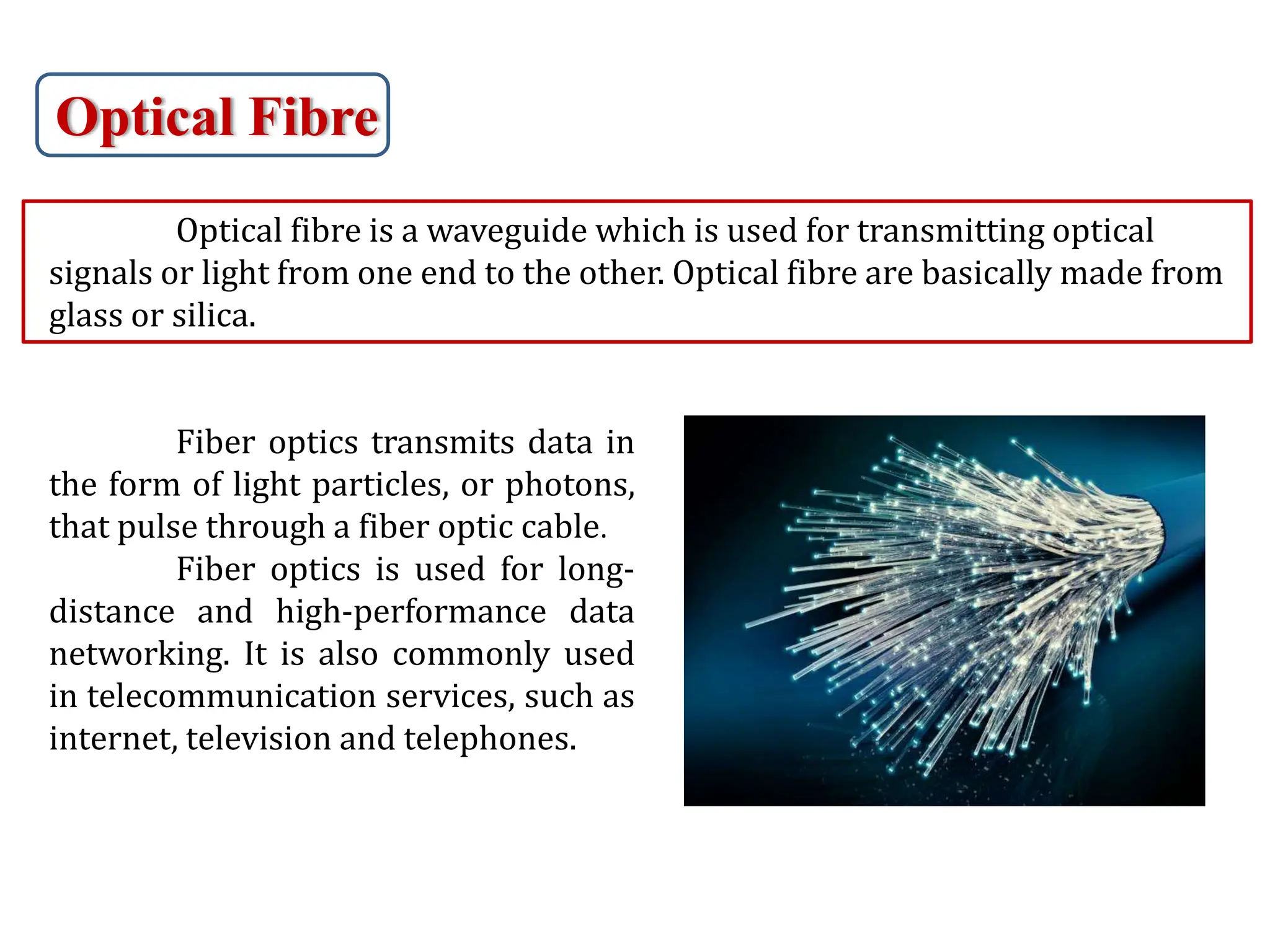
Optical fibre is a waveguide which is used for transmitting optical
signals or light from one end to the other. Optical fibre are basically made from
glass or silica.
Fiber optics transmits data in
the form of light particles, or photons,
that pulse through a fiber optic cable.
Fiber optics is used for long-
distance and high-performance data
networking. It is also commonly used
in telecommunication services, such as
internet, television and telephones.
Main component of optical fibre
1]. Core : is the inner portion of the
fibre made up of glass/silica.
2]. Cladding : Core is surrounded by
glass layer known as cladding.
3]. Buffer Coating : For the protection
from external wear and tear, the whole
assembly is enclosed in plastic jacket
known as buffer coating.
Construction of Optical Fibre
Optical Fibre are typically made from silica with modifying dopant
such as 𝐺𝑒𝑂2. The diameter core is about 100 μm and that of cladding is
125μm.
Propagation Mechanism
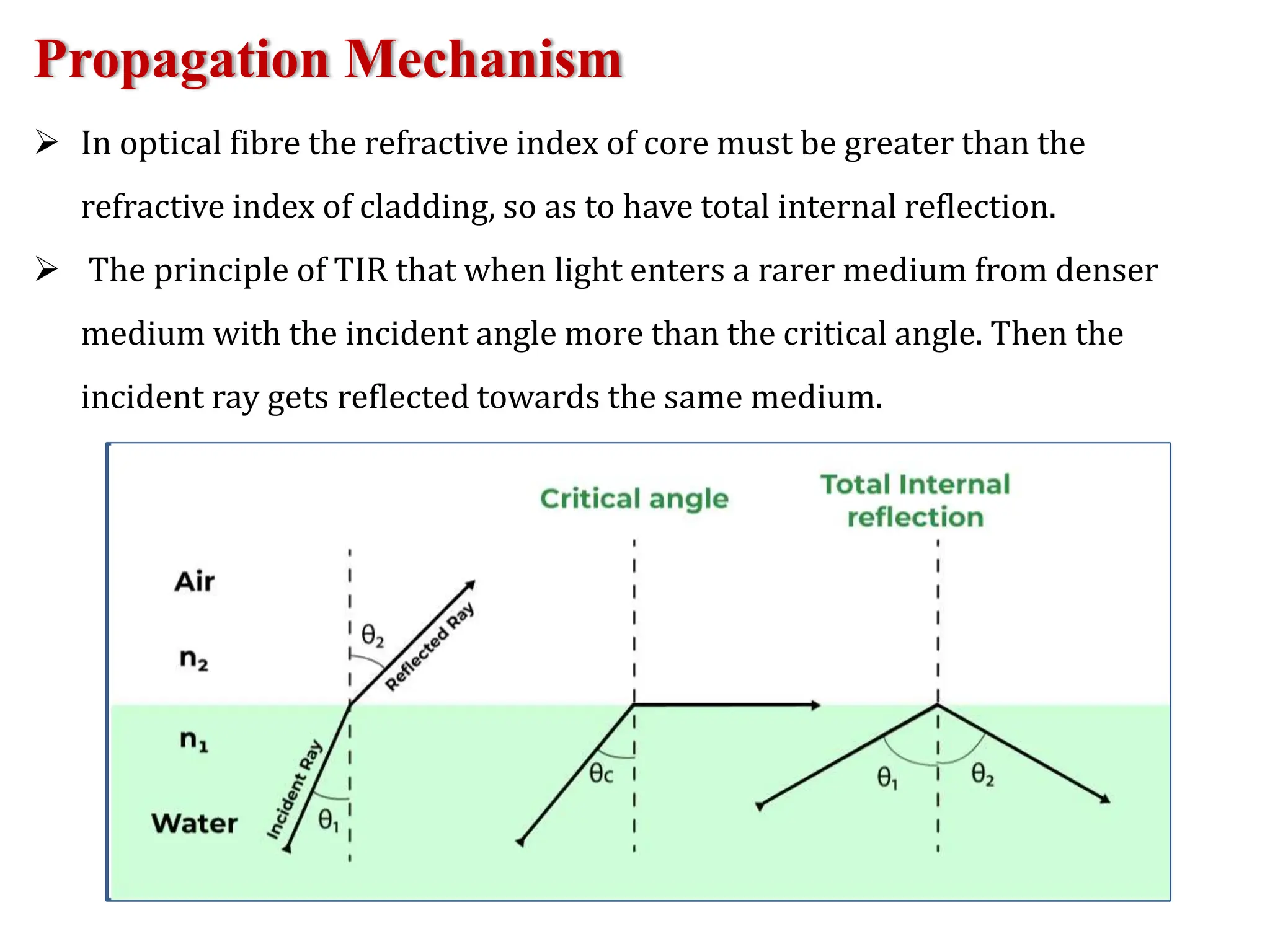
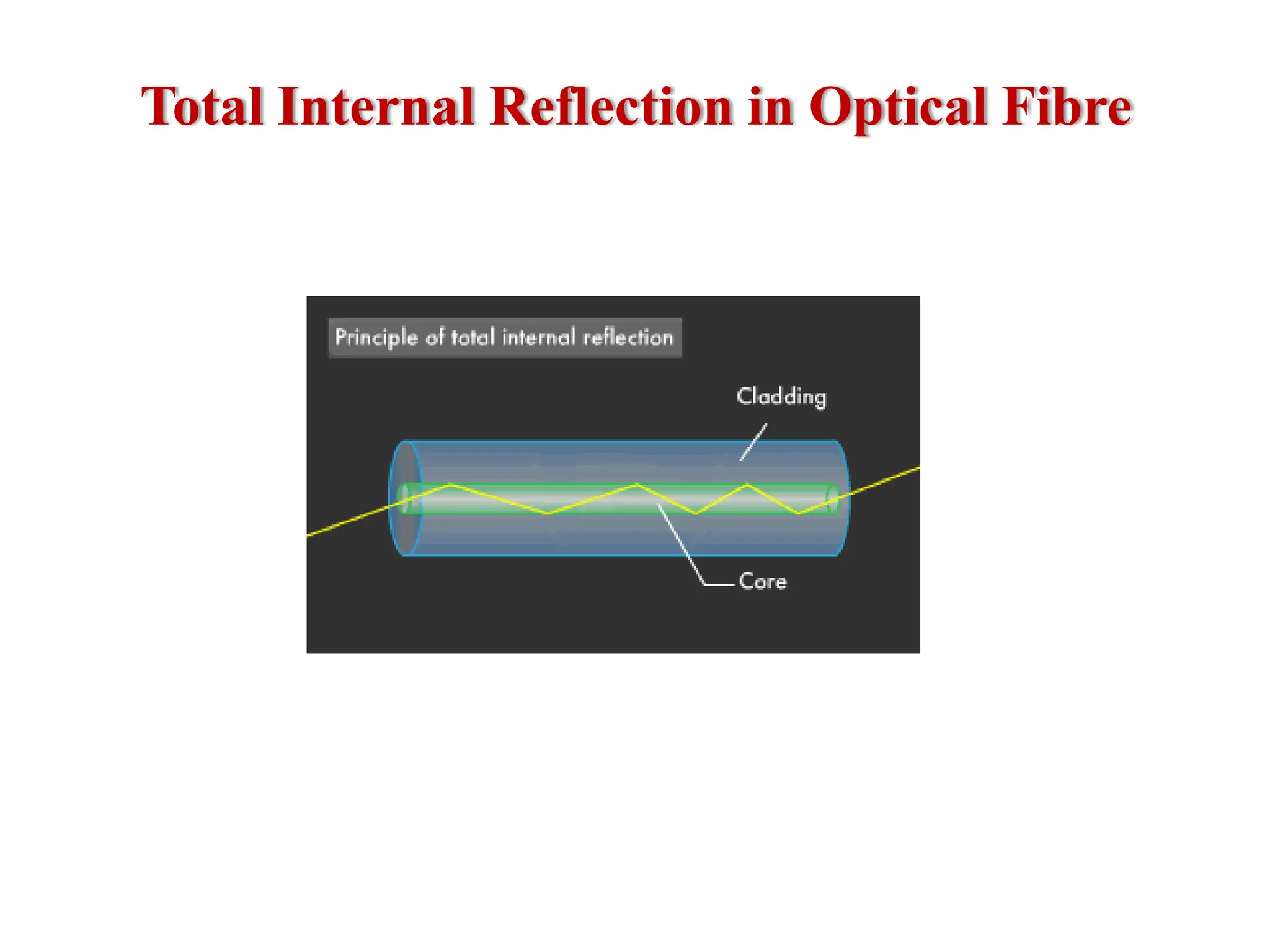
 In optical fibre the refractive index of core must be greater than the
refractive index of cladding, so as to have total internal reflection.
 The principle of TIR that when light enters a rarer medium from denser
medium with the incident angle more than the critical angle. Then the
incident ray gets reflected towards the same medium.
Total Internal Reflection in Optical Fibre
Advantages of Optical fiber
 Lightwave transmission through an optical fiber enables distortion immune
signal propagation.
 Optical fibers permit secured as well as long-distance transmission.
 These cables serve for longer durations as compared to any other
transmission cable.
Disadvantages of Optical fiber
 The installation, as well as maintenance costs of optical fibers, are somewhat
large.
 Due to their fragile nature, they need more protection from environmental
conditions.
 Though less distortion can transmit a signal to large distances, that requires
the use of repeaters at the time of signal transmission.
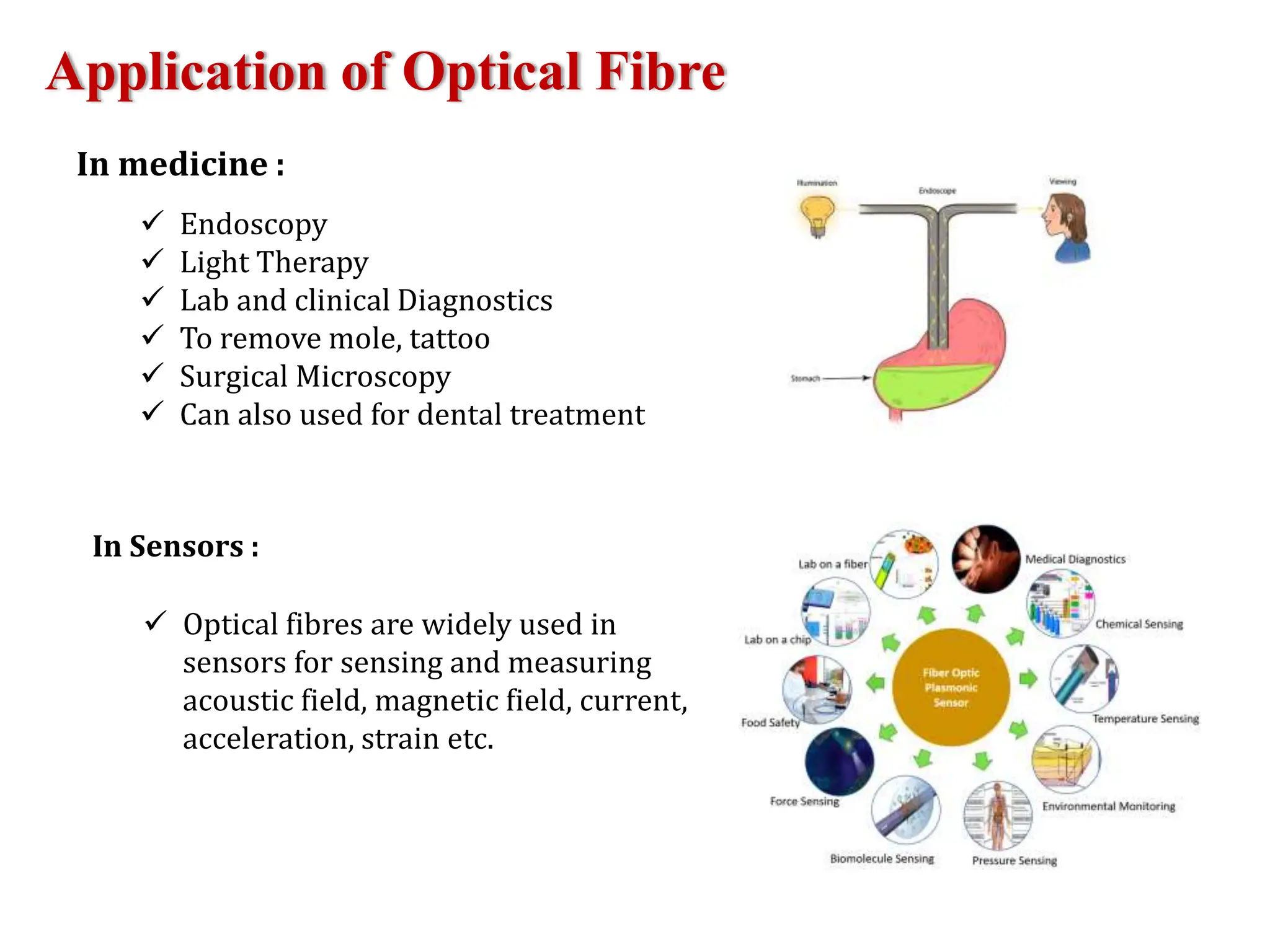
Application of Optical Fibre
In medicine :
In Sensors :
 Endoscopy
 Light Therapy
 Lab and clinical Diagnostics
 To remove mole, tattoo
 Surgical Microscopy
 Can also used for dental treatment
 Optical fibres are widely used in
sensors for sensing and measuring
acoustic field, magnetic field, current,
acceleration, strain etc.
In communication :
In Military :
Optical fibers are ideal for high-speed
communication because they use light to transmit
information, which can travel at an incredibly fast
speed.
 Fibre guided missile are used during war.
 An air craft, ship tank needs of copper wires for
true communication. But by replacing copper
wire with fibre reduces much weight and also
maintain true and accurate communication.
Thank you…!!!!

Optical Fibre and It's Applications.pptx

  • 1.
    Fibre Optics By Dr. PurvaP. Nikam Department of Basic Science and Humanity, SITCOE, Yadrav
  • 2.
     Outline:-  Introduction Structure of optical fibre  Propagation Mechanism  Advantages and disadvantages of optical fibre Application of optical fibre
  • 3.
    Optical Fibre Optical fibreis a waveguide which is used for transmitting optical signals or light from one end to the other. Optical fibre are basically made from glass or silica. Fiber optics transmits data in the form of light particles, or photons, that pulse through a fiber optic cable. Fiber optics is used for long- distance and high-performance data networking. It is also commonly used in telecommunication services, such as internet, television and telephones.
  • 4.
    Main component ofoptical fibre 1]. Core : is the inner portion of the fibre made up of glass/silica. 2]. Cladding : Core is surrounded by glass layer known as cladding. 3]. Buffer Coating : For the protection from external wear and tear, the whole assembly is enclosed in plastic jacket known as buffer coating. Construction of Optical Fibre Optical Fibre are typically made from silica with modifying dopant such as 𝐺𝑒𝑂2. The diameter core is about 100 μm and that of cladding is 125μm.
  • 5.
    Propagation Mechanism  Inoptical fibre the refractive index of core must be greater than the refractive index of cladding, so as to have total internal reflection.  The principle of TIR that when light enters a rarer medium from denser medium with the incident angle more than the critical angle. Then the incident ray gets reflected towards the same medium.
  • 6.
    Total Internal Reflectionin Optical Fibre
  • 7.
    Advantages of Opticalfiber  Lightwave transmission through an optical fiber enables distortion immune signal propagation.  Optical fibers permit secured as well as long-distance transmission.  These cables serve for longer durations as compared to any other transmission cable. Disadvantages of Optical fiber  The installation, as well as maintenance costs of optical fibers, are somewhat large.  Due to their fragile nature, they need more protection from environmental conditions.  Though less distortion can transmit a signal to large distances, that requires the use of repeaters at the time of signal transmission.
  • 8.
    Application of OpticalFibre In medicine : In Sensors :  Endoscopy  Light Therapy  Lab and clinical Diagnostics  To remove mole, tattoo  Surgical Microscopy  Can also used for dental treatment  Optical fibres are widely used in sensors for sensing and measuring acoustic field, magnetic field, current, acceleration, strain etc.
  • 9.
    In communication : InMilitary : Optical fibers are ideal for high-speed communication because they use light to transmit information, which can travel at an incredibly fast speed.  Fibre guided missile are used during war.  An air craft, ship tank needs of copper wires for true communication. But by replacing copper wire with fibre reduces much weight and also maintain true and accurate communication.
  • 10.