OPTICAL COHERENCE
TOMOGRAPHY
Dr. Anuraag Singh
07-07-2018
Introduction
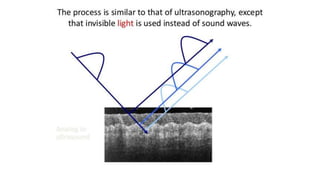
• OCT of the retina is like doing a vertical biopsy section of the
retina. Instead of a knife, light is used.
• Instead of viewing a stained section under a microscope, we are
presented with a false-color& view with micron level resolution.
• There is no physical contact with the eye.
• OCT of the retina is the most important diagnostic tool for retinal
pathology since the advent of fluorescein angiography
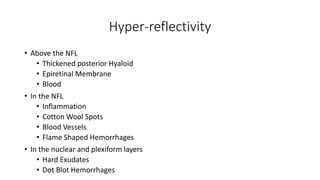
Hyper-reflectivity
• Above the NFL
• Thickened posterior Hyaloid
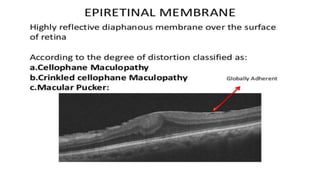
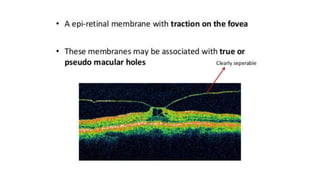
• Epiretinal Membrane
• Blood
• In the NFL
• Inflammation
• Cotton Wool Spots
• Blood Vessels
• Flame Shaped Hemorrhages
• In the nuclear and plexiform layers
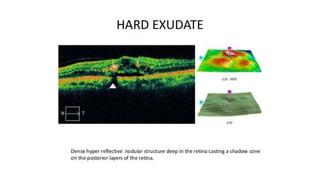
• Hard Exudates
• Dot Blot Hemorrhages
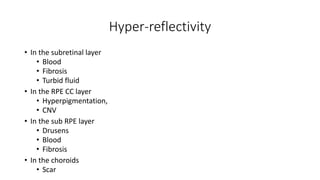
Hyper-reflectivity
• In the subretinal layer
• Blood
• Fibrosis
• Turbid fluid
• In the RPE CC layer
• Hyperpigmentation,
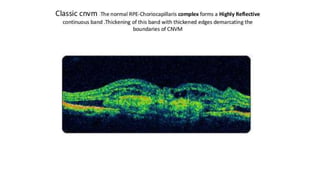
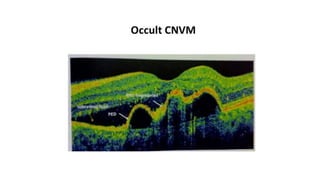
• CNV
• In the sub RPE layer
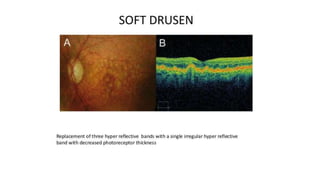
• Drusens
• Blood
• Fibrosis
• In the choroids
• Scar
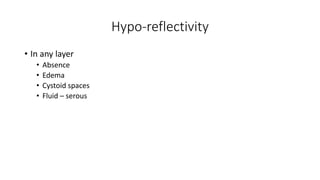
Hypo-reflectivity
• In any layer
• Absence
• Edema
• Cystoid spaces
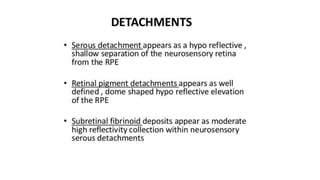
• Fluid – serous
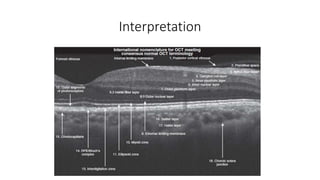
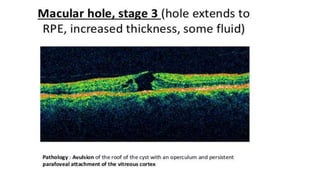
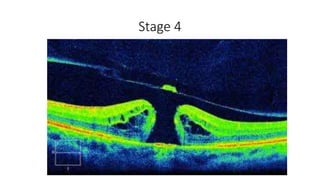
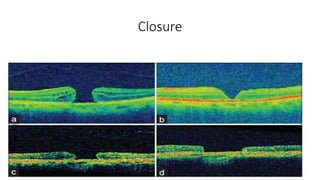
Interpretation
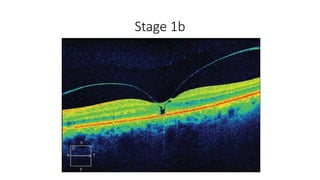
Stage 1b
Stage 4
Closure
Swept Source OCT
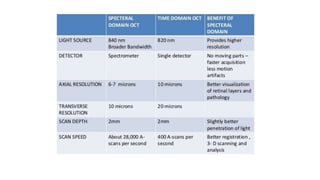
• Swept-source OCT is the latest milestone in retinal and choroidal
imag- ing.
• To overcome scattering by the RPE, which disabled visualization of
deeper lying structures, a longer wave- length was adopted for this
machine (1050 nm vs 840 nm in SD-OCT), and photodetectors instead
of CCD cameras led to a further increase in resolution (1 μm).
• The scan speed in swept-source instruments is twice that of SD-OCT
devices (100 000 A-scans/sec compared with 50 000 A-scans/sec),
enabling faster acquisition of B-scans.
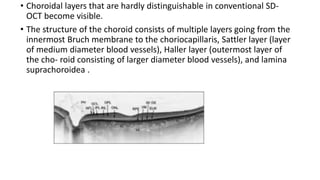
• Choroidal layers that are hardly distinguishable in conventional SD-
OCT become visible.
• The structure of the choroid consists of multiple layers going from the
innermost Bruch membrane to the choriocapillaris, Sattler layer (layer
of medium diameter blood vessels), Haller layer (outermost layer of
the cho- roid consisting of larger diameter blood vessels), and lamina
suprachoroidea .
SS OCT in Glaucoma
• It has been suspected that glaucomatous neuropthy of the optic
nerve may be somehow associated with microstructural changes of
the optic nerve.
• The lamina cribrosa is a mesh-like part of the optic nerve head
through which the retinal ganglion cell axons and retinal blood vessels
pass.
• Axonal damage, resulting in glaucomatous visual field loss, takes place
primarily at the level of the lamina cribrosa.
• SS-OCT demonstrated that the lamina cribrosa is visibly thinner in
eyes with normal-tension glaucoma when compared with normal
subjects.
Optical Coherence Tomography

Optical Coherence Tomography

  • 1.
  • 2.
    Introduction • OCT ofthe retina is like doing a vertical biopsy section of the retina. Instead of a knife, light is used. • Instead of viewing a stained section under a microscope, we are presented with a false-color& view with micron level resolution. • There is no physical contact with the eye. • OCT of the retina is the most important diagnostic tool for retinal pathology since the advent of fluorescein angiography
  • 23.
    Hyper-reflectivity • Above theNFL • Thickened posterior Hyaloid • Epiretinal Membrane • Blood • In the NFL • Inflammation • Cotton Wool Spots • Blood Vessels • Flame Shaped Hemorrhages • In the nuclear and plexiform layers • Hard Exudates • Dot Blot Hemorrhages
  • 24.
    Hyper-reflectivity • In thesubretinal layer • Blood • Fibrosis • Turbid fluid • In the RPE CC layer • Hyperpigmentation, • CNV • In the sub RPE layer • Drusens • Blood • Fibrosis • In the choroids • Scar
  • 25.
    Hypo-reflectivity • In anylayer • Absence • Edema • Cystoid spaces • Fluid – serous
  • 27.
  • 51.
  • 54.
  • 55.
  • 74.
    Swept Source OCT •Swept-source OCT is the latest milestone in retinal and choroidal imag- ing. • To overcome scattering by the RPE, which disabled visualization of deeper lying structures, a longer wave- length was adopted for this machine (1050 nm vs 840 nm in SD-OCT), and photodetectors instead of CCD cameras led to a further increase in resolution (1 μm). • The scan speed in swept-source instruments is twice that of SD-OCT devices (100 000 A-scans/sec compared with 50 000 A-scans/sec), enabling faster acquisition of B-scans.
  • 75.
    • Choroidal layersthat are hardly distinguishable in conventional SD- OCT become visible. • The structure of the choroid consists of multiple layers going from the innermost Bruch membrane to the choriocapillaris, Sattler layer (layer of medium diameter blood vessels), Haller layer (outermost layer of the cho- roid consisting of larger diameter blood vessels), and lamina suprachoroidea .
  • 76.
    SS OCT inGlaucoma • It has been suspected that glaucomatous neuropthy of the optic nerve may be somehow associated with microstructural changes of the optic nerve. • The lamina cribrosa is a mesh-like part of the optic nerve head through which the retinal ganglion cell axons and retinal blood vessels pass. • Axonal damage, resulting in glaucomatous visual field loss, takes place primarily at the level of the lamina cribrosa. • SS-OCT demonstrated that the lamina cribrosa is visibly thinner in eyes with normal-tension glaucoma when compared with normal subjects.

Editor's Notes

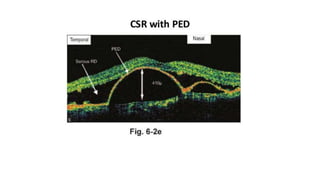
  • #55 Small <250 Medium 250-400 Large -400