RETINAL PROSTHESIS
Introduction
• Retinal prostheses are implantable devices designed to supplant
phototransduction within the eyes of individuals with significant retinal diseases
such as retinitis pigmentosa.
• In the normal eye, photoreceptors located within the outer layers of the retina
contain light-sensitive pigment that trigger the phototransduction cascade to
generate neuronal signals in the presence of light stimuli.
• These signals are passed to and processed by a complex network of neurons within the middle
layers of the retina before reaching the retinal ganglion cells (RGC)  RNFL  Visual cortex.
• In congenital retinal dystrophies such as retinitis pigmentosa,
• the outer layers of the retina where photoreceptors reside are gradually lost, thereby causing
progressive visual loss.
• However, inner retinal layers including RGCs are partially spared.[1]
• In theory then, restoration of vision may be achieved by creating devices, retinal prostheses,
that receive and process incoming light and then transmit the information in the form of
electrical impulses to the remaining inner retinal layers for visual function.
History
• In 1929, It was first discovered that electrical stimulation of visual
pathways may be perceived as light or “phosphenes” by the German
neurologist Otfrid Foerster = used electrodes to stimulate the visual cortex
of the brain.
• Implants of the first retinal prostheses began in 2002 with phase I clinical
trials for the Argus I. Nine years later, the next generation Argus® II was
approved for marketing in Europe after successful implantation in about 30
patients.
• Two years thereafter in 2013, the Argus® II became the first retinal
prosthetic device to be approved by the FDA for late-stage retinitis
pigmentosa. It is estimated that well over $100 million has been spent by
sponsors of almost twenty research groups for the development of retinal
prosthetic devices in the US, UK, Germany, Japan, Korea, Australia, and
China.
Basic Design
• Three main types of retinal implants have been developed:
• Epiretinal prostheses, anchored to the inner surface of retina;
• Subretinal prostheses, embedded between the retina and RPE/choroid;
• Suprachoroidal prostheses, implanted between the choroid and sclera
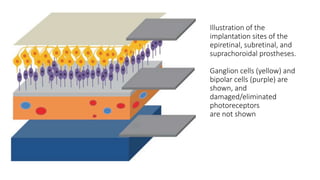
Illustration of the
implantation sites of the
epiretinal, subretinal, and
suprachoroidal prostheses.
Ganglion cells (yellow) and
bipolar cells (purple) are
shown, and
damaged/eliminated
photoreceptors
are not shown
Epiretinal Prostheses
• Epiretinal prostheses, sitting on the innermost layer of retina, have several advantages:
• 1. Ease of surgery:
• the prosthesis contacts the retina on the inner surface that is accessible from the vitreous, and the vitreous
cavity makes room for surgical maneuvers, reducing risks of mechanical damage to the retina.
• 2. Heat dissipation:
• besides choroidal perfusion, fluid in the vitreous cavity serves as an additional heat sink that enhances the
removal of the heat generated by the electronics of the implant, lowering thermal risks for chronic use.
• 3. Proximity to the ganglion cells:
• this proximity makes it easier for the device to directly stimulate ganglion cells, and this is potentially useful in
extended retinal degeneration where inner retina circuitry is altered.
• The potential drawbacks of the epiretinal prostheses include the difficulty of implanting the array in
close proximity to the retina and the perfused/distorted visual percepts due to undesired activation
of the axons of passage, which may be overcome by lengthening the stimulation pulse width.
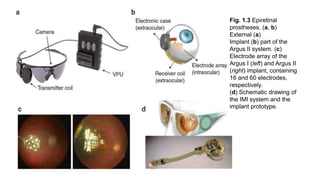
Fig. 1.3 Epiretinal
prostheses. (a, b)
External (a)
Implant (b) part of the
Argus II system. (c)
Electrode array of the
Argus I (left) and Argus II
(right) implant, containing
16 and 60 electrodes,
respectively.
(d) Schematic drawing of
the IMI system and the
implant prototype.
Subretinal Prosthesis
• Subretinal prostheses sit between the degenerated photoreceptor layer and the RPE.
• They pass current to the outer and middle sections of the retina (e.g., bipolar cells), therefore taking
advantage of the existing neural processing in these retinal layers and meanwhile possibly avoiding
the direct stimulation of ganglion cell axons that causes distortion of the visual perception (albeit
retinal reorganization of the remaining retinal neurons may result in worse distortion of visual
perceptions).
• The surgery to implant subretinal devices is considerably more difficult because of having to detach
the retina and/or cut across the highly vascular choroid, and the limited subretinal space puts a
constraint on the implant size, but it allows the implant to be held in place by pressure, without the
need of a tack as is used for epiretinal prostheses, although subretinal implants may use a silicone oil
tamponade (Stingl et al. 2013a) to guard against retinal detachment.
• Compared to epiretinal implantation where the vitreous flow and choroidal perfusion is
unhindered, subretinal implantation may block the fluid communication between the
retina and the choroid, obstructing heat dissipation from the retina and nutrient
transport to the retina.
• Whether this could result in the atrophy of the retinal tissues around the implant area
in the long term is under debate (Rizzo and Wyatt 1997; Peachey and Chow 1999; Sailer
et al. 2007).
• Two basic approaches to subretinal stimulation have been developed:
• one that uses a standard electrode array and the
• other that uses a microphotodiode array (MPDA).
• From the system perspective, the first approach is similar to the
aforementioned epiretinal implants in the sense that images are acquired and
processed by an external device and the electrode array only functions as a
slave current source under the command of the stimulator chip.
• In contrast, MPDA itself detects light, eliminating the need for cameras as the
visual scene is projected by the lens on the array. Each microphotodiode in the
array functions independently by transforming local luminance level, in a
proportional manner, into electrical pulses and directly stimulating the retinal
neurons nearby.
• Since the MPDA is intraocularly located, patients enjoy the benefits of using
eye movement, instead of head movement, to scan the visual scene.
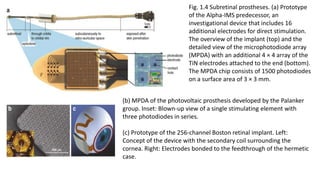
Fig. 1.4 Subretinal prostheses. (a) Prototype
of the Alpha-IMS predecessor, an
investigational device that includes 16
additional electrodes for direct stimulation.
The overview of the implant (top) and the
detailed view of the microphotodiode array
(MPDA) with an additional 4 × 4 array of the
TiN electrodes attached to the end (bottom).
The MPDA chip consists of 1500 photodiodes
on a surface area of 3 × 3 mm.
(b) MPDA of the photovoltaic prosthesis developed by the Palanker
group. Inset: Blown-up view of a single stimulating element with
three photodiodes in series.
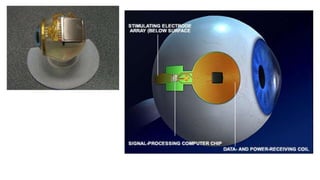
(c) Prototype of the 256-channel Boston retinal implant. Left:
Concept of the device with the secondary coil surrounding the
cornea. Right: Electrodes bonded to the feedthrough of the hermetic
case.
Suprachoroidal Prostheses
• Suprachoroidal prostheses have electrodes placed between the choroid and
the sclera. In comparison with the epiretinal and subretinal counterparts,
suprachoroidal implants are relatively distant from the retina. This separation
potentially reduces the risks of retinal damage from the surgery and the
implant.
• Abundance of the blood vessels at the choroid makes the thermal dissipation
of less concern as heat generated at the choroid layer should be carried away
by the increased blood flow .
• But on the other hand, with lengthened current travel path from the
electrode to the target tissue, this stimulation site may be disadvantaged by
the elevated perceptual threshold and worsened spatial resolution.
• To better steer the current flow through the retina, a return electrode is
typically located in the anterior part of the eye, for example, inside the
vitreous cavity or on the cornea, to be less invasive.
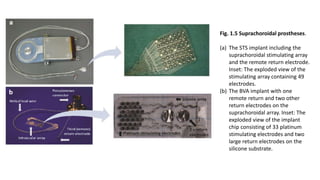
Fig. 1.5 Suprachoroidal prostheses.
(a) The STS implant including the
suprachoroidal stimulating array
and the remote return electrode.
Inset: The exploded view of the
stimulating array containing 49
electrodes.
(b) The BVA implant with one
remote return and two other
return electrodes on the
suprachoroidal array. Inset: The
exploded view of the implant
chip consisting of 33 platinum
stimulating electrodes and two
large return electrodes on the
silicone substrate.
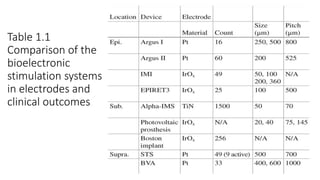
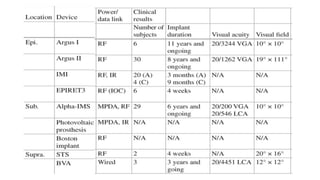
Table 1.1
Comparison of the
bioelectronic
stimulation systems
in electrodes and
clinical outcomes
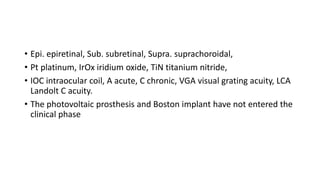
• Epi. epiretinal, Sub. subretinal, Supra. suprachoroidal,
• Pt platinum, IrOx iridium oxide, TiN titanium nitride,
• IOC intraocular coil, A acute, C chronic, VGA visual grating acuity, LCA
Landolt C acuity.
• The photovoltaic prosthesis and Boston implant have not entered the
clinical phase
Complications (Argus II)
• Conjunctival Erosion
• Hypotony
• Endophthalmitis
• Retinal tear or detachment
• Cystoid macular edema
• Uveitis
Specific Designs
Bionic Vision Australia (BVA)
Suprachoroidal Retinal Prosthesis
Implant
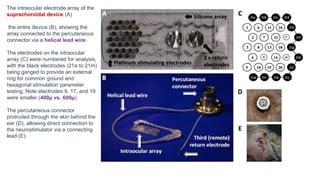
The intraocular electrode array of the
suprachoroidal device (A)
the entire device (B), showing the
array connected to the percutaneous
connector via a helical lead wire.
The electrodes on the intraocular
array (C) were numbered for analysis,
with the black electrodes (21a to 21m)
being ganged to provide an external
ring for common ground and
hexagonal stimulation parameter
testing. Note electrodes 9, 17, and 19
were smaller (400µ vs. 600µ).
The percutaneous connector
protruded through the skin behind the
ear (D), allowing direct connection to
the neurostimulator via a connecting
lead (E).
Design
• Bionic Vision Australia is a research consortium based in Australia currently developing
suprachoroidal retinal prosthesis implants.
• A 24 channel prototype with 20 stimulating electrodes was implanted in three volunteers as a
phase I human clinical trial, but the consortium is now focusing efforts on similar 44 and 98
channel versions.
• The 24 channel implant contained an array of 33,
• 600 micrometer platinum stimulating micro-electrodes set 50 micrometers from the surface of a
silicone substrate measuring 19 mm x 8 mm.
• Of the 33, 20 functioned as independent stimulating electrodes.
• Unlike other implant systems, this one did not use wireless transfer of energy and data.
Rather, a helix of 24 platinum/iridium wires emerging from the micro-electrode ran to a
percutaneously implanted connector surgically implanted behind the ear as has been
done in cochlear implant studies.
• This connector which was surgically anchored to the skull and protruded from the skin
allowed for direct connection of external electronics with the implanted array.
Surgical technique
• The titanium connector piece is attached to the temporal bone with self-tapping screws after making a
curved scalp incision, an incision through the posterior temporalis muscle, and dissection of the temporal
periosteum.
• An additional incision is made in the scalp flap to allow the connector to protrude from the skin. A tunnel
between the connector and the lateral orbital rim is made by dissecting under temporalis fascia, and a
lateral canthotomy is performed to expose the lateral orbital margin. After incision through the periosteum,
10 mm burrs were used to perform a lateral orbitotomy below the zygomaticofrontal suture for securement
of the connecting wire with custom made silicone grommet.
• A temporal peritomy is performed to expose and disinsert the lateral rectus muscle under which a scleral
incision is made and marked with diathermy approximately 9-10 mm posterior to the limbus depending on
axial globe length. After full thickness incision of the sclera with a 15 degree blade, the suprachoroidal
space is dissected with a crescent blade and lens glide.
• To allow for micro-electrode array positioning and wire exit, an incision extending the superior wound edge
posteriorly is made.
• After positioning of the array, visualized using indirect ophthalmoscopy during surgery, in the
suprachoroidal space under the macula the wound is closed and a Dacron patch is sutured to the sclera
over it. Then, the lateral rectus is reattached, the conjunctiva closed, and the connecting wire secured in
the orbitotomy with the grommet.
• Finally, periosteum, subcutaneous tissue, and skin are closed. Surgical time is 3-4 hours.
Results
• Three subjects with light perception visual acuity due to outer retinal degenerative
diseases (2 with rod-cone dystrophy, 1 with syndromic retinitis pigmentosa) were
implanted with suprachoroidal retinal prosthesis devices and percutaneous
connectors.
• Post-surgical hemorrhage in the subretinal and suprachoroidal spaces was noted in all
subjects, but in each case spontaneously resolved without further complications.
• Device stability and integrity was measured regularly using fundus photography,
infrared imaging, OCT, and impedance studies.
• Imaging showed no movements of the device, but distance from the device to the RPE
markedly increased over the course of the year in two subjects [roughly 600 µ to 900 µ ]
• Impedance studies showed significantly decreased micro-electrode impedance in one subject
over time which was thought to be due to changes in the electrode-tissue interface.
• All 3 subjects scored significantly better with the device on than with it off in the
• Visual acuity was estimated to be logMAR 2.62 (20/8397) on average with the device on.
• With the device off, the same subject was unable to see any Landolt-C optotypes.
Retina Implant Alpha-IMS
Fundus photo of Retina Implant Alpha-
IMS device
The Alpha-IMS is a subretinal, micro-photodiode array retinal
prosthesis developed by Retina Implant AG in Reutlingen,
Germany and approved in Europe in 2013.
It is designed to be implanted in the layer of degenerated
photoreceptor cells in patients with degenerative outer retinal
disease.
Consequently, electrical impulses from the device stimulate
bipolar cells in the middle retinal layers which carry the signals
to RGCs.
An earlier version of the device with a retroauricular transdermal
cable connected the device to an external battery and was
implanted in 11 blind volunteers beginning in 2005. After positive
visual function outcomes, a wireless version was developed
which is currently undergoing single and multi-center clinical trials
in Europe.[18]
• The Alpha-IMS array consists of 1500 pixels each containing a
photodiode to sense light intensity, an amplification circuit, and an
electrode to transfer electrical impulses to adjoining retinal layers.
• The impulse amplitude transferred by each pixel is linked to the
brightness of incoming light at the point of the pixel.
• The 3 mm x 3 mm x 70 micrometer array processes visual input at
a rate of 5-7 hertz and is designed to be attached beneath the
fovea.
• It sits on a polyimide foil which exits the choroid and sclera supero-
temporally to connect to a power cable which leads to a subdermal,
retroauricularly placed coil housed inside of a ceramic casing.
• This internal coil receives energy and communication wirelessly
from an external coil which is held magnetically above it behind the
ear. The external coil is attached to a battery pack and handheld
control unit, which allows the user to adjust amplification and gain.
Surgical technique
• Surgical implantation consists of extra- and intra-ocular procedures which may be performed
consecutively over 6-8 hours.
• The extraocular procedure begins with a 4 cm arcuate, retroauricular incision and a secondary,
horizontal incision of about the same size crossing the first. A raspatory is used to dissect down
to the bone to expose an approximately 2 cm by 2 cm square of retroauricular bone upon and
then a standard otologic drill is used to make a 3-4 mm deep implant bed for the ceramic casing
containing electronics. Another incision is made near the lateral orbital rim over the margo
orbitalis and the zygomatic-frontalis suture is exposed by elevating the periosteum.
• Intraorbital periosteum is also elevated to allow for an L-shaped canal to be drilled. A complete
peritomy is performed at the limbus, and a tunnel is dissected from the subconjunctival space to
the orbital rim incision.
• A silicone tube is inserted to keep it patent. Next, a 15 cm long, raspatory is used to tunnel
beneath the periosteum of the temporal bone to connect the orbital rim incision with the
retroauricular site.
• Then, a custom, hollow trocar is inserted anteriorly beneath the temporal periosteum and
extended through to the retroauricular incision site. The power cable and subretinal implant
components, protected by a silicone tube, are pulled from the retroauricular site to the orbital
rim using the trocar and then inserted through the tunnel to the subconjunctival space. Prior to
the intraocular procedure, electrical testing of the implant is performed. The extraocular surgery
takes approximately 60-80 minutes.[20][21]
• To begin the intraocular procedure, a standard pars-plana victretomy is
performed and then a 1 by 4 mm scleral flap made 9 mm posterior to the
limbus in the supero-temporal quadrant. The retina is elevated by injecting
balanced saline solution or Healon. Then, a guiding tool is inserted through
the sclera and choroid to a subretinal position between the choroid and the
retina.
• Correct insertion and positioning of the guiding tool may be aided by
calculating the optimal angle and distance of insertion and making a line
between an insertion point and reference point marked by a corneal marker.
• Insertion depth may be calculated and tracked by calibration lines on the
guidance tool. The polyimide foil is then introduced along the path of the
guiding foil to the subretinal space.
• The outside end of the foil is connected to a sealed ceramic connector piece
which is sutured onto the sclera. Finally a macular hole is created by
separating the pigment epithelium layer from the neuroretina and the array is
placed according to planned positioning as seen on fundus images prior to
surgery.[20][22]
• Alpha-IMS devices have been implanted in at least 29 participants within single and multi-center
modules as a part of an ongoing clinical trial by Zrenner and colleagues.[18] Those receiving implants
had either no light perception or light perception without projection due to degenerative outer
retinal diseases (25 had retinitis pigmentosa, 4 had cone-rod dystrophy) prior to implantation.
• Of the 29 participants, at least two serious adverse events have been reported – one increase of
intraocular pressure up to 46 mmHg and the other a retinal detachment immediately after
explantation of the device.[23] Both were treated and managed without long-term sequelae.
• Notably, after implantation 4 of the 29 subjects could not perceive any light while the device was
turned on. Though the cause was unclear, the Stingl et al. attributed this result to either failure of
the device in vivo or to sequelae of the implantation surgery such as inflammation of the optic
nerve or retina.[18]
• The following results are a summary of visual function test performances of 29 implanted subjects
described by Stingl and colleagues in their 2015 clinical trial interim report.
• According to the interim report, subjects with the Alpha-IMS turned on were significantly more
likely to correctly perceive and localize flashes of light on a screen 60 cm away than with the device
turned off, but there was no significant difference in ability to recognize the direction of movement
of the flashes. These tests were performed according to the Basic Assessment of Light and Motion
which has been described previously.
• With the device on, subjects were also significantly more likely to correctly tell the orientation of a
grating than with it off, but no significant difference was seen when testing acuity with Landolt C-
rings. Of the 4 subjects who passed the Landolt C-ring test, one passed with a visual acuity of
20/546.
• Shape and object perception, localization, and recognition were tested by placing four white
objects on a black table altogether or place around a large white plate and asking subjects
how many, where, and what the objects were.
• In the first few months, subjects performed significantly better when the device was turned
on than turned off, on average perceiving and localizing 2.5 objects and naming 1 object with
the device on versus 0.5 and nearly 0, respectively, when the device was off.
• However, after a year, performances of these tasks with the device turned off improved, and
the statistical significance between the differences of performance with the device turned on
and off was lost.
• Authors attributed visual function gains with the device turned off to a known phenomenon
wherein growth factors are released in the retina after long-term electrical stimulation.
• Tests showed no significant increase in the ability of subjects with the device turned on to
identify the time on a black clock with white hands placed at angles of 0°, 90°, or 180° to
each other or to read white letters covering a visual angle of 10° on a black background.
• After a year, approximately 65% of subjects with the device turned on could distinguish side-
by-side comparisons of differing levels of gray from each other compared to approximately
20% of subjects who could while the device was turned off.
• Subjectively, 8 of the 29 subjects including the 4 without light perception reported no benefit
in daily life from the Alpha-IMS, another 8 reported some benefit in object localization
without seeing shapes or details, while the remaining 13 (45%) reported the ability to
usefully recognize shapes and some details of objects in daily experiences.
Boston Retinal Implant
BRI Design
• Subretinal retinal prosthesis
• The current iteration improves upon a first-generation design in three significant ways:
• 1) an increase in power and data telemetry transfer capabilities due to a larger internal receiver coil,
• 2) a more resilient hermetic, titanium casing of internal circuitry, and
• 3) a longer cable connecting the micro-electrode array to other internal components to allow for easier
implantation.
• External components of the system include a computer controller with an interface which
allows users to adjust parameters of retinal electrical stimulation such as strength, duration,
and spatial distribution.
• Using power amplifiers, this computer sends power and data signals to internal components
wirelessly via near-field inductive coupling.
• These signals are received by internal coils that sit just under the conjunctiva of the anterior eye and
passed along to the internal processor which is housed in a hermetic, titanium casing and attached to the
sclera in the superior nasal quadrant of the eye.
• Internal processors decode data signals and send stimulating impulses via a serpentine, polyimide foil to
the micro-electrode array which enters the sclera and choroid in the superotemporal quadrant and is
implanted subretinally.
• The 16 micro-electrodes on the array are each 400µ in diameter and made from sputtered iron
oxide film. Each is controlled independently by corresponding internal processor channels.
Surgical technique
• The following implantation techniques were used to implant devices in two
minipigs weighing approximately 20 kg.
• Conjunctiva is dissected and a 6 mm x 2 mm scleral flap is created in the
superotemporal quadrant.
• After partial vitrectomy, a needle is used to raise a retinal bleb, a separation of the
choroid and retinal pigment epithelium from the retina, from the front.
• Receiver coils and the casing containing the internal processors are secured to the
sclera anteriorly and in the superior nasal quadrant, respectively.
• Next, an incision is made in the choroid under the scleral flap to insert the micro-
electrode array. The array is positioned so that it rests in the subretinal space created
by the bleb.
• Once the array is positioned, the serpentine, polyimide foil connecting it to the other
internal components is secured to the sclera with sutures and the scleral flap is sutured
close.
• Finally, the conjunctiva is sutured back down over the implanted receiver coils.
Results
• Joseph Rizzo, the principal investigator of the Boston Retina Implant
Project, has stated that his team will forego human trials.
• 16 micro-electrode device has been performed in two minipigs as
part of pre-clinical trials.
• The instruments showed sustained function, the devices were explanted at 3
and 5.5 months from the pigs because the internal receiver coils wore
through the conjunctiva and became exposed.
• Since then, the shape of the coils has been altered for future long-term
implantation studies.
Intelligent Retinal Implant
System (IRIS) Bionic Vision
Restoration System
Design
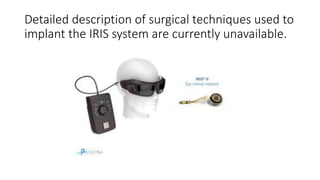
• The IRIS BVRS is an epiretinal implant
• Currently two versions of the IRIS,
• the first containing 49 micro-electrodes
• the second containing 150,
• According to the company’s website, the device includes three components:
• 1) an epiretinal implant attached to a built-in wireless receiver
• 2) a camera and transmitter unit built into a pair of glasses, and
• 3) a pocket computer for optimization of visual signals.
• Pixium touts their camera sensor and processing units as
• containing an array of independent pixel circuits which “encode transient (light change)
information from the scene into the precise timing of spikes
• while sustained (light intensity) information is encoded using a simple spike rate coding
scheme” up to a rate of 1 impulse per millisecond
Detailed description of surgical techniques used to
implant the IRIS system are currently unavailable.
Results
• The IMI retinal implant system upon which the first version of the IRIS Bionic
Vision Restoration System is based was implanted for at least 1 year in 4
patients with retinitis pigmentosa and visual acuities ranging from no light
perception to hand movement.
• Stimulation sessions throughout the year showed subjects able to perceive
basic patterns such as horizontal or vertical bars or crosses.
• Inspection of the retina 3 years after implantation in 3 patients showed no
retinal tissue damage and well-positioned electrode arrays.
• Multi-center clinical trials were begun in 2013 for the IRIS version 1 and at
the beginning of 2016 for IRIS version 2 with estimated enrollments of 20 and
10 subjects and estimated primary completion dates of 2017 and 2022,
respectively
• Recruitment criteria include confirmed diagnosis of retinitis pigmentosa,
choroidemia, or cone-rod dystrophy and a visual acuity of logMAR 2.3 or
worse in both eyes.
EPIRET3
• The EPIRET3 system was designed by the EPI-RET Project group in
Germany to be a wirelessly controlled, epiretinal device.
• Electrical impulses are transferred to the retina by 25, 100 micrometer diameter
electrodes arrayed in a hexagonal pattern coated in a thin film of iridium oxide
and affixed to the end of a via a 40 mm long, 3 mm wide polyimide foil micro-
cable which connects the electrodes to a receiver module implanted within the
lens capsule.
• The receiver module consists of a receiver coil that wirelessly obtains transmitted
data, a receiver chip that processes that data, and a stimulation chip that
generates and sends impulse activation patterns to the micro-electrode array. The
entire implant is coated with parylene C for biocompatibility.[29] The internal coil
receives temporospatial data and power wirelessly from an external coil and
transmitter unit attached to glasses in front of the eye. Data and power originate
from a portable computer system worn or carried by the user.
Surgical Technique
• Prior to EPIRET3 implantation, removal of natural or artificial intraocular lenses and
vitreous must be performed and the posterior chamber filled with perfluorcarbon.
• A complete 20-gauge vitrectomy via the pars plana may accomplish this.
• Additionally, following phacoemulsification of the lens, an eccentric posterior
capsulotomy is created for passage of internal components.
• To begin implantation, the receiver module is inserted into the lens capsule via an
11 mm corneoscleral incision and secured by two trans-scleral sutures. From there,
the polyimide foil cable and array are led through the defect in the posterior
capsule into the vitreous chamber.
• The micro-electrode array is positioned within the macular region by progressively
removing the perfluorcarbon cushion.
• Two titanium retinal tacks are used to affix the stimulator array onto the surface of
the posterior pole of the retina. Before closure, the eye is filled with saline solution.
Surgery reported to take less than 2 hours.
Results
• Successful experimental implantation and explantation of the EPIRET3
system in 6 subjects was reported in 2009 by Roessler and colleagues.
• Per ethics guidelines, the devices remained in the eyes for only 28 days before
explantation.
• Subjects all carried diagnoses of retinitis pigmentosa confirmed by ERG and had
visual acuities ranging from no light perception (1/6 patients) to light perception
(4/6) to hand movements (1/6).
• No severe adverse events were reported in any of the subjects. However, one
patient developed culture-negative hypopyon on post-implantation day 3 which
was treated and cleared by day 5.
• During explantation, a different subject developed a macular hole which
was filled with silicone oil. Although minor gliosis was visible on
angiography near tack sites, visual acuity was stable at long-term follow-
up for all patients.[28][30]
Argus® II Retinal Prosthesis
System
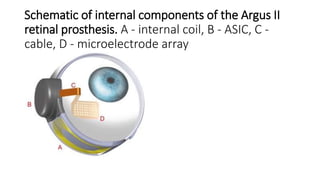
Schematic of internal components of the Argus II
retinal prosthesis. A - internal coil, B - ASIC, C -
cable, D - microelectrode array
Design
• The Argus® II is a second-generation epiretinal, micro-electrode array retinal
prosthesis developed and sold by Second Sight Medical Products.
• It recently was approved for marketing in both Europe (2011) and the United
States (2013), being the first device to gain that distinction.
• Its design differs from the first generation model, the Argus I, in the number and
spacing of microelectrodes on the array (6x10 instead of 4x4), the placement of
internal processing components (sutured onto the sclera instead of subcutaneous
placement inside the temporal recess), and the placement of the external
transmission coil (built into the sidearm of the glasses instead of held magnetically by
the internal components over the temporal bone).[8]
• The Argus® II consists of three external components and three internal
components.
• The external components include a video camera mounted in the center of a pair
of glasses, a visual processing unit (VPU) that may be hung around the neck or
attached to clothing, and a coil attached to the sidearm of the glasses for
transmitting data and power wirelessly via radio frequency telemetry to internal
components.
• The internal components include an internal coil, which receives telemetry data
from the external components and an internal processing unit called an
application specific integrated circuit (ASIC), which is housed in a hermetically
sealed casing with a concave surface designed to be sutured onto the sclera. A
ribbon of cables connects the casing to a 6 by 10 array of platinum micro-
electrodes measuring 200 micrometers in diameter and spaced, center-to-center,
575 micrometers apart embedded in a thin film of polyimide
Surgical technique
• A 360-degree peritomy is performed and the hermetic casing is sutured onto the
scleral surface in the superotemporal quadrant. The antenna coil is placed under the
lateral rectus muscle and sutured to the sclera in the inferotemporal quadrant. The
rest of the device’s silicone band is placed under the remaining rectus muscles and
joined together in the superonasal quadrant with a Watzke sleeve.
• A standard 3-port pars plana vitrectomy is used to implant the intraocular components
of the Argus® II .
• The posterior hyaloid face and any existing epiretinal membranes are removed to
optimize contact between the micro-electrodes and the retinal neurons. Next, a 5.2
millimeter wide sclerotomy is made in the superotemporal quadrant, at a distance of
approximately 3 mm posterior to the limbus.
• The micro-electrode array is inserted through the sclerotomy and place in the macular
region. Once positioned optimally, the micro-electrode array is secured by a spring-
tensioned titanium retinal tack inserted at the heel of the array.
• The sclerotomy is then sutured close. Tutoplast pericardial is place in the superior
temporal quadrant over the hermetic casing. The Tenon’s capsule and conjunctiva is
closed. Surgical time is generally 2 to 4 hours (see video).
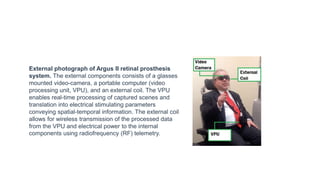
External photograph of Argus II retinal prosthesis
system. The external components consists of a glasses
mounted video-camera, a portable computer (video
processing unit, VPU), and an external coil. The VPU
enables real-time processing of captured scenes and
translation into electrical stimulating parameters
conveying spatial-temporal information. The external coil
allows for wireless transmission of the processed data
from the VPU and electrical power to the internal
components using radiofrequency (RF) telemetry.
RESULTS
• Visual function tests in patients with Argus® II implants have shown
increases in the subjects’ abilities to recognize and discriminate forms,
localize targets, detect motion, and navigate.
• The best estimated visual acuity outcome in studies by grating has been
logMAR 1.8 (20/1262).
• Regarding reading, 21 subjects with average implant duration of 19.9
months consistently identified letters.
• Six of these subjects were able to read letters of reduced size, the smallest
measuring 0.9 cm at 30 cm, and four subjects were able to read two-, three-
and four-letter words. These results demonstrate significant advancement
in the evolution of artificial vision.
• Currently the Argus® II is indicated for use in patients with severe to
profound retinitis pigmentosa who meet the following criteria: adults
age 25 years or older, bare light or no light perception in both eyes, a
previous history of useful form vision, phakic or pseudophakic, and
willingness and ability to receive the recommended post-implant
clinical follow-up, device fitting, and visual rehabilitation.
• The Argus® II implant is intended to be implanted in a single eye,
typically the worse-seeing eye.
Functional Outcomes
• Patients receiving retinal implants will generally be those with end-stage
inherited retinal degenerations. This implies that they have had good, or at
least useful, vision in youth, and sometimes for decades, but they all have
gone through a period where they were functionally blind, with at best
some light perception or projection. A retinal implant restores some
functionality, and the best way to assess this is to follow the crude hierarchy:
• Light perception (telling daylight from night or room lights on from off), Light
projection (where the light is coming from), Light movement (direction in two
dimensions)
• Detecting contrast (borders, outlines), Spatial resolution (two dots/bars) • Crude
hand-eye coordination, Shape discrimination
• Monocular depth cues (size, parallax)
• Functions requiring detail vision, such as reading, face recognition, fine motor tasks,
etc.—well beyond the capabilities of current retinal implants
Retinal prosthesis

Retinal prosthesis

  • 1.
  • 2.
    Introduction • Retinal prosthesesare implantable devices designed to supplant phototransduction within the eyes of individuals with significant retinal diseases such as retinitis pigmentosa. • In the normal eye, photoreceptors located within the outer layers of the retina contain light-sensitive pigment that trigger the phototransduction cascade to generate neuronal signals in the presence of light stimuli. • These signals are passed to and processed by a complex network of neurons within the middle layers of the retina before reaching the retinal ganglion cells (RGC)  RNFL  Visual cortex. • In congenital retinal dystrophies such as retinitis pigmentosa, • the outer layers of the retina where photoreceptors reside are gradually lost, thereby causing progressive visual loss. • However, inner retinal layers including RGCs are partially spared.[1] • In theory then, restoration of vision may be achieved by creating devices, retinal prostheses, that receive and process incoming light and then transmit the information in the form of electrical impulses to the remaining inner retinal layers for visual function.
  • 3.
    History • In 1929,It was first discovered that electrical stimulation of visual pathways may be perceived as light or “phosphenes” by the German neurologist Otfrid Foerster = used electrodes to stimulate the visual cortex of the brain. • Implants of the first retinal prostheses began in 2002 with phase I clinical trials for the Argus I. Nine years later, the next generation Argus® II was approved for marketing in Europe after successful implantation in about 30 patients. • Two years thereafter in 2013, the Argus® II became the first retinal prosthetic device to be approved by the FDA for late-stage retinitis pigmentosa. It is estimated that well over $100 million has been spent by sponsors of almost twenty research groups for the development of retinal prosthetic devices in the US, UK, Germany, Japan, Korea, Australia, and China.
  • 4.
    Basic Design • Threemain types of retinal implants have been developed: • Epiretinal prostheses, anchored to the inner surface of retina; • Subretinal prostheses, embedded between the retina and RPE/choroid; • Suprachoroidal prostheses, implanted between the choroid and sclera
  • 5.
    Illustration of the implantationsites of the epiretinal, subretinal, and suprachoroidal prostheses. Ganglion cells (yellow) and bipolar cells (purple) are shown, and damaged/eliminated photoreceptors are not shown
  • 6.
    Epiretinal Prostheses • Epiretinalprostheses, sitting on the innermost layer of retina, have several advantages: • 1. Ease of surgery: • the prosthesis contacts the retina on the inner surface that is accessible from the vitreous, and the vitreous cavity makes room for surgical maneuvers, reducing risks of mechanical damage to the retina. • 2. Heat dissipation: • besides choroidal perfusion, fluid in the vitreous cavity serves as an additional heat sink that enhances the removal of the heat generated by the electronics of the implant, lowering thermal risks for chronic use. • 3. Proximity to the ganglion cells: • this proximity makes it easier for the device to directly stimulate ganglion cells, and this is potentially useful in extended retinal degeneration where inner retina circuitry is altered. • The potential drawbacks of the epiretinal prostheses include the difficulty of implanting the array in close proximity to the retina and the perfused/distorted visual percepts due to undesired activation of the axons of passage, which may be overcome by lengthening the stimulation pulse width.
  • 7.
    Fig. 1.3 Epiretinal prostheses.(a, b) External (a) Implant (b) part of the Argus II system. (c) Electrode array of the Argus I (left) and Argus II (right) implant, containing 16 and 60 electrodes, respectively. (d) Schematic drawing of the IMI system and the implant prototype.
  • 8.
    Subretinal Prosthesis • Subretinalprostheses sit between the degenerated photoreceptor layer and the RPE. • They pass current to the outer and middle sections of the retina (e.g., bipolar cells), therefore taking advantage of the existing neural processing in these retinal layers and meanwhile possibly avoiding the direct stimulation of ganglion cell axons that causes distortion of the visual perception (albeit retinal reorganization of the remaining retinal neurons may result in worse distortion of visual perceptions). • The surgery to implant subretinal devices is considerably more difficult because of having to detach the retina and/or cut across the highly vascular choroid, and the limited subretinal space puts a constraint on the implant size, but it allows the implant to be held in place by pressure, without the need of a tack as is used for epiretinal prostheses, although subretinal implants may use a silicone oil tamponade (Stingl et al. 2013a) to guard against retinal detachment. • Compared to epiretinal implantation where the vitreous flow and choroidal perfusion is unhindered, subretinal implantation may block the fluid communication between the retina and the choroid, obstructing heat dissipation from the retina and nutrient transport to the retina. • Whether this could result in the atrophy of the retinal tissues around the implant area in the long term is under debate (Rizzo and Wyatt 1997; Peachey and Chow 1999; Sailer et al. 2007).
  • 9.
    • Two basicapproaches to subretinal stimulation have been developed: • one that uses a standard electrode array and the • other that uses a microphotodiode array (MPDA). • From the system perspective, the first approach is similar to the aforementioned epiretinal implants in the sense that images are acquired and processed by an external device and the electrode array only functions as a slave current source under the command of the stimulator chip. • In contrast, MPDA itself detects light, eliminating the need for cameras as the visual scene is projected by the lens on the array. Each microphotodiode in the array functions independently by transforming local luminance level, in a proportional manner, into electrical pulses and directly stimulating the retinal neurons nearby. • Since the MPDA is intraocularly located, patients enjoy the benefits of using eye movement, instead of head movement, to scan the visual scene.
  • 10.
    Fig. 1.4 Subretinalprostheses. (a) Prototype of the Alpha-IMS predecessor, an investigational device that includes 16 additional electrodes for direct stimulation. The overview of the implant (top) and the detailed view of the microphotodiode array (MPDA) with an additional 4 × 4 array of the TiN electrodes attached to the end (bottom). The MPDA chip consists of 1500 photodiodes on a surface area of 3 × 3 mm. (b) MPDA of the photovoltaic prosthesis developed by the Palanker group. Inset: Blown-up view of a single stimulating element with three photodiodes in series. (c) Prototype of the 256-channel Boston retinal implant. Left: Concept of the device with the secondary coil surrounding the cornea. Right: Electrodes bonded to the feedthrough of the hermetic case.
  • 11.
    Suprachoroidal Prostheses • Suprachoroidalprostheses have electrodes placed between the choroid and the sclera. In comparison with the epiretinal and subretinal counterparts, suprachoroidal implants are relatively distant from the retina. This separation potentially reduces the risks of retinal damage from the surgery and the implant. • Abundance of the blood vessels at the choroid makes the thermal dissipation of less concern as heat generated at the choroid layer should be carried away by the increased blood flow . • But on the other hand, with lengthened current travel path from the electrode to the target tissue, this stimulation site may be disadvantaged by the elevated perceptual threshold and worsened spatial resolution. • To better steer the current flow through the retina, a return electrode is typically located in the anterior part of the eye, for example, inside the vitreous cavity or on the cornea, to be less invasive.
  • 12.
    Fig. 1.5 Suprachoroidalprostheses. (a) The STS implant including the suprachoroidal stimulating array and the remote return electrode. Inset: The exploded view of the stimulating array containing 49 electrodes. (b) The BVA implant with one remote return and two other return electrodes on the suprachoroidal array. Inset: The exploded view of the implant chip consisting of 33 platinum stimulating electrodes and two large return electrodes on the silicone substrate.
  • 13.
    Table 1.1 Comparison ofthe bioelectronic stimulation systems in electrodes and clinical outcomes
  • 14.
    • Epi. epiretinal,Sub. subretinal, Supra. suprachoroidal, • Pt platinum, IrOx iridium oxide, TiN titanium nitride, • IOC intraocular coil, A acute, C chronic, VGA visual grating acuity, LCA Landolt C acuity. • The photovoltaic prosthesis and Boston implant have not entered the clinical phase
  • 15.
    Complications (Argus II) •Conjunctival Erosion • Hypotony • Endophthalmitis • Retinal tear or detachment • Cystoid macular edema • Uveitis
  • 16.
  • 17.
    Bionic Vision Australia(BVA) Suprachoroidal Retinal Prosthesis Implant
  • 19.
    The intraocular electrodearray of the suprachoroidal device (A) the entire device (B), showing the array connected to the percutaneous connector via a helical lead wire. The electrodes on the intraocular array (C) were numbered for analysis, with the black electrodes (21a to 21m) being ganged to provide an external ring for common ground and hexagonal stimulation parameter testing. Note electrodes 9, 17, and 19 were smaller (400µ vs. 600µ). The percutaneous connector protruded through the skin behind the ear (D), allowing direct connection to the neurostimulator via a connecting lead (E).
  • 20.
    Design • Bionic VisionAustralia is a research consortium based in Australia currently developing suprachoroidal retinal prosthesis implants. • A 24 channel prototype with 20 stimulating electrodes was implanted in three volunteers as a phase I human clinical trial, but the consortium is now focusing efforts on similar 44 and 98 channel versions. • The 24 channel implant contained an array of 33, • 600 micrometer platinum stimulating micro-electrodes set 50 micrometers from the surface of a silicone substrate measuring 19 mm x 8 mm. • Of the 33, 20 functioned as independent stimulating electrodes. • Unlike other implant systems, this one did not use wireless transfer of energy and data. Rather, a helix of 24 platinum/iridium wires emerging from the micro-electrode ran to a percutaneously implanted connector surgically implanted behind the ear as has been done in cochlear implant studies. • This connector which was surgically anchored to the skull and protruded from the skin allowed for direct connection of external electronics with the implanted array.
  • 21.
    Surgical technique • Thetitanium connector piece is attached to the temporal bone with self-tapping screws after making a curved scalp incision, an incision through the posterior temporalis muscle, and dissection of the temporal periosteum. • An additional incision is made in the scalp flap to allow the connector to protrude from the skin. A tunnel between the connector and the lateral orbital rim is made by dissecting under temporalis fascia, and a lateral canthotomy is performed to expose the lateral orbital margin. After incision through the periosteum, 10 mm burrs were used to perform a lateral orbitotomy below the zygomaticofrontal suture for securement of the connecting wire with custom made silicone grommet. • A temporal peritomy is performed to expose and disinsert the lateral rectus muscle under which a scleral incision is made and marked with diathermy approximately 9-10 mm posterior to the limbus depending on axial globe length. After full thickness incision of the sclera with a 15 degree blade, the suprachoroidal space is dissected with a crescent blade and lens glide. • To allow for micro-electrode array positioning and wire exit, an incision extending the superior wound edge posteriorly is made. • After positioning of the array, visualized using indirect ophthalmoscopy during surgery, in the suprachoroidal space under the macula the wound is closed and a Dacron patch is sutured to the sclera over it. Then, the lateral rectus is reattached, the conjunctiva closed, and the connecting wire secured in the orbitotomy with the grommet. • Finally, periosteum, subcutaneous tissue, and skin are closed. Surgical time is 3-4 hours.
  • 22.
    Results • Three subjectswith light perception visual acuity due to outer retinal degenerative diseases (2 with rod-cone dystrophy, 1 with syndromic retinitis pigmentosa) were implanted with suprachoroidal retinal prosthesis devices and percutaneous connectors. • Post-surgical hemorrhage in the subretinal and suprachoroidal spaces was noted in all subjects, but in each case spontaneously resolved without further complications. • Device stability and integrity was measured regularly using fundus photography, infrared imaging, OCT, and impedance studies. • Imaging showed no movements of the device, but distance from the device to the RPE markedly increased over the course of the year in two subjects [roughly 600 µ to 900 µ ] • Impedance studies showed significantly decreased micro-electrode impedance in one subject over time which was thought to be due to changes in the electrode-tissue interface. • All 3 subjects scored significantly better with the device on than with it off in the • Visual acuity was estimated to be logMAR 2.62 (20/8397) on average with the device on. • With the device off, the same subject was unable to see any Landolt-C optotypes.
  • 23.
  • 24.
    Fundus photo ofRetina Implant Alpha- IMS device The Alpha-IMS is a subretinal, micro-photodiode array retinal prosthesis developed by Retina Implant AG in Reutlingen, Germany and approved in Europe in 2013. It is designed to be implanted in the layer of degenerated photoreceptor cells in patients with degenerative outer retinal disease. Consequently, electrical impulses from the device stimulate bipolar cells in the middle retinal layers which carry the signals to RGCs. An earlier version of the device with a retroauricular transdermal cable connected the device to an external battery and was implanted in 11 blind volunteers beginning in 2005. After positive visual function outcomes, a wireless version was developed which is currently undergoing single and multi-center clinical trials in Europe.[18]
  • 25.
    • The Alpha-IMSarray consists of 1500 pixels each containing a photodiode to sense light intensity, an amplification circuit, and an electrode to transfer electrical impulses to adjoining retinal layers. • The impulse amplitude transferred by each pixel is linked to the brightness of incoming light at the point of the pixel. • The 3 mm x 3 mm x 70 micrometer array processes visual input at a rate of 5-7 hertz and is designed to be attached beneath the fovea. • It sits on a polyimide foil which exits the choroid and sclera supero- temporally to connect to a power cable which leads to a subdermal, retroauricularly placed coil housed inside of a ceramic casing. • This internal coil receives energy and communication wirelessly from an external coil which is held magnetically above it behind the ear. The external coil is attached to a battery pack and handheld control unit, which allows the user to adjust amplification and gain.
  • 26.
    Surgical technique • Surgicalimplantation consists of extra- and intra-ocular procedures which may be performed consecutively over 6-8 hours. • The extraocular procedure begins with a 4 cm arcuate, retroauricular incision and a secondary, horizontal incision of about the same size crossing the first. A raspatory is used to dissect down to the bone to expose an approximately 2 cm by 2 cm square of retroauricular bone upon and then a standard otologic drill is used to make a 3-4 mm deep implant bed for the ceramic casing containing electronics. Another incision is made near the lateral orbital rim over the margo orbitalis and the zygomatic-frontalis suture is exposed by elevating the periosteum. • Intraorbital periosteum is also elevated to allow for an L-shaped canal to be drilled. A complete peritomy is performed at the limbus, and a tunnel is dissected from the subconjunctival space to the orbital rim incision. • A silicone tube is inserted to keep it patent. Next, a 15 cm long, raspatory is used to tunnel beneath the periosteum of the temporal bone to connect the orbital rim incision with the retroauricular site. • Then, a custom, hollow trocar is inserted anteriorly beneath the temporal periosteum and extended through to the retroauricular incision site. The power cable and subretinal implant components, protected by a silicone tube, are pulled from the retroauricular site to the orbital rim using the trocar and then inserted through the tunnel to the subconjunctival space. Prior to the intraocular procedure, electrical testing of the implant is performed. The extraocular surgery takes approximately 60-80 minutes.[20][21]
  • 27.
    • To beginthe intraocular procedure, a standard pars-plana victretomy is performed and then a 1 by 4 mm scleral flap made 9 mm posterior to the limbus in the supero-temporal quadrant. The retina is elevated by injecting balanced saline solution or Healon. Then, a guiding tool is inserted through the sclera and choroid to a subretinal position between the choroid and the retina. • Correct insertion and positioning of the guiding tool may be aided by calculating the optimal angle and distance of insertion and making a line between an insertion point and reference point marked by a corneal marker. • Insertion depth may be calculated and tracked by calibration lines on the guidance tool. The polyimide foil is then introduced along the path of the guiding foil to the subretinal space. • The outside end of the foil is connected to a sealed ceramic connector piece which is sutured onto the sclera. Finally a macular hole is created by separating the pigment epithelium layer from the neuroretina and the array is placed according to planned positioning as seen on fundus images prior to surgery.[20][22]
  • 28.
    • Alpha-IMS deviceshave been implanted in at least 29 participants within single and multi-center modules as a part of an ongoing clinical trial by Zrenner and colleagues.[18] Those receiving implants had either no light perception or light perception without projection due to degenerative outer retinal diseases (25 had retinitis pigmentosa, 4 had cone-rod dystrophy) prior to implantation. • Of the 29 participants, at least two serious adverse events have been reported – one increase of intraocular pressure up to 46 mmHg and the other a retinal detachment immediately after explantation of the device.[23] Both were treated and managed without long-term sequelae. • Notably, after implantation 4 of the 29 subjects could not perceive any light while the device was turned on. Though the cause was unclear, the Stingl et al. attributed this result to either failure of the device in vivo or to sequelae of the implantation surgery such as inflammation of the optic nerve or retina.[18] • The following results are a summary of visual function test performances of 29 implanted subjects described by Stingl and colleagues in their 2015 clinical trial interim report. • According to the interim report, subjects with the Alpha-IMS turned on were significantly more likely to correctly perceive and localize flashes of light on a screen 60 cm away than with the device turned off, but there was no significant difference in ability to recognize the direction of movement of the flashes. These tests were performed according to the Basic Assessment of Light and Motion which has been described previously. • With the device on, subjects were also significantly more likely to correctly tell the orientation of a grating than with it off, but no significant difference was seen when testing acuity with Landolt C- rings. Of the 4 subjects who passed the Landolt C-ring test, one passed with a visual acuity of 20/546.
  • 29.
    • Shape andobject perception, localization, and recognition were tested by placing four white objects on a black table altogether or place around a large white plate and asking subjects how many, where, and what the objects were. • In the first few months, subjects performed significantly better when the device was turned on than turned off, on average perceiving and localizing 2.5 objects and naming 1 object with the device on versus 0.5 and nearly 0, respectively, when the device was off. • However, after a year, performances of these tasks with the device turned off improved, and the statistical significance between the differences of performance with the device turned on and off was lost. • Authors attributed visual function gains with the device turned off to a known phenomenon wherein growth factors are released in the retina after long-term electrical stimulation. • Tests showed no significant increase in the ability of subjects with the device turned on to identify the time on a black clock with white hands placed at angles of 0°, 90°, or 180° to each other or to read white letters covering a visual angle of 10° on a black background. • After a year, approximately 65% of subjects with the device turned on could distinguish side- by-side comparisons of differing levels of gray from each other compared to approximately 20% of subjects who could while the device was turned off. • Subjectively, 8 of the 29 subjects including the 4 without light perception reported no benefit in daily life from the Alpha-IMS, another 8 reported some benefit in object localization without seeing shapes or details, while the remaining 13 (45%) reported the ability to usefully recognize shapes and some details of objects in daily experiences.
  • 30.
  • 32.
    BRI Design • Subretinalretinal prosthesis • The current iteration improves upon a first-generation design in three significant ways: • 1) an increase in power and data telemetry transfer capabilities due to a larger internal receiver coil, • 2) a more resilient hermetic, titanium casing of internal circuitry, and • 3) a longer cable connecting the micro-electrode array to other internal components to allow for easier implantation. • External components of the system include a computer controller with an interface which allows users to adjust parameters of retinal electrical stimulation such as strength, duration, and spatial distribution. • Using power amplifiers, this computer sends power and data signals to internal components wirelessly via near-field inductive coupling. • These signals are received by internal coils that sit just under the conjunctiva of the anterior eye and passed along to the internal processor which is housed in a hermetic, titanium casing and attached to the sclera in the superior nasal quadrant of the eye. • Internal processors decode data signals and send stimulating impulses via a serpentine, polyimide foil to the micro-electrode array which enters the sclera and choroid in the superotemporal quadrant and is implanted subretinally. • The 16 micro-electrodes on the array are each 400µ in diameter and made from sputtered iron oxide film. Each is controlled independently by corresponding internal processor channels.
  • 33.
    Surgical technique • Thefollowing implantation techniques were used to implant devices in two minipigs weighing approximately 20 kg. • Conjunctiva is dissected and a 6 mm x 2 mm scleral flap is created in the superotemporal quadrant. • After partial vitrectomy, a needle is used to raise a retinal bleb, a separation of the choroid and retinal pigment epithelium from the retina, from the front. • Receiver coils and the casing containing the internal processors are secured to the sclera anteriorly and in the superior nasal quadrant, respectively. • Next, an incision is made in the choroid under the scleral flap to insert the micro- electrode array. The array is positioned so that it rests in the subretinal space created by the bleb. • Once the array is positioned, the serpentine, polyimide foil connecting it to the other internal components is secured to the sclera with sutures and the scleral flap is sutured close. • Finally, the conjunctiva is sutured back down over the implanted receiver coils.
  • 34.
    Results • Joseph Rizzo,the principal investigator of the Boston Retina Implant Project, has stated that his team will forego human trials. • 16 micro-electrode device has been performed in two minipigs as part of pre-clinical trials. • The instruments showed sustained function, the devices were explanted at 3 and 5.5 months from the pigs because the internal receiver coils wore through the conjunctiva and became exposed. • Since then, the shape of the coils has been altered for future long-term implantation studies.
  • 35.
    Intelligent Retinal Implant System(IRIS) Bionic Vision Restoration System
  • 36.
    Design • The IRISBVRS is an epiretinal implant • Currently two versions of the IRIS, • the first containing 49 micro-electrodes • the second containing 150, • According to the company’s website, the device includes three components: • 1) an epiretinal implant attached to a built-in wireless receiver • 2) a camera and transmitter unit built into a pair of glasses, and • 3) a pocket computer for optimization of visual signals. • Pixium touts their camera sensor and processing units as • containing an array of independent pixel circuits which “encode transient (light change) information from the scene into the precise timing of spikes • while sustained (light intensity) information is encoded using a simple spike rate coding scheme” up to a rate of 1 impulse per millisecond
  • 37.
    Detailed description ofsurgical techniques used to implant the IRIS system are currently unavailable.
  • 38.
    Results • The IMIretinal implant system upon which the first version of the IRIS Bionic Vision Restoration System is based was implanted for at least 1 year in 4 patients with retinitis pigmentosa and visual acuities ranging from no light perception to hand movement. • Stimulation sessions throughout the year showed subjects able to perceive basic patterns such as horizontal or vertical bars or crosses. • Inspection of the retina 3 years after implantation in 3 patients showed no retinal tissue damage and well-positioned electrode arrays. • Multi-center clinical trials were begun in 2013 for the IRIS version 1 and at the beginning of 2016 for IRIS version 2 with estimated enrollments of 20 and 10 subjects and estimated primary completion dates of 2017 and 2022, respectively • Recruitment criteria include confirmed diagnosis of retinitis pigmentosa, choroidemia, or cone-rod dystrophy and a visual acuity of logMAR 2.3 or worse in both eyes.
  • 39.
  • 40.
    • The EPIRET3system was designed by the EPI-RET Project group in Germany to be a wirelessly controlled, epiretinal device. • Electrical impulses are transferred to the retina by 25, 100 micrometer diameter electrodes arrayed in a hexagonal pattern coated in a thin film of iridium oxide and affixed to the end of a via a 40 mm long, 3 mm wide polyimide foil micro- cable which connects the electrodes to a receiver module implanted within the lens capsule. • The receiver module consists of a receiver coil that wirelessly obtains transmitted data, a receiver chip that processes that data, and a stimulation chip that generates and sends impulse activation patterns to the micro-electrode array. The entire implant is coated with parylene C for biocompatibility.[29] The internal coil receives temporospatial data and power wirelessly from an external coil and transmitter unit attached to glasses in front of the eye. Data and power originate from a portable computer system worn or carried by the user.
  • 41.
    Surgical Technique • Priorto EPIRET3 implantation, removal of natural or artificial intraocular lenses and vitreous must be performed and the posterior chamber filled with perfluorcarbon. • A complete 20-gauge vitrectomy via the pars plana may accomplish this. • Additionally, following phacoemulsification of the lens, an eccentric posterior capsulotomy is created for passage of internal components. • To begin implantation, the receiver module is inserted into the lens capsule via an 11 mm corneoscleral incision and secured by two trans-scleral sutures. From there, the polyimide foil cable and array are led through the defect in the posterior capsule into the vitreous chamber. • The micro-electrode array is positioned within the macular region by progressively removing the perfluorcarbon cushion. • Two titanium retinal tacks are used to affix the stimulator array onto the surface of the posterior pole of the retina. Before closure, the eye is filled with saline solution. Surgery reported to take less than 2 hours.
  • 42.
    Results • Successful experimentalimplantation and explantation of the EPIRET3 system in 6 subjects was reported in 2009 by Roessler and colleagues. • Per ethics guidelines, the devices remained in the eyes for only 28 days before explantation. • Subjects all carried diagnoses of retinitis pigmentosa confirmed by ERG and had visual acuities ranging from no light perception (1/6 patients) to light perception (4/6) to hand movements (1/6). • No severe adverse events were reported in any of the subjects. However, one patient developed culture-negative hypopyon on post-implantation day 3 which was treated and cleared by day 5. • During explantation, a different subject developed a macular hole which was filled with silicone oil. Although minor gliosis was visible on angiography near tack sites, visual acuity was stable at long-term follow- up for all patients.[28][30]
  • 43.
    Argus® II RetinalProsthesis System
  • 44.
    Schematic of internalcomponents of the Argus II retinal prosthesis. A - internal coil, B - ASIC, C - cable, D - microelectrode array
  • 45.
    Design • The Argus®II is a second-generation epiretinal, micro-electrode array retinal prosthesis developed and sold by Second Sight Medical Products. • It recently was approved for marketing in both Europe (2011) and the United States (2013), being the first device to gain that distinction. • Its design differs from the first generation model, the Argus I, in the number and spacing of microelectrodes on the array (6x10 instead of 4x4), the placement of internal processing components (sutured onto the sclera instead of subcutaneous placement inside the temporal recess), and the placement of the external transmission coil (built into the sidearm of the glasses instead of held magnetically by the internal components over the temporal bone).[8]
  • 46.
    • The Argus®II consists of three external components and three internal components. • The external components include a video camera mounted in the center of a pair of glasses, a visual processing unit (VPU) that may be hung around the neck or attached to clothing, and a coil attached to the sidearm of the glasses for transmitting data and power wirelessly via radio frequency telemetry to internal components. • The internal components include an internal coil, which receives telemetry data from the external components and an internal processing unit called an application specific integrated circuit (ASIC), which is housed in a hermetically sealed casing with a concave surface designed to be sutured onto the sclera. A ribbon of cables connects the casing to a 6 by 10 array of platinum micro- electrodes measuring 200 micrometers in diameter and spaced, center-to-center, 575 micrometers apart embedded in a thin film of polyimide
  • 47.
    Surgical technique • A360-degree peritomy is performed and the hermetic casing is sutured onto the scleral surface in the superotemporal quadrant. The antenna coil is placed under the lateral rectus muscle and sutured to the sclera in the inferotemporal quadrant. The rest of the device’s silicone band is placed under the remaining rectus muscles and joined together in the superonasal quadrant with a Watzke sleeve. • A standard 3-port pars plana vitrectomy is used to implant the intraocular components of the Argus® II . • The posterior hyaloid face and any existing epiretinal membranes are removed to optimize contact between the micro-electrodes and the retinal neurons. Next, a 5.2 millimeter wide sclerotomy is made in the superotemporal quadrant, at a distance of approximately 3 mm posterior to the limbus. • The micro-electrode array is inserted through the sclerotomy and place in the macular region. Once positioned optimally, the micro-electrode array is secured by a spring- tensioned titanium retinal tack inserted at the heel of the array. • The sclerotomy is then sutured close. Tutoplast pericardial is place in the superior temporal quadrant over the hermetic casing. The Tenon’s capsule and conjunctiva is closed. Surgical time is generally 2 to 4 hours (see video).
  • 48.
    External photograph ofArgus II retinal prosthesis system. The external components consists of a glasses mounted video-camera, a portable computer (video processing unit, VPU), and an external coil. The VPU enables real-time processing of captured scenes and translation into electrical stimulating parameters conveying spatial-temporal information. The external coil allows for wireless transmission of the processed data from the VPU and electrical power to the internal components using radiofrequency (RF) telemetry.
  • 49.
    RESULTS • Visual functiontests in patients with Argus® II implants have shown increases in the subjects’ abilities to recognize and discriminate forms, localize targets, detect motion, and navigate. • The best estimated visual acuity outcome in studies by grating has been logMAR 1.8 (20/1262). • Regarding reading, 21 subjects with average implant duration of 19.9 months consistently identified letters. • Six of these subjects were able to read letters of reduced size, the smallest measuring 0.9 cm at 30 cm, and four subjects were able to read two-, three- and four-letter words. These results demonstrate significant advancement in the evolution of artificial vision.
  • 50.
    • Currently theArgus® II is indicated for use in patients with severe to profound retinitis pigmentosa who meet the following criteria: adults age 25 years or older, bare light or no light perception in both eyes, a previous history of useful form vision, phakic or pseudophakic, and willingness and ability to receive the recommended post-implant clinical follow-up, device fitting, and visual rehabilitation. • The Argus® II implant is intended to be implanted in a single eye, typically the worse-seeing eye.
  • 51.
    Functional Outcomes • Patientsreceiving retinal implants will generally be those with end-stage inherited retinal degenerations. This implies that they have had good, or at least useful, vision in youth, and sometimes for decades, but they all have gone through a period where they were functionally blind, with at best some light perception or projection. A retinal implant restores some functionality, and the best way to assess this is to follow the crude hierarchy: • Light perception (telling daylight from night or room lights on from off), Light projection (where the light is coming from), Light movement (direction in two dimensions) • Detecting contrast (borders, outlines), Spatial resolution (two dots/bars) • Crude hand-eye coordination, Shape discrimination • Monocular depth cues (size, parallax) • Functions requiring detail vision, such as reading, face recognition, fine motor tasks, etc.—well beyond the capabilities of current retinal implants