ENDOPHTHALMITIS
DR. ANURAAG SINGH
VR FELLOW, SBSSEH AMRITSAR
DEFINITION
• Endophthalmitis is an inflammatory condition of the eye,
presumed to be due to an infectious process from bacteria,
fungi or, on rare occasions, parasites that enter the eye during
the perioperative period.
• Other forms of endophthalmitis may arise from endogenous
sources where septicaemia spreads to the internal eye, or from
perforating injury to the eye from objects or organic matter.
PATHOPHYSIOLOGY
• The severity and clinical course of postoperative endophthalmitis is related
to the virulence and inoculum of infecting bacteria, as well as time to
diagnosis and the patient’s immune status.
• Initial incubation phase which may be clinically unapparent (16-18 hours)
,bacteria proliferate and break down the blood aqueous barrier.
• This is followed by fibrin exudation and cellular infiltration by neutrophilic
granulocytes. The incubation phase varies with the generation time of the
infecting microbe, (eg: up to 10 minutes for S. Aureus and ps. Aeruginosa;
over 5 hours for propionibacterium spp.)
PATHOPHYSIOLOGY
• Along with other factors such as production of bacterial toxins. With
common microorganisms such as S. Epidermidis (CNS) as much as 3
days may lapse before the infiltration reaches its peak. An acceleration
phase and, finally, a destructive phase of the infection develops.
• By 3 days pathogen- specific antibodies can be detected; these help to
eliminate microbes through opsonisation and phagocytosis within
about 10 days.
• Consequently, laboratory results may prove negative while severe
inflammation is occurring within the eye
CLASSIFICATION AND MOST FREQUENTLY
REPORTED ORGANISMS
• Postoperative endophthalmitis
• (a) following cataract surgery:
• Acute-onset postoperative endophthalmitis
Coagulase (−) staphylococci, staphylococcus aureus, streptococcus, gram-
negative bacteria
• Delayed-onset postoperative endophthalmitis
P. Acnes, coagulase (−) staphylococci, fungi
• (c) Following glaucoma surgery:
Streptococcus species, haemophilus influenzae, staphylococcus species
• (D) following elective corneal transplant
• Posttraumatic endophthalmitis
(bacillus species (30–40%), staphylococcus species )
• Endogenous endophthalmitis
(candida species, staphylococcus aureus, gram-negative bacteria)
• Endophthalmitis associated with keratitis (pseudomonas,
staphylococcus species )
• 5. Endophthalmitis associated with intravitreal injections
(staphylococcus/streptococcus species )
Classification and Most Frequently Reported
Organisms
POST OPERATIVE ENDOPHTHALMITIS
DIAGNOSIS AND MANAGEMENT
• The diagnosis of endophthalmitis can be made based on
clinical examination findings. The patient may present with
gradual or sudden onset of symptoms.
• Lid swelling
• Pain
• Redness
• Discharge
• Decrease in the vision
DIAGNOSIS OF ENDOPHTHALMITIS
• Slit-lamp examination may show
• Lid swelling
• Conjunctival congestion
• Chemosis
• Corneal edema
• Epithelial defect
• Corneal infiltrate
• Hypopyon
• Fibrin membrane in the anterior chamber
• Plaque inside the capsular bag
• Loss of fundus red reflex
• Infiltrates in the vitreous cavity
SIGNS AND SYMPTOMS
DIFFERENTIAL DIAGNOSIS
(a) Toxic anterior segment syndrome (TASS)
(b) Retained lens material
(c) Flare-up of preexisting uveitis
(d) Chronic vitreous hemorrhage
(e) Retinoblastoma (in children)
(f) Retained triamcinolone acetonide
(h) Pseudoendophthalmitis from intravitreal injections
DIFFERENTIAL DIAGNOSIS OF
ENDOPHTHALMITIS
• Endophthalmitis is a clinical diagnosis, confirmed with subsequent laboratory testing.
Endophthalmitis must be distinguished from noninfectious inflammation as well as
noninflammatory cellular infiltration, including hemorrhage and tumor cells.
• Endophthalmitis with negative intraocular cultures is relatively common, reported in
the range of about 20% following intraocular surgery and up to 50% following
intravitreal injection.
• It is important to consider the various conditions which may mimic as infectious
endophthalmitis.
Ronge LJ. Toxic anterior segment syndrome: why sterile isn’t clean enough. EyeNet. 2002:17–
RETAINED LENS FRAGMENTS
• Patients with retained lens fragments after cataract surgery may
develop marked intraocular inflammation with hypopyon in the
absence of infection.
• However, concomitant endophthalmitis also may be present and it is
important to make the correct diagnosis.
David Irvine W, Flynn HW, Murray TG, Rubsamen PE. Retained lens fragments after
phacoemulsification manifesting as marked intraocular inflammation with hypopyon. Am J
RETAINED LENS FRAGMENTS
• B scan is a useful tool in evaluating eyes with dense vitritis after
cataract extraction when retained lens material is suspected.
• Lens material typically appears as reflective, mobile material in the
vitreous cavity.
• Lens material may be involved with extensive epiretinal inflammatory
membranes
FLARE-UP OF PRE-EXISTING UVEITIS
• Patients with pre-existing uveitis may have exacerbation of their uveitis
after cataract surgery and may mimic endophthalmitis.
• Diagnosis, control of inflammation, preoperative management,
particularities of the surgical techniques, and postoperative
complications in patients with a history of uveitis are essential to good
vision.
• Inflammation should be controlled in patients with pre-existing uveitis
before proceeding with elective intraocular surgery.
FLARE-UP OF PRE-EXISTING UVEITIS
Berrocal A, Davis J. Uveitis following intraocular surgery. Ophthalmol Clin N Am.
VITREOUS HEMORRHAGE
• Chronic long-standing vitreous hemorrhage may have an appearance similar
to endophthalmitis when the hemorrhage becomes white-gray color after
degenerative changes in the hemoglobin content.
• These clinical features can mimic as endophthalmitis, but the relatively quiet
eye can help in excluding endophthalmitis.
• Perivasculitis and intraretinal hemorrhage may be early signs of
endophthalmitis.
Nguyen JK, Fung AE, Flynn HW, Jr., Scott IU. Hypopyon and pseudoendophthalmitis
associ- ated with chronic vitreous hemorrhage. Ophthalmic Surg Lasers Imaging.
RETINOBLASTOMA
•
• In children, retinoblastoma may mimic endophthalmitis.
• It is important to differentiate between endophthalmitis (pseudo-retinoblastoma) and
retinoblastoma as the management is entirely different for the two entities.
• Endophthalmitis usually has prominent inflammation of anterior segment, hypopyon,
or synechiae formation.
• Ultrasonography and ct scan are useful investigations
Raina UK, Tuli D, Arora R, Mehta DK, Taneja M. Tubercular endophthalmitis
simulating retinoblastoma. Am J Ophthalmol. 2000;130(6):843–5.
RETAINED TRIAMCINOLONE ACETONIDE
• Retained triamcinolone may present with deposits in the anterior chamber also known
as pseudoendophthalmitis.
• These sterile postinjection inflammatory responses are due to the migration of
medication to the anterior chamber.
• Rarely “true endophthalmitis” can occur after triamcinolone intravitreal injection.
Roth DB, Flynn HW, Jr. Distinguishing between infectious and noninfectious
endophthalmitis after intravitreal triamcinolone injection. Am J
PSEUDOENDOPHTHALMITIS FROM INTRAVITREAL
INJECTIONS
• A cluster of injection-related sterile intraocular inflammation was
reported within the first 3 months after approval of aflibercept (eylea;
regeneron, inc., Tarrytown, NY) by the US food and drug administration
on november 18, 2011.
• In 2015, kim et al. Reported sterile inflammation after intravitreal
injection of aflibercept in a korean population.
• Four cases of postinjection sterile inflammation were identified from 723
aflibercept injections in 233 patients.
• Patients presented 1–13 days after intravitreal aflibercept injection
(mean, 5 days).
• Sterile inflammation after intravitreal aflibercept injection in this case
series typically presented without pain, and the visual outcomes were
generally favorable.
Kim JY, You YS, Kwon OW, Kim SH. Sterile inflam- mation after intravitreal injection of aflibercept in a Korean population.
Korean J Ophthalmol. 2015;29(5):325-30.
MICROBIOLOGY
• Treatment of endophthalmitis includes obtaining a vitreous sample for cultures and
injection of intravitreal antimicrobials.
• By obtaining vitreous sample and using it to identify the causative microorganisms, further
management of the patient can be planned after the initial empiric treatment.
EMPIRCAL TREATMENT
• Intravitreal antimicrobial injection
• Once the vitreous sample is obtained, empiric antimicrobials are injected
intravitreally.
• The selection of antimicrobial agents is important, and the decision should
be based on the type of endophthalmitis and suspected microbiological
profile.
• For presumed bacterial cases:
• Intravitreal vancomycin and ceftazidime via separate syringes and
intravitreal dexamethasone can be considered.
• For presumed fungal cases: intravitreal amphotericin b or voriconazole
without intravitreal steroids.
RESULTS OF AC TAP VS VITREOUS TAP
• Microbiologic diagnosis of endophthalmitis is made based on the
identification of organisms from samples obtained from either anterior
chamber fluid or vitreous.
Stains for smears
Gram stain - Gram-positive organisms versus gram-negative
organisms
Acid fast stains - For Mycobacteria
Calcofluor white Fluorescent stain (fungi, microsporidia, and
Acanthamoeba)
MICROBIOLOGY
• Culture medias
• Chocolate agar –
- Used as an enriched medium for the recovery of fastidious organisms (i.E.,
Neisseria gonorrhoeae and haemophilus influenzae)
- Also, is used as a general-purpose medium for the recovery of bacteria, yeasts,
and molds from aqueous and vitreous fluids
• 5% sheep blood agar –
- A general-purpose medium for recovery of the most common bacterial and fungal
endophthalmitis isolates
• Thioglycollate broth –
- an all-purpose, enriched medium for the recovery of low numbers of aerobic or
anaerobic (including P. Acnes) organisms form ocular fluids and tissues
MICROBIOLOGY
• Anaerobic blood agar –
- An all-purpose medium for the recovery of both anaerobic and facultative
anaerobic organisms
- Should be included for all chronic endophthalmitis or where P. Acnes is
suspected
• Sabouraud agar –
- A selective medium used to promote the growth of fungi (yeasts and molds)
• Lowenstein- jensen medium
- A selective medium for the recovery of acid- fast organisms (mycobacteria,
nocardia) from aqueous and vitreous fluids
MICROBIOLOGY
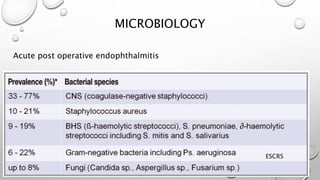
ESCRS
Acute post operative endophthalmitis
MICROBIOLOGY
MICROBIOLOGY
ANTI MICROBIALS
• Emperical treatment
• Intravitreal antimicrobials:
•
For presumed bacterial cases (in separate syringes):
• – vancomycin 1 mg/0.1 ml (for coverage of gram- positive organisms)
• – ceftazidime 2.25 mg/0.1 ml (for coverage of gram- negative organisms)
• For presumed fungal cases:
– amphotericin B 0.005 mg/0.1 ml – voriconazole 0.1 mg/0.2 ml
• – amikacin 200microg may be substituted for ceftazidime.
• – Ceftriaxone (2 mg/0.1 ml) may be substituted for ceftazidime if more
ANTI MICROBIALS
• Systemic antimicrobials:
• for endogenous fungal endophthalmitis
• Voriconazole 200 mg PO bid for 2–4 weeks
• Fluconazole 200 mg PO bid for 2–4 weeks
• Itraconazole 200 mg PO bid for 2–4 weeks
• Ketoconazole 200 mg PO bid for 2–4 weeks
• Amphotericin B 0.25–1.0 mg/kg IV every 6 hours as tolerated
• For endogenous bacterial endophthalmitis
• Vancomycin 1 g IV bid plus ceftazidime 1 g IV bid systemic
fluoroquinolones for susceptible organisms
ANTI MICROBIALS
• Topical antimicrobials:
• Antibiotic topical therapy:
• Fortified vancomycin: 25 mg/ml (2.5%) or 50 mg/ ml (5%)
• Fortified ceftazidime: 50 mg/ml (5%)
• Fortified cefazolin: 50 mg/ml (5%)
• Fortified gentamicin: 14 mg/ml (1.4%)
• Fortified tobramycin: 14 mg/ml (1.4%)
• Fortified amikacin: 8 mg/ml (2.5%)
• Fortified linezolid: 2 mg/ml (0.2%)
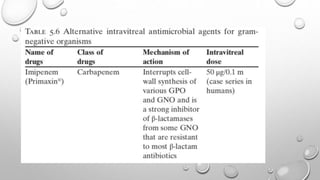
• Fortified imipenem–cilastin: 10 mg/ml (1%)
• Antifungals eye drops:
fortified amphotericin b: 1.5 mg/ml (0.15%)
• Fortified voriconazole: 10 mg/ml (1%)
ADVERSE EFFECTS OF ANTIMICROBIALS
• Adverse effects of intravitreal antimicrobials
• Intravitreal aminoglycoside—risk of macular infarction
• Intravitreal vancomycin—hemorrhagic occlusive retinal
vasculitis
• Intravitreal amphotericin b—risk of retinal damage
• Intravitreal fluoroquinolones—risk of retinal/systemic
toxicity
MACULAR INFARCTION
HORV
ANTIMICROBIAL RESISTANCE AND
ALTERNATIVES
• Emergence of resistance to commonly used antimicrobial agents
is a great challenge in health care.
• The overuse of antibiotics in hospitals and outpatient clinics,
widespread agricultural use of antibiotics, and intrinsic genetic
factors may all contribute to increasing anti- microbial
resistance.
PREVENTION
• Common sources of infection in postoperative endophthalmitis
1. The patient’s own ocular surface flora .Ca majority of contaminants
during, and even after, surgery can be traced to the patient’s own ocular
surface flora.
- The self-administration of topical antibiotic drops in the early postoperative
period and the patient’s personal habits also play a role during this critical
period of wound healing.
2. Infection stemming from contaminated surgical instruments, tubing or the
surgical environment, where occasional clusters of infection suggest a local
epidemic.
COMMON SOURCE OF INFECTION
3. Surgical complications-
• A known risk factor for endophthalmitis
• Although the internal eye is protected to some degree by ocular barriers
that confer an “immune privilege,” if compromised (e.G. By an intra-
operative capsular defect with vitreous loss)
• The risk of endophthalmitis may increase by as much as 10-fold or more.
4. Poor or delayed wound healing.
- An influx of ocular surface tears may occur postoperatively, allowing
access of surface flora to the internal eye.
ENDOPHTHALMITIS PROPHYLAXIS
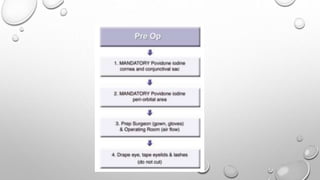
• Antisepsis
• This is the prevention of infection by inhibiting or arresting the growth and
multiplication of germs (infectious agents) which is usually achieved by povidone-
iodine, hydrogen per- oxide, chlorhexidine, or polyhexanide application on the
skin.
ANTISEPSIS
• Povidone-iodine is a low- cost antiseptic agent with no antibiotic resistance
and is rapidly bactericidal and used worldwide.
• 5% povidone-iodine leads to significant reduction in bacterial colonies, and
exposure of 30 seconds appeared to be an adequate time to decrease
conjunctival bacterial counts.
• Chlorhexidine gluconate is a bisguanide germicide available for
preoperative antisepsis.
- Concentrations of 0.1–4% to be highly active against a variety of gram-
positive and gram- negative bacterial pathogens as noted in in vitro
experiments.
OPERATING THEATRE
• Air flow design
• Airflow systems should be equipped with the proper
filters (hepa) and undergo regular maintenance.
• The operating theatres should be under positive pressure, with doors
remaining closed except for transfers.
• Aerobiology data suggest that a hospital operating theatre should have a
minimum of 20 air changes per hour in order to reduce airborne bacterial
counts.
• Ultra-clean air for hip surgery shows that a fast laminar flow of air in the
operating theatre can remove airborne bacteria within seconds, rather than
the minutes required with traditional airflow systems that change air at 20
changes per hour.
EQUIPMENT – STERILISATION AND SINGLE-
USE
• All instruments for surgery should be sterile.
• Limitation to single-use is even more important, as incidents have occurred
where instruments were not washed properly prior to sterilisation, which may
itself also have been faulty.
• Single-use of tubing and other equipment that becomes wet during the
operative procedure is always preferable, if cost allows.
• Tubing is not easily sterilised in an effective manner unless an ethylene oxide
gas steriliser is available.
• Bottles of solution, such as bss (balanced salt solution), should never be kept
or used for more than one operating session.
TOPICAL ANTIBIOTICS
• Topical antibiotics are utilized for endophthalmitis prophylaxis in two
settings:
• Preoperative topical antibiotics
• Postoperative topical antibiotics
• The optimal timing and frequency of topical antibiotic prophylaxis as per
this review has been the subject of debate.
• According to the european society of cataract & refractive surgeons (escrs)
guidelines -the preoperative use of topical antibiotics is not justified when
intracameral antibiotics are used.
• Generally, preoperative and postoperative topical antibiotics are more
commonly used for prophylaxis in the united states.
INTRACAMERAL ANTIBIOTICS
• Vancomycin, a glycopeptide antibiotic, is usually effective against most gram-positive
organisms (streptococcus, staphylococcus, and bacillus species).
• Vancomycin is asso- ciated with hemorrhagic occlusive retinal vasculitis (horv).
• Cefuroxime is a second-generation cephalosporin antibiotic and has broad spectrum
activity against the betalactamase positive pathogens.
• It is effective against various organisms, such as staphylococcus aureus, streptococcus
pneumoniae, haemophilus influenzae, e. Coli, N. Gonorrhea, and many others.
• A prepackaged formulation indicated for intracameral use (aprokam, thea pharmaceuticals,
clermont-ferrand, france) is unavailable in many nations, including the united states, india,
and japan.
• This has been associated with risks of dilution error, and infection during reconstitution.
INTRACAMERAL ANTIBIOTICS
• Moxifloxacin is a fourth-generation synthetic fluoroquinolone.
• This is increasingly used as the drug is readily available.
• It is active against a broad spectrum of bacteria including staphylococcus
aureus, staphylococcus epidermi- dis, streptococcus pneumoniae,
haemophilus influenzae. Klebsiella spp., Moraxella catarrhalis, enterobacter
spp., Mycobacterium spp., Bacillus anthracis,
INTRACAMERAL ANTIBIOTICS
CONCLUSION
• Post operative endophthalmitis is a devastating complication of
intraocular surgery
• Every effort should be made to prevent its occurrence
• Thorough pre op assessment and preparation is mandatory
• Standard guidelines must be followed for sterilization of
instruments and operating theatre environment
• Early diagnosis and treatment is of utmost importance
TAKE HOME MESSAGE
Prevention of endophthalmitis is much cheaper than its management
THANK YOU

New endophthalmitis

  • 1.
    ENDOPHTHALMITIS DR. ANURAAG SINGH VRFELLOW, SBSSEH AMRITSAR
  • 2.
    DEFINITION • Endophthalmitis isan inflammatory condition of the eye, presumed to be due to an infectious process from bacteria, fungi or, on rare occasions, parasites that enter the eye during the perioperative period. • Other forms of endophthalmitis may arise from endogenous sources where septicaemia spreads to the internal eye, or from perforating injury to the eye from objects or organic matter.
  • 3.
    PATHOPHYSIOLOGY • The severityand clinical course of postoperative endophthalmitis is related to the virulence and inoculum of infecting bacteria, as well as time to diagnosis and the patient’s immune status. • Initial incubation phase which may be clinically unapparent (16-18 hours) ,bacteria proliferate and break down the blood aqueous barrier. • This is followed by fibrin exudation and cellular infiltration by neutrophilic granulocytes. The incubation phase varies with the generation time of the infecting microbe, (eg: up to 10 minutes for S. Aureus and ps. Aeruginosa; over 5 hours for propionibacterium spp.)
  • 4.
    PATHOPHYSIOLOGY • Along withother factors such as production of bacterial toxins. With common microorganisms such as S. Epidermidis (CNS) as much as 3 days may lapse before the infiltration reaches its peak. An acceleration phase and, finally, a destructive phase of the infection develops. • By 3 days pathogen- specific antibodies can be detected; these help to eliminate microbes through opsonisation and phagocytosis within about 10 days. • Consequently, laboratory results may prove negative while severe inflammation is occurring within the eye
  • 5.
    CLASSIFICATION AND MOSTFREQUENTLY REPORTED ORGANISMS • Postoperative endophthalmitis • (a) following cataract surgery: • Acute-onset postoperative endophthalmitis Coagulase (−) staphylococci, staphylococcus aureus, streptococcus, gram- negative bacteria • Delayed-onset postoperative endophthalmitis P. Acnes, coagulase (−) staphylococci, fungi • (c) Following glaucoma surgery: Streptococcus species, haemophilus influenzae, staphylococcus species • (D) following elective corneal transplant
  • 6.
    • Posttraumatic endophthalmitis (bacillusspecies (30–40%), staphylococcus species ) • Endogenous endophthalmitis (candida species, staphylococcus aureus, gram-negative bacteria) • Endophthalmitis associated with keratitis (pseudomonas, staphylococcus species ) • 5. Endophthalmitis associated with intravitreal injections (staphylococcus/streptococcus species ) Classification and Most Frequently Reported Organisms
  • 7.
  • 8.
    DIAGNOSIS AND MANAGEMENT •The diagnosis of endophthalmitis can be made based on clinical examination findings. The patient may present with gradual or sudden onset of symptoms. • Lid swelling • Pain • Redness • Discharge • Decrease in the vision
  • 9.
    DIAGNOSIS OF ENDOPHTHALMITIS •Slit-lamp examination may show • Lid swelling • Conjunctival congestion • Chemosis • Corneal edema • Epithelial defect • Corneal infiltrate • Hypopyon • Fibrin membrane in the anterior chamber • Plaque inside the capsular bag • Loss of fundus red reflex • Infiltrates in the vitreous cavity
  • 10.
  • 11.
    DIFFERENTIAL DIAGNOSIS (a) Toxicanterior segment syndrome (TASS) (b) Retained lens material (c) Flare-up of preexisting uveitis (d) Chronic vitreous hemorrhage (e) Retinoblastoma (in children) (f) Retained triamcinolone acetonide (h) Pseudoendophthalmitis from intravitreal injections
  • 12.
    DIFFERENTIAL DIAGNOSIS OF ENDOPHTHALMITIS •Endophthalmitis is a clinical diagnosis, confirmed with subsequent laboratory testing. Endophthalmitis must be distinguished from noninfectious inflammation as well as noninflammatory cellular infiltration, including hemorrhage and tumor cells. • Endophthalmitis with negative intraocular cultures is relatively common, reported in the range of about 20% following intraocular surgery and up to 50% following intravitreal injection. • It is important to consider the various conditions which may mimic as infectious endophthalmitis.
  • 13.
    Ronge LJ. Toxicanterior segment syndrome: why sterile isn’t clean enough. EyeNet. 2002:17–
  • 14.
    RETAINED LENS FRAGMENTS •Patients with retained lens fragments after cataract surgery may develop marked intraocular inflammation with hypopyon in the absence of infection. • However, concomitant endophthalmitis also may be present and it is important to make the correct diagnosis. David Irvine W, Flynn HW, Murray TG, Rubsamen PE. Retained lens fragments after phacoemulsification manifesting as marked intraocular inflammation with hypopyon. Am J
  • 15.
    RETAINED LENS FRAGMENTS •B scan is a useful tool in evaluating eyes with dense vitritis after cataract extraction when retained lens material is suspected. • Lens material typically appears as reflective, mobile material in the vitreous cavity. • Lens material may be involved with extensive epiretinal inflammatory membranes
  • 16.
    FLARE-UP OF PRE-EXISTINGUVEITIS • Patients with pre-existing uveitis may have exacerbation of their uveitis after cataract surgery and may mimic endophthalmitis. • Diagnosis, control of inflammation, preoperative management, particularities of the surgical techniques, and postoperative complications in patients with a history of uveitis are essential to good vision. • Inflammation should be controlled in patients with pre-existing uveitis before proceeding with elective intraocular surgery.
  • 17.
    FLARE-UP OF PRE-EXISTINGUVEITIS Berrocal A, Davis J. Uveitis following intraocular surgery. Ophthalmol Clin N Am.
  • 18.
    VITREOUS HEMORRHAGE • Chroniclong-standing vitreous hemorrhage may have an appearance similar to endophthalmitis when the hemorrhage becomes white-gray color after degenerative changes in the hemoglobin content. • These clinical features can mimic as endophthalmitis, but the relatively quiet eye can help in excluding endophthalmitis. • Perivasculitis and intraretinal hemorrhage may be early signs of endophthalmitis. Nguyen JK, Fung AE, Flynn HW, Jr., Scott IU. Hypopyon and pseudoendophthalmitis associ- ated with chronic vitreous hemorrhage. Ophthalmic Surg Lasers Imaging.
  • 19.
    RETINOBLASTOMA • • In children,retinoblastoma may mimic endophthalmitis. • It is important to differentiate between endophthalmitis (pseudo-retinoblastoma) and retinoblastoma as the management is entirely different for the two entities. • Endophthalmitis usually has prominent inflammation of anterior segment, hypopyon, or synechiae formation. • Ultrasonography and ct scan are useful investigations Raina UK, Tuli D, Arora R, Mehta DK, Taneja M. Tubercular endophthalmitis simulating retinoblastoma. Am J Ophthalmol. 2000;130(6):843–5.
  • 20.
    RETAINED TRIAMCINOLONE ACETONIDE •Retained triamcinolone may present with deposits in the anterior chamber also known as pseudoendophthalmitis. • These sterile postinjection inflammatory responses are due to the migration of medication to the anterior chamber. • Rarely “true endophthalmitis” can occur after triamcinolone intravitreal injection. Roth DB, Flynn HW, Jr. Distinguishing between infectious and noninfectious endophthalmitis after intravitreal triamcinolone injection. Am J
  • 21.
    PSEUDOENDOPHTHALMITIS FROM INTRAVITREAL INJECTIONS •A cluster of injection-related sterile intraocular inflammation was reported within the first 3 months after approval of aflibercept (eylea; regeneron, inc., Tarrytown, NY) by the US food and drug administration on november 18, 2011. • In 2015, kim et al. Reported sterile inflammation after intravitreal injection of aflibercept in a korean population. • Four cases of postinjection sterile inflammation were identified from 723 aflibercept injections in 233 patients. • Patients presented 1–13 days after intravitreal aflibercept injection (mean, 5 days). • Sterile inflammation after intravitreal aflibercept injection in this case series typically presented without pain, and the visual outcomes were generally favorable.
  • 22.
    Kim JY, YouYS, Kwon OW, Kim SH. Sterile inflam- mation after intravitreal injection of aflibercept in a Korean population. Korean J Ophthalmol. 2015;29(5):325-30.
  • 23.
    MICROBIOLOGY • Treatment ofendophthalmitis includes obtaining a vitreous sample for cultures and injection of intravitreal antimicrobials. • By obtaining vitreous sample and using it to identify the causative microorganisms, further management of the patient can be planned after the initial empiric treatment.
  • 24.
    EMPIRCAL TREATMENT • Intravitrealantimicrobial injection • Once the vitreous sample is obtained, empiric antimicrobials are injected intravitreally. • The selection of antimicrobial agents is important, and the decision should be based on the type of endophthalmitis and suspected microbiological profile. • For presumed bacterial cases: • Intravitreal vancomycin and ceftazidime via separate syringes and intravitreal dexamethasone can be considered. • For presumed fungal cases: intravitreal amphotericin b or voriconazole without intravitreal steroids.
  • 25.
    RESULTS OF ACTAP VS VITREOUS TAP • Microbiologic diagnosis of endophthalmitis is made based on the identification of organisms from samples obtained from either anterior chamber fluid or vitreous. Stains for smears Gram stain - Gram-positive organisms versus gram-negative organisms Acid fast stains - For Mycobacteria Calcofluor white Fluorescent stain (fungi, microsporidia, and Acanthamoeba)
  • 26.
    MICROBIOLOGY • Culture medias •Chocolate agar – - Used as an enriched medium for the recovery of fastidious organisms (i.E., Neisseria gonorrhoeae and haemophilus influenzae) - Also, is used as a general-purpose medium for the recovery of bacteria, yeasts, and molds from aqueous and vitreous fluids • 5% sheep blood agar – - A general-purpose medium for recovery of the most common bacterial and fungal endophthalmitis isolates • Thioglycollate broth – - an all-purpose, enriched medium for the recovery of low numbers of aerobic or anaerobic (including P. Acnes) organisms form ocular fluids and tissues
  • 27.
    MICROBIOLOGY • Anaerobic bloodagar – - An all-purpose medium for the recovery of both anaerobic and facultative anaerobic organisms - Should be included for all chronic endophthalmitis or where P. Acnes is suspected • Sabouraud agar – - A selective medium used to promote the growth of fungi (yeasts and molds) • Lowenstein- jensen medium - A selective medium for the recovery of acid- fast organisms (mycobacteria, nocardia) from aqueous and vitreous fluids
  • 28.
  • 29.
  • 30.
  • 31.
    ANTI MICROBIALS • Empericaltreatment • Intravitreal antimicrobials: • For presumed bacterial cases (in separate syringes): • – vancomycin 1 mg/0.1 ml (for coverage of gram- positive organisms) • – ceftazidime 2.25 mg/0.1 ml (for coverage of gram- negative organisms) • For presumed fungal cases: – amphotericin B 0.005 mg/0.1 ml – voriconazole 0.1 mg/0.2 ml • – amikacin 200microg may be substituted for ceftazidime. • – Ceftriaxone (2 mg/0.1 ml) may be substituted for ceftazidime if more
  • 32.
    ANTI MICROBIALS • Systemicantimicrobials: • for endogenous fungal endophthalmitis • Voriconazole 200 mg PO bid for 2–4 weeks • Fluconazole 200 mg PO bid for 2–4 weeks • Itraconazole 200 mg PO bid for 2–4 weeks • Ketoconazole 200 mg PO bid for 2–4 weeks • Amphotericin B 0.25–1.0 mg/kg IV every 6 hours as tolerated • For endogenous bacterial endophthalmitis • Vancomycin 1 g IV bid plus ceftazidime 1 g IV bid systemic fluoroquinolones for susceptible organisms
  • 33.
    ANTI MICROBIALS • Topicalantimicrobials: • Antibiotic topical therapy: • Fortified vancomycin: 25 mg/ml (2.5%) or 50 mg/ ml (5%) • Fortified ceftazidime: 50 mg/ml (5%) • Fortified cefazolin: 50 mg/ml (5%) • Fortified gentamicin: 14 mg/ml (1.4%) • Fortified tobramycin: 14 mg/ml (1.4%) • Fortified amikacin: 8 mg/ml (2.5%) • Fortified linezolid: 2 mg/ml (0.2%) • Fortified imipenem–cilastin: 10 mg/ml (1%) • Antifungals eye drops: fortified amphotericin b: 1.5 mg/ml (0.15%) • Fortified voriconazole: 10 mg/ml (1%)
  • 34.
    ADVERSE EFFECTS OFANTIMICROBIALS • Adverse effects of intravitreal antimicrobials • Intravitreal aminoglycoside—risk of macular infarction • Intravitreal vancomycin—hemorrhagic occlusive retinal vasculitis • Intravitreal amphotericin b—risk of retinal damage • Intravitreal fluoroquinolones—risk of retinal/systemic toxicity
  • 35.
  • 36.
  • 37.
    ANTIMICROBIAL RESISTANCE AND ALTERNATIVES •Emergence of resistance to commonly used antimicrobial agents is a great challenge in health care. • The overuse of antibiotics in hospitals and outpatient clinics, widespread agricultural use of antibiotics, and intrinsic genetic factors may all contribute to increasing anti- microbial resistance.
  • 46.
    PREVENTION • Common sourcesof infection in postoperative endophthalmitis 1. The patient’s own ocular surface flora .Ca majority of contaminants during, and even after, surgery can be traced to the patient’s own ocular surface flora. - The self-administration of topical antibiotic drops in the early postoperative period and the patient’s personal habits also play a role during this critical period of wound healing. 2. Infection stemming from contaminated surgical instruments, tubing or the surgical environment, where occasional clusters of infection suggest a local epidemic.
  • 47.
    COMMON SOURCE OFINFECTION 3. Surgical complications- • A known risk factor for endophthalmitis • Although the internal eye is protected to some degree by ocular barriers that confer an “immune privilege,” if compromised (e.G. By an intra- operative capsular defect with vitreous loss) • The risk of endophthalmitis may increase by as much as 10-fold or more. 4. Poor or delayed wound healing. - An influx of ocular surface tears may occur postoperatively, allowing access of surface flora to the internal eye.
  • 48.
    ENDOPHTHALMITIS PROPHYLAXIS • Antisepsis •This is the prevention of infection by inhibiting or arresting the growth and multiplication of germs (infectious agents) which is usually achieved by povidone- iodine, hydrogen per- oxide, chlorhexidine, or polyhexanide application on the skin.
  • 49.
    ANTISEPSIS • Povidone-iodine isa low- cost antiseptic agent with no antibiotic resistance and is rapidly bactericidal and used worldwide. • 5% povidone-iodine leads to significant reduction in bacterial colonies, and exposure of 30 seconds appeared to be an adequate time to decrease conjunctival bacterial counts. • Chlorhexidine gluconate is a bisguanide germicide available for preoperative antisepsis. - Concentrations of 0.1–4% to be highly active against a variety of gram- positive and gram- negative bacterial pathogens as noted in in vitro experiments.
  • 51.
    OPERATING THEATRE • Airflow design • Airflow systems should be equipped with the proper filters (hepa) and undergo regular maintenance. • The operating theatres should be under positive pressure, with doors remaining closed except for transfers. • Aerobiology data suggest that a hospital operating theatre should have a minimum of 20 air changes per hour in order to reduce airborne bacterial counts. • Ultra-clean air for hip surgery shows that a fast laminar flow of air in the operating theatre can remove airborne bacteria within seconds, rather than the minutes required with traditional airflow systems that change air at 20 changes per hour.
  • 52.
    EQUIPMENT – STERILISATIONAND SINGLE- USE • All instruments for surgery should be sterile. • Limitation to single-use is even more important, as incidents have occurred where instruments were not washed properly prior to sterilisation, which may itself also have been faulty. • Single-use of tubing and other equipment that becomes wet during the operative procedure is always preferable, if cost allows. • Tubing is not easily sterilised in an effective manner unless an ethylene oxide gas steriliser is available. • Bottles of solution, such as bss (balanced salt solution), should never be kept or used for more than one operating session.
  • 53.
    TOPICAL ANTIBIOTICS • Topicalantibiotics are utilized for endophthalmitis prophylaxis in two settings: • Preoperative topical antibiotics • Postoperative topical antibiotics • The optimal timing and frequency of topical antibiotic prophylaxis as per this review has been the subject of debate. • According to the european society of cataract & refractive surgeons (escrs) guidelines -the preoperative use of topical antibiotics is not justified when intracameral antibiotics are used. • Generally, preoperative and postoperative topical antibiotics are more commonly used for prophylaxis in the united states.
  • 54.
    INTRACAMERAL ANTIBIOTICS • Vancomycin,a glycopeptide antibiotic, is usually effective against most gram-positive organisms (streptococcus, staphylococcus, and bacillus species). • Vancomycin is asso- ciated with hemorrhagic occlusive retinal vasculitis (horv). • Cefuroxime is a second-generation cephalosporin antibiotic and has broad spectrum activity against the betalactamase positive pathogens. • It is effective against various organisms, such as staphylococcus aureus, streptococcus pneumoniae, haemophilus influenzae, e. Coli, N. Gonorrhea, and many others. • A prepackaged formulation indicated for intracameral use (aprokam, thea pharmaceuticals, clermont-ferrand, france) is unavailable in many nations, including the united states, india, and japan. • This has been associated with risks of dilution error, and infection during reconstitution.
  • 55.
    INTRACAMERAL ANTIBIOTICS • Moxifloxacinis a fourth-generation synthetic fluoroquinolone. • This is increasingly used as the drug is readily available. • It is active against a broad spectrum of bacteria including staphylococcus aureus, staphylococcus epidermi- dis, streptococcus pneumoniae, haemophilus influenzae. Klebsiella spp., Moraxella catarrhalis, enterobacter spp., Mycobacterium spp., Bacillus anthracis,
  • 56.
  • 57.
    CONCLUSION • Post operativeendophthalmitis is a devastating complication of intraocular surgery • Every effort should be made to prevent its occurrence • Thorough pre op assessment and preparation is mandatory • Standard guidelines must be followed for sterilization of instruments and operating theatre environment • Early diagnosis and treatment is of utmost importance
  • 58.
    TAKE HOME MESSAGE Preventionof endophthalmitis is much cheaper than its management
  • 59.