by
BRIJESH BHARTI
(CIT-06/16)
Under the supervision of
Dr. Gausia Qazi
Department of Electronics & Communication Engineering
National Institute of Technology,
Srinagar
In optical fiber communication
112-12-2017 National Institute of Technology, Srinagar
OPTICAL CDMA system
Outline
• Introduction
• Find major challenges in OCDMA
• Method to overcome the challenges
• Simulation of OCDMA
• Application
2
Introduction
3
optical fiber communication use in very high speed data
transmission .to take full advantage of optical fiber
communication still we are working on the optical
communication for enhance the performance of entire
communication system .
Nowadays, we using optical CDMA system for multiple
user ,data send through the different advanced coding
scheme ,for particular user ,on the optical channel ,
Find challenges in OCDMA
• The major challenge in OCDMA system
• BER
• OCDMA MAI
• Components cost and complexity
• Signal loss in fiber cable
• Attenuation and dispersion
Our focus on only BER and MAI, because is major challenge in OCDMA [1]
4
Method to overcome the challenges
• Using spectral amplitude coding (SAC)[1]
• Spectral phase coding (SPC).[2]
• Based on fiber Bragg grating (FBG)encoder /decoder[3]
our focus on only FBG encoder /decoder , because it overcome the BER issue in
OCDMA system
Simulation of OCDMA in OPTISYSTEM 15
5
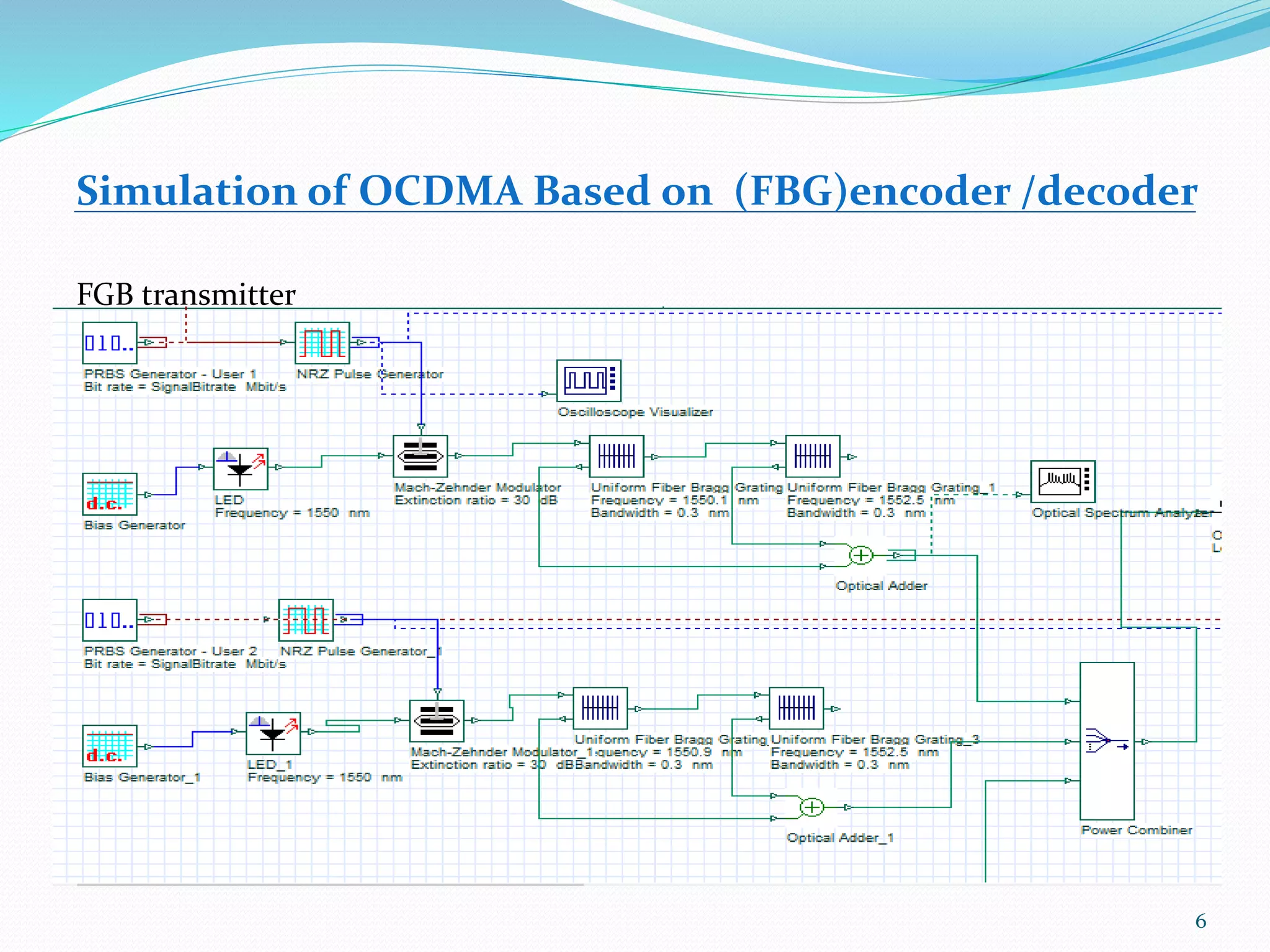
FGB transmitter
6
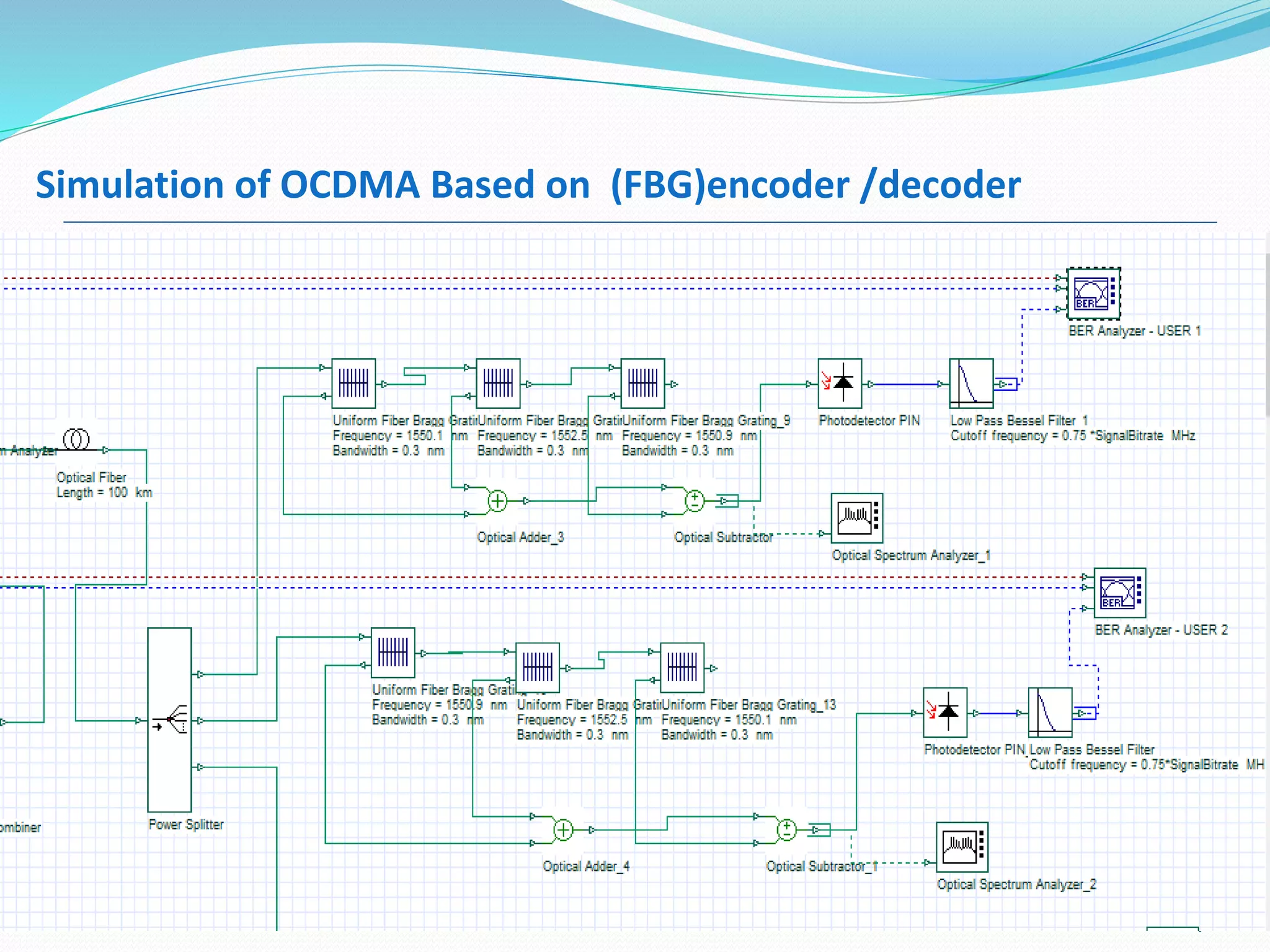
Simulation of OCDMA Based on (FBG)encoder /decoder
FBG receiver
7
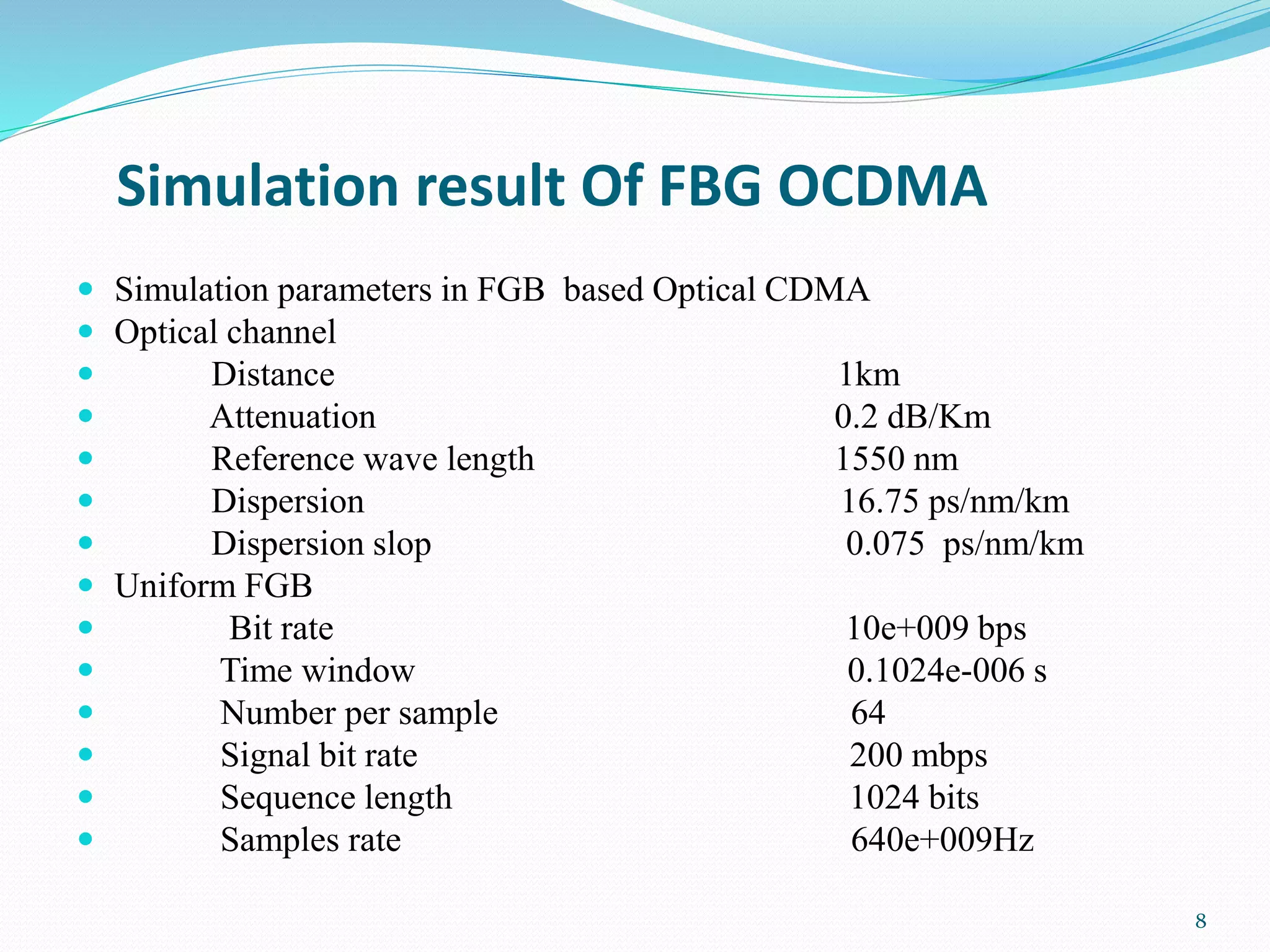
Simulation result Of FBG OCDMA
 Simulation parameters in FGB based Optical CDMA
 Optical channel
 Distance 1km
 Attenuation 0.2 dB/Km
 Reference wave length 1550 nm
 Dispersion 16.75 ps/nm/km
 Dispersion slop 0.075 ps/nm/km
 Uniform FGB
 Bit rate 10e+009 bps
 Time window 0.1024e-006 s
 Number per sample 64
 Signal bit rate 200 mbps
 Sequence length 1024 bits
 Samples rate 640e+009Hz
8
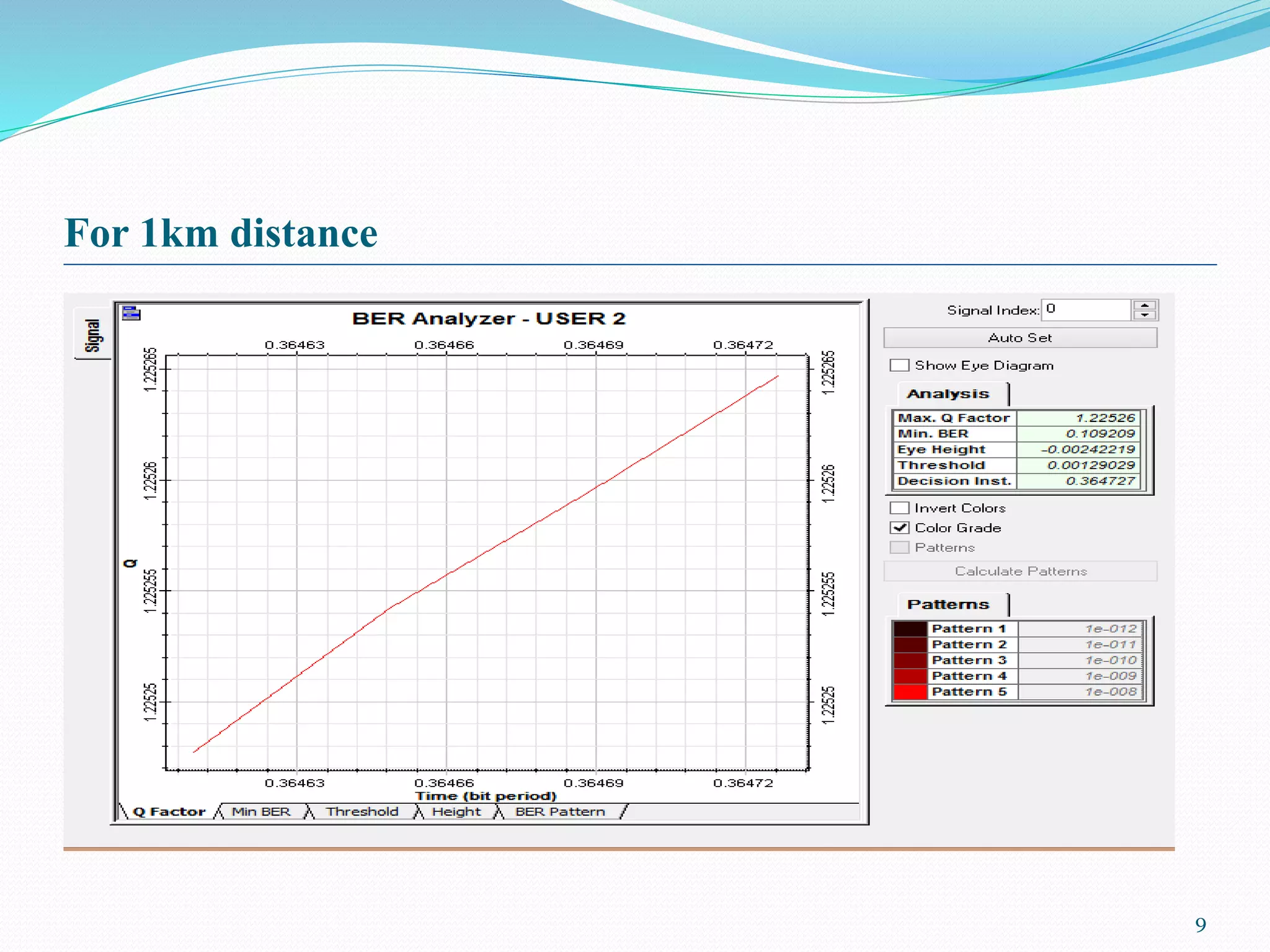
For 1km distance
9
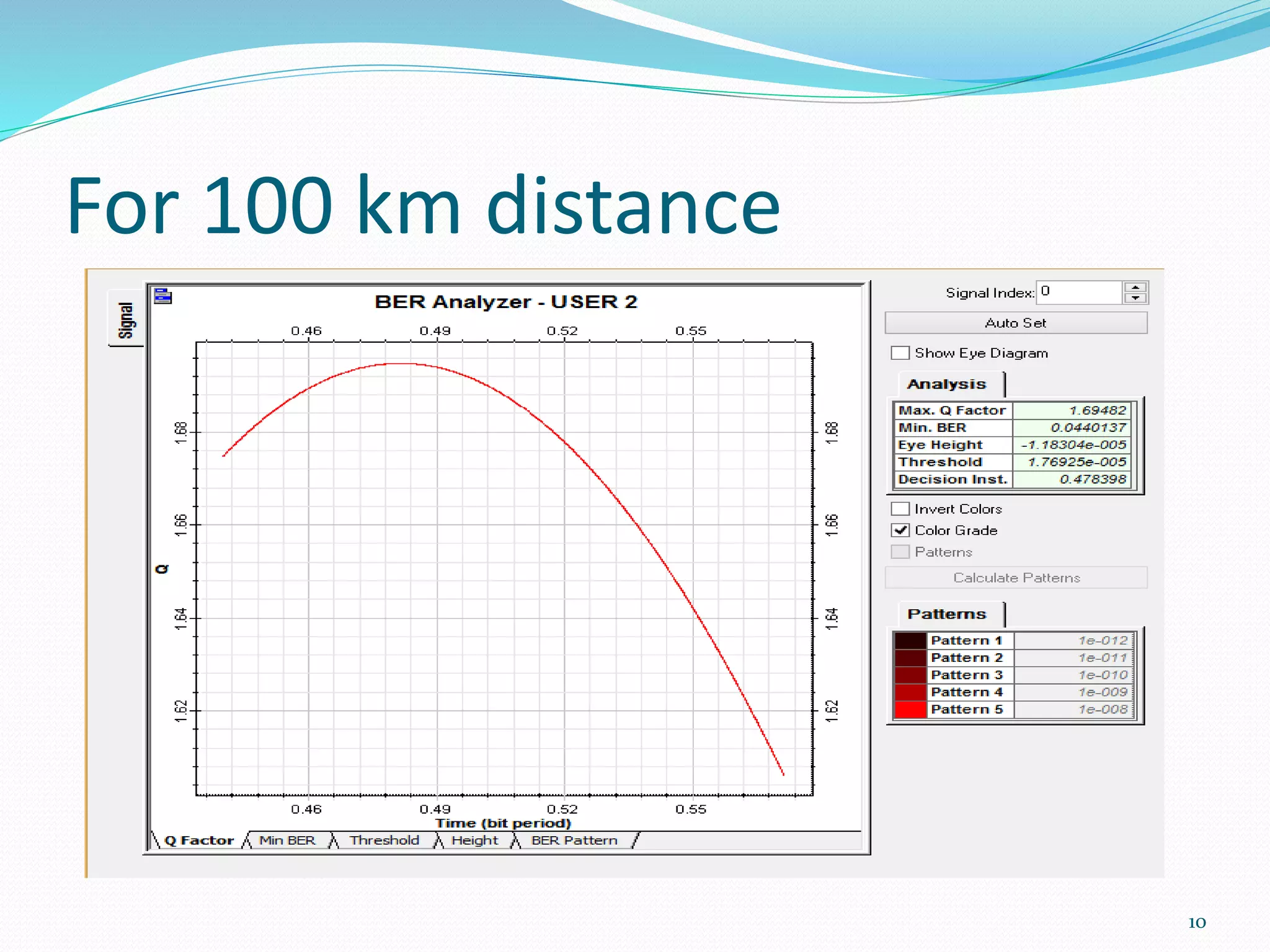
For 100 km distance
10
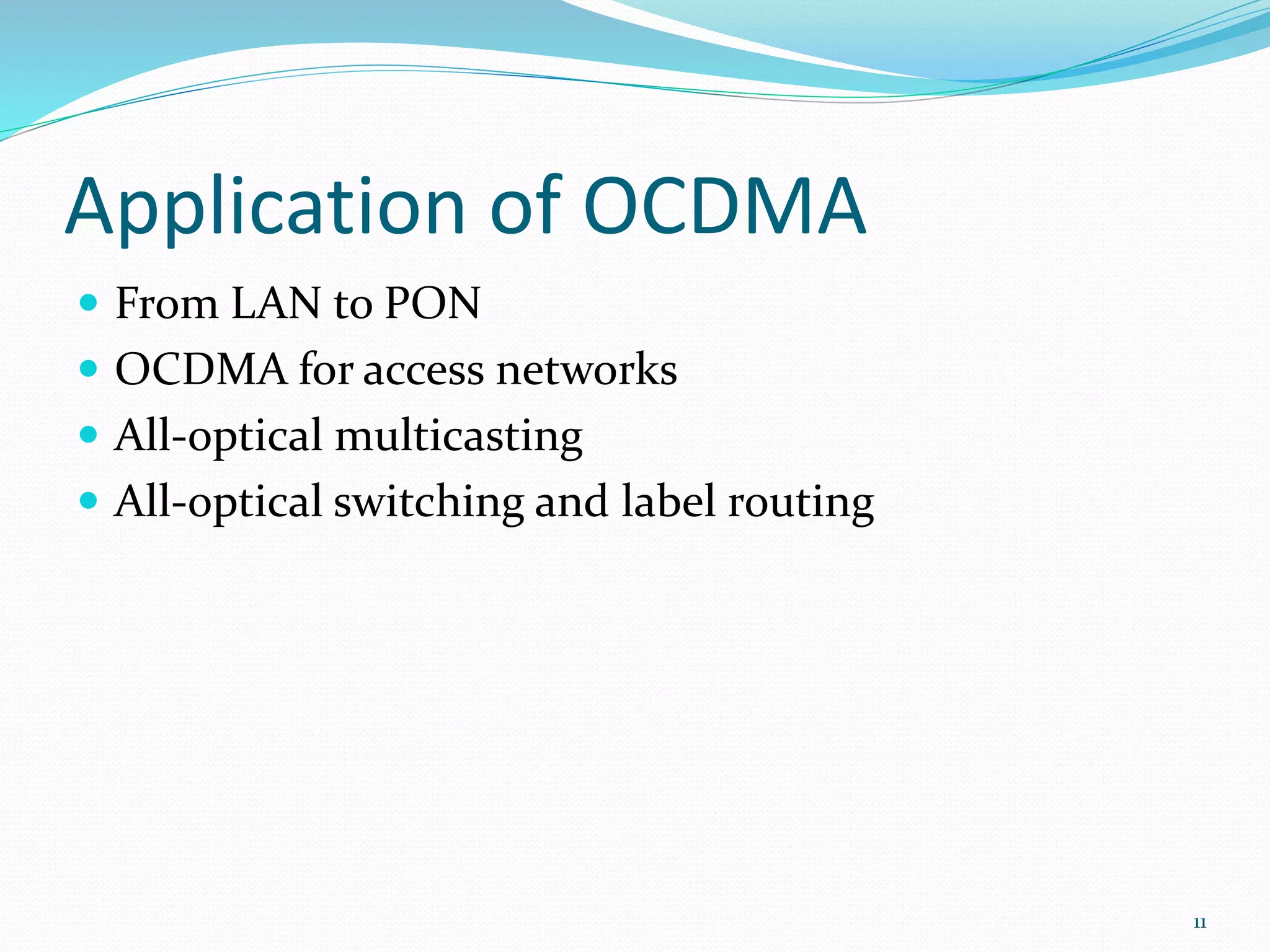
Application of OCDMA
 From LAN to PON
 OCDMA for access networks
 All-optical multicasting
 All-optical switching and label routing
11
Refrences
 [1] https://www.osapublishing.org/ao/abstract.cfm?URI=ao-47-9-1263.
 [2] 2015 11th International Conference on Innovations in Information
Technology (IIT)
Spectral Phase Coding based LR-PON
[3] Hooshang Ghafouri_Shiraz, M. Massoud Karbassian(auth.)-Optical CDMA
Networks_ Principles, Analysis and Applications-Wiley-IEEE Press (2012)
12
13
Thank You

OPTICAL CDMA system

  • 1.
    by BRIJESH BHARTI (CIT-06/16) Under thesupervision of Dr. Gausia Qazi Department of Electronics & Communication Engineering National Institute of Technology, Srinagar In optical fiber communication 112-12-2017 National Institute of Technology, Srinagar OPTICAL CDMA system
  • 2.
    Outline • Introduction • Findmajor challenges in OCDMA • Method to overcome the challenges • Simulation of OCDMA • Application 2
  • 3.
    Introduction 3 optical fiber communicationuse in very high speed data transmission .to take full advantage of optical fiber communication still we are working on the optical communication for enhance the performance of entire communication system . Nowadays, we using optical CDMA system for multiple user ,data send through the different advanced coding scheme ,for particular user ,on the optical channel ,
  • 4.
    Find challenges inOCDMA • The major challenge in OCDMA system • BER • OCDMA MAI • Components cost and complexity • Signal loss in fiber cable • Attenuation and dispersion Our focus on only BER and MAI, because is major challenge in OCDMA [1] 4
  • 5.
    Method to overcomethe challenges • Using spectral amplitude coding (SAC)[1] • Spectral phase coding (SPC).[2] • Based on fiber Bragg grating (FBG)encoder /decoder[3] our focus on only FBG encoder /decoder , because it overcome the BER issue in OCDMA system Simulation of OCDMA in OPTISYSTEM 15 5
  • 6.
    FGB transmitter 6 Simulation ofOCDMA Based on (FBG)encoder /decoder
  • 7.
    Simulation of OCDMABased on (FBG)encoder /decoder FBG receiver 7
  • 8.
    Simulation result OfFBG OCDMA  Simulation parameters in FGB based Optical CDMA  Optical channel  Distance 1km  Attenuation 0.2 dB/Km  Reference wave length 1550 nm  Dispersion 16.75 ps/nm/km  Dispersion slop 0.075 ps/nm/km  Uniform FGB  Bit rate 10e+009 bps  Time window 0.1024e-006 s  Number per sample 64  Signal bit rate 200 mbps  Sequence length 1024 bits  Samples rate 640e+009Hz 8
  • 9.
  • 10.
    For 100 kmdistance 10
  • 11.
    Application of OCDMA From LAN to PON  OCDMA for access networks  All-optical multicasting  All-optical switching and label routing 11
  • 12.
    Refrences  [1] https://www.osapublishing.org/ao/abstract.cfm?URI=ao-47-9-1263. [2] 2015 11th International Conference on Innovations in Information Technology (IIT) Spectral Phase Coding based LR-PON [3] Hooshang Ghafouri_Shiraz, M. Massoud Karbassian(auth.)-Optical CDMA Networks_ Principles, Analysis and Applications-Wiley-IEEE Press (2012) 12
  • 13.