OPIOID ANALGESICS
Presented By,
Bhavesh Vaghela,
INTRODUCTION
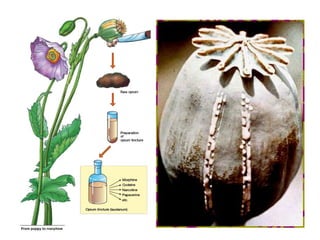
It is white latex (exudate) obtained by incision
of seed pod of Papaver Somniferum.
OPIUM
It is a drug that selectively relieves pain by
acting in CNS or on periferal pain mechanism
without significantly altering consciousness.
OPIOIDS
All opioid receptors are G-protein coupled receptors and inhibit
adenylate cyclase.
They also facilitate opening of potassium channels (causing
hyperpolarisation) and inhibit opening of calcium channels
(inhibiting transmitter release).
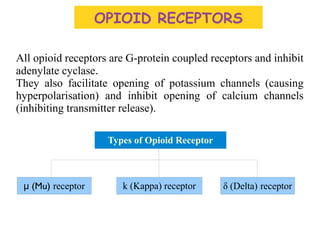
Types of Opioid Receptor
(Mu)μ receptor k (Kappa) receptor δ (Delta) receptor
OPIOID RECEPTORS
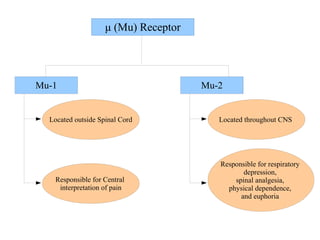
μ (Mu) Receptor
Mu-1 Mu-2
Located outside Spinal Cord
Responsible for Central
interpretation of pain
Located throughout CNS
Responsible for respiratory
depression,
spinal analgesia,
physical dependence,
and euphoria
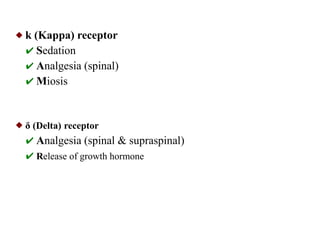
 k (Kappa) receptor
✔ Sedation
✔ Analgesia (spinal)
✔ Miosis
 δ (Delta) receptor
✔ Analgesia (spinal & supraspinal)
✔ Release of growth hormone
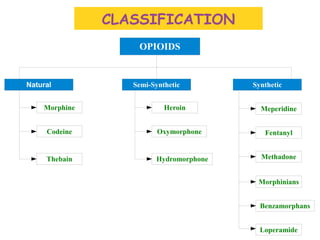
OPIOIDS
Natural Semi-Synthetic Synthetic
Morphine
Codeine
Thebain
Heroin
Oxymorphone
Hydromorphone
Meperidine
Methadone
Morphinians
Benzamorphans
Fentanyl
Loperamide
CLASSIFICATION
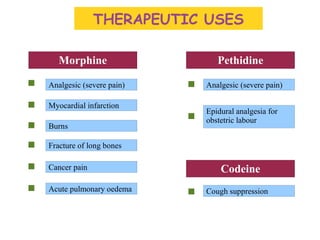
Morphine
Analgesic (severe pain)
Myocardial infarction
Burns
Fracture of long bones
Cancer pain
Acute pulmonary oedema
Pethidine
Analgesic (severe pain)
Epidural analgesia for
obstetric labour
Codeine
Cough suppression
THERAPEUTIC USES
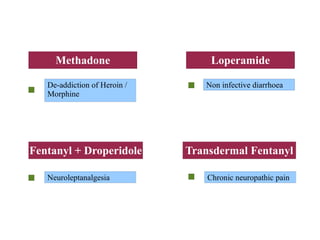
Methadone Loperamide
Non infective diarrhoeaDe-addiction of Heroin /
Morphine
Fentanyl + Droperidole
Neuroleptanalgesia
Transdermal Fentanyl
Chronic neuropathic pain
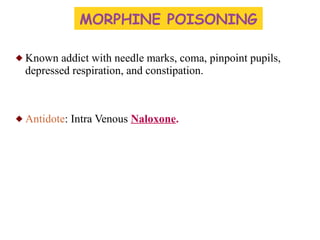
 Known addict with needle marks, coma, pinpoint pupils,
depressed respiration, and constipation.
 Antidote: Intra Venous Naloxone.
MORPHINE POISONING
Opioids

Opioids