PRESENTED BY -
VARSHA SONAWANE
M.PHARM (SEM-І)
DEPARTMENT OF PHARMACOLOGY
R.C.PATEL INSTITUTEOFPHARMACEUTICAL EDUCATION
ANDRESEARCH ,SHIRPUR.
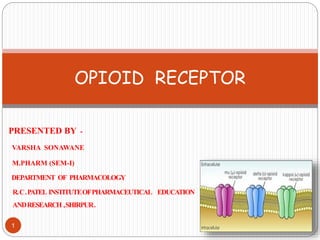
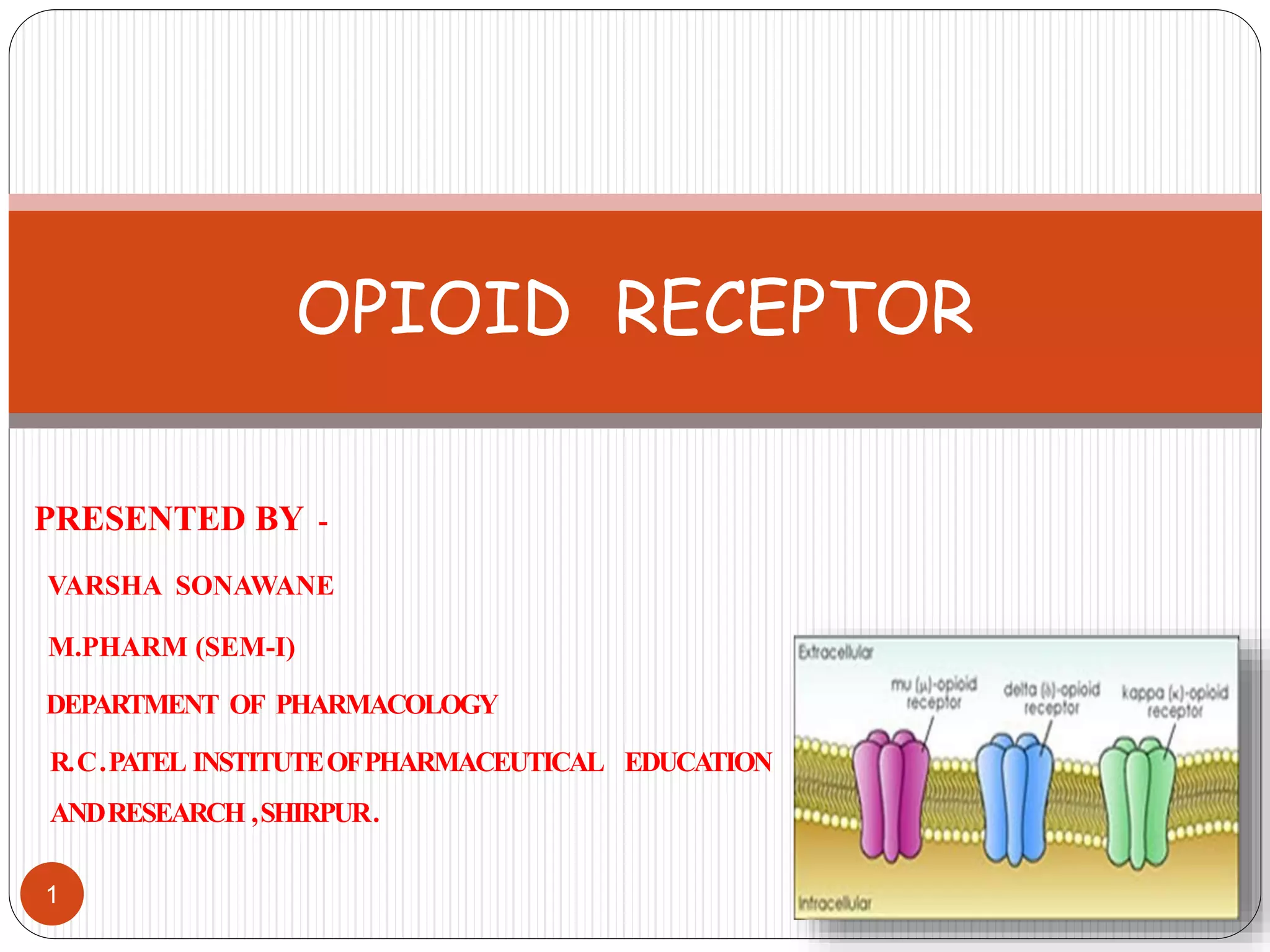
OPIOID RECEPTOR
1
CONTENTS
 History
 Introduction
 Structure,Classification, Receptor stimulators & Nomenclature
 Mechanism of action
 Pain pathway
 Distribution
 Side effects
 Recent advances
2
HISTORY Pain Physician
;2008
 The opium poppy was cultivated as early as 3400 BC in
Mesopotamia. Solomon Snyder and colleagues, first
identified opioid receptors in the brain in 1975.
 Acheson coin the term OPIOID.
 In 1960’s, T sou and Jang performed a pioneering work in
understanding the mechanism.
3
INTRODUCTION Tripathi K.D;2003
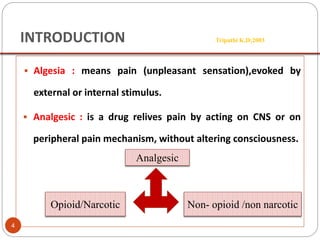
 Algesia : means pain (unpleasant sensation),evoked by
external or internal stimulus.
 Analgesic : is a drug relives pain by acting on CNS or on
peripheral pain mechanism, without altering consciousness.
Analgesic
Opioid/Narcotic Non- opioid /non narcotic
4
OPIATE
“Opiates are group of drug that are use to treating pain
 OPIATE ADDICTION
Opiates produce a sense of wellbeing. A high dose of opiate can
cause death from cardiac or respiratory arrest.
 OPIATE WITHDRAWAL SYNDROME INCLUDES:
Low energy, irritability , anxiety , insomnia , agitation , Runny
nose, teary eyes, Hot and cold sweat , goose bump’s , Yawning,
Muscle ache and pains Abdominal cramping , nausea ,vomiting ,
diarrhoea.
Dr Mahesh Trivedi;2007
5
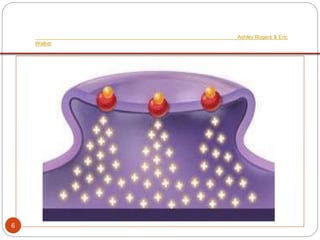
Ashley Rogers & Eric
Walker
6
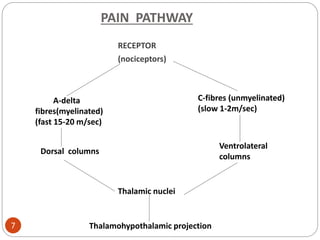
PAIN PATHWAY
RECEPTOR
(nociceptors)
7
A-delta
fibres(myelinated)
(fast 15-20 m/sec)
C-fibres (unmyelinated)
(slow 1-2m/sec)
Dorsal columns
Ventrolateral
columns
Thalamic nuclei
Thalamohypothalamic projection
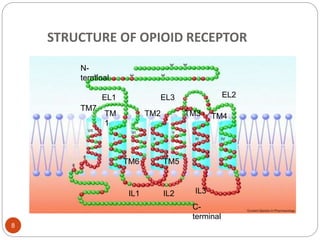
STRUCTURE OF OPIOID RECEPTOR
N-
terminal
C-
terminal
TM7
TM
1
TM2 TM3 TM4
TM5TM6
EL1 EL2EL3
IL1 IL2 IL3
8
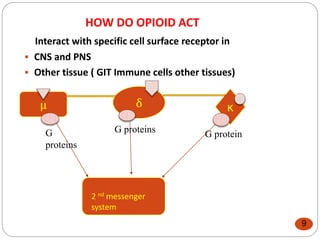
HOW DO OPIOID ACT
9
Interact with specific cell surface receptor in
 CNS and PNS
 Other tissue ( GIT Immune cells other tissues)
μ δ ĸ
2 nd messenger
system
G
proteins
G proteins G protein
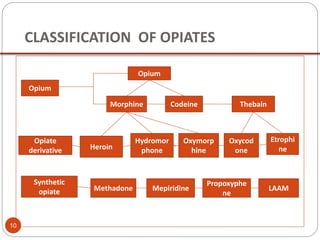
CLASSIFICATION OF OPIATES
Opium
Opium
Morphine Codeine Thebain
Opiate
derivative Heroin
Hydromor
phone
Oxymorp
hine
Oxycod
one
Etrophi
ne
Synthetic
opiate Methadone Mepiridine
Propoxyphe
ne
LAAM
10
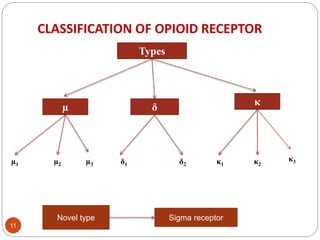
CLASSIFICATION OF OPIOID RECEPTOR
11
Types
µ δ
κ
µ1 µ2 µ3 δ1 δ2 κ1 κ2
κ3
Novel type Sigma receptor
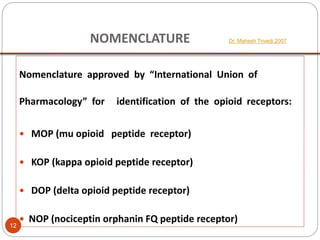
NOMENCLATURE Dr. Mahesh Trivedi,2007
Nomenclature approved by “International Union of
Pharmacology” for identification of the opioid receptors:
 MOP (mu opioid peptide receptor)
 KOP (kappa opioid peptide receptor)
 DOP (delta opioid peptide receptor)
 NOP (nociceptin orphanin FQ peptide receptor)
12
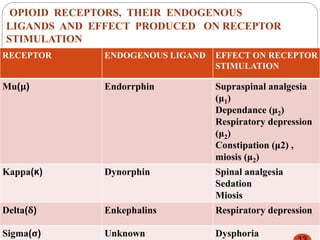
RECEPTOR ENDOGENOUS LIGAND EFFECT ON RECEPTOR
STIMULATION
Mu(μ) Endorrphin Supraspinal analgesia
(μ1)
Dependance (μ2)
Respiratory depression
(μ2)
Constipation (μ2) ,
miosis (μ2)
Kappa(ĸ) Dynorphin Spinal analgesia
Sedation
Miosis
Delta(δ) Enkephalins Respiratory depression
Sigma(σ) Unknown Dysphoria
OPIOID RECEPTORS, THEIR ENDOGENOUS
LIGANDS AND EFFECT PRODUCED ON RECEPTOR
STIMULATION
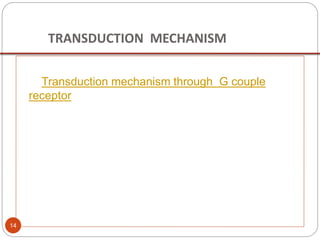
TRANSDUCTION MECHANISM
Transduction mechanism through G couple
receptor
14
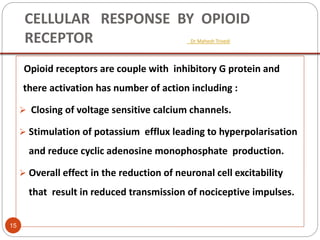
CELLULAR RESPONSE BY OPIOID
RECEPTOR Dr Mahesh Trivedi
Opioid receptors are couple with inhibitory G protein and
there activation has number of action including :
 Closing of voltage sensitive calcium channels.
 Stimulation of potassium efflux leading to hyperpolarisation
and reduce cyclic adenosine monophosphate production.
 Overall effect in the reduction of neuronal cell excitability
that result in reduced transmission of nociceptive impulses.
15
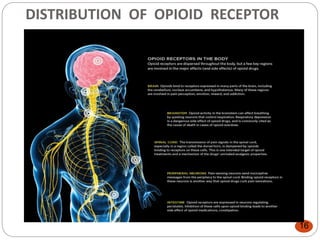
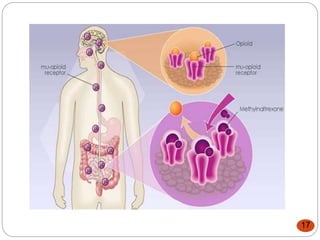
DISTRIBUTION OF OPIOID RECEPTOR
16
17
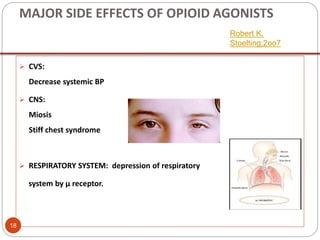
MAJOR SIDE EFFECTS OF OPIOID AGONISTS
 CVS:
Decrease systemic BP
 CNS:
Miosis
Stiff chest syndrome
 RESPIRATORY SYSTEM: depression of respiratory
system by μ receptor.
Robert K.
Stoelting;2oo7
18
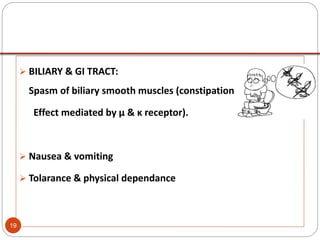
 BILIARY & GI TRACT:
Spasm of biliary smooth muscles (constipation
Effect mediated by μ & ĸ receptor).
 Nausea & vomiting
 Tolarance & physical dependance
19
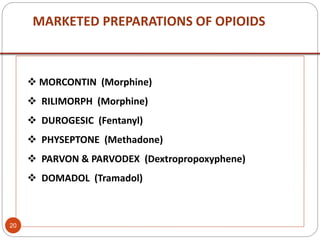
MARKETED PREPARATIONS OF OPIOIDS
 MORCONTIN (Morphine)
 RILIMORPH (Morphine)
 DUROGESIC (Fentanyl)
 PHYSEPTONE (Methadone)
 PARVON & PARVODEX (Dextropropoxyphene)
 DOMADOL (Tramadol)
20
ADVANCES IN RESEARCH ON OPIOID
RECEPTOR FUNCTION
 Opioid peptide receptors in the CNS represent the
peptidergic transmission system and are widely involved in
various pleiotropic functions
 They are essential for various physiological functions
including:
Yuan Feng,et al;2012
21
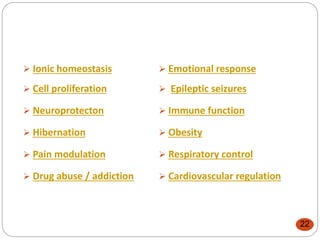
 Ionic homeostasis
 Cell proliferation
 Neuroprotecton
 Hibernation
 Pain modulation
 Drug abuse / addiction
 Emotional response
 Epileptic seizures
 Immune function
 Obesity
 Respiratory control
 Cardiovascular regulation
22
IONIC HOMEOSTASIS
overall effect of Ca 2+ on homeostasis is inhibitory but ,
some studies shows that opioid receptor activates Ca2+
channel.
23
CELL PROLIFERATION
 Opioid receptor affect cell proliferation.
 delta opioid receptor play important role in the neurogenesis
& neuroprotection.
 Some studies have shown that the OGF-OGFr system is
biological regulator of cell proliferation in some cancers
including ovarian cancer, hepatocellular cancer, and so on.
24
NUROPROTECTION
 The DOR neuroprotection involves the stabilization of
ionic homeostasis.
 Administration of MOR and KOR agonists (DAMGO
and 488H respectively) did not induce appreciable
neuroprotection.
25
HIBERNATION
 Mammalian hibernation is a energy-conserving state.
 (MOR,DOR and KOR) levels in the brain of hibernating
animals is decrease on Administration of opioid
antagonists effectively reversed hibernation and prevent
the animals from their stupor.
26
DRUG ADDICTION / ABUSE
Drug abuse induces adaptive changes in opioid receptors
that occurs due to acute and chronic opioid administration.
Development of clinically effective agents that minimize the
risks for abuse.
27
 FEEDING
Syndyphalin-33 (SD33) - a μ-opioid receptor ligand, increases
food intake in sheep through i.v route, and its effects are
mediated via opioid receptor.
OBESITY
Stimulation of μ- opioid receptors preferentially increases
the intake of a high fat diet.
28
 EMOTIONAL RESPONSE
Delta opioid receptor act as inhibitor of stress & anxiety.
KOR mediates antidepressant-like effects by BDNF gene
regulation.
 IMMUNE FUNCTION
Morphine differentially modulates LPS induced expression of
IL-6 and TNF-α, and it found the naltrexone was capable of
preventing LPS-induced septic shock mortality by indirect
inhibition of TNF-α production.
29
RESPIRATORY FUNCTION
There are high densities of opioid receptors in the brain
areas related to respiration. Depress the activity of
respiratory related neurons.
CARDIOVASCULAR REGULATION
A MOR agonist, was found to stimulate excretion of urine
sodium & potassium that suppresses the stress-induced
elevation in blood pressures and heart rate.
30
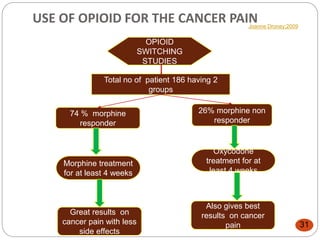
USE OF OPIOID FOR THE CANCER PAIN
31
Total no of patient 186 having 2
groups
74 % morphine
responder
26% morphine non
responder
Great results on
cancer pain with less
side effects
Also gives best
results on cancer
pain
Morphine treatment
for at least 4 weeks
Oxycodone
treatment for at
least 4 weeks
OPIOID
SWITCHING
STUDIES
Joanne Droney;2009
In vivo neuronal co-expression of mu
and delta opioid receptors
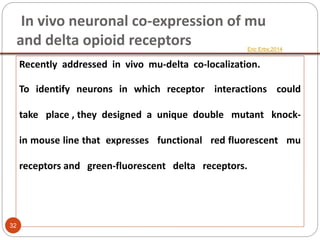
Recently addressed in vivo mu-delta co-localization.
To identify neurons in which receptor interactions could
take place , they designed a unique double mutant knock-
in mouse line that expresses functional red fluorescent mu
receptors and green-fluorescent delta receptors.
Eric Erbs;2014
32
LIGAND DESIGN FOR THE KAPPA OPIOID
RECEPTOR VTV Molecular Modelling ;2013
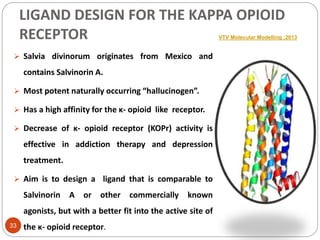
 Salvia divinorum originates from Mexico and
contains Salvinorin A.
 Most potent naturally occurring “hallucinogen”.
 Has a high affinity for the κ- opioid like receptor.
 Decrease of κ- opioid receptor (KOPr) activity is
effective in addiction therapy and depression
treatment.
 Aim is to design a ligand that is comparable to
Salvinorin A or other commercially known
agonists, but with a better fit into the active site of
the κ- opioid receptor.33
REFERENCES
 Andrea . M et al , opioid pharmacology , pain physician; 2008.
 Dr. Mahesh Trivedi , shafee shaikh et al , pharmacology of opioid part
1 anasthesia Tutorial of the week 64; 2007.
 Erich Erbs & Lauren faget , Receptors & clinical investigation 2014 ; 1 :
e210
 Joanne droney et al , recent advances in use of opioid for cancer
pain , journal of pain research ; 2009.
 Shana .L , Bowman et al , cell autonomous regulation of Mu opioid
receptor recycling by substance P ;2015.
 Tripathi K. D , Essential of medical pharmacology , 6th edition , jaypee
brothers medical publishers (p) LTD ; 2006 : 453.
 Yung feng ,Lawrence H . et al current research on opioid receptor
function ,curr drug target ; 2012 ;13(2) : 230-246.
34

Presentation opoid

  • 1.
    PRESENTED BY - VARSHASONAWANE M.PHARM (SEM-І) DEPARTMENT OF PHARMACOLOGY R.C.PATEL INSTITUTEOFPHARMACEUTICAL EDUCATION ANDRESEARCH ,SHIRPUR. OPIOID RECEPTOR 1
  • 2.
    CONTENTS  History  Introduction Structure,Classification, Receptor stimulators & Nomenclature  Mechanism of action  Pain pathway  Distribution  Side effects  Recent advances 2
  • 3.
    HISTORY Pain Physician ;2008 The opium poppy was cultivated as early as 3400 BC in Mesopotamia. Solomon Snyder and colleagues, first identified opioid receptors in the brain in 1975.  Acheson coin the term OPIOID.  In 1960’s, T sou and Jang performed a pioneering work in understanding the mechanism. 3
  • 4.
    INTRODUCTION Tripathi K.D;2003 Algesia : means pain (unpleasant sensation),evoked by external or internal stimulus.  Analgesic : is a drug relives pain by acting on CNS or on peripheral pain mechanism, without altering consciousness. Analgesic Opioid/Narcotic Non- opioid /non narcotic 4
  • 5.
    OPIATE “Opiates are groupof drug that are use to treating pain  OPIATE ADDICTION Opiates produce a sense of wellbeing. A high dose of opiate can cause death from cardiac or respiratory arrest.  OPIATE WITHDRAWAL SYNDROME INCLUDES: Low energy, irritability , anxiety , insomnia , agitation , Runny nose, teary eyes, Hot and cold sweat , goose bump’s , Yawning, Muscle ache and pains Abdominal cramping , nausea ,vomiting , diarrhoea. Dr Mahesh Trivedi;2007 5
  • 6.
    Ashley Rogers &Eric Walker 6
  • 7.
    PAIN PATHWAY RECEPTOR (nociceptors) 7 A-delta fibres(myelinated) (fast 15-20m/sec) C-fibres (unmyelinated) (slow 1-2m/sec) Dorsal columns Ventrolateral columns Thalamic nuclei Thalamohypothalamic projection
  • 8.
    STRUCTURE OF OPIOIDRECEPTOR N- terminal C- terminal TM7 TM 1 TM2 TM3 TM4 TM5TM6 EL1 EL2EL3 IL1 IL2 IL3 8
  • 9.
    HOW DO OPIOIDACT 9 Interact with specific cell surface receptor in  CNS and PNS  Other tissue ( GIT Immune cells other tissues) μ δ ĸ 2 nd messenger system G proteins G proteins G protein
  • 10.
    CLASSIFICATION OF OPIATES Opium Opium MorphineCodeine Thebain Opiate derivative Heroin Hydromor phone Oxymorp hine Oxycod one Etrophi ne Synthetic opiate Methadone Mepiridine Propoxyphe ne LAAM 10
  • 11.
    CLASSIFICATION OF OPIOIDRECEPTOR 11 Types µ δ κ µ1 µ2 µ3 δ1 δ2 κ1 κ2 κ3 Novel type Sigma receptor
  • 12.
    NOMENCLATURE Dr. MaheshTrivedi,2007 Nomenclature approved by “International Union of Pharmacology” for identification of the opioid receptors:  MOP (mu opioid peptide receptor)  KOP (kappa opioid peptide receptor)  DOP (delta opioid peptide receptor)  NOP (nociceptin orphanin FQ peptide receptor) 12
  • 13.
    RECEPTOR ENDOGENOUS LIGANDEFFECT ON RECEPTOR STIMULATION Mu(μ) Endorrphin Supraspinal analgesia (μ1) Dependance (μ2) Respiratory depression (μ2) Constipation (μ2) , miosis (μ2) Kappa(ĸ) Dynorphin Spinal analgesia Sedation Miosis Delta(δ) Enkephalins Respiratory depression Sigma(σ) Unknown Dysphoria OPIOID RECEPTORS, THEIR ENDOGENOUS LIGANDS AND EFFECT PRODUCED ON RECEPTOR STIMULATION
  • 14.
  • 15.
    CELLULAR RESPONSE BYOPIOID RECEPTOR Dr Mahesh Trivedi Opioid receptors are couple with inhibitory G protein and there activation has number of action including :  Closing of voltage sensitive calcium channels.  Stimulation of potassium efflux leading to hyperpolarisation and reduce cyclic adenosine monophosphate production.  Overall effect in the reduction of neuronal cell excitability that result in reduced transmission of nociceptive impulses. 15
  • 16.
  • 17.
  • 18.
    MAJOR SIDE EFFECTSOF OPIOID AGONISTS  CVS: Decrease systemic BP  CNS: Miosis Stiff chest syndrome  RESPIRATORY SYSTEM: depression of respiratory system by μ receptor. Robert K. Stoelting;2oo7 18
  • 19.
     BILIARY &GI TRACT: Spasm of biliary smooth muscles (constipation Effect mediated by μ & ĸ receptor).  Nausea & vomiting  Tolarance & physical dependance 19
  • 20.
    MARKETED PREPARATIONS OFOPIOIDS  MORCONTIN (Morphine)  RILIMORPH (Morphine)  DUROGESIC (Fentanyl)  PHYSEPTONE (Methadone)  PARVON & PARVODEX (Dextropropoxyphene)  DOMADOL (Tramadol) 20
  • 21.
    ADVANCES IN RESEARCHON OPIOID RECEPTOR FUNCTION  Opioid peptide receptors in the CNS represent the peptidergic transmission system and are widely involved in various pleiotropic functions  They are essential for various physiological functions including: Yuan Feng,et al;2012 21
  • 22.
     Ionic homeostasis Cell proliferation  Neuroprotecton  Hibernation  Pain modulation  Drug abuse / addiction  Emotional response  Epileptic seizures  Immune function  Obesity  Respiratory control  Cardiovascular regulation 22
  • 23.
    IONIC HOMEOSTASIS overall effectof Ca 2+ on homeostasis is inhibitory but , some studies shows that opioid receptor activates Ca2+ channel. 23
  • 24.
    CELL PROLIFERATION  Opioidreceptor affect cell proliferation.  delta opioid receptor play important role in the neurogenesis & neuroprotection.  Some studies have shown that the OGF-OGFr system is biological regulator of cell proliferation in some cancers including ovarian cancer, hepatocellular cancer, and so on. 24
  • 25.
    NUROPROTECTION  The DORneuroprotection involves the stabilization of ionic homeostasis.  Administration of MOR and KOR agonists (DAMGO and 488H respectively) did not induce appreciable neuroprotection. 25
  • 26.
    HIBERNATION  Mammalian hibernationis a energy-conserving state.  (MOR,DOR and KOR) levels in the brain of hibernating animals is decrease on Administration of opioid antagonists effectively reversed hibernation and prevent the animals from their stupor. 26
  • 27.
    DRUG ADDICTION /ABUSE Drug abuse induces adaptive changes in opioid receptors that occurs due to acute and chronic opioid administration. Development of clinically effective agents that minimize the risks for abuse. 27
  • 28.
     FEEDING Syndyphalin-33 (SD33)- a μ-opioid receptor ligand, increases food intake in sheep through i.v route, and its effects are mediated via opioid receptor. OBESITY Stimulation of μ- opioid receptors preferentially increases the intake of a high fat diet. 28
  • 29.
     EMOTIONAL RESPONSE Deltaopioid receptor act as inhibitor of stress & anxiety. KOR mediates antidepressant-like effects by BDNF gene regulation.  IMMUNE FUNCTION Morphine differentially modulates LPS induced expression of IL-6 and TNF-α, and it found the naltrexone was capable of preventing LPS-induced septic shock mortality by indirect inhibition of TNF-α production. 29
  • 30.
    RESPIRATORY FUNCTION There arehigh densities of opioid receptors in the brain areas related to respiration. Depress the activity of respiratory related neurons. CARDIOVASCULAR REGULATION A MOR agonist, was found to stimulate excretion of urine sodium & potassium that suppresses the stress-induced elevation in blood pressures and heart rate. 30
  • 31.
    USE OF OPIOIDFOR THE CANCER PAIN 31 Total no of patient 186 having 2 groups 74 % morphine responder 26% morphine non responder Great results on cancer pain with less side effects Also gives best results on cancer pain Morphine treatment for at least 4 weeks Oxycodone treatment for at least 4 weeks OPIOID SWITCHING STUDIES Joanne Droney;2009
  • 32.
    In vivo neuronalco-expression of mu and delta opioid receptors Recently addressed in vivo mu-delta co-localization. To identify neurons in which receptor interactions could take place , they designed a unique double mutant knock- in mouse line that expresses functional red fluorescent mu receptors and green-fluorescent delta receptors. Eric Erbs;2014 32
  • 33.
    LIGAND DESIGN FORTHE KAPPA OPIOID RECEPTOR VTV Molecular Modelling ;2013  Salvia divinorum originates from Mexico and contains Salvinorin A.  Most potent naturally occurring “hallucinogen”.  Has a high affinity for the κ- opioid like receptor.  Decrease of κ- opioid receptor (KOPr) activity is effective in addiction therapy and depression treatment.  Aim is to design a ligand that is comparable to Salvinorin A or other commercially known agonists, but with a better fit into the active site of the κ- opioid receptor.33
  • 34.
    REFERENCES  Andrea .M et al , opioid pharmacology , pain physician; 2008.  Dr. Mahesh Trivedi , shafee shaikh et al , pharmacology of opioid part 1 anasthesia Tutorial of the week 64; 2007.  Erich Erbs & Lauren faget , Receptors & clinical investigation 2014 ; 1 : e210  Joanne droney et al , recent advances in use of opioid for cancer pain , journal of pain research ; 2009.  Shana .L , Bowman et al , cell autonomous regulation of Mu opioid receptor recycling by substance P ;2015.  Tripathi K. D , Essential of medical pharmacology , 6th edition , jaypee brothers medical publishers (p) LTD ; 2006 : 453.  Yung feng ,Lawrence H . et al current research on opioid receptor function ,curr drug target ; 2012 ;13(2) : 230-246. 34