OPIOID AGONISTS AND ANTAGONISTS Dr. Robert L. Copeland
Narcotics  Those drugs which possess both an analgesic (pain relieving) and sedative properties. Opioid  refer to drugs in a generic sense, natural or synthetic, with morphine- like actions
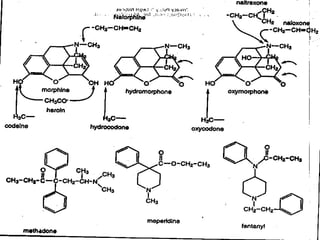
Classification of OPIOIDS Natural phenanthrene   morphine 10%  codeine 0.5%  thebaine 0.2%  semisynthetic   heroin  oxymorphone  Hydromorphone synthetic   meperidine  methadone  morphinians  benzamorphans
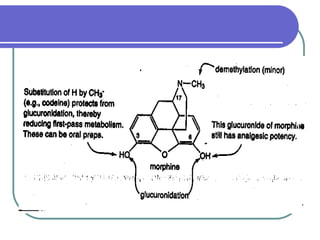
Chemistry Morphine   pentacyclic alkaloid (five ring structure)  oxygen bridge at 4,5 position  three major rings (a, b, c)  phenolic groups (s/a hydroxyl, alcoholic, OH) at position 3 and 6  modifications at those positions changes pharmacokinetics and potency of drug  nitrogen at 16 position (n16)  changing it by adding an alkyl group converts it to naloxone (i.e. go from a agonist to an antagonist)
 
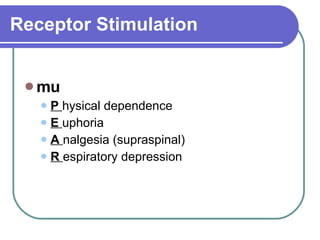
Receptor Stimulation mu P  hysical dependence  E  uphoria  A  nalgesia (supraspinal)  R  espiratory depression
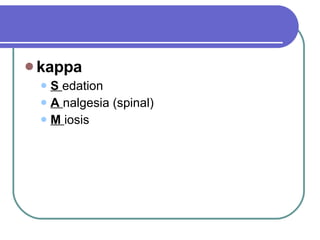
kappa S  edation  A  nalgesia (spinal)  M  iosis
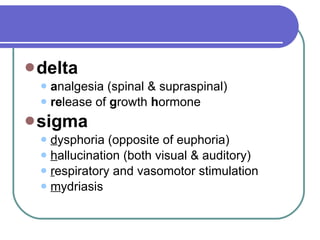
delta   a nalgesia (spinal & supraspinal)  re lease of  g rowth  h ormone     sigma d ysphoria (opposite of euphoria)  h allucination (both visual & auditory) r espiratory and vasomotor stimulation  m ydriasis
OPIOID receptors CNS  distribution is not uniform they are at areas concerned with pain receptor locations beginning with highest concentration areas 1. cerebral cortex 2. amygdala 3. septum 4. thalamus 5. hypothalamus 6. midbrain 7. spinal cord
Endogenous Opioid Peptides Three distinct families of peptides have been identified: the  enkephalins,  the  endorphins,  and the  dynorphins.  Each family is derived from a distinct precursor polypeptide These precursors are now designated as proenkephalin (also proenkephalin A), proopiomelanocortin (POMC), and prodynorphin (also proenkephalin B)
Endogenous Opioid Peptides Enkephalins   they are 5 amino acids long  also have met enkephalin (methionine at 5' position) and leu enkephalin (leucine at 5' position)  enkephalins are neuromodulators since they are small peptides, it was found that they came from larger peptides (pro enkephalins) proenkephalin gene codes for peptide 276 amino acid in length  cleavage of proenkephalin gives 4 to 5 pieces of activated enkephalins
Endorphin   POMC is processed into melanocyte-stimulating hormone (g-MSH), adrenocorticotropin (ACTH), and b-lipotropin (b-LPH); within the 91-amino-acid sequence of b-LPH are found b- endorphin and b-MSH 30 amino acid peptide  last 5 amino acids are the same sequence as enkephalins  endorphins are neurohormones  conservation between species  little difference in humans
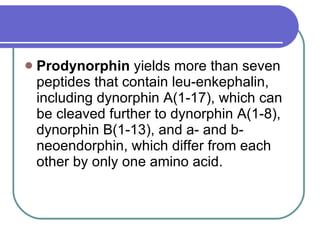
Prodynorphin  yields more than seven peptides that contain leu-enkephalin, including dynorphin A(1-17), which can be cleaved further to dynorphin A(1-8), dynorphin B(1-13), and a- and b-neoendorphin, which differ from each other by only one amino acid.
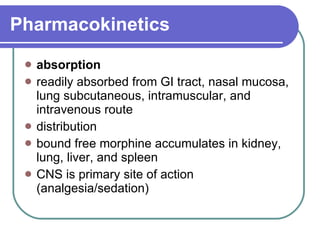
Pharmacokinetics   absorption readily absorbed from GI tract, nasal mucosa, lung subcutaneous, intramuscular, and intravenous route  distribution  bound free morphine accumulates in kidney, lung, liver, and spleen  CNS is primary site of action (analgesia/sedation)
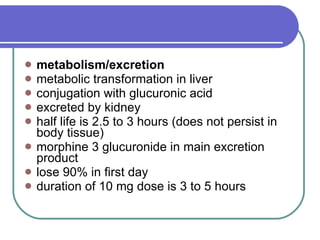
metabolism/excretion metabolic transformation in liver  conjugation with glucuronic acid  excreted by kidney  half life is 2.5 to 3 hours (does not persist in body tissue)  morphine 3 glucuronide in main excretion product  lose 90% in first day  duration of 10 mg dose is 3 to 5 hours
 
Morphine administration   oral morphine not given due to erratic oral availability  significant variable first pass effect from person to person and have intraspecies effect (same dose will vary in person day to day)  IV morphine acts promptly and its main effect is at the CNS
CNS is primary site of action of morphine analgesia  sedation  euphoria  mood change  mental cloudiness
Morphine analgesia ** Changes our reaction and our perception of pain  severe cancer pain is tolerated more when person is given morphine  relieves all types of pain, but most effective against continuous dull aching pain  sharp, stabbing, shooting pain also relieved by morphine Morphine given to a pain free individual   first experience is dysphoric  not experienced in person in pain
Morphine sedation  - morphine causes sedation effect, but no loss of consciousness  Morphine euphoria   sense of well being  reason why morphine is abused
Effects of morphine on respiration   There is a primary and continuous depression of respiration related to dose   decrease rate  decrease volume  decrease tidal exchange
mu  receptor activation produces respiratory depression; with increase in dose can cause further respiratory depression  CNS becomes less responsive to pCO2 thereby causing a build up of CO2  rhythm and responsiveness causes irregular breathing patterns; one will see periods of apnea
nausea and vomiting  – Stimuation of CTZ, in area postrema of medulla  stimulation by stretch receptors causes nausea and vomiting  has afferents from gut and ear  involved in motion sickness
pupil size   morphine causes miosis (pinpoint pupils)  kappa receptor effect  pinpoint pupils still responsive to bright light  oculomotor nerve (CN3) is stimulated by kappa receptor site  if kappa receptor is blocked, mydriasis from sigma effect will result atropine partially blocks effect indicating parasympathetic system involved
Acute overdose High doses (overdose situation) of morphine   excitatory and spinal reflexes   high doses of many OPIOID cause convulsions  due to stimulation at sigma receptor
Cardiovascular effects Cardiovascular effects of morphine lead to  vasodilation, thus a decrease in blood pressure  morphine causes the release of histamine  and  suppression of central adrenergic tone  and suppression of reflex vasoconstriction
Morphine effects on the gastrointestinal system   increase in tone and decrease in mobility  leads to  constipation  decreased concentration of HCl secretion  increased tone in stomach, small intestine, and large intestine delay of passage of food (gastric contents) so more reabsorption of water **tolerance does not develop (i.e. same amount of effect each time) to this constipation effect
Morphine effects on various smooth muscles   biliary tract   marked increase in the pressure in the biliary tract  10 fold increase over normal (normal is 20 mm H 2 0 pressure)  increase due to contraction of Sphincter of Oddi  urinary bladder   tone of detrusor muscle increased  feel urinary urgency  have urinary retention due to increased muscle tone where sphincter closed off  bronchial muscle   bronchoconstriction can result  **contraindicated in asthmatics, particularly before surgery  uterus   contraction of uterus can prolong labor
Neuroendocrine Effects inhibit the release of gonadotropin-releasing hormone (GnRH) and corticotropin-releasing factor (CRF), thus decreasing circulating concentrations of luteinizing hormone (LH), follicle-stimulating hormone (FSH), ACTH, and b- endorphin; the last two peptides are usually released simultaneously from corticotrophs in the pituitary. As a result of the decreased concentrations of pituitary trophic hormones, the concentrations of testosterone and cortisol in plasma decline. Secretion of thyrotropin is relatively unaffected.
Tolerance to morphine   nausea  analgesia  sedation  respiratory depression          cardiovascular  euphoric not to: miosis  constipation
Toxicity of morphine   acute overdose respiratory depression  pinpoint pupils (miosis)  coma  Treatment 1. establish adequate ventilation 1a. 4 point restraints needed 2. give OPIOID antagonist (naloxone)
Naloxone   it has no agonist activity  it displaces morphine from all receptors,  reverses  all of the effects of morphine  its effects are immediate (3-5 min)  duration is 30-45 minutes must be reinjected often
Therapeutic uses of morphine relief of pain  terminal illness  preoperative medications  postoperative medications  acute pulmonary edema  constipating effect  cough  obstetrical analgesia
Drug interactions with Opioids   **in general, the coadministration of CNS depressants with OPIOID often produces at least an additive depression (potentiation)
OPIOID and phenothiazines   produces an additive CNS depression as well as enhancement of the actions of OPIOID (respiratory depression)  this combination may also produce a greater incidence of orthostatic hypotension  OPIOID and tricyclics antidepressants   can produce increased hypotension  meperidine and MOA inhibitors  results in severe and immediate reactions that include excitation, rigidity, hypertension, and severe respiratory depression
OPIOID and barbiturates   increased clearance  morphine and amphetamine   enhanced analgesic effect
Codeine   change in the methyl group on 3 position (substituted for the hydroxyl group)  one tenth the potency (analgesic properties) of morphine  absorbed readily from GI tract  the absorption is more regular than morphine and more predictable  given orally  metabolized like morphine through glucuronic acid  physical dependence is necessity of drug so you don't go through withdrawal  tolerance and physical dependence is protracted from morphine since potency of codeine is low  withdrawal from codeine is mild in relation to morphine  antitussive drug for cough
Heroin (diacetylmorphine)   at 3 and 6 hydroxy positions, there are acetyl groups instead of hydroxyl groups  it is anywhere from 3 to 4 times the analgesic potency of morphine  heroin is the most lipophilic of all the OPIOID  morphine is the least lipophilic of all the OPIOID  OPIOID withdrawal is NOT fatal
When heroin is ingested, it crosses the blood brain barrier rapidly (morphine crosses slow) where it is hydrolyzed to monoacetyl morphine (acetyl group got cleaved off) and then it is hydrolyzed to morphine making more of the drug in the brain making it 3 to 4 times more potent  withdrawal symptoms of heroin similar to morphine, but more intense (rebound effect) mydriasis  diarrhea  vasoconstriction  dysphoria  etc.
Hydromorphone (trade name is dilaudid)   have ketone at 6 hydroxyl position of morphine  also strong agonist  9 times more potent than morphine  more sedation than morphine so less euphoric feeling so not abused much  less constipation  does not produce miosis  tolerance and physical dependence is more intense than morphine because of its high potency  respiratory depression same as morphine
Fentanyl (Sublimaze) synthetic drug  different structure than morphine  80 to 100 times more potent than morphine  rapidly acting drug  used as preoperative medication  short acting (30-45 min)  onset of action is 5 minutes  very high potency  highly abused ,known as  china white  as street name
Meperidine   produced in 1940's  wanted drug with less addictive liability than morphine, but it has same addictive liability as morphine  same CNS actions as morphine  sedation, analgesia, respiratory depression  potency same as morphine
unlike morphine: more respiratory depression  more bronchoconstriction activity  less constipation  no antitussive activity  **it causes mydriasis (not miosis)  toxic effects similar to atropine  dry as a bone, blind as a bat, red as a beet, mad as a hatter  have dry mouth  drug absorbed orally  drug most abused by health care professionlas due to its availability  withdrawal similar to morphine
Methadone   pharmacological activity similar to morphine, same potency as morphine  long duration of activity  absorbed well orally 16 to 20 hour duration of action powerful pain reliever  used in maintenance program for narcotic treatment
Diphenoxylate (Lomotil)   can be OTC drug now  **therapeutic use is antidiarrhea drug (treats diarrhea)  meperidine type drug  has very little analgesic properties at therapeutic dose  no antitussive effect  at high doses it has analgesic problems  causes respiratory depression and euphoria at high doses
Antagonism of Morphine   two drugs:  naloxone  and  naltrexone  (pure antagonist)
Naloxone   no analgesic activity at all  competitive antagonist at mu, kappa, and sigma receptor  displaces morphine and other OPIOID from receptor site  reverses all actions of the OPIOID and does it rather quickly  it will precipitate withdrawal  person on heroin, then naloxone will precipitate withdrawal, but naloxone effects are seen in the first five minutes and it only lasts for 30 minutes:  increased blood pressure  metabolized same as morphine through glucuronic acid and excreted through kidney
Naltrexone   same effect of naloxone except it is used orally so can't use it if for person with acute toxicity  long duration of activity  single dose block action of heroin effects for 24 hours  used for emergency treatment  once stabilized, give patient naltrexone  patient get no euphoric effect from heroin so person gets off heroin (negative reinforcement)  approved for use by the FDA  also used for treatment of alcoholism 
 

OPIOID AGONISTS AND ANTAGONISTS

  • 1.
    OPIOID AGONISTS ANDANTAGONISTS Dr. Robert L. Copeland
  • 2.
    Narcotics Thosedrugs which possess both an analgesic (pain relieving) and sedative properties. Opioid refer to drugs in a generic sense, natural or synthetic, with morphine- like actions
  • 3.
    Classification of OPIOIDSNatural phenanthrene morphine 10% codeine 0.5% thebaine 0.2% semisynthetic heroin oxymorphone Hydromorphone synthetic meperidine methadone morphinians benzamorphans
  • 4.
    Chemistry Morphine pentacyclic alkaloid (five ring structure) oxygen bridge at 4,5 position three major rings (a, b, c) phenolic groups (s/a hydroxyl, alcoholic, OH) at position 3 and 6 modifications at those positions changes pharmacokinetics and potency of drug nitrogen at 16 position (n16) changing it by adding an alkyl group converts it to naloxone (i.e. go from a agonist to an antagonist)
  • 5.
  • 6.
    Receptor Stimulation muP hysical dependence E uphoria A nalgesia (supraspinal) R espiratory depression
  • 7.
    kappa S edation A nalgesia (spinal) M iosis
  • 8.
    delta a nalgesia (spinal & supraspinal) re lease of g rowth h ormone    sigma d ysphoria (opposite of euphoria) h allucination (both visual & auditory) r espiratory and vasomotor stimulation m ydriasis
  • 9.
    OPIOID receptors CNS distribution is not uniform they are at areas concerned with pain receptor locations beginning with highest concentration areas 1. cerebral cortex 2. amygdala 3. septum 4. thalamus 5. hypothalamus 6. midbrain 7. spinal cord
  • 10.
    Endogenous Opioid PeptidesThree distinct families of peptides have been identified: the enkephalins, the endorphins, and the dynorphins. Each family is derived from a distinct precursor polypeptide These precursors are now designated as proenkephalin (also proenkephalin A), proopiomelanocortin (POMC), and prodynorphin (also proenkephalin B)
  • 11.
    Endogenous Opioid PeptidesEnkephalins they are 5 amino acids long also have met enkephalin (methionine at 5' position) and leu enkephalin (leucine at 5' position) enkephalins are neuromodulators since they are small peptides, it was found that they came from larger peptides (pro enkephalins) proenkephalin gene codes for peptide 276 amino acid in length cleavage of proenkephalin gives 4 to 5 pieces of activated enkephalins
  • 12.
    Endorphin POMC is processed into melanocyte-stimulating hormone (g-MSH), adrenocorticotropin (ACTH), and b-lipotropin (b-LPH); within the 91-amino-acid sequence of b-LPH are found b- endorphin and b-MSH 30 amino acid peptide last 5 amino acids are the same sequence as enkephalins endorphins are neurohormones conservation between species little difference in humans
  • 13.
    Prodynorphin yieldsmore than seven peptides that contain leu-enkephalin, including dynorphin A(1-17), which can be cleaved further to dynorphin A(1-8), dynorphin B(1-13), and a- and b-neoendorphin, which differ from each other by only one amino acid.
  • 14.
    Pharmacokinetics absorption readily absorbed from GI tract, nasal mucosa, lung subcutaneous, intramuscular, and intravenous route distribution bound free morphine accumulates in kidney, lung, liver, and spleen CNS is primary site of action (analgesia/sedation)
  • 15.
    metabolism/excretion metabolic transformationin liver conjugation with glucuronic acid excreted by kidney half life is 2.5 to 3 hours (does not persist in body tissue) morphine 3 glucuronide in main excretion product lose 90% in first day duration of 10 mg dose is 3 to 5 hours
  • 16.
  • 17.
    Morphine administration oral morphine not given due to erratic oral availability significant variable first pass effect from person to person and have intraspecies effect (same dose will vary in person day to day) IV morphine acts promptly and its main effect is at the CNS
  • 18.
    CNS is primarysite of action of morphine analgesia sedation euphoria mood change mental cloudiness
  • 19.
    Morphine analgesia **Changes our reaction and our perception of pain severe cancer pain is tolerated more when person is given morphine relieves all types of pain, but most effective against continuous dull aching pain sharp, stabbing, shooting pain also relieved by morphine Morphine given to a pain free individual first experience is dysphoric not experienced in person in pain
  • 20.
    Morphine sedation - morphine causes sedation effect, but no loss of consciousness Morphine euphoria sense of well being reason why morphine is abused
  • 21.
    Effects of morphineon respiration There is a primary and continuous depression of respiration related to dose decrease rate decrease volume decrease tidal exchange
  • 22.
    mu receptoractivation produces respiratory depression; with increase in dose can cause further respiratory depression CNS becomes less responsive to pCO2 thereby causing a build up of CO2 rhythm and responsiveness causes irregular breathing patterns; one will see periods of apnea
  • 23.
    nausea and vomiting – Stimuation of CTZ, in area postrema of medulla stimulation by stretch receptors causes nausea and vomiting has afferents from gut and ear involved in motion sickness
  • 24.
    pupil size morphine causes miosis (pinpoint pupils) kappa receptor effect pinpoint pupils still responsive to bright light oculomotor nerve (CN3) is stimulated by kappa receptor site if kappa receptor is blocked, mydriasis from sigma effect will result atropine partially blocks effect indicating parasympathetic system involved
  • 25.
    Acute overdose Highdoses (overdose situation) of morphine excitatory and spinal reflexes high doses of many OPIOID cause convulsions due to stimulation at sigma receptor
  • 26.
    Cardiovascular effects Cardiovasculareffects of morphine lead to vasodilation, thus a decrease in blood pressure morphine causes the release of histamine and suppression of central adrenergic tone and suppression of reflex vasoconstriction
  • 27.
    Morphine effects onthe gastrointestinal system increase in tone and decrease in mobility leads to constipation decreased concentration of HCl secretion increased tone in stomach, small intestine, and large intestine delay of passage of food (gastric contents) so more reabsorption of water **tolerance does not develop (i.e. same amount of effect each time) to this constipation effect
  • 28.
    Morphine effects onvarious smooth muscles biliary tract marked increase in the pressure in the biliary tract 10 fold increase over normal (normal is 20 mm H 2 0 pressure) increase due to contraction of Sphincter of Oddi urinary bladder tone of detrusor muscle increased feel urinary urgency have urinary retention due to increased muscle tone where sphincter closed off bronchial muscle bronchoconstriction can result **contraindicated in asthmatics, particularly before surgery uterus contraction of uterus can prolong labor
  • 29.
    Neuroendocrine Effects inhibitthe release of gonadotropin-releasing hormone (GnRH) and corticotropin-releasing factor (CRF), thus decreasing circulating concentrations of luteinizing hormone (LH), follicle-stimulating hormone (FSH), ACTH, and b- endorphin; the last two peptides are usually released simultaneously from corticotrophs in the pituitary. As a result of the decreased concentrations of pituitary trophic hormones, the concentrations of testosterone and cortisol in plasma decline. Secretion of thyrotropin is relatively unaffected.
  • 30.
    Tolerance to morphine nausea analgesia sedation respiratory depression         cardiovascular euphoric not to: miosis constipation
  • 31.
    Toxicity of morphine acute overdose respiratory depression pinpoint pupils (miosis) coma Treatment 1. establish adequate ventilation 1a. 4 point restraints needed 2. give OPIOID antagonist (naloxone)
  • 32.
    Naloxone it has no agonist activity it displaces morphine from all receptors, reverses all of the effects of morphine its effects are immediate (3-5 min) duration is 30-45 minutes must be reinjected often
  • 33.
    Therapeutic uses ofmorphine relief of pain terminal illness preoperative medications postoperative medications acute pulmonary edema constipating effect cough obstetrical analgesia
  • 34.
    Drug interactions withOpioids **in general, the coadministration of CNS depressants with OPIOID often produces at least an additive depression (potentiation)
  • 35.
    OPIOID and phenothiazines produces an additive CNS depression as well as enhancement of the actions of OPIOID (respiratory depression) this combination may also produce a greater incidence of orthostatic hypotension OPIOID and tricyclics antidepressants can produce increased hypotension meperidine and MOA inhibitors results in severe and immediate reactions that include excitation, rigidity, hypertension, and severe respiratory depression
  • 36.
    OPIOID and barbiturates increased clearance morphine and amphetamine enhanced analgesic effect
  • 37.
    Codeine change in the methyl group on 3 position (substituted for the hydroxyl group) one tenth the potency (analgesic properties) of morphine absorbed readily from GI tract the absorption is more regular than morphine and more predictable given orally metabolized like morphine through glucuronic acid physical dependence is necessity of drug so you don't go through withdrawal tolerance and physical dependence is protracted from morphine since potency of codeine is low withdrawal from codeine is mild in relation to morphine antitussive drug for cough
  • 38.
    Heroin (diacetylmorphine) at 3 and 6 hydroxy positions, there are acetyl groups instead of hydroxyl groups it is anywhere from 3 to 4 times the analgesic potency of morphine heroin is the most lipophilic of all the OPIOID morphine is the least lipophilic of all the OPIOID OPIOID withdrawal is NOT fatal
  • 39.
    When heroin isingested, it crosses the blood brain barrier rapidly (morphine crosses slow) where it is hydrolyzed to monoacetyl morphine (acetyl group got cleaved off) and then it is hydrolyzed to morphine making more of the drug in the brain making it 3 to 4 times more potent withdrawal symptoms of heroin similar to morphine, but more intense (rebound effect) mydriasis diarrhea vasoconstriction dysphoria etc.
  • 40.
    Hydromorphone (trade nameis dilaudid) have ketone at 6 hydroxyl position of morphine also strong agonist 9 times more potent than morphine more sedation than morphine so less euphoric feeling so not abused much less constipation does not produce miosis tolerance and physical dependence is more intense than morphine because of its high potency respiratory depression same as morphine
  • 41.
    Fentanyl (Sublimaze) syntheticdrug different structure than morphine 80 to 100 times more potent than morphine rapidly acting drug used as preoperative medication short acting (30-45 min) onset of action is 5 minutes very high potency highly abused ,known as china white as street name
  • 42.
    Meperidine produced in 1940's wanted drug with less addictive liability than morphine, but it has same addictive liability as morphine same CNS actions as morphine sedation, analgesia, respiratory depression potency same as morphine
  • 43.
    unlike morphine: morerespiratory depression more bronchoconstriction activity less constipation no antitussive activity **it causes mydriasis (not miosis) toxic effects similar to atropine dry as a bone, blind as a bat, red as a beet, mad as a hatter have dry mouth drug absorbed orally drug most abused by health care professionlas due to its availability withdrawal similar to morphine
  • 44.
    Methadone pharmacological activity similar to morphine, same potency as morphine long duration of activity absorbed well orally 16 to 20 hour duration of action powerful pain reliever used in maintenance program for narcotic treatment
  • 45.
    Diphenoxylate (Lomotil) can be OTC drug now **therapeutic use is antidiarrhea drug (treats diarrhea) meperidine type drug has very little analgesic properties at therapeutic dose no antitussive effect at high doses it has analgesic problems causes respiratory depression and euphoria at high doses
  • 46.
    Antagonism of Morphine two drugs: naloxone and naltrexone (pure antagonist)
  • 47.
    Naloxone no analgesic activity at all competitive antagonist at mu, kappa, and sigma receptor displaces morphine and other OPIOID from receptor site reverses all actions of the OPIOID and does it rather quickly it will precipitate withdrawal person on heroin, then naloxone will precipitate withdrawal, but naloxone effects are seen in the first five minutes and it only lasts for 30 minutes: increased blood pressure metabolized same as morphine through glucuronic acid and excreted through kidney
  • 48.
    Naltrexone same effect of naloxone except it is used orally so can't use it if for person with acute toxicity long duration of activity single dose block action of heroin effects for 24 hours used for emergency treatment once stabilized, give patient naltrexone patient get no euphoric effect from heroin so person gets off heroin (negative reinforcement) approved for use by the FDA also used for treatment of alcoholism 
  • 49.