Serotonin or
5-hydroxytryptamine
The serotonin receptors, also known as 5-hydroxytryptamine
receptors or 5-HT receptors, are a group of G protein-coupled
receptors (GPCRs) and ligand-gated ion channels (LGICs) found
in the central and peripheral nervous systems.
They mediate both excitatory and inhibitory neurotransmission.
The serotonin receptors are activated by the neurotransmitter
serotonin, which acts as their natural ligand.
• Widely distributed in invertebrates
and plants(banana, pear,
pineapple)
• In humans, present in GI
enterochromaffin cells (90%),
platelets and brain.
Synthesis,Storage & Destruction
• 5-HT is beta-aminoethyl-5-
hydroxyindole.
• It is synthesized from the amino acid
tryptophan and degraded primarily by
monoamino oxidase and to small
extent by dehydrogenase.
• This is explained as follows-
N
C
N
C NH2
COOH COOH
NH2
OH
N
C NH2
OH H
Tryptophan 5-Hydroxytryptophan
5-Hydroxytryptamine
N
C COOH
5-OH Indole
Acetaldehyde
5-Hydroxy Indole
Acetic Acid
Tryptophan
hydroxylase
5-OH Tryptophan
decarboxylase
M
AO
Aldehyde
dehydrogenase
(Rate limiting)
In diet. Active
CNS transport
• There is close parallelism between
carbonic anhydrase and 5 HT.
• The decarboxylase is non-specific, acts on
DOPA (Dihydroxyphenyl alanine) as well
as 5-HTP to produce dopamine and 5-HT
respectively.
• 5-HT is actively taken up by an amine
pump serotonin transporter (SERT) , a Na+
dependent carrier, which operates at the
membrane of platelets.
• This pump is inhibited by selective
serotonin reuptake inhibitors and tricyclic
anti-depressants.
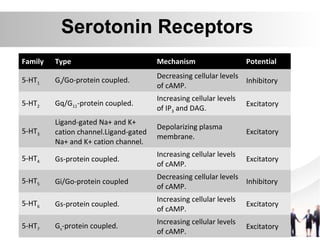
Serotonin Receptors
Family Type Mechanism Potential
5-HT1 Gi/Go-protein coupled.
Decreasing cellular levels
of cAMP.
Inhibitory
5-HT2 Gq/G11-protein coupled.
Increasing cellular levels
of IP3 and DAG.
Excitatory
5-HT3
Ligand-gated Na+ and K+
cation channel.Ligand-gated
Na+ and K+ cation channel.
Depolarizing plasma
membrane.
Excitatory
5-HT4 Gs-protein coupled.
Increasing cellular levels
of cAMP.
Excitatory
5-HT5 Gi/Go-protein coupled
Decreasing cellular levels
of cAMP.
Inhibitory
5-HT6 Gs-protein coupled.
Increasing cellular levels
of cAMP.
Excitatory
5-HT7 Gs-protein coupled.
Increasing cellular levels
of cAMP.
Excitatory
Serotonin
Pharmacological Effects
• Respiratory system: bronchoconstriction if
asthmatic; stimulation of aortic and carotid
chemoreceptors → ↑ RR and minute vol.
• GI tract: small intestine very sensitive to
serotonin → paristalsis is increased and
diarrhoea can occur.
• Also stimulates vomiting (5-HT3 receptors )
Cardiovascular system: Multiple direct and indirect
effects:
1. Direct vasoconstriction (large arteries) and
indirect vasodilation.
2. Heart: direct inotropic and chronotropic effects
3. Reflex mechanisms due to change in BP
Serotonin
Pharmacological Effects -2
• Pain perception
• Sleep/Wakefulness
• Various behaviors normal/abnormal:
depression, obsessive compulsive
behavior, etc.
• Neuroendocrine regulation – controls
hypothalamic cells involved in release of
several anterior pituitary hormones.
Serotonin in the
Central Nervous System
5-HT Antagonists
• The ability to antagonize at least some
action of some of the 5-HT is found in
many classes-
• 1. Cycloheptadine: It primarily blocks 5-
HT2a receptor and has additional sedative
properties.
• It increases the appetite and has been
used in children and poor eaters to
promote weight gain.
Examples:
• Sumatriptan: 5-HT1D agonist; contraindicated in
patients with angina
• Fluoxetine: Selective serotonin uptake inhibitors for
depression and other indications
• Buspirone: 5-HT1A agonist for anxiety
• Cisapride: 5-HT4 agonist to ↑ GI motility .
Serotonin Antagonists
• Methysergide and Cyproheptadine.
5HT2 antagonists. In carcinoid, migraine.
• Ketanserin: 5HT2 and Alpha antagonist –
used as antihypertensive.
• Ondansetron: 5-HT3 antagonist for
chemotherapy induced nausea and
vomiting
• Clozapine: 5HT2A/2C antagonist: for
schizophrenia.(mental disorder)
Migraine
• "pain on one side of the
head".
• Migraine is a chronic
neurological disease
characterized by recurrent
moderate to severe
headache often in
association with a number
of autonomic nervous
system symptoms.
Types Of Migraine
• Mild Migraine: Tolerable headache lasting
upto 8 hrs.
• Attacks once in a month.
• Drug Therapy-Analgesics like paracetamol or
aspirin & NSAIDS like ibuprofen ,
diclophenac are given.
Moderate Migraine:
• More than one attacks in a month.
• more intense, last for 6-24 hrs,
nausea/vomiting and the patient is
functionally impaired.
• Sinple analgesic are not effective here
strongers NSAIDS in combination i,e ergot
preparation are given.
Severe Migraine:
• These patients suffer 2-3 attacks per
month.
• Headache lasting for 12-48 hrs with
vertigo,vomitting and symptoms.
• Here antiemetics are
recommended.
Indications for prophylaxis
• British Association for the Study of
Headache (BASH) guidelines state that
prophylaxis should be used when
symptoms are inadequately controlled with
acute prescriptions, or the frequency of
attacks is leading to overuse of acute
medicines.
First-line prophylactic drugs
Beta-blockers-
• In theory, the ideal beta-blocker for use in
migraine should be hydrophilic and
cardioselective so as to produce fewer side-
effects, so as to be more effective.
Ex- Metoprolol 50-100 mg bd is cardioselective.
• Propranolol LA 80 mg od to 160 mg bd. Good
supporting evidence for efficacy, but not
cardioselective and often requires two doses
daily.
• Second-line prophylactic drugs-
• Topiramate and sodium valproate can be used
for preventing migraines. A Cochrane review
found that there was evidence that gabapentin
was not effective for the prophylaxis of episodic
migraine in adults.
• Third-line prophylactic drugs-
• Pizotifen 1.5 mg daily has been used for a long
time but evidence of efficacy is limited and
certainly there is no justification for higher doses.
Pizotifen may cause weight gain.
THANK YOU!!!

Serotonin

  • 2.
    Serotonin or 5-hydroxytryptamine The serotoninreceptors, also known as 5-hydroxytryptamine receptors or 5-HT receptors, are a group of G protein-coupled receptors (GPCRs) and ligand-gated ion channels (LGICs) found in the central and peripheral nervous systems. They mediate both excitatory and inhibitory neurotransmission. The serotonin receptors are activated by the neurotransmitter serotonin, which acts as their natural ligand.
  • 3.
    • Widely distributedin invertebrates and plants(banana, pear, pineapple) • In humans, present in GI enterochromaffin cells (90%), platelets and brain.
  • 4.
    Synthesis,Storage & Destruction •5-HT is beta-aminoethyl-5- hydroxyindole. • It is synthesized from the amino acid tryptophan and degraded primarily by monoamino oxidase and to small extent by dehydrogenase. • This is explained as follows-
  • 5.
    N C N C NH2 COOH COOH NH2 OH N CNH2 OH H Tryptophan 5-Hydroxytryptophan 5-Hydroxytryptamine N C COOH 5-OH Indole Acetaldehyde 5-Hydroxy Indole Acetic Acid Tryptophan hydroxylase 5-OH Tryptophan decarboxylase M AO Aldehyde dehydrogenase (Rate limiting) In diet. Active CNS transport
  • 6.
    • There isclose parallelism between carbonic anhydrase and 5 HT. • The decarboxylase is non-specific, acts on DOPA (Dihydroxyphenyl alanine) as well as 5-HTP to produce dopamine and 5-HT respectively. • 5-HT is actively taken up by an amine pump serotonin transporter (SERT) , a Na+ dependent carrier, which operates at the membrane of platelets. • This pump is inhibited by selective serotonin reuptake inhibitors and tricyclic anti-depressants.
  • 7.
    Serotonin Receptors Family TypeMechanism Potential 5-HT1 Gi/Go-protein coupled. Decreasing cellular levels of cAMP. Inhibitory 5-HT2 Gq/G11-protein coupled. Increasing cellular levels of IP3 and DAG. Excitatory 5-HT3 Ligand-gated Na+ and K+ cation channel.Ligand-gated Na+ and K+ cation channel. Depolarizing plasma membrane. Excitatory 5-HT4 Gs-protein coupled. Increasing cellular levels of cAMP. Excitatory 5-HT5 Gi/Go-protein coupled Decreasing cellular levels of cAMP. Inhibitory 5-HT6 Gs-protein coupled. Increasing cellular levels of cAMP. Excitatory 5-HT7 Gs-protein coupled. Increasing cellular levels of cAMP. Excitatory
  • 8.
    Serotonin Pharmacological Effects • Respiratorysystem: bronchoconstriction if asthmatic; stimulation of aortic and carotid chemoreceptors → ↑ RR and minute vol. • GI tract: small intestine very sensitive to serotonin → paristalsis is increased and diarrhoea can occur. • Also stimulates vomiting (5-HT3 receptors )
  • 9.
    Cardiovascular system: Multipledirect and indirect effects: 1. Direct vasoconstriction (large arteries) and indirect vasodilation. 2. Heart: direct inotropic and chronotropic effects 3. Reflex mechanisms due to change in BP Serotonin Pharmacological Effects -2
  • 10.
    • Pain perception •Sleep/Wakefulness • Various behaviors normal/abnormal: depression, obsessive compulsive behavior, etc. • Neuroendocrine regulation – controls hypothalamic cells involved in release of several anterior pituitary hormones. Serotonin in the Central Nervous System
  • 11.
    5-HT Antagonists • Theability to antagonize at least some action of some of the 5-HT is found in many classes- • 1. Cycloheptadine: It primarily blocks 5- HT2a receptor and has additional sedative properties. • It increases the appetite and has been used in children and poor eaters to promote weight gain.
  • 12.
    Examples: • Sumatriptan: 5-HT1Dagonist; contraindicated in patients with angina • Fluoxetine: Selective serotonin uptake inhibitors for depression and other indications • Buspirone: 5-HT1A agonist for anxiety • Cisapride: 5-HT4 agonist to ↑ GI motility .
  • 13.
    Serotonin Antagonists • Methysergideand Cyproheptadine. 5HT2 antagonists. In carcinoid, migraine. • Ketanserin: 5HT2 and Alpha antagonist – used as antihypertensive. • Ondansetron: 5-HT3 antagonist for chemotherapy induced nausea and vomiting • Clozapine: 5HT2A/2C antagonist: for schizophrenia.(mental disorder)
  • 14.
    Migraine • "pain onone side of the head". • Migraine is a chronic neurological disease characterized by recurrent moderate to severe headache often in association with a number of autonomic nervous system symptoms.
  • 16.
    Types Of Migraine •Mild Migraine: Tolerable headache lasting upto 8 hrs. • Attacks once in a month. • Drug Therapy-Analgesics like paracetamol or aspirin & NSAIDS like ibuprofen , diclophenac are given.
  • 17.
    Moderate Migraine: • Morethan one attacks in a month. • more intense, last for 6-24 hrs, nausea/vomiting and the patient is functionally impaired. • Sinple analgesic are not effective here strongers NSAIDS in combination i,e ergot preparation are given.
  • 18.
    Severe Migraine: • Thesepatients suffer 2-3 attacks per month. • Headache lasting for 12-48 hrs with vertigo,vomitting and symptoms. • Here antiemetics are recommended.
  • 19.
    Indications for prophylaxis •British Association for the Study of Headache (BASH) guidelines state that prophylaxis should be used when symptoms are inadequately controlled with acute prescriptions, or the frequency of attacks is leading to overuse of acute medicines.
  • 20.
    First-line prophylactic drugs Beta-blockers- •In theory, the ideal beta-blocker for use in migraine should be hydrophilic and cardioselective so as to produce fewer side- effects, so as to be more effective. Ex- Metoprolol 50-100 mg bd is cardioselective. • Propranolol LA 80 mg od to 160 mg bd. Good supporting evidence for efficacy, but not cardioselective and often requires two doses daily.
  • 21.
    • Second-line prophylacticdrugs- • Topiramate and sodium valproate can be used for preventing migraines. A Cochrane review found that there was evidence that gabapentin was not effective for the prophylaxis of episodic migraine in adults. • Third-line prophylactic drugs- • Pizotifen 1.5 mg daily has been used for a long time but evidence of efficacy is limited and certainly there is no justification for higher doses. Pizotifen may cause weight gain.
  • 22.