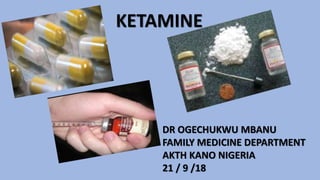
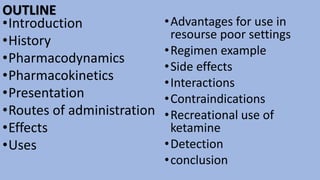
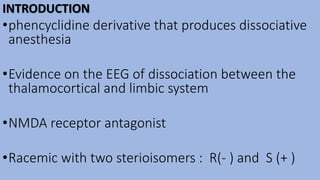
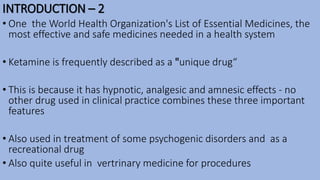
KETAMINE
DR OGECHUKWU MBANU
FAMILY MEDICINE DEPARTMENT
AKTH KANO NIGERIA
21 / 9 /18
OUTLINE
•Introduction
•History
•Pharmacodynamics
•Pharmacokinetics
•Presentation
•Routes of administration
•Effects
•Uses
•Advantages for use in
resourse poor settings
•Regimen example
•Side effects
•Interactions
•Contraindications
•Recreational use of
ketamine
•Detection
•conclusion
INTRODUCTION
•phencyclidine derivative that produces dissociative
anesthesia
•Evidence on the EEG of dissociation between the
thalamocortical and limbic system
•NMDA receptor antagonist
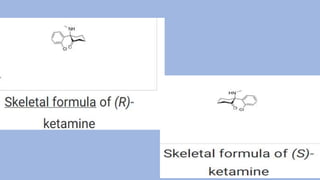
•Racemic with two sterioisomers : R(- ) and S (+ )
INTRODUCTION – 2
• One the World Health Organization's List of Essential Medicines, the
most effective and safe medicines needed in a health system
• Ketamine is frequently described as a "unique drug“
• This is because it has hypnotic, analgesic and amnesic effects - no
other drug used in clinical practice combines these three important
features
• Also used in treatment of some psychogenic disorders and as a
recreational drug
• Also quite useful in vertrinary medicine for procedures
HISTORY
• First synthesized in 1962 by Calvin L. Stevens, a professor of Chemistry at Wayne
State University and a Parke-Davis consultant conducting research on
alphahydroxyimine rearrangements
• Initially tested in animals
• first tested in humans in 1964
• approved for use in the United States in 1970
• Shortly after its US approval, it was extensively used for surgical anesthesia in the
Vietnam War, due to its safety.
HISTORY
• Nonmedical use of ketamine began on the West Coast of the United States in the
early 1970s(ecstasy)
• Its psychiatric use also started in the 1970s
• Become a federally controlled substance in the United States in 1999
• Much of the current ketamine diverted for nonmedical use originates in China and
India
Pharmacodynamics
• Ketamine acts as a selective uncompetitive antagonist of the NMDA (N
– Methyl – D – Aspartic acid) an ionotropic glutamate receptor found
in neuronal cells
• Blocks glutamate binding to these receptors thereby inhibiting the
processing of CNS
• S(+) and R(–) enantiomers
• S(+) is 2- to 3-fold greater affinity for the receptor than R(–) so is more
potent.
Pharmacodynamics – 2
•Besides NMDA receptor antagonism, other known actions of
ketamine include :
•Potentiator of the serotonin 5-HT3 receptor
•Muscarinic acetylcholine receptor antagonist
• Inhibitor of cholinesterase
• Inhibitor of the reuptake of serotonin, norepinephrine, and
dopamine
• may also act via an agonist effect on k-opioid receptors
•Mechanism of action for the antidepressant effects at lower
doses is not yet to be fully understood
Pharmacokinetics
•Rapid onset of action, relatively short duration of action
•water and lipid soluble
• Initially distributed to highly perfused tissues such as
brain
•Undergoes extensive redistribution and can accumulate
in fatty tissues
•solubility ensures its rapid transfer across the BBB
Pharmacokinetics 2
•Peak plasma concentrations occur within 1 min after IV
administration & within 5 mins after IM injection
•Oral ketamine is easily broken down by bile acids, thus
has a low bioavailability
•Ketamine undergoes hepatic metabolism.
•N- Demethylation results in the major metabolite, -
norketamine, and then dehydronorketamine
Pharmacokinetics 3
•Norketamine possesses sedative and analgesic
properties (potency is 20 % of ketamine).
•Ketamine has high hepatic clearance rate(1 L/min)
•After hydroxylation and conjugation, norketamine is
excreted by the kidneys
•Dehydronorketamine and norketamine, are the most
prevalent metabolite detected in urine
Pharmacokinetics – 4
• Bioavailability through the oral route reaches 17–20%;
• 93% intramuscularly,
• 8–50% intranasally,
• 30% sublingually, and
• 30% rectally
•Peak plasma concentrations are reached within
• a minute intravenously,
• 5 to 15 minutes intramuscularly and
• 30 minutes orally
•Ketamine's duration of action in a clinical setting is
• 30 minutes to 2 hours intramuscularly and
• 4 to 6 hours orally
PRESENTATION
•Ketamine was initially presented as a racemic mixture
• The R(-) optical isomer is believed to be responsible for many
of the drug’s unwanted effects
• Ketamine in its pure S(+) optical isomeric is available.
•The S(+) form is more potent and has a faster recovery time
than the original form, allowing for lower doses with reduced
psychological side effects
PRESENTATION -- 2
•If S(+) ketamine is used, approximately half the dose of
the racemic mixture should be used
•Concentration available includes 10, 50, 100 mg/ml
formulations
•The appropriate dose should always be calculated
•Combination drugs are available such as ketaphol(
ketamine + propofol),ketamine +fentanyl
ROUTES OF ADMINISTRATION
•Ketamine can be given by either the intravenous route 1-
2 mg/kg or intramuscular route 4-8 mg/kg to provide
anesthesia
•Other routes of administration include
•oral ,
•subcutaneous infusion
• topical
• intranasal /inhalational
• rectal
•Epidural
EFFECT – CNS
•Ketamine is potent cerebral vasodilator
•Capable of increasing cerebral blood flow by 60% in normal
individual & causes a rise in intracranial pressure
• cerebral metabolic rate of oxygen consumption (CMRO2)
•With i/v injection the effects on the CNS begin slowly than
other anaesthetic induction agents (1-5 minutes for ketamine
compared with 30 -60 seconds for Thiopentone)
•The duration of action depends on the route of
administration
EFFECT – CNS 2
• "dissociative anesthesia" -- patient is detached from the environment
and self
• In contrast to the smooth induction of anaesthesia, the patient may be
agitated on recovery
• This is often called "emergence delirium", during which the patient
may be disorientated, restless, and even crying.
• Patients may continue to experience unpleasant dreams up to 24
hours after the drug has been given
EFFECTS – CVS
•stimulate rather than depress the CVS
• SBP rises about 20 to 40 mmhg
• small  in diastolic
•HR is  by about 20%
•overall effect is therefore to increase the workload of the heart
EFFECTS – CVS 2
•BP rises steadily over 3-5 minutes and then returns to normal
10-20 minutes after injection
•These increases do not seem to be dose-related when more
than 1mg/kg is given
•larger doses do not necessarily cause a greater increase in
pressure
•Premedication with midazolam may reduces this rise in blood
pressure
EFFECTS – RESPIRATORY SYSTEM
•Airway is usually well maintained during Ketamine anesthesia
•Some preservation of pharyngeal & laryngeal reflexes in
comparison with other intravenous agents
•However normal airway care must be maintained when
possible
•After a slow intravenous induction, breathing is well
maintained and may even increase slightly
EFFECTS – RESPIRATORY SYSTEM – 2
•Rapidly by IV injection causes the patient to stop breathing for
a short time (up to one minute)
•Following an intravenous induction with ketamine (2 mg/kg)
the oxygen saturation falls
•A simple oxygen mask or nasal prongs may be used.
•Produces bronchodilation making it a useful anaesthetic drug
for patients with asthma
EFFECTS – THE EYE
•The intra-ocular pressure rises for a short time after
administration.
•Eye movements may continue throughout surgery
•Pupils are moderately dilated
•It is not suitable for use in patients with a perforated eye injury
•Also not suitable for ophthalmic surgery where a still eye is
required.
EFFECTS – OTHERS
•SKELETAL MUSCLE
• Muscle tone is often increased.
• Spontaneous movements may occur during anesthesia
•UTERUS
• Increases uterine tone without adverse effect on the uterine
blood flow
•PLACENTA
• Ketamine crosses the placenta easily .
•SECRETIONS
• Salivation is increased
USES
• Anesthesia in children, as the sole anesthetic for minor procedures
such as ear foreign body removal, entrapment of penis in zipper
• Asthmatics or people with chronic obstructive airway disease
• As a sedative for physically painful procedures in emergency
departments
• Emergency surgery in field conditions in war zones
• To supplement spinal or epidural anesthesia/analgesia using low
doses
USES -- 2
• It is the anesthetic of choice when reliable ventilation equipment is
not available
• For people in shock may be due to sepsis or acute blood loss who
are at risk of hypotension
• Ketamine is a bronchodilator and can be used as part of the
treatment for status asthmaticus
• In Modified rapid sequence induction
• For Patients who have strong allergy to sulfur group or egg protiens (
as is a component of thiopental and propofol respectively),ketamine
may be used
USES – 3
•Sub-anesthetic doses of ketamine i.e. 0.3 mg/kg/hr
improves analgesia and may reduce the likelihood of
opioid tolerance.
•May be used for postoperative pain management. Low
doses may  morphine use,  nausea, and  vomiting
after surgery.
•As an intravenous analgesic with opiates to manage
intractable , neuropathic pain
USES – PSYCHOTHERAPY
• Ketamine at subanaesthetic doses is a rapid-acting used in depression
disorders,
• These antidepressant effects persist for at least a week following a single
infusion
• Not yet approved or marketed for use as an antidepressant though
“ketamine clinics” give intravenous ketamine (off-label) to treat depression
• It also may be effective in rapidly alleviating suicidal ideation
• Intermittent treatment with low dose ketamine also results in long-term
suppression of obsessions & compulsions in patients with obsessive
compulsive disorder
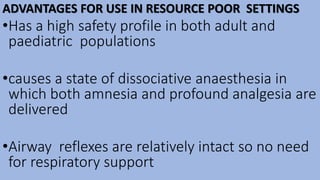
ADVANTAGES FOR USE IN RESOURCE POOR SETTINGS
•Has a high safety profile in both adult and
paediatric populations
•causes a state of dissociative anaesthesia in
which both amnesia and profound analgesia are
delivered
•Airway reflexes are relatively intact so no need
for respiratory support
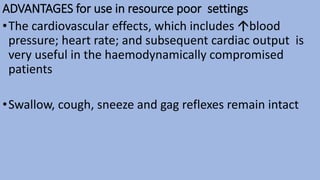
ADVANTAGES for use in resource poor settings
•The cardiovascular effects, which includes blood
pressure; heart rate; and subsequent cardiac output is
very useful in the haemodynamically compromised
patients
•Swallow, cough, sneeze and gag reflexes remain intact
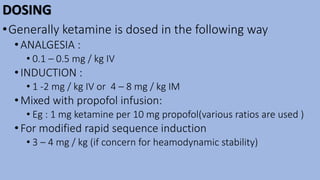
DOSING
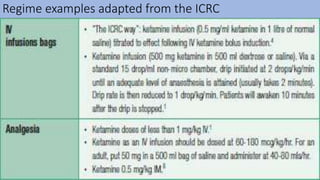
•Generally ketamine is dosed in the following way
•ANALGESIA :
• 0.1 – 0.5 mg / kg IV
•INDUCTION :
• 1 -2 mg / kg IV or 4 – 8 mg / kg IM
•Mixed with propofol infusion:
• Eg : 1 mg ketamine per 10 mg propofol(various ratios are used )
•For modified rapid sequence induction
• 3 – 4 mg / kg (if concern for heamodynamic stability)
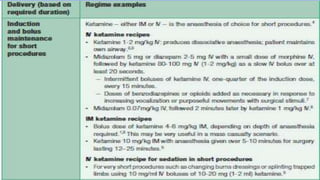
Regime examples adapted from the ICRC
SIDE EFFECTS
•Mostly related to the R enantiomer
•Increase pulse rate, high blood pressure
•Increased intracranial pressure.
• Transient reddening of the skin , transient measles-like
rash
• reduced appetite, nausea, increased salivation,
vomiting
•Pain, eruptions or rashes at the injection site
•tonic-clonic movements
SIDE EFFECTS
•Double vision , involuntary eye movements, tunnel vision
•Increased bronchial secretions
•Anaphylaxis,
•dependence,
• emergence reaction
•ketamine has been associated with
• cognitive deficits,
•urotoxicity,
•hepatotoxicity, and other complications in some individuals
with long-term use.
INTERACTIONS
•Plasma concentrations are  by
•CYP3A4 inhibitors (e.g., diazepam) and
• CYP2B6 inhibitors (e.g., orphenadrine)
•This is due to inhibition of its metabolism.
•Plasma levels are  by
• CYP2B6 and
• CYP3A4 inducers
• eg are carbamazepine, phenobarbital, phenytoin,
and rifampicin may  plasma levels of ketamine
INTERACTIONS
• Drugs which increase BP have an additive effect with ketamine on BP eg
stimulants, MAOIs.
• heart rate, palpitations, and arrhythmias may occur with above drugs
• the effects of alcohol, opioids , anticholinergics, and barbiturates
• Can cause siezures with theophylline
• Potentiation of neuromuscular blocking drugs
• Benzodiazepines may diminish the antidepressant effects of ketamine
ABSOLUTE CONTRAINDICATIONS
•Schizophrenia and psychosis
•Ketamine hypersensitivity
•Age < 3months( risk of respiratory complications )
•porphyria
•Hypertthyroidism and thyroid medication
•Uncontrolled epilepsy
Relative contraindications
•Posterior oropharynx procedures
•Pregnancy ??
•Tracheal surgery or tracheal stenosis
•Significant upper respiratory tract infection
•Uncontrolled Hypertension
•Eye injury / increased intraocular pressure(  is usually mild
<3-5mmhg)
DISPROVEN RELATIVE CONTRAINDICATIONS
•Coronary artery dx , CCF – theorecically risk of
worsening conditions
•Evidence shows improved cardiac
contractility,improvement of stunned myocardium
effect
•Increased intracranial pressure
•Newer data suggest safe in brain injury
,neuroprotective due to  cerebral perfusion
RECREATIONAL USE OF KETAMINE
• There is increase in the non-medical recreational use of ketamine,
particularly in individuals who frequent the night-time economy
• Recreational use of ketamine was first reported amongst those with
access to the drug, particularly medical professionals, in 1967
• It then spread beyond this group to the community-at-large, firstly
in the United States and then internationally
• This is usually associated with toxicities which can be acute or
chronic
RECREATIONAL USE OF KETAMINE – 2
• acute toxicity  neuro - behavioural abnormalities such as
agitation, hallucinations (falling into the k- Hole ), anxiety, psychosis.
• Secondarily  risk of physical harm/trauma.
• CVS features : hypertension and tachycardia
• The risk of death from recreational use is low and is predominately
due to the physical harm/trauma
• Chronic toxicity is associated with neuropsychiatric conditions such
as schizophrenia like syndrome, urologic disorders(heamorrhagic
cystitis ) hepatotoxicity
• Management both acute and chronic toxicities is largely supportive
and abstinence from ongoing exposure
Detection
•Ketamine may be quantitated in blood or plasma
•This may be needed to
• confirm a diagnosis of poisoning in hospitalized patients
• provide evidence in an impaired driving arrest or
• to assist in a medicolegal death investigation.
•Plasma concentrations are usually in a range of 0.5–5.0
mg/L in persons receiving the drug therapeutically
(during general anesthesia)
Detection – 2
•1–2 mg/L in those arrested for impaired driving
•3–20 mg/L in victims of acute fatal overdosage
• Urine is preferred specimen for routine drug use
monitoring purposes
•The presence of norketamine is useful for
confirmation of ketamine ingestion
CONCLUSION
• Ketamine is a special example of how an old drug can be readapted for new
applications.
• The mechanisms of ketamine's effects are mainly related to its inhibition of the
NMDA receptor and its pathway
• It has the potential to become a first-line antidepressive medication, especially
for refractory major depression, as well as in suicidal ideation and OCD
• It is of great importance to the family physician due to its relative high safety
profile in medical use and increasing emergence of acute and chronic toxicities
from non medical / recreational use
REFERENCE
• Mahoney P. F Etal .Anaesthesia In The ICRC Environment. In : Wood P .Craven R
.Jeyanathan J.Mahoney P.F . Aneasthesia Handbook .Geneva : 2017 7 .37
• Absalom A . Dissociative Anesthesia 2010 Https://Www.Researchgate .NET/Publication/
303657853
• General Anaesthesia By Attia
• Wikipedia
• Ketamine – What’s Old Is New Again By Kandhway V
• Ketamine , Can It Tame The Pain? By Glass C .Brtatalik D . Post . C
• Ketamine For Induction – Use In Prehospital Setting
• Gao M .Rejaeni D , Lui H .Ketamine Use In Current Clinical Practice . Acute Pharmacol
Sin 2016 Jul . 37 (7 ) : 865 – 872
• Ketamine – F P Notebook
• Kalsi S S . Wood D .Dargan P I The Epidemiology And Patterns Of Acute And Chronic
Toxicity Associated With recreational Ketamine Use .Emerging Health Threats Journal
2011. 4: 10 .3407 /Ehtj.V4i0.7107

Ketamine

  • 1.
    KETAMINE DR OGECHUKWU MBANU FAMILYMEDICINE DEPARTMENT AKTH KANO NIGERIA 21 / 9 /18
  • 2.
    OUTLINE •Introduction •History •Pharmacodynamics •Pharmacokinetics •Presentation •Routes of administration •Effects •Uses •Advantagesfor use in resourse poor settings •Regimen example •Side effects •Interactions •Contraindications •Recreational use of ketamine •Detection •conclusion
  • 3.
    INTRODUCTION •phencyclidine derivative thatproduces dissociative anesthesia •Evidence on the EEG of dissociation between the thalamocortical and limbic system •NMDA receptor antagonist •Racemic with two sterioisomers : R(- ) and S (+ )
  • 4.
    INTRODUCTION – 2 •One the World Health Organization's List of Essential Medicines, the most effective and safe medicines needed in a health system • Ketamine is frequently described as a "unique drug“ • This is because it has hypnotic, analgesic and amnesic effects - no other drug used in clinical practice combines these three important features • Also used in treatment of some psychogenic disorders and as a recreational drug • Also quite useful in vertrinary medicine for procedures
  • 5.
    HISTORY • First synthesizedin 1962 by Calvin L. Stevens, a professor of Chemistry at Wayne State University and a Parke-Davis consultant conducting research on alphahydroxyimine rearrangements • Initially tested in animals • first tested in humans in 1964 • approved for use in the United States in 1970 • Shortly after its US approval, it was extensively used for surgical anesthesia in the Vietnam War, due to its safety.
  • 6.
    HISTORY • Nonmedical useof ketamine began on the West Coast of the United States in the early 1970s(ecstasy) • Its psychiatric use also started in the 1970s • Become a federally controlled substance in the United States in 1999 • Much of the current ketamine diverted for nonmedical use originates in China and India
  • 8.
    Pharmacodynamics • Ketamine actsas a selective uncompetitive antagonist of the NMDA (N – Methyl – D – Aspartic acid) an ionotropic glutamate receptor found in neuronal cells • Blocks glutamate binding to these receptors thereby inhibiting the processing of CNS • S(+) and R(–) enantiomers • S(+) is 2- to 3-fold greater affinity for the receptor than R(–) so is more potent.
  • 9.
    Pharmacodynamics – 2 •BesidesNMDA receptor antagonism, other known actions of ketamine include : •Potentiator of the serotonin 5-HT3 receptor •Muscarinic acetylcholine receptor antagonist • Inhibitor of cholinesterase • Inhibitor of the reuptake of serotonin, norepinephrine, and dopamine • may also act via an agonist effect on k-opioid receptors •Mechanism of action for the antidepressant effects at lower doses is not yet to be fully understood
  • 10.
    Pharmacokinetics •Rapid onset ofaction, relatively short duration of action •water and lipid soluble • Initially distributed to highly perfused tissues such as brain •Undergoes extensive redistribution and can accumulate in fatty tissues •solubility ensures its rapid transfer across the BBB
  • 11.
    Pharmacokinetics 2 •Peak plasmaconcentrations occur within 1 min after IV administration & within 5 mins after IM injection •Oral ketamine is easily broken down by bile acids, thus has a low bioavailability •Ketamine undergoes hepatic metabolism. •N- Demethylation results in the major metabolite, - norketamine, and then dehydronorketamine
  • 12.
    Pharmacokinetics 3 •Norketamine possessessedative and analgesic properties (potency is 20 % of ketamine). •Ketamine has high hepatic clearance rate(1 L/min) •After hydroxylation and conjugation, norketamine is excreted by the kidneys •Dehydronorketamine and norketamine, are the most prevalent metabolite detected in urine
  • 13.
    Pharmacokinetics – 4 •Bioavailability through the oral route reaches 17–20%; • 93% intramuscularly, • 8–50% intranasally, • 30% sublingually, and • 30% rectally •Peak plasma concentrations are reached within • a minute intravenously, • 5 to 15 minutes intramuscularly and • 30 minutes orally •Ketamine's duration of action in a clinical setting is • 30 minutes to 2 hours intramuscularly and • 4 to 6 hours orally
  • 14.
    PRESENTATION •Ketamine was initiallypresented as a racemic mixture • The R(-) optical isomer is believed to be responsible for many of the drug’s unwanted effects • Ketamine in its pure S(+) optical isomeric is available. •The S(+) form is more potent and has a faster recovery time than the original form, allowing for lower doses with reduced psychological side effects
  • 15.
    PRESENTATION -- 2 •IfS(+) ketamine is used, approximately half the dose of the racemic mixture should be used •Concentration available includes 10, 50, 100 mg/ml formulations •The appropriate dose should always be calculated •Combination drugs are available such as ketaphol( ketamine + propofol),ketamine +fentanyl
  • 16.
    ROUTES OF ADMINISTRATION •Ketaminecan be given by either the intravenous route 1- 2 mg/kg or intramuscular route 4-8 mg/kg to provide anesthesia •Other routes of administration include •oral , •subcutaneous infusion • topical • intranasal /inhalational • rectal •Epidural
  • 17.
    EFFECT – CNS •Ketamineis potent cerebral vasodilator •Capable of increasing cerebral blood flow by 60% in normal individual & causes a rise in intracranial pressure • cerebral metabolic rate of oxygen consumption (CMRO2) •With i/v injection the effects on the CNS begin slowly than other anaesthetic induction agents (1-5 minutes for ketamine compared with 30 -60 seconds for Thiopentone) •The duration of action depends on the route of administration
  • 18.
    EFFECT – CNS2 • "dissociative anesthesia" -- patient is detached from the environment and self • In contrast to the smooth induction of anaesthesia, the patient may be agitated on recovery • This is often called "emergence delirium", during which the patient may be disorientated, restless, and even crying. • Patients may continue to experience unpleasant dreams up to 24 hours after the drug has been given
  • 19.
    EFFECTS – CVS •stimulaterather than depress the CVS • SBP rises about 20 to 40 mmhg • small  in diastolic •HR is  by about 20% •overall effect is therefore to increase the workload of the heart
  • 20.
    EFFECTS – CVS2 •BP rises steadily over 3-5 minutes and then returns to normal 10-20 minutes after injection •These increases do not seem to be dose-related when more than 1mg/kg is given •larger doses do not necessarily cause a greater increase in pressure •Premedication with midazolam may reduces this rise in blood pressure
  • 21.
    EFFECTS – RESPIRATORYSYSTEM •Airway is usually well maintained during Ketamine anesthesia •Some preservation of pharyngeal & laryngeal reflexes in comparison with other intravenous agents •However normal airway care must be maintained when possible •After a slow intravenous induction, breathing is well maintained and may even increase slightly
  • 22.
    EFFECTS – RESPIRATORYSYSTEM – 2 •Rapidly by IV injection causes the patient to stop breathing for a short time (up to one minute) •Following an intravenous induction with ketamine (2 mg/kg) the oxygen saturation falls •A simple oxygen mask or nasal prongs may be used. •Produces bronchodilation making it a useful anaesthetic drug for patients with asthma
  • 23.
    EFFECTS – THEEYE •The intra-ocular pressure rises for a short time after administration. •Eye movements may continue throughout surgery •Pupils are moderately dilated •It is not suitable for use in patients with a perforated eye injury •Also not suitable for ophthalmic surgery where a still eye is required.
  • 24.
    EFFECTS – OTHERS •SKELETALMUSCLE • Muscle tone is often increased. • Spontaneous movements may occur during anesthesia •UTERUS • Increases uterine tone without adverse effect on the uterine blood flow •PLACENTA • Ketamine crosses the placenta easily . •SECRETIONS • Salivation is increased
  • 25.
    USES • Anesthesia inchildren, as the sole anesthetic for minor procedures such as ear foreign body removal, entrapment of penis in zipper • Asthmatics or people with chronic obstructive airway disease • As a sedative for physically painful procedures in emergency departments • Emergency surgery in field conditions in war zones • To supplement spinal or epidural anesthesia/analgesia using low doses
  • 26.
    USES -- 2 •It is the anesthetic of choice when reliable ventilation equipment is not available • For people in shock may be due to sepsis or acute blood loss who are at risk of hypotension • Ketamine is a bronchodilator and can be used as part of the treatment for status asthmaticus • In Modified rapid sequence induction • For Patients who have strong allergy to sulfur group or egg protiens ( as is a component of thiopental and propofol respectively),ketamine may be used
  • 27.
    USES – 3 •Sub-anestheticdoses of ketamine i.e. 0.3 mg/kg/hr improves analgesia and may reduce the likelihood of opioid tolerance. •May be used for postoperative pain management. Low doses may  morphine use,  nausea, and  vomiting after surgery. •As an intravenous analgesic with opiates to manage intractable , neuropathic pain
  • 28.
    USES – PSYCHOTHERAPY •Ketamine at subanaesthetic doses is a rapid-acting used in depression disorders, • These antidepressant effects persist for at least a week following a single infusion • Not yet approved or marketed for use as an antidepressant though “ketamine clinics” give intravenous ketamine (off-label) to treat depression • It also may be effective in rapidly alleviating suicidal ideation • Intermittent treatment with low dose ketamine also results in long-term suppression of obsessions & compulsions in patients with obsessive compulsive disorder
  • 29.
    ADVANTAGES FOR USEIN RESOURCE POOR SETTINGS •Has a high safety profile in both adult and paediatric populations •causes a state of dissociative anaesthesia in which both amnesia and profound analgesia are delivered •Airway reflexes are relatively intact so no need for respiratory support
  • 30.
    ADVANTAGES for usein resource poor settings •The cardiovascular effects, which includes blood pressure; heart rate; and subsequent cardiac output is very useful in the haemodynamically compromised patients •Swallow, cough, sneeze and gag reflexes remain intact
  • 31.
    DOSING •Generally ketamine isdosed in the following way •ANALGESIA : • 0.1 – 0.5 mg / kg IV •INDUCTION : • 1 -2 mg / kg IV or 4 – 8 mg / kg IM •Mixed with propofol infusion: • Eg : 1 mg ketamine per 10 mg propofol(various ratios are used ) •For modified rapid sequence induction • 3 – 4 mg / kg (if concern for heamodynamic stability)
  • 33.
  • 34.
    SIDE EFFECTS •Mostly relatedto the R enantiomer •Increase pulse rate, high blood pressure •Increased intracranial pressure. • Transient reddening of the skin , transient measles-like rash • reduced appetite, nausea, increased salivation, vomiting •Pain, eruptions or rashes at the injection site •tonic-clonic movements
  • 35.
    SIDE EFFECTS •Double vision, involuntary eye movements, tunnel vision •Increased bronchial secretions •Anaphylaxis, •dependence, • emergence reaction •ketamine has been associated with • cognitive deficits, •urotoxicity, •hepatotoxicity, and other complications in some individuals with long-term use.
  • 36.
    INTERACTIONS •Plasma concentrations are by •CYP3A4 inhibitors (e.g., diazepam) and • CYP2B6 inhibitors (e.g., orphenadrine) •This is due to inhibition of its metabolism. •Plasma levels are  by • CYP2B6 and • CYP3A4 inducers • eg are carbamazepine, phenobarbital, phenytoin, and rifampicin may  plasma levels of ketamine
  • 37.
    INTERACTIONS • Drugs whichincrease BP have an additive effect with ketamine on BP eg stimulants, MAOIs. • heart rate, palpitations, and arrhythmias may occur with above drugs • the effects of alcohol, opioids , anticholinergics, and barbiturates • Can cause siezures with theophylline • Potentiation of neuromuscular blocking drugs • Benzodiazepines may diminish the antidepressant effects of ketamine
  • 38.
    ABSOLUTE CONTRAINDICATIONS •Schizophrenia andpsychosis •Ketamine hypersensitivity •Age < 3months( risk of respiratory complications ) •porphyria •Hypertthyroidism and thyroid medication •Uncontrolled epilepsy
  • 39.
    Relative contraindications •Posterior oropharynxprocedures •Pregnancy ?? •Tracheal surgery or tracheal stenosis •Significant upper respiratory tract infection •Uncontrolled Hypertension •Eye injury / increased intraocular pressure(  is usually mild <3-5mmhg)
  • 40.
    DISPROVEN RELATIVE CONTRAINDICATIONS •Coronaryartery dx , CCF – theorecically risk of worsening conditions •Evidence shows improved cardiac contractility,improvement of stunned myocardium effect •Increased intracranial pressure •Newer data suggest safe in brain injury ,neuroprotective due to  cerebral perfusion
  • 41.
    RECREATIONAL USE OFKETAMINE • There is increase in the non-medical recreational use of ketamine, particularly in individuals who frequent the night-time economy • Recreational use of ketamine was first reported amongst those with access to the drug, particularly medical professionals, in 1967 • It then spread beyond this group to the community-at-large, firstly in the United States and then internationally • This is usually associated with toxicities which can be acute or chronic
  • 42.
    RECREATIONAL USE OFKETAMINE – 2 • acute toxicity  neuro - behavioural abnormalities such as agitation, hallucinations (falling into the k- Hole ), anxiety, psychosis. • Secondarily  risk of physical harm/trauma. • CVS features : hypertension and tachycardia • The risk of death from recreational use is low and is predominately due to the physical harm/trauma • Chronic toxicity is associated with neuropsychiatric conditions such as schizophrenia like syndrome, urologic disorders(heamorrhagic cystitis ) hepatotoxicity • Management both acute and chronic toxicities is largely supportive and abstinence from ongoing exposure
  • 43.
    Detection •Ketamine may bequantitated in blood or plasma •This may be needed to • confirm a diagnosis of poisoning in hospitalized patients • provide evidence in an impaired driving arrest or • to assist in a medicolegal death investigation. •Plasma concentrations are usually in a range of 0.5–5.0 mg/L in persons receiving the drug therapeutically (during general anesthesia)
  • 44.
    Detection – 2 •1–2mg/L in those arrested for impaired driving •3–20 mg/L in victims of acute fatal overdosage • Urine is preferred specimen for routine drug use monitoring purposes •The presence of norketamine is useful for confirmation of ketamine ingestion
  • 45.
    CONCLUSION • Ketamine isa special example of how an old drug can be readapted for new applications. • The mechanisms of ketamine's effects are mainly related to its inhibition of the NMDA receptor and its pathway • It has the potential to become a first-line antidepressive medication, especially for refractory major depression, as well as in suicidal ideation and OCD • It is of great importance to the family physician due to its relative high safety profile in medical use and increasing emergence of acute and chronic toxicities from non medical / recreational use
  • 47.
    REFERENCE • Mahoney P.F Etal .Anaesthesia In The ICRC Environment. In : Wood P .Craven R .Jeyanathan J.Mahoney P.F . Aneasthesia Handbook .Geneva : 2017 7 .37 • Absalom A . Dissociative Anesthesia 2010 Https://Www.Researchgate .NET/Publication/ 303657853 • General Anaesthesia By Attia • Wikipedia • Ketamine – What’s Old Is New Again By Kandhway V • Ketamine , Can It Tame The Pain? By Glass C .Brtatalik D . Post . C • Ketamine For Induction – Use In Prehospital Setting • Gao M .Rejaeni D , Lui H .Ketamine Use In Current Clinical Practice . Acute Pharmacol Sin 2016 Jul . 37 (7 ) : 865 – 872 • Ketamine – F P Notebook • Kalsi S S . Wood D .Dargan P I The Epidemiology And Patterns Of Acute And Chronic Toxicity Associated With recreational Ketamine Use .Emerging Health Threats Journal 2011. 4: 10 .3407 /Ehtj.V4i0.7107

Editor's Notes

  • #4 NMDA == N – METHYL - D – ASPARTATIC ACID Ketamine has advantages over propofol & etomidate in not requiring a lipid emulsion vehicle. A RACEMIC MIXTURE IS ONE THAT HAS EQUAL AMOUNTS OF LEFT - AND RIGHT – HANDED ENANTIOMERS OF A CHIRAL MOLECULE AN ENANTIOMER HAS EACH PAIR OF MOLECULE AS A MIRROR IMAGE OF EACH OTHER . Dissociative anesthesia is a form of anesthesia characterized by catalepsy, catatonia, analgesia, and amnesia
  • #9 R(-) ketamine may preferentially bind to opioid receptors
  • #10 OTHER NMDA RECEPTOR BLOCKERS INCLUDE NITROUS OXIDE , XENON CYCLOPROPANE , DEXTROMETHORPHAN(AN ANTI TUSSIVE IN COUGH SYRUPS) , MUSCINOL (A POTENT GABA A AGONIST) , SALVINORIN , PHENCYCLIDINE THE SUBJECTIVE EFFECTS OF KETAMINE APPEAR TO BE MEDIATED BY INCREASED RELEASE OF GLUTAMATE (DEAKIN ET AL. 2008) AND ALSO BY INCREASED DOPAMINE RELEASE MEDIATED BY A GLUTAMATE-DOPAMINE INTERACTION IN THE POSTERIOR CINGULATE CORTEX (AALTO ET AL. 2005). DESPITE ITS SPECIFICITY IN RECEPTOR-LIGAND INTERACTIONS NOTED EARLIER, KETAMINE MAY CAUSE INDIRECT INHIBITORY EFFECTS ON GABA-ERGIC INTERNEURONS, RESULTING IN A DISINHIBITING EFFECT, WITH A RESULTING INCREASED RELEASE OF SEROTONIN, NOREPINEPHRINE, AND DOPAMINE 57 AT DOWNSTREAM SITES.
  • #18 The anesthetic state produced is frequently called "dissociative anesthesia" which implies that the patient is detached from the environment and self
  • #20 SBP = systolic BP There is no evidence to suggest that patients with a high preoperative blood pressure are at greater risk of developing a rise in blood pressure following ketamine administration when compared with normotensive patients. As the cardiovascular stimulation following ketamine is mediated through the sympathetic nervous system it would seem appropriate to give alpha or beta blockers to patients who develop excessively high blood pressures.
  • #22 Ketamine is used as a bronchodilator in the treatment of severe asthma. However, evidence of clinical benefit islimited
  • #27  is harmful in people with severe head injury
  • #29 a 2017 review described ketamine as the single most important advance in the treatment of depression in over 50 years.
  • #30 The drug has a high safety profile in both adult and paediatric populations and “emergence” issues are readily managed with benzodiazepines
  • #35 It does not increase ICP more than opioids
  • #36 EMERGENCE PHENOMENON CAN BE REDUCED BY MINIMIZING STIMULATION TO THE PERSON DURING RECOVERY AND PRETREATING WITH A BENZODIAZEPINE, ALONGSIDE A LOWER DOSE OF KETAMINE. SYMPTOMS FROM KETAMINE RECREATIONAL USE INCLUDES URINARY TRACT SYMPTOMS WHICH HAVE BEEN COLLECTIVELY REFERRED TO AS "KETAMINE-INDUCED ULCERATIVE CYSTITIS" OR "KETAMINE-INDUCED VESICOPATHY", AND THEY INCLUDE URGE INCONTINENCE, DECREASED BLADDER COMPLIANCE, DECREASED BLADDER VOLUME, DETRUSOR OVERACTIVITY, AND PAINFUL BLOOD IN URINE. BILATERAL HYDRONEPHROSIS AND RENAL PAPILLARY NECROSIS Management of these symptoms primarily involves ketamine cessation, for which compliance is low. Other treatments have been used, including antibiotics, NSAIDs, steroids, anticholinergics, and cystodistension