OPIOID
ANALGESICS
Dr. Krishna Singh, MBBS, MD
ANALGESICS
 Derived from the opium seed.
They are the drugs which relieves the deep seated
pain without causing loss of consciousness.
Pain is an unpleasant sensation which only the individual
himself can appreciate; it can’t be objectively defined
satisfactorily.
Pain receptors are distributed throughout the body.
Analgesics are divided into 2 groups:
1. Narcotic/ opioid/ morphine like analgesics.
2. Non_ narcotic/ non steroidal anti- inflammatory
analgesic _ antipyretic agents.
 Opioid analgesics act primarily at the level of
spinal cord & brain which NSAIDS act primarily at
peripheral sites to inhibit the synthesis of pain
sensitizing substances like PGs.
Endogenous Opioid Peptides & its respective recepters
•Endorphins, Endomorphins : greater affinity to miu receptor
•Enkephalins: affinity to delta receptors
•Dynorphins: . more potent on kappa receptors .
•Found in hypothalamus, thalamus, arculate nucleus ,brain stem,
dorsal horn of spinal cord (Brain ,spinal cord & some in
periphery Like GIT)
•These opioid peptides function as neuromodulator or
neurotransmitter. They appear to regulate pain responsiveness
at spinal & supra spinal levels.
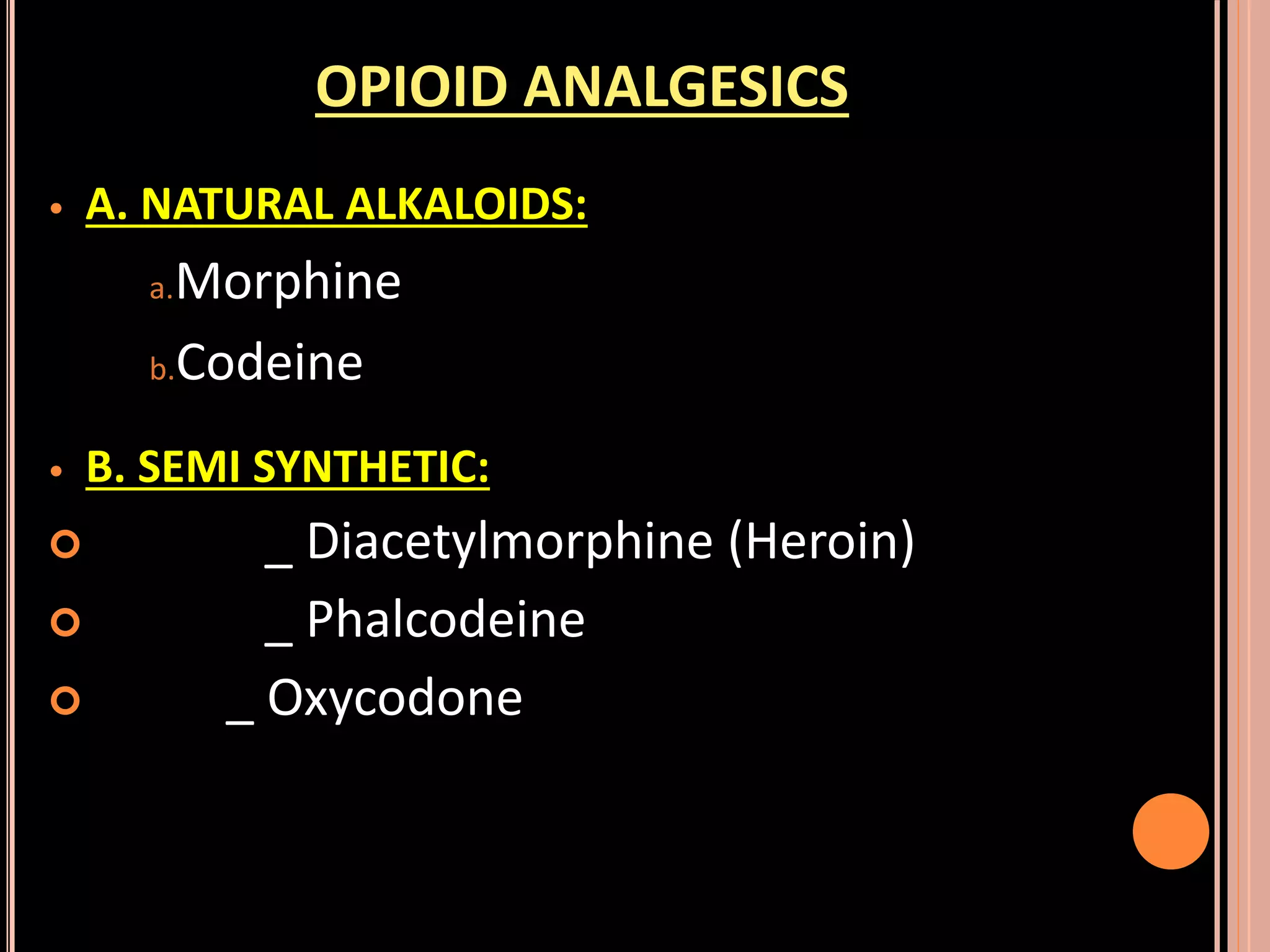
OPIOID ANALGESICS
• A. NATURAL ALKALOIDS:
a.Morphine
b.Codeine
• B. SEMI SYNTHETIC:
 _ Diacetylmorphine (Heroin)
 _ Phalcodeine
 _ Oxycodone
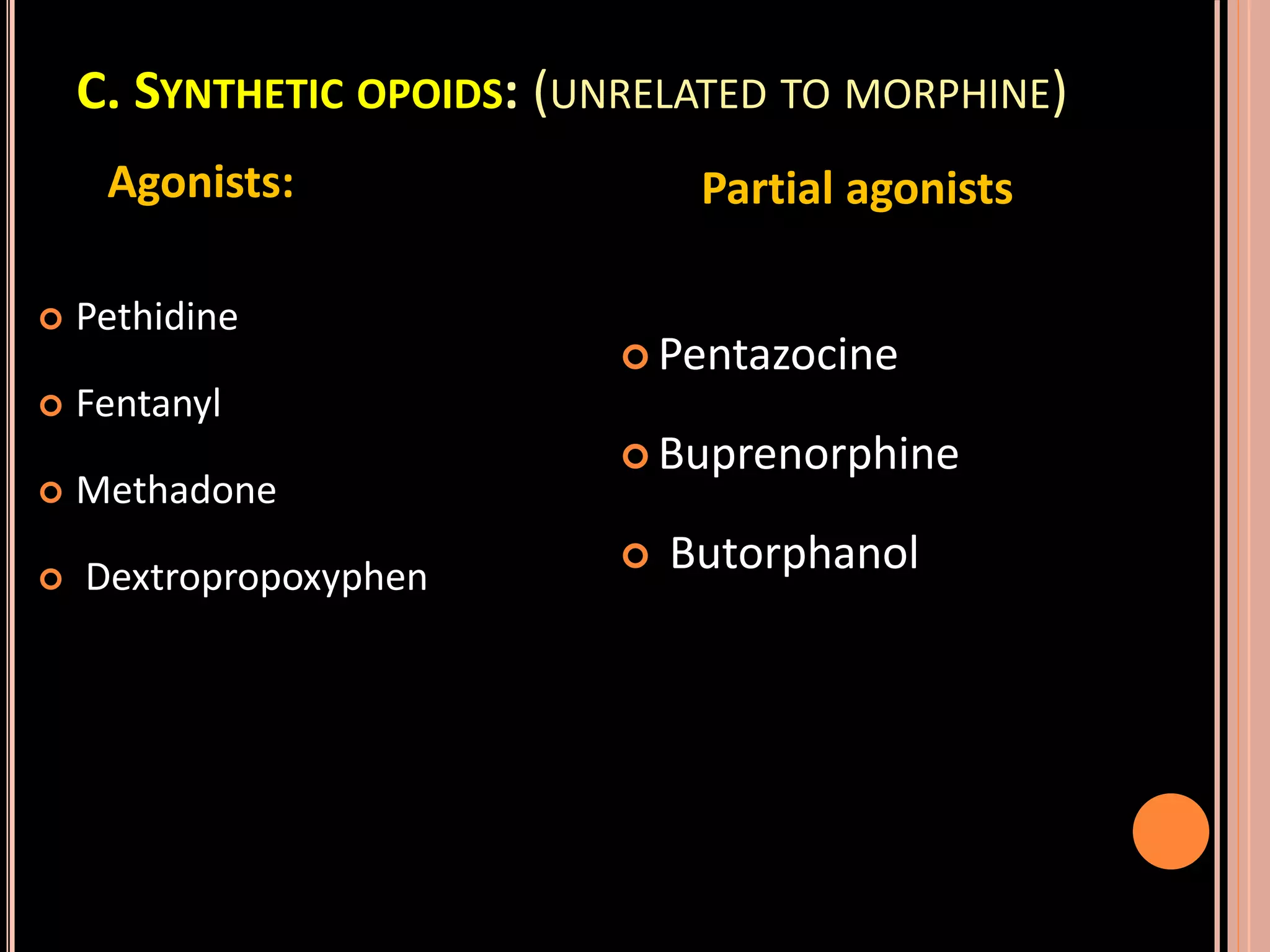
C. SYNTHETIC OPOIDS: (UNRELATED TO MORPHINE)
Agonists:
 Pethidine
 Fentanyl
 Methadone
 Dextropropoxyphen
Partial agonists
 Pentazocine
 Buprenorphine
 Butorphanol
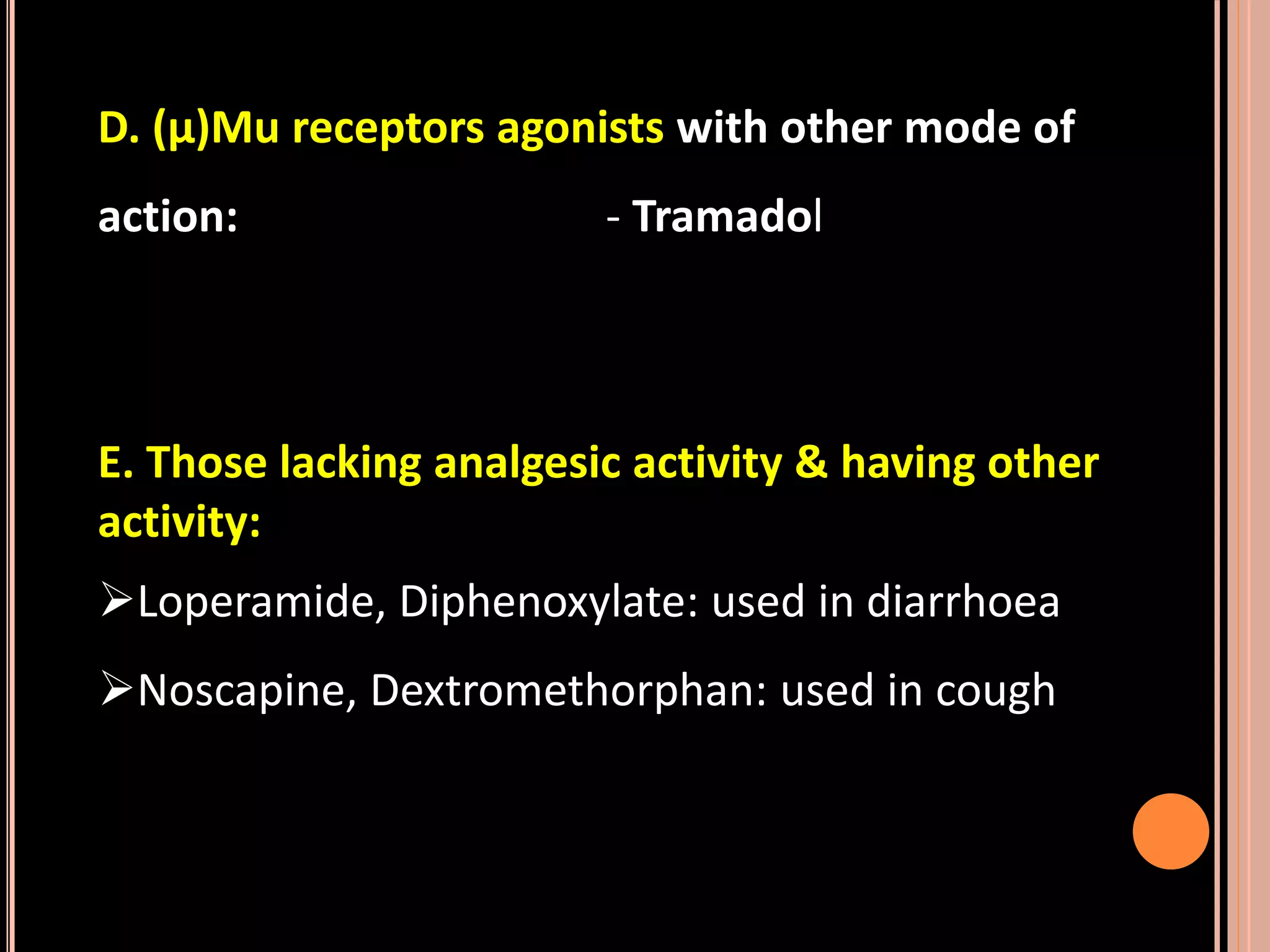
D. (µ)Mu receptors agonists with other mode of
action: - Tramadol
E. Those lacking analgesic activity & having other
activity:
Loperamide, Diphenoxylate: used in diarrhoea
Noscapine, Dextromethorphan: used in cough
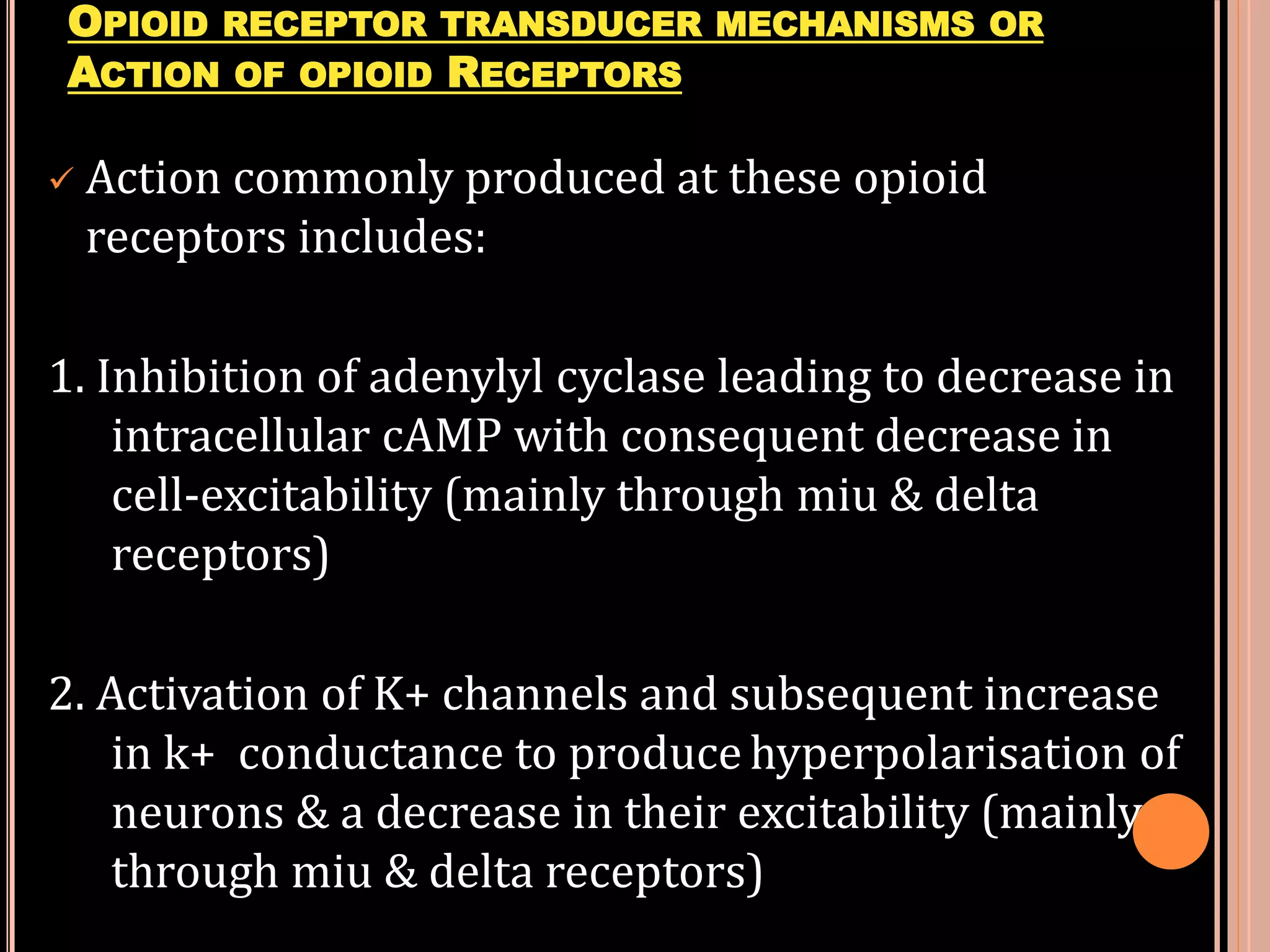
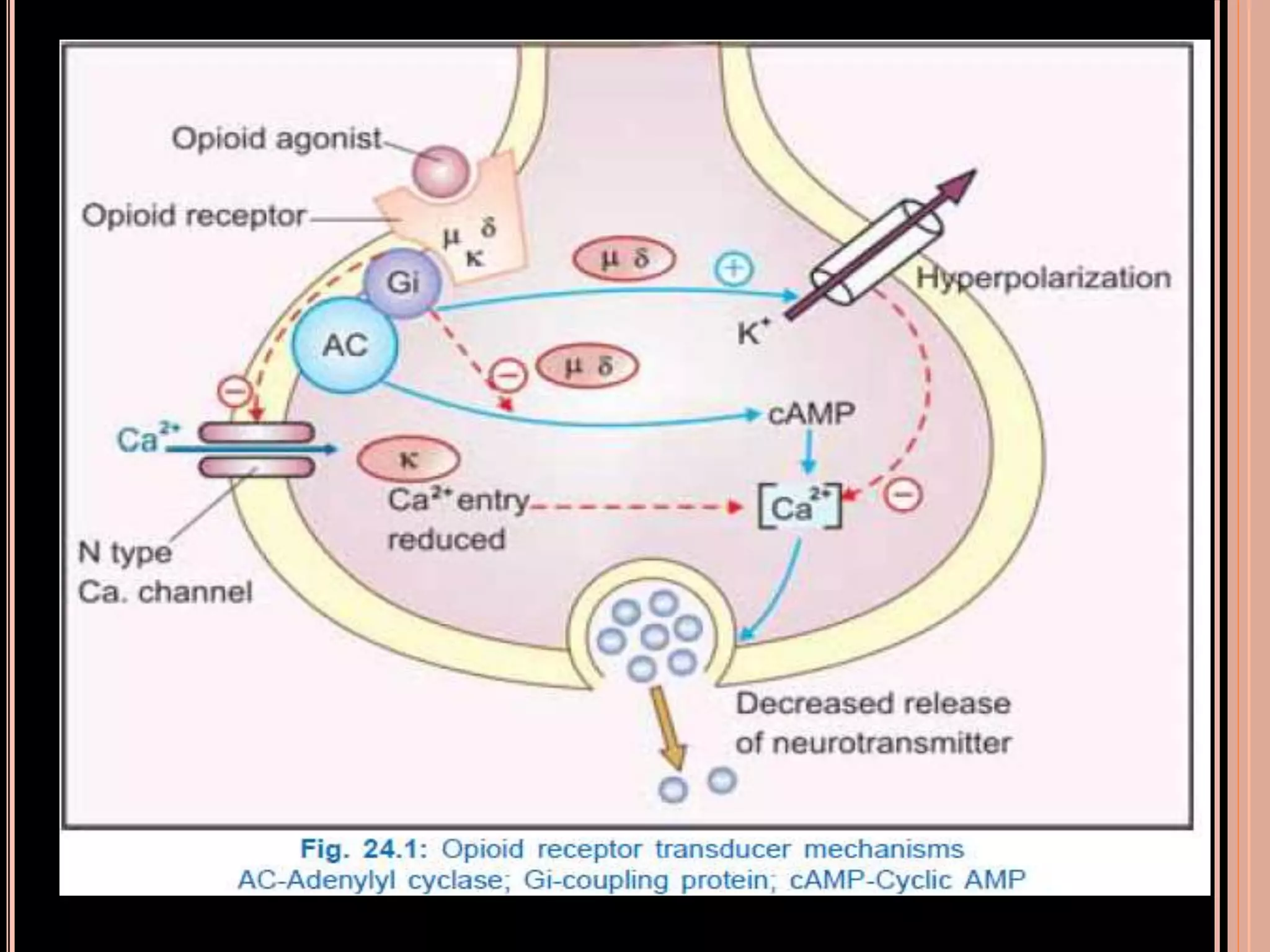
OPIOID RECEPTOR TRANSDUCER MECHANISMS OR
ACTION OF OPIOID RECEPTORS
 Action commonly produced at these opioid
receptors includes:
1. Inhibition of adenylyl cyclase leading to decrease in
intracellular cAMP with consequent decrease in
cell-excitability (mainly through miu & delta
receptors)
2. Activation of K+ channels and subsequent increase
in k+ conductance to produce hyperpolarisation of
neurons & a decrease in their excitability (mainly
through miu & delta receptors)
3. Inhibition of ca+ conductance by suppressing
voltage gated N- type ca+ channels (mainly through
kappa receptors) → decrease the release of
neurotransmitters like substance-P and glutamate
from nociceptive terminals.
Morphine & other opioids apparently mimic the
action of these ‘endogenous opioid peptides’ by
binding to various types of opioid receptors.
MORPHINE (Prototype opioid agonist):
A.CENTRAL PHARMACOLOGICAL EFFECTS:
C.N.S: Morphine has site specific depressant & stimulant
action in CNS.
1.Analgesia:
•Opioid induced analgesia involves both sensory as well
as affective (emotional) components. By acting on (µ)
periphery and both spinal & supra spinal brain areas,
particularly limbic system.
2.Euphoria, Dysphoria & convulsions:
•produces a sense of emotional well being (µ)termed
euphoria. It eliminates the normal fear, panic,
withdrawal & flight response to pain & aids analgesic
action of morphine.
•Ability to produce euphoria even in the absence of
pain makes morphine one of the worst drugs of abuse.
•dysphoria (kappa) characterized by restlessness &
malaise.
•In high doses morphine increase : supra spinal
stimulation which can lead to convulsions.
3. Sedation: Drowsiness & clouding of judgment
4. Respiratory depression: morphine produced
depression of respiration (µ) by direct depressant action
on brain stem respiratory centre
5.Cough suppression: Morphine & codeine : Cough
Centre is depressed
6.Temperature regulating centre: :hypothermia occurs
in cold
7.Vasomotor centre: is depressed at high doses &
contribute to fall in B.P
8.Nausea & vomiting: initially opioids directly stimulate
the CTZ & produce emesis. Later they depress the
vomiting centre.
9.Miosis: Edingerr Westphal Nucleus of 3rd nerve
stimulation producing miosis- (pin point pupil at
overdose).
10. Miscellaneous: morphine produced a release of
ADH with resultant decrease in urinary output.
Administration of morphine reduces the effiency of
diuretics in pts. with CHF.
 CVS: Morphine by a central action impairs
sympathetic tone & stimulates the vagal
centre causing dilatation of vessels
bradycardia
It also releases histamine (vasodilation).
B.Peripheral Pharmacological effects:
GIT & other smooth muscles::
Reduces propulsive peristaltic movements & leads to
constipation.
Relaxation of ureter: retention of urine
Increase the tone of bronchi & bronchioles causing
bronchospasm.
ADVERSE REACTIONS OF MORPHINE:
 Constipation
Vomiting
Headache
Postural hypotension
Urinary retention
Respiratory depression
Bronchospasm
Urticaria , itching (due to histamine release)
Tolerance & dependence (on prolonged use)
A withdrawal syndrome may occur in a morphine
addict.
Therapeutic uses 0f Morphine:
1. For relief of pain in condition such as:
Acute MI (minimizes shock due to severe pain)
Fracture of long bones
Biliary colic (in combination with atropine
Burns
Terminal stages of malignancy
2. Pre-anesthetic medication: for sedation to reduce
anxiety & apprehension.
3.Acute left ventricular failure (LVF): decrease the
preload and afterload
4. Pulmonary oedema.
IT REDUCES BOTH:
• Pre-load (by causing venodilatation)
and
After load (by causing arteriolar dilatation) to the
heart so it decreases myocardial O2 demand & cardiac
work.
Contraindication:
•Hypotension
•Hepatic damage
•Hypertrophy of prostate
•Head injury
•Bronchial asthma
•Babies
CODEINE:
•acts as a prodrug to morphine
•less potent analgesic used as antitussive & included in
many cough syrups
HEROIN : ( Diamorphine, Diacetylmorphine, brown
sugar)
•About 3 times more potent than morphine
•Produces greater euphoria & has greater dependence
liability
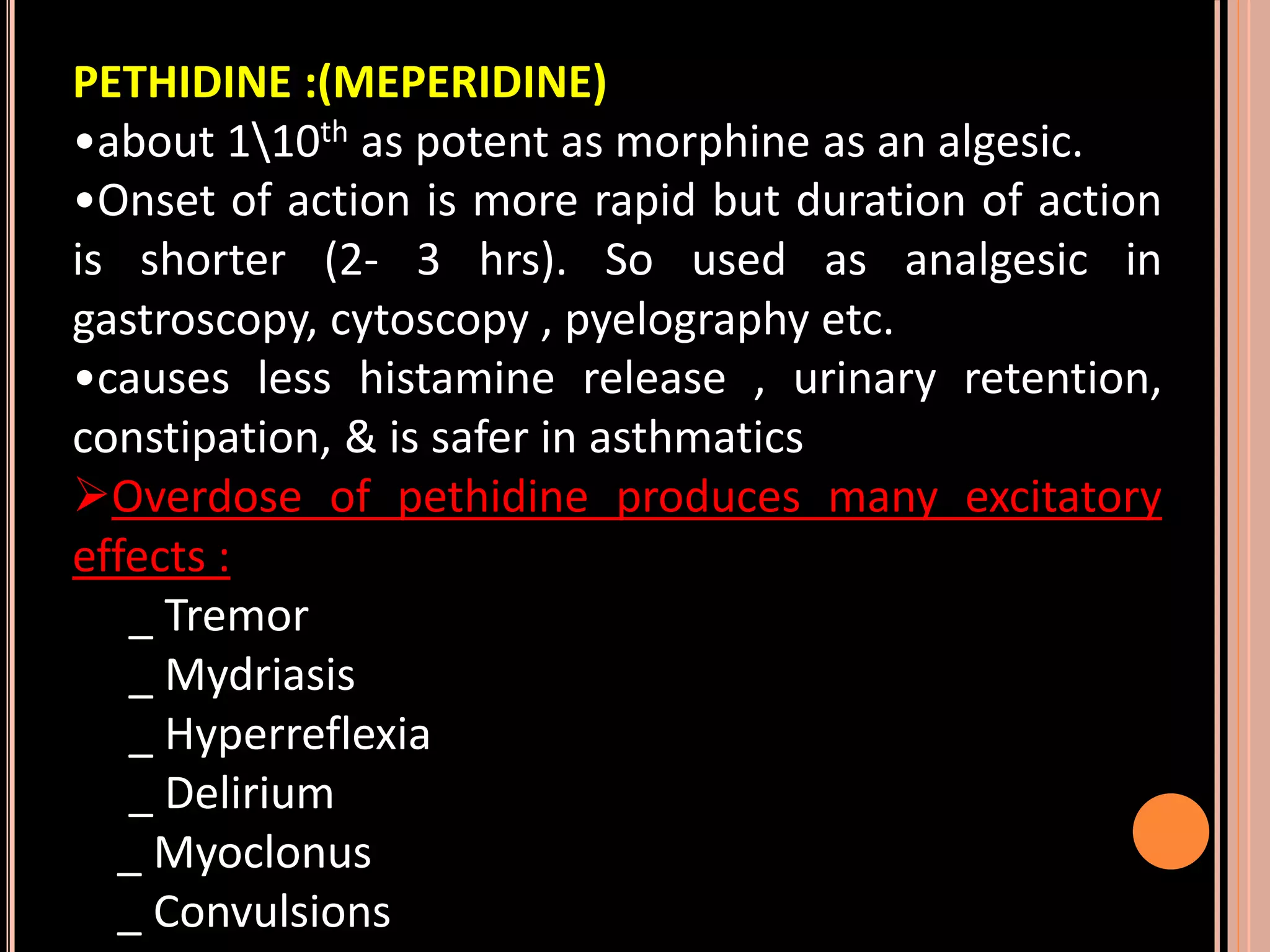
PETHIDINE :(MEPERIDINE)
•about 110th as potent as morphine as an algesic.
•Onset of action is more rapid but duration of action
is shorter (2- 3 hrs). So used as analgesic in
gastroscopy, cytoscopy , pyelography etc.
•causes less histamine release , urinary retention,
constipation, & is safer in asthmatics
Overdose of pethidine produces many excitatory
effects :
_ Tremor
_ Mydriasis
_ Hyperreflexia
_ Delirium
_ Myoclonus
_ Convulsions
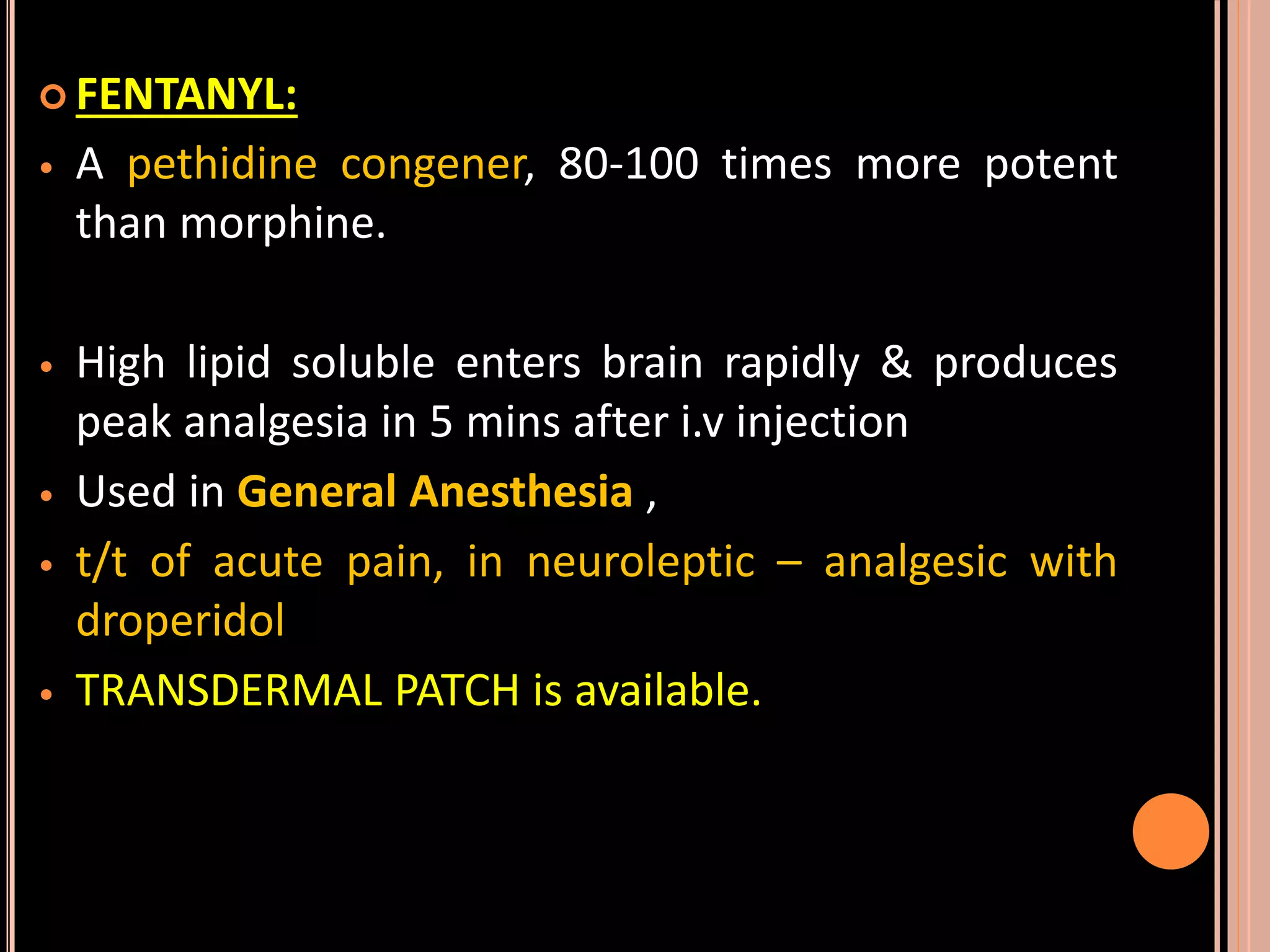
 FENTANYL:
• A pethidine congener, 80-100 times more potent
than morphine.
• High lipid soluble enters brain rapidly & produces
peak analgesia in 5 mins after i.v injection
• Used in General Anesthesia ,
• t/t of acute pain, in neuroleptic – analgesic with
droperidol
• TRANSDERMAL PATCH is available.
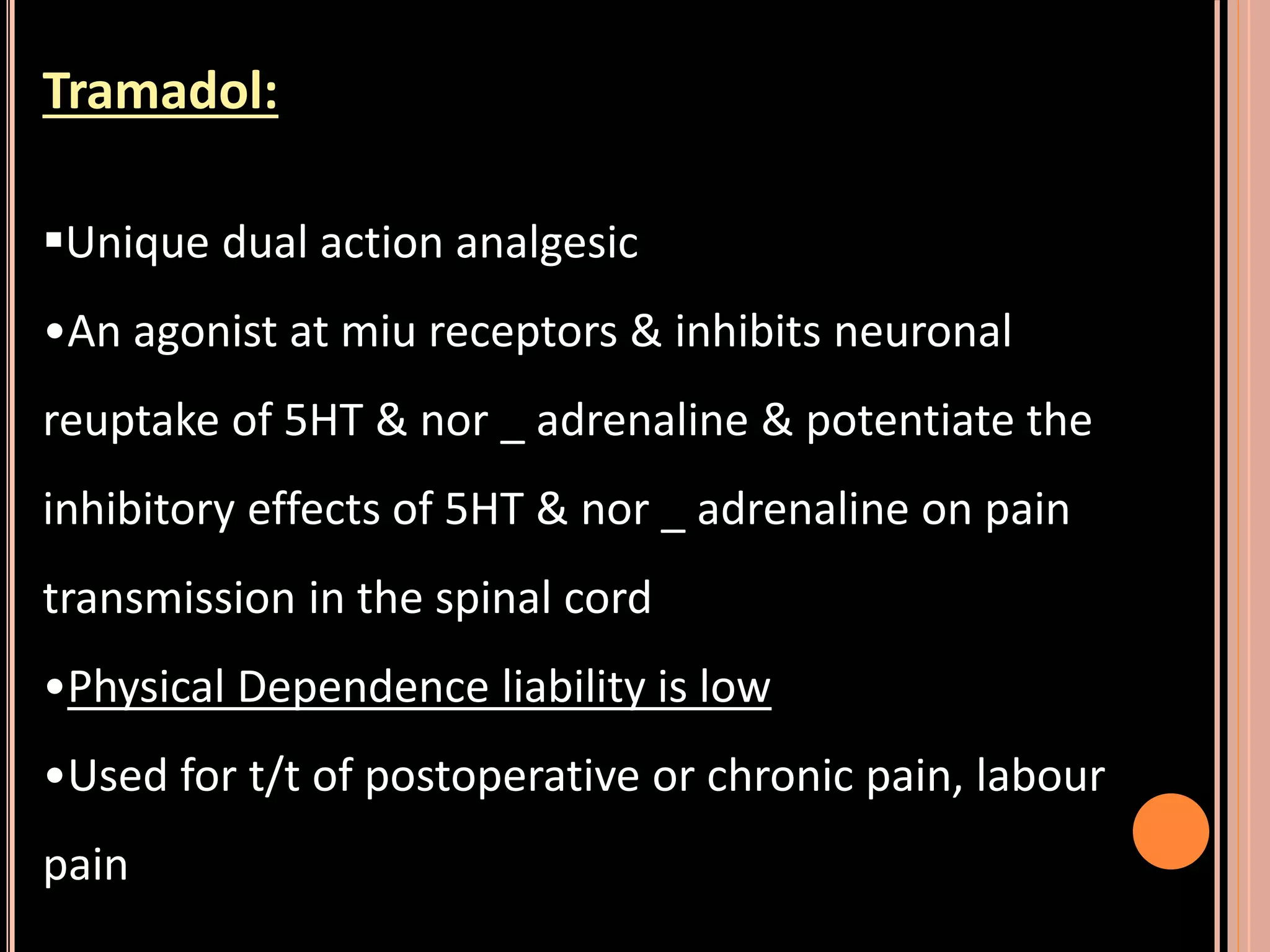
Tramadol:
Unique dual action analgesic
•An agonist at miu receptors & inhibits neuronal
reuptake of 5HT & nor _ adrenaline & potentiate the
inhibitory effects of 5HT & nor _ adrenaline on pain
transmission in the spinal cord
•Physical Dependence liability is low
•Used for t/t of postoperative or chronic pain, labour
pain
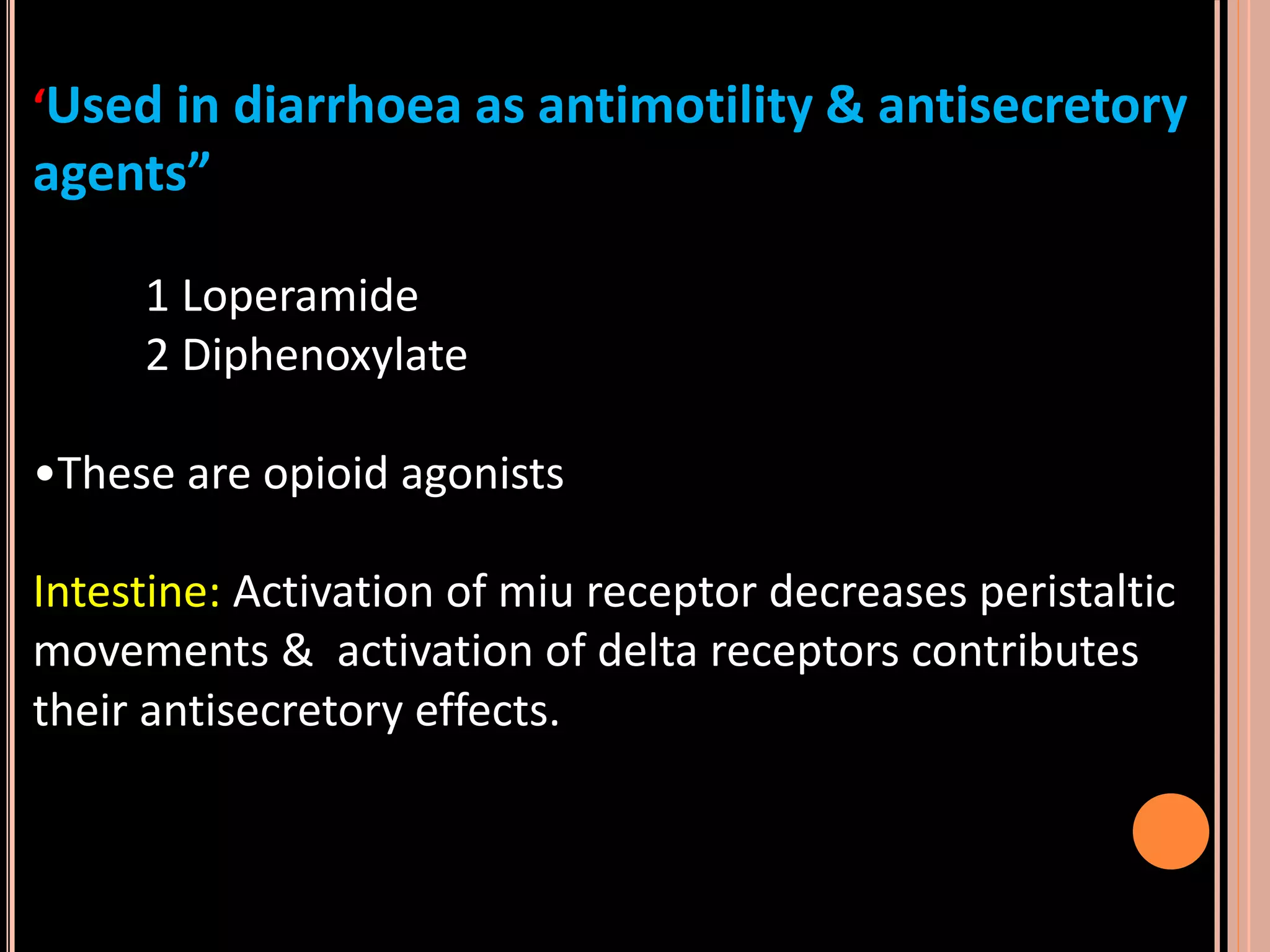
‘Used in diarrhoea as antimotility & antisecretory
agents”
1 Loperamide
2 Diphenoxylate
•These are opioid agonists
Intestine: Activation of miu receptor decreases peristaltic
movements & activation of delta receptors contributes
their antisecretory effects.
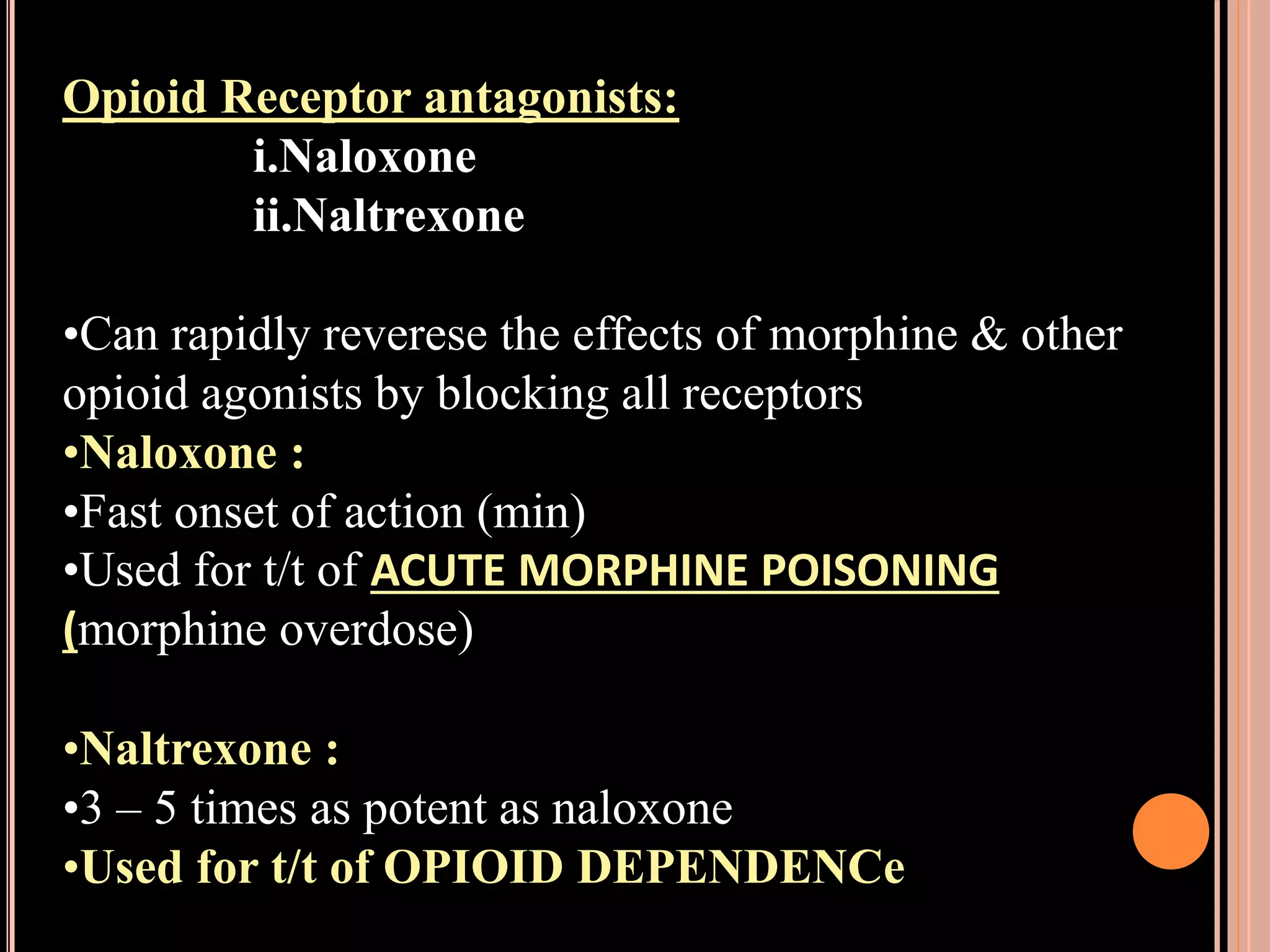
Opioid Receptor antagonists:
i.Naloxone
ii.Naltrexone
•Can rapidly reverese the effects of morphine & other
opioid agonists by blocking all receptors
•Naloxone :
•Fast onset of action (min)
•Used for t/t of ACUTE MORPHINE POISONING
(morphine overdose)
•Naltrexone :
•3 – 5 times as potent as naloxone
•Used for t/t of OPIOID DEPENDENCe
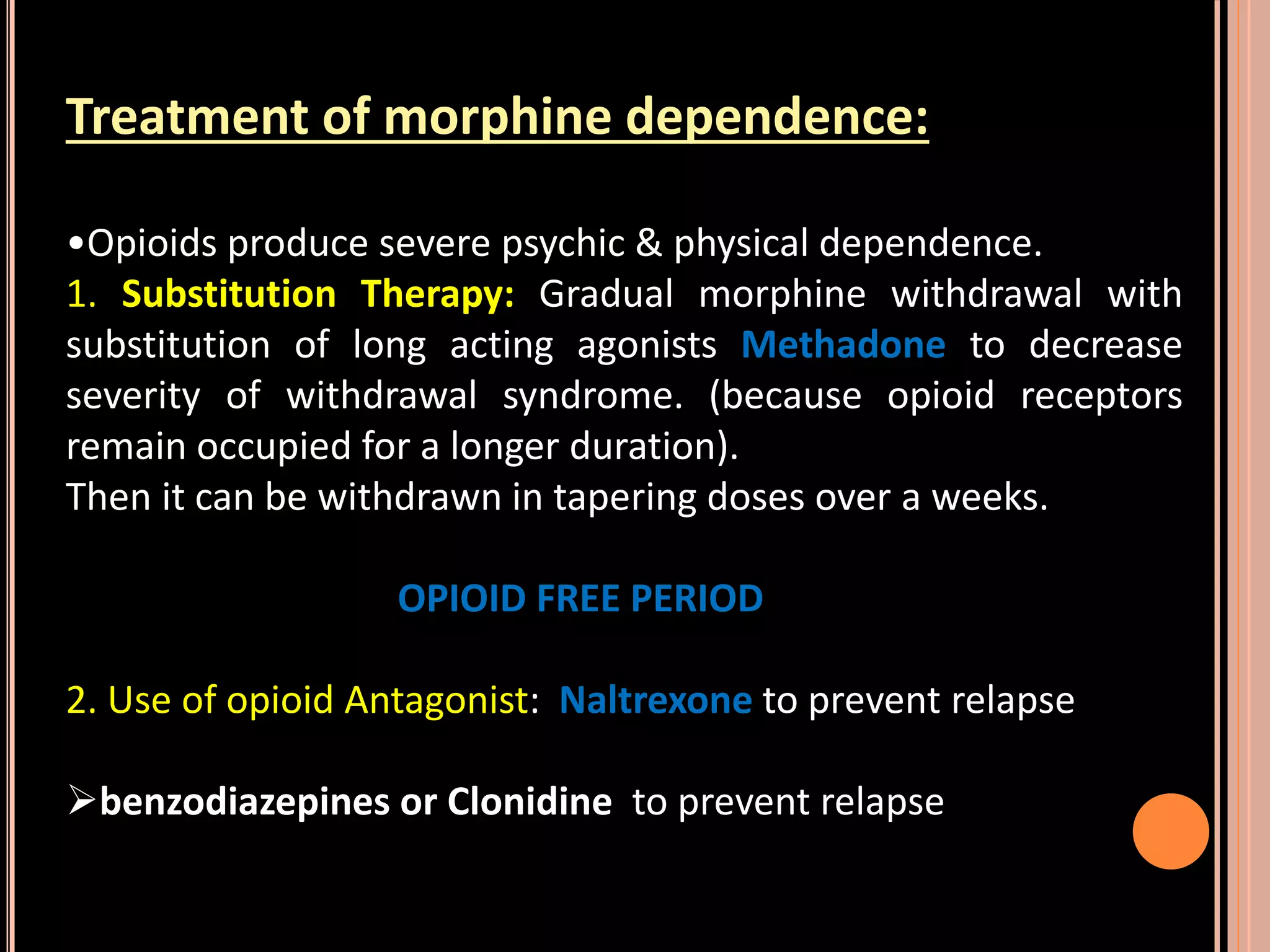
Treatment of morphine dependence:
•Opioids produce severe psychic & physical dependence.
1. Substitution Therapy: Gradual morphine withdrawal with
substitution of long acting agonists Methadone to decrease
severity of withdrawal syndrome. (because opioid receptors
remain occupied for a longer duration).
Then it can be withdrawn in tapering doses over a weeks.
OPIOID FREE PERIOD
2. Use of opioid Antagonist: Naltrexone to prevent relapse
benzodiazepines or Clonidine to prevent relapse
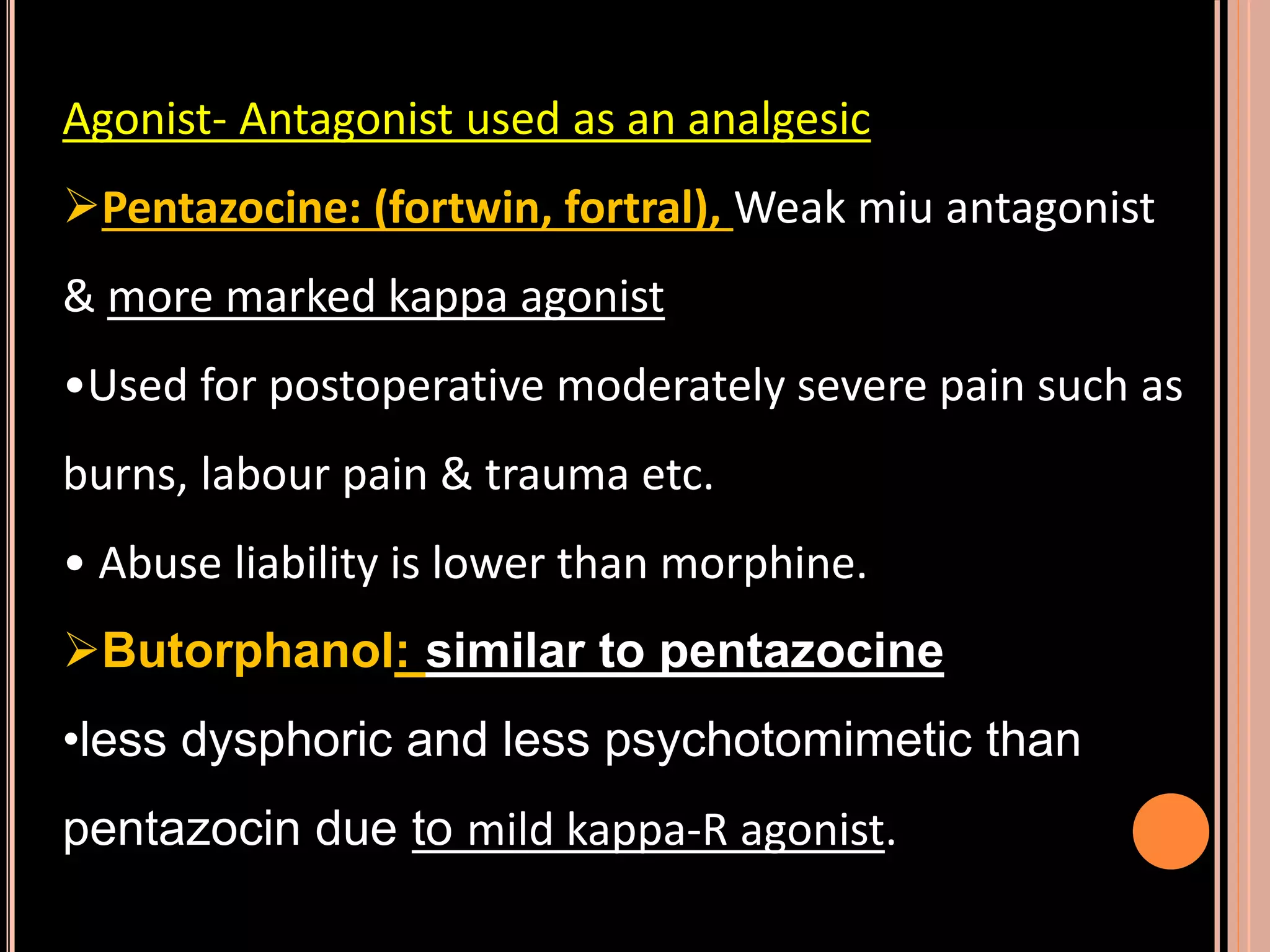
Agonist- Antagonist used as an analgesic
Pentazocine: (fortwin, fortral), Weak miu antagonist
& more marked kappa agonist
•Used for postoperative moderately severe pain such as
burns, labour pain & trauma etc.
• Abuse liability is lower than morphine.
Butorphanol: similar to pentazocine
•less dysphoric and less psychotomimetic than
pentazocin due to mild kappa-R agonist.
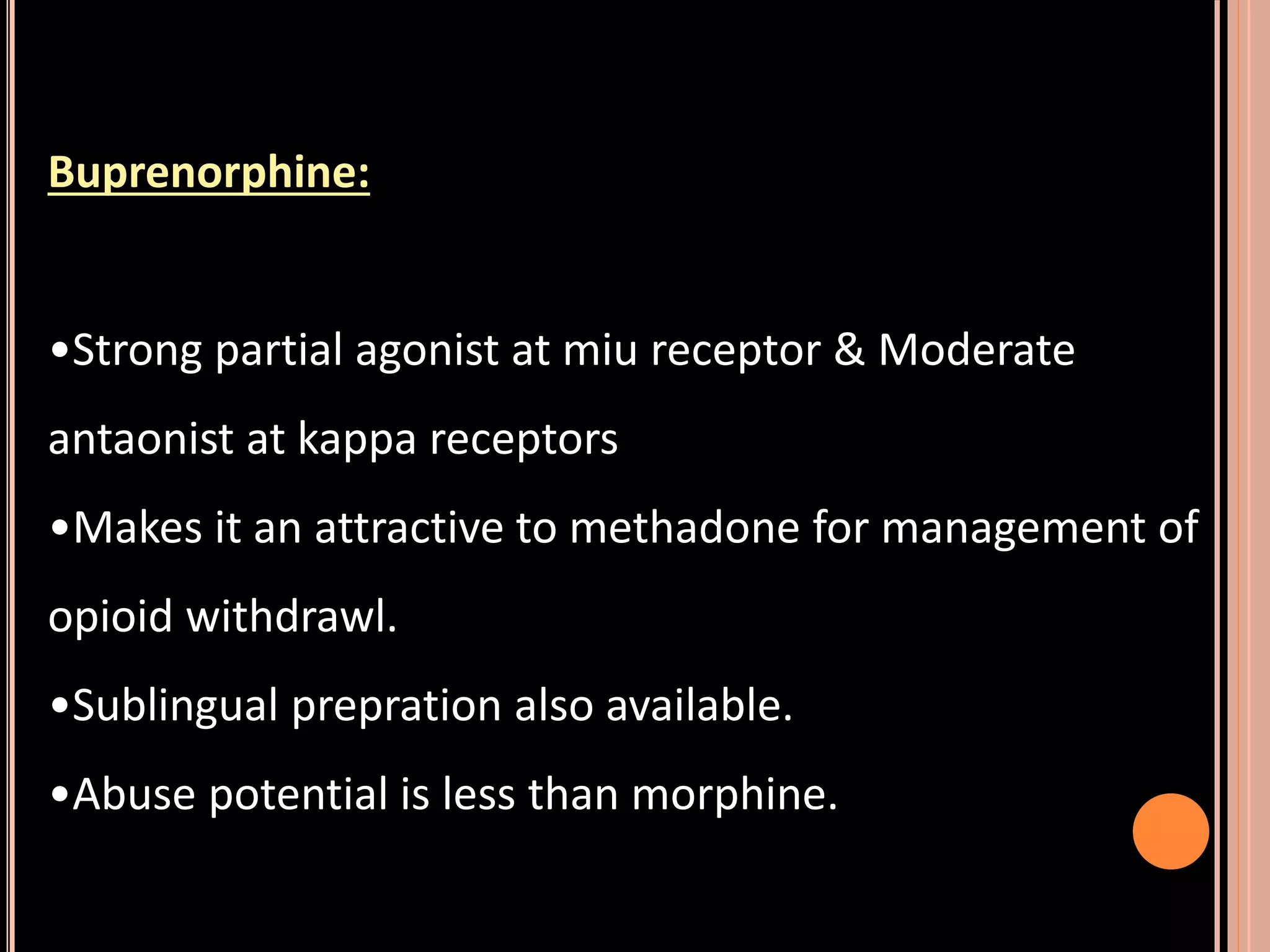
Buprenorphine:
•Strong partial agonist at miu receptor & Moderate
antaonist at kappa receptors
•Makes it an attractive to methadone for management of
opioid withdrawl.
•Sublingual prepration also available.
•Abuse potential is less than morphine.
Thank
you

OPIOIDS - Copy.ppt

  • 1.
  • 2.
    ANALGESICS  Derived fromthe opium seed. They are the drugs which relieves the deep seated pain without causing loss of consciousness. Pain is an unpleasant sensation which only the individual himself can appreciate; it can’t be objectively defined satisfactorily. Pain receptors are distributed throughout the body.
  • 3.
    Analgesics are dividedinto 2 groups: 1. Narcotic/ opioid/ morphine like analgesics. 2. Non_ narcotic/ non steroidal anti- inflammatory analgesic _ antipyretic agents.  Opioid analgesics act primarily at the level of spinal cord & brain which NSAIDS act primarily at peripheral sites to inhibit the synthesis of pain sensitizing substances like PGs.
  • 4.
    Endogenous Opioid Peptides& its respective recepters •Endorphins, Endomorphins : greater affinity to miu receptor •Enkephalins: affinity to delta receptors •Dynorphins: . more potent on kappa receptors . •Found in hypothalamus, thalamus, arculate nucleus ,brain stem, dorsal horn of spinal cord (Brain ,spinal cord & some in periphery Like GIT) •These opioid peptides function as neuromodulator or neurotransmitter. They appear to regulate pain responsiveness at spinal & supra spinal levels.
  • 5.
    OPIOID ANALGESICS • A.NATURAL ALKALOIDS: a.Morphine b.Codeine • B. SEMI SYNTHETIC:  _ Diacetylmorphine (Heroin)  _ Phalcodeine  _ Oxycodone
  • 6.
    C. SYNTHETIC OPOIDS:(UNRELATED TO MORPHINE) Agonists:  Pethidine  Fentanyl  Methadone  Dextropropoxyphen Partial agonists  Pentazocine  Buprenorphine  Butorphanol
  • 7.
    D. (µ)Mu receptorsagonists with other mode of action: - Tramadol E. Those lacking analgesic activity & having other activity: Loperamide, Diphenoxylate: used in diarrhoea Noscapine, Dextromethorphan: used in cough
  • 8.
    OPIOID RECEPTOR TRANSDUCERMECHANISMS OR ACTION OF OPIOID RECEPTORS  Action commonly produced at these opioid receptors includes: 1. Inhibition of adenylyl cyclase leading to decrease in intracellular cAMP with consequent decrease in cell-excitability (mainly through miu & delta receptors) 2. Activation of K+ channels and subsequent increase in k+ conductance to produce hyperpolarisation of neurons & a decrease in their excitability (mainly through miu & delta receptors)
  • 9.
    3. Inhibition ofca+ conductance by suppressing voltage gated N- type ca+ channels (mainly through kappa receptors) → decrease the release of neurotransmitters like substance-P and glutamate from nociceptive terminals. Morphine & other opioids apparently mimic the action of these ‘endogenous opioid peptides’ by binding to various types of opioid receptors.
  • 11.
    MORPHINE (Prototype opioidagonist): A.CENTRAL PHARMACOLOGICAL EFFECTS: C.N.S: Morphine has site specific depressant & stimulant action in CNS. 1.Analgesia: •Opioid induced analgesia involves both sensory as well as affective (emotional) components. By acting on (µ) periphery and both spinal & supra spinal brain areas, particularly limbic system.
  • 12.
    2.Euphoria, Dysphoria &convulsions: •produces a sense of emotional well being (µ)termed euphoria. It eliminates the normal fear, panic, withdrawal & flight response to pain & aids analgesic action of morphine. •Ability to produce euphoria even in the absence of pain makes morphine one of the worst drugs of abuse. •dysphoria (kappa) characterized by restlessness & malaise. •In high doses morphine increase : supra spinal stimulation which can lead to convulsions.
  • 13.
    3. Sedation: Drowsiness& clouding of judgment 4. Respiratory depression: morphine produced depression of respiration (µ) by direct depressant action on brain stem respiratory centre 5.Cough suppression: Morphine & codeine : Cough Centre is depressed 6.Temperature regulating centre: :hypothermia occurs in cold
  • 14.
    7.Vasomotor centre: isdepressed at high doses & contribute to fall in B.P 8.Nausea & vomiting: initially opioids directly stimulate the CTZ & produce emesis. Later they depress the vomiting centre. 9.Miosis: Edingerr Westphal Nucleus of 3rd nerve stimulation producing miosis- (pin point pupil at overdose). 10. Miscellaneous: morphine produced a release of ADH with resultant decrease in urinary output. Administration of morphine reduces the effiency of diuretics in pts. with CHF.
  • 15.
     CVS: Morphineby a central action impairs sympathetic tone & stimulates the vagal centre causing dilatation of vessels bradycardia It also releases histamine (vasodilation).
  • 16.
    B.Peripheral Pharmacological effects: GIT& other smooth muscles:: Reduces propulsive peristaltic movements & leads to constipation. Relaxation of ureter: retention of urine Increase the tone of bronchi & bronchioles causing bronchospasm.
  • 17.
    ADVERSE REACTIONS OFMORPHINE:  Constipation Vomiting Headache Postural hypotension Urinary retention Respiratory depression Bronchospasm Urticaria , itching (due to histamine release) Tolerance & dependence (on prolonged use) A withdrawal syndrome may occur in a morphine addict.
  • 18.
    Therapeutic uses 0fMorphine: 1. For relief of pain in condition such as: Acute MI (minimizes shock due to severe pain) Fracture of long bones Biliary colic (in combination with atropine Burns Terminal stages of malignancy
  • 19.
    2. Pre-anesthetic medication:for sedation to reduce anxiety & apprehension. 3.Acute left ventricular failure (LVF): decrease the preload and afterload 4. Pulmonary oedema. IT REDUCES BOTH: • Pre-load (by causing venodilatation) and After load (by causing arteriolar dilatation) to the heart so it decreases myocardial O2 demand & cardiac work.
  • 20.
    Contraindication: •Hypotension •Hepatic damage •Hypertrophy ofprostate •Head injury •Bronchial asthma •Babies
  • 21.
    CODEINE: •acts as aprodrug to morphine •less potent analgesic used as antitussive & included in many cough syrups HEROIN : ( Diamorphine, Diacetylmorphine, brown sugar) •About 3 times more potent than morphine •Produces greater euphoria & has greater dependence liability
  • 22.
    PETHIDINE :(MEPERIDINE) •about 110thas potent as morphine as an algesic. •Onset of action is more rapid but duration of action is shorter (2- 3 hrs). So used as analgesic in gastroscopy, cytoscopy , pyelography etc. •causes less histamine release , urinary retention, constipation, & is safer in asthmatics Overdose of pethidine produces many excitatory effects : _ Tremor _ Mydriasis _ Hyperreflexia _ Delirium _ Myoclonus _ Convulsions
  • 23.
     FENTANYL: • Apethidine congener, 80-100 times more potent than morphine. • High lipid soluble enters brain rapidly & produces peak analgesia in 5 mins after i.v injection • Used in General Anesthesia , • t/t of acute pain, in neuroleptic – analgesic with droperidol • TRANSDERMAL PATCH is available.
  • 24.
    Tramadol: Unique dual actionanalgesic •An agonist at miu receptors & inhibits neuronal reuptake of 5HT & nor _ adrenaline & potentiate the inhibitory effects of 5HT & nor _ adrenaline on pain transmission in the spinal cord •Physical Dependence liability is low •Used for t/t of postoperative or chronic pain, labour pain
  • 25.
    ‘Used in diarrhoeaas antimotility & antisecretory agents” 1 Loperamide 2 Diphenoxylate •These are opioid agonists Intestine: Activation of miu receptor decreases peristaltic movements & activation of delta receptors contributes their antisecretory effects.
  • 26.
    Opioid Receptor antagonists: i.Naloxone ii.Naltrexone •Canrapidly reverese the effects of morphine & other opioid agonists by blocking all receptors •Naloxone : •Fast onset of action (min) •Used for t/t of ACUTE MORPHINE POISONING (morphine overdose) •Naltrexone : •3 – 5 times as potent as naloxone •Used for t/t of OPIOID DEPENDENCe
  • 27.
    Treatment of morphinedependence: •Opioids produce severe psychic & physical dependence. 1. Substitution Therapy: Gradual morphine withdrawal with substitution of long acting agonists Methadone to decrease severity of withdrawal syndrome. (because opioid receptors remain occupied for a longer duration). Then it can be withdrawn in tapering doses over a weeks. OPIOID FREE PERIOD 2. Use of opioid Antagonist: Naltrexone to prevent relapse benzodiazepines or Clonidine to prevent relapse
  • 28.
    Agonist- Antagonist usedas an analgesic Pentazocine: (fortwin, fortral), Weak miu antagonist & more marked kappa agonist •Used for postoperative moderately severe pain such as burns, labour pain & trauma etc. • Abuse liability is lower than morphine. Butorphanol: similar to pentazocine •less dysphoric and less psychotomimetic than pentazocin due to mild kappa-R agonist.
  • 29.
    Buprenorphine: •Strong partial agonistat miu receptor & Moderate antaonist at kappa receptors •Makes it an attractive to methadone for management of opioid withdrawl. •Sublingual prepration also available. •Abuse potential is less than morphine.
  • 30.