Opioid Analgesics
Sameen Rashid
M.Phil. Pharmacology
Analgesics
Analgesics, or pain killers, that bind to opioid receptors which are
found principally in the:
CNS
Gastrointestinal tract
Classification:
Natural opiates
Semi-synthetic Opiates
Fully synthetic opioids
Endogenous opioid peptides
• Actions
•
Full agonists - Morphine
• partial agonists - Codeine
• Antagonists - Nalbuphine
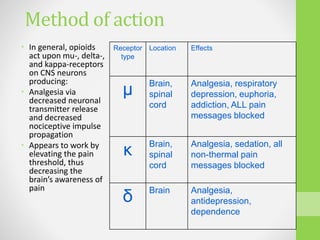
Method of action
Receptor
type
Location Effects
μ Brain,
spinal
cord
Analgesia, respiratory
depression, euphoria,
addiction, ALL pain
messages blocked
κ Brain,
spinal
cord
Analgesia, sedation, all
non-thermal pain
messages blocked
δ Brain Analgesia,
antidepression,
dependence
• In general, opioids
act upon mu-, delta-,
and kappa-receptors
on CNS neurons
producing:
• Analgesia via
decreased neuronal
transmitter release
and decreased
nociceptive impulse
propagation
• Appears to work by
elevating the pain
threshold, thus
decreasing the
brain’s awareness of
pain
Pharmacokinetics
Absorption
• Most opioid analgesics are well absorbed when
given by subcutaneous, intramuscular, and oral
routes
• Other routes of opioid administration include
oral mucosa via lozenges, and transdermal via
transdermal patches.
• Recently an iontophoretic transdermal system
has been introduced, allowing needle-free
delivery of fentanyl for patient-controlled
analgesia.
Distribution
• All opioids bind to plasma proteins with varying
affinity.
• the drugs rapidly leave the blood compartment
and localize in highest concentrations in tissues.
• Drug concentrations in skeletal muscle may be
much lower, but this tissue serves as the main
reservoir because of its greater bulk.
Metabolism
• The opioids are converted in large part to polar
metabolites.
• Morphine is metabolized to M3G and M6G.
• M3G, a compound with neuroexcitatory
properties and M6G, an active metabolite with
analgesic property.
• Esters (e.g, heroin, remifentanil) are rapidly
hydrolyzed by common tissue esterases.
• Heroin (diacetylmorphine) is hydrolyzed to
monoacetylmorphine and finally to morphine,
which is then conjugated with glucuronic acid.
Excretion
• Polar metabolites, including glucuronide
conjugates of opioid analgesics, are excreted
mainly in the urine.
• Small amounts of unchanged drug may also be
found in the urine.
• Glucuronide conjugates are found in the bile.
• Enterohepatic circulation represents only a small
portion of the excretory process.
Pharmacodynamics
Mechanism of Action
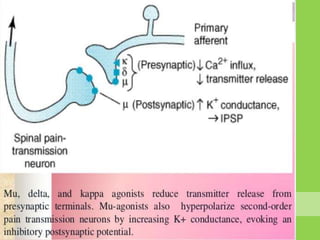
• Opioid drug bind to opioid receptor widely
distributed in CNS and other tissues.
• A part of family of G- protein complex receptors.
• Open K+ Channels.
• Prevent opening of Ca2+ channels.
• Inhibit the release of other neurotransmitters.
Properties of Morphine
• Good for treating dull, constant pain rather than sharp,
periodic pain
• Unfortunately, it also has a large number of side effects
including:
• Depression of the respiratory centre
• Constipation
• Excitation
• Euphoria
• Nausea
• Pupil constriction
• Tolerance and dependence
Clinical Uses
• Analgesia
• Acute Pulmonary Edema
• Cough Suppression
• Diarrhea
• Severe cute shooting visceral pain.
• MI.
• Shivering
• Terminal stages of malignancy.
• Severe crush injuries.
• Postoperative pain.
• Applications in Anesthesia
Side effects
• Tolerance
• Dependence
• Addiction
• Death
• Confusion
• Constipation
• Dizziness
• Respiratory depression
• Hallucination
• Hypotension
• Itching
• Nausea
• Sedation
• Rash
Withdrawal symptoms
• Anorexia
• Weight loss
• Pupil dilation
• Chills
• Excessive sweating
• Abdominal cramps
• Muscle spasms
• Hyperirritability
• Lacrimation
• Tremor
• Increased heart rate
• Increased blood pressure
Overdose
• A study was done in W. Virginia to evaluate persons dying
of unintentional pharmaceutical overdose, the types of
drugs involved and role of drug abuse in the deaths.
• Opioid analgesics were taken by 93.2% (275/295) of all
people who died of pharmaceutical overdoses in W.
Virginia in 2006.
• Only 44.4% (122/275) of those people had ever been
prescribed these drugs.
• The majority of overdose deaths in West Virginia in 2006
were associated with nonmedical use and diversion of
pharmaceuticals, primarily opioid analgesics.
Treatment of Opioid
Overdosage
• Intravenous injection of naloxone dramatically reverses coma
due to opioid overdose but not that due to other CNS
depressants. Use of the antagonist should not, of course,
delay the institution of other therapeutic measures, especially
respiratory support.
Treatment for addiction
• Several treatments and treatment strategies exist for opioid
addiction. They are
• The Cold Turkey Approach
• Traditional Opioid Drug Treatment
• Rapid Detoxification
The Cold Turkey Method
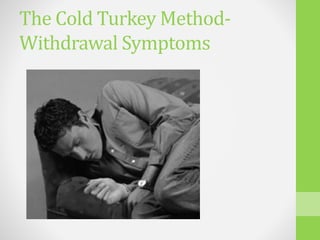
• About eight to twelve hours after the last heroin use, an
addict's eyes begin to tear and he/she starts to experience flu-
like symptoms: sneezing, weakness, depression, muscle
cramps, nausea, vomiting, diarrhea. The symptoms increase in
severity over two to three days.
• Within a week to 10 days the illness is over.
• The phrase 'cold turkey' probably comes from the appearance
of goose bumps all over the body, which resembles a plucked
turkey. Muscle spasms in the legs produce kicking movements,
and this may be the derivation of the expression 'kick the
habit.'
The Cold Turkey Method-
Withdrawal Symptoms
Traditional Drug Based
Treatments- Methadone
• Methadone has traditionally been provided to the
addiction population
• Numerous clinics start addicts at 30mg and raise the
dosage 10mg a day until the addict feels they are at a
comfortable level of dosage.
• At proper dosing, methadone usually reduces the
appetite for and need to take heroin.
• Many factors determine the treatment dose schedule,
and some follow the philosophy that methadone
maintenance treatment is not curative for heroin
addiction
Rapid Detoxification
• The process involves intubation and external ventilation of the
patient coupled with the administration of opioid receptor
antagonists (blockers) while the patient is under general
anesthesia.
• The most often used drugs are Naloxone and Naltrexone.
• Naloxone is a powerful Mu opioid receptor antagonist that is
capable of rapidly displacing other opioids from the opioid
receptors.
• As a result, massive withdrawal symptoms are triggered but
are attenuated by the fact that the patient is under
anesthesia.
Patient undergoing Rapid
Detox
OPIOID ANTAGONISTS
• The pure opioid antagonist drugs are
• Naloxone
• Naltrexone
• Nalmefene
Clinical Use
• Treatment of acute opioid overdose.
• Treatment of opioid addiction.
• Analgesic.
• Used to reverse the effects of narcotic drugs
used during surgery or to treat pain.
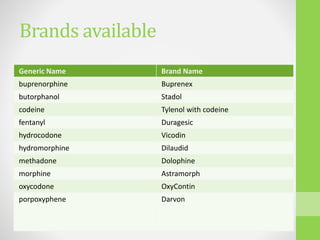
Brands available
Generic Name Brand Name
buprenorphine Buprenex
butorphanol Stadol
codeine Tylenol with codeine
fentanyl Duragesic
hydrocodone Vicodin
hydromorphine Dilaudid
methadone Dolophine
morphine Astramorph
oxycodone OxyContin
porpoxyphene Darvon

Opioid analgesics

  • 1.
  • 2.
    Analgesics Analgesics, or painkillers, that bind to opioid receptors which are found principally in the: CNS Gastrointestinal tract Classification: Natural opiates Semi-synthetic Opiates Fully synthetic opioids Endogenous opioid peptides
  • 3.
    • Actions • Full agonists- Morphine • partial agonists - Codeine • Antagonists - Nalbuphine
  • 5.
    Method of action Receptor type LocationEffects μ Brain, spinal cord Analgesia, respiratory depression, euphoria, addiction, ALL pain messages blocked κ Brain, spinal cord Analgesia, sedation, all non-thermal pain messages blocked δ Brain Analgesia, antidepression, dependence • In general, opioids act upon mu-, delta-, and kappa-receptors on CNS neurons producing: • Analgesia via decreased neuronal transmitter release and decreased nociceptive impulse propagation • Appears to work by elevating the pain threshold, thus decreasing the brain’s awareness of pain
  • 6.
  • 7.
    Absorption • Most opioidanalgesics are well absorbed when given by subcutaneous, intramuscular, and oral routes • Other routes of opioid administration include oral mucosa via lozenges, and transdermal via transdermal patches. • Recently an iontophoretic transdermal system has been introduced, allowing needle-free delivery of fentanyl for patient-controlled analgesia.
  • 8.
    Distribution • All opioidsbind to plasma proteins with varying affinity. • the drugs rapidly leave the blood compartment and localize in highest concentrations in tissues. • Drug concentrations in skeletal muscle may be much lower, but this tissue serves as the main reservoir because of its greater bulk.
  • 9.
    Metabolism • The opioidsare converted in large part to polar metabolites. • Morphine is metabolized to M3G and M6G. • M3G, a compound with neuroexcitatory properties and M6G, an active metabolite with analgesic property. • Esters (e.g, heroin, remifentanil) are rapidly hydrolyzed by common tissue esterases. • Heroin (diacetylmorphine) is hydrolyzed to monoacetylmorphine and finally to morphine, which is then conjugated with glucuronic acid.
  • 10.
    Excretion • Polar metabolites,including glucuronide conjugates of opioid analgesics, are excreted mainly in the urine. • Small amounts of unchanged drug may also be found in the urine. • Glucuronide conjugates are found in the bile. • Enterohepatic circulation represents only a small portion of the excretory process.
  • 11.
  • 12.
    Mechanism of Action •Opioid drug bind to opioid receptor widely distributed in CNS and other tissues. • A part of family of G- protein complex receptors. • Open K+ Channels. • Prevent opening of Ca2+ channels. • Inhibit the release of other neurotransmitters.
  • 18.
    Properties of Morphine •Good for treating dull, constant pain rather than sharp, periodic pain • Unfortunately, it also has a large number of side effects including: • Depression of the respiratory centre • Constipation • Excitation • Euphoria • Nausea • Pupil constriction • Tolerance and dependence
  • 19.
    Clinical Uses • Analgesia •Acute Pulmonary Edema • Cough Suppression • Diarrhea • Severe cute shooting visceral pain. • MI. • Shivering • Terminal stages of malignancy. • Severe crush injuries. • Postoperative pain. • Applications in Anesthesia
  • 20.
    Side effects • Tolerance •Dependence • Addiction • Death • Confusion • Constipation • Dizziness • Respiratory depression • Hallucination • Hypotension • Itching • Nausea • Sedation • Rash
  • 21.
    Withdrawal symptoms • Anorexia •Weight loss • Pupil dilation • Chills • Excessive sweating • Abdominal cramps • Muscle spasms • Hyperirritability • Lacrimation • Tremor • Increased heart rate • Increased blood pressure
  • 22.
    Overdose • A studywas done in W. Virginia to evaluate persons dying of unintentional pharmaceutical overdose, the types of drugs involved and role of drug abuse in the deaths. • Opioid analgesics were taken by 93.2% (275/295) of all people who died of pharmaceutical overdoses in W. Virginia in 2006. • Only 44.4% (122/275) of those people had ever been prescribed these drugs. • The majority of overdose deaths in West Virginia in 2006 were associated with nonmedical use and diversion of pharmaceuticals, primarily opioid analgesics.
  • 23.
    Treatment of Opioid Overdosage •Intravenous injection of naloxone dramatically reverses coma due to opioid overdose but not that due to other CNS depressants. Use of the antagonist should not, of course, delay the institution of other therapeutic measures, especially respiratory support.
  • 24.
    Treatment for addiction •Several treatments and treatment strategies exist for opioid addiction. They are • The Cold Turkey Approach • Traditional Opioid Drug Treatment • Rapid Detoxification
  • 25.
    The Cold TurkeyMethod • About eight to twelve hours after the last heroin use, an addict's eyes begin to tear and he/she starts to experience flu- like symptoms: sneezing, weakness, depression, muscle cramps, nausea, vomiting, diarrhea. The symptoms increase in severity over two to three days. • Within a week to 10 days the illness is over. • The phrase 'cold turkey' probably comes from the appearance of goose bumps all over the body, which resembles a plucked turkey. Muscle spasms in the legs produce kicking movements, and this may be the derivation of the expression 'kick the habit.'
  • 26.
    The Cold TurkeyMethod- Withdrawal Symptoms
  • 27.
    Traditional Drug Based Treatments-Methadone • Methadone has traditionally been provided to the addiction population • Numerous clinics start addicts at 30mg and raise the dosage 10mg a day until the addict feels they are at a comfortable level of dosage. • At proper dosing, methadone usually reduces the appetite for and need to take heroin. • Many factors determine the treatment dose schedule, and some follow the philosophy that methadone maintenance treatment is not curative for heroin addiction
  • 28.
    Rapid Detoxification • Theprocess involves intubation and external ventilation of the patient coupled with the administration of opioid receptor antagonists (blockers) while the patient is under general anesthesia. • The most often used drugs are Naloxone and Naltrexone. • Naloxone is a powerful Mu opioid receptor antagonist that is capable of rapidly displacing other opioids from the opioid receptors. • As a result, massive withdrawal symptoms are triggered but are attenuated by the fact that the patient is under anesthesia.
  • 29.
  • 30.
    OPIOID ANTAGONISTS • Thepure opioid antagonist drugs are • Naloxone • Naltrexone • Nalmefene
  • 31.
    Clinical Use • Treatmentof acute opioid overdose. • Treatment of opioid addiction. • Analgesic. • Used to reverse the effects of narcotic drugs used during surgery or to treat pain.
  • 32.
    Brands available Generic NameBrand Name buprenorphine Buprenex butorphanol Stadol codeine Tylenol with codeine fentanyl Duragesic hydrocodone Vicodin hydromorphine Dilaudid methadone Dolophine morphine Astramorph oxycodone OxyContin porpoxyphene Darvon