OPIOIDS
OPIOIDS
drugs with depressant action on the CNS, which cause:
• analgesia
• calming anxiety
• sedation
• euphoria
OPIOIDS
• Opioids are natural or synthetic compounds that produce
morphine-like effects.
• The term “opiate” is reserved for drugs, such as morphine and
codeine, obtained from the juice of the opium poppy.
• All drugs in this category act by binding to specific opioid
receptors in the CNS to produce effects that mimic the action
of endogenous peptide neurotransmitters (for example,
endorphins, enkephalins, and dynorphins).
• Although the opioids have a broad range of effects, their
primary use is to relieve intense pain, whether that pain is
from surgery or a result of injury or disease such as cancer
Types of opioids
• endogenous opioids
• exogenous opioids - extracted from opium or produced
by synthesis
ENDOGENOUS OPIOIDS
Role = neuromodulators
• enkephalin
• B- endorphin
• dynorphins
• NOCICEPTIN
ENDOGENOUS OPIOIDS
Role = neuromodulators
• Distribution:
- central - CNS
- peripheral – intestine
1. ENKEPHALINE = pentapeptide:
It acts on miu and delta receptors
ENDORPHINE = polypeptide
Precursors = pro-opiomelanocortin (POMC)
POMC => endorphins, ACTH
It acts on miu and delta receptors
ENDOGENOUS OPIOIDS
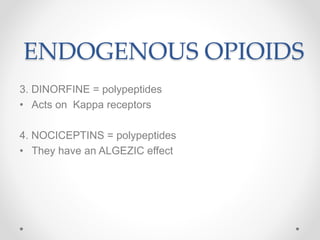
3. DINORFINE = polypeptides
• Acts on Kappa receptors
4. NOCICEPTINS = polypeptides
• They have an ALGEZIC effect
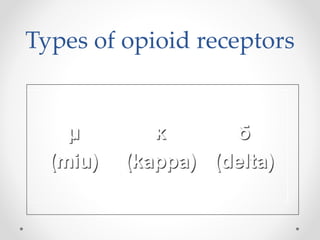
Types of opioid receptors
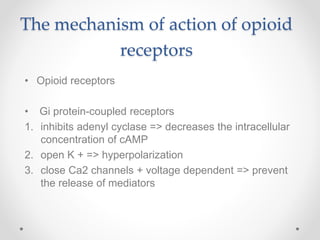
The mechanism of action of opioid
receptors
• Opioid receptors
• Gi protein-coupled receptors
1. inhibits adenyl cyclase => decreases the intracellular
concentration of cAMP
2. open K + => hyperpolarization
3. close Ca2 channels + voltage dependent => prevent
the release of mediators
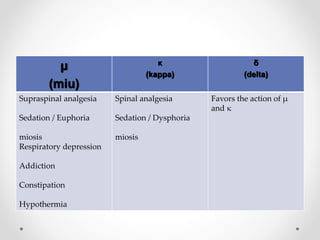
µ
(miu)
κ
(kappa)
δ
(delta)
Supraspinal analgesia
Sedation / Euphoria
miosis
Respiratory depression
Addiction
Constipation
Hypothermia
Spinal analgesia
Sedation / Dysphoria
miosis
Favors the action of µ
and κ
Classification of opioids
1. Agonists (encephalomimetics)
2. Agonists k - antagonists µ
3. Antagonists
OPIOUS AGONISTS
STRONG AGONISTS
• Alfentanil ALFENTA
• Fentanyl ACTIQ, DURAGESIC, FENTORA
• Heroin
• Hydrocodone various
• Hydromorphone DILAUDID
• Meperidine DEMEROL
• Methadone DOLOPHINE
• Morphine ROXANOL, CONTIN, ORAMORPH,
• KADIAN, AVINZA
• Oxycodone OXYCONTIN
• Oxymorphone OPANA
• Remifentanil ULTIVA
• Sufentanil SUFENTA
• Tapentadol NUCYNTA
MODERATE/LOW AGONISTS
• Codeine
MIXED AGONIST-ANTAGONISTS AND PARTIAL AGONISTS
• Buprenorphine BUPRENEX, SUBUTEX
• Butorphanol STADOL
• Nalbuphine NUBAIN
• Pentazocine TALWIN
Morphine
PHARMACOLOGICAL EFFECTS
• CNS effects
• Digestive effects
• Genitourinary effects
• Cardiovascular effects
• Lung effects
• Effects on the eye
• Effects on thermoregulation
• Neurohormonal effects
• Tolerance and dependence
Morphine
1. Effects on the CNS
a. Intense analgesia
• increases the threshold of painful perception
• decreases reactions to pain: screaming, fear
• changes the perception of pain - detachment from pain
• - duration of analgesia = 4 - 6 hours
• - place of action: central, bone marrow, peripheral (can be
administered for example in a joint and causes local analgesia)
b. Respiratory depression
• - is installed in parallel with analgesia
• - occurs by decreasing the sensitivity of the respiratory centers to CO2
c. Depression of the cough center
d. Behavioral change
• - euphoria, sedation, well-being
e. Vomiting - causes vomiting at low doses
Morphine
2. Digestive effects
• 1. decreases digestive peristalsis
• 2. decreases digestive secretions
→→constipation →antidiarrheal effect
3. spasm of the bile ducts and sphincter of Odi => in colic
is associated with antispasmodics
Morphine
3. Effects at the genitourinary level
• - increases the contraction of the ureters => in renal colic
is associated with antispasmodics
• - increases the tonus of the bladder detrusor
• - increases the tonus of sphincter of the bladder
→difficult urination
Morphine
4. Cardiovascular effects
a. vasodilation
-arterial and venous => indication in acute pulmonary
edema
-cerebral vessels => increases CSF pressure =>
contraindicated in brain trauma
- cutaneous => congestion, sweating
b. depress circulatory => orthostatic hypotension
Morphine
5. Effects on the lungs
• - bronchospasm - by the release of histamine
6. Eye effects – miosis
7. Effects on thermoregulation – depression
8. Neurohormonal effects
- decreases the secretion of ACTH, FSH, LH - increases
the secretion of prolactin.
9. Tolerance and dependence
Indications
1. Analgesia
-when there is no response to other painkillers
- in cancer pre and postoperative
2. Acute pulmonary edema
3. Colic - associated with antispasmodics
4. Diarrhea - loperamide IS better
5.Cough - better codeine or dextromethorphan
Contraindications and side effects
• addiction => contraindicated abusive administration
• respiratory depression => contraindicated in patients with
respiratory failure
• Sedation
• vomiting
• hypotension
• increase in intracranial pressure => contraindicated in head
trauma
• constipation
• urinary retention => contraindicated in patients with prostate
adenoma
• contraindicated in labor in administration iv => newborn
asphyxia
• contraindicated in allergies - because it causes the release of
histamine
Heroin
• - is a synthetic opiate produced by acetylation of
morphine
• - it is more fat soluble than morphine => it crosses the
blood-brain barrier better => it transforms into morphine
• - has a potency 2-3x higher than morphine (10 mg
morphine = 5 mg herion)
• - duration of action approx. 2 hours (½ of morphine
duration of action)
• - is not used in therapy
• - used by drug addicts
Meperidine( Mialgin)
• - synthetic opioid (first)
Pharmacological effects :
• analgesia 10 times lower than morphine (10 mg morphine =
100 mg meperidine)
• shorter duration of action - 2-4 hours
• sedation / euphoria - more pronounced than morphine
• respiratory depression - less than or equal to morphine
• mydriasis not miosis like morphine
• - atropine-like effect
Indications
• - Just like morphine
• - not for coughs and diarrhea
Methadone
• - synthetic opioid with oral administration
Pharmacological effects
• Analgesia similar to morphine after parenteral
administration, but much higher after oral administration
because it is better absorbed
• long duration of action (3 - 5 HOURS)
Indications :
1. detoxification cure - as a substitute for morphine because
it causes in abstinence syndrome slower onset and milder
than morphine due to long T / 2 (35 hours vs. 2-3 hours
morphine)
2. analgesic - orally - in chronic pain - 5-15 mg
- sc. - 5-10mg
. Fentanyl
• - acts predominantly on miu receptors
Pharmacological effects:
Analgesia
100 times higher than morphine
immediate action after adm. iv and short - ½ hour
Parasympathomimetic effects => bradycardia
Indications
- dissociative anesthesia together with droperidol
- treatment of neoplastic pain - transdermal devices (72 hours)
MIXED AGONIST-
ANTAGONISTS AND
PARTIAL AGONISTS
Buprenorphine
Butorphanol
Nalbuphine
Pentazocine
Pentazocine
• an agonist on κ receptors and is a weak antagonist at µ and δ
receptors.
Pharmacological effects:
• analgesic action lower than morphine
• low risk of addiction (may cause withdrawal syndrome in
morphine addicts)
• depresses the breath less than morphine
• sedative
• ATTENTION: at high doses - dysphoria, hallucinations (by
kappa stimulation)
Indications - acute and chronic pain
OPIOUS ANTAGONISTS
Naloxone
Use:
• Acute opioid poisoning
• Respiratory depression caused by opioids
Naltrexone
Indications :
Treatment of drug addicts after detoxification

OPIOIDS.pptx

  • 1.
  • 2.
    OPIOIDS drugs with depressantaction on the CNS, which cause: • analgesia • calming anxiety • sedation • euphoria
  • 3.
    OPIOIDS • Opioids arenatural or synthetic compounds that produce morphine-like effects. • The term “opiate” is reserved for drugs, such as morphine and codeine, obtained from the juice of the opium poppy. • All drugs in this category act by binding to specific opioid receptors in the CNS to produce effects that mimic the action of endogenous peptide neurotransmitters (for example, endorphins, enkephalins, and dynorphins). • Although the opioids have a broad range of effects, their primary use is to relieve intense pain, whether that pain is from surgery or a result of injury or disease such as cancer
  • 4.
    Types of opioids •endogenous opioids • exogenous opioids - extracted from opium or produced by synthesis
  • 6.
    ENDOGENOUS OPIOIDS Role =neuromodulators • enkephalin • B- endorphin • dynorphins • NOCICEPTIN
  • 7.
    ENDOGENOUS OPIOIDS Role =neuromodulators • Distribution: - central - CNS - peripheral – intestine 1. ENKEPHALINE = pentapeptide: It acts on miu and delta receptors ENDORPHINE = polypeptide Precursors = pro-opiomelanocortin (POMC) POMC => endorphins, ACTH It acts on miu and delta receptors
  • 8.
    ENDOGENOUS OPIOIDS 3. DINORFINE= polypeptides • Acts on Kappa receptors 4. NOCICEPTINS = polypeptides • They have an ALGEZIC effect
  • 9.
    Types of opioidreceptors
  • 10.
    The mechanism ofaction of opioid receptors • Opioid receptors • Gi protein-coupled receptors 1. inhibits adenyl cyclase => decreases the intracellular concentration of cAMP 2. open K + => hyperpolarization 3. close Ca2 channels + voltage dependent => prevent the release of mediators
  • 11.
    µ (miu) κ (kappa) δ (delta) Supraspinal analgesia Sedation /Euphoria miosis Respiratory depression Addiction Constipation Hypothermia Spinal analgesia Sedation / Dysphoria miosis Favors the action of µ and κ
  • 12.
    Classification of opioids 1.Agonists (encephalomimetics) 2. Agonists k - antagonists µ 3. Antagonists
  • 13.
    OPIOUS AGONISTS STRONG AGONISTS •Alfentanil ALFENTA • Fentanyl ACTIQ, DURAGESIC, FENTORA • Heroin • Hydrocodone various • Hydromorphone DILAUDID • Meperidine DEMEROL • Methadone DOLOPHINE • Morphine ROXANOL, CONTIN, ORAMORPH, • KADIAN, AVINZA • Oxycodone OXYCONTIN • Oxymorphone OPANA • Remifentanil ULTIVA • Sufentanil SUFENTA • Tapentadol NUCYNTA MODERATE/LOW AGONISTS • Codeine MIXED AGONIST-ANTAGONISTS AND PARTIAL AGONISTS • Buprenorphine BUPRENEX, SUBUTEX • Butorphanol STADOL • Nalbuphine NUBAIN • Pentazocine TALWIN
  • 14.
    Morphine PHARMACOLOGICAL EFFECTS • CNSeffects • Digestive effects • Genitourinary effects • Cardiovascular effects • Lung effects • Effects on the eye • Effects on thermoregulation • Neurohormonal effects • Tolerance and dependence
  • 15.
    Morphine 1. Effects onthe CNS a. Intense analgesia • increases the threshold of painful perception • decreases reactions to pain: screaming, fear • changes the perception of pain - detachment from pain • - duration of analgesia = 4 - 6 hours • - place of action: central, bone marrow, peripheral (can be administered for example in a joint and causes local analgesia) b. Respiratory depression • - is installed in parallel with analgesia • - occurs by decreasing the sensitivity of the respiratory centers to CO2 c. Depression of the cough center d. Behavioral change • - euphoria, sedation, well-being e. Vomiting - causes vomiting at low doses
  • 16.
    Morphine 2. Digestive effects •1. decreases digestive peristalsis • 2. decreases digestive secretions →→constipation →antidiarrheal effect 3. spasm of the bile ducts and sphincter of Odi => in colic is associated with antispasmodics
  • 17.
    Morphine 3. Effects atthe genitourinary level • - increases the contraction of the ureters => in renal colic is associated with antispasmodics • - increases the tonus of the bladder detrusor • - increases the tonus of sphincter of the bladder →difficult urination
  • 18.
    Morphine 4. Cardiovascular effects a.vasodilation -arterial and venous => indication in acute pulmonary edema -cerebral vessels => increases CSF pressure => contraindicated in brain trauma - cutaneous => congestion, sweating b. depress circulatory => orthostatic hypotension
  • 19.
    Morphine 5. Effects onthe lungs • - bronchospasm - by the release of histamine 6. Eye effects – miosis 7. Effects on thermoregulation – depression 8. Neurohormonal effects - decreases the secretion of ACTH, FSH, LH - increases the secretion of prolactin. 9. Tolerance and dependence
  • 20.
    Indications 1. Analgesia -when thereis no response to other painkillers - in cancer pre and postoperative 2. Acute pulmonary edema 3. Colic - associated with antispasmodics 4. Diarrhea - loperamide IS better 5.Cough - better codeine or dextromethorphan
  • 21.
    Contraindications and sideeffects • addiction => contraindicated abusive administration • respiratory depression => contraindicated in patients with respiratory failure • Sedation • vomiting • hypotension • increase in intracranial pressure => contraindicated in head trauma • constipation • urinary retention => contraindicated in patients with prostate adenoma • contraindicated in labor in administration iv => newborn asphyxia • contraindicated in allergies - because it causes the release of histamine
  • 22.
    Heroin • - isa synthetic opiate produced by acetylation of morphine • - it is more fat soluble than morphine => it crosses the blood-brain barrier better => it transforms into morphine • - has a potency 2-3x higher than morphine (10 mg morphine = 5 mg herion) • - duration of action approx. 2 hours (½ of morphine duration of action) • - is not used in therapy • - used by drug addicts
  • 23.
    Meperidine( Mialgin) • -synthetic opioid (first) Pharmacological effects : • analgesia 10 times lower than morphine (10 mg morphine = 100 mg meperidine) • shorter duration of action - 2-4 hours • sedation / euphoria - more pronounced than morphine • respiratory depression - less than or equal to morphine • mydriasis not miosis like morphine • - atropine-like effect Indications • - Just like morphine • - not for coughs and diarrhea
  • 24.
    Methadone • - syntheticopioid with oral administration Pharmacological effects • Analgesia similar to morphine after parenteral administration, but much higher after oral administration because it is better absorbed • long duration of action (3 - 5 HOURS) Indications : 1. detoxification cure - as a substitute for morphine because it causes in abstinence syndrome slower onset and milder than morphine due to long T / 2 (35 hours vs. 2-3 hours morphine) 2. analgesic - orally - in chronic pain - 5-15 mg - sc. - 5-10mg
  • 25.
    . Fentanyl • -acts predominantly on miu receptors Pharmacological effects: Analgesia 100 times higher than morphine immediate action after adm. iv and short - ½ hour Parasympathomimetic effects => bradycardia Indications - dissociative anesthesia together with droperidol - treatment of neoplastic pain - transdermal devices (72 hours)
  • 26.
    MIXED AGONIST- ANTAGONISTS AND PARTIALAGONISTS Buprenorphine Butorphanol Nalbuphine Pentazocine
  • 27.
    Pentazocine • an agoniston κ receptors and is a weak antagonist at µ and δ receptors. Pharmacological effects: • analgesic action lower than morphine • low risk of addiction (may cause withdrawal syndrome in morphine addicts) • depresses the breath less than morphine • sedative • ATTENTION: at high doses - dysphoria, hallucinations (by kappa stimulation) Indications - acute and chronic pain
  • 28.
    OPIOUS ANTAGONISTS Naloxone Use: • Acuteopioid poisoning • Respiratory depression caused by opioids Naltrexone Indications : Treatment of drug addicts after detoxification