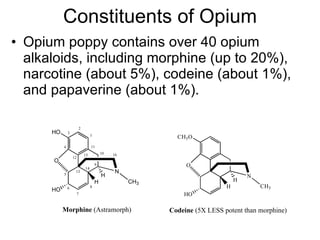
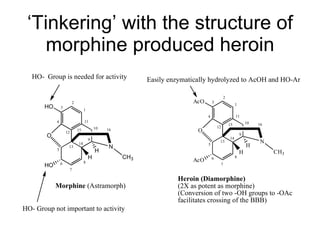
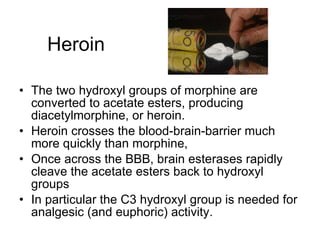
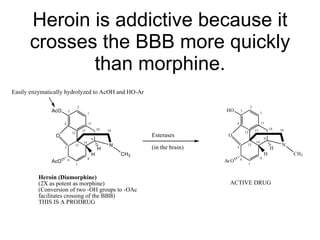
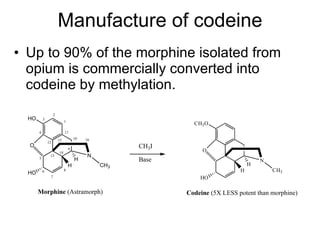
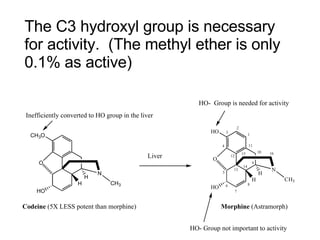
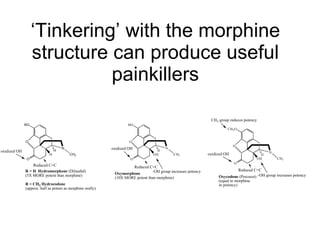
The document discusses opioids and their history. It describes how opium poppies contain morphine and other alkaloids. It discusses the development of the hypodermic syringe allowing injection of pure morphine in the 19th century. Morphinism became widespread after the US Civil War due to injured soldiers' opioid use. Morphine works by agonizing mu, delta, and kappa opioid receptors, preferring mu receptors. Side effects include respiratory depression, dependence, and addiction. Heroin is converted from morphine and crosses the blood-brain barrier faster, causing addiction. Codeine is converted to morphine in the liver and is used as a cough suppressant.