OPIOIDS
DR. SURAJ KURMI (INTERN)
DEPARTMENT OF ANESTHESIOLOGY
“Among the remedies which it has pleased
Almighty God to give to man to relieve his
sufferings, none is so universal and so efficacious
as opium.”
OBJECTIVES
• INTRODUCTION/ TERMINOLOGY
• HISTORY
• CLASSIFICATION
• OPIOIDS RECEPTORS AND ITS DISTRIBUTION
• MECHANISM OF ACTIONS
• SYSTEMIC EFFECTS
• USES IN ANESTHESIA
• IMPORTANT OPIOIDS AND ITS USES AND EFFECTS
• OPIOD WITHDRAWAL SYNDROME
INTRODUCTION/TERMINOLOGY
• Opioids:
It includes all the natural and semisynthetic alkaloid
derivatives from opium as well as their synthetic
surrogates with the action that mimic those of
morphine.
It includes:
1. Opiates
2. Synthetic opioids( agonist, mixed agonist-
antagonist and antagonist)
3. Endogenous opioids
• Opiates
opiates are taken to those opiod drugs that are derived from
alkaloids of the opium poppy( papaver somniferum)
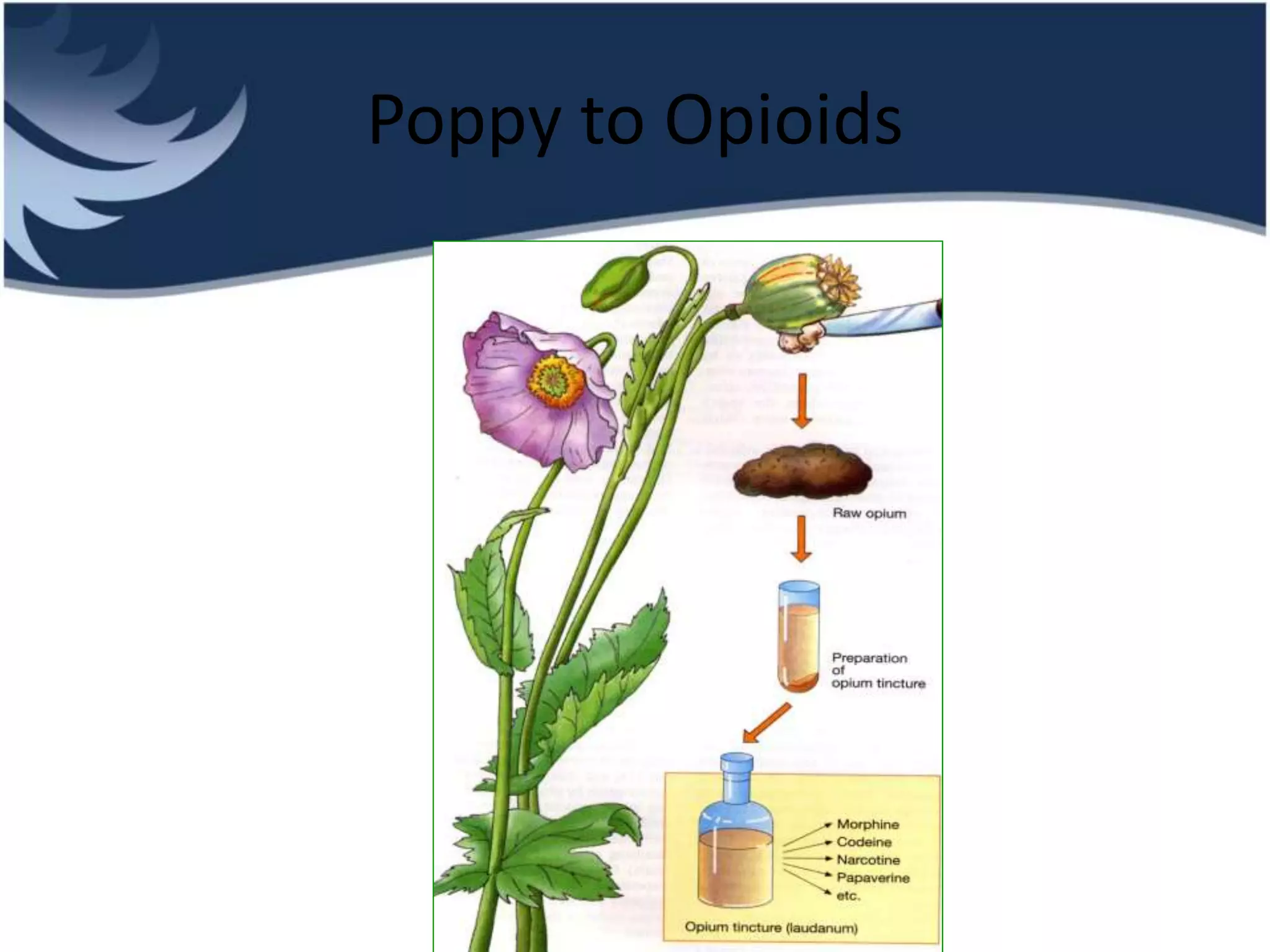
Opium is a Greek word meaning “juice,” or the exudate from
the poppy
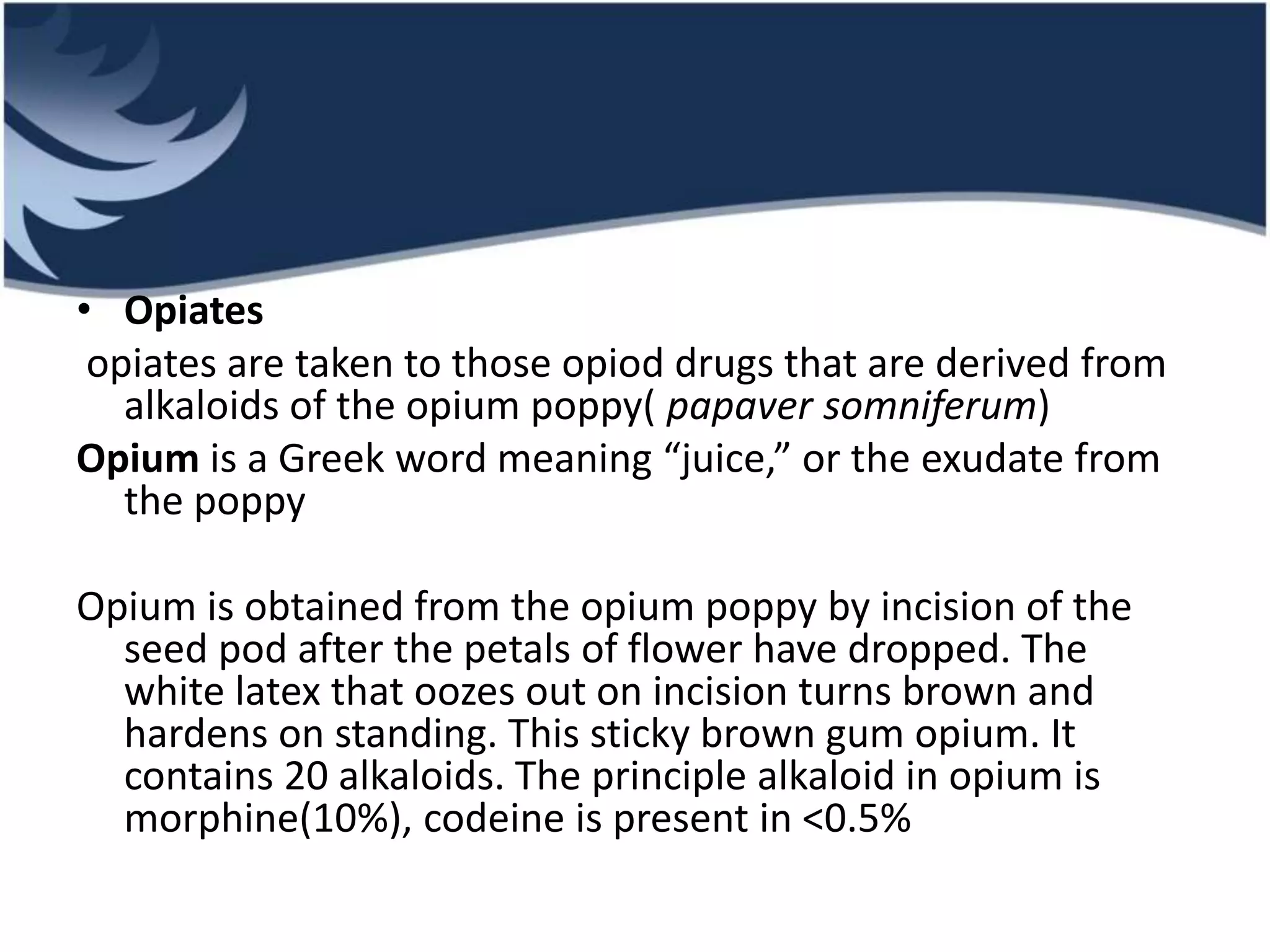
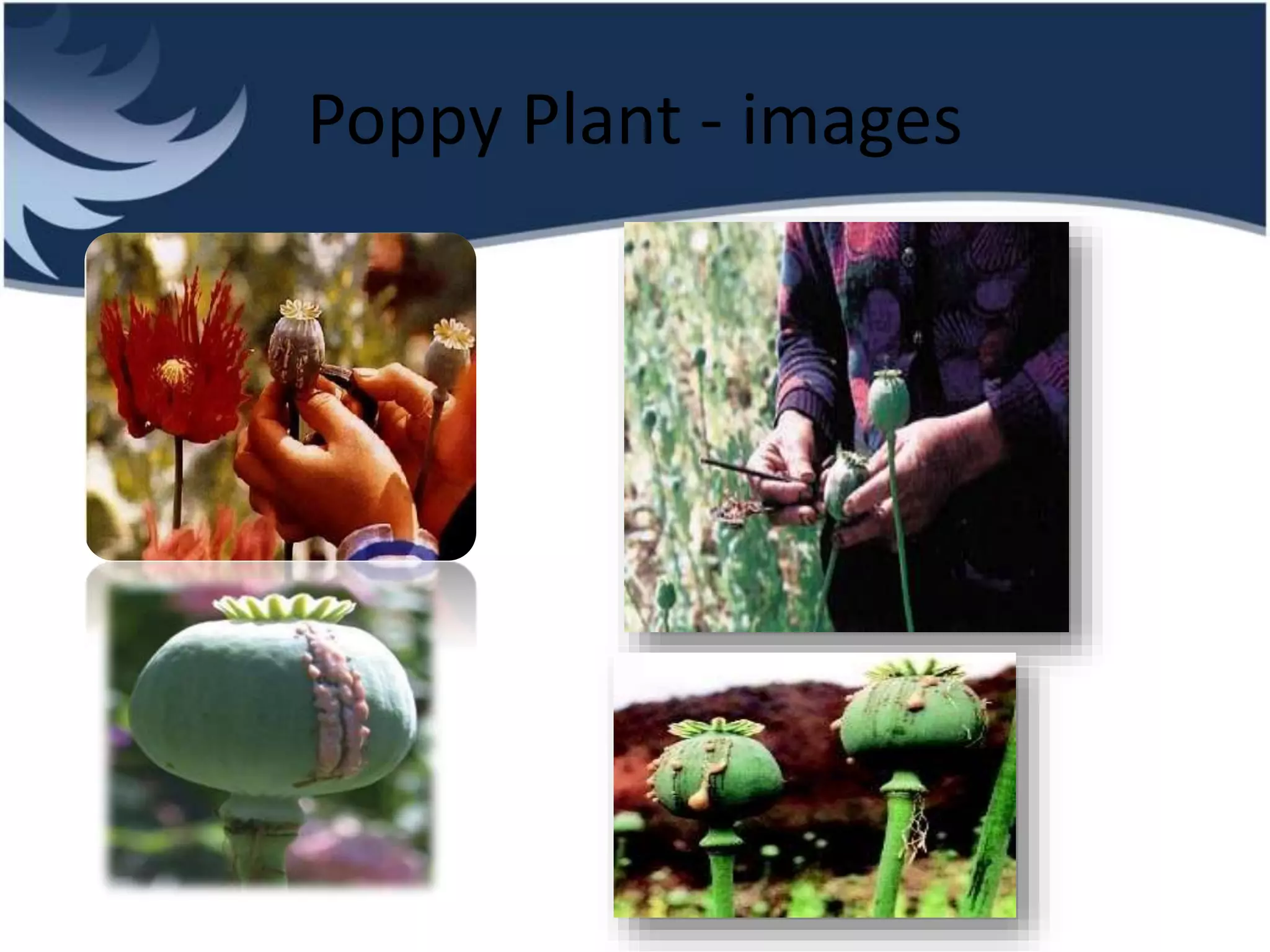
Opium is obtained from the opium poppy by incision of the
seed pod after the petals of flower have dropped. The
white latex that oozes out on incision turns brown and
hardens on standing. This sticky brown gum opium. It
contains 20 alkaloids. The principle alkaloid in opium is
morphine(10%), codeine is present in <0.5%
Poppy Plant - images
Poppy to Opioids
Endogenous opiods
• Enkephalins (act through delta receptor)
• Endorphins( act through mu receptor)
• Dynorphins( act through kappa receptor)
Enkephalins and endorphins mediate
supraspinal control of pain while dynorphins
mediate pain control at spinal level.
enkephalins are responsible for producing
acupuncture mediated analgesia
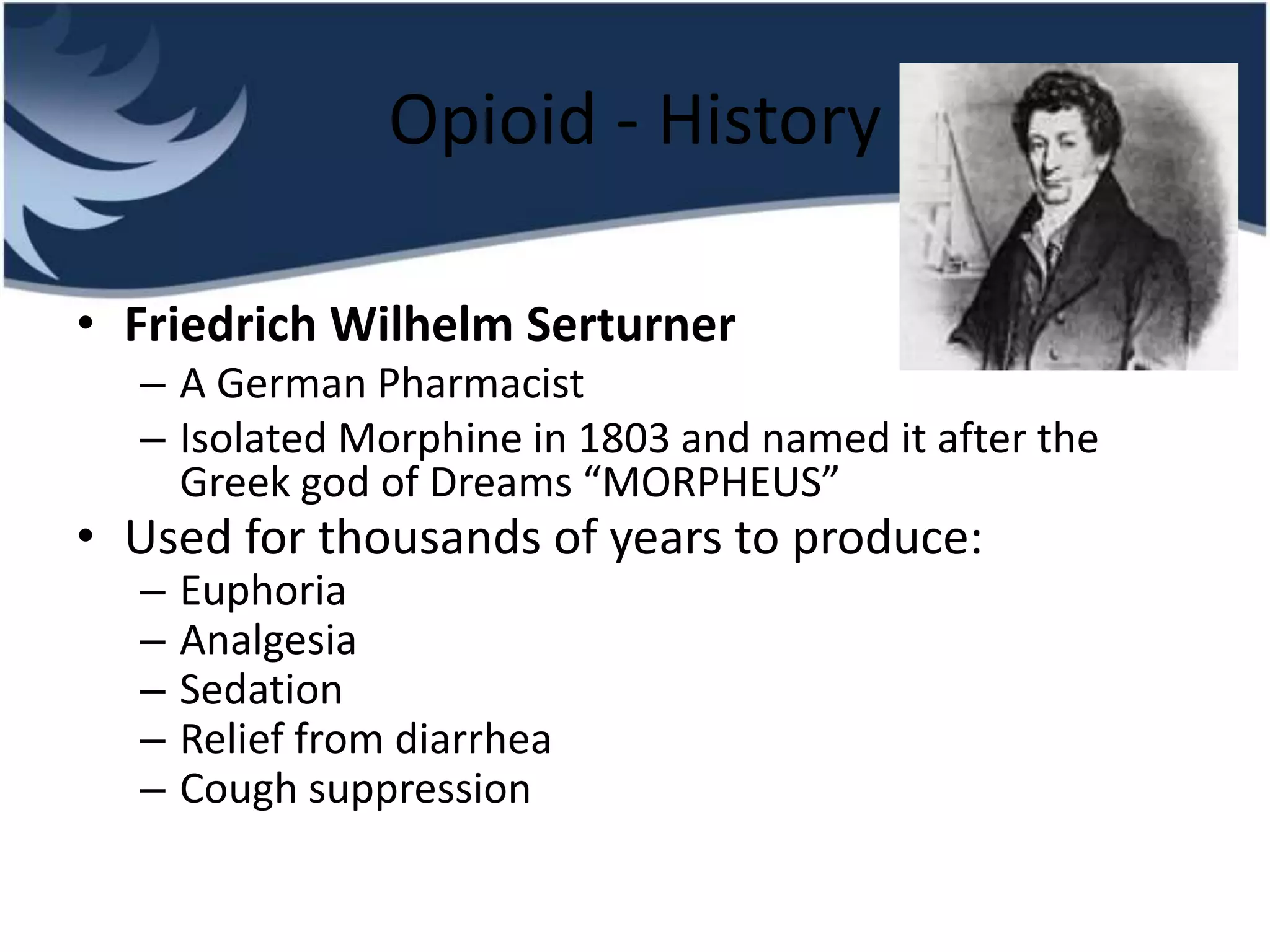
Opioid - History
• Friedrich Wilhelm Serturner
– A German Pharmacist
– Isolated Morphine in 1803 and named it after the
Greek god of Dreams “MORPHEUS”
• Used for thousands of years to produce:
– Euphoria
– Analgesia
– Sedation
– Relief from diarrhea
– Cough suppression
Opioid- history
• Used medicinally and recreationally from early Greek
and Roman times
• Opium and laudanum (opium combined with alcohol)
were used to treat almost all known diseases
• Invention of the hypodermic needle in 1856 produced
drug abusers who self administered opioids by
injection
• Controlling the widespread use of opioids has been
unsuccessful because of the euphoria, tolerance and
physiological dependence that opioids produce
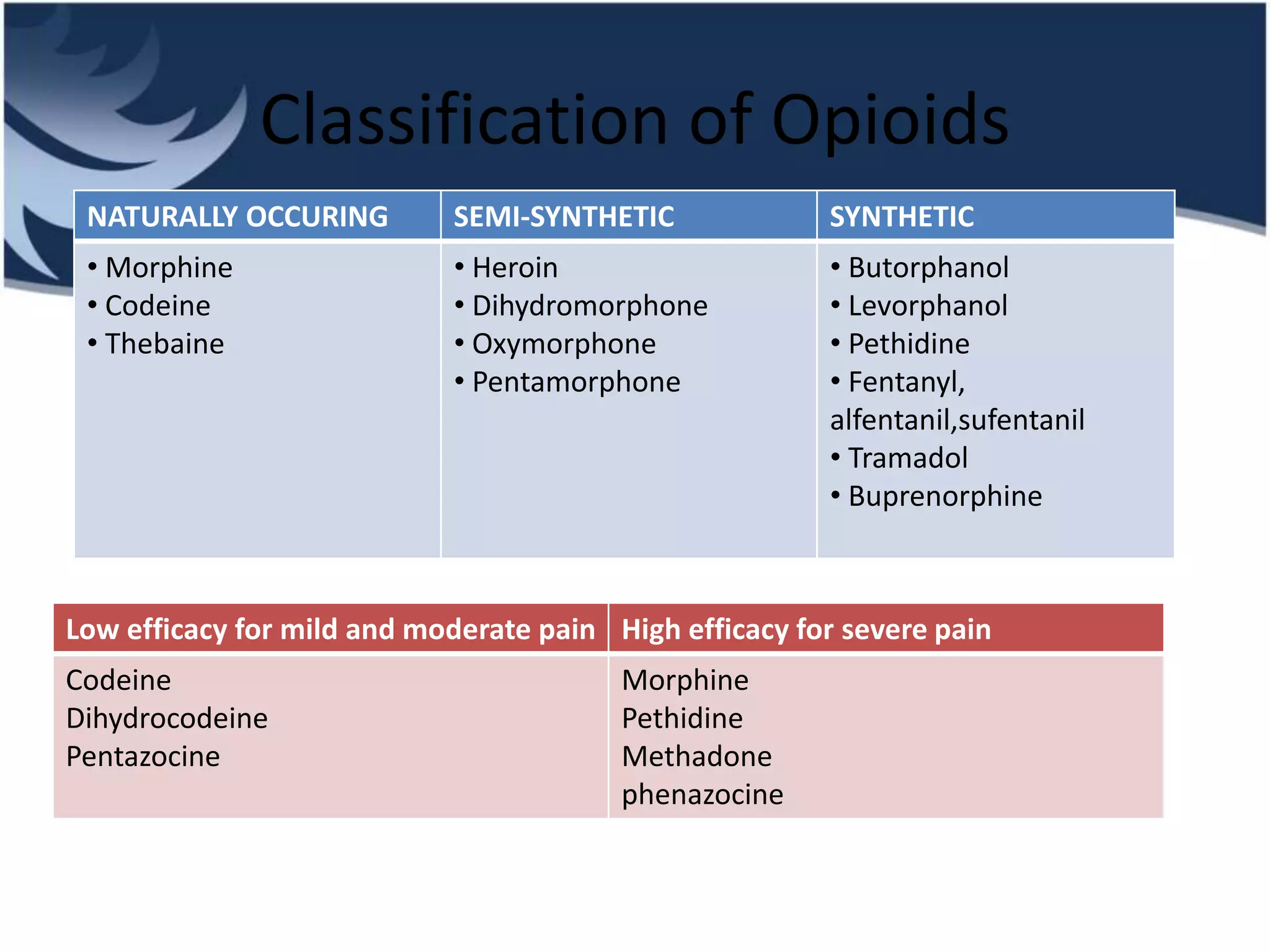
Classification of Opioids
Low efficacy for mild and moderate pain High efficacy for severe pain
Codeine
Dihydrocodeine
Pentazocine
Morphine
Pethidine
Methadone
phenazocine
NATURALLY OCCURING SEMI-SYNTHETIC SYNTHETIC
• Morphine
• Codeine
• Thebaine
• Heroin
• Dihydromorphone
• Oxymorphone
• Pentamorphone
• Butorphanol
• Levorphanol
• Pethidine
• Fentanyl,
alfentanil,sufentanil
• Tramadol
• Buprenorphine
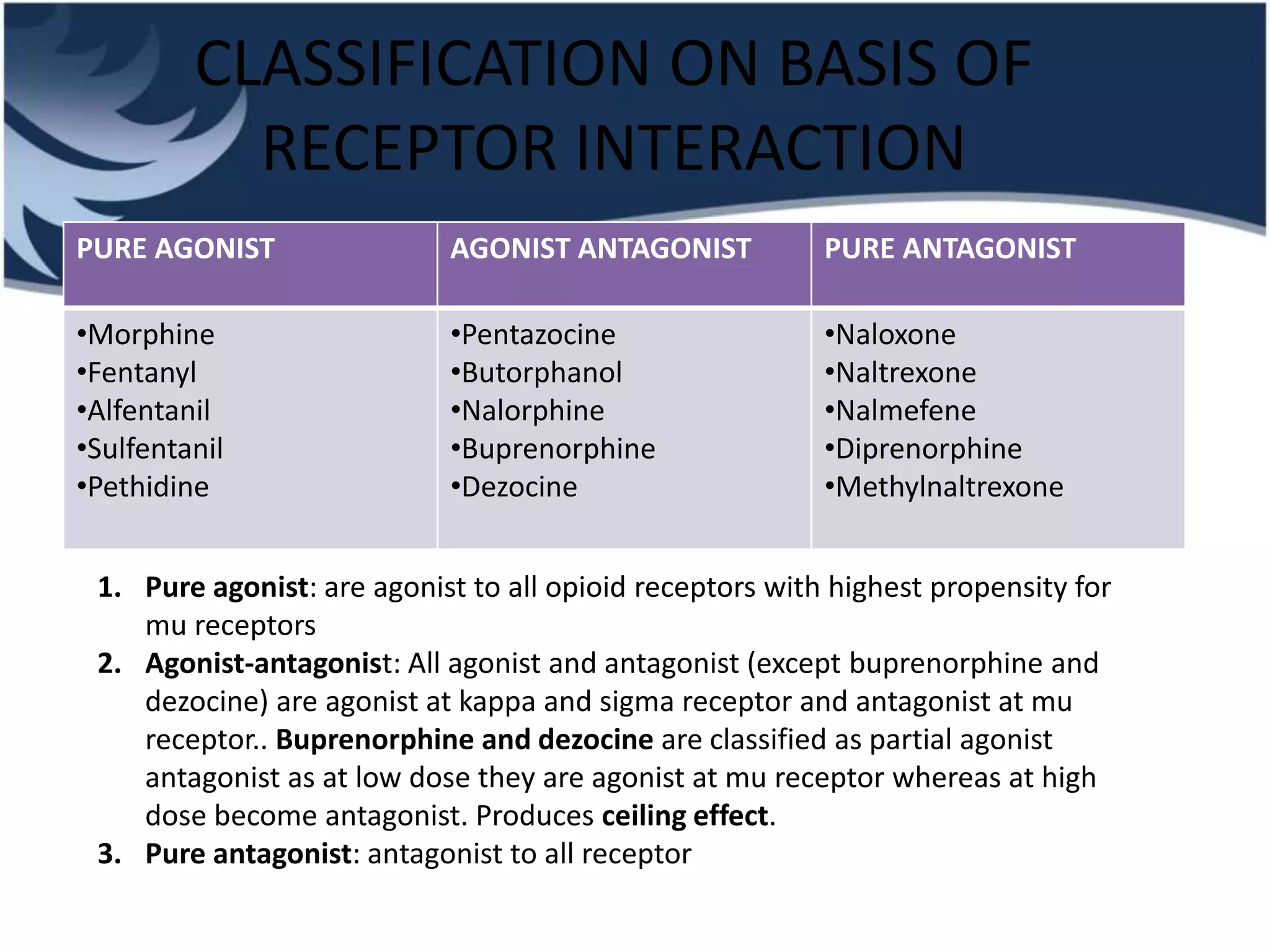
CLASSIFICATION ON BASIS OF
RECEPTOR INTERACTION
PURE AGONIST AGONIST ANTAGONIST PURE ANTAGONIST
•Morphine
•Fentanyl
•Alfentanil
•Sulfentanil
•Pethidine
•Pentazocine
•Butorphanol
•Nalorphine
•Buprenorphine
•Dezocine
•Naloxone
•Naltrexone
•Nalmefene
•Diprenorphine
•Methylnaltrexone
1. Pure agonist: are agonist to all opioid receptors with highest propensity for
mu receptors
2. Agonist-antagonist: All agonist and antagonist (except buprenorphine and
dezocine) are agonist at kappa and sigma receptor and antagonist at mu
receptor.. Buprenorphine and dezocine are classified as partial agonist
antagonist as at low dose they are agonist at mu receptor whereas at high
dose become antagonist. Produces ceiling effect.
3. Pure antagonist: antagonist to all receptor
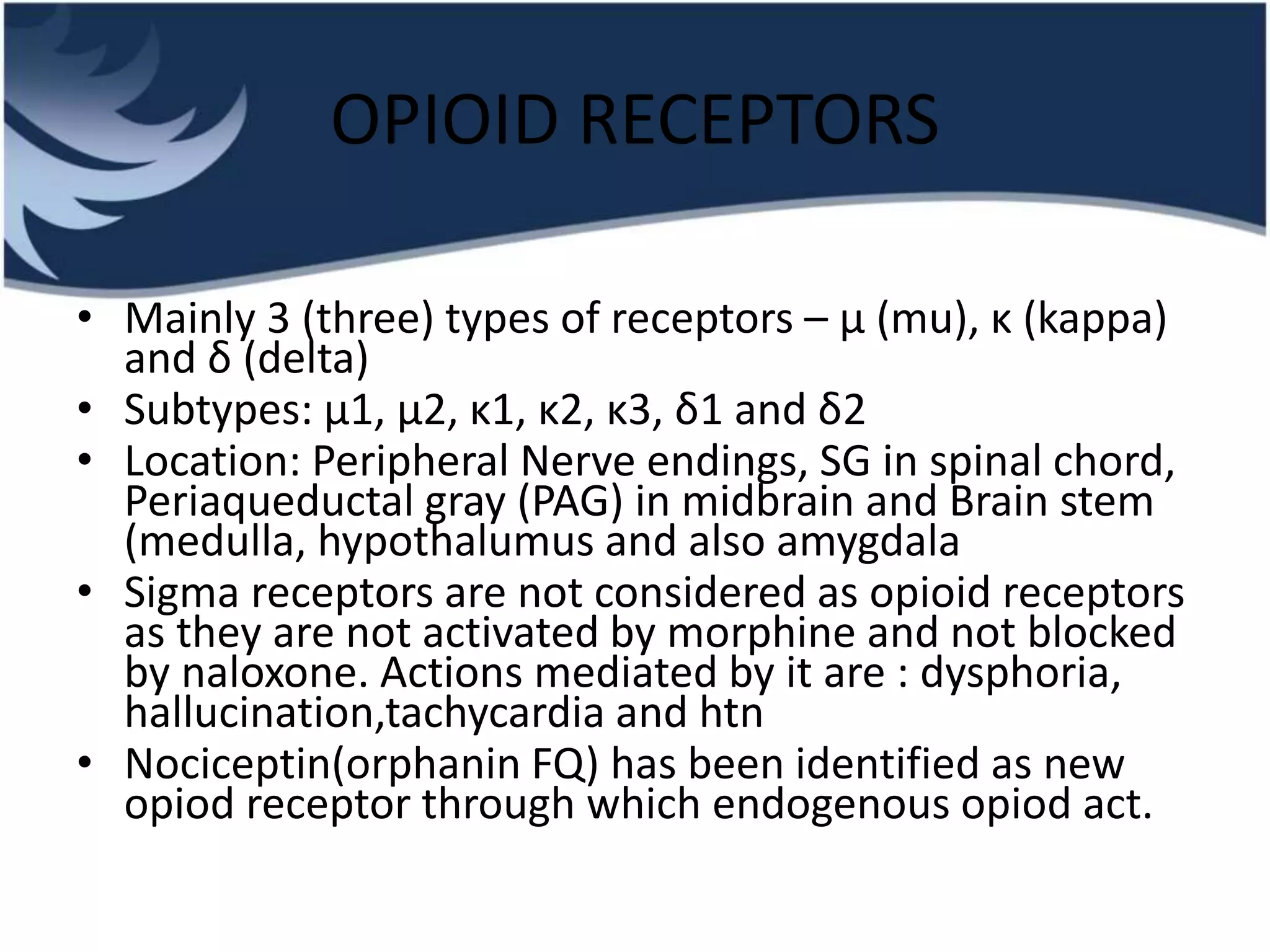
OPIOID RECEPTORS
• Mainly 3 (three) types of receptors – μ (mu), κ (kappa)
and δ (delta)
• Subtypes: μ1, μ2, κ1, κ2, κ3, δ1 and δ2
• Location: Peripheral Nerve endings, SG in spinal chord,
Periaqueductal gray (PAG) in midbrain and Brain stem
(medulla, hypothalumus and also amygdala
• Sigma receptors are not considered as opioid receptors
as they are not activated by morphine and not blocked
by naloxone. Actions mediated by it are : dysphoria,
hallucination,tachycardia and htn
• Nociceptin(orphanin FQ) has been identified as new
opiod receptor through which endogenous opiod act.
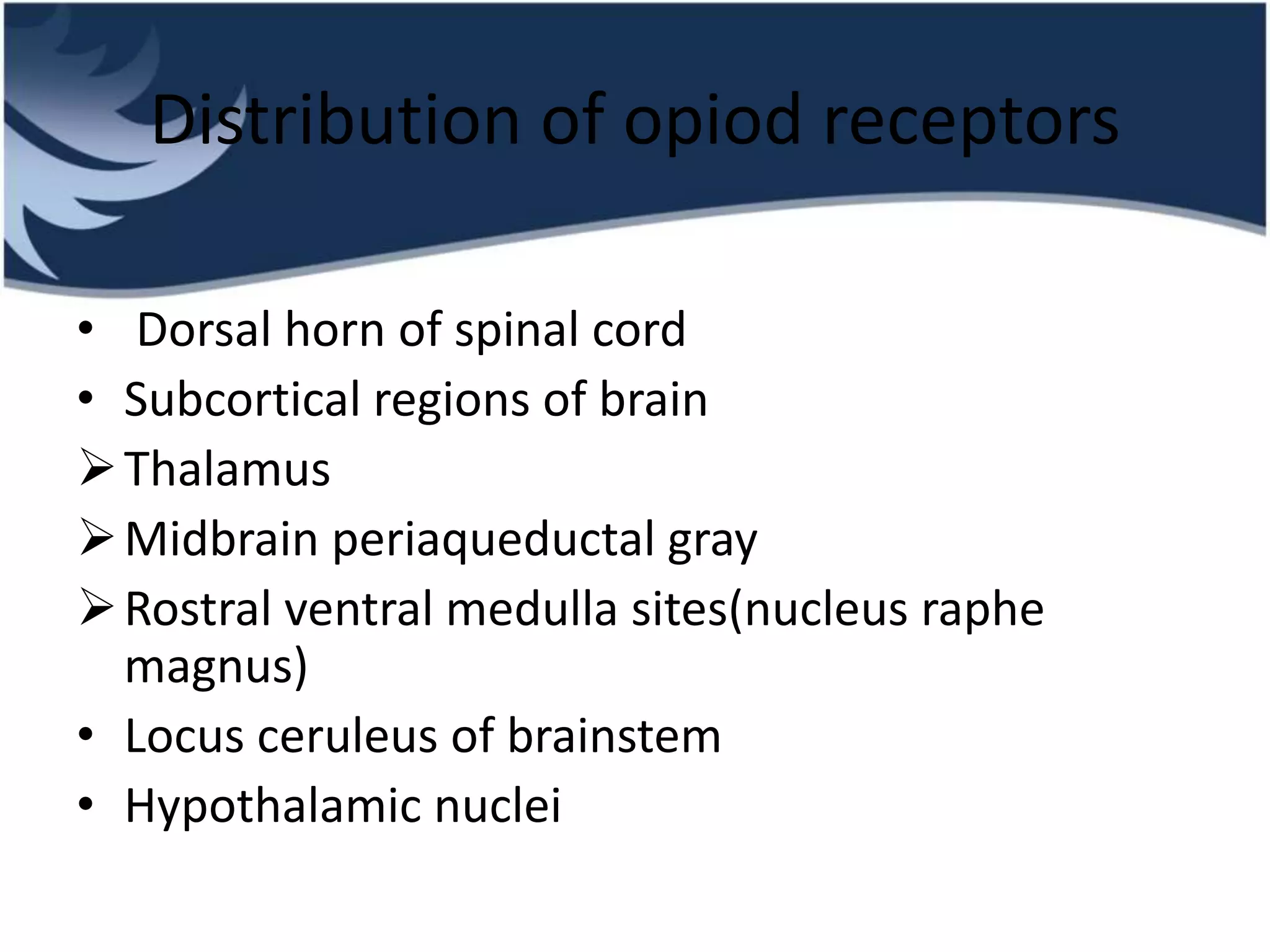
Distribution of opiod receptors
• Dorsal horn of spinal cord
• Subcortical regions of brain
Thalamus
Midbrain periaqueductal gray
Rostral ventral medulla sites(nucleus raphe
magnus)
• Locus ceruleus of brainstem
• Hypothalamic nuclei
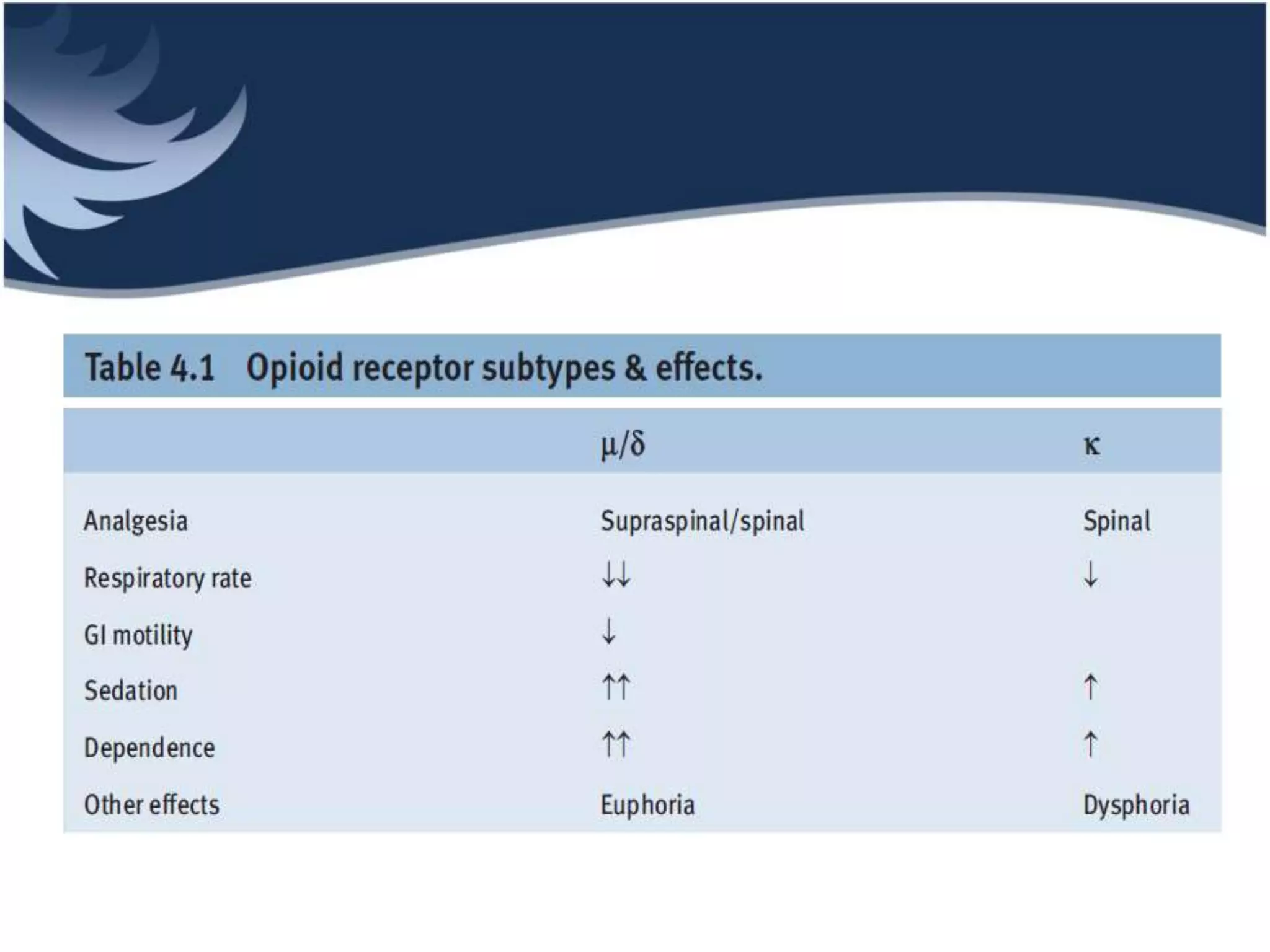
Receptors and its effects
μ (mu) receptors
• μ 1: mediates analgesia (supraspinal),sedation, miosis,
urinary retention, muscle rigidity, prolactin release
• μ 2: mediates respiratory depression
K (KAPPA) receptor:
• K1: mediates spinal analgesia
• K3: mediates supraspinal analgesia
δ (delta) receptor: mediates analgesia at spinal level,
respiratory depression and dependence.
MECHANISM OF ACTION OF OPIOIDS
SUPRASPINAL: opioids binds with receptors in rostroventral
region of medulla and cause stimulation of off cells present
there, thereby blocking nociceptive stimuli transmission
SPINAL LEVEL: act in substantia gelatinosa of dorsal horn cells
and inhibit the release of excitatory transmitters
Cellular level: opioids bind with the receptors and stimulate G
protein synthesis and increases cAMP which causes:
Increase K+: hyperpolarization of membrane
Decreases calcium: decreases excitability
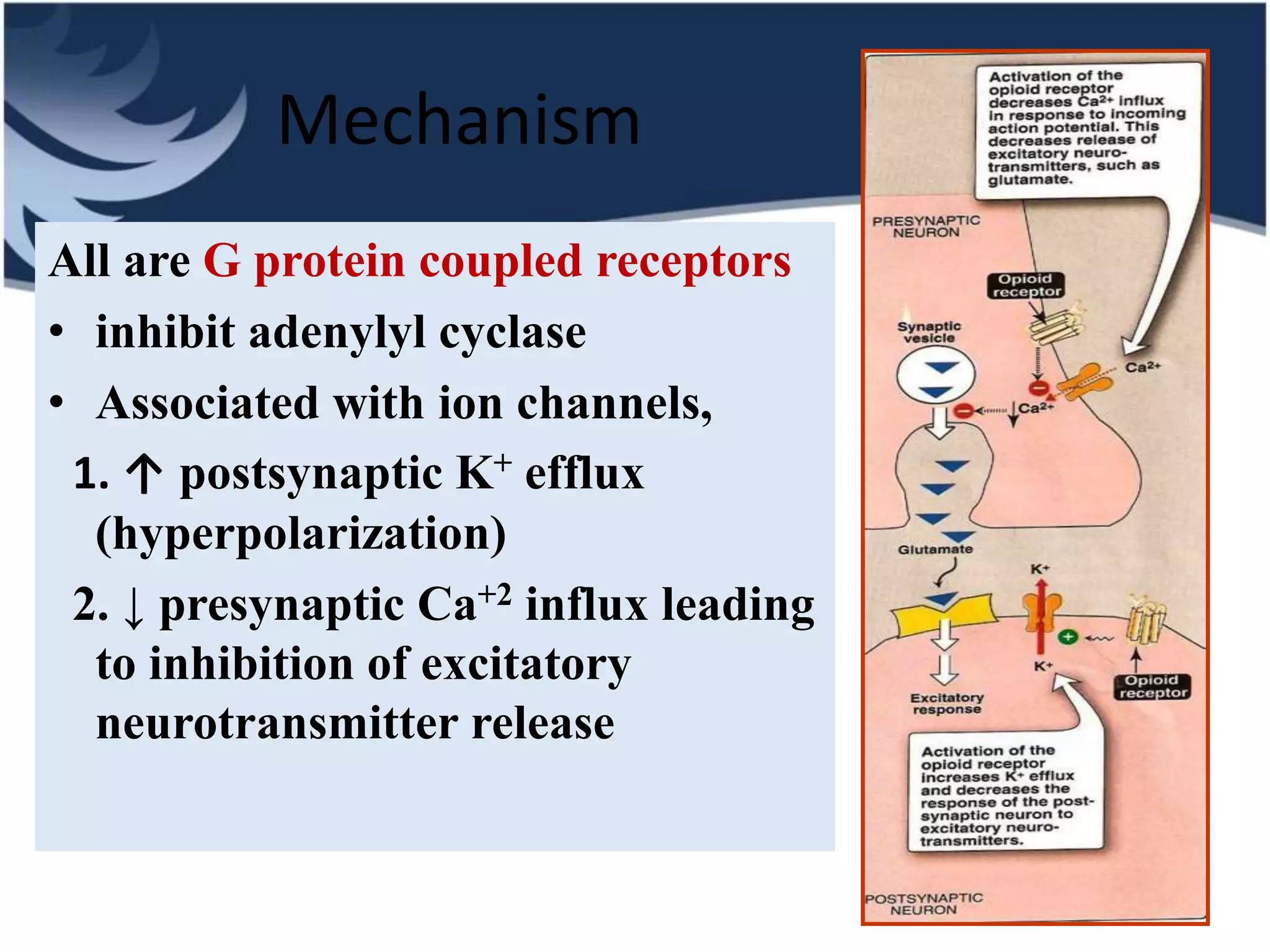
Mechanism
All are G protein coupled receptors
• inhibit adenylyl cyclase
• Associated with ion channels,
1. ↑ postsynaptic K+ efflux
(hyperpolarization)
2. ↓ presynaptic Ca+2 influx leading
to inhibition of excitatory
neurotransmitter release
Uses in anesthesia
 Mainly used for analgesia, for both intraoperative and
postoperative
 Blunting cardiovascular reponse to intubation. Fentanyl is
most commonly used but sulfentanil is the agent of choice
 Painless labour (fentanyl+bupivacaine by epidural route)
 Sedation in ICU
 Pulmonary edema ( morphine is the agent of choice)
 Intraoperative myocardial ischemia( morphine is used)
 To abolish shivering( pethidine ad tramadol)
 For day care surgery( propofol+remifentanil is the
combination of choice)
Systemic effects
CARDIOVASCULAR SYSTEM
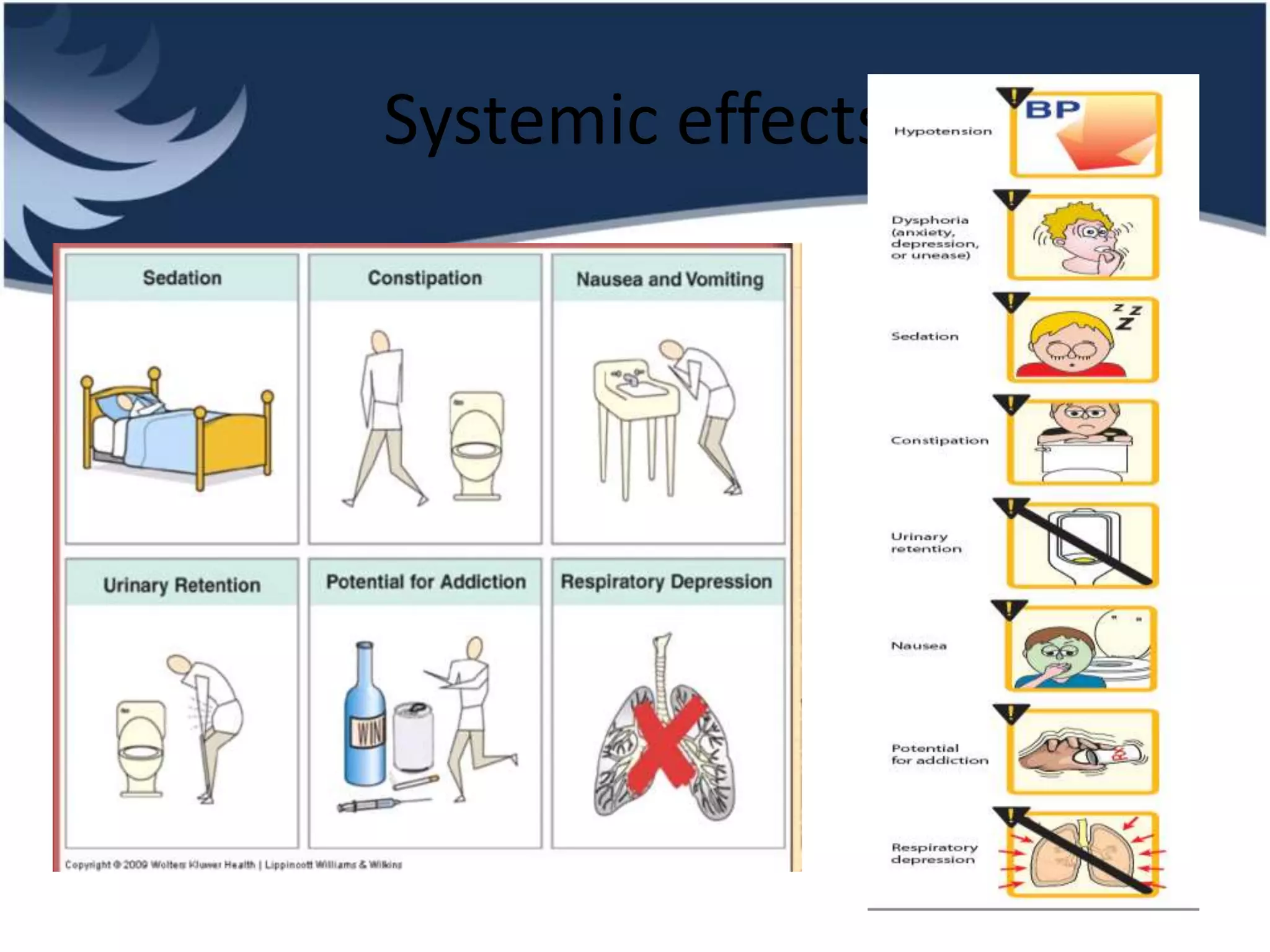
HYPOTENSION: due to decreased central sympathetic
tone.(minimum with fentanyl) . Pethidine and
pentazocine causes hypertension
BRADYCARDIA,( except pentazocine and pethidine
causes tachycardia)
Shifting of blood from pulmonary to systemic
circulation( Rx of left ventricular failure)
Vasolidation,
Decrease peripheral vascular resistance,
Decrease pulmonary vascular resisitance
RESPIRATORY SYSTEM
•Respiratory depression
•Medulla: mu2 receptor
•Decreases both the rate and volume
•Usual cause of death in opioid poisoning
•Bronchospasm
•Morphine, pethidine: histamine release
•Directly acting on bronchial muscle opiods
are bronchodilator but can cause
bronchoconstriction by release of histamine
•Inhibits airway and tracheal reflex(so used in
intubation and laryngoscopy and used in cough
syrups(codeine))
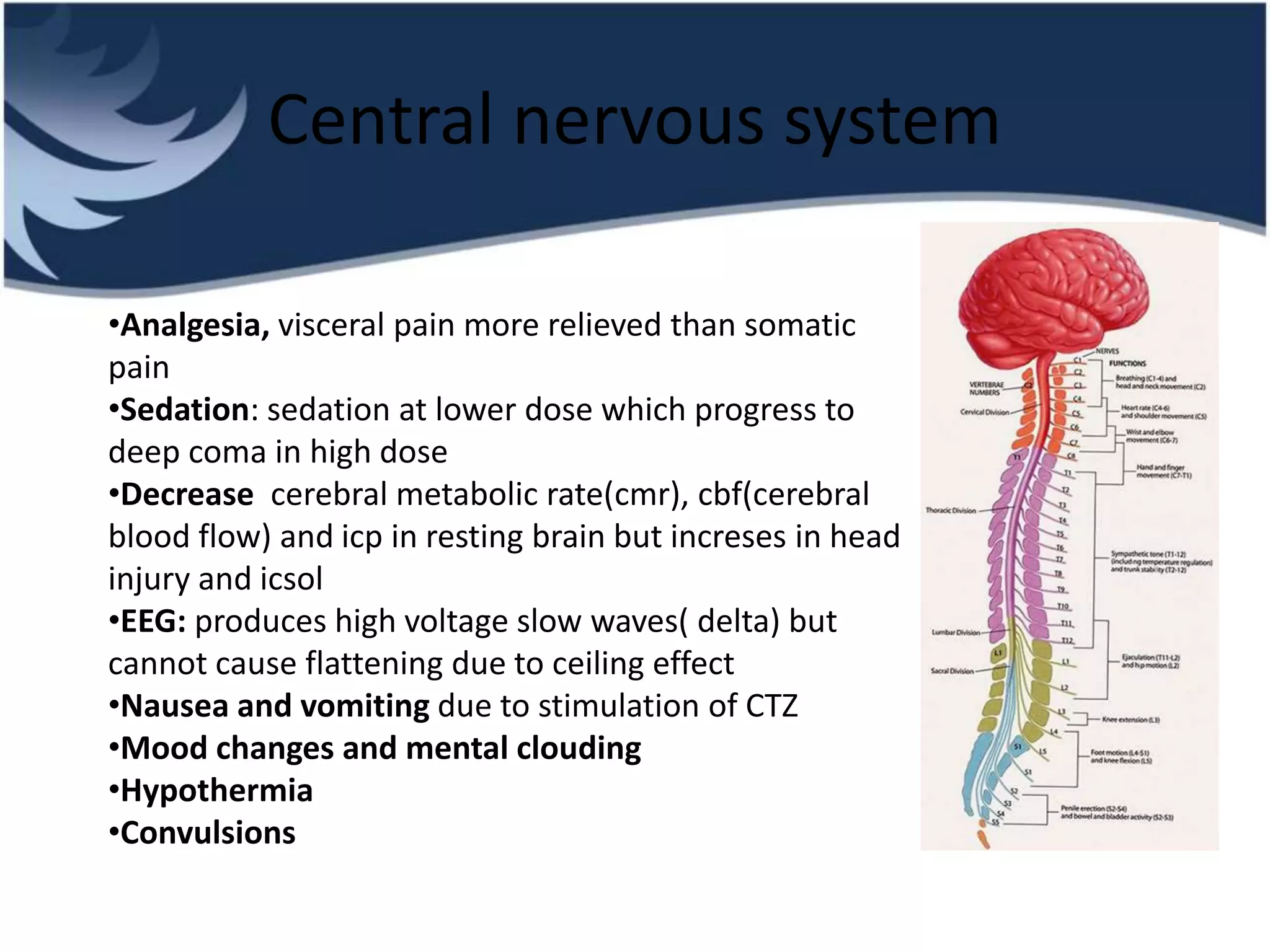
Central nervous system
•Analgesia, visceral pain more relieved than somatic
pain
•Sedation: sedation at lower dose which progress to
deep coma in high dose
•Decrease cerebral metabolic rate(cmr), cbf(cerebral
blood flow) and icp in resting brain but increses in head
injury and icsol
•EEG: produces high voltage slow waves( delta) but
cannot cause flattening due to ceiling effect
•Nausea and vomiting due to stimulation of CTZ
•Mood changes and mental clouding
•Hypothermia
•Convulsions
Systemic effects
• Muscular system:can cause muscle rigidity which can sometime
severe in thoracic muscle that hypoxia occurs.( wooden chest
syndrome or stiff chest syndrome)
• GIT: Decrease peristalsis
• Ileus
• Constipation
• Constriction of sphincter of oddi and Increase of biliary duct
pressure
• Urinary system: urinary retention due to relaxation of urinary
bladder
• Eye: causes miosis, decreases IOP
Systemic effects
• Endocrine: stress hormones decresed like
ACTH,FSH,LH and cortisol. Whereas ADH, GH
and prolactin synthesis increased
• Decrease effect of shivering: pethidine
• Tolerance, physical dependence and
addiction
Pharmacodynamics(effects of opioid)
Systemic effects
Opioid agonist
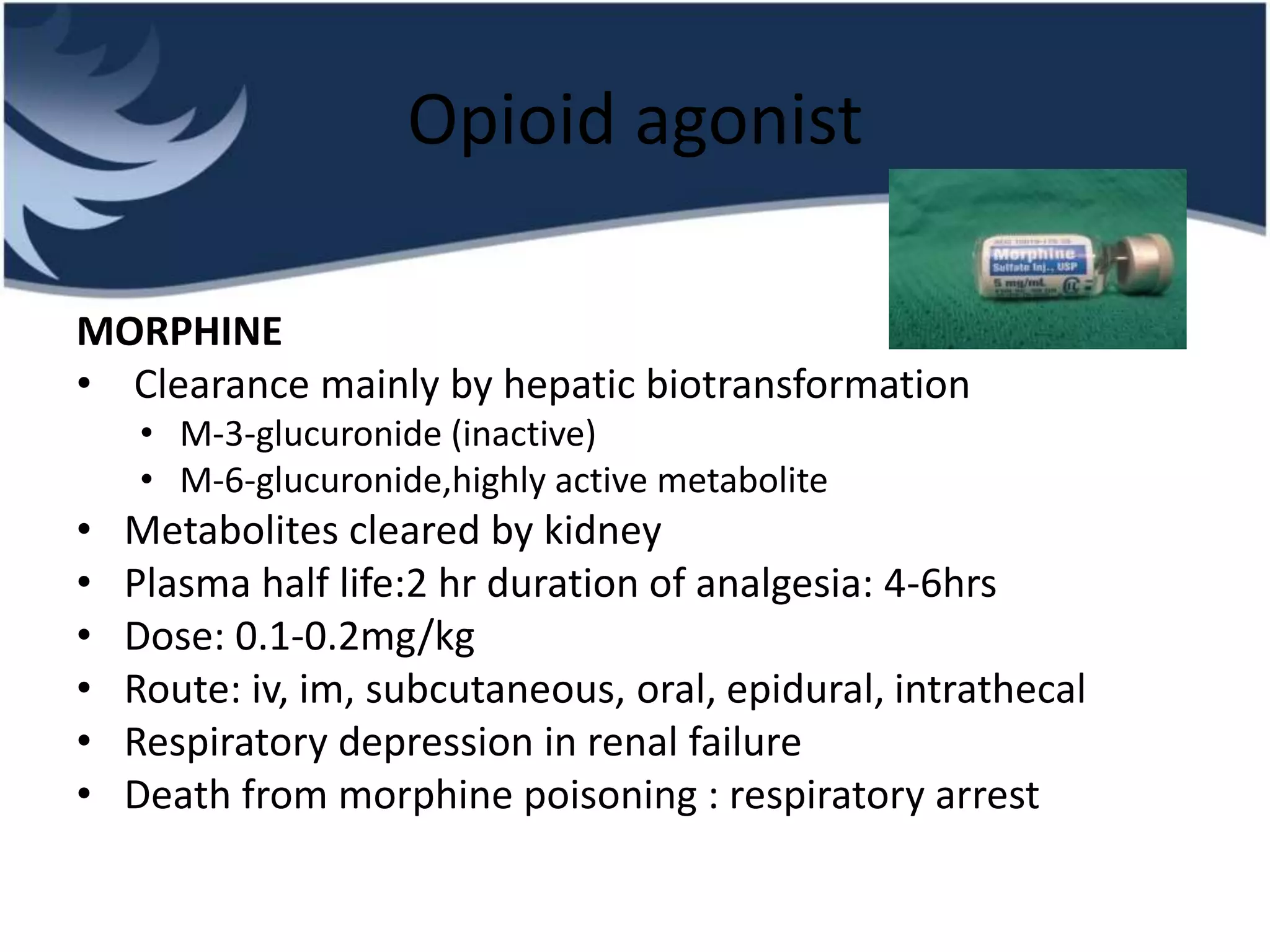
MORPHINE
• Clearance mainly by hepatic biotransformation
• M-3-glucuronide (inactive)
• M-6-glucuronide,highly active metabolite
• Metabolites cleared by kidney
• Plasma half life:2 hr duration of analgesia: 4-6hrs
• Dose: 0.1-0.2mg/kg
• Route: iv, im, subcutaneous, oral, epidural, intrathecal
• Respiratory depression in renal failure
• Death from morphine poisoning : respiratory arrest
Morphine
Indications:
 As analgesic in visceral pain, following operation, terminal illness(cancer), burn
 Myocardial infarction
 Travelers diarrhea
 To suppress cough
 Acute LVF and pulmonary edema
Contrainication
 Respiratory depression
 Nausea. Vomiting
 Constipation, biliary and ureteric spasm
 Hypotension
 Bronchospasm
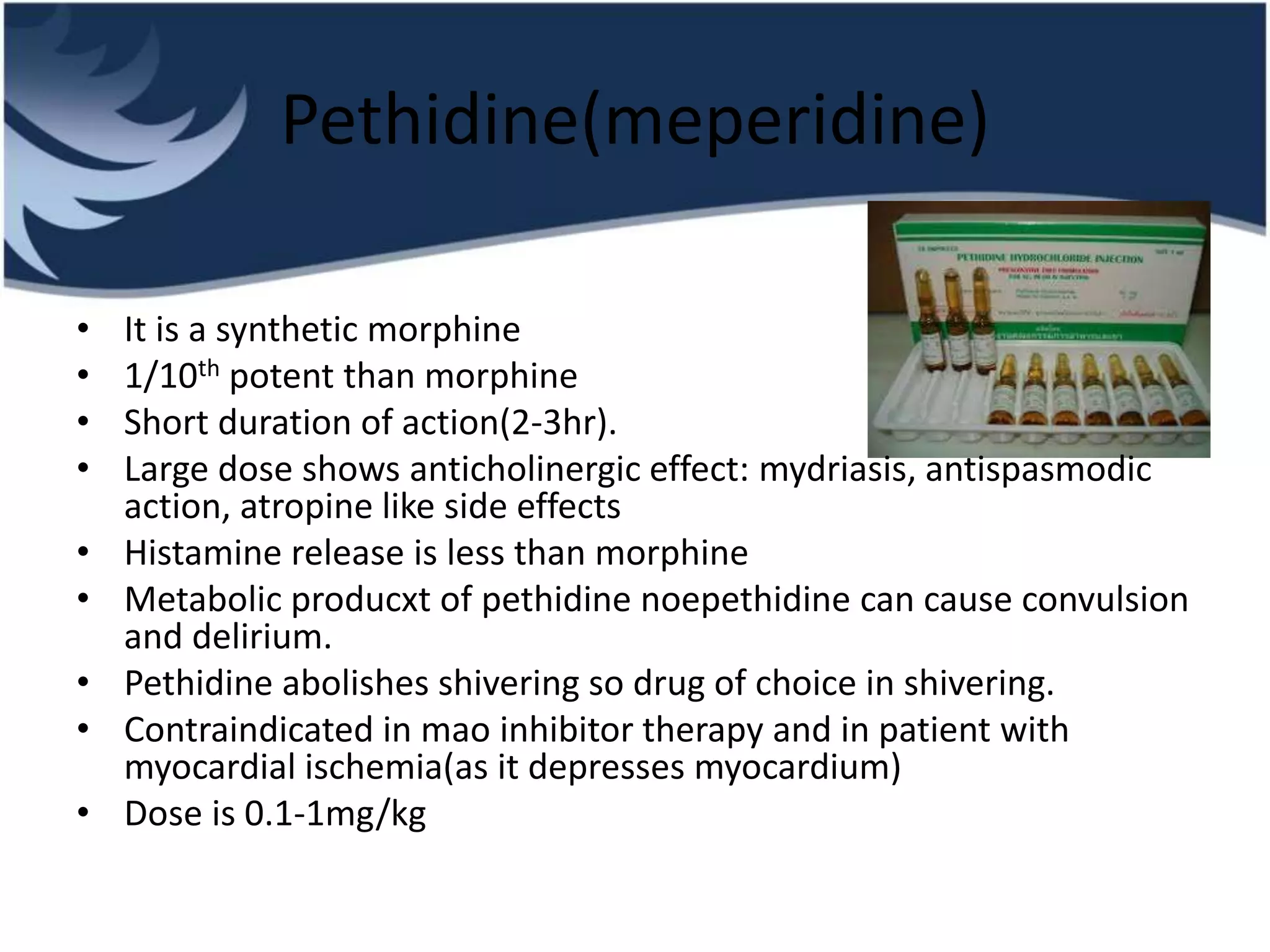
Pethidine(meperidine)
• It is a synthetic morphine
• 1/10th potent than morphine
• Short duration of action(2-3hr).
• Large dose shows anticholinergic effect: mydriasis, antispasmodic
action, atropine like side effects
• Histamine release is less than morphine
• Metabolic producxt of pethidine noepethidine can cause convulsion
and delirium.
• Pethidine abolishes shivering so drug of choice in shivering.
• Contraindicated in mao inhibitor therapy and in patient with
myocardial ischemia(as it depresses myocardium)
• Dose is 0.1-1mg/kg
Fentanyl
• 100 times more potent than morphine
• Due to high lipid solubility it has rapid onset( 2-5 minute) and rapid
recovery(1-2hrs)
• Can be given im, iv, tranmucosal(fentanyl lollipop),
transdermal(fentanyl patch), intrathecal and epidural route
• Cardiac stability
• With bupivacaine used epidurally for painless labour
• Fentanyl can produce significant muscle rigidity
• Dose: 2-5mcg/kg
• Sulfentanil analogue of fentanyl is 500 times more potent than
morphine, agent of choice for inhibiting stress response to
laryngoscopy and intubation
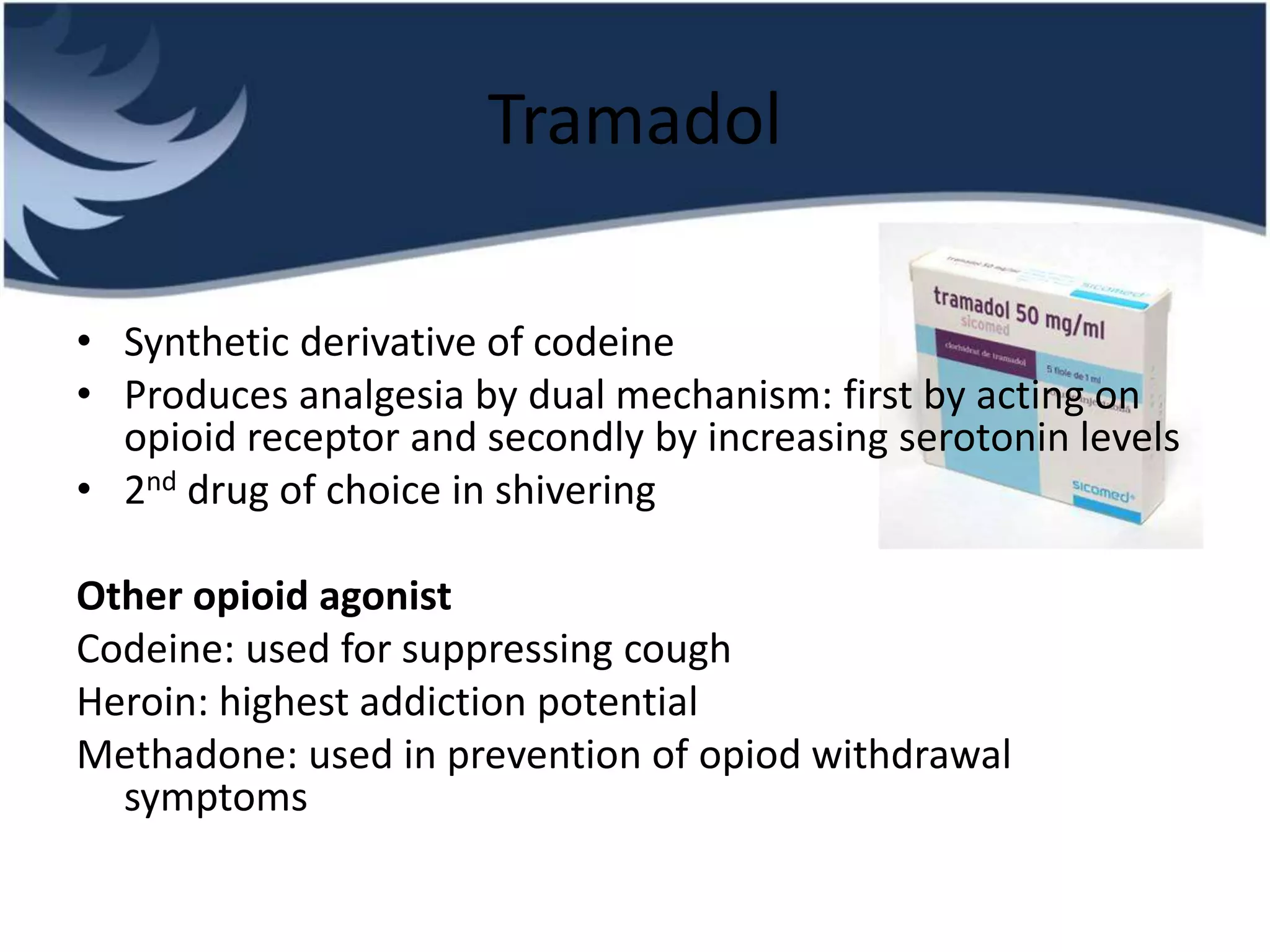
Tramadol
• Synthetic derivative of codeine
• Produces analgesia by dual mechanism: first by acting on
opioid receptor and secondly by increasing serotonin levels
• 2nd drug of choice in shivering
Other opioid agonist
Codeine: used for suppressing cough
Heroin: highest addiction potential
Methadone: used in prevention of opiod withdrawal
symptoms
Agonist -antagonist
Produces ceiling to respiratory depression.
PENTAZOCINE( FORTWIN)
 Agonist at kappa and delta receptor and antagonist at mu receptor
 Mainly acts on kappa receptors at spinal level
 Causes tachycardia and hypertension
 Depress respiration but has ceiling effect on respiratory depression
 Less nausea/vomiting
 Less addiction potential than morphine
 Dose: 1mg/kg can be given iv, im, routes
 Pentazocine is used for sequential analgesic anesthesia. Th this
technique pentazocine is administered after fentanyl is given in
moderate doses
Buprenorphine
• mu agonist at low dose but become
antagonist at high dose(after 1.2mg in adults),
so respiratoey depression which may be seen
intially is reversed and there is increased
ventilation.
• 25 times more potent than morphine
• Dose: 0.3mg
Opioid antagonist
Naloxone
 Acts on all receptors with maximum propensity for mu receptors
 Reverses the action of all opioIds with partial reversal of
buprenorphine
 Onset of action is 1-2 minutes and duration of action is 30-60
minutes
 Metabolized in liver
 Systemic effects: cvs- causes sympathetic stimulation and produces
severe hypertension and tachycardia and in cns causes incresed
metabolic rate, oxygen consumption and blood flow(increse icp)
Naloxone
Contraindication
 Myocardial ischemia
 Intracranial lesion
 Pheochromocytoma
Uses of naloxone:
• Acute Morphine Poisoning (0.4 – 0.8 mg IV 2-3 min, maximum 10 mg.
• Reverse the effect of diazepam, barbiturates(though GABA receptor),
nitrous oxide, endogenous opioids, alcohol, ketamine
• Diagnosis of opioid dependence
• Treating neonatal asphyxia if opioid are used during labour
• Treatment of septicemia, hypovolemic and spinal shock
• In treating alzheimer’s disease. schizophrenia.
Opiate withdrawal syndrome
Treatment: withdrawal of morphine and substitution with oral methadone,
followed by gradual withdrawal of methadone
Drug interactions
• The depressant actions of morphine are
enhanced by phenothiazines, MAOIs, and TCAs.
• Analgesia enhanced by: Low doses of
amphetamine & hydroxyzine.
Presentation by Dr.suraj kurmi

Presentation by Dr.suraj kurmi

  • 1.
    OPIOIDS DR. SURAJ KURMI(INTERN) DEPARTMENT OF ANESTHESIOLOGY “Among the remedies which it has pleased Almighty God to give to man to relieve his sufferings, none is so universal and so efficacious as opium.”
  • 2.
    OBJECTIVES • INTRODUCTION/ TERMINOLOGY •HISTORY • CLASSIFICATION • OPIOIDS RECEPTORS AND ITS DISTRIBUTION • MECHANISM OF ACTIONS • SYSTEMIC EFFECTS • USES IN ANESTHESIA • IMPORTANT OPIOIDS AND ITS USES AND EFFECTS • OPIOD WITHDRAWAL SYNDROME
  • 3.
    INTRODUCTION/TERMINOLOGY • Opioids: It includesall the natural and semisynthetic alkaloid derivatives from opium as well as their synthetic surrogates with the action that mimic those of morphine. It includes: 1. Opiates 2. Synthetic opioids( agonist, mixed agonist- antagonist and antagonist) 3. Endogenous opioids
  • 4.
    • Opiates opiates aretaken to those opiod drugs that are derived from alkaloids of the opium poppy( papaver somniferum) Opium is a Greek word meaning “juice,” or the exudate from the poppy Opium is obtained from the opium poppy by incision of the seed pod after the petals of flower have dropped. The white latex that oozes out on incision turns brown and hardens on standing. This sticky brown gum opium. It contains 20 alkaloids. The principle alkaloid in opium is morphine(10%), codeine is present in <0.5%
  • 5.
  • 6.
  • 7.
    Endogenous opiods • Enkephalins(act through delta receptor) • Endorphins( act through mu receptor) • Dynorphins( act through kappa receptor) Enkephalins and endorphins mediate supraspinal control of pain while dynorphins mediate pain control at spinal level. enkephalins are responsible for producing acupuncture mediated analgesia
  • 8.
    Opioid - History •Friedrich Wilhelm Serturner – A German Pharmacist – Isolated Morphine in 1803 and named it after the Greek god of Dreams “MORPHEUS” • Used for thousands of years to produce: – Euphoria – Analgesia – Sedation – Relief from diarrhea – Cough suppression
  • 9.
    Opioid- history • Usedmedicinally and recreationally from early Greek and Roman times • Opium and laudanum (opium combined with alcohol) were used to treat almost all known diseases • Invention of the hypodermic needle in 1856 produced drug abusers who self administered opioids by injection • Controlling the widespread use of opioids has been unsuccessful because of the euphoria, tolerance and physiological dependence that opioids produce
  • 10.
    Classification of Opioids Lowefficacy for mild and moderate pain High efficacy for severe pain Codeine Dihydrocodeine Pentazocine Morphine Pethidine Methadone phenazocine NATURALLY OCCURING SEMI-SYNTHETIC SYNTHETIC • Morphine • Codeine • Thebaine • Heroin • Dihydromorphone • Oxymorphone • Pentamorphone • Butorphanol • Levorphanol • Pethidine • Fentanyl, alfentanil,sufentanil • Tramadol • Buprenorphine
  • 11.
    CLASSIFICATION ON BASISOF RECEPTOR INTERACTION PURE AGONIST AGONIST ANTAGONIST PURE ANTAGONIST •Morphine •Fentanyl •Alfentanil •Sulfentanil •Pethidine •Pentazocine •Butorphanol •Nalorphine •Buprenorphine •Dezocine •Naloxone •Naltrexone •Nalmefene •Diprenorphine •Methylnaltrexone 1. Pure agonist: are agonist to all opioid receptors with highest propensity for mu receptors 2. Agonist-antagonist: All agonist and antagonist (except buprenorphine and dezocine) are agonist at kappa and sigma receptor and antagonist at mu receptor.. Buprenorphine and dezocine are classified as partial agonist antagonist as at low dose they are agonist at mu receptor whereas at high dose become antagonist. Produces ceiling effect. 3. Pure antagonist: antagonist to all receptor
  • 12.
    OPIOID RECEPTORS • Mainly3 (three) types of receptors – μ (mu), κ (kappa) and δ (delta) • Subtypes: μ1, μ2, κ1, κ2, κ3, δ1 and δ2 • Location: Peripheral Nerve endings, SG in spinal chord, Periaqueductal gray (PAG) in midbrain and Brain stem (medulla, hypothalumus and also amygdala • Sigma receptors are not considered as opioid receptors as they are not activated by morphine and not blocked by naloxone. Actions mediated by it are : dysphoria, hallucination,tachycardia and htn • Nociceptin(orphanin FQ) has been identified as new opiod receptor through which endogenous opiod act.
  • 13.
    Distribution of opiodreceptors • Dorsal horn of spinal cord • Subcortical regions of brain Thalamus Midbrain periaqueductal gray Rostral ventral medulla sites(nucleus raphe magnus) • Locus ceruleus of brainstem • Hypothalamic nuclei
  • 15.
    Receptors and itseffects μ (mu) receptors • μ 1: mediates analgesia (supraspinal),sedation, miosis, urinary retention, muscle rigidity, prolactin release • μ 2: mediates respiratory depression K (KAPPA) receptor: • K1: mediates spinal analgesia • K3: mediates supraspinal analgesia δ (delta) receptor: mediates analgesia at spinal level, respiratory depression and dependence.
  • 17.
    MECHANISM OF ACTIONOF OPIOIDS SUPRASPINAL: opioids binds with receptors in rostroventral region of medulla and cause stimulation of off cells present there, thereby blocking nociceptive stimuli transmission SPINAL LEVEL: act in substantia gelatinosa of dorsal horn cells and inhibit the release of excitatory transmitters Cellular level: opioids bind with the receptors and stimulate G protein synthesis and increases cAMP which causes: Increase K+: hyperpolarization of membrane Decreases calcium: decreases excitability
  • 18.
    Mechanism All are Gprotein coupled receptors • inhibit adenylyl cyclase • Associated with ion channels, 1. ↑ postsynaptic K+ efflux (hyperpolarization) 2. ↓ presynaptic Ca+2 influx leading to inhibition of excitatory neurotransmitter release
  • 19.
    Uses in anesthesia Mainly used for analgesia, for both intraoperative and postoperative  Blunting cardiovascular reponse to intubation. Fentanyl is most commonly used but sulfentanil is the agent of choice  Painless labour (fentanyl+bupivacaine by epidural route)  Sedation in ICU  Pulmonary edema ( morphine is the agent of choice)  Intraoperative myocardial ischemia( morphine is used)  To abolish shivering( pethidine ad tramadol)  For day care surgery( propofol+remifentanil is the combination of choice)
  • 20.
    Systemic effects CARDIOVASCULAR SYSTEM HYPOTENSION:due to decreased central sympathetic tone.(minimum with fentanyl) . Pethidine and pentazocine causes hypertension BRADYCARDIA,( except pentazocine and pethidine causes tachycardia) Shifting of blood from pulmonary to systemic circulation( Rx of left ventricular failure) Vasolidation, Decrease peripheral vascular resistance, Decrease pulmonary vascular resisitance
  • 21.
    RESPIRATORY SYSTEM •Respiratory depression •Medulla:mu2 receptor •Decreases both the rate and volume •Usual cause of death in opioid poisoning •Bronchospasm •Morphine, pethidine: histamine release •Directly acting on bronchial muscle opiods are bronchodilator but can cause bronchoconstriction by release of histamine •Inhibits airway and tracheal reflex(so used in intubation and laryngoscopy and used in cough syrups(codeine))
  • 22.
    Central nervous system •Analgesia,visceral pain more relieved than somatic pain •Sedation: sedation at lower dose which progress to deep coma in high dose •Decrease cerebral metabolic rate(cmr), cbf(cerebral blood flow) and icp in resting brain but increses in head injury and icsol •EEG: produces high voltage slow waves( delta) but cannot cause flattening due to ceiling effect •Nausea and vomiting due to stimulation of CTZ •Mood changes and mental clouding •Hypothermia •Convulsions
  • 23.
    Systemic effects • Muscularsystem:can cause muscle rigidity which can sometime severe in thoracic muscle that hypoxia occurs.( wooden chest syndrome or stiff chest syndrome) • GIT: Decrease peristalsis • Ileus • Constipation • Constriction of sphincter of oddi and Increase of biliary duct pressure • Urinary system: urinary retention due to relaxation of urinary bladder • Eye: causes miosis, decreases IOP
  • 24.
    Systemic effects • Endocrine:stress hormones decresed like ACTH,FSH,LH and cortisol. Whereas ADH, GH and prolactin synthesis increased • Decrease effect of shivering: pethidine • Tolerance, physical dependence and addiction
  • 25.
  • 26.
  • 27.
    Opioid agonist MORPHINE • Clearancemainly by hepatic biotransformation • M-3-glucuronide (inactive) • M-6-glucuronide,highly active metabolite • Metabolites cleared by kidney • Plasma half life:2 hr duration of analgesia: 4-6hrs • Dose: 0.1-0.2mg/kg • Route: iv, im, subcutaneous, oral, epidural, intrathecal • Respiratory depression in renal failure • Death from morphine poisoning : respiratory arrest
  • 28.
    Morphine Indications:  As analgesicin visceral pain, following operation, terminal illness(cancer), burn  Myocardial infarction  Travelers diarrhea  To suppress cough  Acute LVF and pulmonary edema Contrainication  Respiratory depression  Nausea. Vomiting  Constipation, biliary and ureteric spasm  Hypotension  Bronchospasm
  • 29.
    Pethidine(meperidine) • It isa synthetic morphine • 1/10th potent than morphine • Short duration of action(2-3hr). • Large dose shows anticholinergic effect: mydriasis, antispasmodic action, atropine like side effects • Histamine release is less than morphine • Metabolic producxt of pethidine noepethidine can cause convulsion and delirium. • Pethidine abolishes shivering so drug of choice in shivering. • Contraindicated in mao inhibitor therapy and in patient with myocardial ischemia(as it depresses myocardium) • Dose is 0.1-1mg/kg
  • 30.
    Fentanyl • 100 timesmore potent than morphine • Due to high lipid solubility it has rapid onset( 2-5 minute) and rapid recovery(1-2hrs) • Can be given im, iv, tranmucosal(fentanyl lollipop), transdermal(fentanyl patch), intrathecal and epidural route • Cardiac stability • With bupivacaine used epidurally for painless labour • Fentanyl can produce significant muscle rigidity • Dose: 2-5mcg/kg • Sulfentanil analogue of fentanyl is 500 times more potent than morphine, agent of choice for inhibiting stress response to laryngoscopy and intubation
  • 31.
    Tramadol • Synthetic derivativeof codeine • Produces analgesia by dual mechanism: first by acting on opioid receptor and secondly by increasing serotonin levels • 2nd drug of choice in shivering Other opioid agonist Codeine: used for suppressing cough Heroin: highest addiction potential Methadone: used in prevention of opiod withdrawal symptoms
  • 32.
    Agonist -antagonist Produces ceilingto respiratory depression. PENTAZOCINE( FORTWIN)  Agonist at kappa and delta receptor and antagonist at mu receptor  Mainly acts on kappa receptors at spinal level  Causes tachycardia and hypertension  Depress respiration but has ceiling effect on respiratory depression  Less nausea/vomiting  Less addiction potential than morphine  Dose: 1mg/kg can be given iv, im, routes  Pentazocine is used for sequential analgesic anesthesia. Th this technique pentazocine is administered after fentanyl is given in moderate doses
  • 33.
    Buprenorphine • mu agonistat low dose but become antagonist at high dose(after 1.2mg in adults), so respiratoey depression which may be seen intially is reversed and there is increased ventilation. • 25 times more potent than morphine • Dose: 0.3mg
  • 34.
    Opioid antagonist Naloxone  Actson all receptors with maximum propensity for mu receptors  Reverses the action of all opioIds with partial reversal of buprenorphine  Onset of action is 1-2 minutes and duration of action is 30-60 minutes  Metabolized in liver  Systemic effects: cvs- causes sympathetic stimulation and produces severe hypertension and tachycardia and in cns causes incresed metabolic rate, oxygen consumption and blood flow(increse icp)
  • 35.
    Naloxone Contraindication  Myocardial ischemia Intracranial lesion  Pheochromocytoma Uses of naloxone: • Acute Morphine Poisoning (0.4 – 0.8 mg IV 2-3 min, maximum 10 mg. • Reverse the effect of diazepam, barbiturates(though GABA receptor), nitrous oxide, endogenous opioids, alcohol, ketamine • Diagnosis of opioid dependence • Treating neonatal asphyxia if opioid are used during labour • Treatment of septicemia, hypovolemic and spinal shock • In treating alzheimer’s disease. schizophrenia.
  • 36.
  • 37.
    Opiate withdrawal syndrome Treatment:withdrawal of morphine and substitution with oral methadone, followed by gradual withdrawal of methadone
  • 38.
    Drug interactions • Thedepressant actions of morphine are enhanced by phenothiazines, MAOIs, and TCAs. • Analgesia enhanced by: Low doses of amphetamine & hydroxyzine.

Editor's Notes

  • #18 Inhibits release of transmitters – NA, DA, 5-HT, GABA and Glutamate