MEETING THE NEEDS OF
PERIOPERATIVE PATIENTS
PERIOPERATIVE NURSING
 Perioperative nursing includes activities
performed by the registered nurse during
pre operative, intra operative and post
operative phases of the patient’s surgical
experiences.
Period of the time that constitute the
surgical experience, include the preoperative,
intra-operative,postoperative phases
DEFINITION OF PERIOPERATIVE
NURSING
 Nursing care of the surgical patients before,
during,& after surgery is called as
perioperative nursing.
 Operation room nurse: Operation room (OR)
nurse are referred to as peri operative nurse to
meet accurately reflect their specialized duties.
 Scrub nurse: Selecting and passing instruments
and supplies used for the operation to maintain a
safe, comfortable environment.
 Postoperative period: The postoperative period
begins after the transfer to the PACU( Peri-
Anesthetic Care Unit) and terminates with the
resolution of the surgical sequelae. It is quite
common for this period to end outside of the
care of the surgical team
 Preoperative phase: This phase begins when
the decision for surgical intervention is made
and ends when the patient is transferred from
the operating room.
 Intra operative phase: This phase begins
when the patient is admitted or transferred to
the surgery department and ends when he or
she is admitted to the recovery area.
 Ectomy: A suffix denoting removal or excision of a
structure, e.g. hysterectomy (removal of the uterus).
 Orrhaphy: A plastic or repair operation; e.g.,
perineorrhaphy (repair of the perineum.The plasty is
also used, to describe a plastic operation where the
aim is to rebuild and restore tissue destroyed by
injury or disease.
 Oscopy: Inspection of the interior of an organ or
passage by means of special instruments, usually
carrying a light, e.g., cystoscopy (examination of the
bladder by means of acystoscope).
 Ostomy: Constructing an artificial opening
into an organ, e.g., gastrostomy (makes an
opening from the stomach on to the surface
of the abdomen).
 Ectomy: Incision or dividing a structure, e.g.,
laparotomy (incision and opening
theabdomen), tenotomy (dividing a tendon).
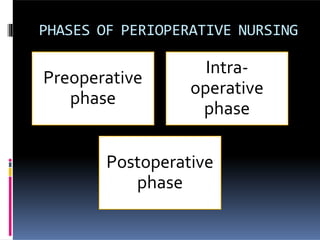
Preoperative
phase
Intra-
operative
phase
Postoperative
phase
PHASES OF PERIOPERATIVE NURSING
 1) Pre-operative phase: This is the phase of the
patient’s surgical experience which begins when
the decision is made to undergo surgical
intervention.
 This phase ends when the patient is transferred
to the operating table
 2) Intra-operative phase: this phase begins with
transfer of the patient to the operating table and
extends to the time the patient is admitted to
the recovery area.
 3) Post operative phase: this phase begins with
admission of the patient to the recovery area
which includes post anesthesia care unit or an
intensive care unit.
 This phase ends when the surgeon discontinues
follow-up care
1. PREOPERATIVE PHASE
 Preoperative phase is the period between the decision
to do the surgery & the client being shifted to the
operation table.
 During this phase the nurse gathers data by doing
assessment and plan components of nursing process
 The nurse identifies the patient’s physiologic,
psychologic and spiritual needs and finds existing or
potential problems
PURPOSES
 Preoperative nursing is based on the nursing care
is the care given to the patient before surgery.
 The preoperative period for different type
surgery is different e. g, for emergency surgery
preoperative period is very short. For planned
surgery time for surgery is fixed with the mutual
consent of the surgeon and the patient.
 Preoperative care of the patient surgeon makes
with diagnosis end decides that an operation is
necessary for the patient.
NURSING RESPONSIBILITY IN PRE-
OPERATIVE PHASE
 Assessment of the patients
 Identify health problem.
 Plan for care according to individual health
needs.
 HealthTeaching: client & supportive people.
 Preparation of client for surgery.
PREPARATION OF PATIENT FOR
SURGERY
1. Psychological preparation:
 Give information about surgery:
 Type of surgery
 Problem to be faced
 Sequence of surgery
 Duration of hospitalization
 Cost of surgery
 Purpose of investigation / treatment done before
surgery
 Necessary arrangement about financial
matters,works,hospitalization.
2. Eradicate fear of operation from
the patient.
 Ask question & clear doubts
 Introduction to other patients who had
similar surgery
 Explain about anesthesia
 Answers all question in their language
 The patient see the person,place,equipment
involved in operation
 Start procedure with explanation.
 3)Meet the spiritual needs of the patients
 Help the patient to meet the ministers of his
religion.
 4)Obtain informed consent
 Take sign of patients or relatives
 Explain complication
5)Build up the general health of patients &
Correction of disease process for speedy
recovery
 Assist doctor to carry out physical examination
 Take whole history
 Carry out investigation
 Arrange for blood donors
 Diet to be adjusted to correct under
weightoverweight
 Fluid administered if dehydrated
 6)Preoperative teaching
 Stop smoking
 Maintain personal hygiene
 Deep breathing & coughing exercise
 Exercise of limbs
 Control of visitors to prevent infection.
7)Surgical preparation of the skin:
 Check type of operation &area &prepared
 Check cleanliness of the skin lesions
 Wash hands
 Shave skin
8)Preparation of patients on the evening
before surgery:
 Remove jewellery & hand over to relatives
 Get order from doctor
 Give medication as per order
 Shave the part of operation
 Paint area of operation
 Enema is ordered
 Light diet & fasting after midnight is advised to
prevent vomitting & aspiration(6-8hrs prior to
surgery)
 Diazepam for good sleep
 Remove fear & anxiety
9)Preparation of patients on day of
surgery:
 Help patients to go toilet & for mouth wash
 Remove jewellery
 Comb hair and tie
 Fasting before surgery
 Bowel preparation
 Clean operation site
 Paint area of operation
 Cover operation site with sterile towel
 Introduce naso gastric tube, catheter etc.
10)Sending patients to Operating Room
 Administer pre medication before 1hr of
surgery
 Check vital signs
 Change O.T dress
 Bind identity band on hand
 Ask to patients to void just before surgery
 Transfer toO.T
 Never leave patient alone
 Sent patients with reports& charts.
2. INTRA OPERATIVE PHASE
 Is the period from the time the client is shifted to
operating table & later admitted to the post
anesthesia care unit or recovery room.
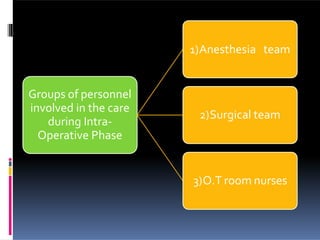
 Intraoperative nurses are responsible for the safety
circulating nurse and scrub nurse
and well-being of the patient, the cordination of
operating room personnel and activities of
1)Anesthesia team
Groups of personnel
involved in the care
during Intra-
Operative Phase
2)Surgical team
3)O.T room nurses
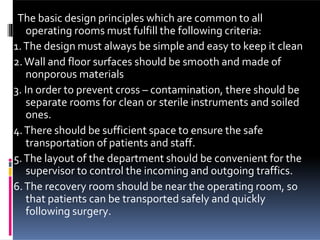
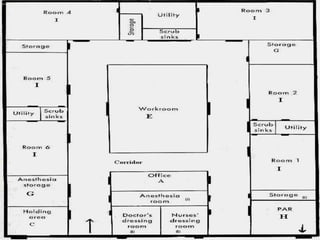
The basic design principles which are common to all
operating rooms must fulfill the following criteria:
1.The design must always be simple and easy to keep it clean
2.Wall and floor surfaces should be smooth and made of
nonporous materials
3. In order to prevent cross – contamination, there should be
separate rooms for clean or sterile instruments and soiled
ones.
4.There should be sufficient space to ensure the safe
transportation of patients and staff.
5.The layout of the department should be convenient for the
supervisor to control the incoming and outgoing traffics.
6.The recovery room should be near the operating room, so
that patients can be transported safely and quickly
following surgery.
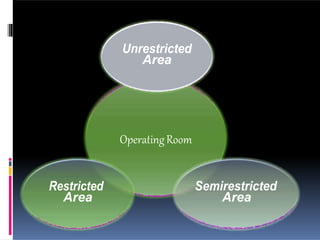
Unrestricted
Area
OperatingRoom
Restricted
Area
Semirestricted
Area
A. Unrestricted Area
 Street cloths are permitted.
 It serves as an outside-to-inside access area.
B. Semi restricted Area
 Limited to properly attired (dressed) personnel
 Body and head coverings are required
 This area includes peripheral support areas and
access corridors to the operating rooms.
 The patient may be transferred to a clean inside
stretcher on entry to this area
 The patient’s hair must be covered
C. Restricted Area
 Masks are required to supplement surgical attire
 Sterile procedures are carried out in this area
 The area includes the operating rooms, scrub sink
areas and sub sterile rooms or clean core area(s)
where unwrapped supplies are sterilized.
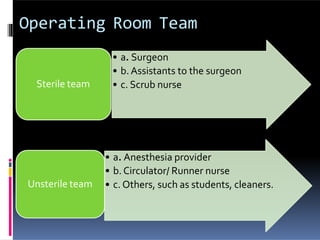
Operating Room Team
Sterile team
• a. Surgeon
• b. Assistants to the surgeon
• c. Scrub nurse
Unsterile team
• a. Anesthesia provider
• b. Circulator/ Runner nurse
• c. Others, such as students, cleaners.
ROLE OF SCRUB NURSE BEFORETHE
OPERATION:
 Collect the equipment & linen
 Gowning & gloving
 Draping trolley
 Collect suture material ,needles ,blades ,mops ,gauze
cotton .
 Check patients identity withO.T list
 Ensuring safe positioning of patients.
ROLE OF SCRUB NURSE DURING OPERATION
 Skin preparation agents & swabs
 Assisting in draping
 Positioning table
 Arranging diathermy & suction
 Passing instruments ,suture ,swabs to doctor
 Count extra instruments
 Maintain discipline& minimum disturbance
ROLE OF SCRUB NURSE AT THE END OF
OPERATION
 Confirming instruments
 Collect dressing materials from circulator
 Removing draps
 Disposing the blades, needles
 Clean perioperative area
 Cover patient with clean sheets
 Returning instruments for washing &
Sterilization
 Completing entries in the operation registers.
ROLE OF CIRCULATORY NURSE BEFORE
OPERATION
 Who helps the scrubbed nurse & available through
procedure
 Check O.T clean
 Equipment are working condition or not
 Check light, suction and other machine
 Ensuring the temperature & humidity controls are
correctly set
 Collect necessary stocks
 Prepare sterile gown & gloves
 Assists with counts & records.
ROLE OF CIRCULATORY NURSE DURING
OPERATION
 Being available in O.T
 Connect machine
 Disposing of used swabs or other materials
 Ensuring doors close
 Anticipating the requirements of the team
 Preparing wound dressings
ROLE OF CIRCULATORY NURSE AFTER
OPERATION
 Handing dressing to scrub assistant
 Help in removal of drapes
 Help in shift patient
 Ensuring clean the theater & prepared for
next patient
 Removing instruments trolley
 Post operative period begins as soon as the
operation is completed. It is described as the
period of 1-4 hours after surgery.
 The Post-Anesthesia Care Unit (PACU), also
called the post anesthesia recovery room, is
located adjacent to the operating rooms.
PHASES OF POSTANESTHESIA CARE
Post-Anaesthesia care is divided into two phases.
Phase I PACU:
 Used during the immediate recovery phase,
 Intensive nursing care is provided.
Phase II PACU:
 Is reserved for patients who require less frequent
observation and less nursing care.
 The patient is prepared for discharge.
 May also be referred to as step-down, sit-up, or
progressive care units.
 Patients may remain in a phase II PACU unit for as
long as 4 to 6 hours, depending on the type of
surgery and any pre-existing conditions of the
patient.
1) Preparation of post anesthetic bed &
reception of the patient:
 Prepare bed without disturbing functioning of
the devices
 Receive patients on bed without complication
 Ask about operation to theatre staff nurse
 Check vital signs
 Compare records
 Check operation sites
 Never leave patient alone
 Give treatments as per dr.order.
2)Care of patients who is under the
effects of anesthesia
 Close observation until patient recover
 Noisy breathing indicate airway obstruction so
do suction
 Give suitable position to prevent vomits &
aspiration
 Cyanosed then administer oxygen
 Put side rails
 While awakening from anesthesia orient patient
 Ask for drinking water
 Informed successfully completion of surgery
3)Observation of patient in post operative
period
 Need close observation to find out complication
 2 hrly check vital sign ,intake output, bowel
movements ,pain ,breathing difficulty ,
operation sites.
4)Care of wounds
 Promote intake of foods high in protein and vitamin C.
 Prevent infection that delays healing.
 Change soiled wet dressings immediately.
 Use strict aseptic technique when changing dressings.
 Cover moist dressings with a dry sterile cover.
 Surgical wounds because they are aseptically created,
generally heal well and quickly. Dressings over closed
wounds are usually removed by 3rd
or 4th
day.
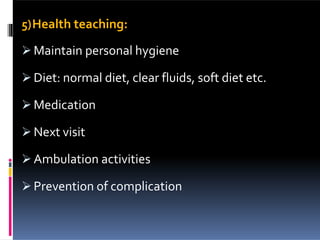
5)Health teaching:
 Maintain personal hygiene
 Diet: normal diet, clear fluids, soft diet etc.
 Medication
 Next visit
 Ambulation activities
 Prevention of complication
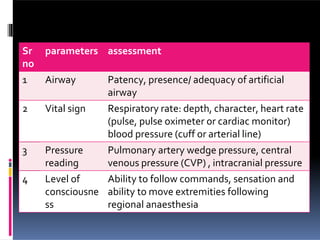
Sr
no
parameters assessment
1 Airway Patency, presence/ adequacy of artificial
airway
2 Vital sign Respiratory rate: depth, character, heart rate
(pulse, pulse oximeter or cardiac monitor)
blood pressure (cuff or arterial line)
3 Pressure
reading
Pulmonary artery wedge pressure, central
venous pressure (CVP) , intracranial pressure
4 Level of
consciousne
ss
Ability to follow commands, sensation and
ability to move extremities following
regional anaesthesia
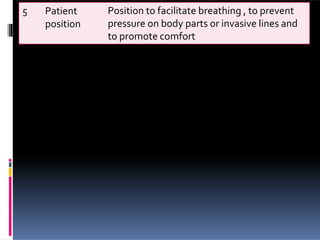
5 Patient
position
Position to facilitate breathing , to prevent
pressure on body parts or invasive lines and
to promote comfort
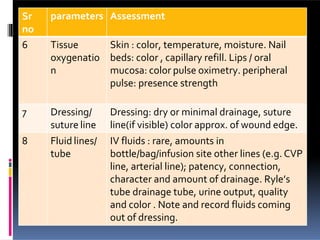
Sr
no
parameters Assessment
6 Tissue
oxygenatio
n
Skin : color, temperature, moisture. Nail
beds: color , capillary refill. Lips / oral
mucosa: color pulse oximetry. peripheral
pulse: presence strength
7 Dressing/
suture line
Dressing: dry or minimal drainage, suture
line(if visible) color approx. of wound edge.
8 Fluid lines/
tube
IV fluids : rare, amounts in
bottle/bag/infusion site other lines (e.g. CVP
line, arterial line); patency, connection,
character and amount of drainage. Ryle’s
tube drainage tube, urine output, quality
and color . Note and record fluids coming
out of dressing.
POST OPERATIVE COMPLICATION
 Shock. ...
 Hemorrhage. ...
 Wound infection. ...
 Deep vein thrombosis (DVT) and pulmonary embolism (PE). ...
 Pulmonary embolism. ...
 Lung (pulmonary) complications. ...
 Urinary retention. ...
 Reaction to anesthesia.
1.

PERIOPERATIVE NURSING.docx

  • 1.
    MEETING THE NEEDSOF PERIOPERATIVE PATIENTS
  • 3.
    PERIOPERATIVE NURSING  Perioperativenursing includes activities performed by the registered nurse during pre operative, intra operative and post operative phases of the patient’s surgical experiences. Period of the time that constitute the surgical experience, include the preoperative,
  • 4.
    intra-operative,postoperative phases DEFINITION OFPERIOPERATIVE NURSING  Nursing care of the surgical patients before, during,& after surgery is called as perioperative nursing.
  • 6.
     Operation roomnurse: Operation room (OR) nurse are referred to as peri operative nurse to meet accurately reflect their specialized duties.  Scrub nurse: Selecting and passing instruments and supplies used for the operation to maintain a safe, comfortable environment.  Postoperative period: The postoperative period begins after the transfer to the PACU( Peri- Anesthetic Care Unit) and terminates with the resolution of the surgical sequelae. It is quite common for this period to end outside of the care of the surgical team
  • 7.
     Preoperative phase:This phase begins when the decision for surgical intervention is made and ends when the patient is transferred from the operating room.  Intra operative phase: This phase begins when the patient is admitted or transferred to the surgery department and ends when he or she is admitted to the recovery area.
  • 8.
     Ectomy: Asuffix denoting removal or excision of a structure, e.g. hysterectomy (removal of the uterus).  Orrhaphy: A plastic or repair operation; e.g., perineorrhaphy (repair of the perineum.The plasty is also used, to describe a plastic operation where the aim is to rebuild and restore tissue destroyed by injury or disease.  Oscopy: Inspection of the interior of an organ or passage by means of special instruments, usually carrying a light, e.g., cystoscopy (examination of the bladder by means of acystoscope).
  • 9.
     Ostomy: Constructingan artificial opening into an organ, e.g., gastrostomy (makes an opening from the stomach on to the surface of the abdomen).  Ectomy: Incision or dividing a structure, e.g., laparotomy (incision and opening theabdomen), tenotomy (dividing a tendon).
  • 10.
  • 11.
     1) Pre-operativephase: This is the phase of the patient’s surgical experience which begins when the decision is made to undergo surgical intervention.  This phase ends when the patient is transferred to the operating table
  • 12.
     2) Intra-operativephase: this phase begins with transfer of the patient to the operating table and extends to the time the patient is admitted to the recovery area.  3) Post operative phase: this phase begins with admission of the patient to the recovery area which includes post anesthesia care unit or an intensive care unit.  This phase ends when the surgeon discontinues follow-up care
  • 13.
    1. PREOPERATIVE PHASE Preoperative phase is the period between the decision to do the surgery & the client being shifted to the operation table.  During this phase the nurse gathers data by doing assessment and plan components of nursing process  The nurse identifies the patient’s physiologic, psychologic and spiritual needs and finds existing or potential problems
  • 14.
    PURPOSES  Preoperative nursingis based on the nursing care is the care given to the patient before surgery.  The preoperative period for different type surgery is different e. g, for emergency surgery preoperative period is very short. For planned surgery time for surgery is fixed with the mutual consent of the surgeon and the patient.  Preoperative care of the patient surgeon makes with diagnosis end decides that an operation is necessary for the patient.
  • 15.
    NURSING RESPONSIBILITY INPRE- OPERATIVE PHASE  Assessment of the patients  Identify health problem.  Plan for care according to individual health needs.  HealthTeaching: client & supportive people.  Preparation of client for surgery.
  • 16.
    PREPARATION OF PATIENTFOR SURGERY 1. Psychological preparation:  Give information about surgery:  Type of surgery  Problem to be faced  Sequence of surgery  Duration of hospitalization  Cost of surgery  Purpose of investigation / treatment done before surgery  Necessary arrangement about financial matters,works,hospitalization.
  • 17.
    2. Eradicate fearof operation from the patient.  Ask question & clear doubts  Introduction to other patients who had similar surgery  Explain about anesthesia  Answers all question in their language  The patient see the person,place,equipment involved in operation  Start procedure with explanation.
  • 18.
     3)Meet thespiritual needs of the patients  Help the patient to meet the ministers of his religion.  4)Obtain informed consent  Take sign of patients or relatives  Explain complication
  • 19.
    5)Build up thegeneral health of patients & Correction of disease process for speedy recovery  Assist doctor to carry out physical examination  Take whole history  Carry out investigation  Arrange for blood donors  Diet to be adjusted to correct under weightoverweight  Fluid administered if dehydrated
  • 20.
     6)Preoperative teaching Stop smoking  Maintain personal hygiene  Deep breathing & coughing exercise  Exercise of limbs  Control of visitors to prevent infection.
  • 21.
    7)Surgical preparation ofthe skin:  Check type of operation &area &prepared  Check cleanliness of the skin lesions  Wash hands  Shave skin
  • 22.
    8)Preparation of patientson the evening before surgery:  Remove jewellery & hand over to relatives  Get order from doctor  Give medication as per order  Shave the part of operation  Paint area of operation  Enema is ordered  Light diet & fasting after midnight is advised to prevent vomitting & aspiration(6-8hrs prior to surgery)  Diazepam for good sleep  Remove fear & anxiety
  • 23.
    9)Preparation of patientson day of surgery:  Help patients to go toilet & for mouth wash  Remove jewellery  Comb hair and tie  Fasting before surgery  Bowel preparation  Clean operation site  Paint area of operation  Cover operation site with sterile towel  Introduce naso gastric tube, catheter etc.
  • 24.
    10)Sending patients toOperating Room  Administer pre medication before 1hr of surgery  Check vital signs  Change O.T dress  Bind identity band on hand  Ask to patients to void just before surgery  Transfer toO.T  Never leave patient alone  Sent patients with reports& charts.
  • 25.
    2. INTRA OPERATIVEPHASE  Is the period from the time the client is shifted to operating table & later admitted to the post anesthesia care unit or recovery room.  Intraoperative nurses are responsible for the safety circulating nurse and scrub nurse and well-being of the patient, the cordination of operating room personnel and activities of
  • 26.
    1)Anesthesia team Groups ofpersonnel involved in the care during Intra- Operative Phase 2)Surgical team 3)O.T room nurses
  • 27.
    The basic designprinciples which are common to all operating rooms must fulfill the following criteria: 1.The design must always be simple and easy to keep it clean 2.Wall and floor surfaces should be smooth and made of nonporous materials 3. In order to prevent cross – contamination, there should be separate rooms for clean or sterile instruments and soiled ones. 4.There should be sufficient space to ensure the safe transportation of patients and staff. 5.The layout of the department should be convenient for the supervisor to control the incoming and outgoing traffics. 6.The recovery room should be near the operating room, so that patients can be transported safely and quickly following surgery.
  • 29.
  • 30.
    A. Unrestricted Area Street cloths are permitted.  It serves as an outside-to-inside access area. B. Semi restricted Area  Limited to properly attired (dressed) personnel  Body and head coverings are required  This area includes peripheral support areas and access corridors to the operating rooms.  The patient may be transferred to a clean inside stretcher on entry to this area  The patient’s hair must be covered
  • 31.
    C. Restricted Area Masks are required to supplement surgical attire  Sterile procedures are carried out in this area  The area includes the operating rooms, scrub sink areas and sub sterile rooms or clean core area(s) where unwrapped supplies are sterilized.
  • 32.
    Operating Room Team Sterileteam • a. Surgeon • b. Assistants to the surgeon • c. Scrub nurse Unsterile team • a. Anesthesia provider • b. Circulator/ Runner nurse • c. Others, such as students, cleaners.
  • 33.
    ROLE OF SCRUBNURSE BEFORETHE OPERATION:  Collect the equipment & linen  Gowning & gloving  Draping trolley  Collect suture material ,needles ,blades ,mops ,gauze cotton .  Check patients identity withO.T list  Ensuring safe positioning of patients.
  • 34.
    ROLE OF SCRUBNURSE DURING OPERATION  Skin preparation agents & swabs  Assisting in draping  Positioning table  Arranging diathermy & suction  Passing instruments ,suture ,swabs to doctor  Count extra instruments  Maintain discipline& minimum disturbance
  • 35.
    ROLE OF SCRUBNURSE AT THE END OF OPERATION  Confirming instruments  Collect dressing materials from circulator  Removing draps  Disposing the blades, needles  Clean perioperative area  Cover patient with clean sheets  Returning instruments for washing & Sterilization  Completing entries in the operation registers.
  • 36.
    ROLE OF CIRCULATORYNURSE BEFORE OPERATION  Who helps the scrubbed nurse & available through procedure  Check O.T clean  Equipment are working condition or not  Check light, suction and other machine  Ensuring the temperature & humidity controls are correctly set  Collect necessary stocks  Prepare sterile gown & gloves  Assists with counts & records.
  • 37.
    ROLE OF CIRCULATORYNURSE DURING OPERATION  Being available in O.T  Connect machine  Disposing of used swabs or other materials  Ensuring doors close  Anticipating the requirements of the team  Preparing wound dressings
  • 38.
    ROLE OF CIRCULATORYNURSE AFTER OPERATION  Handing dressing to scrub assistant  Help in removal of drapes  Help in shift patient  Ensuring clean the theater & prepared for next patient  Removing instruments trolley
  • 39.
     Post operativeperiod begins as soon as the operation is completed. It is described as the period of 1-4 hours after surgery.  The Post-Anesthesia Care Unit (PACU), also called the post anesthesia recovery room, is located adjacent to the operating rooms.
  • 40.
    PHASES OF POSTANESTHESIACARE Post-Anaesthesia care is divided into two phases. Phase I PACU:  Used during the immediate recovery phase,  Intensive nursing care is provided. Phase II PACU:  Is reserved for patients who require less frequent observation and less nursing care.  The patient is prepared for discharge.  May also be referred to as step-down, sit-up, or progressive care units.  Patients may remain in a phase II PACU unit for as long as 4 to 6 hours, depending on the type of surgery and any pre-existing conditions of the patient.
  • 41.
    1) Preparation ofpost anesthetic bed & reception of the patient:  Prepare bed without disturbing functioning of the devices  Receive patients on bed without complication  Ask about operation to theatre staff nurse  Check vital signs  Compare records  Check operation sites  Never leave patient alone  Give treatments as per dr.order.
  • 42.
    2)Care of patientswho is under the effects of anesthesia  Close observation until patient recover  Noisy breathing indicate airway obstruction so do suction  Give suitable position to prevent vomits & aspiration  Cyanosed then administer oxygen  Put side rails  While awakening from anesthesia orient patient  Ask for drinking water  Informed successfully completion of surgery
  • 43.
    3)Observation of patientin post operative period  Need close observation to find out complication  2 hrly check vital sign ,intake output, bowel movements ,pain ,breathing difficulty , operation sites.
  • 44.
    4)Care of wounds Promote intake of foods high in protein and vitamin C.  Prevent infection that delays healing.  Change soiled wet dressings immediately.  Use strict aseptic technique when changing dressings.  Cover moist dressings with a dry sterile cover.  Surgical wounds because they are aseptically created, generally heal well and quickly. Dressings over closed wounds are usually removed by 3rd or 4th day.
  • 45.
    5)Health teaching:  Maintainpersonal hygiene  Diet: normal diet, clear fluids, soft diet etc.  Medication  Next visit  Ambulation activities  Prevention of complication
  • 46.
    Sr no parameters assessment 1 AirwayPatency, presence/ adequacy of artificial airway 2 Vital sign Respiratory rate: depth, character, heart rate (pulse, pulse oximeter or cardiac monitor) blood pressure (cuff or arterial line) 3 Pressure reading Pulmonary artery wedge pressure, central venous pressure (CVP) , intracranial pressure 4 Level of consciousne ss Ability to follow commands, sensation and ability to move extremities following regional anaesthesia
  • 47.
    5 Patient position Position tofacilitate breathing , to prevent pressure on body parts or invasive lines and to promote comfort
  • 48.
    Sr no parameters Assessment 6 Tissue oxygenatio n Skin: color, temperature, moisture. Nail beds: color , capillary refill. Lips / oral mucosa: color pulse oximetry. peripheral pulse: presence strength 7 Dressing/ suture line Dressing: dry or minimal drainage, suture line(if visible) color approx. of wound edge. 8 Fluid lines/ tube IV fluids : rare, amounts in bottle/bag/infusion site other lines (e.g. CVP line, arterial line); patency, connection, character and amount of drainage. Ryle’s tube drainage tube, urine output, quality and color . Note and record fluids coming out of dressing.
  • 49.
    POST OPERATIVE COMPLICATION Shock. ...  Hemorrhage. ...  Wound infection. ...  Deep vein thrombosis (DVT) and pulmonary embolism (PE). ...  Pulmonary embolism. ...  Lung (pulmonary) complications. ...  Urinary retention. ...  Reaction to anesthesia.
  • 50.