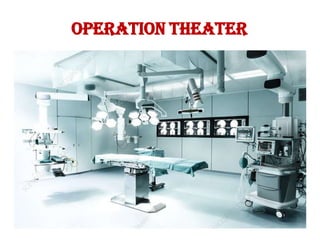
Operation Theater
WELCOME
Mr. Abhay Rajpoot
Medical-Surgical Nursing Department
Operation Theater
Review Questions:
1.What is OT?
2.Why OT is important?
3.Explain Structure of an Ideal OT?
4.What are the Functions of OT?
4.What are staffing pattern of OT?
Review Basic Terms
&
Concepts
Types of Surgery
Elective-Performed on the basis of client’s
choice; not essential and may not necessary
for health.
Urgent- Necessary for client’ health, may
prevent additional problem from developing
(e.g. tissue destruction);not necessarily
emergency.
Emergent- Must be done immediately to save
life or preserve function of body part.
Required- Has to performed at some point; can
be pre-scheduled.
Types of Surgery
• Diagnostic-Allows to confirm diagnosis.
• Corrective- Excision or removal of
diseased body part.
• Reconstructive-Restore function or
appearance to traumatized or
malfunctioning tissues.
Types of Surgery
• Procurement for transplant- Removal of
organs and/or tissues from a person
pronounced brain death for
transplantation into another person.
• Constructive- Restores function lost or
reduced as result of congenital anomalies.
• Cosmetic- Performed to improve personal
appearance.
Types of Surgery
• Extent of surgery :
Simple- Only the most overtly affected areas
involved in the surgery.
Radical- Extensive surgery beyond the area
obviously involved; is directed at finding a root
cause.
• Location: Based on the area of the body on
which the surgery occurs (e.g. abdominal,
heart surgery).
Purpose of Surgery
• Diagnostic
– Determine or confirm a diagnosis
(breast biopsy, bronchoscopy)
• Cure/Curative
– Removal of diseased tissue, organ, or
extremity (appendectomy, amputation)
• Constructive
– Build tissues or organs that are absent;
congenital anomalies (cleft lip repair)
• Prevention/Preventive
– (e.g. removal of mole)
Purpose of Surgery
• Reconstructive
– Rebuild tissue or organ that has
been damaged (skin graft after a
burn, total joint replacement
• Exploration – Surgical examination
to determine the nature or extent of
a disease (Laparotomy)
• Cosmetic Improvement –
(repairing a burn scar, or changing breast
shape)
Purpose of Surgery
• Palliative
– Alleviate symptoms of a
disease (not curative)
(bowel resection in client
with terminal cancer)
• Transplant
– Replace organ or tissue to
restore function (Heart lung
liver kidney transplant)
Surgical Setting
• Hospital
• Ambulatory surgery
–Emergency
departments
–Doctors offices? (clnic)
–Freestanding surgical
clinics (camps)
–Outpatient surgeries in
hospitals
Types of Surgeries Performed in
an Inpatient Setting
• Amputations
• Transplants
• Total Joint Replacement
• Colostomy
• Nephrectomy
• Heart Bypass Surgery
• C-sections
• Ruptured Aneurysm
• Life-threatening Trauma
Types of Surgeries Performed in
an Outpatient Setting
• Breast Biopsy
• Bronchoscopy
• Appendectomy?
• Removal of Skin Lesion
• Cataract Extraction?
• Cosmetic Surgery ?
• Hernia Repair ?
• Tubal Ligation
• Vasectomy
• Dilation and Curettage
• Hemorrhoidectomies ?
Minor OT?
Inpatient Surgery-Advantages
• More time for rapport
• More time to assess for risks
and needs
• More time to teach
• Increased availability of:
– Professional care and
assistance
– Treatment and diagnostic
facilities
– Medications and blood
Inpatient Setting: Disadvantages
• Higher cost
• Higher risk of hospital
acquired infection
• Interruption of family
routine
• Interruption of work and
responsibilities
• More stressful for the
patient and family
Outpatient Setting: Advantages
• Lower cost
• Less risk for hospital acquired
infection
• Less interruption of family
routine
• Possible reduction in time lost
from work and other
responsibilities
• Less physiologic stress to the
patient and family
Outpatient Setting: Disadvantages
• Less time for rapport
• Less time to assess risks and needs
• Less time to teach
Common Pre-admission Directions
• Time and date of arrival
• NPO
• Bowel preparation
• Valuables, jewelry
• Clothing
• Medicines
OT
Definition
Specialized facility in hospital
where invasive treatment is given
under strict aseptic controlled
environment by trained personnel
An OT is that specialized facility of the
hospital where life saving or life
improving procedures are carried out
on human body by invasive methods
under strict aseptic conditions in a
controlled environment by specially
trained personnel to promote healing
and cure with maximum safety,
comfort and economy.
OPERATING ROOM
• The identification of physiological &
sociological needs of the client, & the
implementation of an individualized
program of care in order to restore
or maintain the health & welfare of
the patient before, during & after
surgical intervention.
PHILOSOPHY :
• To give service that aims to provide
comprehensive support physically,
morally, psychologically, spiritually, &
socially to a patient undergoing
surgery.
Support services play a large part in
maximizing efficiency by providing:
• Pre-operative preparation and assessment
•Available beds
•Sterile theatre equipment
•Portering, cleaning and maintenance staff.
Goals
Key elements to efficient use of operating
theatres are:
• Effective management
• Good communication
• Well trained staff
• Appropriate facilities and equipment
• Operational layout that allows flow of patients
Fundamental purposes of the O.R. :
It is a place. . .
1. Tocorrelate theory & practice.
2. Todevelop skills in assisting the surgeon in
the operation.
3. Tocreate a suitable sterile field for surgical
procedures to prevent complications.
OBJECTIVES OF PLANNING
• Promote high standards of asepsis
• Ensure maximum standard of safety
• Optimum utilization of OT and staff time
• Optimize working conditions
• Patient and staff comfort in terms of
thermal, acoustic and lighting
requirements
OBJECTIVES OF PLANNING………
• Allow flexibility
• Facilities coordinated services
• Minimize maintenance
• Ensures functional separation of spaces
• Provide a smoothing environment
• Regulate the flow of traffic
DESIGN PARAMETERS
• Avoidance of unrelated hospital traffic flow
• Convenient functional flow between related
departments like ICU,CCU etc
• Avoidance of outdoor noise
• Provision for future expansion
• Sliding doors
• Desirable floors to be smooth and non-
slippery
• Ceilings to be painted with washable paints
DESIGN PARAMETERS………..
• Taps in scrub room should be knee/elbow
operated /infrared operated.
• Provisions of high speed autoclaves
• Essential pharmaceutical storage
• X-ray films illuminators
• Emergency communicators that can be
activated without the use of hand
• Toilets
Design considerations
•Location
•Workflow
•Basic work areas and Division of space
•Zoning concept
•Air filters
•Machinery and equipment
•Organization
•Policies and procedures
•Problems
PHYSICAL EVIRONMENT
• TEMPERATURE
• HUMIDITY
• VENTILATION
PHYSICAL EVIRONMENT
•Air – supply, direction of flow, pressure
changes in areas, air changes, monitoring
of quality
•Temperature and humidity – 21-24 centi,
45-60% humidity
•Lighting – at incision area 50 to 125K lux
with intensity cntrl, non-shadow ,blue-
white color of daylight, heat cntrl
Areas with higher hygienic
requirements for air quality.
• Areas with high clean-air requirements include the
operating theatre, any sterile preparation and pre-
operative areas, sterile storage, the anesthesia and
equipment storerooms and the entrances and the
exits.
• The highest clean-air requirements apply to the
operation area and the sterile preparation area.
• With respect to air treatment, the operating theatre
and a number of adjacent areas have to comply with
the provisions of the working conditions policy
regulation.
Thank you
PLANNING AND DESIGNING OF
OPERATION THEATRE
Number of OT beds:
1. According to Rao committee (India) : One
operation theatre for 50 surgical beds
2. American pattern One operation theatre for
25 surgical beds
3. European countries One operation theatre for
50 surgical beds
Number of OTs required for 600
bedded hospital.
•For 600 bedded hospital (300 Surg. Beds)
•Out of Surgical Beds, 50% of Pts are expected
to undergo the surgery as such
•For 8 Hrs working for 6 days a week
–No of surgeries= Surg Beds x Bed Occupancy
x Working days/Average Length of stay
=300 beds x 60% x 250 days/10 days(ALS)
=4500 surgeries/ year
Important Zones of OT:
1. Outer Zone - include: administrative area,
reception, control-area, class-room,
conference-room, staff locker area, patient
holding area.
• Space is necessary for reception, paper work,
clinical instruction, offices of: anesthesiology,
surgeon, dictate and write medical note,
locker, toilet, coffee etc.
Outer Zone……………
• A main access door
• An accessible area for the removal of waste
• A sluice
• Storage for medical and surgical supplies
• An entrance to the changing facilities
2. RESTRICTED ZONE OR CLEAN ZONE
• Changing room
• Patient transfer area
• Stores room
• Nursing staff room
• Anaesthetist room
• Recovery room.
• The sterile supplies store
• A clean corridor
• Rest rooms for the staff.
3. The intermediate zone- Large area, out
patient delivery, supplies and materials,
post-operative room.
• Store large number of CSSD and
autoclave supplies, linen pack, gloves,
bandages, linen, post anesthetic room.
4. The Inner Zone/ ASEPTIC ZONE :
Actual operation room, scrub
area, patient induction area, Area
for instrument packing and
sterilization.
• The highest level of cleanliness
and sterile condition should be
maintained.
5. DISPOSAL ZONE
• Area where used equipment are cleaned and
biohazardous waste is disposed
Recovery Room
• Charting Facilities, medication, hand
washing facilities, link provision,
bedpan, laboratory.
OT Zones: Summary
ZONE 1
– PROTECTIVE - reception, waiting, trolley bay, change rooms
ZONE 2
– CLEAN AREA –preoperative, recovery, plaster room,
staff lounges, stores
ZONE 3
– STERILE AREA – operating room, scrub room, anesthesia room,
setup room
ZONE 4
– DISPOSAL AREA – dirty utility, disposal corridor
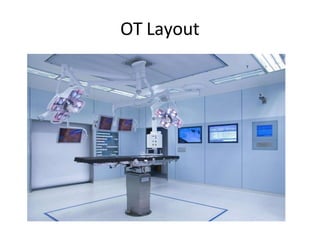
OT Layout
Layout
• Room Size: 7.5 x 7.5 Meter
• standard size is 20 X 20 X 10 with a minimum floor
space of 360 square feet.
• Corridors: 10-12” wide: two stretcher can pass at a
time.
• Light: 3 meter from furnished floor
• Lighting: high level, special ceiling mounted light to
illuminate operating area, light control system.
• Operative microscope: enough space area: vascular
surgery requires microscope.
Layout………
• Sore: CSSD, Main equipment, disposable hold,
medical gases, blood (freeze).
• Orthopedic surgery store: splint, traction,
plaster of peris room, plaster sink etc.
Facilities and space requirement:
• Control station:
located as to permit visual observation of all
traffic in to and in the departure.
• Supervisor’s office
• Pre-operative holding area
• Induction area
• Recovery room
• Sterilization facilities
• Area for portable x-ray
Facilities and space requirement…..
• Medicine store with refrigeration facilities.
• Scrub facilities
• Soiled work room, sink room
• Fluid waste facilities
• Clean work room (duty work room)
• Medical gases facilities room
• Equipment store room
• Staff clothing changing room (M/F): categories=
Nurses, Doctor, Consultant ant, Technician, helper
etc. with toilet and hand washing facilities.
Surgical Operating Suites
OPERATION ROOM: Single
1. Big enough for free circulation
2. Two openings (optional)Towards scrub area/
Towards sterile area
3. Openings fitted with swing doors.
4. Marble or polished stone flooring
5. Glaze tiled walls
6. No false ceiling
OT Layout
Automatic Remote Controlled C-arm Table
Remote Control OT Tables
NUMBER OF OPERTING SUITES
 Number and type of surgeons
 Type of hospitals
 Hospital policy and procedure
 Bed strength
 Number and type of surgery patients
 Number of operations per day
 Time a Time allowed for staff breaks
 Average time for operations
 Time allowed for maintenance of OT
 Expected ALOS
 Size of an average OT list
• LOCATIONG:
- GOUND FLOOR
- TOP FLOOR (best if all the facilities)
- ANYWHERE INTHE HOSPITAL
OT Furniture
• OT furniture is important aspect owing to its
specialized design.
• This furniture has certain functions needed to
support patients who have decreased
mobility.
• In such cases the specialized design of OT
furniture serves the need of providing the
required support.
O.T. Light
Operation theatre (OT) light comes with the
following features:
• Perfect
• Comfortable
• Lights brilliant
• Exclusive design
• Trouble free
• Mounting is economic
Venous OT lights
 Shadow less Ceiling Operating light combination that
provides the superior performance for all kinds if
surgeries.
 Compact, Light weight and sealed dome made of
aluminium consists of glass diachronic reflector to
provide cool, bright and homogenous illumination.
 OT Lights are made to spot light the operation table
area.
 They illuminate the area to the right level of
brightness
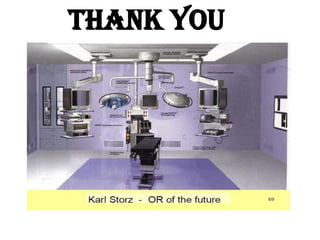
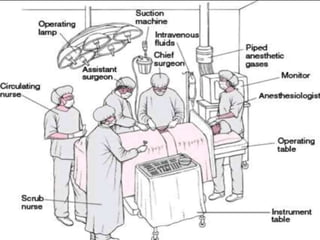
SCRUB TEAM WORK
THE OPERATING ROOM
Thank you
Types of air supply
Air is supplied to the operating theatre by:
1. Plenum Ventilation: This is the most frequently used
system in general purpose operating rooms.
 The bacterial counts at the wound site should be no
more than 50 -500 colony forming units (cfu) per cubic
meter.
2. Laminar Flow Ventilation (Ultra Clean Ventilation): This
system is unidirectional and delivers air flow over the
operating table of 300 air changes per hour. A bacterial count
of 10 cfu or less per cubic meter at the wound site is
achieved.
3. Wall Mounted Air Conditioners: These are installed in some
tropical
 countries more for comfort than for clean air delivery. They
should not be
 used as air delivery systems. The units are usually mounted on
the hot
 outside wall and the air is directed down and back onto the unit
itself (towards the wall).
 The operating table does not receive any significant air changes
and the bacterial counts remain unaffected.
4. Free-standing Air Conditioners: These are cooling units
with no filtration of air and therefore do not fulfill the
criteria for air delivery systems, especially for an OT.
Remember
Windows should remain closed.
The operating theatre should maintain at positive pressure.
Air should be introduced at the ceiling and should be exhausted
near the floor in order to prevent bacterial contamination in the
operative field
Air changes should be at least 20 changes per hour.
Air should first pass through a series of dust filters and then enter
the room through a HEPA filter. Split-unit air conditioning is not
allowed.
Humidity should be controlled and maintained between 50-55%.
Temperature should be controlled and maintained between 18-24
degrees Celsius.
Human
anatomical waste
Chemo drugs
Soiled waste
Expired or
Discarded
Medicines,
soiled linen
C)ontaminated
Plastic Waste
(Recyclable
Waste
sharps
including
Metals
Glassware:
Broken or
discarded
&
contaminated
glass including
medicine vials
& ampoules
37
General
waste
3 BINS, 01 CONTAINER, O1 BOX
OT

OT

  • 1.
  • 2.
  • 3.
    Operation Theater Review Questions: 1.Whatis OT? 2.Why OT is important? 3.Explain Structure of an Ideal OT? 4.What are the Functions of OT? 4.What are staffing pattern of OT?
  • 4.
  • 5.
    Types of Surgery Elective-Performedon the basis of client’s choice; not essential and may not necessary for health. Urgent- Necessary for client’ health, may prevent additional problem from developing (e.g. tissue destruction);not necessarily emergency. Emergent- Must be done immediately to save life or preserve function of body part. Required- Has to performed at some point; can be pre-scheduled.
  • 6.
    Types of Surgery •Diagnostic-Allows to confirm diagnosis. • Corrective- Excision or removal of diseased body part. • Reconstructive-Restore function or appearance to traumatized or malfunctioning tissues.
  • 7.
    Types of Surgery •Procurement for transplant- Removal of organs and/or tissues from a person pronounced brain death for transplantation into another person. • Constructive- Restores function lost or reduced as result of congenital anomalies. • Cosmetic- Performed to improve personal appearance.
  • 8.
    Types of Surgery •Extent of surgery : Simple- Only the most overtly affected areas involved in the surgery. Radical- Extensive surgery beyond the area obviously involved; is directed at finding a root cause. • Location: Based on the area of the body on which the surgery occurs (e.g. abdominal, heart surgery).
  • 9.
    Purpose of Surgery •Diagnostic – Determine or confirm a diagnosis (breast biopsy, bronchoscopy) • Cure/Curative – Removal of diseased tissue, organ, or extremity (appendectomy, amputation) • Constructive – Build tissues or organs that are absent; congenital anomalies (cleft lip repair) • Prevention/Preventive – (e.g. removal of mole)
  • 10.
    Purpose of Surgery •Reconstructive – Rebuild tissue or organ that has been damaged (skin graft after a burn, total joint replacement • Exploration – Surgical examination to determine the nature or extent of a disease (Laparotomy) • Cosmetic Improvement – (repairing a burn scar, or changing breast shape)
  • 11.
    Purpose of Surgery •Palliative – Alleviate symptoms of a disease (not curative) (bowel resection in client with terminal cancer) • Transplant – Replace organ or tissue to restore function (Heart lung liver kidney transplant)
  • 12.
    Surgical Setting • Hospital •Ambulatory surgery –Emergency departments –Doctors offices? (clnic) –Freestanding surgical clinics (camps) –Outpatient surgeries in hospitals
  • 13.
    Types of SurgeriesPerformed in an Inpatient Setting • Amputations • Transplants • Total Joint Replacement • Colostomy • Nephrectomy • Heart Bypass Surgery • C-sections • Ruptured Aneurysm • Life-threatening Trauma
  • 14.
    Types of SurgeriesPerformed in an Outpatient Setting • Breast Biopsy • Bronchoscopy • Appendectomy? • Removal of Skin Lesion • Cataract Extraction? • Cosmetic Surgery ? • Hernia Repair ? • Tubal Ligation • Vasectomy • Dilation and Curettage • Hemorrhoidectomies ? Minor OT?
  • 15.
    Inpatient Surgery-Advantages • Moretime for rapport • More time to assess for risks and needs • More time to teach • Increased availability of: – Professional care and assistance – Treatment and diagnostic facilities – Medications and blood
  • 16.
    Inpatient Setting: Disadvantages •Higher cost • Higher risk of hospital acquired infection • Interruption of family routine • Interruption of work and responsibilities • More stressful for the patient and family
  • 17.
    Outpatient Setting: Advantages •Lower cost • Less risk for hospital acquired infection • Less interruption of family routine • Possible reduction in time lost from work and other responsibilities • Less physiologic stress to the patient and family
  • 18.
    Outpatient Setting: Disadvantages •Less time for rapport • Less time to assess risks and needs • Less time to teach
  • 19.
    Common Pre-admission Directions •Time and date of arrival • NPO • Bowel preparation • Valuables, jewelry • Clothing • Medicines
  • 20.
  • 21.
    Definition Specialized facility inhospital where invasive treatment is given under strict aseptic controlled environment by trained personnel
  • 22.
    An OT isthat specialized facility of the hospital where life saving or life improving procedures are carried out on human body by invasive methods under strict aseptic conditions in a controlled environment by specially trained personnel to promote healing and cure with maximum safety, comfort and economy.
  • 23.
    OPERATING ROOM • Theidentification of physiological & sociological needs of the client, & the implementation of an individualized program of care in order to restore or maintain the health & welfare of the patient before, during & after surgical intervention.
  • 24.
    PHILOSOPHY : • Togive service that aims to provide comprehensive support physically, morally, psychologically, spiritually, & socially to a patient undergoing surgery.
  • 25.
    Support services playa large part in maximizing efficiency by providing: • Pre-operative preparation and assessment •Available beds •Sterile theatre equipment •Portering, cleaning and maintenance staff.
  • 26.
    Goals Key elements toefficient use of operating theatres are: • Effective management • Good communication • Well trained staff • Appropriate facilities and equipment • Operational layout that allows flow of patients
  • 27.
    Fundamental purposes ofthe O.R. : It is a place. . . 1. Tocorrelate theory & practice. 2. Todevelop skills in assisting the surgeon in the operation. 3. Tocreate a suitable sterile field for surgical procedures to prevent complications.
  • 28.
    OBJECTIVES OF PLANNING •Promote high standards of asepsis • Ensure maximum standard of safety • Optimum utilization of OT and staff time • Optimize working conditions • Patient and staff comfort in terms of thermal, acoustic and lighting requirements
  • 29.
    OBJECTIVES OF PLANNING……… •Allow flexibility • Facilities coordinated services • Minimize maintenance • Ensures functional separation of spaces • Provide a smoothing environment • Regulate the flow of traffic
  • 30.
    DESIGN PARAMETERS • Avoidanceof unrelated hospital traffic flow • Convenient functional flow between related departments like ICU,CCU etc • Avoidance of outdoor noise • Provision for future expansion • Sliding doors • Desirable floors to be smooth and non- slippery • Ceilings to be painted with washable paints
  • 31.
    DESIGN PARAMETERS……….. • Tapsin scrub room should be knee/elbow operated /infrared operated. • Provisions of high speed autoclaves • Essential pharmaceutical storage • X-ray films illuminators • Emergency communicators that can be activated without the use of hand • Toilets
  • 32.
    Design considerations •Location •Workflow •Basic workareas and Division of space •Zoning concept •Air filters •Machinery and equipment •Organization •Policies and procedures •Problems
  • 37.
  • 38.
    PHYSICAL EVIRONMENT •Air –supply, direction of flow, pressure changes in areas, air changes, monitoring of quality •Temperature and humidity – 21-24 centi, 45-60% humidity •Lighting – at incision area 50 to 125K lux with intensity cntrl, non-shadow ,blue- white color of daylight, heat cntrl
  • 39.
    Areas with higherhygienic requirements for air quality. • Areas with high clean-air requirements include the operating theatre, any sterile preparation and pre- operative areas, sterile storage, the anesthesia and equipment storerooms and the entrances and the exits. • The highest clean-air requirements apply to the operation area and the sterile preparation area. • With respect to air treatment, the operating theatre and a number of adjacent areas have to comply with the provisions of the working conditions policy regulation.
  • 40.
  • 41.
    PLANNING AND DESIGNINGOF OPERATION THEATRE
  • 42.
    Number of OTbeds: 1. According to Rao committee (India) : One operation theatre for 50 surgical beds 2. American pattern One operation theatre for 25 surgical beds 3. European countries One operation theatre for 50 surgical beds
  • 43.
    Number of OTsrequired for 600 bedded hospital. •For 600 bedded hospital (300 Surg. Beds) •Out of Surgical Beds, 50% of Pts are expected to undergo the surgery as such •For 8 Hrs working for 6 days a week –No of surgeries= Surg Beds x Bed Occupancy x Working days/Average Length of stay =300 beds x 60% x 250 days/10 days(ALS) =4500 surgeries/ year
  • 44.
    Important Zones ofOT: 1. Outer Zone - include: administrative area, reception, control-area, class-room, conference-room, staff locker area, patient holding area. • Space is necessary for reception, paper work, clinical instruction, offices of: anesthesiology, surgeon, dictate and write medical note, locker, toilet, coffee etc.
  • 45.
    Outer Zone…………… • Amain access door • An accessible area for the removal of waste • A sluice • Storage for medical and surgical supplies • An entrance to the changing facilities
  • 46.
    2. RESTRICTED ZONEOR CLEAN ZONE • Changing room • Patient transfer area • Stores room • Nursing staff room • Anaesthetist room • Recovery room. • The sterile supplies store • A clean corridor • Rest rooms for the staff.
  • 47.
    3. The intermediatezone- Large area, out patient delivery, supplies and materials, post-operative room. • Store large number of CSSD and autoclave supplies, linen pack, gloves, bandages, linen, post anesthetic room.
  • 48.
    4. The InnerZone/ ASEPTIC ZONE : Actual operation room, scrub area, patient induction area, Area for instrument packing and sterilization. • The highest level of cleanliness and sterile condition should be maintained.
  • 49.
    5. DISPOSAL ZONE •Area where used equipment are cleaned and biohazardous waste is disposed
  • 50.
    Recovery Room • ChartingFacilities, medication, hand washing facilities, link provision, bedpan, laboratory.
  • 51.
    OT Zones: Summary ZONE1 – PROTECTIVE - reception, waiting, trolley bay, change rooms ZONE 2 – CLEAN AREA –preoperative, recovery, plaster room, staff lounges, stores ZONE 3 – STERILE AREA – operating room, scrub room, anesthesia room, setup room ZONE 4 – DISPOSAL AREA – dirty utility, disposal corridor
  • 52.
  • 54.
    Layout • Room Size:7.5 x 7.5 Meter • standard size is 20 X 20 X 10 with a minimum floor space of 360 square feet. • Corridors: 10-12” wide: two stretcher can pass at a time. • Light: 3 meter from furnished floor • Lighting: high level, special ceiling mounted light to illuminate operating area, light control system. • Operative microscope: enough space area: vascular surgery requires microscope.
  • 55.
    Layout……… • Sore: CSSD,Main equipment, disposable hold, medical gases, blood (freeze). • Orthopedic surgery store: splint, traction, plaster of peris room, plaster sink etc.
  • 56.
    Facilities and spacerequirement: • Control station: located as to permit visual observation of all traffic in to and in the departure. • Supervisor’s office • Pre-operative holding area • Induction area • Recovery room • Sterilization facilities • Area for portable x-ray
  • 57.
    Facilities and spacerequirement….. • Medicine store with refrigeration facilities. • Scrub facilities • Soiled work room, sink room • Fluid waste facilities • Clean work room (duty work room) • Medical gases facilities room • Equipment store room • Staff clothing changing room (M/F): categories= Nurses, Doctor, Consultant ant, Technician, helper etc. with toilet and hand washing facilities.
  • 58.
  • 59.
    OPERATION ROOM: Single 1.Big enough for free circulation 2. Two openings (optional)Towards scrub area/ Towards sterile area 3. Openings fitted with swing doors. 4. Marble or polished stone flooring 5. Glaze tiled walls 6. No false ceiling
  • 60.
  • 63.
  • 64.
  • 65.
    NUMBER OF OPERTINGSUITES  Number and type of surgeons  Type of hospitals  Hospital policy and procedure  Bed strength  Number and type of surgery patients  Number of operations per day  Time a Time allowed for staff breaks  Average time for operations  Time allowed for maintenance of OT  Expected ALOS  Size of an average OT list
  • 66.
    • LOCATIONG: - GOUNDFLOOR - TOP FLOOR (best if all the facilities) - ANYWHERE INTHE HOSPITAL
  • 67.
    OT Furniture • OTfurniture is important aspect owing to its specialized design. • This furniture has certain functions needed to support patients who have decreased mobility. • In such cases the specialized design of OT furniture serves the need of providing the required support.
  • 68.
    O.T. Light Operation theatre(OT) light comes with the following features: • Perfect • Comfortable • Lights brilliant • Exclusive design • Trouble free • Mounting is economic
  • 69.
    Venous OT lights Shadow less Ceiling Operating light combination that provides the superior performance for all kinds if surgeries.  Compact, Light weight and sealed dome made of aluminium consists of glass diachronic reflector to provide cool, bright and homogenous illumination.  OT Lights are made to spot light the operation table area.  They illuminate the area to the right level of brightness
  • 71.
  • 72.
  • 74.
  • 82.
    Types of airsupply Air is supplied to the operating theatre by: 1. Plenum Ventilation: This is the most frequently used system in general purpose operating rooms.  The bacterial counts at the wound site should be no more than 50 -500 colony forming units (cfu) per cubic meter. 2. Laminar Flow Ventilation (Ultra Clean Ventilation): This system is unidirectional and delivers air flow over the operating table of 300 air changes per hour. A bacterial count of 10 cfu or less per cubic meter at the wound site is achieved.
  • 83.
    3. Wall MountedAir Conditioners: These are installed in some tropical  countries more for comfort than for clean air delivery. They should not be  used as air delivery systems. The units are usually mounted on the hot  outside wall and the air is directed down and back onto the unit itself (towards the wall).  The operating table does not receive any significant air changes and the bacterial counts remain unaffected. 4. Free-standing Air Conditioners: These are cooling units with no filtration of air and therefore do not fulfill the criteria for air delivery systems, especially for an OT.
  • 84.
    Remember Windows should remainclosed. The operating theatre should maintain at positive pressure. Air should be introduced at the ceiling and should be exhausted near the floor in order to prevent bacterial contamination in the operative field Air changes should be at least 20 changes per hour. Air should first pass through a series of dust filters and then enter the room through a HEPA filter. Split-unit air conditioning is not allowed. Humidity should be controlled and maintained between 50-55%. Temperature should be controlled and maintained between 18-24 degrees Celsius.
  • 119.
    Human anatomical waste Chemo drugs Soiledwaste Expired or Discarded Medicines, soiled linen C)ontaminated Plastic Waste (Recyclable Waste sharps including Metals Glassware: Broken or discarded & contaminated glass including medicine vials & ampoules 37 General waste 3 BINS, 01 CONTAINER, O1 BOX