INTENSIVE CARE UNIT(ICU)
by Vidya
ICU is highly specified & sophisticated area of a hospital which is specifically designed,
staff, located furnished and equipped, dedicated to management of critically sick patient,
injuries or complications.
It is a department with dedicated medical, nursing and allied staff.
It has its own team of doctors, nurses and other staff who are trained to requirement.
The design of ICU, or the modification of existing units, requires not only a knowledge of
regulatory agency standards but also the expertise of critical care practitioners who are
families with special needs of this patient population
In 1988 the society of critical care medicine developed guideline for the design of ICUs.
INTENSIVE CARE UNIT
Functions of ICU
• Close observation and treatment of critically ill patient
• To provide specialized treatment with specialized manpower and equipment
• To utilize staff more effectively and efficiently
• Care for post surgical operations
• Provide care for medical emergency
• Provide care for cardiac emergency
• To provide support to critically ill patient
Indicator for Admission
• Pre and Post operative patient and who underwent major surgeries.
• Craniotomy patient: A craniotomy is the surgical removal of part of the bone from the
skull to expose the brain. then replaced after the brain surgery has been done.
• Thoracotomy patient: it is a surgery of chest usually performed to remove cyst, tumor, or
part of lung.
• Ultra major surgeries.
• Unstable multiple trauma patient.
• Patient with head or spine trauma requiring mechanical ventilation.
• Any surgical patient who requires continuous monitoring or continuous life support.
Monitoring System
• Blood pressure
• Central venous pressure CVP
• Heart rate
• Pulmonary artery pressure PAP
• Oxygen saturation
• Patient temperature
• Intra cerebral pressure
• ECG (Electro Cardio Gram)
Planning and Organisation of ICU
ICU planning
committee
Physician,
Paediatrician
Architect
Central Public
Work Dept.
Surgeon,
Neuron
surgeon
Medical
Superintendent
HODs
Anaethesia
Nursing
Superintendent
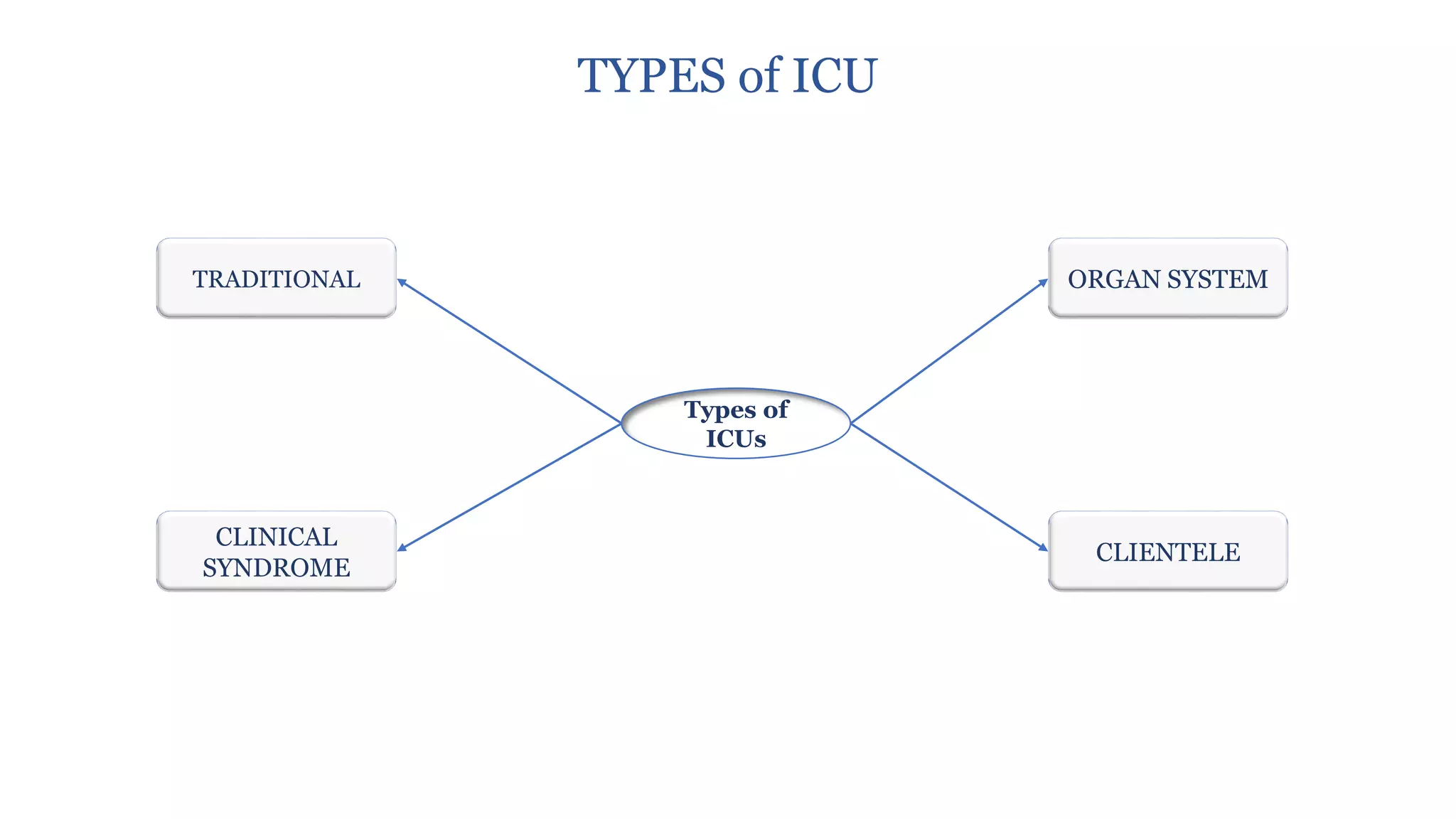
TYPES of ICU
Types of
ICUs
TRADITIONAL
CLIENTELE
CLINICAL
SYNDROME
ORGAN SYSTEM
Types of ICU
➢ Traditional
▪ Surgical
▪ Medical
▪ Paediatric
➢ Organ System
▪ Cardiac
▪ Neuro
▪ Renal
▪ Respiratory
➢ Clinical Syndrome
▪ Burn
▪ Trauma
▪ Stroke
➢ Clientele
▪ Neonatal
▪ Paediatric
▪ gynaecology
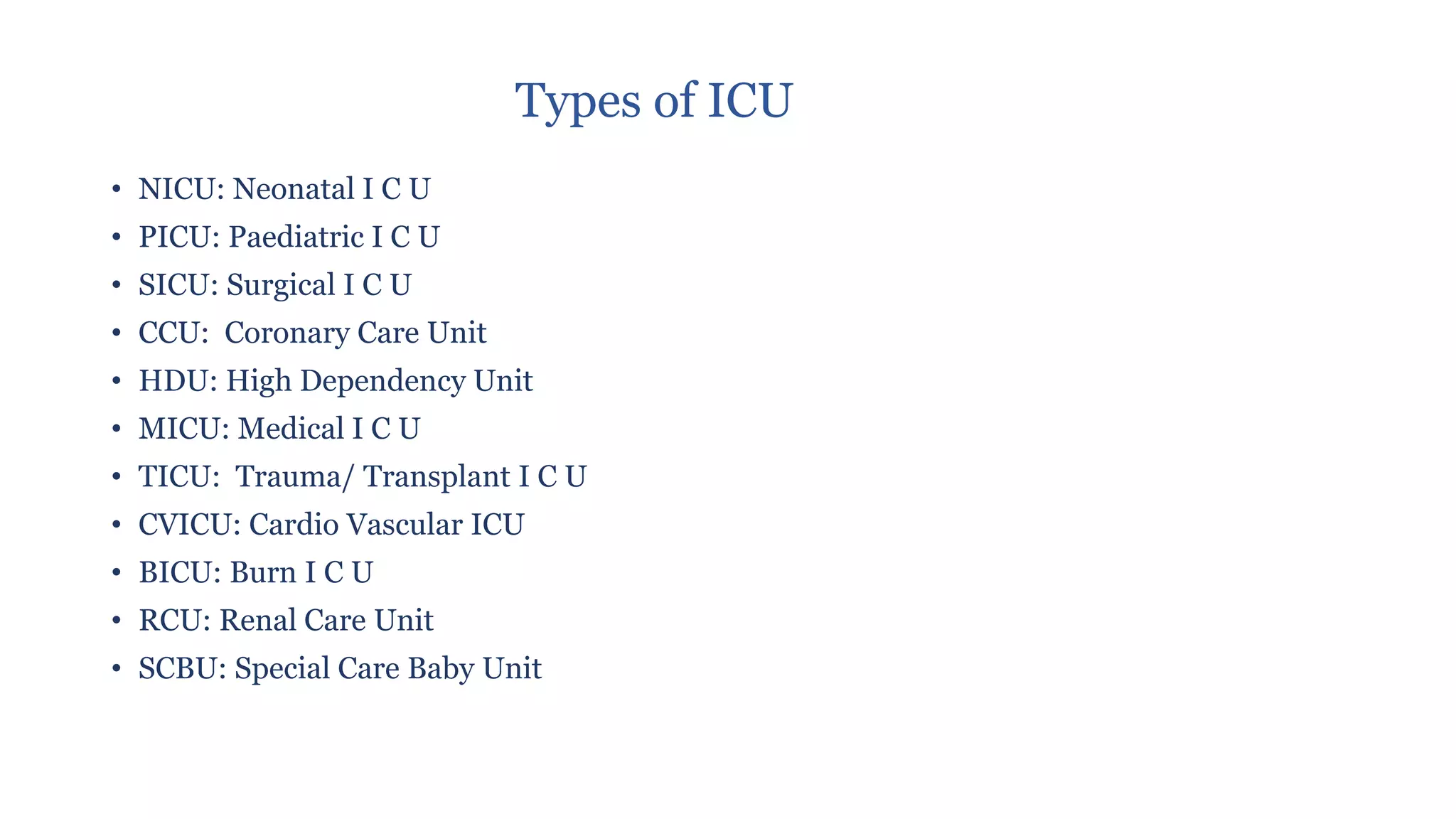
Types of ICU
• NICU: Neonatal I C U
• PICU: Paediatric I C U
• SICU: Surgical I C U
• CCU: Coronary Care Unit
• HDU: High Dependency Unit
• MICU: Medical I C U
• TICU: Trauma/ Transplant I C U
• CVICU: Cardio Vascular ICU
• BICU: Burn I C U
• RCU: Renal Care Unit
• SCBU: Special Care Baby Unit
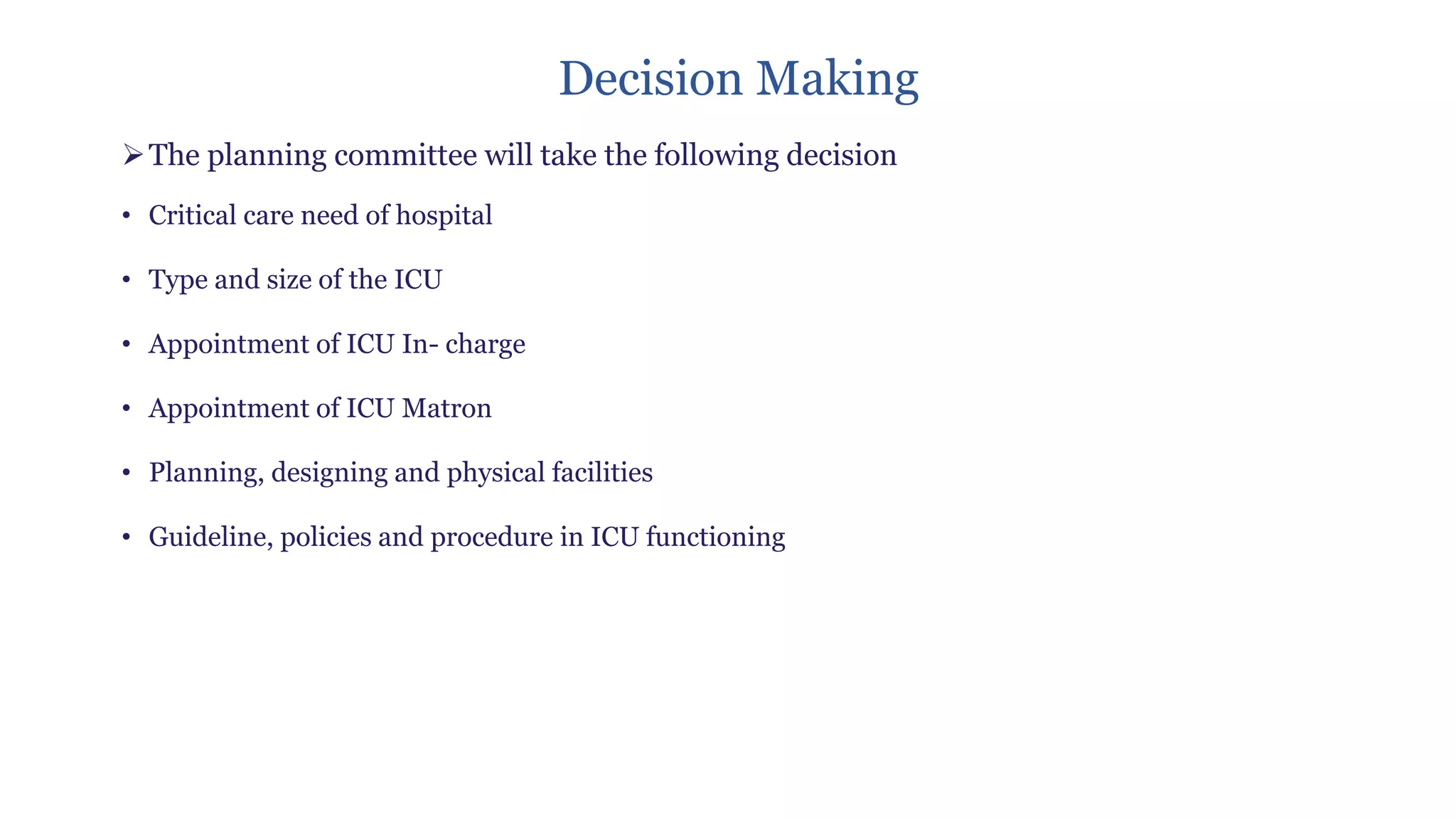
Decision Making
➢The planning committee will take the following decision
• Critical care need of hospital
• Type and size of the ICU
• Appointment of ICU In- charge
• Appointment of ICU Matron
• Planning, designing and physical facilities
• Guideline, policies and procedure in ICU functioning
Physical Facilities
• Location- close to OT/ Recovery room
• Easy access to emergency, respiratory therapy, surgery, pathology, radiology
• Bed strength 6-20
• Patient space minimum 5sq.ft of clear area
• Nursing call- two way communication system
• Hand washing patient bed area
• Patient’s services pipeline oxygen compressed air, electrical socket 5/15 ampere
• Lighting- nonreflecting 25-30 Lux active, treatment, 150-200Lux doctor’s/ nurse’s room
• Temperature- 60-70 degree F, Noise- 50decible, Humidity- 50-60%
• Electricity: round the clock with UPS, Inverter, Stand by
• Medication- essential drugs, IV- fluids, refrigerator, SOP for inventory control
• Isolation room
• Storage area- house keeping & other supplies
Physical facilities
Physical
Facilities
Entrance
Patient care Area
Ancillary Area
Auxiliary Area
Physical Planning
Location Designing
Environmental
Planning
Physical
Facilities
Size
Physical
Planning
Physical Planning
➢Location:
▪ Should be centrally located with easy access to emergency and other wards, OT, OPD
▪ Easily approachable
▪ Away from general hospital traffic
▪ Restricted entry
➢Size:
▪ Size of ICU depends on the type of service provided
▪ In Super specialty hospital 10% of the total beds
▪ In general hospital 2% of hospital
▪ Optimum size is 14 beds and minimum 4beds
▪ If No. of beds required is 14 then it’s better to have two ICUs be opened, an ideal ICU has
10 bedded
Designing of ICU
Principle of
designing
All patients can be
closely observed
Adequate Light,
Electrical fixture
Ample space around
bed for free
movement
Piped Gas supply
Patient Care Area
Patient Care
Bed Space
Hand Washing Wall Fixtures
Call Bell System
Equipment
Nursing
Monitoring
station
PATIENT AREA
NURSING STATION ISOLATION ROOM
I
C
U
T
Y
P
I
C
A
L
R
O
O
M
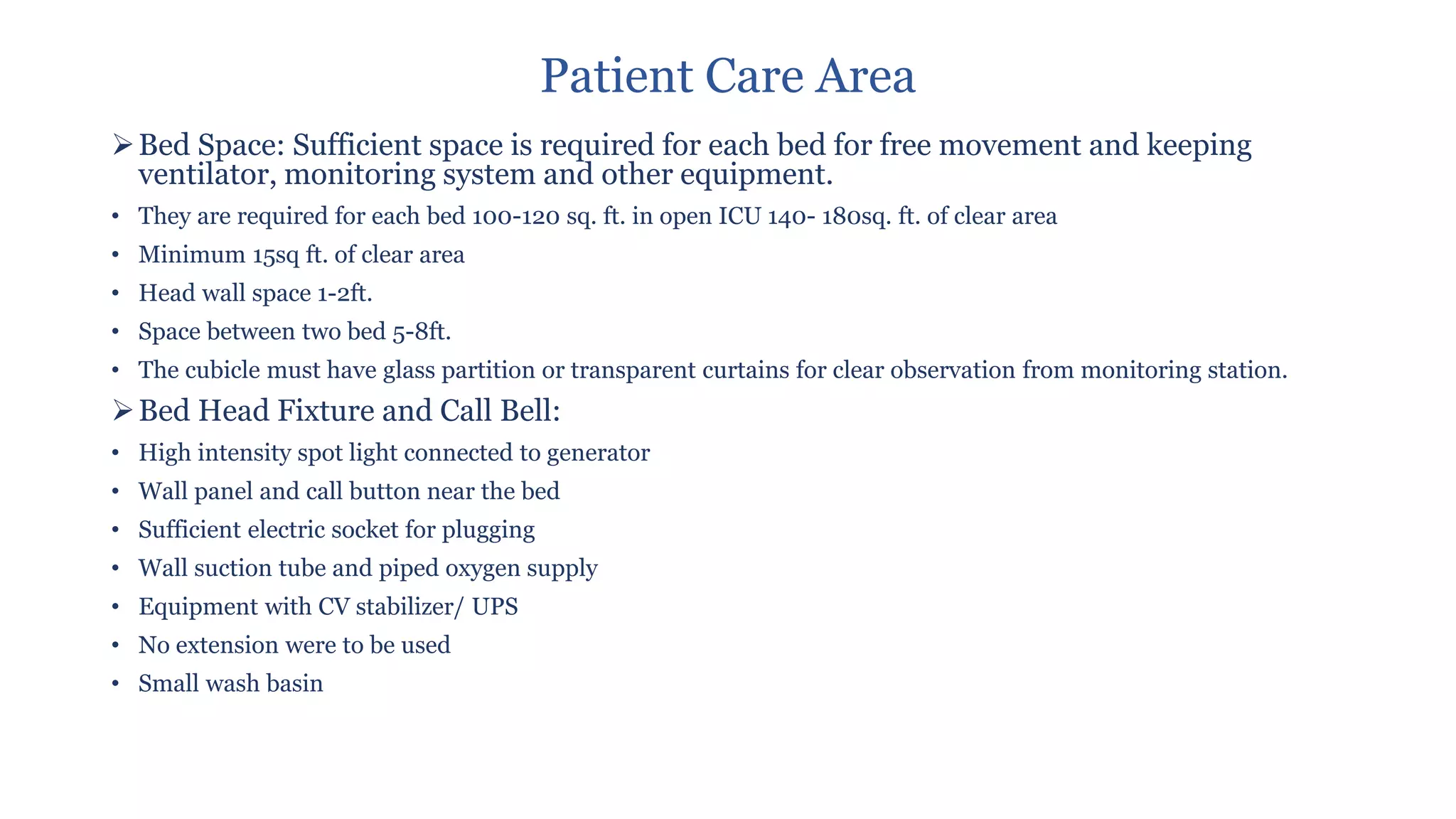
Patient Care Area
➢Bed Space: Sufficient space is required for each bed for free movement and keeping
ventilator, monitoring system and other equipment.
• They are required for each bed 100-120 sq. ft. in open ICU 140- 180sq. ft. of clear area
• Minimum 15sq ft. of clear area
• Head wall space 1-2ft.
• Space between two bed 5-8ft.
• The cubicle must have glass partition or transparent curtains for clear observation from monitoring station.
➢Bed Head Fixture and Call Bell:
• High intensity spot light connected to generator
• Wall panel and call button near the bed
• Sufficient electric socket for plugging
• Wall suction tube and piped oxygen supply
• Equipment with CV stabilizer/ UPS
• No extension were to be used
• Small wash basin
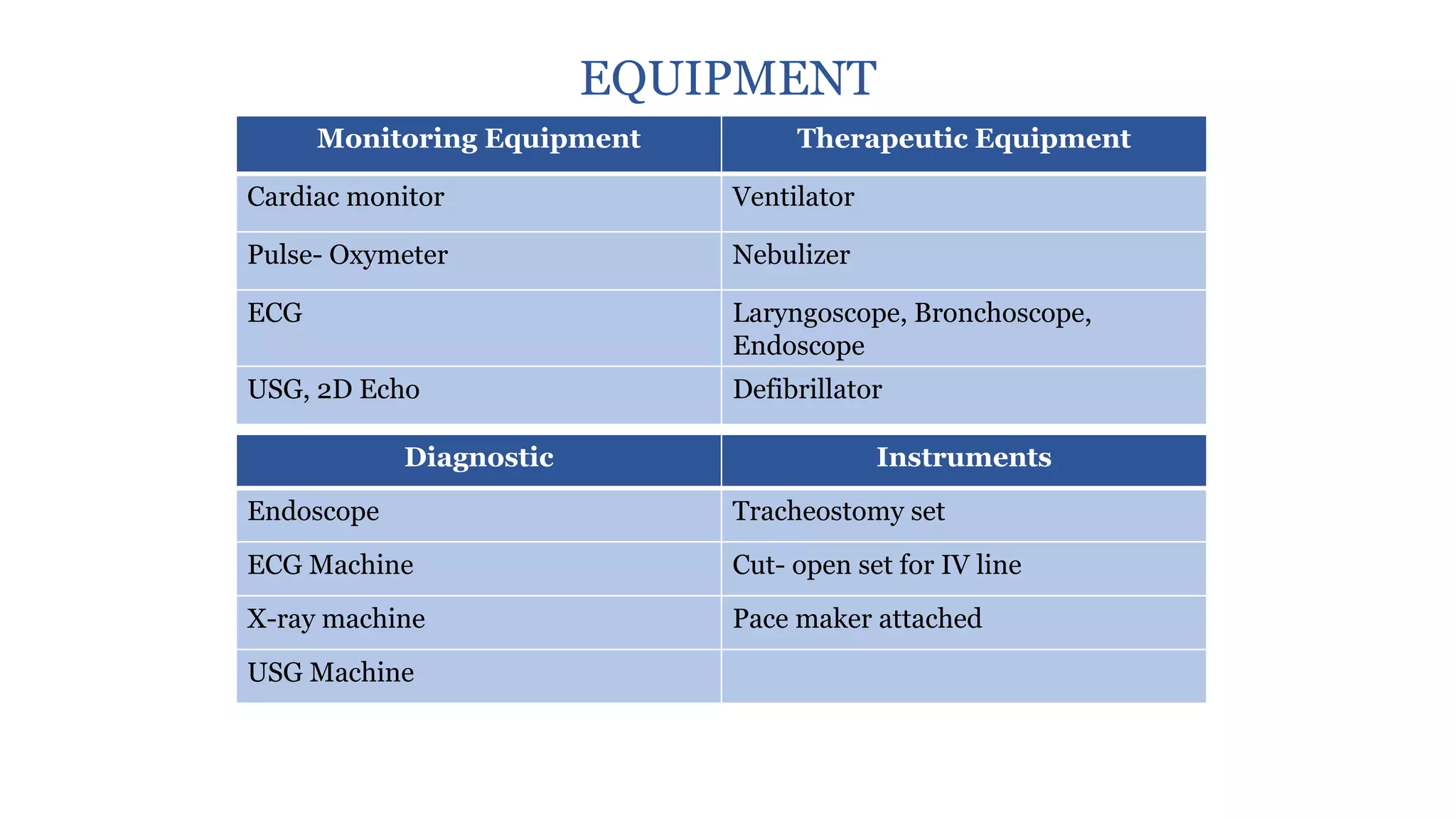
EQUIPMENT
Monitoring Equipment Therapeutic Equipment
Cardiac monitor Ventilator
Pulse- Oxymeter Nebulizer
ECG Laryngoscope, Bronchoscope,
Endoscope
USG, 2D Echo Defibrillator
Diagnostic Instruments
Endoscope Tracheostomy set
ECG Machine Cut- open set for IV line
X-ray machine Pace maker attached
USG Machine
EQUIPMENT
CARDIAC MONITOR PULSE- OXYMETER E C G ULTRA SOUND
VENTILATOR DEFIBRILATOR
NEBULIZER LARYNGOSCOPE
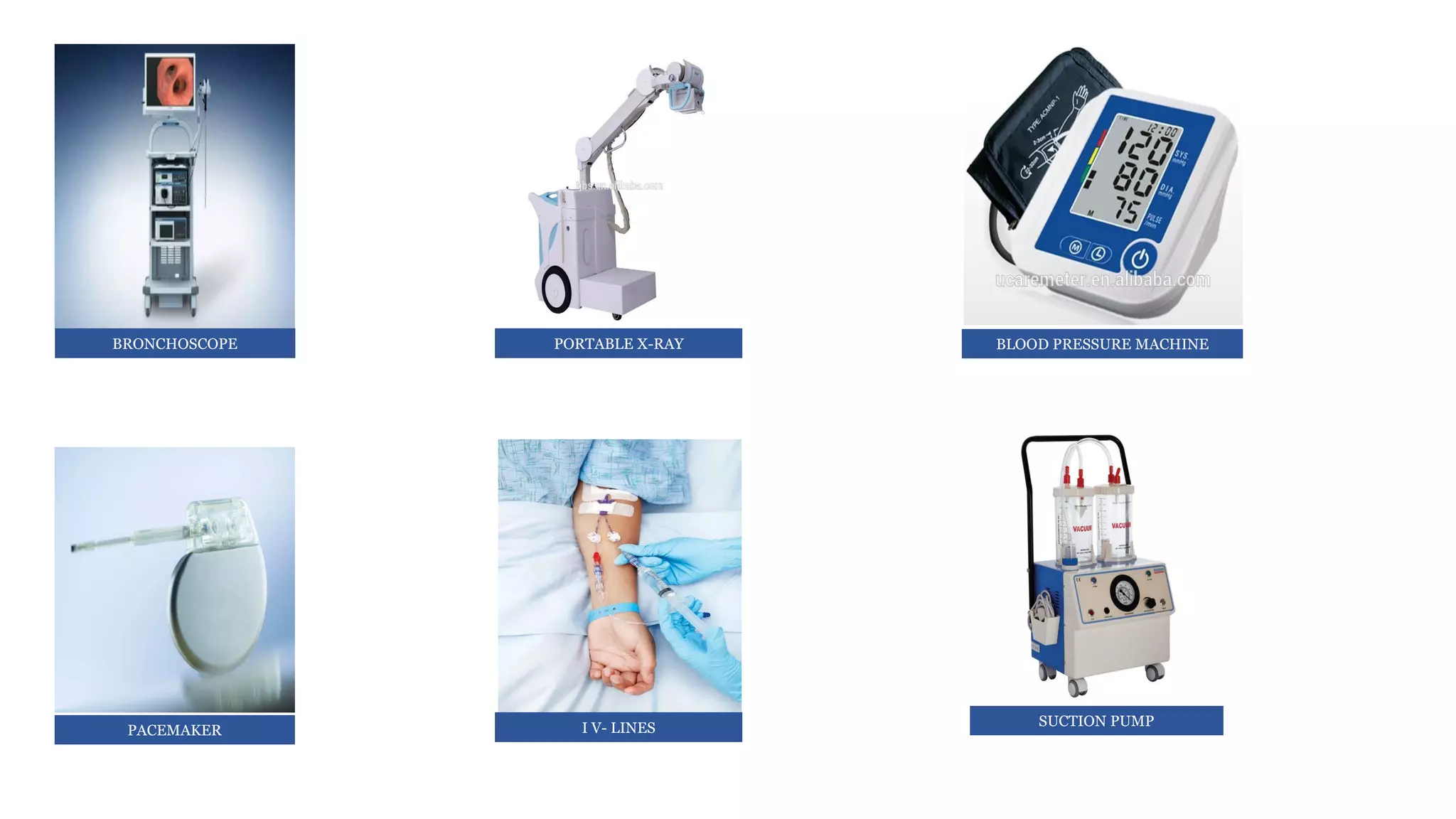
BRONCHOSCOPE PORTABLE X-RAY
SUCTION PUMP
BLOOD PRESSURE MACHINE
PACEMAKER I V- LINES
Nursing Station
Nursing Station
• A central nursing station should provide a comfortable area of sufficient size to
accommodate all necessary staff functions.
• When an ICU is of a modular design each nursing substation should be capable of
providing most if not all functions of a central station.
• There must be adequate overhead and task lighting and a wall mounted clock should be
present.
• Adequate space for computer terminals and printers is essential when automated system
are in use.
• Patient records should be readily accessible.
AUXILARY AREA
AUXILARY AREA
DRESSING ROOM
CLEAN & DIRTY
UTILITY ROOM
PANTRY
ISOLATION ROOM/
AREA
DOCTOR’S DUTY ROOM
NURSING CHANGING
ROOM
MEDICATION &
NURSING AREA
EQUIPMENT
MAINTENANCE
STORE
AUXILIARY AREA
CLEAN & DIRTY UTILITY ROOM DOCTOR’S DUTY ROOM
DRESSING ROOM STORE ROOM EQUIPMENT MAINTENANCEPANTRY
ISOLATION ROOM
➢The working area is equal to total bed area. This area has the 14sq. Yards area comprises
of:
• Washing, utility area
• Securable cabinet for staff room
• Clean supply room
• Work room with separate sink
• Toilet and dirty utility
• X-ray viewing, special examination/ procedure
• 24hrs lab, radiology and pharmacy
Clean & Dirty Utility Room
• Clean and dirty utility room must be separate room that lacks inter connection.
• They must be adequately temperature controlled and the air supply from the dirty utility
area supply from the dirty utility area must be exhausted.
• The clean utility room should be for the storage of all the clean and sterile supplies, and
may also be used for the storage of clean linen.
• Separate covered container must be provided for soiled linen and waste materials
• There should be designated mechanisms for the disposal of items contaminated body
substances and fluids.
• Flooring should be made of seamless to facilitate clean.
ANCILLARY AREA
Ancillary
Area
Office space &
record room
Staff lounge
ICU Matron’s
office
Telephone facility
Staff rest room
Janitor room
Medical Environment required in ICU
➢ Air Conditioner
• ICU must be air conditioned
• Temperature maintained at 250-27o C and 40- 50% humidity
• Plenty of sunlight, large window
➢ Ventilation
• 6/8 air changes per hour
• Filter less than 10 micron
• Positive pressure flow from patient area to outside
➢ Lighting
• Varying degree of illumination for patient area, working area
• Intensity 1 to 30 lumen as per need
• Soothing and glare free
• Provision of dimmer lights
➢ Noise
• To be noise free
• Soft and light music
• Noise absorbable material
• Wall reflection free, light colour
• Floor mosaic
➢ Electrical Power
• 110 volt electrical outlet with 30amp circuit
• Sixteen out let as per bed
➢ Water supply
• The water supply must be certified source
• Especially if haemodialysis is to be performed
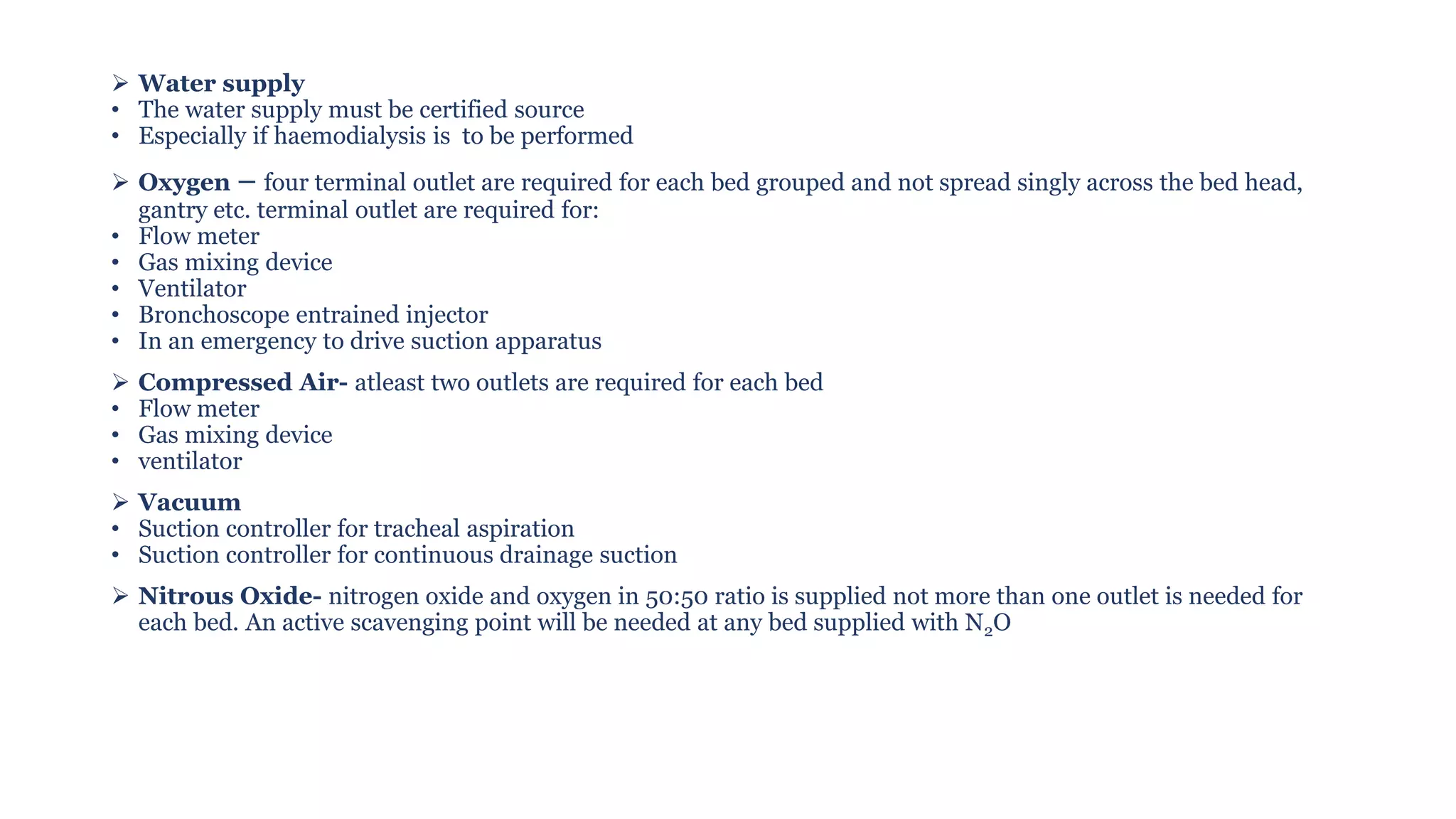
➢ Oxygen – four terminal outlet are required for each bed grouped and not spread singly across the bed head,
gantry etc. terminal outlet are required for:
• Flow meter
• Gas mixing device
• Ventilator
• Bronchoscope entrained injector
• In an emergency to drive suction apparatus
➢ Compressed Air- atleast two outlets are required for each bed
• Flow meter
• Gas mixing device
• ventilator
➢ Vacuum
• Suction controller for tracheal aspiration
• Suction controller for continuous drainage suction
➢ Nitrous Oxide- nitrogen oxide and oxygen in 50:50 ratio is supplied not more than one outlet is needed for
each bed. An active scavenging point will be needed at any bed supplied with N2O
Organisation of ICU services
Organisation
Staffing
Admission
criteria
Policies &
Guidelines
Administration
STAFFING
Staffing
Ancillary Staff
Nursing Staff
Technical Staff
Medical Staff
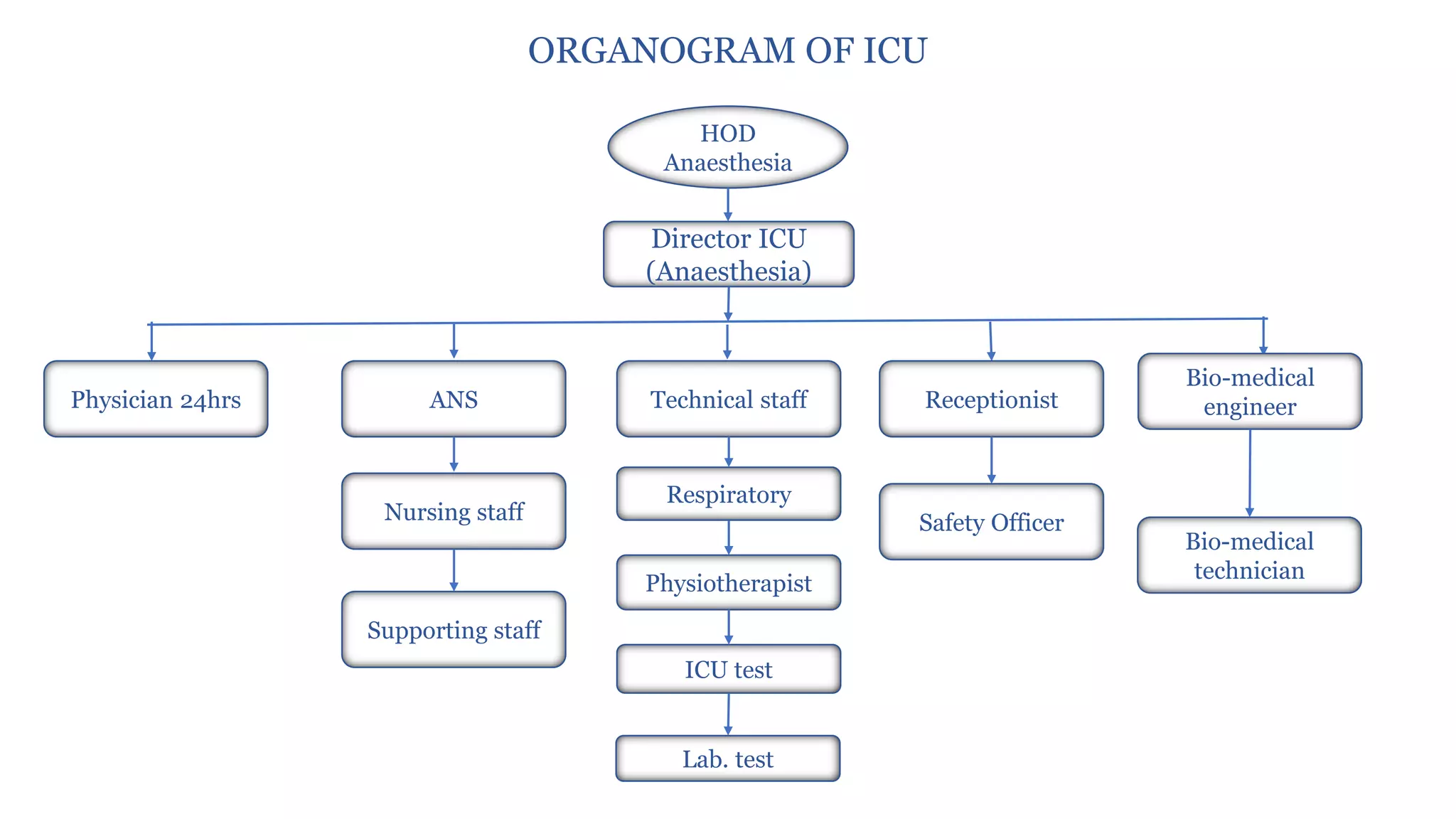
ORGANOGRAM OF ICU
HOD
Anaesthesia
Director ICU
(Anaesthesia)
Physician 24hrs ANS Technical staff Receptionist
Bio-medical
engineer
Supporting staff
Nursing staff
ICU test
Physiotherapist
Respiratory
Lab. test
Safety Officer
Bio-medical
technician
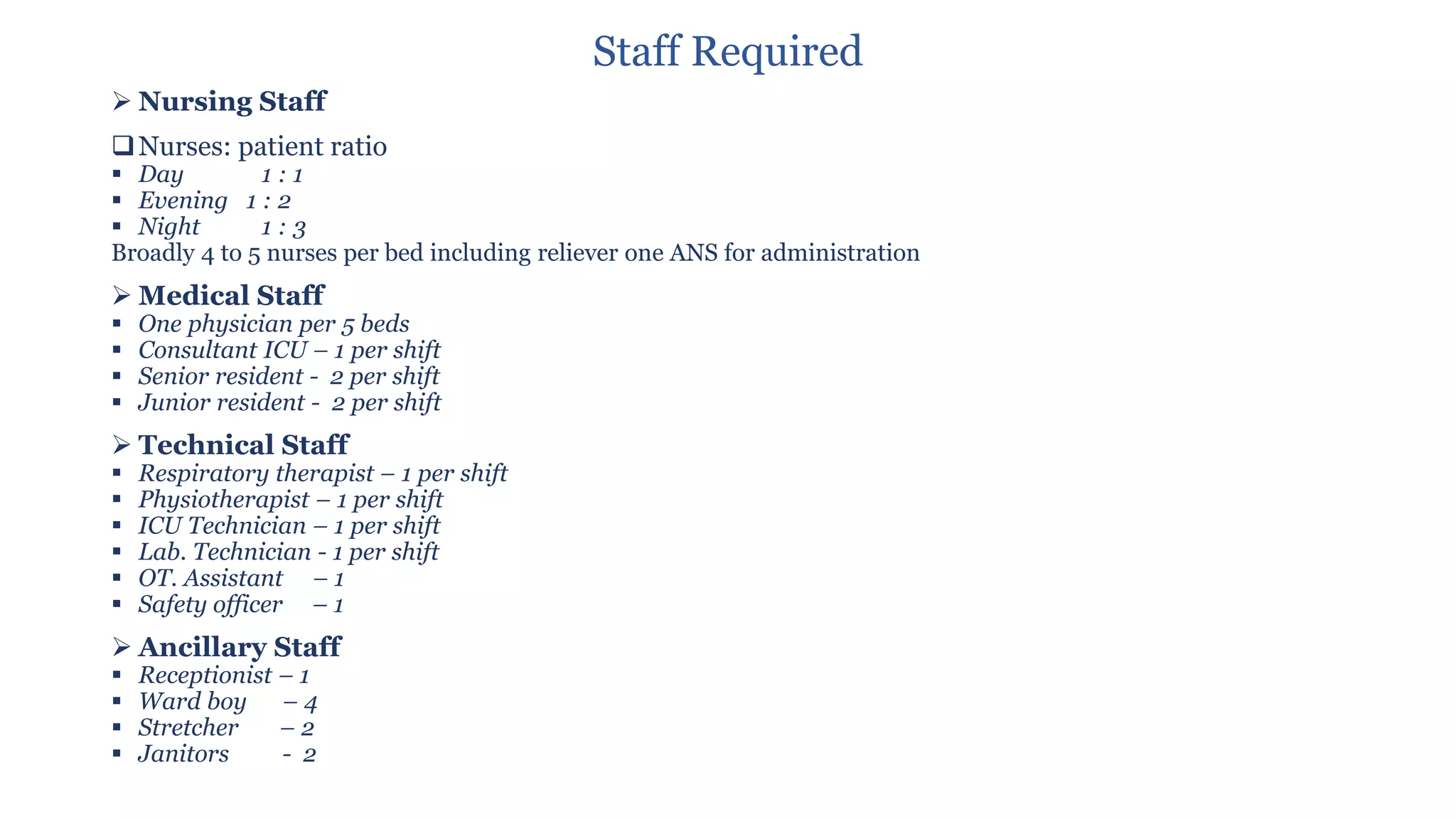
Staff Required
➢ Nursing Staff
❑Nurses: patient ratio
▪ Day 1 : 1
▪ Evening 1 : 2
▪ Night 1 : 3
Broadly 4 to 5 nurses per bed including reliever one ANS for administration
➢ Medical Staff
▪ One physician per 5 beds
▪ Consultant ICU – 1 per shift
▪ Senior resident - 2 per shift
▪ Junior resident - 2 per shift
➢ Technical Staff
▪ Respiratory therapist – 1 per shift
▪ Physiotherapist – 1 per shift
▪ ICU Technician – 1 per shift
▪ Lab. Technician - 1 per shift
▪ OT. Assistant – 1
▪ Safety officer – 1
➢ Ancillary Staff
▪ Receptionist – 1
▪ Ward boy – 4
▪ Stretcher – 2
▪ Janitors - 2
ADMISSION CRITERIA
TRAUMA HEAD
INJURY
TOXAEMIA &
SEPTILEMIA
TRANSPLANT
PATIENT
HAEMORRAGEIC
SHOCK ELECTROLITE
IMBALANCE
REQUIRING AIRWAY
SUPPORT &
ARTIFICIAL
VENTILATION
MAJOR OPERATION
REQUIRING VITAL
MONITORING
CRITERIA
ADMISSION POLICY
➢Level 1:
▪ Monitoring
▪ Observation
▪ Short term ventilation
➢Level 2:
▪ Monitoring
▪ Observation
▪ Long term ventilation
➢Level 3:
▪ Intensive care
▪ Invasive procedure
▪ Haemo dialysis
▪ Constant support
Treatment Policies
➢Responsibility lies with the in charge of unit admitting the case
➢A vacant bed is allocated in original ward for patient return
➢No direct admission to ICU but transferred from unit
➢Admission only a recommendation of ICU director subjected to availability of bed
➢20% bed to be kept vacant for emergency admission
➢Continuity of treatment is the per view of ICU in charge in consultation with unit incharge
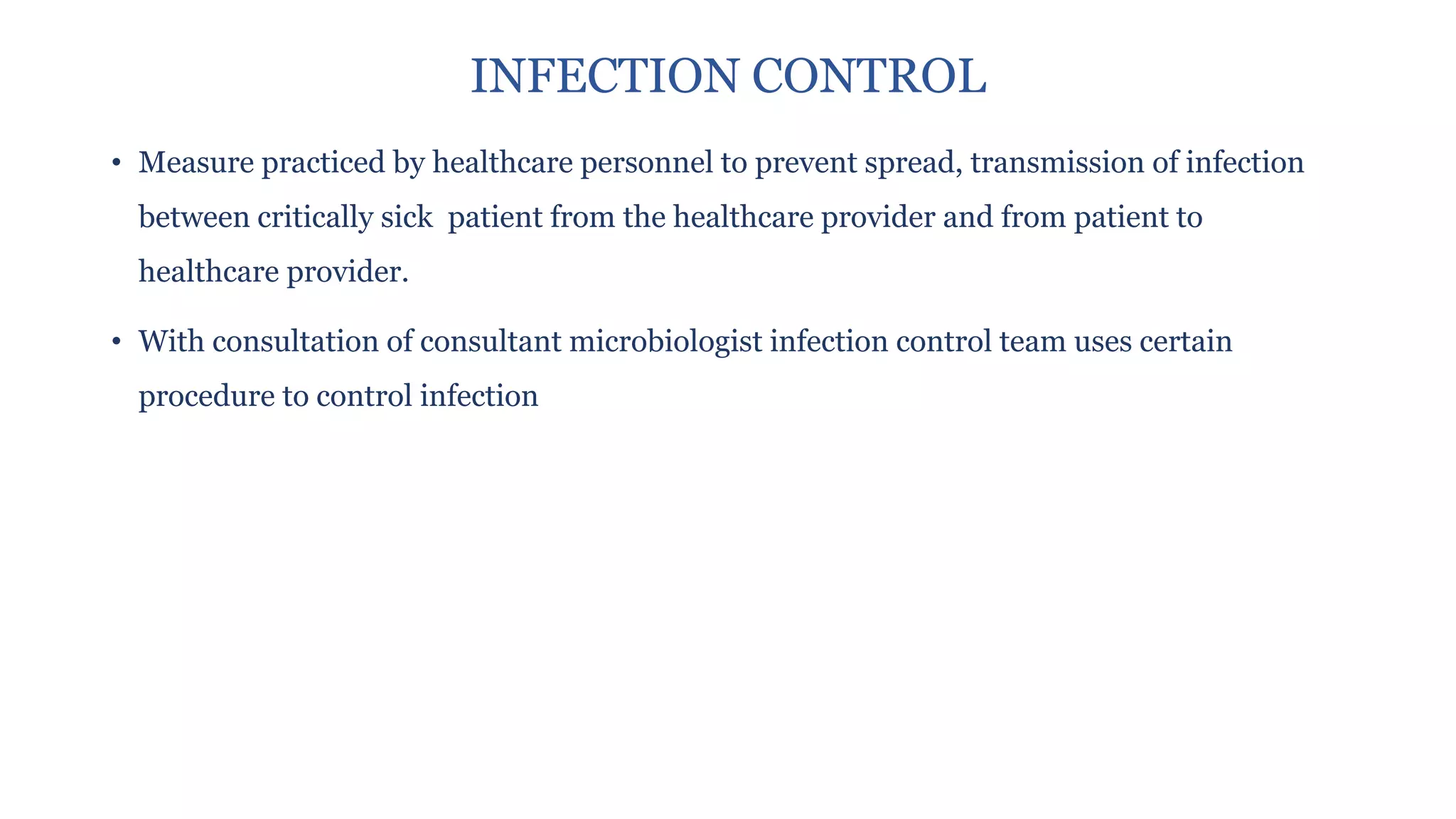
INFECTION CONTROL
• Measure practiced by healthcare personnel to prevent spread, transmission of infection
between critically sick patient from the healthcare provider and from patient to
healthcare provider.
• With consultation of consultant microbiologist infection control team uses certain
procedure to control infection
Risk Due to Infection
• Low resistance of patient to infection
• Invasive procedure/ intervention
• In appropriate anti-microbial usage
• Drug resistance of endemic
• Contaminated environment
Common Organism
Bacteria
Staphylococcus Aureus
Enterococcus
Pseudomonas Aeruginosa
Klebsiella
E- coli
Virus
Human Immunodeficiency Virus(HIV)
Hepatitis B Virus (HBV)
Hepatitis C Virus (HCV)
Cytomegalic Virus
Fungal
Candid Albicans
Aspergillus
Parasites
Giardia
Lambia
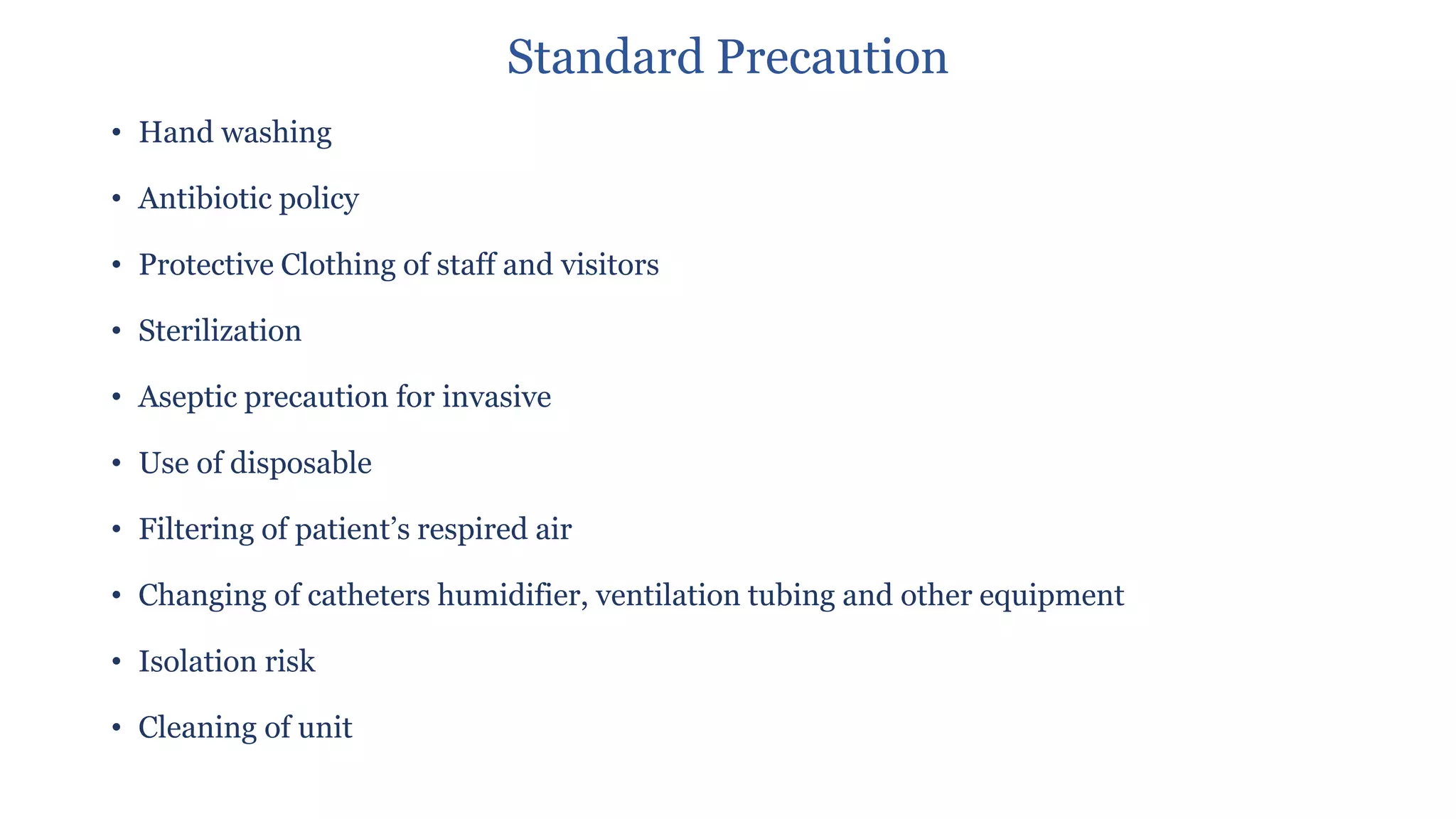
Standard Precaution
• Hand washing
• Antibiotic policy
• Protective Clothing of staff and visitors
• Sterilization
• Aseptic precaution for invasive
• Use of disposable
• Filtering of patient’s respired air
• Changing of catheters humidifier, ventilation tubing and other equipment
• Isolation risk
• Cleaning of unit
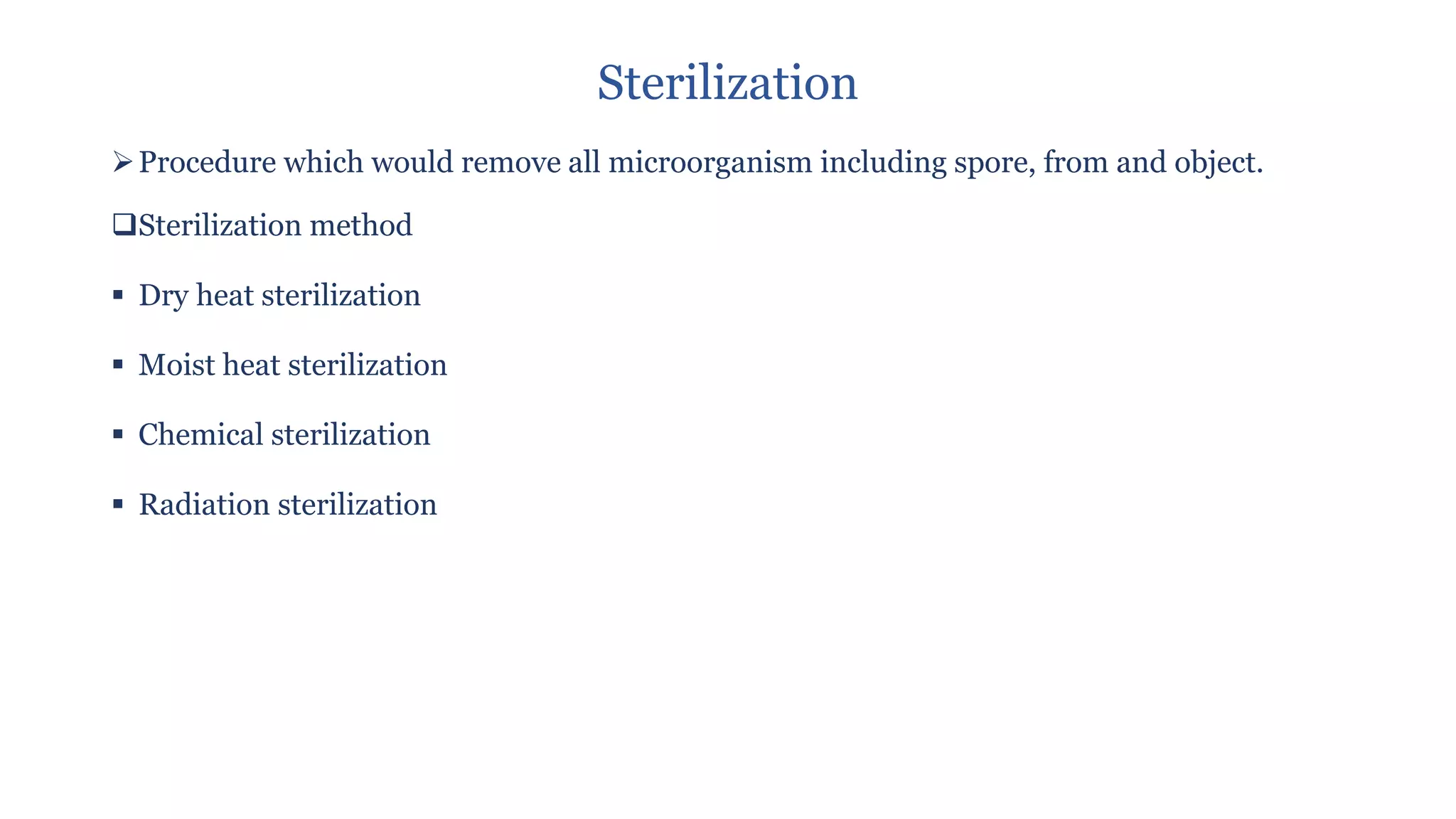
Sterilization
➢Procedure which would remove all microorganism including spore, from and object.
❑Sterilization method
▪ Dry heat sterilization
▪ Moist heat sterilization
▪ Chemical sterilization
▪ Radiation sterilization
Protective Clothing for Staff and Visitors
GLOVE GOWN MASK
PROTECTIVE EYEWEAR FACE SHIELD APRON
DISINFECTION
Reduce the number of microorganism on an object or surface but not completely
destruction of all microorganism or spores.:
➢Type of disinfection
▪ High level disinfection
2% glutaradehyde
stabilized hydrogen
1%sodium hypochlorite
▪ Intermediate level disinfection
0.1% sodium hypochlorite
Iodophores and phenolic solution
▪ Low level disinfection
Quaternary ammonium compounds
Bio-Medical Waste Management
➢Biomedical waste is the waste generated at the time of treatment, diagnosis,
immunization and different types of procedures of human being or animals.
➢Biomedical waste management is of utmost importance as its improper management
poses serious threat to healthcare workers, care giver, community and finally the
environment
➢Segregation of biomedical waste was being done at the site of generation in almost all the
areas of the hospital in colour code polythene bags per hospital protocol.
DISCHARGE POLICIES
➢Discharge summary contains the reasons for admission, significant findings and
diagnosis and the patient‘s condition at the time of discharge.
➢Discharge summary contains information regarding investigation results, any procedure
performed, medication administered and other treatment given.
➢Discharge summary contains follow-up advice, medication and other instructions in an
understandable manner.
➢Discharge summary incorporates instructions about when and how to obtain urgent care
➢In case the cause of death is not clear and a post mortem is being performed (Eg MLC),
the same shall be documented.
ICU (Intensive Care Unit)

ICU (Intensive Care Unit)

  • 1.
  • 2.
    ICU is highlyspecified & sophisticated area of a hospital which is specifically designed, staff, located furnished and equipped, dedicated to management of critically sick patient, injuries or complications. It is a department with dedicated medical, nursing and allied staff. It has its own team of doctors, nurses and other staff who are trained to requirement. The design of ICU, or the modification of existing units, requires not only a knowledge of regulatory agency standards but also the expertise of critical care practitioners who are families with special needs of this patient population In 1988 the society of critical care medicine developed guideline for the design of ICUs. INTENSIVE CARE UNIT
  • 3.
    Functions of ICU •Close observation and treatment of critically ill patient • To provide specialized treatment with specialized manpower and equipment • To utilize staff more effectively and efficiently • Care for post surgical operations • Provide care for medical emergency • Provide care for cardiac emergency • To provide support to critically ill patient
  • 4.
    Indicator for Admission •Pre and Post operative patient and who underwent major surgeries. • Craniotomy patient: A craniotomy is the surgical removal of part of the bone from the skull to expose the brain. then replaced after the brain surgery has been done. • Thoracotomy patient: it is a surgery of chest usually performed to remove cyst, tumor, or part of lung. • Ultra major surgeries. • Unstable multiple trauma patient. • Patient with head or spine trauma requiring mechanical ventilation. • Any surgical patient who requires continuous monitoring or continuous life support.
  • 5.
    Monitoring System • Bloodpressure • Central venous pressure CVP • Heart rate • Pulmonary artery pressure PAP • Oxygen saturation • Patient temperature • Intra cerebral pressure • ECG (Electro Cardio Gram)
  • 6.
    Planning and Organisationof ICU ICU planning committee Physician, Paediatrician Architect Central Public Work Dept. Surgeon, Neuron surgeon Medical Superintendent HODs Anaethesia Nursing Superintendent
  • 7.
    TYPES of ICU Typesof ICUs TRADITIONAL CLIENTELE CLINICAL SYNDROME ORGAN SYSTEM
  • 8.
    Types of ICU ➢Traditional ▪ Surgical ▪ Medical ▪ Paediatric ➢ Organ System ▪ Cardiac ▪ Neuro ▪ Renal ▪ Respiratory ➢ Clinical Syndrome ▪ Burn ▪ Trauma ▪ Stroke ➢ Clientele ▪ Neonatal ▪ Paediatric ▪ gynaecology
  • 9.
    Types of ICU •NICU: Neonatal I C U • PICU: Paediatric I C U • SICU: Surgical I C U • CCU: Coronary Care Unit • HDU: High Dependency Unit • MICU: Medical I C U • TICU: Trauma/ Transplant I C U • CVICU: Cardio Vascular ICU • BICU: Burn I C U • RCU: Renal Care Unit • SCBU: Special Care Baby Unit
  • 10.
    Decision Making ➢The planningcommittee will take the following decision • Critical care need of hospital • Type and size of the ICU • Appointment of ICU In- charge • Appointment of ICU Matron • Planning, designing and physical facilities • Guideline, policies and procedure in ICU functioning
  • 11.
    Physical Facilities • Location-close to OT/ Recovery room • Easy access to emergency, respiratory therapy, surgery, pathology, radiology • Bed strength 6-20 • Patient space minimum 5sq.ft of clear area • Nursing call- two way communication system • Hand washing patient bed area • Patient’s services pipeline oxygen compressed air, electrical socket 5/15 ampere • Lighting- nonreflecting 25-30 Lux active, treatment, 150-200Lux doctor’s/ nurse’s room • Temperature- 60-70 degree F, Noise- 50decible, Humidity- 50-60% • Electricity: round the clock with UPS, Inverter, Stand by • Medication- essential drugs, IV- fluids, refrigerator, SOP for inventory control • Isolation room • Storage area- house keeping & other supplies
  • 12.
  • 13.
  • 14.
    Physical Planning ➢Location: ▪ Shouldbe centrally located with easy access to emergency and other wards, OT, OPD ▪ Easily approachable ▪ Away from general hospital traffic ▪ Restricted entry ➢Size: ▪ Size of ICU depends on the type of service provided ▪ In Super specialty hospital 10% of the total beds ▪ In general hospital 2% of hospital ▪ Optimum size is 14 beds and minimum 4beds ▪ If No. of beds required is 14 then it’s better to have two ICUs be opened, an ideal ICU has 10 bedded
  • 15.
    Designing of ICU Principleof designing All patients can be closely observed Adequate Light, Electrical fixture Ample space around bed for free movement Piped Gas supply
  • 16.
    Patient Care Area PatientCare Bed Space Hand Washing Wall Fixtures Call Bell System Equipment Nursing Monitoring station
  • 17.
    PATIENT AREA NURSING STATIONISOLATION ROOM I C U T Y P I C A L R O O M
  • 18.
    Patient Care Area ➢BedSpace: Sufficient space is required for each bed for free movement and keeping ventilator, monitoring system and other equipment. • They are required for each bed 100-120 sq. ft. in open ICU 140- 180sq. ft. of clear area • Minimum 15sq ft. of clear area • Head wall space 1-2ft. • Space between two bed 5-8ft. • The cubicle must have glass partition or transparent curtains for clear observation from monitoring station. ➢Bed Head Fixture and Call Bell: • High intensity spot light connected to generator • Wall panel and call button near the bed • Sufficient electric socket for plugging • Wall suction tube and piped oxygen supply • Equipment with CV stabilizer/ UPS • No extension were to be used • Small wash basin
  • 19.
    EQUIPMENT Monitoring Equipment TherapeuticEquipment Cardiac monitor Ventilator Pulse- Oxymeter Nebulizer ECG Laryngoscope, Bronchoscope, Endoscope USG, 2D Echo Defibrillator Diagnostic Instruments Endoscope Tracheostomy set ECG Machine Cut- open set for IV line X-ray machine Pace maker attached USG Machine
  • 20.
    EQUIPMENT CARDIAC MONITOR PULSE-OXYMETER E C G ULTRA SOUND VENTILATOR DEFIBRILATOR NEBULIZER LARYNGOSCOPE
  • 21.
    BRONCHOSCOPE PORTABLE X-RAY SUCTIONPUMP BLOOD PRESSURE MACHINE PACEMAKER I V- LINES
  • 22.
  • 23.
    Nursing Station • Acentral nursing station should provide a comfortable area of sufficient size to accommodate all necessary staff functions. • When an ICU is of a modular design each nursing substation should be capable of providing most if not all functions of a central station. • There must be adequate overhead and task lighting and a wall mounted clock should be present. • Adequate space for computer terminals and printers is essential when automated system are in use. • Patient records should be readily accessible.
  • 24.
    AUXILARY AREA AUXILARY AREA DRESSINGROOM CLEAN & DIRTY UTILITY ROOM PANTRY ISOLATION ROOM/ AREA DOCTOR’S DUTY ROOM NURSING CHANGING ROOM MEDICATION & NURSING AREA EQUIPMENT MAINTENANCE STORE
  • 25.
    AUXILIARY AREA CLEAN &DIRTY UTILITY ROOM DOCTOR’S DUTY ROOM DRESSING ROOM STORE ROOM EQUIPMENT MAINTENANCEPANTRY
  • 26.
    ISOLATION ROOM ➢The workingarea is equal to total bed area. This area has the 14sq. Yards area comprises of: • Washing, utility area • Securable cabinet for staff room • Clean supply room • Work room with separate sink • Toilet and dirty utility • X-ray viewing, special examination/ procedure • 24hrs lab, radiology and pharmacy
  • 27.
    Clean & DirtyUtility Room • Clean and dirty utility room must be separate room that lacks inter connection. • They must be adequately temperature controlled and the air supply from the dirty utility area supply from the dirty utility area must be exhausted. • The clean utility room should be for the storage of all the clean and sterile supplies, and may also be used for the storage of clean linen. • Separate covered container must be provided for soiled linen and waste materials • There should be designated mechanisms for the disposal of items contaminated body substances and fluids. • Flooring should be made of seamless to facilitate clean.
  • 28.
    ANCILLARY AREA Ancillary Area Office space& record room Staff lounge ICU Matron’s office Telephone facility Staff rest room Janitor room
  • 29.
    Medical Environment requiredin ICU ➢ Air Conditioner • ICU must be air conditioned • Temperature maintained at 250-27o C and 40- 50% humidity • Plenty of sunlight, large window ➢ Ventilation • 6/8 air changes per hour • Filter less than 10 micron • Positive pressure flow from patient area to outside ➢ Lighting • Varying degree of illumination for patient area, working area • Intensity 1 to 30 lumen as per need • Soothing and glare free • Provision of dimmer lights ➢ Noise • To be noise free • Soft and light music • Noise absorbable material • Wall reflection free, light colour • Floor mosaic ➢ Electrical Power • 110 volt electrical outlet with 30amp circuit • Sixteen out let as per bed
  • 30.
    ➢ Water supply •The water supply must be certified source • Especially if haemodialysis is to be performed ➢ Oxygen – four terminal outlet are required for each bed grouped and not spread singly across the bed head, gantry etc. terminal outlet are required for: • Flow meter • Gas mixing device • Ventilator • Bronchoscope entrained injector • In an emergency to drive suction apparatus ➢ Compressed Air- atleast two outlets are required for each bed • Flow meter • Gas mixing device • ventilator ➢ Vacuum • Suction controller for tracheal aspiration • Suction controller for continuous drainage suction ➢ Nitrous Oxide- nitrogen oxide and oxygen in 50:50 ratio is supplied not more than one outlet is needed for each bed. An active scavenging point will be needed at any bed supplied with N2O
  • 31.
    Organisation of ICUservices Organisation Staffing Admission criteria Policies & Guidelines Administration
  • 32.
  • 33.
    ORGANOGRAM OF ICU HOD Anaesthesia DirectorICU (Anaesthesia) Physician 24hrs ANS Technical staff Receptionist Bio-medical engineer Supporting staff Nursing staff ICU test Physiotherapist Respiratory Lab. test Safety Officer Bio-medical technician
  • 34.
    Staff Required ➢ NursingStaff ❑Nurses: patient ratio ▪ Day 1 : 1 ▪ Evening 1 : 2 ▪ Night 1 : 3 Broadly 4 to 5 nurses per bed including reliever one ANS for administration ➢ Medical Staff ▪ One physician per 5 beds ▪ Consultant ICU – 1 per shift ▪ Senior resident - 2 per shift ▪ Junior resident - 2 per shift ➢ Technical Staff ▪ Respiratory therapist – 1 per shift ▪ Physiotherapist – 1 per shift ▪ ICU Technician – 1 per shift ▪ Lab. Technician - 1 per shift ▪ OT. Assistant – 1 ▪ Safety officer – 1 ➢ Ancillary Staff ▪ Receptionist – 1 ▪ Ward boy – 4 ▪ Stretcher – 2 ▪ Janitors - 2
  • 35.
    ADMISSION CRITERIA TRAUMA HEAD INJURY TOXAEMIA& SEPTILEMIA TRANSPLANT PATIENT HAEMORRAGEIC SHOCK ELECTROLITE IMBALANCE REQUIRING AIRWAY SUPPORT & ARTIFICIAL VENTILATION MAJOR OPERATION REQUIRING VITAL MONITORING CRITERIA
  • 36.
    ADMISSION POLICY ➢Level 1: ▪Monitoring ▪ Observation ▪ Short term ventilation ➢Level 2: ▪ Monitoring ▪ Observation ▪ Long term ventilation ➢Level 3: ▪ Intensive care ▪ Invasive procedure ▪ Haemo dialysis ▪ Constant support
  • 37.
    Treatment Policies ➢Responsibility lieswith the in charge of unit admitting the case ➢A vacant bed is allocated in original ward for patient return ➢No direct admission to ICU but transferred from unit ➢Admission only a recommendation of ICU director subjected to availability of bed ➢20% bed to be kept vacant for emergency admission ➢Continuity of treatment is the per view of ICU in charge in consultation with unit incharge
  • 38.
    INFECTION CONTROL • Measurepracticed by healthcare personnel to prevent spread, transmission of infection between critically sick patient from the healthcare provider and from patient to healthcare provider. • With consultation of consultant microbiologist infection control team uses certain procedure to control infection
  • 39.
    Risk Due toInfection • Low resistance of patient to infection • Invasive procedure/ intervention • In appropriate anti-microbial usage • Drug resistance of endemic • Contaminated environment
  • 40.
    Common Organism Bacteria Staphylococcus Aureus Enterococcus PseudomonasAeruginosa Klebsiella E- coli Virus Human Immunodeficiency Virus(HIV) Hepatitis B Virus (HBV) Hepatitis C Virus (HCV) Cytomegalic Virus Fungal Candid Albicans Aspergillus Parasites Giardia Lambia
  • 41.
    Standard Precaution • Handwashing • Antibiotic policy • Protective Clothing of staff and visitors • Sterilization • Aseptic precaution for invasive • Use of disposable • Filtering of patient’s respired air • Changing of catheters humidifier, ventilation tubing and other equipment • Isolation risk • Cleaning of unit
  • 43.
    Sterilization ➢Procedure which wouldremove all microorganism including spore, from and object. ❑Sterilization method ▪ Dry heat sterilization ▪ Moist heat sterilization ▪ Chemical sterilization ▪ Radiation sterilization
  • 44.
    Protective Clothing forStaff and Visitors GLOVE GOWN MASK PROTECTIVE EYEWEAR FACE SHIELD APRON
  • 45.
    DISINFECTION Reduce the numberof microorganism on an object or surface but not completely destruction of all microorganism or spores.: ➢Type of disinfection ▪ High level disinfection 2% glutaradehyde stabilized hydrogen 1%sodium hypochlorite ▪ Intermediate level disinfection 0.1% sodium hypochlorite Iodophores and phenolic solution ▪ Low level disinfection Quaternary ammonium compounds
  • 46.
    Bio-Medical Waste Management ➢Biomedicalwaste is the waste generated at the time of treatment, diagnosis, immunization and different types of procedures of human being or animals. ➢Biomedical waste management is of utmost importance as its improper management poses serious threat to healthcare workers, care giver, community and finally the environment ➢Segregation of biomedical waste was being done at the site of generation in almost all the areas of the hospital in colour code polythene bags per hospital protocol.
  • 48.
    DISCHARGE POLICIES ➢Discharge summarycontains the reasons for admission, significant findings and diagnosis and the patient‘s condition at the time of discharge. ➢Discharge summary contains information regarding investigation results, any procedure performed, medication administered and other treatment given. ➢Discharge summary contains follow-up advice, medication and other instructions in an understandable manner. ➢Discharge summary incorporates instructions about when and how to obtain urgent care ➢In case the cause of death is not clear and a post mortem is being performed (Eg MLC), the same shall be documented.