INFECTION PREVENTION
&CONTROL IN OPERATION
ROOM
Dr. Moustapha Ramadan
Feb 2015
Outlines
 Aim
 Layout / sterile zone
 Standard and Universal precautions
 CDC recommendations and Category
 Risk factors
 Management of blood spillage
 Evaluation of infection control
Aim
 Provide a sterile field for a safe surgery
 Prevention of All HAIs ( not only SSI)
 Prevention of occupational hazards
Layout of OT
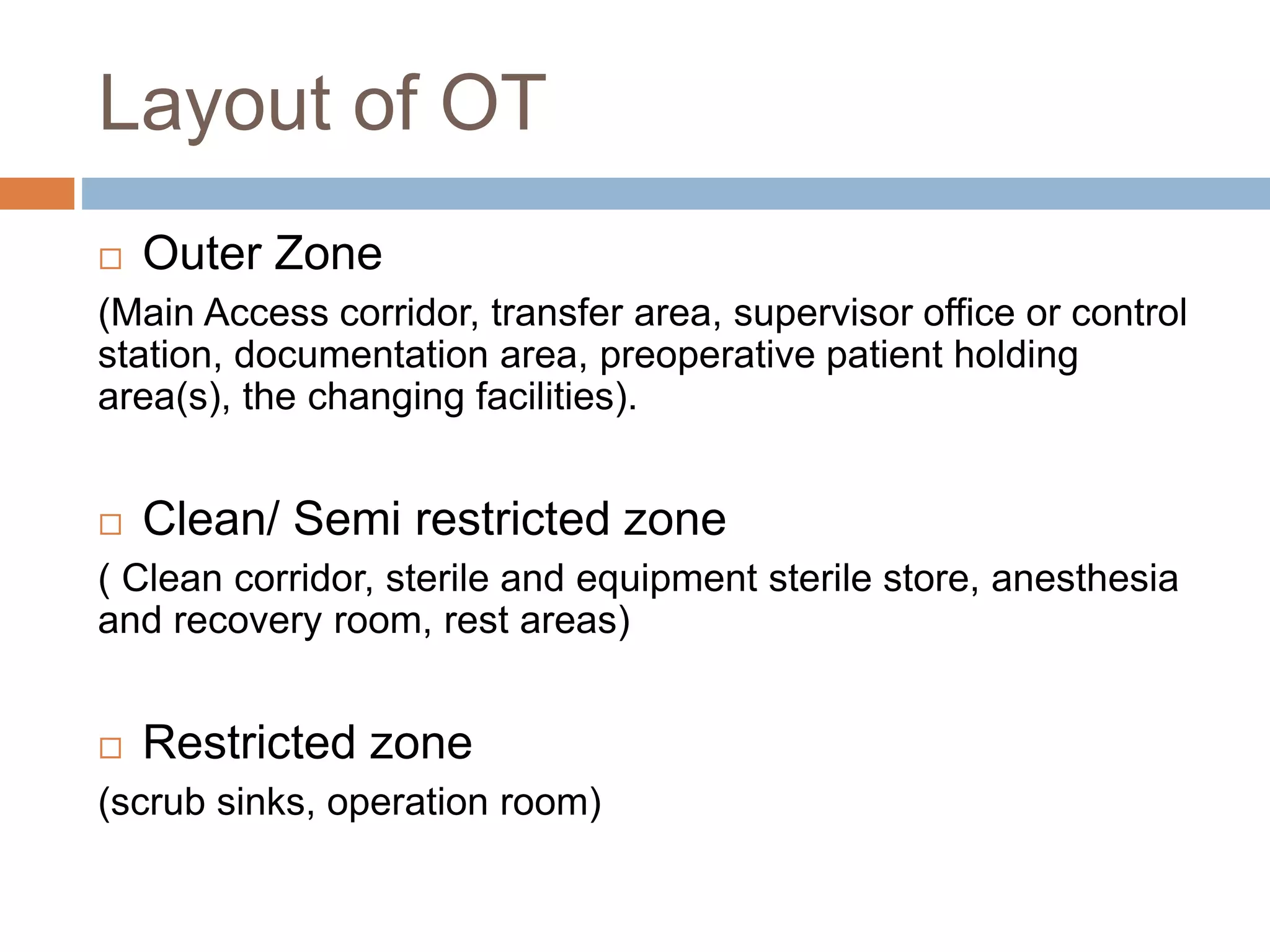
 Outer Zone
(Main Access corridor, transfer area, supervisor office or control
station, documentation area, preoperative patient holding
area(s), the changing facilities).
 Clean/ Semi restricted zone
( Clean corridor, sterile and equipment sterile store, anesthesia
and recovery room, rest areas)
 Restricted zone
(scrub sinks, operation room)
 Staff must change into theatre clothes and
shoes before entering the clean/ semi
restricted area
 The operating theatre ( restricted zone) should
be restricted to just the personnel involved in
the actual operation
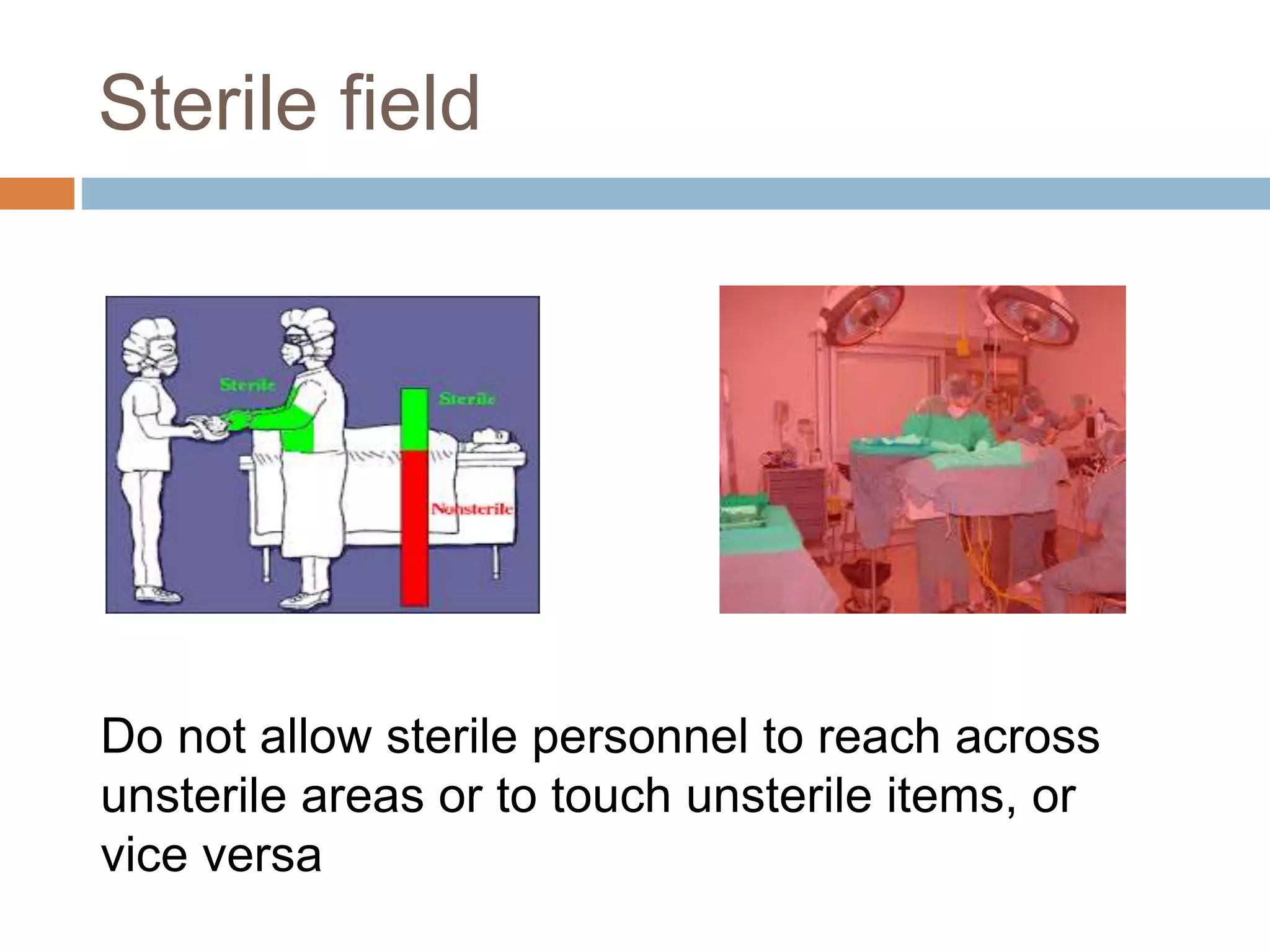
Sterile field
Do not allow sterile personnel to reach across
unsterile areas or to touch unsterile items, or
vice versa
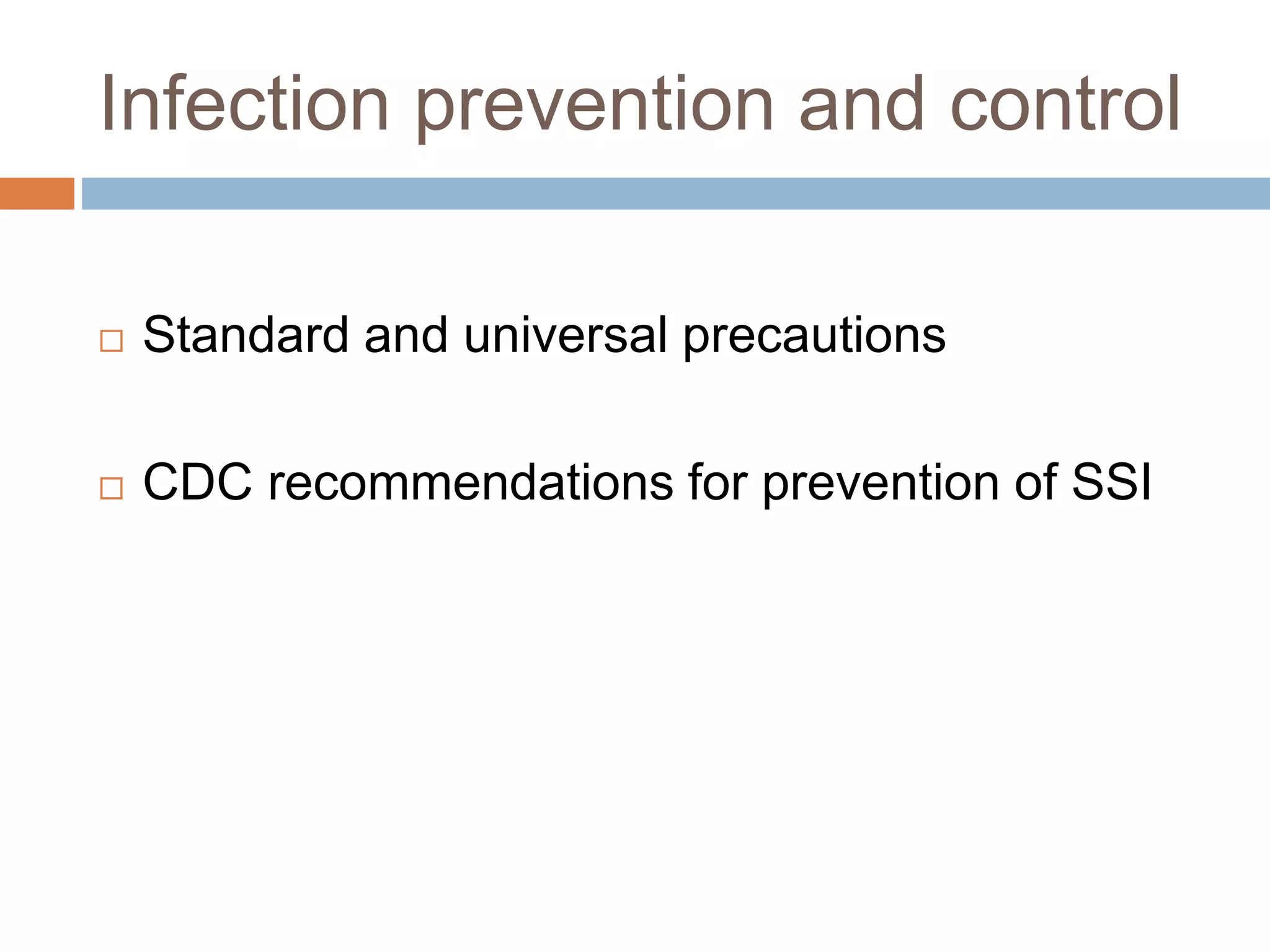
Infection prevention and control
 Standard and universal precautions
 CDC recommendations for prevention of SSI
Standard and Universal
precautions
Standard Precautions:
1. Hand hygiene
2. PPE
3. Aseptic technique- Prevention of needle stick
4. Environmental Cleaning
5. Instruments reprocessing
6. Waste management
Universal precautions:
Blood spillage management/ blood and body fluid
post exposure management
CDC recommendation for
prevention of SSI
Category IA. Strongly recommended for
implementation and supported by well-designed
experimental, clinical, or epidemiological studies.
Category IB. Strongly recommended for
implementation and supported by some
experimental, clinical, or epidemiological studies
and strong theoretical rationale.
CDC recommendation for
prevention of SSI
 Category II. Suggested for implementation and
supported by suggestive clinical or
epidemiological studies or theoretical
rationale.
 No recommendation; unresolved issue.
Practices for which insufficient evidence or no
consensus regarding efficacy exists.
CDC recommendation for
prevention of SSI
 Preoperative
 Intraoperative
 Postoperative
 Surveillance
Preoperative
 Preparation of patient
 Hand antisepsis for surgical team members
 Management of infected or colonized surgical
personnel
 Antimicrobial prophylaxis
Preparation of the patient
Identify and treat all infections remote to surgical
site before elective operations IA
Do not remove hair preoperatively unless it will
interfere with the operation IA
If needed, remove hair immediately before the
operation preferably with electric clippers IA
Preparation of the patient
Require patients to shower or bathe with an
antiseptic agent at least the night before the
operative day IB
Thoroughly wash and clean at and around the
incision site to remove gross contamination
before performing skin preparation IB
Hand/forearm antisepsis for
surgical team
 Keep nails short and do not wear artificial nails
IB
 Perform preoperative surgical scrub for at least
2 to 5 minutes using an appropriate antiseptic
IB
 Dry hands with sterile towels and don a sterile
gowns and gloves IB
Antimicrobial prophylaxis
 Administer a prophylactic antimicrobial agent
only when indicated IA
 Administer by the IV route the initial dose not
more 1 hour before incision IA
Intraoperative
 Ventilation system
 Cleaning and disinfection of environmental
surfaces
 Microbiological sampling
 Sterilization of surgical instruments
 Surgical attire and drapes
 Asepsis and surgical technique
Ventilation
 Maintain positive pressure ventilation in the
operating room IB
 Maintain a minimum of 15 air changes per hour
with at least 3 fresh air IB
 Do not use UV radiation in the operating room to
prevent SSI IB
 Keep operating room doors closed except as
needed for passage of equipment personnel and
the patient IB
Cleaning and disinfection of
environmental surfaces
 When visible soiling or contamination with
blood or other body fluids of surfaces or
equipment occurs, use an approved
disinfectant to the clean the affected area
before the next operation IB
 Do not perform special closing the operation
room after contaminated or dirty operation IB
Sterilization of surgical
instruments
 Sterilize all surgical instruments according to
the guidelines IB
Surgical attire and drapes
 Wear full PPE IB
• Surgical mask that fully covers the mouth and nose
• Cap or hood to fully cover hair on head and face
• Sterile gloves
• Impermeable sterile gowns
 Change scrub suits when visibly soiled or
contaminated with blood or body fluids IB
Asepsis and surgical technique
 Adhere to principles of asepsis when placing
intravascular devices IA
 If drainage is used , use a closed suction
drain, insert it through a separate incision
distant from the operative incision and remove
it as soon as possible IB
Risk Factors
 Classify the risk factors according to your
setting situation
 Target the modifiable and high priority
Easy to change and high
priority
Easy to change and not high
priority
Hard to change and high priority Hard to change and not high
priority
Cleaning Spills of Blood and
Body Fluids
Procedures for dealing with small spillages eg,
splashes and droplets
 Gloves and a plastic apron must be worn
 The area should be wiped thoroughly using
disposable paper roll / towels.
 The areas should be cleaned using a neutral
detergent and warm water.
Cleaning Spills of Blood and
Body Fluids
Procedures for dealing with small spillages eg,
splashes and droplets
 Recommended concentration of Presept 1 tab
in 2.5 water liters to decontaminate surfaces.
 Used gloves, apron / towels should be disposed
in yellow waste bag.
 Wash hands.
Cleaning Spills of Blood and
Body Fluids
Large blood spills in 'dry' areas (such as
clinical areas)
 Where possible, isolate spill area
 The area must be vacated for at least 30
minutes.
 Wear protective equipment like disposable
cleaning gloves, eyewear, mask and plastic
apron
 Cover the spill with paper towels
Cleaning Spills of Blood and
Body Fluids
Large blood spills in 'dry' areas (such as
clinical areas)
 Place all contaminated items into yellow
plastic bag or in sharp container for disposal
.
 Pour (3.5 tab Presept in 1 water liter)solution
and allow 10 minutes to react then wipe up
 Decontaminated areas should then be
cleaned thoroughly with warm water and
neutral detergent .
Cleaning Spills of Blood and
Body Fluids
Large blood spills in 'dry' areas (such as
clinical areas)
 Follow this decontamination process with a
terminal disinfection.
 Discard contaminated materials (absorbent
toweling, cleaning cloths, disposable gloves and
plastic apron).
 Wash hands
Evaluation of infection control
practices
 Checklists
 Surveillance
Evaluation of infection control
practices
Checklists
• Used to evaluate everyday performance and
compliance to infection control practices
• Provide feedback to OT staff to rapid
intervention.
Evaluation of infection control
practices
Surveillance IB
• Use CDC case definitions to identify SSIs and
all other HAIs either during hospital stay or
after patient discharge.
• Provides incidence rate of infection
• Stratifies risk factors HAIs that need strong
intervention.

Infection control in operation room

  • 1.
    INFECTION PREVENTION &CONTROL INOPERATION ROOM Dr. Moustapha Ramadan Feb 2015
  • 2.
    Outlines  Aim  Layout/ sterile zone  Standard and Universal precautions  CDC recommendations and Category  Risk factors  Management of blood spillage  Evaluation of infection control
  • 3.
    Aim  Provide asterile field for a safe surgery  Prevention of All HAIs ( not only SSI)  Prevention of occupational hazards
  • 4.
    Layout of OT Outer Zone (Main Access corridor, transfer area, supervisor office or control station, documentation area, preoperative patient holding area(s), the changing facilities).  Clean/ Semi restricted zone ( Clean corridor, sterile and equipment sterile store, anesthesia and recovery room, rest areas)  Restricted zone (scrub sinks, operation room)
  • 5.
     Staff mustchange into theatre clothes and shoes before entering the clean/ semi restricted area  The operating theatre ( restricted zone) should be restricted to just the personnel involved in the actual operation
  • 6.
    Sterile field Do notallow sterile personnel to reach across unsterile areas or to touch unsterile items, or vice versa
  • 7.
    Infection prevention andcontrol  Standard and universal precautions  CDC recommendations for prevention of SSI
  • 8.
    Standard and Universal precautions StandardPrecautions: 1. Hand hygiene 2. PPE 3. Aseptic technique- Prevention of needle stick 4. Environmental Cleaning 5. Instruments reprocessing 6. Waste management Universal precautions: Blood spillage management/ blood and body fluid post exposure management
  • 9.
    CDC recommendation for preventionof SSI Category IA. Strongly recommended for implementation and supported by well-designed experimental, clinical, or epidemiological studies. Category IB. Strongly recommended for implementation and supported by some experimental, clinical, or epidemiological studies and strong theoretical rationale.
  • 10.
    CDC recommendation for preventionof SSI  Category II. Suggested for implementation and supported by suggestive clinical or epidemiological studies or theoretical rationale.  No recommendation; unresolved issue. Practices for which insufficient evidence or no consensus regarding efficacy exists.
  • 11.
    CDC recommendation for preventionof SSI  Preoperative  Intraoperative  Postoperative  Surveillance
  • 12.
    Preoperative  Preparation ofpatient  Hand antisepsis for surgical team members  Management of infected or colonized surgical personnel  Antimicrobial prophylaxis
  • 13.
    Preparation of thepatient Identify and treat all infections remote to surgical site before elective operations IA Do not remove hair preoperatively unless it will interfere with the operation IA If needed, remove hair immediately before the operation preferably with electric clippers IA
  • 14.
    Preparation of thepatient Require patients to shower or bathe with an antiseptic agent at least the night before the operative day IB Thoroughly wash and clean at and around the incision site to remove gross contamination before performing skin preparation IB
  • 15.
    Hand/forearm antisepsis for surgicalteam  Keep nails short and do not wear artificial nails IB  Perform preoperative surgical scrub for at least 2 to 5 minutes using an appropriate antiseptic IB  Dry hands with sterile towels and don a sterile gowns and gloves IB
  • 16.
    Antimicrobial prophylaxis  Administera prophylactic antimicrobial agent only when indicated IA  Administer by the IV route the initial dose not more 1 hour before incision IA
  • 17.
    Intraoperative  Ventilation system Cleaning and disinfection of environmental surfaces  Microbiological sampling  Sterilization of surgical instruments  Surgical attire and drapes  Asepsis and surgical technique
  • 18.
    Ventilation  Maintain positivepressure ventilation in the operating room IB  Maintain a minimum of 15 air changes per hour with at least 3 fresh air IB  Do not use UV radiation in the operating room to prevent SSI IB  Keep operating room doors closed except as needed for passage of equipment personnel and the patient IB
  • 19.
    Cleaning and disinfectionof environmental surfaces  When visible soiling or contamination with blood or other body fluids of surfaces or equipment occurs, use an approved disinfectant to the clean the affected area before the next operation IB  Do not perform special closing the operation room after contaminated or dirty operation IB
  • 20.
    Sterilization of surgical instruments Sterilize all surgical instruments according to the guidelines IB
  • 21.
    Surgical attire anddrapes  Wear full PPE IB • Surgical mask that fully covers the mouth and nose • Cap or hood to fully cover hair on head and face • Sterile gloves • Impermeable sterile gowns  Change scrub suits when visibly soiled or contaminated with blood or body fluids IB
  • 22.
    Asepsis and surgicaltechnique  Adhere to principles of asepsis when placing intravascular devices IA  If drainage is used , use a closed suction drain, insert it through a separate incision distant from the operative incision and remove it as soon as possible IB
  • 23.
    Risk Factors  Classifythe risk factors according to your setting situation  Target the modifiable and high priority Easy to change and high priority Easy to change and not high priority Hard to change and high priority Hard to change and not high priority
  • 24.
    Cleaning Spills ofBlood and Body Fluids Procedures for dealing with small spillages eg, splashes and droplets  Gloves and a plastic apron must be worn  The area should be wiped thoroughly using disposable paper roll / towels.  The areas should be cleaned using a neutral detergent and warm water.
  • 25.
    Cleaning Spills ofBlood and Body Fluids Procedures for dealing with small spillages eg, splashes and droplets  Recommended concentration of Presept 1 tab in 2.5 water liters to decontaminate surfaces.  Used gloves, apron / towels should be disposed in yellow waste bag.  Wash hands.
  • 26.
    Cleaning Spills ofBlood and Body Fluids Large blood spills in 'dry' areas (such as clinical areas)  Where possible, isolate spill area  The area must be vacated for at least 30 minutes.  Wear protective equipment like disposable cleaning gloves, eyewear, mask and plastic apron  Cover the spill with paper towels
  • 27.
    Cleaning Spills ofBlood and Body Fluids Large blood spills in 'dry' areas (such as clinical areas)  Place all contaminated items into yellow plastic bag or in sharp container for disposal .  Pour (3.5 tab Presept in 1 water liter)solution and allow 10 minutes to react then wipe up  Decontaminated areas should then be cleaned thoroughly with warm water and neutral detergent .
  • 28.
    Cleaning Spills ofBlood and Body Fluids Large blood spills in 'dry' areas (such as clinical areas)  Follow this decontamination process with a terminal disinfection.  Discard contaminated materials (absorbent toweling, cleaning cloths, disposable gloves and plastic apron).  Wash hands
  • 29.
    Evaluation of infectioncontrol practices  Checklists  Surveillance
  • 30.
    Evaluation of infectioncontrol practices Checklists • Used to evaluate everyday performance and compliance to infection control practices • Provide feedback to OT staff to rapid intervention.
  • 31.
    Evaluation of infectioncontrol practices Surveillance IB • Use CDC case definitions to identify SSIs and all other HAIs either during hospital stay or after patient discharge. • Provides incidence rate of infection • Stratifies risk factors HAIs that need strong intervention.