OPERATING ROOM
SAFETY
DR. ANKIT MADHARIA
JUNIOR RESIDENT, DEPARTMENT OF ORTHOPAEDICS
LATA MANGESHKAR HOSPITAL, NAGPUR
Outline
Why talk about OR safety?
Do we have a problem?
Is there anywhere we can look for help?
Is there a “Culture of Safety”?
As surgeons, what do we want the
operating room to be?
Efficient
Easy access to schedule cases
Have the supplies and instruments we
need when we need them
Safe
Who’s safety are we talking about?
Surgicalteam
Surgeon
Nursing staff
Anaesthetist
Attendants
Patient’s
safety
How do we benefit from surgery that is
safe for our patients
Less morbidity and mortality
Improved quality of our work
Less liability
Greater efficiency
Operating Room Errors:
× Wrong patient
× Wrong operation
× Wrong site or side
× Unexpected intra-
operative death
× Intra-operative
complications
× Retained foreign
bodies
× Operating room fires
× Mishandling of
surgical specimens
× Patient injury due to
positioning or burns
× Medication errors
× Transfusion mishaps
× Injury to the
surgical team
members
When is our patient safe in the OR?
Never –
errors can and do occur !!
◦To Err is Human…..
Hazards in operating room
•Blood/body fluid exposures
from sharps
•Exposure to released
particulates
•Exposures to waste
anesthetic gases
•Possible exposures to
chemical cleaning agents
Slips/trips/fall hazards
•Exposures to lasers/ X-ray
Radiations
•Hitting heads on OR lights
•Electrical shock hazards
•Fires
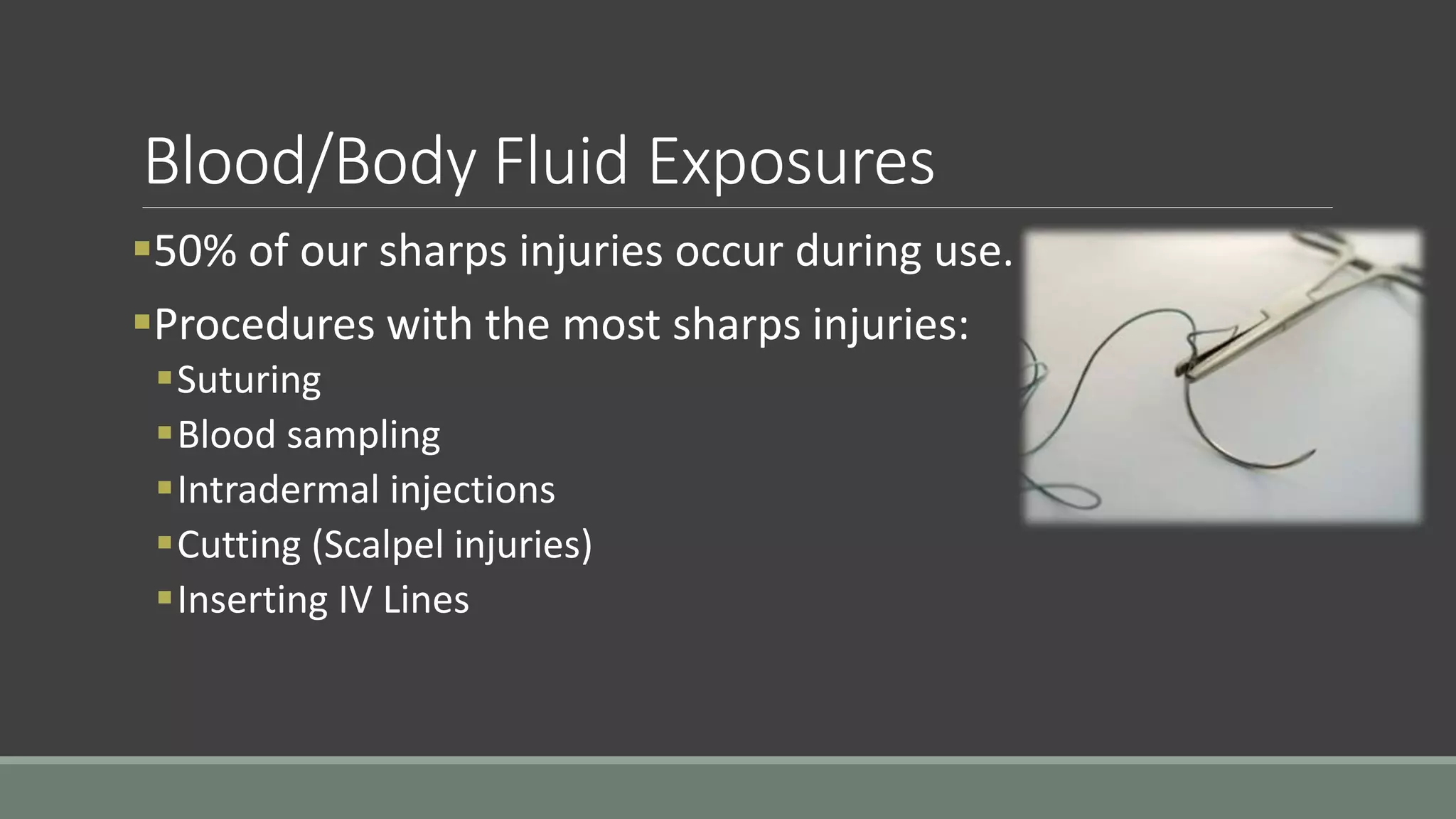
Blood/Body Fluid Exposures
50% of our sharps injuries occur during use.
Procedures with the most sharps injuries:
Suturing
Blood sampling
Intradermal injections
Cutting (Scalpel injuries)
Inserting IV Lines
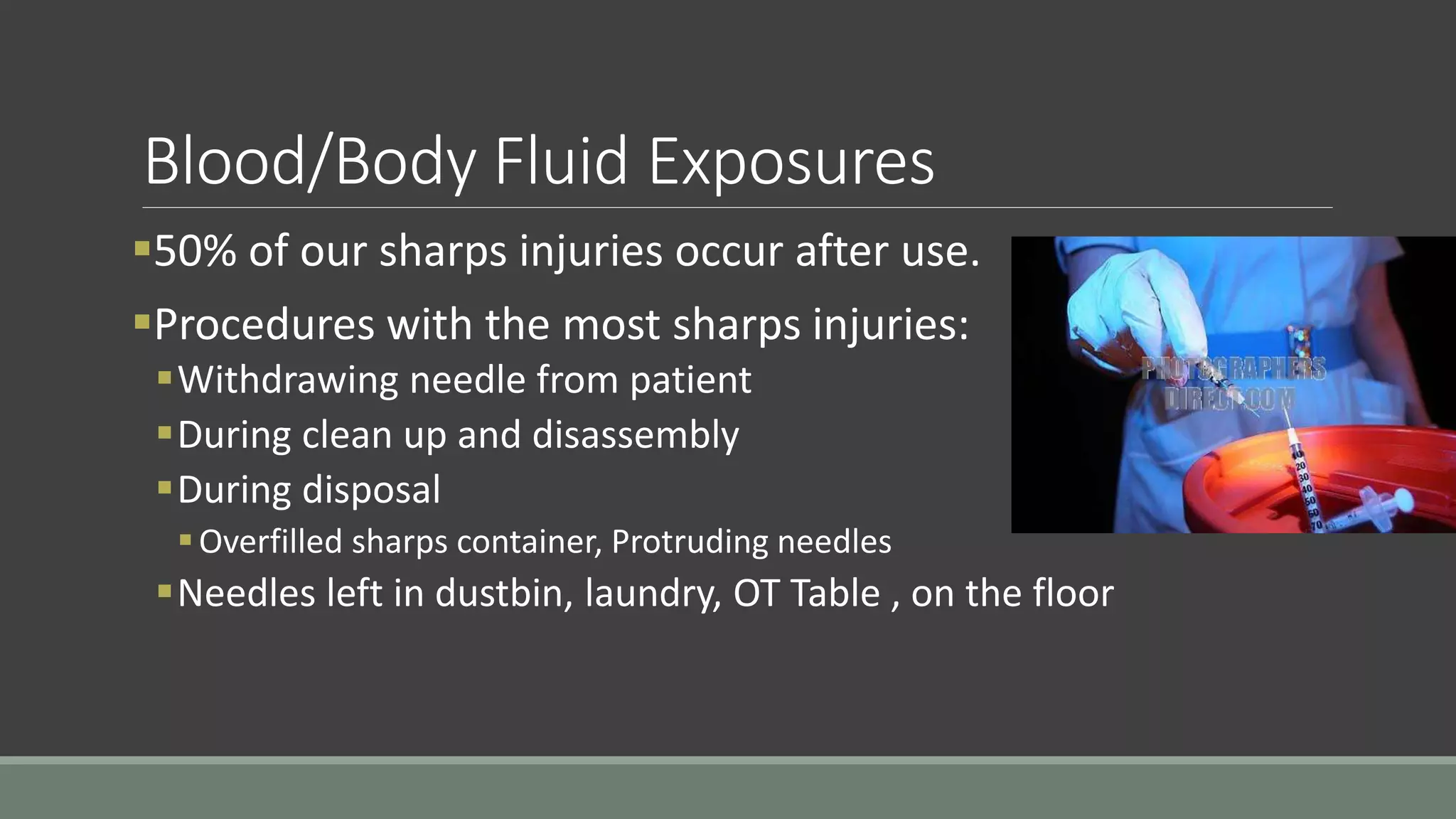
Blood/Body Fluid Exposures
50% of our sharps injuries occur after use.
Procedures with the most sharps injuries:
Withdrawing needle from patient
During clean up and disassembly
During disposal
Overfilled sharps container, Protruding needles
Needles left in dustbin, laundry, OT Table , on the floor
Blood/Body Fluid Exposures
What can we do to prevent these exposure
injuries?
Utilize safe zone during each surgical procedure
Account for all sharps used
Dispose off sharp in sharps container
immediately after use
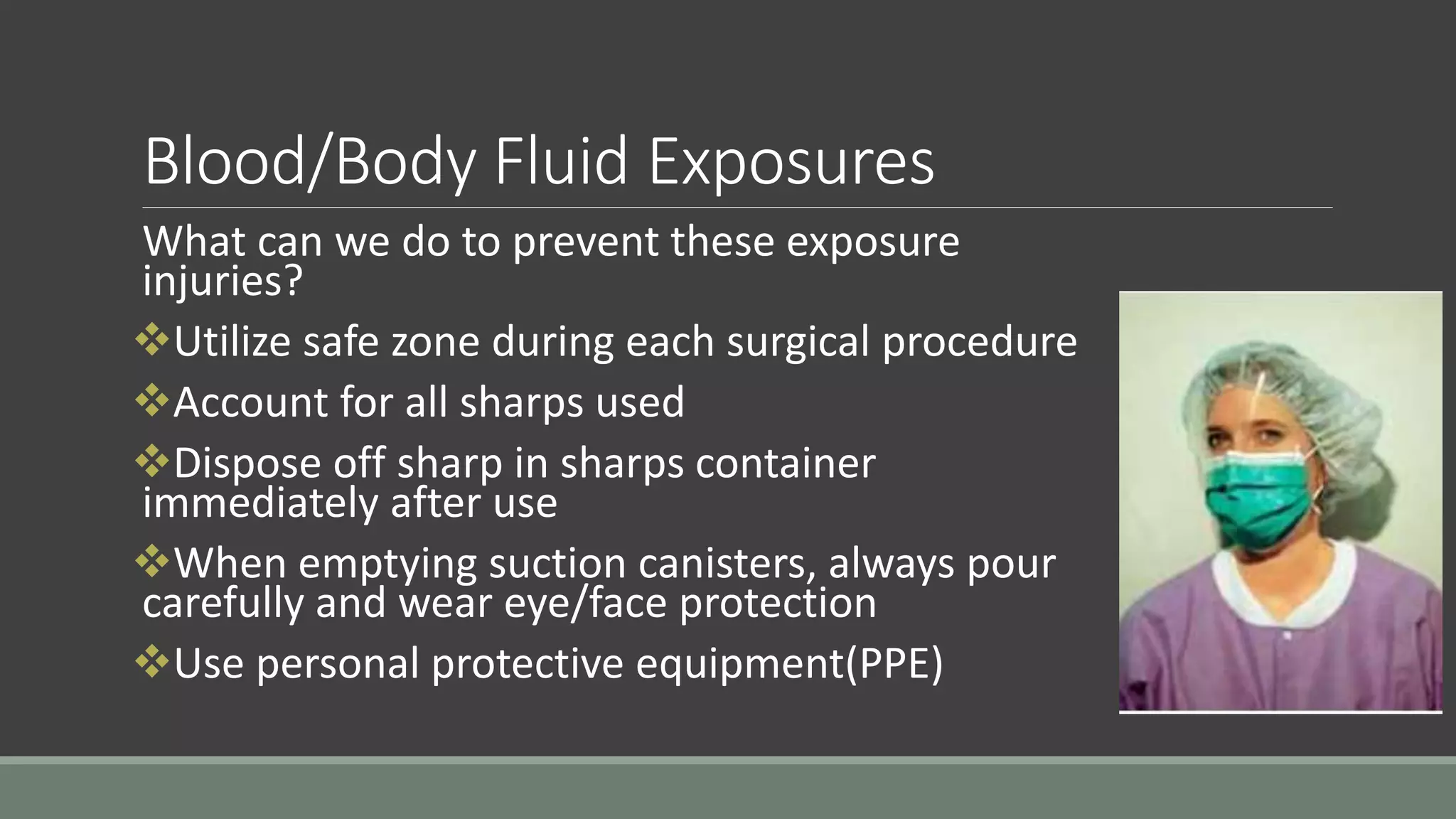
When emptying suction canisters, always pour
carefully and wear eye/face protection
Use personal protective equipment(PPE)
Blood/Body Fluid Exposures
Should an exposure occur:
For face/ eye exposure: Rinse with water
for about 15 minutes
For needle-stick injuries:
Express blood from stick
 wash with soap and water or betadine.
 Spirit/sterillium NOT to be used.
Particulate releases
Some procedures in the OR generate particulates into
the air (i.e., from cauterizing blood vessels, using lasers)
These particulates can have viable organisms present
that can cause infections
Preventive actions:
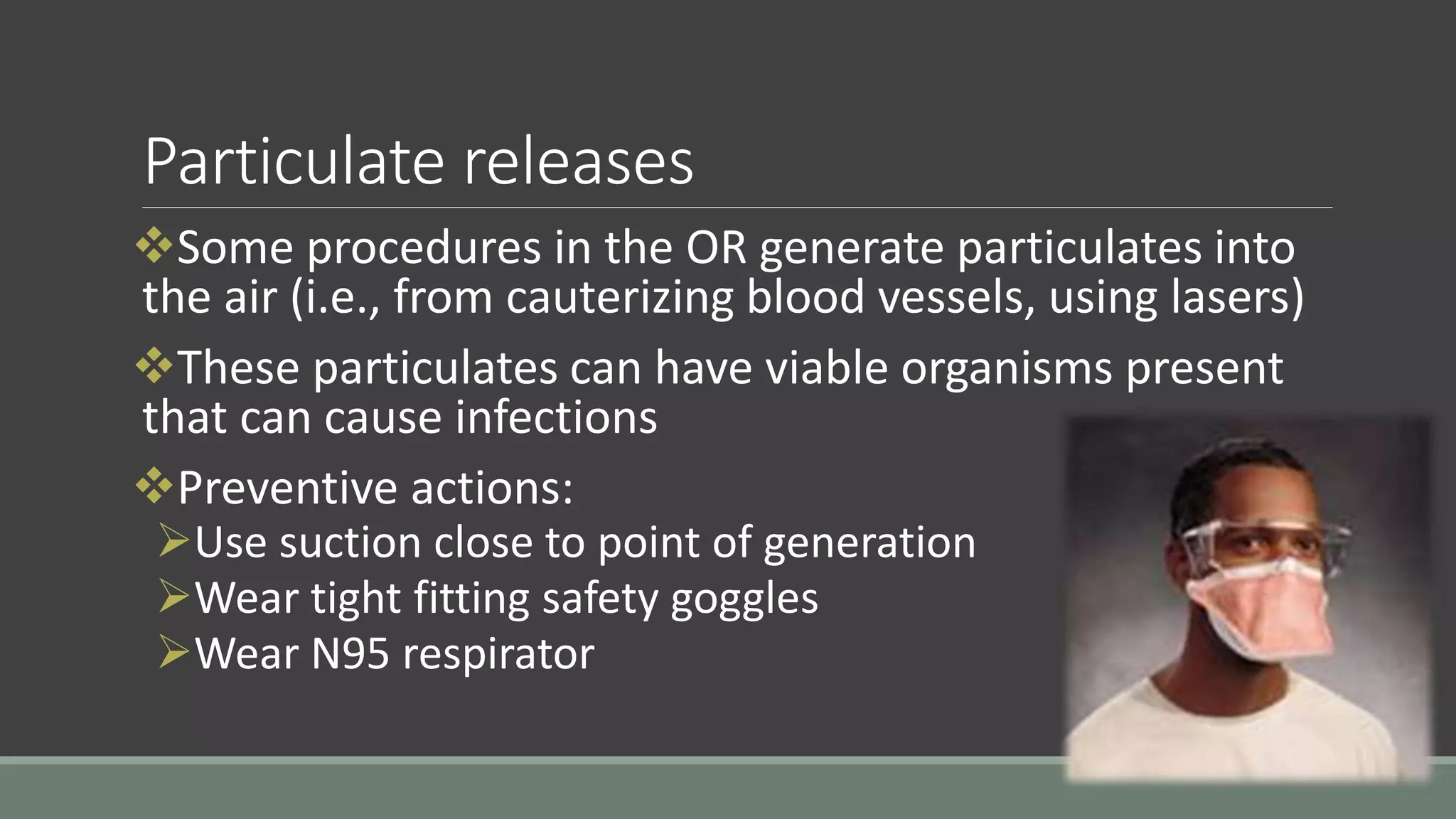
Use suction close to point of generation
Wear tight fitting safety goggles
Wear N95 respirator
Waste Anaesthetic Gases
Releases of anaesthetic gases into an OT can result in loss
of small motor skills, slowing of reflexes, metal confusion,
tiredness
Action by the anaesthesiologist can minimize these
exposures:
Check all connections before use for leaks
Pack endotracheal tube to prevent leaks
Have equipment serviced/checked periodically
Slips/Trips/Falls
The walking surface of OT locations can be
slippery, causing an injury
Take the appropriate precautions
Wear slip resistant foot wear
Report water/fluids on floor for clean up
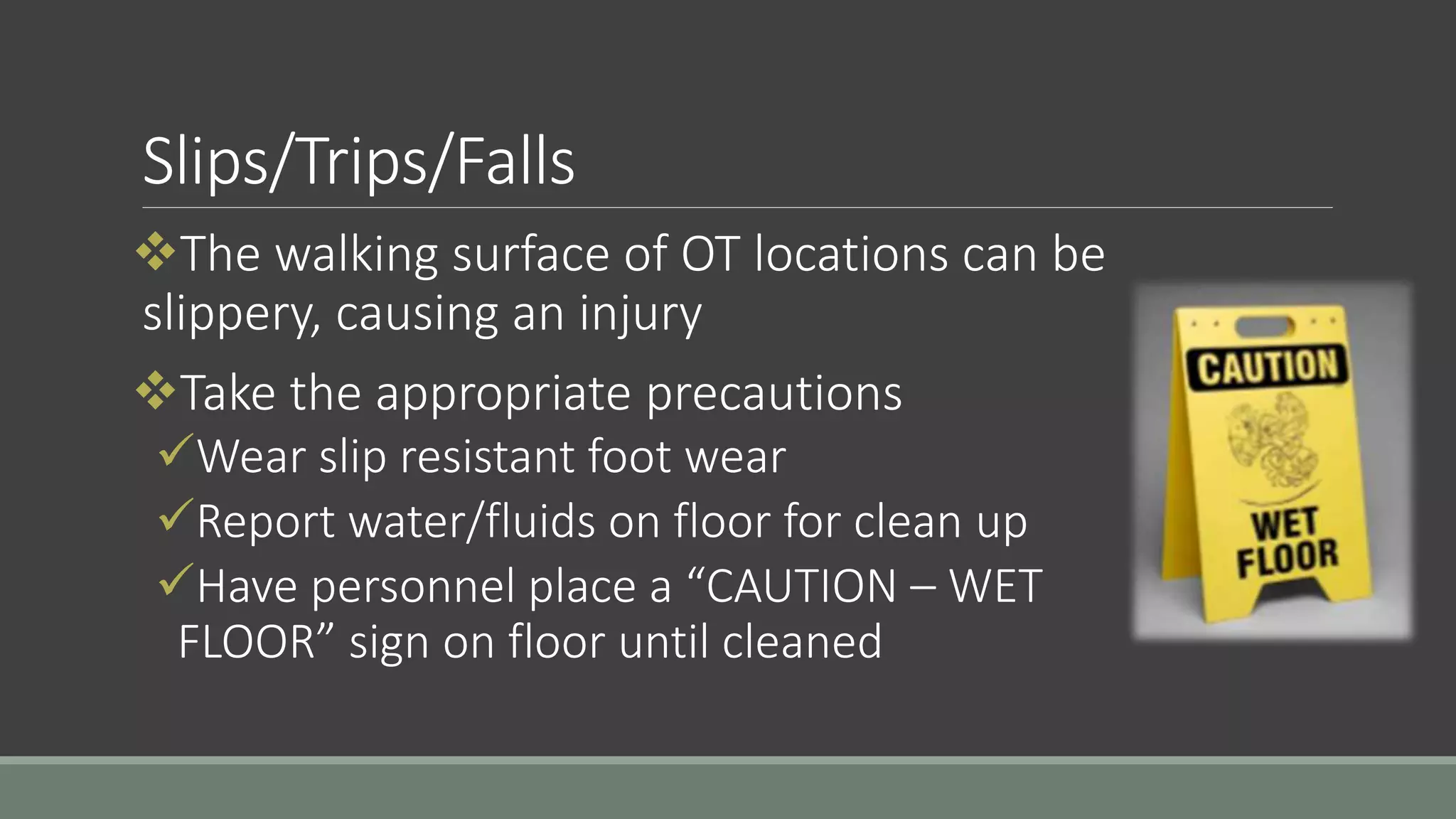
Have personnel place a “CAUTION – WET
FLOOR” sign on floor until cleaned
X-rays , Lasers
We must prepare the OT for use of X-Rays/ Lasers
 Place Lead aprons / lead thyroid shield at the entry
of OT to be used by everyone inside the OT
 Place the eye protection equipment at the entry of
OT if Laser is to be used,
 Verify that personnel entering the OT have
adequate protection on
 Keep the use of C-arm to the minimum
Head injuries
OT lights are adjustable. Sometimes they
may be in a position that can cause a head
injury.
Use these simple rules:
Keep light up, out of the way until needed
Once done using, move the light up, out of
the way
Electrical Shocks
Shocks are usually the result of faulty
equipment
Take the following actions:
Unplug power cords by holding the plug, never
pull the cord
Never operate equipment if the ground plug is
missing. Take the unit out of service for repairs
Prevent exposure of electrical equipment from
body fluids/ Other electrolytes inside the OT
Fire
In order to understand how fire extinguishers work, you first
need to know a little bit about fire.
Essentially, fire extinguishers put out fire by taking away one
or more elements of the fire triangle.
Pressure injuries to patient
Anaesthetised patient is prone to pressure injury
It can be prevented by:
Proper patient positioning
Adequate padding
Preventing generation of pressure points
Safety Success story
Commercial Airline Industry
Tenerife – the crash that changed the
airline industry
Deadliest crash in aviation history: 538 Fatalities
1977, Tenerife island, Canary islands
Collision of KLM Boeing 747 and Pan Am Boeing 747
Tenerife – the crash that changed the
airline industry
Cockpit KLM 747
•Captain Jacob van Zanten – A Star pilot
•Copilot- First officer
•Flight Engineer- Second officer
Dense fog, one runway
Pan Am 747 on runway, out of sight of KLM 747
Tenerife – the crash that changed the
airline industry
Captain Co-Pilot
Captain puts
KLM plane on
runway and is in
a rush to take
off
Tenerife – the crash that changed the
airline industry
Captain Co-Pilot
Wait, we do
not have
clearance yet!
With great hesitation
Tenerife – the crash that changed the
airline industry
Captain Co-Pilot
Air traffic
control
clearance given
but takeoff
clearance not
given and
captain begins
throttling up
Tenerife – the crash that changed the
airline industry
Captain Co-Pilot
Copilot rushes
to try and get
clearance,
communication
is poor with
tower but co-
pilot gives pilot
the OK to
takeoff.
Tenerife – the crash that changed the
airline industry
Captain Co-Pilot
Copilot focuses
on his duties to
assist the
captain and says
nothing
Tenerife – the crash that changed the
airline industry
Captain Co-Pilot
At 45 knots,
the very junior
flight engineer
speaks up
lightly and
says
Is he not clear
then, the Pan
Am
Flight engineer
Tenerife – the crash that changed the
airline industry
Captain Co-Pilot
At 45 knots,
the very junior
flight engineer
speaks up
lightly and
says
Is he not clear
then, the Pan
Am
Flight engineer
What? What?
Tenerife – the crash that changed the
airline industry
Captain Co-Pilot
At 80 knots,
the flight
engineer
repeats in a
soft voice
Is he not clear
then, the Pan
Am
Flight engineer
Tenerife – the crash that changed the
airline industry
Captain Co-Pilot
At 80 knots,
the flight
engineer
repeats in a
soft voice
Is he not clear
then, the Pan
Am
Flight engineer
What!
Tenerife – the crash that changed the
airline industry
At 112 knots, the
captain sees Pan Am
747 sideways on
runway and tries to
leapfrog over the
plane…..collision
occurs….538 fatalities
WHY?
Several factors
Myth: senior airline captains are failsafe ; avoiding
mistakes due to their experience, and wits.
Assumption - a person of such stature is presumed to be
perfect
Culture of the airline cockpit before Tenerife
Misunderstood words or phrases
Lack of communication
Response
1978 – NASA research indicates that majority of airline
disasters NOT due to pilots lack of technical skill or
mechanical failure BUT from errors associated with
breakdowns in:
Communication
Leadership
Teamwork
Response
Cockpit Resource Management (CRM) evolved:
oFocus on human and systems issues
oWork culture within cockpit gradually modified
oAll members of crew empowered to provide feedback,
opinion, ask questions, “hard stop”
oError management
oStandardized checklists, forcing functions and language of
cockpit communications
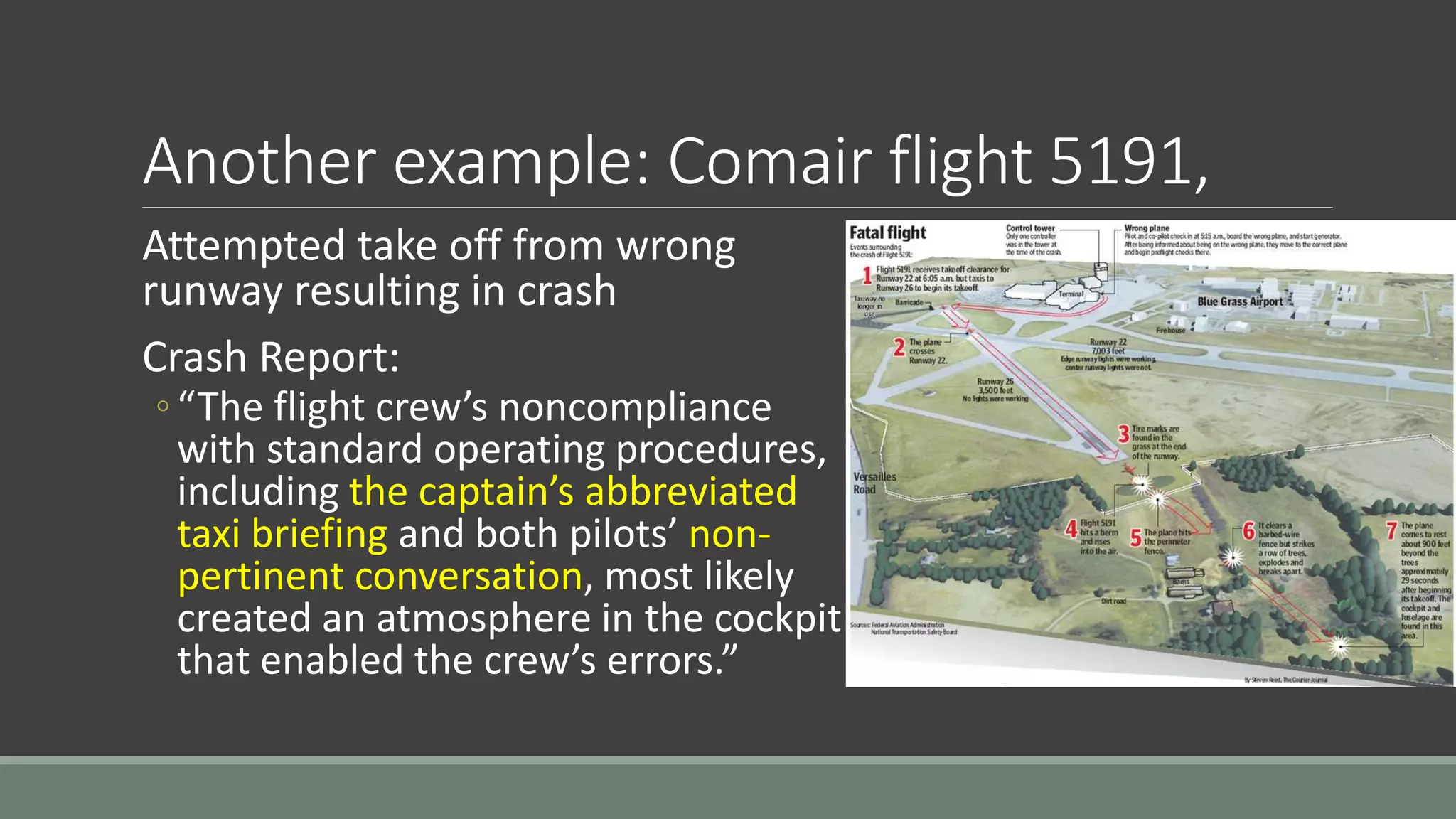
Another example: Comair flight 5191,
Attempted take off from wrong
runway resulting in crash
Crash Report:
◦“The flight crewmembers failed to
recognize that they were initiating
a take off on the wrong runway
because they did not crosscheck
and confirm the airplane’s position
on the runway before takeoff and
they were likely influenced by
confirmation bias.”
Another example: Comair flight 5191,
Attempted take off from wrong
runway resulting in crash
Crash Report:
◦“The flight crew’s noncompliance
with standard operating procedures,
including the captain’s abbreviated
taxi briefing and both pilots’ non-
pertinent conversation, most likely
created an atmosphere in the cockpit
that enabled the crew’s errors.”
THINK ABOUT THIS…
Technical excellence alone does not
always guarantee a positive outcome
Being a good leader and getting the
most from a team are not directly linked
to your technical expertise
The Impact of Crew Resource Management
(CRM) on the Commercial Airline Industry
Improved cockpit team interactions
Fewer errors
Better morale
Commercial flight more cost effective
Overall rate of airline incidents has declined
Commercial aviation is the safest form of transportation
on a per mile basis
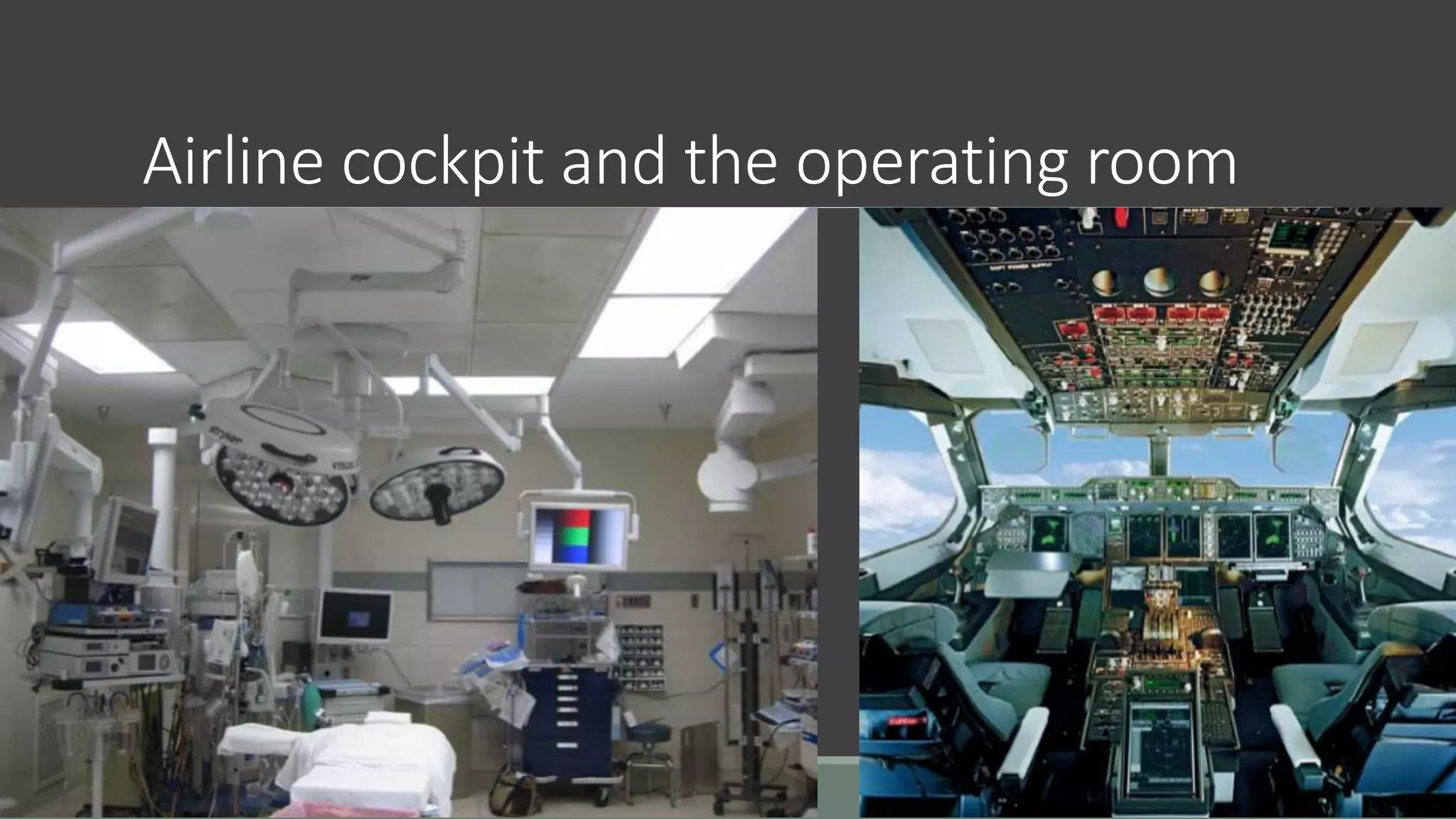
Airline cockpit and the operating room
Similarities:
High risk
Highly complex technical work
Intelligent motivated people
Teams
Differences:
Airline pilots have strict duty hours
Pilots avoid punishment if they
promptly report errors, surgeons fear
litigation and loss of registration
Airlines learned long ago that
certain weather conditions make a
safe landing unlikely….surgeon tend
to operate on anyone they want to !!
What makes an OR safer?
Less Errors
OR Safety Pyramid
Errors that cause
harm
Errors
Near misses
Process problems
These we all hear about
Our OR needs to have a
system to capture these
Our OR needs to
capture signals that tell
us we may have these
Errors depend on two kinds of failures:
An error of planning
An error of execution
“Slips, lapses and
mistakes”
- part of humanity
- exacerbated by
anxiety, fatigue and
fear
American college of Surgeons
- OR Safety and Crew Resource Management
(CRM)
Applying the aviation model to the operating room
Seven principles (CRM)
1. Command – one final decision maker who must be
willing to foster the team and accept responsibility
and accountability for their team’s actions.
Seven principles (CRM)
2. Leadership – defined by commanders willingness
to let team members exercise their rights and
responsibilities to ensure a safe and positive
outcome. Although there is only one commander
any member of a team can show leadership.
Surgeons who encourage teamwork are MORE
respected.
Seven principles (CRM)
3. Communication – teams that fail to communicate
are doomed to negative results and errors. Adverse
OR events often related to poor communication due
to factors such as steep hierarchies, stress and
cultural differences
Seven principles (CRM)
4. Situational awareness – an effective leader relies
on team to promote situational awareness through
effective communication about what is occurring.
“Why didn’t you tell me !”
Seven principles (CRM)
5. Workload management – organizing tasks such
that there is equitable distribution amongst team
members. “Plan the work and work the plan”
Seven principles (CRM)
6. Resource management – optimal use of all
information, data, assistance available to the team.
Ensuring the presence of needed resources.
Seven principles (CRM)
7. Decision making
Collaborative – discouraged in high performance teams
Unilateral – fast but is a problem if leader is not aware of
all information or makes incorrect decision
Consultative – most effective in high performance
teams. Leader must know when to stop gathering data.
WHO Guidelines for safe surgery
What can we do to achieve a “Culture of
Safety” in our ORs
Commit to safety
Focus on safe operations
Recognize a high risk
situation
View safety as a system
responsibility with individual
accountability
 Surgeons provide
leadership
 Encourage teamwork
Collect data
OR quality and safety
committee
Conclusions
The airline industry has taught us that:
The most experienced, most skilled, most
dedicated, most charming pilot (surgeon) can make a
bad mistake.
Even the best pilot (surgeon) will not be able to
single handedly prevent all errors made in the cockpit
(Operating room)
Conclusions
An optimal error reduction (safety) system involves:
A team approach – you cannot do it alone
A fair and non-threatening workplace
Standardized approaches such as “Time out”
Rigorous and real time scrutiny of errors, close calls and near
misses
Don’t play the blame game - Hold individuals responsible for
recklessness and foster personal accountability BUT hold the
system responsible for errors.
A constant unrelenting desire to improve
Strive for a “Culture of Safety” in our ORs
It’s good for our patients
It will minimize OUR chance of getting into trouble
It will minimize the chance of someone else getting US
into trouble
It will make the OR a more efficient place for us to work
Thank you.

Operating room safety

  • 1.
    OPERATING ROOM SAFETY DR. ANKITMADHARIA JUNIOR RESIDENT, DEPARTMENT OF ORTHOPAEDICS LATA MANGESHKAR HOSPITAL, NAGPUR
  • 2.
    Outline Why talk aboutOR safety? Do we have a problem? Is there anywhere we can look for help? Is there a “Culture of Safety”?
  • 3.
    As surgeons, whatdo we want the operating room to be? Efficient Easy access to schedule cases Have the supplies and instruments we need when we need them Safe
  • 4.
    Who’s safety arewe talking about? Surgicalteam Surgeon Nursing staff Anaesthetist Attendants Patient’s safety
  • 5.
    How do webenefit from surgery that is safe for our patients Less morbidity and mortality Improved quality of our work Less liability Greater efficiency
  • 6.
    Operating Room Errors: ×Wrong patient × Wrong operation × Wrong site or side × Unexpected intra- operative death × Intra-operative complications × Retained foreign bodies × Operating room fires × Mishandling of surgical specimens × Patient injury due to positioning or burns × Medication errors × Transfusion mishaps × Injury to the surgical team members
  • 7.
    When is ourpatient safe in the OR? Never – errors can and do occur !! ◦To Err is Human…..
  • 8.
    Hazards in operatingroom •Blood/body fluid exposures from sharps •Exposure to released particulates •Exposures to waste anesthetic gases •Possible exposures to chemical cleaning agents Slips/trips/fall hazards •Exposures to lasers/ X-ray Radiations •Hitting heads on OR lights •Electrical shock hazards •Fires
  • 9.
    Blood/Body Fluid Exposures 50%of our sharps injuries occur during use. Procedures with the most sharps injuries: Suturing Blood sampling Intradermal injections Cutting (Scalpel injuries) Inserting IV Lines
  • 10.
    Blood/Body Fluid Exposures 50%of our sharps injuries occur after use. Procedures with the most sharps injuries: Withdrawing needle from patient During clean up and disassembly During disposal Overfilled sharps container, Protruding needles Needles left in dustbin, laundry, OT Table , on the floor
  • 11.
    Blood/Body Fluid Exposures Whatcan we do to prevent these exposure injuries? Utilize safe zone during each surgical procedure Account for all sharps used Dispose off sharp in sharps container immediately after use When emptying suction canisters, always pour carefully and wear eye/face protection Use personal protective equipment(PPE)
  • 12.
    Blood/Body Fluid Exposures Shouldan exposure occur: For face/ eye exposure: Rinse with water for about 15 minutes For needle-stick injuries: Express blood from stick  wash with soap and water or betadine.  Spirit/sterillium NOT to be used.
  • 13.
    Particulate releases Some proceduresin the OR generate particulates into the air (i.e., from cauterizing blood vessels, using lasers) These particulates can have viable organisms present that can cause infections Preventive actions: Use suction close to point of generation Wear tight fitting safety goggles Wear N95 respirator
  • 14.
    Waste Anaesthetic Gases Releasesof anaesthetic gases into an OT can result in loss of small motor skills, slowing of reflexes, metal confusion, tiredness Action by the anaesthesiologist can minimize these exposures: Check all connections before use for leaks Pack endotracheal tube to prevent leaks Have equipment serviced/checked periodically
  • 15.
    Slips/Trips/Falls The walking surfaceof OT locations can be slippery, causing an injury Take the appropriate precautions Wear slip resistant foot wear Report water/fluids on floor for clean up Have personnel place a “CAUTION – WET FLOOR” sign on floor until cleaned
  • 16.
    X-rays , Lasers Wemust prepare the OT for use of X-Rays/ Lasers  Place Lead aprons / lead thyroid shield at the entry of OT to be used by everyone inside the OT  Place the eye protection equipment at the entry of OT if Laser is to be used,  Verify that personnel entering the OT have adequate protection on  Keep the use of C-arm to the minimum
  • 17.
    Head injuries OT lightsare adjustable. Sometimes they may be in a position that can cause a head injury. Use these simple rules: Keep light up, out of the way until needed Once done using, move the light up, out of the way
  • 18.
    Electrical Shocks Shocks areusually the result of faulty equipment Take the following actions: Unplug power cords by holding the plug, never pull the cord Never operate equipment if the ground plug is missing. Take the unit out of service for repairs Prevent exposure of electrical equipment from body fluids/ Other electrolytes inside the OT
  • 19.
    Fire In order tounderstand how fire extinguishers work, you first need to know a little bit about fire. Essentially, fire extinguishers put out fire by taking away one or more elements of the fire triangle.
  • 20.
    Pressure injuries topatient Anaesthetised patient is prone to pressure injury It can be prevented by: Proper patient positioning Adequate padding Preventing generation of pressure points
  • 21.
  • 22.
    Tenerife – thecrash that changed the airline industry Deadliest crash in aviation history: 538 Fatalities 1977, Tenerife island, Canary islands Collision of KLM Boeing 747 and Pan Am Boeing 747
  • 23.
    Tenerife – thecrash that changed the airline industry Cockpit KLM 747 •Captain Jacob van Zanten – A Star pilot •Copilot- First officer •Flight Engineer- Second officer Dense fog, one runway Pan Am 747 on runway, out of sight of KLM 747
  • 24.
    Tenerife – thecrash that changed the airline industry Captain Co-Pilot Captain puts KLM plane on runway and is in a rush to take off
  • 25.
    Tenerife – thecrash that changed the airline industry Captain Co-Pilot Wait, we do not have clearance yet! With great hesitation
  • 26.
    Tenerife – thecrash that changed the airline industry Captain Co-Pilot Air traffic control clearance given but takeoff clearance not given and captain begins throttling up
  • 27.
    Tenerife – thecrash that changed the airline industry Captain Co-Pilot Copilot rushes to try and get clearance, communication is poor with tower but co- pilot gives pilot the OK to takeoff.
  • 28.
    Tenerife – thecrash that changed the airline industry Captain Co-Pilot Copilot focuses on his duties to assist the captain and says nothing
  • 29.
    Tenerife – thecrash that changed the airline industry Captain Co-Pilot At 45 knots, the very junior flight engineer speaks up lightly and says Is he not clear then, the Pan Am Flight engineer
  • 30.
    Tenerife – thecrash that changed the airline industry Captain Co-Pilot At 45 knots, the very junior flight engineer speaks up lightly and says Is he not clear then, the Pan Am Flight engineer What? What?
  • 31.
    Tenerife – thecrash that changed the airline industry Captain Co-Pilot At 80 knots, the flight engineer repeats in a soft voice Is he not clear then, the Pan Am Flight engineer
  • 32.
    Tenerife – thecrash that changed the airline industry Captain Co-Pilot At 80 knots, the flight engineer repeats in a soft voice Is he not clear then, the Pan Am Flight engineer What!
  • 33.
    Tenerife – thecrash that changed the airline industry At 112 knots, the captain sees Pan Am 747 sideways on runway and tries to leapfrog over the plane…..collision occurs….538 fatalities
  • 34.
    WHY? Several factors Myth: seniorairline captains are failsafe ; avoiding mistakes due to their experience, and wits. Assumption - a person of such stature is presumed to be perfect Culture of the airline cockpit before Tenerife Misunderstood words or phrases Lack of communication
  • 35.
    Response 1978 – NASAresearch indicates that majority of airline disasters NOT due to pilots lack of technical skill or mechanical failure BUT from errors associated with breakdowns in: Communication Leadership Teamwork
  • 36.
    Response Cockpit Resource Management(CRM) evolved: oFocus on human and systems issues oWork culture within cockpit gradually modified oAll members of crew empowered to provide feedback, opinion, ask questions, “hard stop” oError management oStandardized checklists, forcing functions and language of cockpit communications
  • 37.
    Another example: Comairflight 5191, Attempted take off from wrong runway resulting in crash Crash Report: ◦“The flight crewmembers failed to recognize that they were initiating a take off on the wrong runway because they did not crosscheck and confirm the airplane’s position on the runway before takeoff and they were likely influenced by confirmation bias.”
  • 38.
    Another example: Comairflight 5191, Attempted take off from wrong runway resulting in crash Crash Report: ◦“The flight crew’s noncompliance with standard operating procedures, including the captain’s abbreviated taxi briefing and both pilots’ non- pertinent conversation, most likely created an atmosphere in the cockpit that enabled the crew’s errors.”
  • 39.
    THINK ABOUT THIS… Technicalexcellence alone does not always guarantee a positive outcome Being a good leader and getting the most from a team are not directly linked to your technical expertise
  • 40.
    The Impact ofCrew Resource Management (CRM) on the Commercial Airline Industry Improved cockpit team interactions Fewer errors Better morale Commercial flight more cost effective Overall rate of airline incidents has declined Commercial aviation is the safest form of transportation on a per mile basis
  • 41.
    Airline cockpit andthe operating room
  • 42.
    Airline cockpit andthe operating room Similarities: High risk Highly complex technical work Intelligent motivated people Teams Differences: Airline pilots have strict duty hours Pilots avoid punishment if they promptly report errors, surgeons fear litigation and loss of registration Airlines learned long ago that certain weather conditions make a safe landing unlikely….surgeon tend to operate on anyone they want to !!
  • 43.
    What makes anOR safer? Less Errors
  • 44.
    OR Safety Pyramid Errorsthat cause harm Errors Near misses Process problems These we all hear about Our OR needs to have a system to capture these Our OR needs to capture signals that tell us we may have these
  • 45.
    Errors depend ontwo kinds of failures: An error of planning An error of execution “Slips, lapses and mistakes” - part of humanity - exacerbated by anxiety, fatigue and fear
  • 46.
    American college ofSurgeons - OR Safety and Crew Resource Management (CRM) Applying the aviation model to the operating room
  • 47.
    Seven principles (CRM) 1.Command – one final decision maker who must be willing to foster the team and accept responsibility and accountability for their team’s actions.
  • 48.
    Seven principles (CRM) 2.Leadership – defined by commanders willingness to let team members exercise their rights and responsibilities to ensure a safe and positive outcome. Although there is only one commander any member of a team can show leadership. Surgeons who encourage teamwork are MORE respected.
  • 49.
    Seven principles (CRM) 3.Communication – teams that fail to communicate are doomed to negative results and errors. Adverse OR events often related to poor communication due to factors such as steep hierarchies, stress and cultural differences
  • 50.
    Seven principles (CRM) 4.Situational awareness – an effective leader relies on team to promote situational awareness through effective communication about what is occurring. “Why didn’t you tell me !”
  • 51.
    Seven principles (CRM) 5.Workload management – organizing tasks such that there is equitable distribution amongst team members. “Plan the work and work the plan”
  • 52.
    Seven principles (CRM) 6.Resource management – optimal use of all information, data, assistance available to the team. Ensuring the presence of needed resources.
  • 53.
    Seven principles (CRM) 7.Decision making Collaborative – discouraged in high performance teams Unilateral – fast but is a problem if leader is not aware of all information or makes incorrect decision Consultative – most effective in high performance teams. Leader must know when to stop gathering data.
  • 54.
    WHO Guidelines forsafe surgery
  • 55.
    WHO Guidelines forsafe surgery
  • 56.
    What can wedo to achieve a “Culture of Safety” in our ORs Commit to safety Focus on safe operations Recognize a high risk situation View safety as a system responsibility with individual accountability  Surgeons provide leadership  Encourage teamwork Collect data OR quality and safety committee
  • 57.
    Conclusions The airline industryhas taught us that: The most experienced, most skilled, most dedicated, most charming pilot (surgeon) can make a bad mistake. Even the best pilot (surgeon) will not be able to single handedly prevent all errors made in the cockpit (Operating room)
  • 58.
    Conclusions An optimal errorreduction (safety) system involves: A team approach – you cannot do it alone A fair and non-threatening workplace Standardized approaches such as “Time out” Rigorous and real time scrutiny of errors, close calls and near misses Don’t play the blame game - Hold individuals responsible for recklessness and foster personal accountability BUT hold the system responsible for errors. A constant unrelenting desire to improve
  • 59.
    Strive for a“Culture of Safety” in our ORs It’s good for our patients It will minimize OUR chance of getting into trouble It will minimize the chance of someone else getting US into trouble It will make the OR a more efficient place for us to work
  • 60.

Editor's Notes

  • #55 The Safe Surgery Saves Lives initiative was established by the World Alliance for Patient Safety as part of the World Health Organization’s efforts to reduce the number of surgical deaths across the world. The aim of this initiative is to harness clinical will to address important safety issues, including inadequate anaesthetic safety practices, avoidable surgical infection and poor communication among team members. These have proved to be common, deadly and preventable problems in all countries and settings
  • #56 HOW TO RUN THE CHECKLIST: In order to implement the Checklist during surgery, a single person must be made responsible for checking the boxes on the list The Checklist divides the operation into three phases, the period before induction of anaesthesia (Sign In), the period after induction and before surgical incision (Time Out), and the period during or immediately after wound closure but before removing the patient from the operating room (Sign Out). In each phase, the Checklist coordinator must be permitted to confirm that the team has completed its tasks before it proceeds further.