Chapter-08

Operation Research Techniques
       in Transportation
North West Corner Rule
• Model to determine the optimum solution to a
  problem of separate demand points being
  supplied from separate points
• Let us take a situation where there are 3 supply
  sources S1,S2,S3 and S4 and demand sinks
  D1,D2,D3,D4
• The costs associate with 12 combinations as
  well as the supplies ex each supply point and
  demands at each demand center are depicted in
  the figure on next slide

                                 Ch-08 - 0peration Research Techniques in
                                                 Transportation
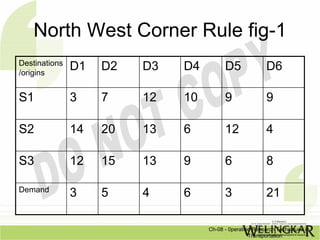
North West Corner Rule fig-1
Destinations
/origins
               D1   D2   D3   D4         D5              D6

S1             3    7    12   10         9               9

S2             14   20   13   6          12              4

S3             12   15   13   9          6               8

Demand
               3    5    4    6          3               21

                                   Ch-08 - 0peration Research Techniques in
                                                   Transportation
North West Corner Rule fig-1
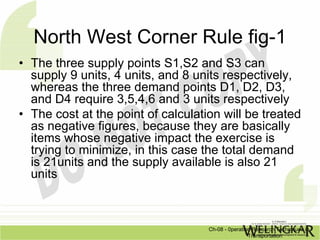
• The three supply points S1,S2 and S3 can
  supply 9 units, 4 units, and 8 units respectively,
  whereas the three demand points D1, D2, D3,
  and D4 require 3,5,4,6 and 3 units respectively
• The cost at the point of calculation will be treated
  as negative figures, because they are basically
  items whose negative impact the exercise is
  trying to minimize, in this case the total demand
  is 21units and the supply available is also 21
  units


                                    Ch-08 - 0peration Research Techniques in
                                                    Transportation
North West Corner Rule
• Where the supply may be more than demand,
  an additional dummy demand column has to be
  put with the residual supply being shown as
  units required by this demand center, and in the
  boxes for costs zero should be put
• Similarly, in case demand exceeds shown there
  against, and again in the cost zero should be put
  in the respective additional squares.


                                  Ch-08 - 0peration Research Techniques in
                                                  Transportation
North West Corner Rule Figure-
              2
Destinations/                                             Supply
origins
                D1   D2   D3   D4         D5

S1              11   12   13   14         15              9

S2              21   22   23   24         25              4

S3              31   32   33   34         35              8

Demand
                3    5    4    6          3               21

                                    Ch-08 - 0peration Research Techniques in
                                                    Transportation
North West Corner Rule Figure-
              2
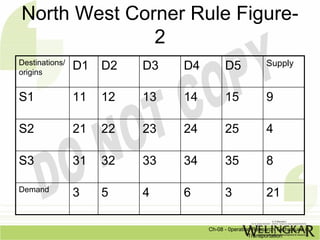
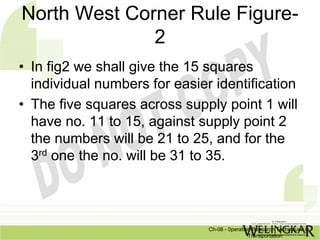
• In fig2 we shall give the 15 squares
  individual numbers for easier identification
• The five squares across supply point 1 will
  have no. 11 to 15, against supply point 2
  the numbers will be 21 to 25, and for the
  3rd one the no. will be 31 to 35.


                               Ch-08 - 0peration Research Techniques in
                                               Transportation
North West Corner Rule Figure-
              2
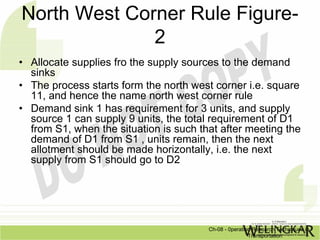
• Allocate supplies fro the supply sources to the demand
  sinks
• The process starts form the north west corner i.e. square
  11, and hence the name north west corner rule
• Demand sink 1 has requirement for 3 units, and supply
  source 1 can supply 9 units, the total requirement of D1
  from S1, when the situation is such that after meeting the
  demand of D1 from S1 , units remain, then the next
  allotment should be made horizontally, i.e. the next
  supply from S1 should go to D2


                                        Ch-08 - 0peration Research Techniques in
                                                        Transportation
Deploying vehicles-Listing Method


            C        D

    A                                                G


                E
        B                          F


                      Ch-08 - 0peration Research Techniques in
                                      Transportation
Deploying vehicles-Listing Method
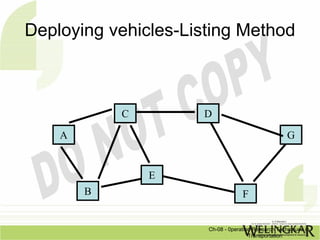
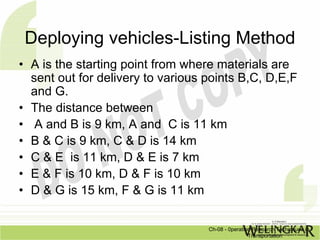
• A is the starting point from where materials are
  sent out for delivery to various points B,C, D,E,F
  and G.
• The distance between
• A and B is 9 km, A and C is 11 km
• B & C is 9 km, C & D is 14 km
• C & E is 11 km, D & E is 7 km
• E & F is 10 km, D & F is 10 km
• D & G is 15 km, F & G is 11 km

                                   Ch-08 - 0peration Research Techniques in
                                                   Transportation
Listing Method
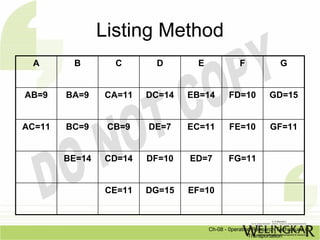
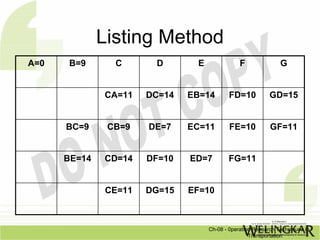
 A       B        C      D       E               F               G


AB=9    BA=9    CA=11   DC=14   EB=14        FD=10           GD=15


AC=11   BC=9     CB=9   DE=7    EC=11        FE=10           GF=11


        BE=14   CD=14   DF=10   ED=7        FG=11


                CE=11   DG=15   EF=10


                                     Ch-08 - 0peration Research Techniques in
                                                     Transportation
Listing Method
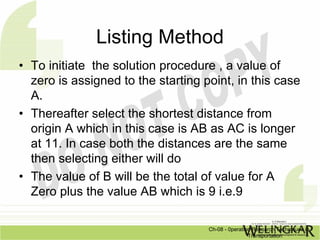
• To initiate the solution procedure , a value of
  zero is assigned to the starting point, in this case
  A.
• Thereafter select the shortest distance from
  origin A which in this case is AB as AC is longer
  at 11. In case both the distances are the same
  then selecting either will do
• The value of B will be the total of value for A
  Zero plus the value AB which is 9 i.e.9

                                    Ch-08 - 0peration Research Techniques in
                                                    Transportation
Listing Method
A=0   B=9       C      D       E               F               G


              CA=11   DC=14   EB=14        FD=10           GD=15


      BC=9     CB=9   DE=7    EC=11        FE=10           GF=11


      BE=14   CD=14   DF=10   ED=7        FG=11


              CE=11   DG=15   EF=10


                                   Ch-08 - 0peration Research Techniques in
                                                   Transportation
Listing Method
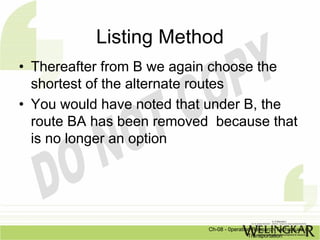
• Thereafter from B we again choose the
  shortest of the alternate routes
• You would have noted that under B, the
  route BA has been removed because that
  is no longer an option


                           Ch-08 - 0peration Research Techniques in
                                           Transportation
Listing Method
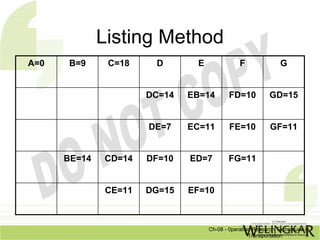
A=0   B=9      C=18    D       E               F               G


                      DC=14   EB=14        FD=10           GD=15


                      DE=7    EC=11        FE=10           GF=11


      BE=14   CD=14   DF=10   ED=7        FG=11


              CE=11   DG=15   EF=10


                                   Ch-08 - 0peration Research Techniques in
                                                   Transportation
Listing Method
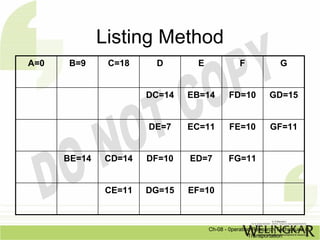
A=0   B=9      C=18    D       E               F               G


                      DC=14   EB=14        FD=10           GD=15


                      DE=7    EC=11        FE=10           GF=11


      BE=14   CD=14   DF=10   ED=7        FG=11


              CE=11   DG=15   EF=10


                                   Ch-08 - 0peration Research Techniques in
                                                   Transportation
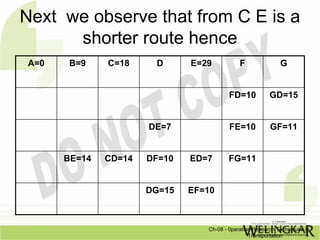
Next we observe that from C E is a
      shorter route hence
A=0   B=9     C=18     D      E=29           F               G


                                         FD=10           GD=15


                      DE=7               FE=10           GF=11


      BE=14   CD=14   DF=10   ED=7      FG=11


                      DG=15   EF=10


                                 Ch-08 - 0peration Research Techniques in
                                                 Transportation
Listing Method
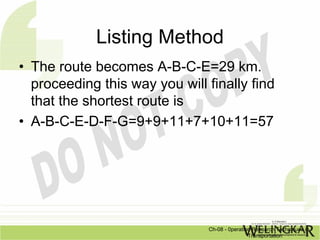
• The route becomes A-B-C-E=29 km.
  proceeding this way you will finally find
  that the shortest route is
• A-B-C-E-D-F-G=9+9+11+7+10+11=57


                               Ch-08 - 0peration Research Techniques in
                                               Transportation
Listing Method
• The importance of this model is listing
• Unless they are plotted systematically and
  eliminated sequentially the above
  apparently simple exercise may be difficult
  in real life


                              Ch-08 - 0peration Research Techniques in
                                              Transportation
PERT & CPM
• In order to realize valid results within time
  and budget expectations, one has to
  schedule jobs and tasks
• Through scheduling one not only plans
  tasks, but also checks that resources are
  utilized optimally
• Above two techniques are very commonly
  used


                                Ch-08 - 0peration Research Techniques in
                                                Transportation
Critical Path Method
• In CPM the entire project work plan is
  graphically portrayed. This graph or network
  displays the interdependencies between
  activities that will lead to successful completion
  of the project. It must satisfy the following
  objectives
   – Evaluate progress towards attainment of project
     completion
   – Focus attention on potential and actual problems
     during work


                                       Ch-08 - 0peration Research Techniques in
                                                       Transportation
Critical Path Method
– Provide frequent, accurate status reports at
  critical check points
– Provide a regular and updated prediction of
  when the project will be completed
– Provide at any time during the project
  determination of the shortest completion time
  if priorities and resources are shifted


                               Ch-08 - 0peration Research Techniques in
                                               Transportation
Preparing a flow chart
• The project events joined by lines
  (activities)
• The activities are depicted by lines
  illustrate project relationships and inter
  dependences


                                Ch-08 - 0peration Research Techniques in
                                                Transportation
Preparing a flow chart
• The events depict significant occurrences or
  milestones in the completion of the project
• Activities may be real or dummy, when it
  signifies an actual task that has be done, which
  means resources to be needed whereas dummy
  activities depicted in the flow chart just to show
  that the dummy activity needs to be completed
  before another activity can be taken up, which
  means in terms of resource the dummy will not
  extent any


                                   Ch-08 - 0peration Research Techniques in
                                                   Transportation
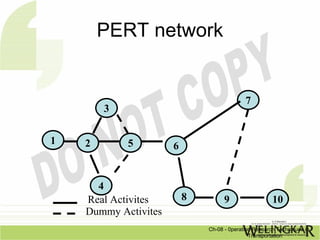
PERT network


                                            7
        3


1   2       5         6


      4
    Real Activites        8         9                  10
    Dummy Activites
                              Ch-08 - 0peration Research Techniques in
                                              Transportation
PERT

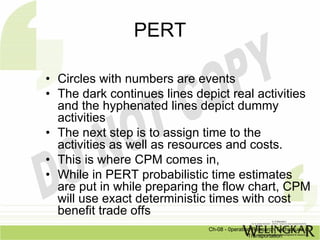
• Circles with numbers are events
• The dark continues lines depict real activities
  and the hyphenated lines depict dummy
  activities
• The next step is to assign time to the
  activities as well as resources and costs.
• This is where CPM comes in,
• While in PERT probabilistic time estimates
  are put in while preparing the flow chart, CPM
  will use exact deterministic times with cost
  benefit trade offs
                              Ch-08 - 0peration Research Techniques in
                                              Transportation
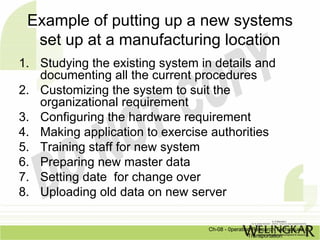
Example of putting up a new systems
  set up at a manufacturing location
1. Studying the existing system in details and
   documenting all the current procedures
2. Customizing the system to suit the
   organizational requirement
3. Configuring the hardware requirement
4. Making application to exercise authorities
5. Training staff for new system
6. Preparing new master data
7. Setting date for change over
8. Uploading old data on new server

                                  Ch-08 - 0peration Research Techniques in
                                                  Transportation
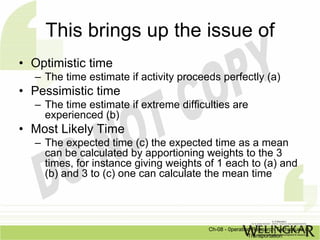
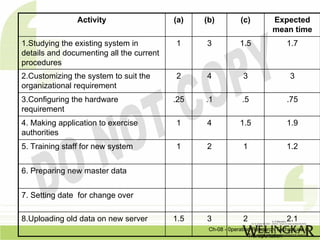
This brings up the issue of
• Optimistic time
  – The time estimate if activity proceeds perfectly (a)
• Pessimistic time
  – The time estimate if extreme difficulties are
    experienced (b)
• Most Likely Time
  – The expected time (c) the expected time as a mean
    can be calculated by apportioning weights to the 3
    times, for instance giving weights of 1 each to (a) and
    (b) and 3 to (c) one can calculate the mean time


                                        Ch-08 - 0peration Research Techniques in
                                                        Transportation
Activity                  (a)   (b)          (c)          Expected
                                                                          mean time
1.Studying the existing system in         1     3            1.5                1.7
details and documenting all the current
procedures
2.Customizing the system to suit the      2     4             3                  3
organizational requirement
3.Configuring the hardware                .25   .1            .5                .75
requirement
4. Making application to exercise         1     4            1.5                1.9
authorities
5. Training staff for new system          1     2             1                 1.2


6. Preparing new master data


7. Setting date for change over

8.Uploading old data on new server        1.5   3             2                 2.1
                                                 Ch-08 - 0peration Research Techniques in
                                                                 Transportation
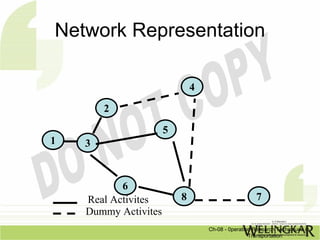
Network Representation

                              4

        2

                      5
1   3


           6
    Real Activites        8                         7
    Dummy Activites
                                  Ch-08 - 0peration Research Techniques in
                                                  Transportation
Interpretation
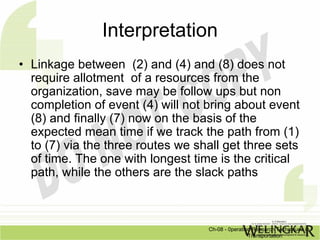
• Linkage between (2) and (4) and (8) does not
  require allotment of a resources from the
  organization, save may be follow ups but non
  completion of event (4) will not bring about event
  (8) and finally (7) now on the basis of the
  expected mean time if we track the path from (1)
  to (7) via the three routes we shall get three sets
  of time. The one with longest time is the critical
  path, while the others are the slack paths


                                   Ch-08 - 0peration Research Techniques in
                                                   Transportation
Summary
• To determine optimum solution to a
  distribution problem, we need to employ
  suitable operation research technique
• North-west corner rule, listing method are
  suitable for planning and assigning
  vehicles for different routes
• PERT and CPM are useful for timely
  completion of a project


                              Ch-08 - 0peration Research Techniques in
                                              Transportation

Operation Research Technique in Transportation

  • 1.
  • 2.
    North West CornerRule • Model to determine the optimum solution to a problem of separate demand points being supplied from separate points • Let us take a situation where there are 3 supply sources S1,S2,S3 and S4 and demand sinks D1,D2,D3,D4 • The costs associate with 12 combinations as well as the supplies ex each supply point and demands at each demand center are depicted in the figure on next slide Ch-08 - 0peration Research Techniques in Transportation
  • 3.
    North West CornerRule fig-1 Destinations /origins D1 D2 D3 D4 D5 D6 S1 3 7 12 10 9 9 S2 14 20 13 6 12 4 S3 12 15 13 9 6 8 Demand 3 5 4 6 3 21 Ch-08 - 0peration Research Techniques in Transportation
  • 4.
    North West CornerRule fig-1 • The three supply points S1,S2 and S3 can supply 9 units, 4 units, and 8 units respectively, whereas the three demand points D1, D2, D3, and D4 require 3,5,4,6 and 3 units respectively • The cost at the point of calculation will be treated as negative figures, because they are basically items whose negative impact the exercise is trying to minimize, in this case the total demand is 21units and the supply available is also 21 units Ch-08 - 0peration Research Techniques in Transportation
  • 5.
    North West CornerRule • Where the supply may be more than demand, an additional dummy demand column has to be put with the residual supply being shown as units required by this demand center, and in the boxes for costs zero should be put • Similarly, in case demand exceeds shown there against, and again in the cost zero should be put in the respective additional squares. Ch-08 - 0peration Research Techniques in Transportation
  • 6.
    North West CornerRule Figure- 2 Destinations/ Supply origins D1 D2 D3 D4 D5 S1 11 12 13 14 15 9 S2 21 22 23 24 25 4 S3 31 32 33 34 35 8 Demand 3 5 4 6 3 21 Ch-08 - 0peration Research Techniques in Transportation
  • 7.
    North West CornerRule Figure- 2 • In fig2 we shall give the 15 squares individual numbers for easier identification • The five squares across supply point 1 will have no. 11 to 15, against supply point 2 the numbers will be 21 to 25, and for the 3rd one the no. will be 31 to 35. Ch-08 - 0peration Research Techniques in Transportation
  • 8.
    North West CornerRule Figure- 2 • Allocate supplies fro the supply sources to the demand sinks • The process starts form the north west corner i.e. square 11, and hence the name north west corner rule • Demand sink 1 has requirement for 3 units, and supply source 1 can supply 9 units, the total requirement of D1 from S1, when the situation is such that after meeting the demand of D1 from S1 , units remain, then the next allotment should be made horizontally, i.e. the next supply from S1 should go to D2 Ch-08 - 0peration Research Techniques in Transportation
  • 9.
    Deploying vehicles-Listing Method C D A G E B F Ch-08 - 0peration Research Techniques in Transportation
  • 10.
    Deploying vehicles-Listing Method •A is the starting point from where materials are sent out for delivery to various points B,C, D,E,F and G. • The distance between • A and B is 9 km, A and C is 11 km • B & C is 9 km, C & D is 14 km • C & E is 11 km, D & E is 7 km • E & F is 10 km, D & F is 10 km • D & G is 15 km, F & G is 11 km Ch-08 - 0peration Research Techniques in Transportation
  • 11.
    Listing Method A B C D E F G AB=9 BA=9 CA=11 DC=14 EB=14 FD=10 GD=15 AC=11 BC=9 CB=9 DE=7 EC=11 FE=10 GF=11 BE=14 CD=14 DF=10 ED=7 FG=11 CE=11 DG=15 EF=10 Ch-08 - 0peration Research Techniques in Transportation
  • 12.
    Listing Method • Toinitiate the solution procedure , a value of zero is assigned to the starting point, in this case A. • Thereafter select the shortest distance from origin A which in this case is AB as AC is longer at 11. In case both the distances are the same then selecting either will do • The value of B will be the total of value for A Zero plus the value AB which is 9 i.e.9 Ch-08 - 0peration Research Techniques in Transportation
  • 13.
    Listing Method A=0 B=9 C D E F G CA=11 DC=14 EB=14 FD=10 GD=15 BC=9 CB=9 DE=7 EC=11 FE=10 GF=11 BE=14 CD=14 DF=10 ED=7 FG=11 CE=11 DG=15 EF=10 Ch-08 - 0peration Research Techniques in Transportation
  • 14.
    Listing Method • Thereafterfrom B we again choose the shortest of the alternate routes • You would have noted that under B, the route BA has been removed because that is no longer an option Ch-08 - 0peration Research Techniques in Transportation
  • 15.
    Listing Method A=0 B=9 C=18 D E F G DC=14 EB=14 FD=10 GD=15 DE=7 EC=11 FE=10 GF=11 BE=14 CD=14 DF=10 ED=7 FG=11 CE=11 DG=15 EF=10 Ch-08 - 0peration Research Techniques in Transportation
  • 16.
    Listing Method A=0 B=9 C=18 D E F G DC=14 EB=14 FD=10 GD=15 DE=7 EC=11 FE=10 GF=11 BE=14 CD=14 DF=10 ED=7 FG=11 CE=11 DG=15 EF=10 Ch-08 - 0peration Research Techniques in Transportation
  • 17.
    Next we observethat from C E is a shorter route hence A=0 B=9 C=18 D E=29 F G FD=10 GD=15 DE=7 FE=10 GF=11 BE=14 CD=14 DF=10 ED=7 FG=11 DG=15 EF=10 Ch-08 - 0peration Research Techniques in Transportation
  • 18.
    Listing Method • Theroute becomes A-B-C-E=29 km. proceeding this way you will finally find that the shortest route is • A-B-C-E-D-F-G=9+9+11+7+10+11=57 Ch-08 - 0peration Research Techniques in Transportation
  • 19.
    Listing Method • Theimportance of this model is listing • Unless they are plotted systematically and eliminated sequentially the above apparently simple exercise may be difficult in real life Ch-08 - 0peration Research Techniques in Transportation
  • 20.
    PERT & CPM •In order to realize valid results within time and budget expectations, one has to schedule jobs and tasks • Through scheduling one not only plans tasks, but also checks that resources are utilized optimally • Above two techniques are very commonly used Ch-08 - 0peration Research Techniques in Transportation
  • 21.
    Critical Path Method •In CPM the entire project work plan is graphically portrayed. This graph or network displays the interdependencies between activities that will lead to successful completion of the project. It must satisfy the following objectives – Evaluate progress towards attainment of project completion – Focus attention on potential and actual problems during work Ch-08 - 0peration Research Techniques in Transportation
  • 22.
    Critical Path Method –Provide frequent, accurate status reports at critical check points – Provide a regular and updated prediction of when the project will be completed – Provide at any time during the project determination of the shortest completion time if priorities and resources are shifted Ch-08 - 0peration Research Techniques in Transportation
  • 23.
    Preparing a flowchart • The project events joined by lines (activities) • The activities are depicted by lines illustrate project relationships and inter dependences Ch-08 - 0peration Research Techniques in Transportation
  • 24.
    Preparing a flowchart • The events depict significant occurrences or milestones in the completion of the project • Activities may be real or dummy, when it signifies an actual task that has be done, which means resources to be needed whereas dummy activities depicted in the flow chart just to show that the dummy activity needs to be completed before another activity can be taken up, which means in terms of resource the dummy will not extent any Ch-08 - 0peration Research Techniques in Transportation
  • 25.
    PERT network 7 3 1 2 5 6 4 Real Activites 8 9 10 Dummy Activites Ch-08 - 0peration Research Techniques in Transportation
  • 26.
    PERT • Circles withnumbers are events • The dark continues lines depict real activities and the hyphenated lines depict dummy activities • The next step is to assign time to the activities as well as resources and costs. • This is where CPM comes in, • While in PERT probabilistic time estimates are put in while preparing the flow chart, CPM will use exact deterministic times with cost benefit trade offs Ch-08 - 0peration Research Techniques in Transportation
  • 27.
    Example of puttingup a new systems set up at a manufacturing location 1. Studying the existing system in details and documenting all the current procedures 2. Customizing the system to suit the organizational requirement 3. Configuring the hardware requirement 4. Making application to exercise authorities 5. Training staff for new system 6. Preparing new master data 7. Setting date for change over 8. Uploading old data on new server Ch-08 - 0peration Research Techniques in Transportation
  • 28.
    This brings upthe issue of • Optimistic time – The time estimate if activity proceeds perfectly (a) • Pessimistic time – The time estimate if extreme difficulties are experienced (b) • Most Likely Time – The expected time (c) the expected time as a mean can be calculated by apportioning weights to the 3 times, for instance giving weights of 1 each to (a) and (b) and 3 to (c) one can calculate the mean time Ch-08 - 0peration Research Techniques in Transportation
  • 29.
    Activity (a) (b) (c) Expected mean time 1.Studying the existing system in 1 3 1.5 1.7 details and documenting all the current procedures 2.Customizing the system to suit the 2 4 3 3 organizational requirement 3.Configuring the hardware .25 .1 .5 .75 requirement 4. Making application to exercise 1 4 1.5 1.9 authorities 5. Training staff for new system 1 2 1 1.2 6. Preparing new master data 7. Setting date for change over 8.Uploading old data on new server 1.5 3 2 2.1 Ch-08 - 0peration Research Techniques in Transportation
  • 30.
    Network Representation 4 2 5 1 3 6 Real Activites 8 7 Dummy Activites Ch-08 - 0peration Research Techniques in Transportation
  • 31.
    Interpretation • Linkage between(2) and (4) and (8) does not require allotment of a resources from the organization, save may be follow ups but non completion of event (4) will not bring about event (8) and finally (7) now on the basis of the expected mean time if we track the path from (1) to (7) via the three routes we shall get three sets of time. The one with longest time is the critical path, while the others are the slack paths Ch-08 - 0peration Research Techniques in Transportation
  • 32.
    Summary • To determineoptimum solution to a distribution problem, we need to employ suitable operation research technique • North-west corner rule, listing method are suitable for planning and assigning vehicles for different routes • PERT and CPM are useful for timely completion of a project Ch-08 - 0peration Research Techniques in Transportation