STRATEGIC
CONTROL
Submitted by : Vidhu Arora (68-MBA-16)
Submitted to : Mr. Sudhanshu Gupta
STRATEGIC CONTROL
• Strategic control is concerned with tracking a
strategy as it is being implemented, detecting
problems or changes in its underlying premises
and making necessary adjustments.
• Schreyogg and Steinmann (1987) : “The
critical evaluation of plans, activities, and
results, thereby providing information for
the future action".
• The most important purpose of strategic control is
to help achieve organizational goals through
monitoring and evaluating the strategic
management process.
 It takes into account the changing
assumptions that determine a strategy,
continually evaluate the strategy as it is
being implemented, and take the
necessary steps to adjust the strategy to
the new requirement.
 It is early warning systems and differ from
post action controls which evaluate only
after the implementation has been
completed.
IDEAL CONTROL SYSTEM
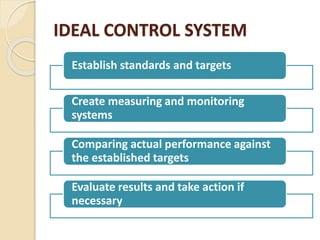
Establish standards and targets
Create measuring and monitoring
systems
Comparing actual performance against
the established targets
Evaluate results and take action if
necessary
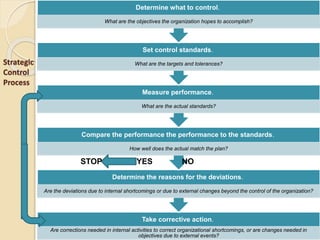
Strategic
Control
Process
Take corrective action.
Are corrections needed in internal activities to correct organizational shortcomings, or are changes needed in
objectives due to external events?
Determine the reasons for the deviations.
Are the deviations due to internal shortcomings or due to external changes beyond the control of the organization?
Compare the performance the performance to the standards.
How well does the actual match the plan?
Measure performance.
What are the actual standards?
Set control standards.
What are the targets and tolerances?
Determine what to control.
What are the objectives the organization hopes to accomplish?
NOYESSTOP
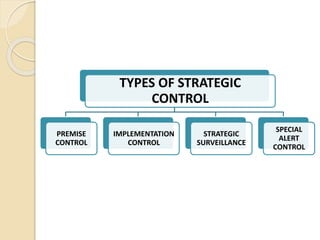
TYPES OF STRATEGIC
CONTROL
PREMISE
CONTROL
IMPLEMENTATION
CONTROL
STRATEGIC
SURVEILLANCE
SPECIAL
ALERT
CONTROL
PREMISE CONTROL
 Premise control is necessary to identify
the key assumptions, and keep track of
any change in them so as to assess
their impact on strategy and its
implementation.
 Premise control serves the purpose
of continually testing the
assumptions to find out whether they
are still valid or not. It helps in the
strategists to take corrective action at
right time.
 Premise control responsibility can
IMPLEMENTATION CONTROL
 The implementation of a strategy results in a
series of plans, programmes, and projects.
 Implementation control can be
implemented by identifying and monitoring
strategic requirement with respect to
market success. It also helps in determining
whether to go for diversification or not.
 It can also be carried out through identifying
critical points in terms of events, substantial
resource allocation, or significant end-time.
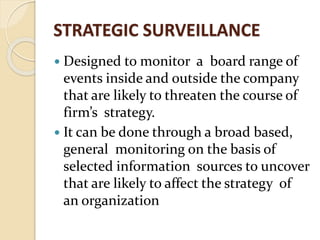
STRATEGIC SURVEILLANCE
 Designed to monitor a board range of
events inside and outside the company
that are likely to threaten the course of
firm’s strategy.
 It can be done through a broad based,
general monitoring on the basis of
selected information sources to uncover
that are likely to affect the strategy of
an organization
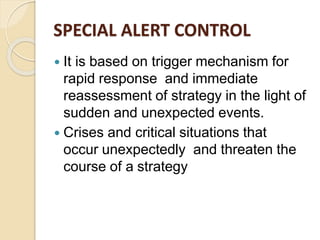
SPECIAL ALERT CONTROL
 It is based on trigger mechanism for
rapid response and immediate
reassessment of strategy in the light of
sudden and unexpected events.
 Crises and critical situations that
occur unexpectedly and threaten the
course of a strategy
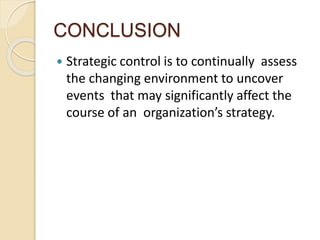
CONCLUSION
 Strategic control is to continually assess
the changing environment to uncover
events that may significantly affect the
course of an organization’s strategy.

Strategic control

  • 1.
    STRATEGIC CONTROL Submitted by :Vidhu Arora (68-MBA-16) Submitted to : Mr. Sudhanshu Gupta
  • 2.
    STRATEGIC CONTROL • Strategiccontrol is concerned with tracking a strategy as it is being implemented, detecting problems or changes in its underlying premises and making necessary adjustments. • Schreyogg and Steinmann (1987) : “The critical evaluation of plans, activities, and results, thereby providing information for the future action". • The most important purpose of strategic control is to help achieve organizational goals through monitoring and evaluating the strategic management process.
  • 3.
     It takesinto account the changing assumptions that determine a strategy, continually evaluate the strategy as it is being implemented, and take the necessary steps to adjust the strategy to the new requirement.  It is early warning systems and differ from post action controls which evaluate only after the implementation has been completed.
  • 4.
    IDEAL CONTROL SYSTEM Establishstandards and targets Create measuring and monitoring systems Comparing actual performance against the established targets Evaluate results and take action if necessary
  • 5.
    Strategic Control Process Take corrective action. Arecorrections needed in internal activities to correct organizational shortcomings, or are changes needed in objectives due to external events? Determine the reasons for the deviations. Are the deviations due to internal shortcomings or due to external changes beyond the control of the organization? Compare the performance the performance to the standards. How well does the actual match the plan? Measure performance. What are the actual standards? Set control standards. What are the targets and tolerances? Determine what to control. What are the objectives the organization hopes to accomplish? NOYESSTOP
  • 6.
  • 7.
    PREMISE CONTROL  Premisecontrol is necessary to identify the key assumptions, and keep track of any change in them so as to assess their impact on strategy and its implementation.  Premise control serves the purpose of continually testing the assumptions to find out whether they are still valid or not. It helps in the strategists to take corrective action at right time.  Premise control responsibility can
  • 8.
    IMPLEMENTATION CONTROL  Theimplementation of a strategy results in a series of plans, programmes, and projects.  Implementation control can be implemented by identifying and monitoring strategic requirement with respect to market success. It also helps in determining whether to go for diversification or not.  It can also be carried out through identifying critical points in terms of events, substantial resource allocation, or significant end-time.
  • 9.
    STRATEGIC SURVEILLANCE  Designedto monitor a board range of events inside and outside the company that are likely to threaten the course of firm’s strategy.  It can be done through a broad based, general monitoring on the basis of selected information sources to uncover that are likely to affect the strategy of an organization
  • 10.
    SPECIAL ALERT CONTROL It is based on trigger mechanism for rapid response and immediate reassessment of strategy in the light of sudden and unexpected events.  Crises and critical situations that occur unexpectedly and threaten the course of a strategy
  • 11.
    CONCLUSION  Strategic controlis to continually assess the changing environment to uncover events that may significantly affect the course of an organization’s strategy.