A Quick Safari Through Network
    Information Processing


              Reza Rahimi,
      Software Engineering Systems,
           University of Regina,
                 Canada.
Problem Formulation
   In Networking
   Main Problem:
      In a given network we want to transfer data from
    the group of sources to the group of destinations.
   Constraints:
       Network Topology and Architecture (in abstract level:
        Directed Graph, Undirected Graph, Special Family of
        Graph( Trees, Mesh, Layered Graphs, Random Graphs,
        Geometric Graphs,…).
       Physical Constraints ( capacity of the link, power
        constraint, noise,…).
   Optimization Metrics:
       Maximum amount of information into terminals
        (Internet).
       Energy (Wireless Sensor Networks).
       Delay (Internet Telephone).
       Load Balancing (almost important in every networks).
       Fault Tolerant (specially in wireless networks).
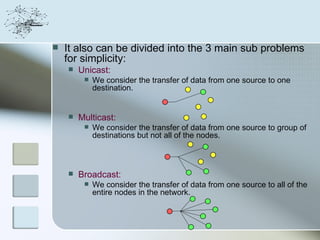
   It also can be divided into the 3 main sub problems
    for simplicity:
       Unicast:
            We consider the transfer of data from one source to one
             destination.


       Multicast:
            We consider the transfer of data from one source to group of
             destinations but not all of the nodes.


       Broadcast:
            We consider the transfer of data from one source to all of the
             entire nodes in the network.
   The main problem can be formulated in general using
    optimization methods, and sometimes can be solved in
    centralized or distributed manners at least in theory.

   In many cases, the optimization approach will give us
    Integer Optimization which is generally NP-Hard
    problem. We should use relaxation to make it traceable.

   Using another methods will usually give us much better
    insight and algorithms for the problem.

   In this note I try to consider this problem according to the
    Maximum Amount of Information that Could be
    Transferred metric.

   We will investigate the theoretical bounds for the problem
    and consider different techniques for achieving it.
Network Information
    Processing
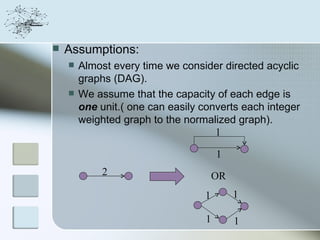
   Assumptions:
       Almost every time we consider directed acyclic
        graphs (DAG).
       We assume that the capacity of each edge is
        one unit.( one can easily converts each integer
        weighted graph to the normalized graph).
                                     1

                                       1
             2                        OR
                                  1        1

                                   1       1
   Question1:
       What is the Maximum Amount of
        Information could be transferred in
        Unicast scenario?
   Question2:
       Is this Maximum Amount Traceable with
        Deterministic, Randomized, or
        Distributed Algorithms?
Maximum-Flow Min-Cut Theorem
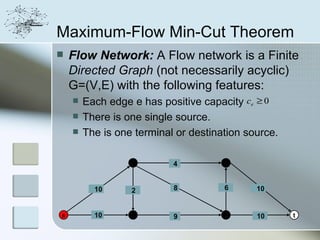
   Flow Network: A Flow network is a Finite
    Directed Graph (not necessarily acyclic)
    G=(V,E) with the following features:
       Each edge e has positive capacity ce ≥ 0
       There is one single source.
       The is one terminal or destination source.

                  2        4          4


          10      2        8          6      10


s         10      3        9          5      10      t
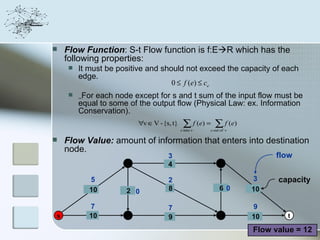
   Flow Function: S-t Flow function is f:ER which has the
    following properties:
        It must be positive and should not exceed the capacity of each
         edge.
                                    0 ≤ f (e) ≤ ce
        ٍٍFor each node except for s and t sum of the input flow must be
         equal to some of the output flow (Physical Law: ex. Information
         Conservation).
                          ∀v ∈ V - {s, t}    ∑ f ( e) = ∑ f ( e )
                                            e into v   e out of v

   Flow Value: amount of information that enters into destination
    node.
                                     3                                   flow
                      2              4                      4

            5                        2                              3     capacity
            10        2 0            8                      6 0     10

            7                        7                              9
s           10        3              9                      5       10      t

                                                                    Flow value = 12
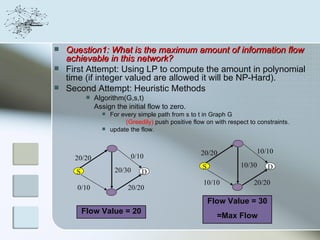
   Question1: What is the maximum amount of information flow
    achievable in this network?
   First Attempt: Using LP to compute the amount in polynomial
    time (if integer valued are allowed it will be NP-Hard).
   Second Attempt: Heuristic Methods
              Algorithm(G,s,t)
               Assign the initial flow to zero.
                    For every simple path from s to t in Graph G
                          (Greedily) push positive flow on with respect to constraints.
                    update the flow.


                                                      20/20                10/10
      20/20                 0/10
                                                       S             10/30     D
      S               20/30     D
                                                       10/10             20/20
      0/10                 20/20
                                                           Flow Value = 30
          Flow Value = 20
                                                             =Max Flow
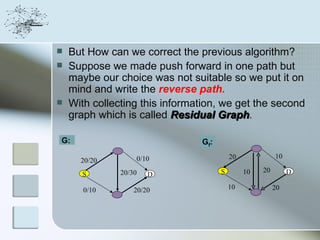
   But How can we correct the previous algorithm?
   Suppose we made push forward in one path but
    maybe our choice was not suitable so we put it on
    mind and write the reverse path.
   With collecting this information, we get the second
    graph which is called Residual Graph.
                                      Graph

G:                              Gf:

                   0/10                   20             10
      20/20
               20/30                  S        10   20        D
      S                D

       0/10        20/20                  10             20
   So we can edit the previous algorithm
    as below:
       Ford-Fulkerson Method (G,s,t):
          Start   with zero flow.
               While there is a simple path between source and
                destination in residual graph Gf :
                   Push flow in it and update the flow function.

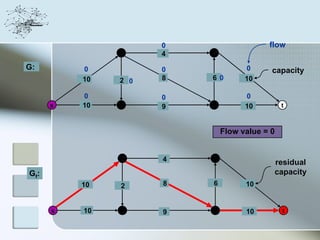
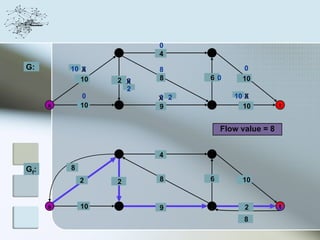
   Lets consider one example
    graphically:
0                   flow
               2     4   4

G:        0          0             0      capacity
          10   2 0   8   6 0       10

          0          0             0
      s   10   3     9   5         10         t


                             Flow value = 0


               2     4   4
                                          residual
Gf:                                       capacity
          10   2     8   6         10


      s   10   3     9   5         10         t
0
                   2     4     4

G:        10 X
             8           8              0
             10    2 X
                     0   8     6 0      10
                     2
              0          X 2
                         0            10 X
                                         8
      s       10   3     9     5        10          t


                                   Flow value = 8


                   2     4     4

Gf:       8
              2    2     8     6        10


      s       10   3     9     5         2          t

                                         8
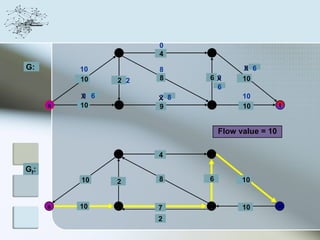
0
                2     4     4

G:        10          8               0
                                      X 6
          10    2 2   8     6X
                             0        10
                             6
          X 6
          0           X 8
                      2               10
      s   10    3     9     5         10          t


                                Flow value = 10

                2     4     4

Gf:
          10    2     8     6         10


      s   10    3     7     5         10          t

                      2
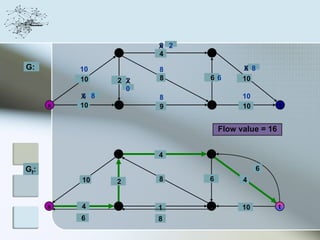
0
                      X 2
                2     4     4

G:        10          8               6
                                      X 8
          10    2 X
                  2   8     6 6       10
                  0
          X 8
          6           8               10
      s   10    3     9     5         10          t


                                Flow value = 16


                2     4     4

Gf:                                        6
          10    2     8     6         4


      s   4     3     1     5         10          t
          6           8
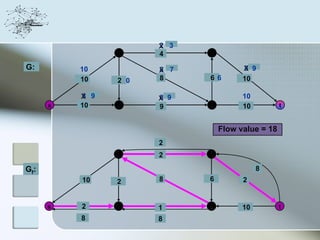
2
                      X 3
                2     4     4

G:        10          X 7
                      8               8
                                      X 9
          10    2 0   8     6 6       10

          X 9
          8           X 9
                      8               10
      s   10    3     9     5         10          t


                                Flow value = 18
                      2
                2     2     4

Gf:                                        8
          10    2     8     6         2


      s   2     3     1     5         10          t
          8           8
3
               2     4       4

G:        10         7                 9
          10   2 0   8       6 6       10

          9          9                 10
      s   10   3     9       5         10          t


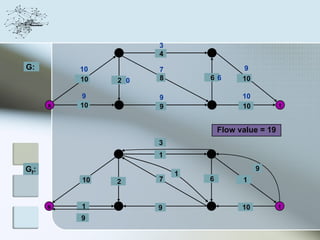
                                 Flow value = 19
                     3
               2     1       4

Gf:                                         9
                         1
          10   2     7       6         1


      s   1    3     9       5         10          t
          9
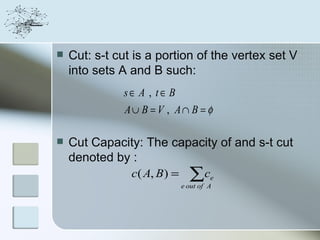
   Cut: s-t cut is a portion of the vertex set V
    into sets A and B such:
              s∈ A , t∈ B
               A∪ B = V , A∩ B = φ

   Cut Capacity: The capacity of and s-t cut
    denoted by :
                c( A, B ) =     ∑c
                              e out of A
                                        e
   And finally we have the famous Max-Flow Min-
    Cut Theorem:
   Max-Flow Min-Cut Theorem:

    In every flow network the Ford-Fulkerson
     method Reaches the graph maximum flow
      and it is equal to minimum cut capacity.

   There are several Polynomial Time Algorithms
    suggested for this problem. The following table
    shows some of the famous ones.
So we can reach the maximum
  information transferring with
 routing (only with forwarding)
 in polynomial time in Unicast
           Scenario.
Maximum Information
   Transferring in
Multicasting Scenario
   What is the maximum amount of
    information that could be transferred in
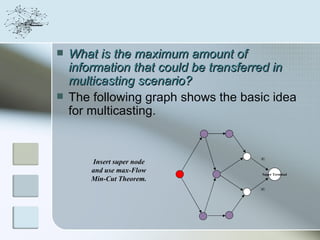
    multicasting scenario?
   The following graph shows the basic idea
    for multicasting.


                                     ∞
       Insert super node
       and use max-Flow               Super Terminal
       Min-Cut Theorem.
                                     ∞
 So we can not exceed this bound.
 Now another question arises:

How can we make much more diversity of
       independent packets in each
                destination?
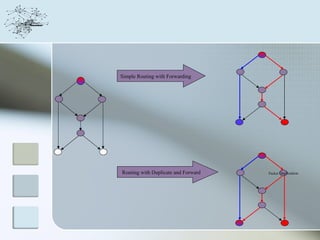
Simple Routing with Forwarding


Routing with Duplicate and Forward   Packet Duplication
Lesson That we have learned:


With the usage of some functions in
  each routing node, we could get
 much more diversity of information
       in each terminal nodes.
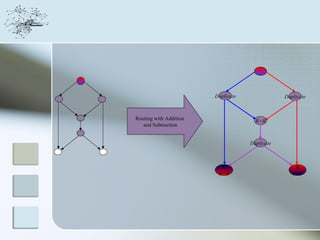
Duplicate               Duplicate


Routing with Addition                 R+B
   and Subtraction


                                    Duplicate


                          B,                        R
                         R+B                       R+B
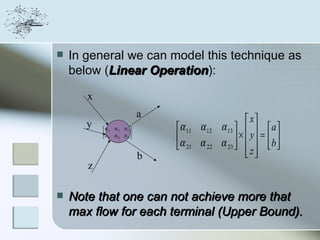
   In general we can model this technique as
    below (Linear Operation):
                   Operation
       x
                               a
       y                                                  x
           α 11 α 12 α 13        α 11 α 12   α 13     a 
                                                      ×  y = b
           α              
            21 α 22 α 23 
                                   α α         α 23 
                                    21 22                z  
                                                          
                               b
       z

   Note that one can not achieve more that
    max flow for each terminal (Upper Bound).
   The previous technique is divided into
    two categories:
     Duplicate and Forward (Routing).
     Network Coding.
 The first strategy is something that is
  used in current networking
  technology.
 The second one may be used in near
  future.
Duplicate and Forward
       Sterategy
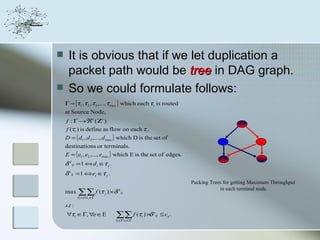
    It is obvious that if we let duplication a
     packet path would be tree in DAG graph.
    So we could formulate follows:
    Γ = {τ1 ,τ 2 ,τ 3 ,...,τ max } which each τi is routed
    at Source Node,
    f : Γ → ℜ+ ( Ζ+ )
    f (τ i ) is define as flow on each τi .
    D = { d1 , d 2 ,..., d max } which D is the set of
    destinations or terminals.
    E = {e1 , e2 ,..., emax } which E is the set of edges.
    δ d ij = 1 ⇔ d i ∈τ j .
    δ e ij = 1 ⇔ ei ∈τ j .
                                                                       Packing Trees for getting Maximum Throughput
                                                                                   in each terminal node.
    max     ∑∑ f (τ
             τ
            d i ∈D
                           j   ) ×δ d ij
                     j∈Γ

    s.t :
    ∀τi ∈Γ, ∀e ∈E                  ∑∑ f (τ ) ×δ
                                   τ
                                                 i
                                                     e
                                                         ij   ≤ ce .
                                     i ∈ ei ∈
                                        Γ    E
   There are some points about this
    formulation.
       Generally the number of trees are exponential
        according to the size of input graph.
       If we consider only integer values it will be
        Linear Integer Programming.
   So where is the exact location of the tree
    packing problem in polynomial time
    hierarchy?
   It can be proved that this problem is NP-
    Hard.
 So it seems that in general the
  problem is hard.
 Let’s simplify the problem a bit to see
  if it will be traceable.
 Lets assume that we want to pack
  tree in a way that all of the terminals
  get the same number of colors.
 It is obvious that the number of colors
  could not exceed than min max-flow
  (s,T).
   Unfortunately this version again is not
    traceable.
   It is equal to Packing Steiner Trees which is
    NP-Hard.
      Generally there is no Polynomial Time
         Algorithms that we could optimally
     transfer packets with only Duplicate and
     Forward strategy in Multicasting (P≠NP).
   Now if we empower each node with
    complete linear operation what will happen?
    (switching to network coding).
Linear Network Coding
    In Multicasting
   We are working in GF(2q) field and
    assuming each packet is in this field.
   All mathematical calculation is valid like
    real number field.
   Just like previous session we assume that
    the graph is DAG.
   There is no delay in each node for
    scrambling inputs to make outputs.
   For Inputs we use X variable, for
    intermediate Nodes Y and for the output
    signals to be recovered, Z.
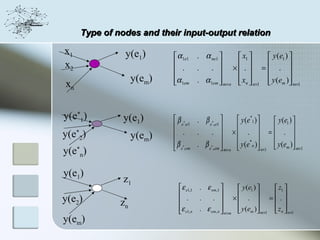
Type of nodes and their input-output relation

x1             y(e1)        α1e1 . α ne1     x1       y (e1 ) 
x2                          .    .   .  × .  =  . 
                                                              
                   y(em)   α1em . α1em  m×n  xn  n×1  y (em ) m×1
                                                              
xn


y(e*1)         y(e1)        β e* e1 . β e* e1             y (e*1 )            y (e1 ) 
                            1                                        
                                                                                = . 
                                           n


y(e*2)             y(em)       .    .    .              × .                           
                           β *                            y (e * n )          y (em ) m×1
y(e*n)                      e 1em . β e*nem      m× n                   n×1           


y(e1)
               z1
                             ε e1,1 . ε em ,1       y (e1 )      z1 
                                              
y(e2)                           .   .    .  × .  =  . 
              zn             ε e1,n . ε em,n 
                                                                   
                                               n×m  y (em ) m×1  zn  n×1
                                                                   
y(em)
e1

                     v2
     x1                                e5
                                                       z1
                e2
     x2   v1                 e4
                                                 v4    z2
                                       e6
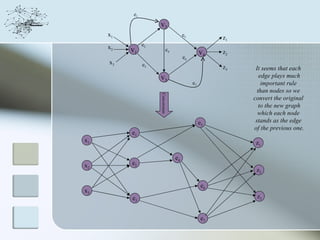
     x3         e3                                     z3    It seems that each
                     v3                                        edge plays much
                                            e7                  important rule
                                                              than nodes so we


                     Conversion
                                                            convert the original
                                                               to the new graph
                                                              which each node
                                                 e5          stands as the edge
                                                            of the previous one.
          e1
x1                                                           z1

                                  e4
x2        e2
                                                             z2

                                                  e6
x3
          e3                                                 z3


                                                  e7
e5          εe5,1
                                                                        βe1,e5
                       α1,e1                        e1                                                              εe5,2
                                                                                                       εe5,3
         x1         α1,e2                                 βe1,e4                                                                                   z1
              α1,e3                                           βe2,e5
               α2,e1                                                                     e4
                                    α2,e2           e2
         x2                                                           βe2,e4                      βe4,e6
                                     α3,e2                                                                                                         z2
                 α3,e1                                                                   βe4,e7                 εe6,1   εe6,2
                               α2,e3                                                                       e6
         x3                                                            βe3,e6                                                             εe6,3
                         α3,e3                      e3                                                                       εe7,2                 z3
                                                                                                            εe7,1
                                                                                βe3,e7                                      εe7,3
                                                                                                           e7

                                                                                                            Output Matrix:
    Internal Matrix:                                                                                  0           0       0        0 εe 5,1       εe 6,1     εe 7 ,1 
                                                                                                                                                                      
                                                                                                  B = 0           0       0        0 εe 5, 2      εe 6, 2    εe 7 , 2 
    0   0 0           β e1,e 4        β e1,e5              0               0                        0
                                                                                                                  0       0        0 ε e 5, 3     εe 6 , 3   εe 7 , 3 
                                                                                                                                                                       
    0   0      0      β e 2 ,e 4      β e 2 ,e 5           0               0 
                                                                                   
    0   0      0         0               0              β e 3, e 6      β e 3, e 7 
    
F = 0   0      0         0               0              β e 4,e 6
                                                                                    
                                                                         β e 4 ,e 7                            Input Matrix:
    0   0      0         0               0                 0               0 
                                                                                   
    0   0 0              0               0                 0               0                        α1,e1 α1,e 2 α1,e 3                        0 0 0 0
    0                                                                                                                                                  
        0 0              0               0                 0               0                   A = α 2,e1 α 2,e 2 α 2,e 3                     0 0 0 0
                                                                                                      α 3,e1 α 3,e 2 α 3,e 3
                                                                                                                                                 0 0 0 0
                                                                                                                                                         
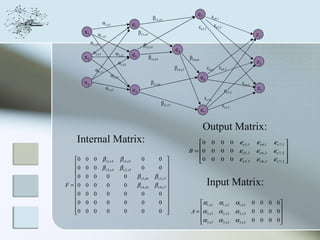
   Question: How we can relate inputs and
    outputs using these Matrices?
       It is obvious that A shows the inputs inject into
        the network and the same, B shows that how
        network information inject into outputs.
       How can we get the propagation in the
        network?
   We must find all walk between source
    edges and output edges.
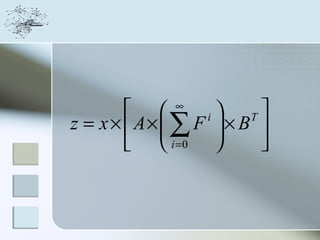
   It can be proved easily, according to some
    algebraic graph theory algorithms that:
  ∞
                 i   T
z = x × A×  ∑ F × B 
          i =0      
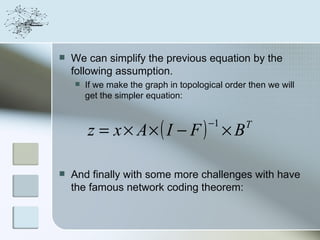
   We can simplify the previous equation by the
    following assumption.
       If we make the graph in topological order then we will
        get the simpler equation:


        z = x × A× ( I − F ) × B
                                       −1        T


   And finally with some more challenges with have
    the famous network coding theorem:
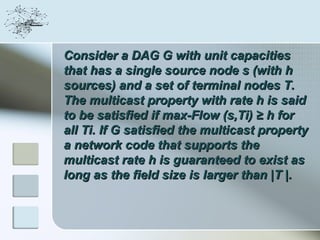
Consider a DAG G with unit capacities
that has a single source node s (with h
sources) and a set of terminal nodes T.
The multicast property with rate h is said
to be satisfied if max-Flow (s,Ti) ≥ h for
all Ti. If G satisfied the multicast property
a network code that supports the
multicast rate h is guaranteed to exist as
long as the field size is larger than |T |.
   So if the field size is large enough there
    always exists network coding scheme that
    reaches the limit.
   The are some polynomial time algorithms
    suggested for making network codes, for
    example LIF and Randomized Network
    Coding Algorithms.
   For some special graphs with network
    coding we could reach the maximum flow
    for each node.
   So in summary we have:
With network coding we can
reach the maximum throughput
      in polynomial time.
Comparison between two
 methods in Multicasting
       Scenario
 What is the theoretical Gap between
  Network Coding and Routing?
 It can be proved that if the graph is
  directed the gap is very large
  (Ω(logn): where n is the number of
  terminals).
 But if the graph is not directed the
  gap is in the order of constant
  number.
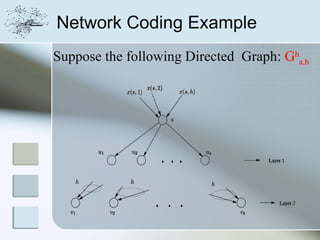
Network Coding Example
Suppose the following Directed Graph: Gha,b
   Lemma: Under routing the capacity of
    the Gh2h,C(2h,h) is less than 2.
 with network coding the capacity of the
  network could be h.
 with some error control coding codes
  we can get the maximum capacity for
  network coding.
 Example Reed-Solomon Codes:
Re ed − Solomon R ( n, k ) ::
          →
         M 1×k = [ M 0 , M 1 ,..., M k −1 ]
         {α1 , α2 ,..., αn } ∈ GF (q) , ∀αi ≠ 0.
          →
         C1×n = [C0 , C1 ,..., Cn −1 ]
                          1    1             ...  1 
                                                       
         →         →
                          α1   α2            ... α n 
         C 1×n   = M 1×k 
                            .    .            ...   . 
                          k −1                         
                         α 1 α k −12              k −1 
                                              ... α n 
                         


The structure of the above matrix is Vandermonde
And with any h subset of the Codeword we can make
the original message.
 So in the source node we can use
  RS(a,h) and in the terminals the
  original signal can be made.
 This concept is sometimes categorized
  as the source coding.
Maximum Information
   Transferring in
Broadcasting Scenario
   In Broadcasting according to the
    Edmond’s paper we can always pack
    k- edge disjoint spanning trees where
    k=min max-flow (s,Ti).
   So in this scenario, routing with
    duplication has the same power as
    network coding in general case.
Conclusion
   The basics of routing and its theoretical bounds
    are reviewed.
   The basics of network coding and its theoretical
    bounds are reviewed.
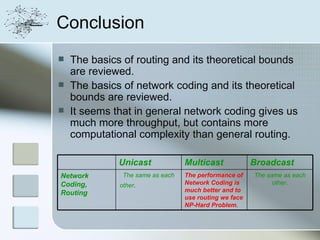
   It seems that in general network coding gives us
    much more throughput, but contains more
    computational complexity than general routing.

              Unicast             Multicast             Broadcast
Network        The same as each   The performance of    The same as each
Coding,       other.              Network Coding is           other.
Routing                           much better and to
                                  use routing we face
                                  NP-Hard Problem.

Network Information Processing

  • 1.
    A Quick SafariThrough Network Information Processing Reza Rahimi, Software Engineering Systems, University of Regina, Canada.
  • 2.
    Problem Formulation In Networking
  • 3.
    Main Problem:  In a given network we want to transfer data from the group of sources to the group of destinations.  Constraints:  Network Topology and Architecture (in abstract level: Directed Graph, Undirected Graph, Special Family of Graph( Trees, Mesh, Layered Graphs, Random Graphs, Geometric Graphs,…).  Physical Constraints ( capacity of the link, power constraint, noise,…).  Optimization Metrics:  Maximum amount of information into terminals (Internet).  Energy (Wireless Sensor Networks).  Delay (Internet Telephone).  Load Balancing (almost important in every networks).  Fault Tolerant (specially in wireless networks).
  • 4.
    It also can be divided into the 3 main sub problems for simplicity:  Unicast:  We consider the transfer of data from one source to one destination.  Multicast:  We consider the transfer of data from one source to group of destinations but not all of the nodes.  Broadcast:  We consider the transfer of data from one source to all of the entire nodes in the network.

  • 5.
    The main problem can be formulated in general using optimization methods, and sometimes can be solved in centralized or distributed manners at least in theory.  In many cases, the optimization approach will give us Integer Optimization which is generally NP-Hard problem. We should use relaxation to make it traceable.  Using another methods will usually give us much better insight and algorithms for the problem.  In this note I try to consider this problem according to the Maximum Amount of Information that Could be Transferred metric.  We will investigate the theoretical bounds for the problem and consider different techniques for achieving it.
  • 6.
  • 7.
    Assumptions:  Almost every time we consider directed acyclic graphs (DAG).  We assume that the capacity of each edge is one unit.( one can easily converts each integer weighted graph to the normalized graph). 1 1 2 OR 1 1 1 1
  • 8.
    Question1:  What is the Maximum Amount of Information could be transferred in Unicast scenario?  Question2:  Is this Maximum Amount Traceable with Deterministic, Randomized, or Distributed Algorithms?
  • 9.
    Maximum-Flow Min-Cut Theorem  Flow Network: A Flow network is a Finite Directed Graph (not necessarily acyclic) G=(V,E) with the following features:  Each edge e has positive capacity ce ≥ 0  There is one single source.  The is one terminal or destination source. 2 4 4 10 2 8 6 10 s 10 3 9 5 10 t
  • 10.
    Flow Function: S-t Flow function is f:ER which has the following properties:  It must be positive and should not exceed the capacity of each edge. 0 ≤ f (e) ≤ ce  ٍٍFor each node except for s and t sum of the input flow must be equal to some of the output flow (Physical Law: ex. Information Conservation). ∀v ∈ V - {s, t} ∑ f ( e) = ∑ f ( e ) e into v e out of v  Flow Value: amount of information that enters into destination node. 3 flow 2 4 4 5 2 3 capacity 10 2 0 8 6 0 10 7 7 9 s 10 3 9 5 10 t Flow value = 12
  • 11.
    Question1: What is the maximum amount of information flow achievable in this network?  First Attempt: Using LP to compute the amount in polynomial time (if integer valued are allowed it will be NP-Hard).  Second Attempt: Heuristic Methods  Algorithm(G,s,t) Assign the initial flow to zero.  For every simple path from s to t in Graph G (Greedily) push positive flow on with respect to constraints.  update the flow. 20/20 10/10 20/20 0/10 S 10/30 D S 20/30 D 10/10 20/20 0/10 20/20 Flow Value = 30 Flow Value = 20 =Max Flow
  • 12.
    But How can we correct the previous algorithm?  Suppose we made push forward in one path but maybe our choice was not suitable so we put it on mind and write the reverse path.  With collecting this information, we get the second graph which is called Residual Graph. Graph G: Gf: 0/10 20 10 20/20 20/30 S 10 20 D S D 0/10 20/20 10 20
  • 13.
    So we can edit the previous algorithm as below:  Ford-Fulkerson Method (G,s,t):  Start with zero flow.  While there is a simple path between source and destination in residual graph Gf :  Push flow in it and update the flow function.  Lets consider one example graphically:
  • 14.
    0 flow 2 4 4 G: 0 0 0 capacity 10 2 0 8 6 0 10 0 0 0 s 10 3 9 5 10 t Flow value = 0 2 4 4 residual Gf: capacity 10 2 8 6 10 s 10 3 9 5 10 t
  • 15.
    0 2 4 4 G: 10 X 8 8 0 10 2 X 0 8 6 0 10 2 0 X 2 0 10 X 8 s 10 3 9 5 10 t Flow value = 8 2 4 4 Gf: 8 2 2 8 6 10 s 10 3 9 5 2 t 8
  • 16.
    0 2 4 4 G: 10 8 0 X 6 10 2 2 8 6X 0 10 6 X 6 0 X 8 2 10 s 10 3 9 5 10 t Flow value = 10 2 4 4 Gf: 10 2 8 6 10 s 10 3 7 5 10 t 2
  • 17.
    0 X 2 2 4 4 G: 10 8 6 X 8 10 2 X 2 8 6 6 10 0 X 8 6 8 10 s 10 3 9 5 10 t Flow value = 16 2 4 4 Gf: 6 10 2 8 6 4 s 4 3 1 5 10 t 6 8
  • 18.
    2 X 3 2 4 4 G: 10 X 7 8 8 X 9 10 2 0 8 6 6 10 X 9 8 X 9 8 10 s 10 3 9 5 10 t Flow value = 18 2 2 2 4 Gf: 8 10 2 8 6 2 s 2 3 1 5 10 t 8 8
  • 19.
    3 2 4 4 G: 10 7 9 10 2 0 8 6 6 10 9 9 10 s 10 3 9 5 10 t Flow value = 19 3 2 1 4 Gf: 9 1 10 2 7 6 1 s 1 3 9 5 10 t 9
  • 20.
    Cut: s-t cut is a portion of the vertex set V into sets A and B such: s∈ A , t∈ B A∪ B = V , A∩ B = φ  Cut Capacity: The capacity of and s-t cut denoted by : c( A, B ) = ∑c e out of A e
  • 21.
    And finally we have the famous Max-Flow Min- Cut Theorem:  Max-Flow Min-Cut Theorem: In every flow network the Ford-Fulkerson method Reaches the graph maximum flow and it is equal to minimum cut capacity.  There are several Polynomial Time Algorithms suggested for this problem. The following table shows some of the famous ones.
  • 23.
    So we canreach the maximum information transferring with routing (only with forwarding) in polynomial time in Unicast Scenario.
  • 24.
    Maximum Information Transferring in Multicasting Scenario
  • 25.
    What is the maximum amount of information that could be transferred in multicasting scenario?  The following graph shows the basic idea for multicasting. ∞ Insert super node and use max-Flow Super Terminal Min-Cut Theorem. ∞
  • 26.
     So wecan not exceed this bound.  Now another question arises: How can we make much more diversity of independent packets in each destination?
  • 27.
    Simple Routing withForwarding Routing with Duplicate and Forward Packet Duplication
  • 28.
    Lesson That wehave learned:  With the usage of some functions in each routing node, we could get much more diversity of information in each terminal nodes.
  • 29.
    Duplicate Duplicate Routing with Addition R+B and Subtraction Duplicate B, R R+B R+B
  • 30.
    In general we can model this technique as below (Linear Operation): Operation x a y  x α 11 α 12 α 13  α 11 α 12 α 13     a   ×  y = b α   21 α 22 α 23  α α α 23   21 22  z     b z  Note that one can not achieve more that max flow for each terminal (Upper Bound).
  • 31.
    The previous technique is divided into two categories:  Duplicate and Forward (Routing).  Network Coding.  The first strategy is something that is used in current networking technology.  The second one may be used in near future.
  • 32.
  • 33.
    It is obvious that if we let duplication a packet path would be tree in DAG graph.  So we could formulate follows: Γ = {τ1 ,τ 2 ,τ 3 ,...,τ max } which each τi is routed at Source Node, f : Γ → ℜ+ ( Ζ+ ) f (τ i ) is define as flow on each τi . D = { d1 , d 2 ,..., d max } which D is the set of destinations or terminals. E = {e1 , e2 ,..., emax } which E is the set of edges. δ d ij = 1 ⇔ d i ∈τ j . δ e ij = 1 ⇔ ei ∈τ j . Packing Trees for getting Maximum Throughput in each terminal node. max ∑∑ f (τ τ d i ∈D j ) ×δ d ij j∈Γ s.t : ∀τi ∈Γ, ∀e ∈E ∑∑ f (τ ) ×δ τ i e ij ≤ ce . i ∈ ei ∈ Γ E
  • 34.
    There are some points about this formulation.  Generally the number of trees are exponential according to the size of input graph.  If we consider only integer values it will be Linear Integer Programming.  So where is the exact location of the tree packing problem in polynomial time hierarchy?  It can be proved that this problem is NP- Hard.
  • 35.
     So itseems that in general the problem is hard.  Let’s simplify the problem a bit to see if it will be traceable.  Lets assume that we want to pack tree in a way that all of the terminals get the same number of colors.  It is obvious that the number of colors could not exceed than min max-flow (s,T).
  • 36.
    Unfortunately this version again is not traceable.  It is equal to Packing Steiner Trees which is NP-Hard. Generally there is no Polynomial Time Algorithms that we could optimally transfer packets with only Duplicate and Forward strategy in Multicasting (P≠NP).  Now if we empower each node with complete linear operation what will happen? (switching to network coding).
  • 37.
    Linear Network Coding In Multicasting
  • 38.
    We are working in GF(2q) field and assuming each packet is in this field.  All mathematical calculation is valid like real number field.  Just like previous session we assume that the graph is DAG.  There is no delay in each node for scrambling inputs to make outputs.  For Inputs we use X variable, for intermediate Nodes Y and for the output signals to be recovered, Z.
  • 39.
    Type of nodesand their input-output relation x1 y(e1)  α1e1 . α ne1   x1   y (e1 )  x2  . . .  × .  =  .        y(em) α1em . α1em  m×n  xn  n×1  y (em ) m×1       xn y(e*1) y(e1)  β e* e1 . β e* e1   y (e*1 )   y (e1 )   1    = .  n y(e*2) y(em)  . . .  × .    β *   y (e * n )   y (em ) m×1 y(e*n)  e 1em . β e*nem  m× n   n×1   y(e1) z1 ε e1,1 . ε em ,1   y (e1 )   z1    y(e2)  . . .  × .  =  .  zn ε e1,n . ε em,n        n×m  y (em ) m×1  zn  n×1     y(em)
  • 40.
    e1 v2 x1 e5 z1 e2 x2 v1 e4 v4 z2 e6 x3 e3 z3 It seems that each v3 edge plays much e7 important rule than nodes so we Conversion convert the original to the new graph which each node e5 stands as the edge of the previous one. e1 x1 z1 e4 x2 e2 z2 e6 x3 e3 z3 e7
  • 41.
    e5 εe5,1 βe1,e5 α1,e1 e1 εe5,2 εe5,3 x1 α1,e2 βe1,e4 z1 α1,e3 βe2,e5 α2,e1 e4 α2,e2 e2 x2 βe2,e4 βe4,e6 α3,e2 z2 α3,e1 βe4,e7 εe6,1 εe6,2 α2,e3 e6 x3 βe3,e6 εe6,3 α3,e3 e3 εe7,2 z3 εe7,1 βe3,e7 εe7,3 e7 Output Matrix: Internal Matrix: 0 0 0 0 εe 5,1 εe 6,1 εe 7 ,1    B = 0 0 0 0 εe 5, 2 εe 6, 2 εe 7 , 2  0 0 0 β e1,e 4 β e1,e5 0 0  0  0 0 0 ε e 5, 3 εe 6 , 3 εe 7 , 3   0 0 0 β e 2 ,e 4 β e 2 ,e 5 0 0    0 0 0 0 0 β e 3, e 6 β e 3, e 7   F = 0 0 0 0 0 β e 4,e 6  β e 4 ,e 7  Input Matrix: 0 0 0 0 0 0 0    0 0 0 0 0 0 0  α1,e1 α1,e 2 α1,e 3 0 0 0 0 0    0 0 0 0 0 0   A = α 2,e1 α 2,e 2 α 2,e 3 0 0 0 0 α 3,e1 α 3,e 2 α 3,e 3  0 0 0 0 
  • 42.
    Question: How we can relate inputs and outputs using these Matrices?  It is obvious that A shows the inputs inject into the network and the same, B shows that how network information inject into outputs.  How can we get the propagation in the network?  We must find all walk between source edges and output edges.  It can be proved easily, according to some algebraic graph theory algorithms that:
  • 43.
      ∞ i T z = x × A×  ∑ F × B    i =0  
  • 44.
    We can simplify the previous equation by the following assumption.  If we make the graph in topological order then we will get the simpler equation: z = x × A× ( I − F ) × B −1 T  And finally with some more challenges with have the famous network coding theorem:
  • 45.
    Consider a DAGG with unit capacities that has a single source node s (with h sources) and a set of terminal nodes T. The multicast property with rate h is said to be satisfied if max-Flow (s,Ti) ≥ h for all Ti. If G satisfied the multicast property a network code that supports the multicast rate h is guaranteed to exist as long as the field size is larger than |T |.
  • 46.
    So if the field size is large enough there always exists network coding scheme that reaches the limit.  The are some polynomial time algorithms suggested for making network codes, for example LIF and Randomized Network Coding Algorithms.  For some special graphs with network coding we could reach the maximum flow for each node.  So in summary we have:
  • 47.
    With network codingwe can reach the maximum throughput in polynomial time.
  • 48.
    Comparison between two methods in Multicasting Scenario
  • 49.
     What isthe theoretical Gap between Network Coding and Routing?  It can be proved that if the graph is directed the gap is very large (Ω(logn): where n is the number of terminals).  But if the graph is not directed the gap is in the order of constant number.
  • 50.
    Network Coding Example Supposethe following Directed Graph: Gha,b
  • 51.
    Lemma: Under routing the capacity of the Gh2h,C(2h,h) is less than 2.  with network coding the capacity of the network could be h.  with some error control coding codes we can get the maximum capacity for network coding.  Example Reed-Solomon Codes:
  • 52.
    Re ed −Solomon R ( n, k ) :: → M 1×k = [ M 0 , M 1 ,..., M k −1 ] {α1 , α2 ,..., αn } ∈ GF (q) , ∀αi ≠ 0. → C1×n = [C0 , C1 ,..., Cn −1 ]  1 1 ... 1    → →  α1 α2 ... α n  C 1×n = M 1×k  . . ... .   k −1  α 1 α k −12 k −1  ... α n   The structure of the above matrix is Vandermonde And with any h subset of the Codeword we can make the original message.
  • 53.
     So inthe source node we can use RS(a,h) and in the terminals the original signal can be made.  This concept is sometimes categorized as the source coding.
  • 54.
    Maximum Information Transferring in Broadcasting Scenario
  • 55.
    In Broadcasting according to the Edmond’s paper we can always pack k- edge disjoint spanning trees where k=min max-flow (s,Ti).  So in this scenario, routing with duplication has the same power as network coding in general case.
  • 56.
    Conclusion  The basics of routing and its theoretical bounds are reviewed.  The basics of network coding and its theoretical bounds are reviewed.  It seems that in general network coding gives us much more throughput, but contains more computational complexity than general routing. Unicast Multicast Broadcast Network The same as each The performance of The same as each Coding, other. Network Coding is other. Routing much better and to use routing we face NP-Hard Problem.