





By Dr. Manal Nageeb
Objectives
Definition .
Causes .
.Classification
Diagnosis .
Management .
Complication .
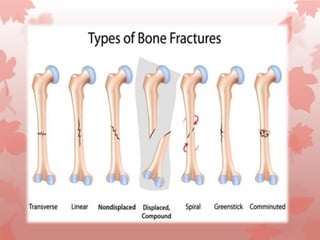
Definition:
A fracture in which broken bone
fragments lacerate soft tissue and
protrude through an open wound in
the skin.
Also called “compound
fracture”.
This type of fracture is particularly
serious because once the skin is
broken, infection in both the wound
and the bone can occur
An open fracture can be defined as a
broken bone that is in communication
through the skin with the
environment
Causes
Open fractures are caused by high-
energy trauma, most commonly from a
direct blow, such as from a fall or motor
vehicle collision.
These fractures can also occur
indirectly, such as a high-energy
twisting type of injury.
Classification :
“ GRADING”
:Open fractures have been classified by
“Gustilo and Anderson
The classification of open fractures is based on
the size of the wound and the amount of soft-
tissue injury, and correlates with both infection
and amputation rates as shown below.
Gustilo and Anderson classification of
open fractures
 Type I: clean wound smaller than 1 cm in
diameter, appears clean, simple fracture
pattern, no skin crushing.
 Type II: a laceration larger than 1 cm but
without significant soft-tissue crushing,
including no flaps, degloving, or contusion.
Fracture pattern may be more complex..
 Type III: an open segmental fracture or a single
fracture with extensive soft-tissue injury. Also
included are injuries older than 8 hours. Type III
injuries are subdivided into three types:
o Type IIIA: adequate soft-tissue coverage of the fracture
despite high-energy trauma or extensive laceration or
skin flaps.
o Type IIIB: inadequate soft-tissue coverage with
periosteal stripping. Soft-tissue reconstruction is
necessary.
o Type IIIC: any open fracture that is associated with
vascular injury that requires repair.
Diagnosis :
1-clinical features .
2-Radiology .
Clinically
* History :-
- Mechanism of injury “cause “-age
-General health & specific
comorbidities
- pt.'s activity level , disability ambulatory
status
Physical examination :
- Open wound ,deformity , swelling ,instability ,
crepitus
- Tests for Compartment syndrome
- Vascular assessment , distal pulses
- Nerves assessment
- Assessment & monitoring of soft tissue swelling &
injury .
Radiology(X-RAY) :
• PLAIN X-RAY should show JOINT above
&JOINT below in at least 2 views
• CT SCAN • MRI .. Non helpful in fractures
diag… other than association with injuries to
the CNS or SUBTROCHANTERIC (ST)
disruption .
Management :
General considerations
Assessment
Emergency management
Débridement and irrigation
Fracture stabilization
Wound management
Definitive treatment
1- General considerations
 1-First :- ABCD …
 2-Wound-severity classification
>>>> Gustilo and Anderson
 The AO classification of fracture wound severity
provides a grading system for injuries of each of the
skin (I), muscles and tendons (MT), and
neurovascular (NV), each of which is divided into
five degrees of severity.
2- Assessment
 1- Neurovascular assessment
- The dorsalis pedis and posterior tibial pulses should be palpated in the foot.
Reduced pulses require urgent further assessment.
- Motor function in each of the four leg compartments should be evaluated
- (toe flexion, toe extension, ankle eversion and
plantarflexion).
- Test sensation of the following nerves:
 tibial (plantar surface of foot)
 deep peroneal (dorsal webspace between 1st and 2nd toe)
 superficial peroneal (dorsal lateral foot)
 saphenous (medial foot)
 2- Imaging to assess location and severity of fracture
3- Emergency management
-Iv fluid , or blood - analgesics
- A temporary splint may be applied to protect
the soft tissues while awaiting the availability of
an operating room .
- As in all open fracture injuries, the patient
must receive anti-tetanus prophylaxis and
appropriate antibiotic coverage ( co-amoxiclav ).
Antibiotics should be given intravenously as
soon as possible.
4- Débridement and irrigation
-- Wound excision >> wound margins
-- Wound extension :
>> Starting with the skin, each layer is debrided
systematically. One can imagine a clock face;
wound débridement starts at the 12 o’clock
position and continues in a clockwise manner
around the circumference of the wound. This is
repeated for each layer down to the level of the
bone.
- Delivery of the fracture >> bend the joint
-- Remove devitalized tissue >>
-
The quality of the muscle tissue is assessed using
the classic 4 C’s:
- Color (red or brown)
- Consistency (how does the muscle feel)
- Capillary Circulation (does it bleed?)
- Contractility (responds to pinch or electro-
cautery)
Irrigation
After removing visible dirt and necrotic tissue, irrigation
with several liters of fluid is a key component of the
decontamination of the injury zone.
5- Fracture stabilization (temporary )
 External fixation. Depending on your injury,
your doctor may use external fixation to hold you
bones in general alignment. In external fixation,
pins or screws are placed into the broken bone
above and below the fracture site. Then the
orthopaedic surgeon repositions the bone
fragments. The pins or screws are connected to a
metal bar or bars outside the skin. This device is
a stabilizing frame that holds the bones in the
proper position.
6- Wound management
1->> Systemic antibiotics are a critical part of open
fracture wound management. Their choice and duration
will depend upon several factors including severity of
the wound, patient comorbidities, contamination etc.
Antibiotics may also be applied locally to deliver
high concentrations directly to the wound site itself.
2->>Repeat débridement
every 2-3 days, until only healthy, viable tissue remains
and no further necrotic tissue is found on follow-up
débridements.
7- Definitive treatment
 1-Internal fixation.
 During the operation, the bone fragments are first repositioned
(reduced) into their normal alignment, and then held together with
special screws or by attaching metal plates to the outer surface of the
bone.
 2- wound closure .
 Definitive fixation is considered, when:
- the patients clinical status is optimized
- the wounds are healthy and the soft-tissue envelope
will allow for chosen surgical approach
- a good preoperative plan has been created.
According to severity of # & wound :
>>>
1- minor # -> stabilized by external
fixation
2-sever # -> external fixation -> internal
fixation
3- COPLEX # -> as sever # + :
Local Flap OR Free Flap
Complications :
1- Infection .
2- Neurovascular injury .
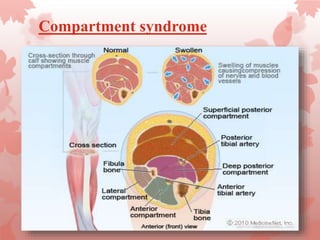
3- Acute Compartment syndrome .
Compartment syndrome
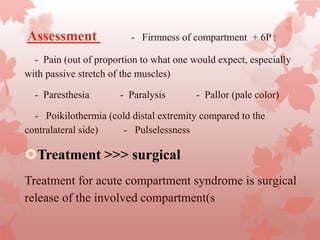
Assessment - Firmness of compartment + 6P :
- Pain (out of proportion to what one would expect, especially
with passive stretch of the muscles)
- Paresthesia - Paralysis - Pallor (pale color)
- Poikilothermia (cold distal extremity compared to the
contralateral side) - Pulselessness
Treatment >>> surgical
Treatment for acute compartment syndrome is surgical
release of the involved compartment(s
‘GOOD LUCK ,

Open fructures

  • 1.
  • 3.
  • 4.
    Definition: A fracture inwhich broken bone fragments lacerate soft tissue and protrude through an open wound in the skin. Also called “compound fracture”.
  • 5.
    This type offracture is particularly serious because once the skin is broken, infection in both the wound and the bone can occur An open fracture can be defined as a broken bone that is in communication through the skin with the environment
  • 6.
    Causes Open fractures arecaused by high- energy trauma, most commonly from a direct blow, such as from a fall or motor vehicle collision. These fractures can also occur indirectly, such as a high-energy twisting type of injury.
  • 7.
    Classification : “ GRADING” :Openfractures have been classified by “Gustilo and Anderson The classification of open fractures is based on the size of the wound and the amount of soft- tissue injury, and correlates with both infection and amputation rates as shown below.
  • 8.
    Gustilo and Andersonclassification of open fractures  Type I: clean wound smaller than 1 cm in diameter, appears clean, simple fracture pattern, no skin crushing.  Type II: a laceration larger than 1 cm but without significant soft-tissue crushing, including no flaps, degloving, or contusion. Fracture pattern may be more complex..
  • 9.
     Type III:an open segmental fracture or a single fracture with extensive soft-tissue injury. Also included are injuries older than 8 hours. Type III injuries are subdivided into three types: o Type IIIA: adequate soft-tissue coverage of the fracture despite high-energy trauma or extensive laceration or skin flaps. o Type IIIB: inadequate soft-tissue coverage with periosteal stripping. Soft-tissue reconstruction is necessary. o Type IIIC: any open fracture that is associated with vascular injury that requires repair.
  • 10.
    Diagnosis : 1-clinical features. 2-Radiology . Clinically * History :- - Mechanism of injury “cause “-age -General health & specific comorbidities - pt.'s activity level , disability ambulatory status
  • 11.
    Physical examination : -Open wound ,deformity , swelling ,instability , crepitus - Tests for Compartment syndrome - Vascular assessment , distal pulses - Nerves assessment - Assessment & monitoring of soft tissue swelling & injury .
  • 12.
    Radiology(X-RAY) : • PLAINX-RAY should show JOINT above &JOINT below in at least 2 views • CT SCAN • MRI .. Non helpful in fractures diag… other than association with injuries to the CNS or SUBTROCHANTERIC (ST) disruption .
  • 13.
    Management : General considerations Assessment Emergencymanagement Débridement and irrigation Fracture stabilization Wound management Definitive treatment
  • 14.
    1- General considerations 1-First :- ABCD …  2-Wound-severity classification >>>> Gustilo and Anderson  The AO classification of fracture wound severity provides a grading system for injuries of each of the skin (I), muscles and tendons (MT), and neurovascular (NV), each of which is divided into five degrees of severity.
  • 15.
    2- Assessment  1-Neurovascular assessment - The dorsalis pedis and posterior tibial pulses should be palpated in the foot. Reduced pulses require urgent further assessment. - Motor function in each of the four leg compartments should be evaluated - (toe flexion, toe extension, ankle eversion and plantarflexion). - Test sensation of the following nerves:  tibial (plantar surface of foot)  deep peroneal (dorsal webspace between 1st and 2nd toe)  superficial peroneal (dorsal lateral foot)  saphenous (medial foot)  2- Imaging to assess location and severity of fracture
  • 16.
    3- Emergency management -Ivfluid , or blood - analgesics - A temporary splint may be applied to protect the soft tissues while awaiting the availability of an operating room . - As in all open fracture injuries, the patient must receive anti-tetanus prophylaxis and appropriate antibiotic coverage ( co-amoxiclav ). Antibiotics should be given intravenously as soon as possible.
  • 17.
    4- Débridement andirrigation -- Wound excision >> wound margins -- Wound extension : >> Starting with the skin, each layer is debrided systematically. One can imagine a clock face; wound débridement starts at the 12 o’clock position and continues in a clockwise manner around the circumference of the wound. This is repeated for each layer down to the level of the bone.
  • 18.
    - Delivery ofthe fracture >> bend the joint -- Remove devitalized tissue >> - The quality of the muscle tissue is assessed using the classic 4 C’s: - Color (red or brown) - Consistency (how does the muscle feel) - Capillary Circulation (does it bleed?) - Contractility (responds to pinch or electro- cautery)
  • 19.
    Irrigation After removing visibledirt and necrotic tissue, irrigation with several liters of fluid is a key component of the decontamination of the injury zone.
  • 20.
    5- Fracture stabilization(temporary )  External fixation. Depending on your injury, your doctor may use external fixation to hold you bones in general alignment. In external fixation, pins or screws are placed into the broken bone above and below the fracture site. Then the orthopaedic surgeon repositions the bone fragments. The pins or screws are connected to a metal bar or bars outside the skin. This device is a stabilizing frame that holds the bones in the proper position.
  • 21.
    6- Wound management 1->>Systemic antibiotics are a critical part of open fracture wound management. Their choice and duration will depend upon several factors including severity of the wound, patient comorbidities, contamination etc. Antibiotics may also be applied locally to deliver high concentrations directly to the wound site itself. 2->>Repeat débridement every 2-3 days, until only healthy, viable tissue remains and no further necrotic tissue is found on follow-up débridements.
  • 22.
    7- Definitive treatment 1-Internal fixation.  During the operation, the bone fragments are first repositioned (reduced) into their normal alignment, and then held together with special screws or by attaching metal plates to the outer surface of the bone.  2- wound closure .  Definitive fixation is considered, when: - the patients clinical status is optimized - the wounds are healthy and the soft-tissue envelope will allow for chosen surgical approach - a good preoperative plan has been created.
  • 23.
    According to severityof # & wound : >>> 1- minor # -> stabilized by external fixation 2-sever # -> external fixation -> internal fixation 3- COPLEX # -> as sever # + : Local Flap OR Free Flap
  • 24.
    Complications : 1- Infection. 2- Neurovascular injury . 3- Acute Compartment syndrome .
  • 25.
  • 26.
    Assessment - Firmnessof compartment + 6P : - Pain (out of proportion to what one would expect, especially with passive stretch of the muscles) - Paresthesia - Paralysis - Pallor (pale color) - Poikilothermia (cold distal extremity compared to the contralateral side) - Pulselessness Treatment >>> surgical Treatment for acute compartment syndrome is surgical release of the involved compartment(s
  • 27.