ORTHOPAEDIC
TRAUMA
-General introduction
-Fracture classification
Dr. Anshu Sharma
Assistant Professor,
Dept. of Orthopaedics
GMCH,Udaipur
DEFINITION of FRACTURE –
A fracture is a break in the
continuity of bone (even a Single
cortex) with or without
displacement.
Classification:-
Based on fracture line:
-Complete,
-Incomplete
Incomplete usually occurs in children
-Periosteum in children is more thick and
strong than adult.
On radiology can be seen as
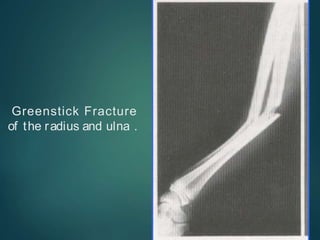
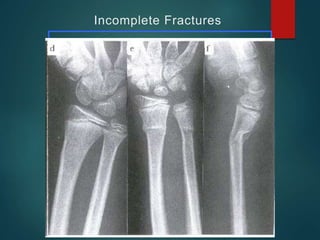
Greenstick fracture,
Torus fracture,
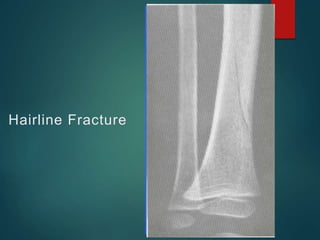
Hairline fracture.
Greenstick Fracture
of the radius and ulna .
Hairline Fracture
Incomplete Fractures
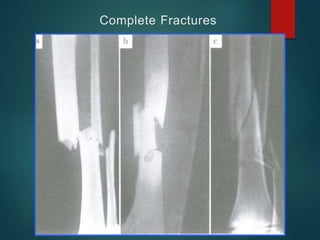
In adults complete fracture line leads
to complete loss of bone continuity.
➣ Trauma in adult produce fracture
line which result in to
-Transverse Fracture .
-Oblique Fracture.
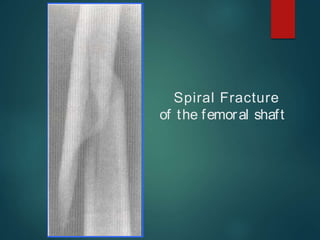
-Spiral Fracture.
- Segmental F r a c t ure.
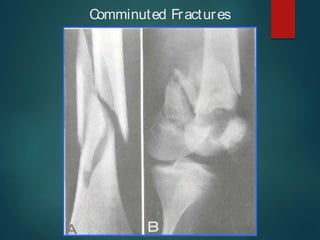
-Comminuted Fracture.
Transverse Fracture ObliqueFracture
Spiral Fracture
of the femoral shaft
 Based on etiology can be classified
as:-
-Traumatic fractures,
-Pathological fractures,
-Stress fractures,
-Fragility fractures.
Comminuted Fractures
Complete Fractures
According of mechanism of injury
➣Direct or indirect
➣Low or Height energy
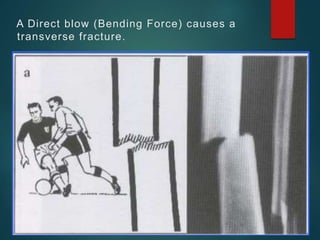
A Direct blow (Bending Force) causes a
transverse fracture.
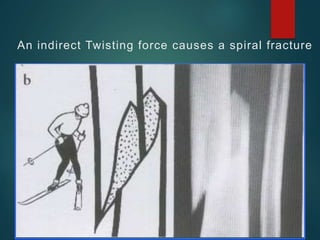
An indirect Twisting force causes a spiral fracture
Based on Bone Fragment
Displacement:
- Undisplaced Fractures,
- Displaced Fractures.
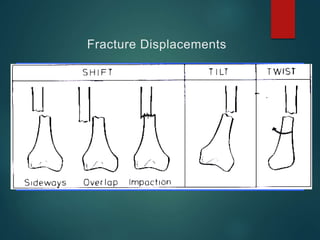
Fracture Displacements
Based on Communication with external
environment:
-Close Fracture:- No contact of Fracture
hematoma with external environment.
-Open Fracture:- Fracture hematoma is
in contact with external environment.
Gustillo Anderson Classification:-
G r a d e I : Wound 1cm or less and clean,
Fracture line transverse or oblique.
Grade II: Wound >1cm laceration, mild contamination,
Fracture line transversa, short oblique,
minimal comminution.
Grade III :
III-A:Extensive soft tissue damage,
Adequate Bone coverage,
Simple or Segmental fracture
III-B:Extensive soft tissue injury with
periosteal stripping and Bone exposed.
III-C: Any size of wound and any type of
fracture with Vascular injury.
Clinical Diagnosis
History of Trauma or RTA.
Complaints of Pain,
Swelling and
Deformity.
Systemic associated injury
-Neurological
-Abdominal
-Urology,
-Thorax.
 Local Sign :
-Look: Sweling, deformity, wound
-Feel: Tenderness, Crepitus, Pulse &
sensation.
-Move: Abnormal movement.
Investigations :
Laboratory:
-CBC,
-BT & CT,
-HHH.
Radiology:
-Xrays:-AP/Lateral/Oblique
-CT-Scan
- M R I
Management:
 ATLS Protocol: A, B, C.
 Closed Reduction and plaster
application.
 Open reduction with or without Internal
Fixation.
Management Open Fracture
Debridement:
-Wound cleaning by Pulse lavage,
-Surgery:Excise all dead and necrotic soft
tissue,
Remove all foreign body and
contamination.
TheGoal of treatment of an open fracture are
Prevention of infection,
Healing of the fracture and
Restoration of the function in the extremity.
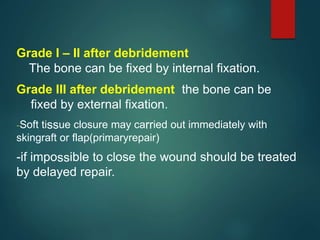
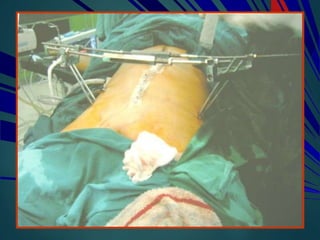
Grade I – II after debridement
The bone can be fixed by internal fixation.
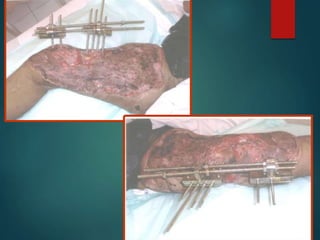
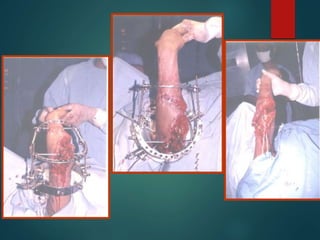
Grade III after debridement the bone can be
fixed by external fixation.
-Soft tissue closure may carried out immediately with
skingraft or flap(primaryrepair)
-if impossible to close the wound should be treated
by delayed repair.
Thank You.

Fracture classification and Trauma introduction.