Fracture Description &
Classification
By Daaneyal J. Dilawar
Anatomic description of fractures
 Type
 Comminution
 Location
 Displacement
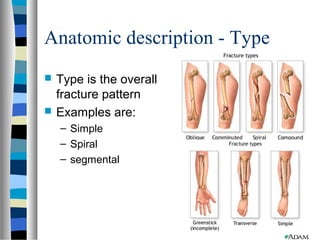
Anatomic description - Type
 Type is the overall
fracture pattern
 Examples are:
– Simple
– Spiral
– segmental
Anatomic description -
Communition
 Comminution is the measure of the
number of pieces of broken bone that
there are.
 Examples are: non-comminuted or
mildly comminuted or severely
comminuted
Anatomic description - Location
 Location is the anatomic location of the
fracture usually described by giving the
bone involved and location on the bone
 Examples are: distal radial shaft,
proximal 1/3 humeral shaft, intra-
articular distal tibial
Anatomic description -
Displacement
 Displacement is the amount the pieces
of a fracture have moved from their
normal location
 Can be displaced or non-displaced
 Subdivided into 3 sub-categories:
translation, angulation, and shortening
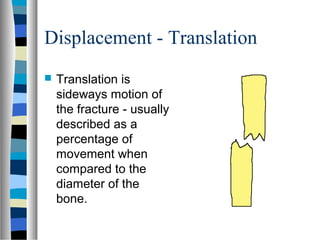
Displacement - Translation
 Translation is
sideways motion of
the fracture - usually
described as a
percentage of
movement when
compared to the
diameter of the
bone.
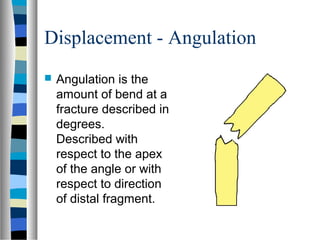
Displacement - Angulation
 Angulation is the
amount of bend at a
fracture described in
degrees.
Described with
respect to the apex
of the angle or with
respect to direction
of distal fragment.
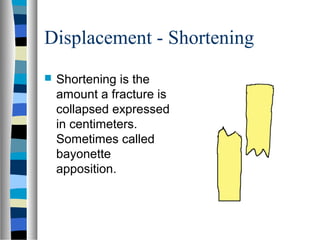
Displacement - Shortening
 Shortening is the
amount a fracture is
collapsed expressed
in centimeters.
Sometimes called
bayonette
apposition.
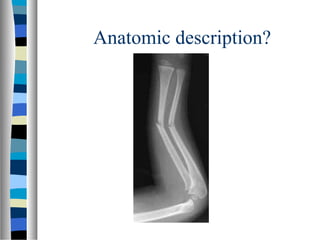
Anatomic description?
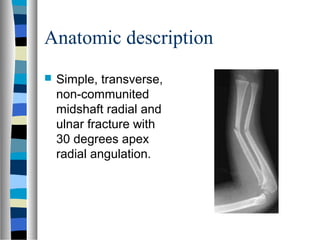
Anatomic description
 Simple, transverse,
non-communited
midshaft radial and
ulnar fracture with
30 degrees apex
radial angulation.
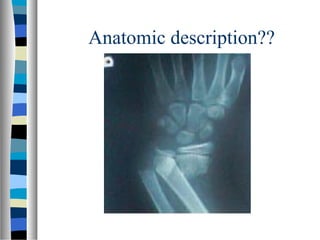
Anatomic description??
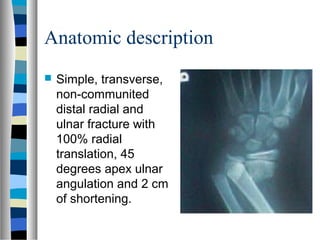
Anatomic description
 Simple, transverse,
non-communited
distal radial and
ulnar fracture with
100% radial
translation, 45
degrees apex ulnar
angulation and 2 cm
of shortening.
Why classify fractures?
 Classification or description of fractures
is only used when the classification or
description is useful in providing
treatment or outcomes
Types of classifications
 Anatomic description
 AO classification
 Salter-Harris classification
 Gustillo open fracture classification
 Fracture specific classifications
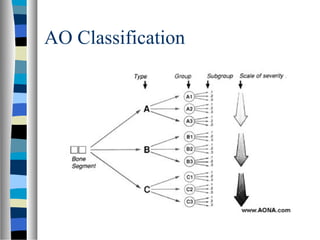
AO Classification
AO Classification
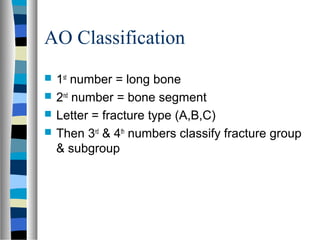
 1st
number = long bone
 2nd
number = bone segment
 Letter = fracture type (A,B,C)
 Then 3rd
& 4th
numbers classify fracture group
& subgroup
Salter-Harris Classification
 Only used for pediatric fractures that
involve the growth plate (physis)
 Five types (I-V)
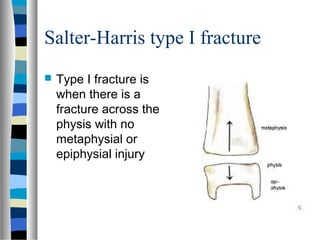
Salter-Harris type I fracture
 Type I fracture is
when there is a
fracture across the
physis with no
metaphysial or
epiphysial injury
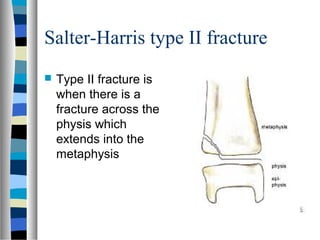
Salter-Harris type II fracture
 Type II fracture is
when there is a
fracture across the
physis which
extends into the
metaphysis
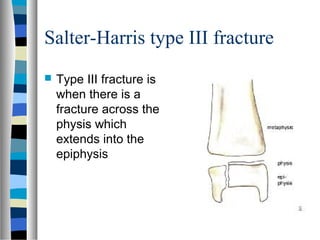
Salter-Harris type III fracture
 Type III fracture is
when there is a
fracture across the
physis which
extends into the
epiphysis
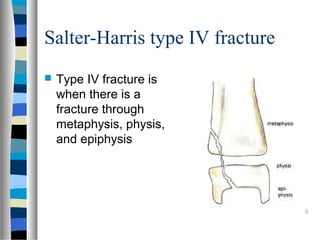
Salter-Harris type IV fracture
 Type IV fracture is
when there is a
fracture through
metaphysis, physis,
and epiphysis
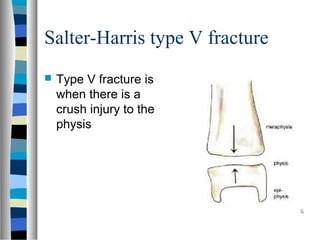
Salter-Harris type V fracture
 Type V fracture is
when there is a
crush injury to the
physis
Gustillo classification
 The Gustillo classification is used to
classify open fracture - ones in which
the skin has been disrupted
 Three grades that try to quantify the
amount of soft tissue damage
associated with the fracture
Open fractures - grade 1
 wound less than 1 cm w/ minimal soft
tissue injury
 wound bed is clean
 bone injury is simple w/ minimal
comminution
 w/ IM nailing, average time to union is
21-28 weeks
Open fractures - grade 2
 wound is greater than 1 cm w/
moderate soft tissue injury
 wound bed is moderately contaminated
 fracture contains moderate
comminution
 w/ IM nailing, average time to union is
26-28 weeks
Open fractures - grade 3A
 wound greater than 10 cm w/ crushed
tissue and contamination
 soft tissue coverage of bone is usually
possible
 w/ IM nailing, average time to union is
30-35 weeks
Open fractures - grade 3B
 wound greater than 10 cm w/ crushed
tissue and contamination
 soft tissue is inadequate and requires
regional or free flap
 w/ IM nailing, average time to union is
30-35 weeks
Open fractures - grade 3C
 is fracture in which there is a major
vascular injury requiring repair for limb
salvage
 fractures can be classified using the
MESS
 in some cases it will be necessary to
consider BKA following tibial fracture
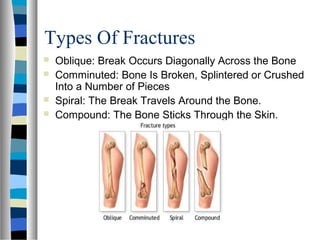
Types Of Fractures
 Oblique: Break Occurs Diagonally Across the Bone
 Comminuted: Bone Is Broken, Splintered or Crushed
Into a Number of Pieces
 Spiral: The Break Travels Around the Bone.
 Compound: The Bone Sticks Through the Skin.
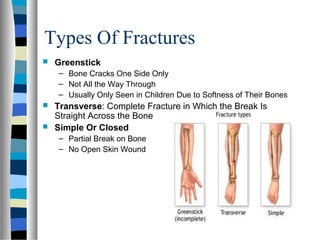
Types Of Fractures
 Greenstick
– Bone Cracks One Side Only
– Not All the Way Through
– Usually Only Seen in Children Due to Softness of Their Bones
 Transverse: Complete Fracture in Which the Break Is
Straight Across the Bone
 Simple Or Closed
– Partial Break on Bone
– No Open Skin Wound
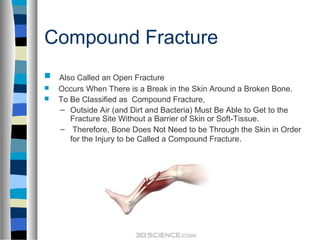
Compound Fracture
 Also Called an Open Fracture
 Occurs When There is a Break in the Skin Around a Broken Bone.
 To Be Classified as Compound Fracture,
– Outside Air (and Dirt and Bacteria) Must Be Able to Get to the
Fracture Site Without a Barrier of Skin or Soft-Tissue.
– Therefore, Bone Does Not Need to be Through the Skin in Order
for the Injury to be Called a Compound Fracture.
The Fuss About Compound
Fractures
 Injuries Are Open to the Outside World
– There Is a Very Significant Risk of Developing an
Infection Around the Fracture.
– If Infection Develops, There Can Be Problems with
Healing Process
 Therefore, Compound Fractures Are
Generally Treated with Surgery to Clean the
Site of Injury and Stabilize the Fracture.
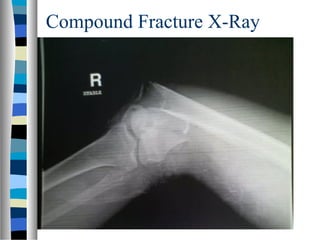
Compound Fracture X-Ray
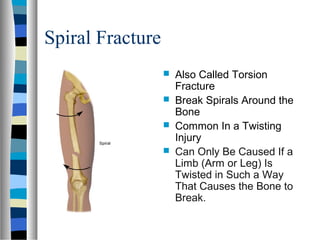
Spiral Fracture
 Also Called Torsion
Fracture
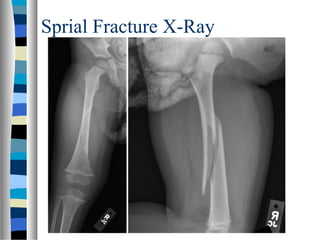
 Break Spirals Around the
Bone
 Common In a Twisting
Injury
 Can Only Be Caused If a
Limb (Arm or Leg) Is
Twisted in Such a Way
That Causes the Bone to
Break.
Spiral Fracture
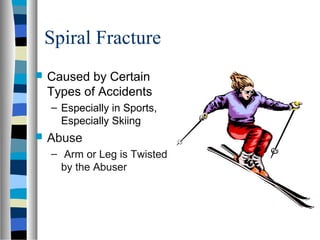
 Caused by Certain
Types of Accidents
– Especially in Sports,
Especially Skiing
 Abuse
– Arm or Leg is Twisted
by the Abuser
Causes Of Spiral Fracture
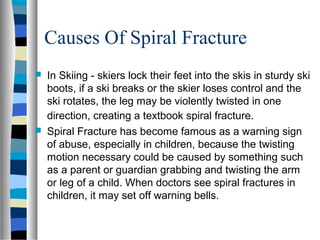
 In Skiing - skiers lock their feet into the skis in sturdy ski
boots, if a ski breaks or the skier loses control and the
ski rotates, the leg may be violently twisted in one
direction, creating a textbook spiral fracture.
 Spiral Fracture has become famous as a warning sign
of abuse, especially in children, because the twisting
motion necessary could be caused by something such
as a parent or guardian grabbing and twisting the arm
or leg of a child. When doctors see spiral fractures in
children, it may set off warning bells.
Sprial Fracture X-Ray
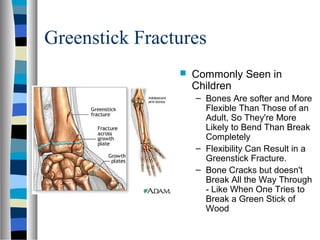
Greenstick Fractures
 Commonly Seen in
Children
– Bones Are softer and More
Flexible Than Those of an
Adult, So They're More
Likely to Bend Than Break
Completely
– Flexibility Can Result in a
Greenstick Fracture.
– Bone Cracks but doesn't
Break All the Way Through
- Like When One Tries to
Break a Green Stick of
Wood
Greenstick Fractures
 May Occur When a Child Falls While Playing or
Participating in Sports.
 Arm Bones Are the Most Likely to be Harmed
Because of the Instinct to Throw out the Arms
to Catch Fall.
 Can Be Difficult to Diagnose, Because It May
Not Cause All the Classic Signs and Symptoms
of a Broken Bone
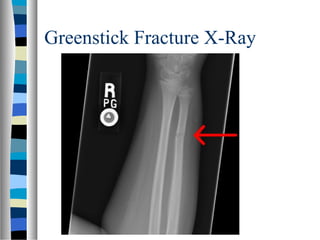
Greenstick Fracture X-Ray
Thank You!

Types and classification of fractures

  • 1.
  • 2.
    Anatomic description offractures  Type  Comminution  Location  Displacement
  • 3.
    Anatomic description -Type  Type is the overall fracture pattern  Examples are: – Simple – Spiral – segmental
  • 4.
    Anatomic description - Communition Comminution is the measure of the number of pieces of broken bone that there are.  Examples are: non-comminuted or mildly comminuted or severely comminuted
  • 5.
    Anatomic description -Location  Location is the anatomic location of the fracture usually described by giving the bone involved and location on the bone  Examples are: distal radial shaft, proximal 1/3 humeral shaft, intra- articular distal tibial
  • 6.
    Anatomic description - Displacement Displacement is the amount the pieces of a fracture have moved from their normal location  Can be displaced or non-displaced  Subdivided into 3 sub-categories: translation, angulation, and shortening
  • 7.
    Displacement - Translation Translation is sideways motion of the fracture - usually described as a percentage of movement when compared to the diameter of the bone.
  • 8.
    Displacement - Angulation Angulation is the amount of bend at a fracture described in degrees. Described with respect to the apex of the angle or with respect to direction of distal fragment.
  • 9.
    Displacement - Shortening Shortening is the amount a fracture is collapsed expressed in centimeters. Sometimes called bayonette apposition.
  • 10.
  • 11.
    Anatomic description  Simple,transverse, non-communited midshaft radial and ulnar fracture with 30 degrees apex radial angulation.
  • 12.
  • 13.
    Anatomic description  Simple,transverse, non-communited distal radial and ulnar fracture with 100% radial translation, 45 degrees apex ulnar angulation and 2 cm of shortening.
  • 14.
    Why classify fractures? Classification or description of fractures is only used when the classification or description is useful in providing treatment or outcomes
  • 15.
    Types of classifications Anatomic description  AO classification  Salter-Harris classification  Gustillo open fracture classification  Fracture specific classifications
  • 16.
  • 17.
    AO Classification  1st number= long bone  2nd number = bone segment  Letter = fracture type (A,B,C)  Then 3rd & 4th numbers classify fracture group & subgroup
  • 18.
    Salter-Harris Classification  Onlyused for pediatric fractures that involve the growth plate (physis)  Five types (I-V)
  • 19.
    Salter-Harris type Ifracture  Type I fracture is when there is a fracture across the physis with no metaphysial or epiphysial injury
  • 20.
    Salter-Harris type IIfracture  Type II fracture is when there is a fracture across the physis which extends into the metaphysis
  • 21.
    Salter-Harris type IIIfracture  Type III fracture is when there is a fracture across the physis which extends into the epiphysis
  • 22.
    Salter-Harris type IVfracture  Type IV fracture is when there is a fracture through metaphysis, physis, and epiphysis
  • 23.
    Salter-Harris type Vfracture  Type V fracture is when there is a crush injury to the physis
  • 24.
    Gustillo classification  TheGustillo classification is used to classify open fracture - ones in which the skin has been disrupted  Three grades that try to quantify the amount of soft tissue damage associated with the fracture
  • 25.
    Open fractures -grade 1  wound less than 1 cm w/ minimal soft tissue injury  wound bed is clean  bone injury is simple w/ minimal comminution  w/ IM nailing, average time to union is 21-28 weeks
  • 26.
    Open fractures -grade 2  wound is greater than 1 cm w/ moderate soft tissue injury  wound bed is moderately contaminated  fracture contains moderate comminution  w/ IM nailing, average time to union is 26-28 weeks
  • 27.
    Open fractures -grade 3A  wound greater than 10 cm w/ crushed tissue and contamination  soft tissue coverage of bone is usually possible  w/ IM nailing, average time to union is 30-35 weeks
  • 28.
    Open fractures -grade 3B  wound greater than 10 cm w/ crushed tissue and contamination  soft tissue is inadequate and requires regional or free flap  w/ IM nailing, average time to union is 30-35 weeks
  • 29.
    Open fractures -grade 3C  is fracture in which there is a major vascular injury requiring repair for limb salvage  fractures can be classified using the MESS  in some cases it will be necessary to consider BKA following tibial fracture
  • 30.
    Types Of Fractures Oblique: Break Occurs Diagonally Across the Bone  Comminuted: Bone Is Broken, Splintered or Crushed Into a Number of Pieces  Spiral: The Break Travels Around the Bone.  Compound: The Bone Sticks Through the Skin.
  • 31.
    Types Of Fractures Greenstick – Bone Cracks One Side Only – Not All the Way Through – Usually Only Seen in Children Due to Softness of Their Bones  Transverse: Complete Fracture in Which the Break Is Straight Across the Bone  Simple Or Closed – Partial Break on Bone – No Open Skin Wound
  • 32.
    Compound Fracture  AlsoCalled an Open Fracture  Occurs When There is a Break in the Skin Around a Broken Bone.  To Be Classified as Compound Fracture, – Outside Air (and Dirt and Bacteria) Must Be Able to Get to the Fracture Site Without a Barrier of Skin or Soft-Tissue. – Therefore, Bone Does Not Need to be Through the Skin in Order for the Injury to be Called a Compound Fracture.
  • 33.
    The Fuss AboutCompound Fractures  Injuries Are Open to the Outside World – There Is a Very Significant Risk of Developing an Infection Around the Fracture. – If Infection Develops, There Can Be Problems with Healing Process  Therefore, Compound Fractures Are Generally Treated with Surgery to Clean the Site of Injury and Stabilize the Fracture.
  • 34.
  • 35.
    Spiral Fracture  AlsoCalled Torsion Fracture  Break Spirals Around the Bone  Common In a Twisting Injury  Can Only Be Caused If a Limb (Arm or Leg) Is Twisted in Such a Way That Causes the Bone to Break.
  • 36.
    Spiral Fracture  Causedby Certain Types of Accidents – Especially in Sports, Especially Skiing  Abuse – Arm or Leg is Twisted by the Abuser
  • 37.
    Causes Of SpiralFracture  In Skiing - skiers lock their feet into the skis in sturdy ski boots, if a ski breaks or the skier loses control and the ski rotates, the leg may be violently twisted in one direction, creating a textbook spiral fracture.  Spiral Fracture has become famous as a warning sign of abuse, especially in children, because the twisting motion necessary could be caused by something such as a parent or guardian grabbing and twisting the arm or leg of a child. When doctors see spiral fractures in children, it may set off warning bells.
  • 38.
  • 39.
    Greenstick Fractures  CommonlySeen in Children – Bones Are softer and More Flexible Than Those of an Adult, So They're More Likely to Bend Than Break Completely – Flexibility Can Result in a Greenstick Fracture. – Bone Cracks but doesn't Break All the Way Through - Like When One Tries to Break a Green Stick of Wood
  • 40.
    Greenstick Fractures  MayOccur When a Child Falls While Playing or Participating in Sports.  Arm Bones Are the Most Likely to be Harmed Because of the Instinct to Throw out the Arms to Catch Fall.  Can Be Difficult to Diagnose, Because It May Not Cause All the Classic Signs and Symptoms of a Broken Bone
  • 41.
  • 42.