Fashion Etymology and Terminology
Fashion Fashion is a major force in our daily lives which affects every aspect of our lives... what we see, do or wear. It is a complex concept involving much more than apparel, accessories, cosmetics and hairstyle. It is a style that is accepted and used by the majority of a group at any given time. Fashion leads us to discard a product that is still useful but is no longer ā€œINā€. Fashion is a prevailing custom, usage or style. Fashion is vital, challenging and ever changing force.
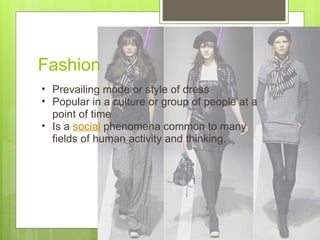
Fashion Prevailing mode or style of dress Popular in a culture or group of people at a point of time Is a  social  phenomena common to many fields of human activity and thinking.
Ā 
Style A type of product that has one or more specific features as characteristic that distinguishes it and make it different from other products. A style is a particular design, shape or type of apparel item. It is a way of expressing something that is characteristic of a particular person or group of people of a period.
Trend/Popular Fashion This is the ā€˜Fashion’ that is popular everywhere. A fashion which is religiously followed by a certain group is called a trend. In a trend the following things combine to make a fashion: Its eye appeal and the comfort in an essence. Its wearable quality. It is adapted to figure types and to different age groups
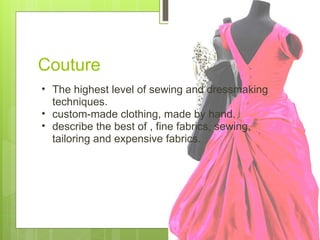
Couture The highest level of sewing and dressmaking techniques.  custom-made clothing, made by hand. describe the best of , fine fabrics, sewing, tailoring and expensive fabrics.
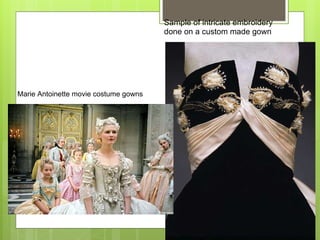
Sample of intricate embroidery done on a custom made gown Marie Antoinette movie costume gowns
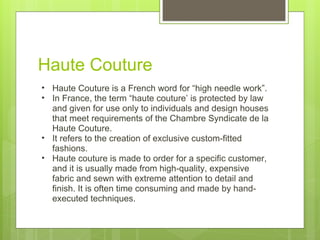
Haute Couture Haute Couture is a French word for ā€œhigh needle workā€. In France, the term ā€œhaute couture’ is protected by law and given for use only to individuals and design houses that meet requirements of the Chambre Syndicate de la Haute Couture.  It refers to the creation of exclusive custom-fitted fashions. Haute couture is made to order for a specific customer, and it is usually made from high-quality, expensive fabric and sewn with extreme attention to detail and finish. It is often time consuming and made by hand-executed techniques.
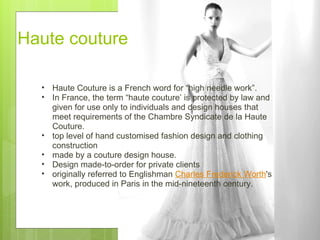
Haute couture  Haute Couture is a French word for ā€œhigh needle workā€. In France, the term ā€œhaute couture’ is protected by law and given for use only to individuals and design houses that meet requirements of the Chambre Syndicate de la Haute Couture.  top level of hand customised fashion design and clothing construction made by a couture design house.Ā   Design made-to-order for private clients  originally referred to Englishman  Charles Frederick Worth 's work, produced in Paris in the mid-nineteenth century.
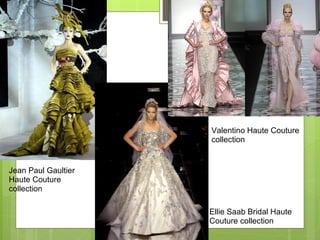
Jean Paul Gaultier Haute Couture collection Ellie Saab Bridal Haute Couture collection Valentino Haute Couture collection
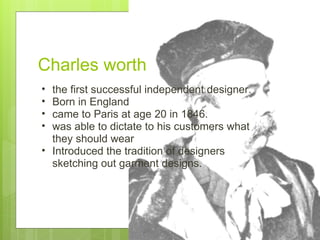
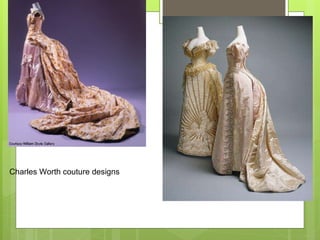
Charles worth  the first successful independent designer. Born in England came to Paris at age 20 in 1846.  was able to dictate to his customers what they should wear Introduced the tradition of designers sketching out garment designs.
Charles Worth couture designs
Bridge fashion Typically, bridge designers are one notch under designer lines. Bridge lines have more unique styling than contemporary ones but are usually not as pricey as designer lines. The hierarchy with regard to styling, price and exclusivity from highest to lowest is: Haute Couture >> Designer RTW >> Bridge >> Contemporary
Pret-a-Porter Ready to wear clothes Aimed to satisfy masses demand. Volume, turnover
Classic When a style stays in trend for a long period and is accepted anywhere and everywhere, it becomes a classic. A classic stays in the fashion cycle for a long period.  It is accepted by all groups of a society. It serves as the established model or standard. It has lasting significance or worth. A classic is a typical or traditional example.
Fad A fad is a fashion that comes into popularity overnight. The style becomes a fashion very quickly and it fades off even quicker.  A fad refers to a fashion that gains popularity in a culture relatively quick, but loses popularity dramatically. Some fads may come back if another generation gets interested in it.
Collection A line of products manufactured for a particular season, as those developed by a fashion designer.
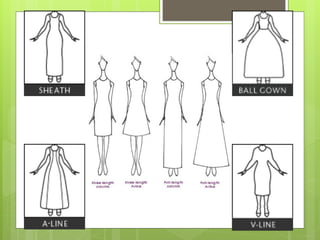
Silhouette - It is the outline or basic contours of an object. Silhouettes are always changing in fashion. The general direction that a silhouette (becomes wider, narrower, longer, shorter) takes shows a fashion trend.
Ā 
Adaptation Dress designing term for an interpretation of an expensive designer dress reproduced with modification of design and fabric. Copy of particular design without compromising in quality with slight modifications.
Knock offs Adaptations are referred to as ā€œline-for-line copiesā€ or ā€œknock-offsā€ and are made of less expensive materials. Manufactures copies new looks or adapt some of their dominant features, making simpler styles in preparation for rising sales expectations.  Knowing what is selling, rapid production capabilities and to sell at lower price.
Motifs It is a design or figure that consists or recurring shapes, colours as in architecture or decoration. It is a unifying idea that is a recurrent element in artistic work
Trimmings Something added as decoration or ornament, especially a band or lace or embroidery on clothing.
Boutique A boutique is a French word for ā€œshopā€, is a small shopping outlet. It specializes in elite and fashionable items such as clothing and jewellery.
Texture Texture refers to the properties held and sensations caused by the external surface of objects received through the sense of touch.
Hue A particular gradation of colour, shade. Hue is also one of the three dimensions in some colour spaces along with saturation and brightness. Usually, colours with the same hue are distinguished with adjectives referring to their lightness and saturation.
Value Value is a measure of where a particular colour lies along the lightness-darkness axis.
Intensity Strength of a colour  Brightness or dullness of a hue Quality which makes yellow different from lemon yellow.
Stylist A stylist is either a person who co-ordinates the clothes, jewelry, and accessories used in fashion photographs and catwalk shows.
Toile Toile is from a French word meaning ā€œclothā€ or ā€œwebā€ – particularly cloth or canvas for painting on. A toile is a version of a garment made by fashion designers to test a pattern.  They are usually made in cheap material, as multiple toiles may be made in the process of perfecting a design.  Toiles may be called ā€œmuslinsā€ in the United States.
Atelier French word for an artist’s studio or workroom.  Classified as ā€˜Flou’ for soft dressmaking (basically women dress) or ā€˜tailleur’ for tailoring suits and coats. One step forward from boutique.
Fashion forecast A prediction of fashion trends
Avant Garde French term commonly used in English meaning new, unconventional, ahead of the time.  Used as an adjective to describe an apparel that may be startling. Most daring and wild designs
Coordinates  Garments designed to mix and match interchangeably.

Fashion_Etymology_and_Terminology

  • 1.
  • 2.
    Fashion Fashion isa major force in our daily lives which affects every aspect of our lives... what we see, do or wear. It is a complex concept involving much more than apparel, accessories, cosmetics and hairstyle. It is a style that is accepted and used by the majority of a group at any given time. Fashion leads us to discard a product that is still useful but is no longer ā€œINā€. Fashion is a prevailing custom, usage or style. Fashion is vital, challenging and ever changing force.
  • 3.
    Fashion Prevailing modeor style of dress Popular in a culture or group of people at a point of time Is a social phenomena common to many fields of human activity and thinking.
  • 4.
  • 5.
    Style A typeof product that has one or more specific features as characteristic that distinguishes it and make it different from other products. A style is a particular design, shape or type of apparel item. It is a way of expressing something that is characteristic of a particular person or group of people of a period.
  • 6.
    Trend/Popular Fashion Thisis the ā€˜Fashion’ that is popular everywhere. A fashion which is religiously followed by a certain group is called a trend. In a trend the following things combine to make a fashion: Its eye appeal and the comfort in an essence. Its wearable quality. It is adapted to figure types and to different age groups
  • 7.
    Couture The highestlevel of sewing and dressmaking techniques. custom-made clothing, made by hand. describe the best of , fine fabrics, sewing, tailoring and expensive fabrics.
  • 8.
    Sample of intricateembroidery done on a custom made gown Marie Antoinette movie costume gowns
  • 9.
    Haute Couture HauteCouture is a French word for ā€œhigh needle workā€. In France, the term ā€œhaute couture’ is protected by law and given for use only to individuals and design houses that meet requirements of the Chambre Syndicate de la Haute Couture. It refers to the creation of exclusive custom-fitted fashions. Haute couture is made to order for a specific customer, and it is usually made from high-quality, expensive fabric and sewn with extreme attention to detail and finish. It is often time consuming and made by hand-executed techniques.
  • 10.
    Haute couture Haute Couture is a French word for ā€œhigh needle workā€. In France, the term ā€œhaute couture’ is protected by law and given for use only to individuals and design houses that meet requirements of the Chambre Syndicate de la Haute Couture. top level of hand customised fashion design and clothing construction made by a couture design house.Ā  Design made-to-order for private clients originally referred to Englishman Charles Frederick Worth 's work, produced in Paris in the mid-nineteenth century.
  • 11.
    Jean Paul GaultierHaute Couture collection Ellie Saab Bridal Haute Couture collection Valentino Haute Couture collection
  • 12.
    Charles worth the first successful independent designer. Born in England came to Paris at age 20 in 1846. was able to dictate to his customers what they should wear Introduced the tradition of designers sketching out garment designs.
  • 13.
  • 14.
    Bridge fashion Typically,bridge designers are one notch under designer lines. Bridge lines have more unique styling than contemporary ones but are usually not as pricey as designer lines. The hierarchy with regard to styling, price and exclusivity from highest to lowest is: Haute Couture >> Designer RTW >> Bridge >> Contemporary
  • 15.
    Pret-a-Porter Ready towear clothes Aimed to satisfy masses demand. Volume, turnover
  • 16.
    Classic When astyle stays in trend for a long period and is accepted anywhere and everywhere, it becomes a classic. A classic stays in the fashion cycle for a long period. It is accepted by all groups of a society. It serves as the established model or standard. It has lasting significance or worth. A classic is a typical or traditional example.
  • 17.
    Fad A fadis a fashion that comes into popularity overnight. The style becomes a fashion very quickly and it fades off even quicker. A fad refers to a fashion that gains popularity in a culture relatively quick, but loses popularity dramatically. Some fads may come back if another generation gets interested in it.
  • 18.
    Collection A lineof products manufactured for a particular season, as those developed by a fashion designer.
  • 19.
    Silhouette - Itis the outline or basic contours of an object. Silhouettes are always changing in fashion. The general direction that a silhouette (becomes wider, narrower, longer, shorter) takes shows a fashion trend.
  • 20.
  • 21.
    Adaptation Dress designingterm for an interpretation of an expensive designer dress reproduced with modification of design and fabric. Copy of particular design without compromising in quality with slight modifications.
  • 22.
    Knock offs Adaptationsare referred to as ā€œline-for-line copiesā€ or ā€œknock-offsā€ and are made of less expensive materials. Manufactures copies new looks or adapt some of their dominant features, making simpler styles in preparation for rising sales expectations. Knowing what is selling, rapid production capabilities and to sell at lower price.
  • 23.
    Motifs It isa design or figure that consists or recurring shapes, colours as in architecture or decoration. It is a unifying idea that is a recurrent element in artistic work
  • 24.
    Trimmings Something addedas decoration or ornament, especially a band or lace or embroidery on clothing.
  • 25.
    Boutique A boutiqueis a French word for ā€œshopā€, is a small shopping outlet. It specializes in elite and fashionable items such as clothing and jewellery.
  • 26.
    Texture Texture refersto the properties held and sensations caused by the external surface of objects received through the sense of touch.
  • 27.
    Hue A particulargradation of colour, shade. Hue is also one of the three dimensions in some colour spaces along with saturation and brightness. Usually, colours with the same hue are distinguished with adjectives referring to their lightness and saturation.
  • 28.
    Value Value isa measure of where a particular colour lies along the lightness-darkness axis.
  • 29.
    Intensity Strength ofa colour Brightness or dullness of a hue Quality which makes yellow different from lemon yellow.
  • 30.
    Stylist A stylistis either a person who co-ordinates the clothes, jewelry, and accessories used in fashion photographs and catwalk shows.
  • 31.
    Toile Toile isfrom a French word meaning ā€œclothā€ or ā€œwebā€ – particularly cloth or canvas for painting on. A toile is a version of a garment made by fashion designers to test a pattern. They are usually made in cheap material, as multiple toiles may be made in the process of perfecting a design. Toiles may be called ā€œmuslinsā€ in the United States.
  • 32.
    Atelier French wordfor an artist’s studio or workroom. Classified as ā€˜Flou’ for soft dressmaking (basically women dress) or ā€˜tailleur’ for tailoring suits and coats. One step forward from boutique.
  • 33.
    Fashion forecast Aprediction of fashion trends
  • 34.
    Avant Garde Frenchterm commonly used in English meaning new, unconventional, ahead of the time. Used as an adjective to describe an apparel that may be startling. Most daring and wild designs
  • 35.
    Coordinates Garmentsdesigned to mix and match interchangeably.