by:  Ashutosh Vatsa Kr. Pramendra Sinha Mohan Pegu Pankaj Pathak Sanath Kr. Pegu Sushant Kumar
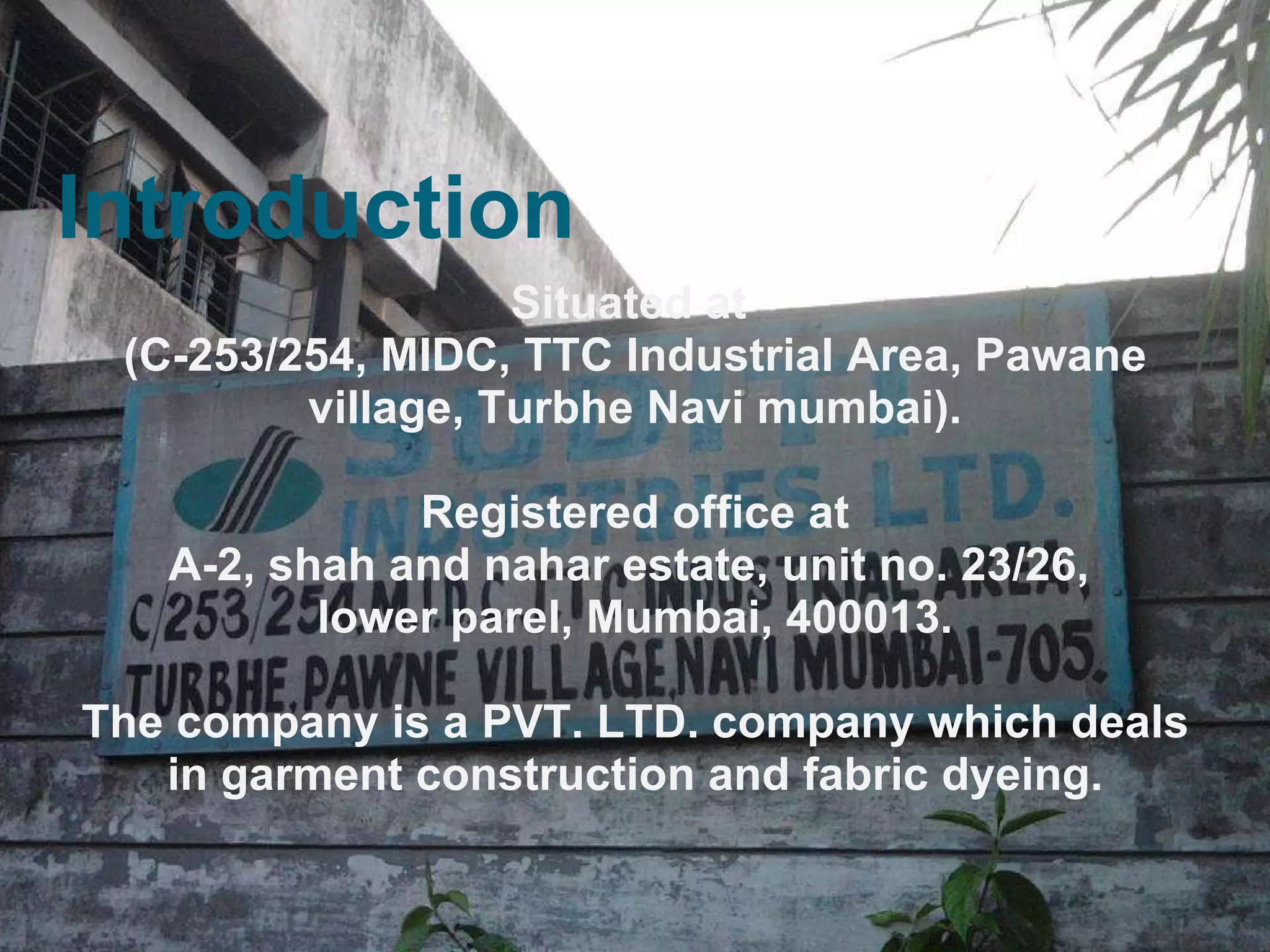
Introduction Situated at  (C-253/254, MIDC, TTC Industrial Area, Pawane village, Turbhe Navi mumbai). Registered office at A-2, shah and nahar estate, unit no. 23/26,  lower parel, Mumbai, 400013. The company is a PVT. LTD. company which deals in garment construction and fabric dyeing.
About the company Mr.   Anand Agarwal , is The MD and chairman of the company. Mr . V. Gopalkrishanan  is VP and COMPANY SECRETARY. The company is a listed company in  Bombay Stock Exchange (BSE)  and the  National Stock Exchange (NSE)  as  521113  and  SUDITIND  respectively.
About the company The company was incorporated on Sep. 21, 1991 and came out with a public issue on Jan. 18, 1994. The company is  ISO 9001-2000  certified company from AQSR. The company has  OEKOTEX standard 100 certification  which   has helped obtain orders from  Belgium, Italy, Spain,  and other countries,   besides  USA.
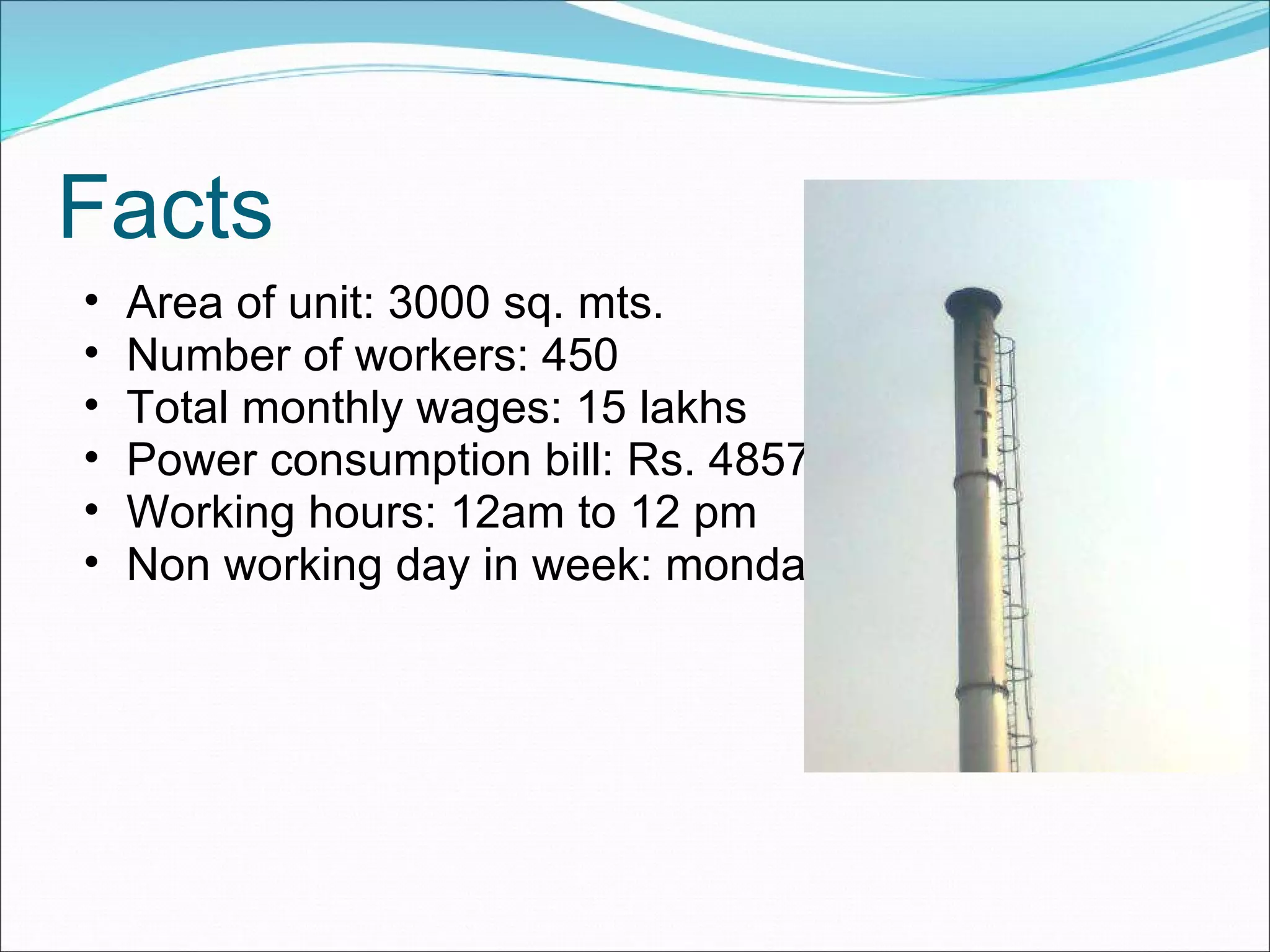
Facts Area of unit: 3000 sq. mts. Number of workers: 450 Total monthly wages: 15 lakhs Power consumption bill: Rs. 48573 Working hours: 12am to 12 pm Non working day in week: monday
Steps in dyeing of fabric Raw cloth is washed and bleached. In automatic dispensing machine, dye solution is prepared. In the fabric dyeing machine, dyeing of fabric is done. In the drying machine, the wet fabric is dried. After this soft ironing is done. At last finishing of fabric is done.
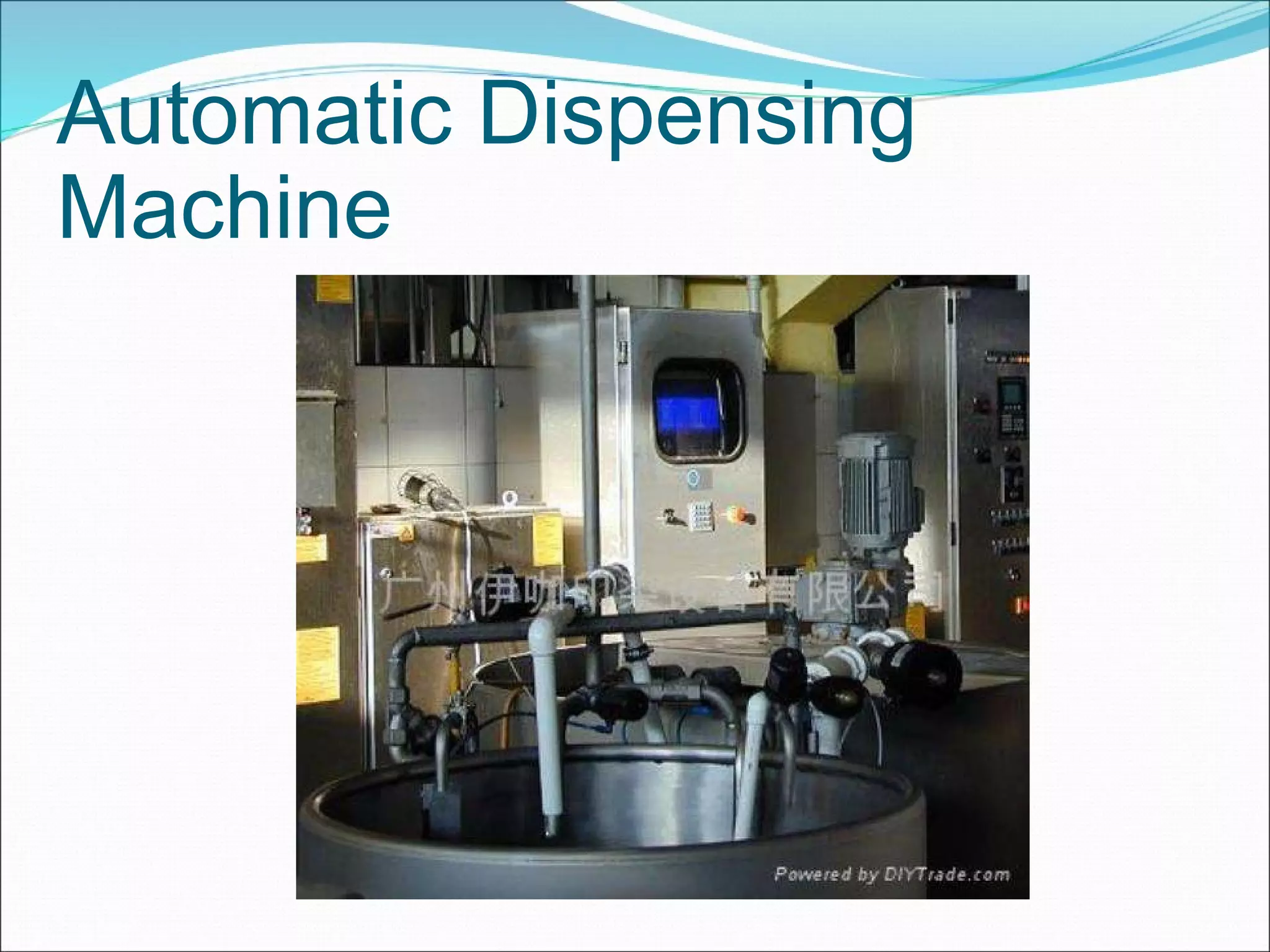
Automatic Dispensing Machine
Automatic Dispensing Machine The main functioning of this machine is the mixing of colour, pigments, dyes, salts and chemicals in the proper solvent and then making a homogeneous solution. Raw material: Chemicals, Salts (glober salt,table salt,NaCl),  Colours (Remazole, Seepra, Magenta, Blue, Green)  Dissolution time: 3-5 hrs
Fabric Dyeing Machine
Fabric Dyeing Machine These machines work on the principle of  WASHING MACHINES. There were machines of capacity of 100kgs, 200kgs, 300kgs, 500kgs and 1 ton. Fabric and dye solution are rotated for 3-4 hours at an even temerature. The temperature required for dyeing is around  65-75 0  C  , but can work upto  135 0  C  .
Features: Body made up of Heavy duty cast stainless steel Magnetic level indicator High efficiency heat exchanger Low liquor ratio of 1:6 Low power consumption Low weight loss of 3.5% No pilling effects Maximum working pressure of 3.2 bar Dye - 30 to 450 g/mt.sq.
Drying Machine
Drying Machine This machine works on the principle of the  HAIR DRYER. The bundle of fabric is placed in roller and the cloth is dried by blowing hot air from bottom. The temperature range is 160-170 0 C. Before drying process, the dyeing solution is squeezed and the fabric is made straight into plane forms by rollers for uniform drying
Finishing Machines
Finishing Machines They provide the finishing touch to the dyed fabric, after the drying of the fabric takes places. It checks the defects of the fabric if there is any hole in the fabric or any spots in the dyeing. Soft ironing Packaging
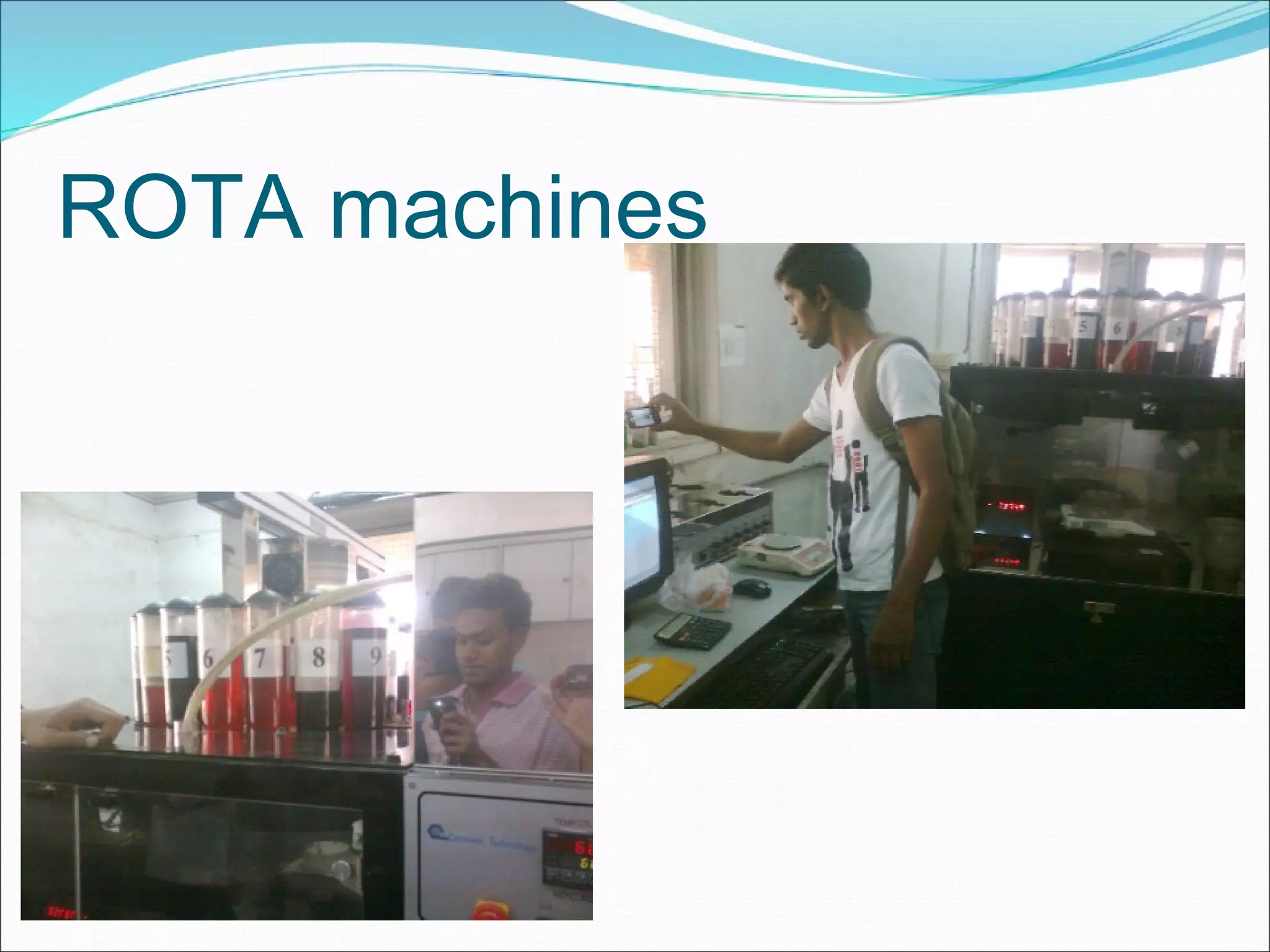
ROTA machines Name - ROTA 20-30  Type - Lubrication cartouche Manufacturer - Collomix (Germany) Mixing capacity - 35 kg Motor power - 1.1 kW Power rate - 230V/50 Hz Machine dimension - 780*800*1092 mm Weight - 207 kg Cost - 30-40 lakhs
ROTA machines
Facts about the machine Mixing in closed containers; oval/round/square BIAXIAL hi speed mixing process, short mixing times of less than 90 seconds even for heavy machines Maximum reliability due to sturdy design Attractive design, powder- coated housing Swing door, simple and robust
Advantages of using Rota machine Fully automatic process: clamp-mix-release Safety by clamping sensor Smooth operation using gentle Biax technology Container table can be pulled out full length User support using LCD display Easy to service Easy to access and transport rollers
Environmental Issues EFFULENT DISCHARGES: Industrial effluent=250 CMD Disposed at=C.E.P.T AIR EMMISIONS: SO 2 =140-150 kg per day SPM/TPM=150 mg/Nm 2 HAZARDOUS WASTES: Category number 24.1 & 24.2=200kg/M Disposed at=TTCWMA HAZARDOUS CHEMICALS : Acetic acid=5T/M Hydrochloric acid=1T/M Hydrogen peroxide=4.5T/M
Safety Measures Fire extinguishers Trained personnel Specially designed protective dresses Regular inspection of machines Appropriate maintenance Careful handling of chemicals First aid service
Health Measures Exposure to dyeing dust Exposure to chemicals Exposure to noise
Bibliography Websites: Http://en.wikipedia.org/wiki/Dyeing  Books: A hand book on dyeing process by R. L. Mathur
Thank you.

Field studies

  • 1.
    by: AshutoshVatsa Kr. Pramendra Sinha Mohan Pegu Pankaj Pathak Sanath Kr. Pegu Sushant Kumar
  • 2.
    Introduction Situated at (C-253/254, MIDC, TTC Industrial Area, Pawane village, Turbhe Navi mumbai). Registered office at A-2, shah and nahar estate, unit no. 23/26, lower parel, Mumbai, 400013. The company is a PVT. LTD. company which deals in garment construction and fabric dyeing.
  • 3.
    About the companyMr. Anand Agarwal , is The MD and chairman of the company. Mr . V. Gopalkrishanan is VP and COMPANY SECRETARY. The company is a listed company in Bombay Stock Exchange (BSE) and the National Stock Exchange (NSE) as 521113 and SUDITIND respectively.
  • 4.
    About the companyThe company was incorporated on Sep. 21, 1991 and came out with a public issue on Jan. 18, 1994. The company is ISO 9001-2000 certified company from AQSR. The company has OEKOTEX standard 100 certification which has helped obtain orders from Belgium, Italy, Spain, and other countries, besides USA.
  • 5.
    Facts Area ofunit: 3000 sq. mts. Number of workers: 450 Total monthly wages: 15 lakhs Power consumption bill: Rs. 48573 Working hours: 12am to 12 pm Non working day in week: monday
  • 6.
    Steps in dyeingof fabric Raw cloth is washed and bleached. In automatic dispensing machine, dye solution is prepared. In the fabric dyeing machine, dyeing of fabric is done. In the drying machine, the wet fabric is dried. After this soft ironing is done. At last finishing of fabric is done.
  • 7.
  • 8.
    Automatic Dispensing MachineThe main functioning of this machine is the mixing of colour, pigments, dyes, salts and chemicals in the proper solvent and then making a homogeneous solution. Raw material: Chemicals, Salts (glober salt,table salt,NaCl), Colours (Remazole, Seepra, Magenta, Blue, Green) Dissolution time: 3-5 hrs
  • 9.
  • 10.
    Fabric Dyeing MachineThese machines work on the principle of WASHING MACHINES. There were machines of capacity of 100kgs, 200kgs, 300kgs, 500kgs and 1 ton. Fabric and dye solution are rotated for 3-4 hours at an even temerature. The temperature required for dyeing is around 65-75 0 C , but can work upto 135 0 C .
  • 11.
    Features: Body madeup of Heavy duty cast stainless steel Magnetic level indicator High efficiency heat exchanger Low liquor ratio of 1:6 Low power consumption Low weight loss of 3.5% No pilling effects Maximum working pressure of 3.2 bar Dye - 30 to 450 g/mt.sq.
  • 12.
  • 13.
    Drying Machine Thismachine works on the principle of the HAIR DRYER. The bundle of fabric is placed in roller and the cloth is dried by blowing hot air from bottom. The temperature range is 160-170 0 C. Before drying process, the dyeing solution is squeezed and the fabric is made straight into plane forms by rollers for uniform drying
  • 14.
  • 15.
    Finishing Machines Theyprovide the finishing touch to the dyed fabric, after the drying of the fabric takes places. It checks the defects of the fabric if there is any hole in the fabric or any spots in the dyeing. Soft ironing Packaging
  • 16.
    ROTA machines Name- ROTA 20-30 Type - Lubrication cartouche Manufacturer - Collomix (Germany) Mixing capacity - 35 kg Motor power - 1.1 kW Power rate - 230V/50 Hz Machine dimension - 780*800*1092 mm Weight - 207 kg Cost - 30-40 lakhs
  • 17.
  • 18.
    Facts about themachine Mixing in closed containers; oval/round/square BIAXIAL hi speed mixing process, short mixing times of less than 90 seconds even for heavy machines Maximum reliability due to sturdy design Attractive design, powder- coated housing Swing door, simple and robust
  • 19.
    Advantages of usingRota machine Fully automatic process: clamp-mix-release Safety by clamping sensor Smooth operation using gentle Biax technology Container table can be pulled out full length User support using LCD display Easy to service Easy to access and transport rollers
  • 20.
    Environmental Issues EFFULENTDISCHARGES: Industrial effluent=250 CMD Disposed at=C.E.P.T AIR EMMISIONS: SO 2 =140-150 kg per day SPM/TPM=150 mg/Nm 2 HAZARDOUS WASTES: Category number 24.1 & 24.2=200kg/M Disposed at=TTCWMA HAZARDOUS CHEMICALS : Acetic acid=5T/M Hydrochloric acid=1T/M Hydrogen peroxide=4.5T/M
  • 21.
    Safety Measures Fireextinguishers Trained personnel Specially designed protective dresses Regular inspection of machines Appropriate maintenance Careful handling of chemicals First aid service
  • 22.
    Health Measures Exposureto dyeing dust Exposure to chemicals Exposure to noise
  • 23.
    Bibliography Websites: Http://en.wikipedia.org/wiki/Dyeing Books: A hand book on dyeing process by R. L. Mathur
  • 24.