Our Presentation Topics
FABRIC
MANUFACTURING
ENGINEERING-1
Welcome to My
Presentation
WINDING
Presented By :
Md. Ariful Islam (Arif)
ID : 175002
Department of Textile Engineering
Email : arif.duet.te@gmail.com
Presented To:
Mr. Shamsuzzaman Sheikh
Assistant Professor
Department of Textile Engineering
DUET, Gazipur
DHAKA UNIVERSITY OF ENGINEERING & TECHNOLOGY,
GAZIPUR
DHAKA UNIVERSITY OF ENGINEERING & TECHNOLOGY,
GAZIPUR07-Jan-20 2
ABOUT WINDING MACHINE
WHAT IS WINDING?
 Definition: The process of transferring yarn from small
packages like hank, bobbing etc to a large package such as cones,
pirns, cheese etc, containing considerable length of yarn is called
winding.
 Example: From hanks to bobbins, bobbins to cone, cone to pirn etc.
DHAKA UNIVERSITY OF ENGINEERING & TECHNOLOGY,
GAZIPUR07-Jan-20 3
Objectives :
 To transfer yarn from one package to another
suitable package, this can be conveniently used
for weaving purpose.
 To remove yarn faults like hairiness, neps,
slubs and foreign matters.
 To clean yarn.
 To improve the quality of yarn.
 To get a suitable package.
 To store the yarn.
 To make easier the next process.
 To preparing soft package of yarn dyeing.
DHAKA UNIVERSITY OF ENGINEERING & TECHNOLOGY,
GAZIPUR07-Jan-20 4
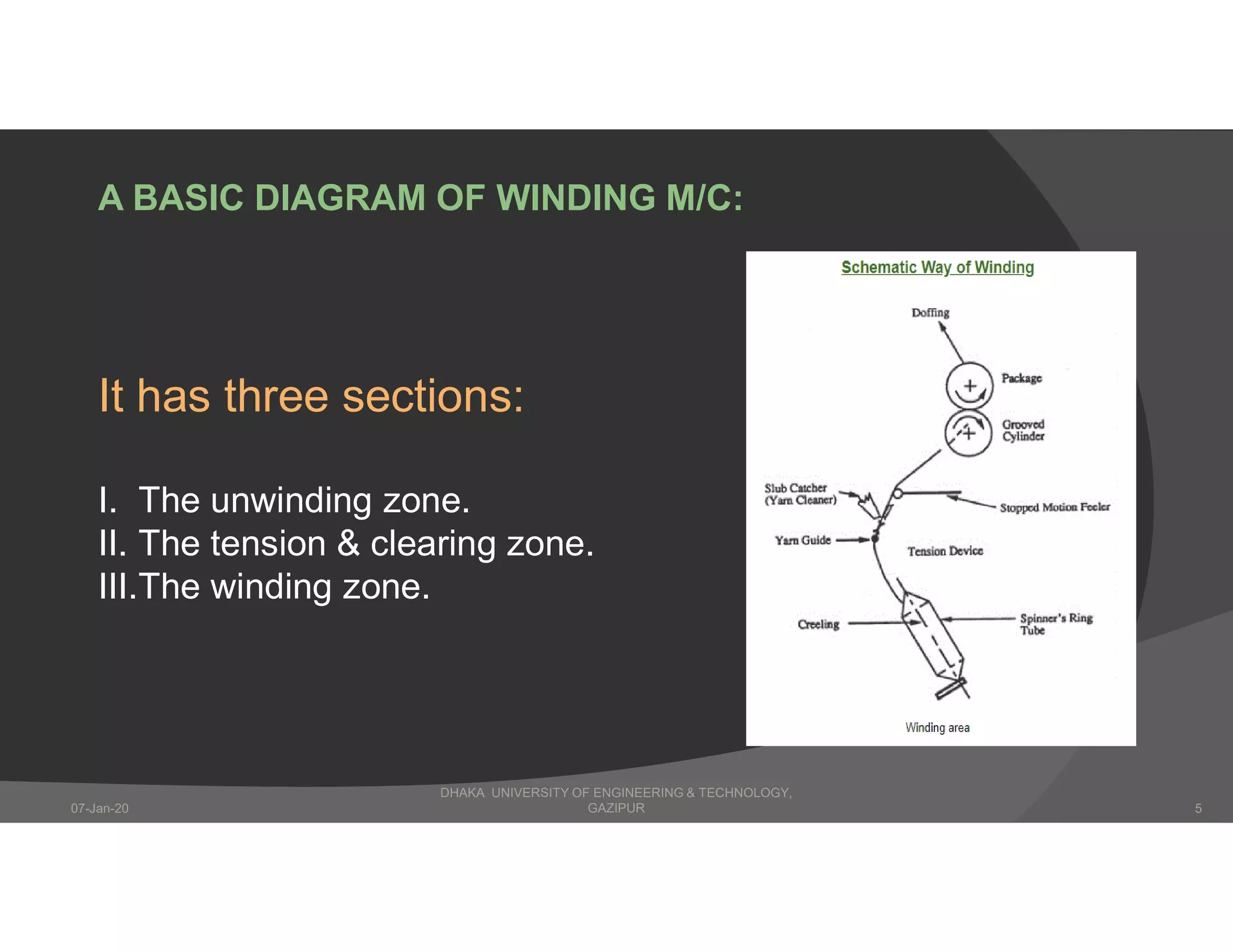
A BASIC DIAGRAM OF WINDING M/C:
It has three sections:
I. The unwinding zone.
II. The tension & clearing zone.
III.The winding zone.
DHAKA UNIVERSITY OF ENGINEERING & TECHNOLOGY,
GAZIPUR07-Jan-20 5
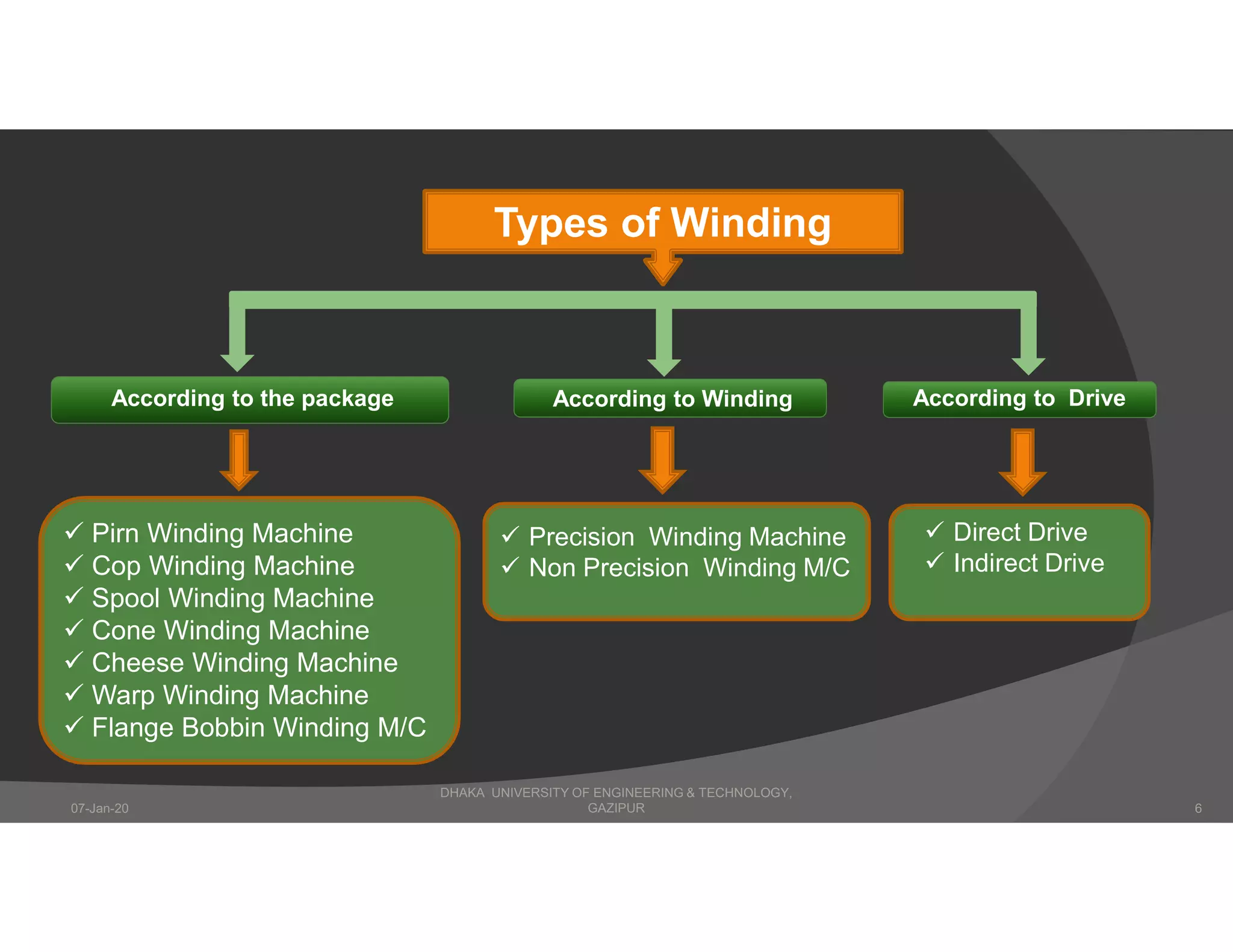
Types of Winding
 Precision Winding Machine
 Non Precision Winding M/C
According to Drive
 Direct Drive
 Indirect Drive
According to WindingAccording to the package
 Pirn Winding Machine
 Cop Winding Machine
 Spool Winding Machine
 Cone Winding Machine
 Cheese Winding Machine
 Warp Winding Machine
 Flange Bobbin Winding M/C
DHAKA UNIVERSITY OF ENGINEERING & TECHNOLOGY,
GAZIPUR07-Jan-20 6
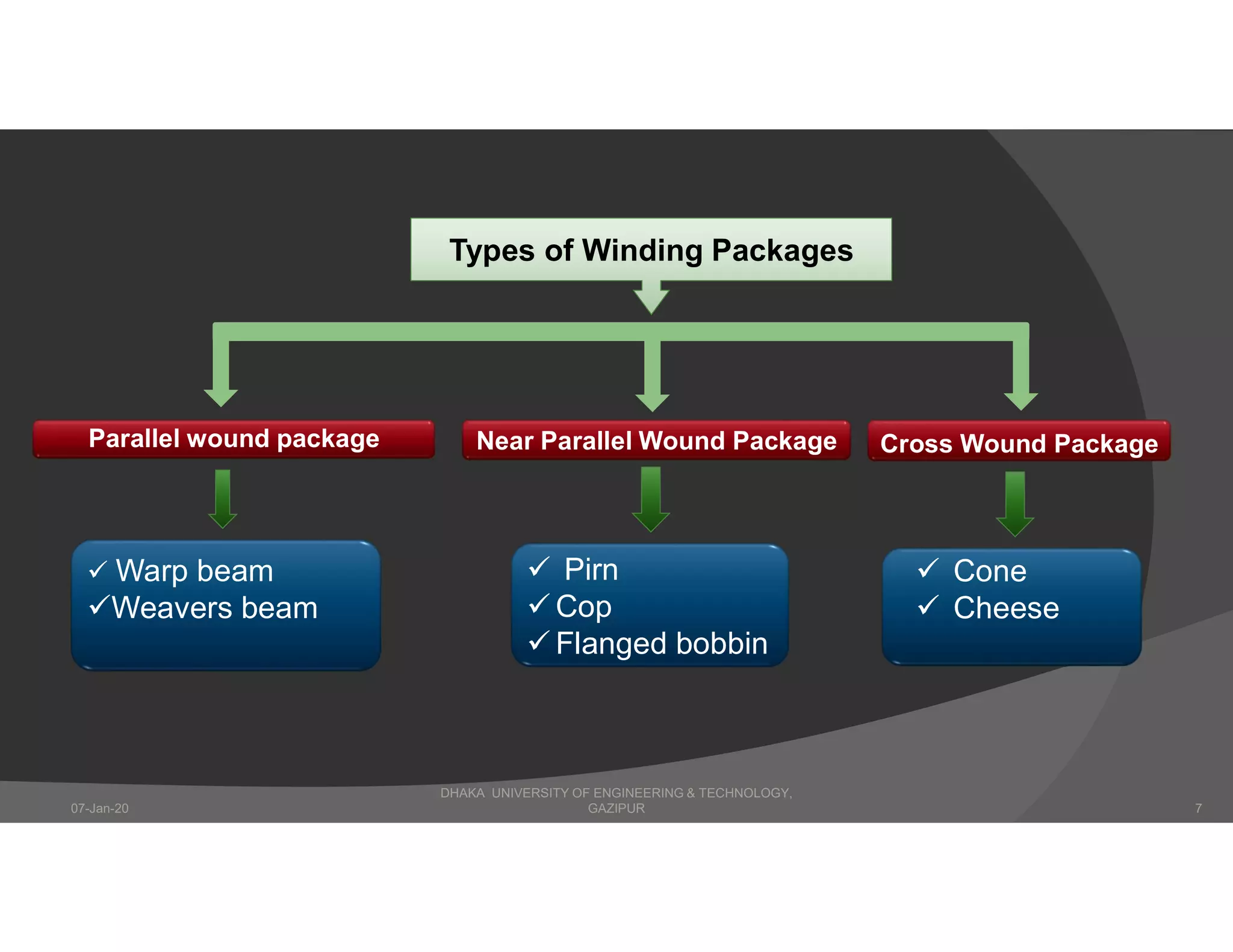
Types of Winding Packages
 Pirn
 Cop
 Flanged bobbin
Cross Wound Package
 Cone
 Cheese
Near Parallel Wound PackageParallel wound package
 Warp beam
Weavers beam
DHAKA UNIVERSITY OF ENGINEERING & TECHNOLOGY,
GAZIPUR07-Jan-20 7
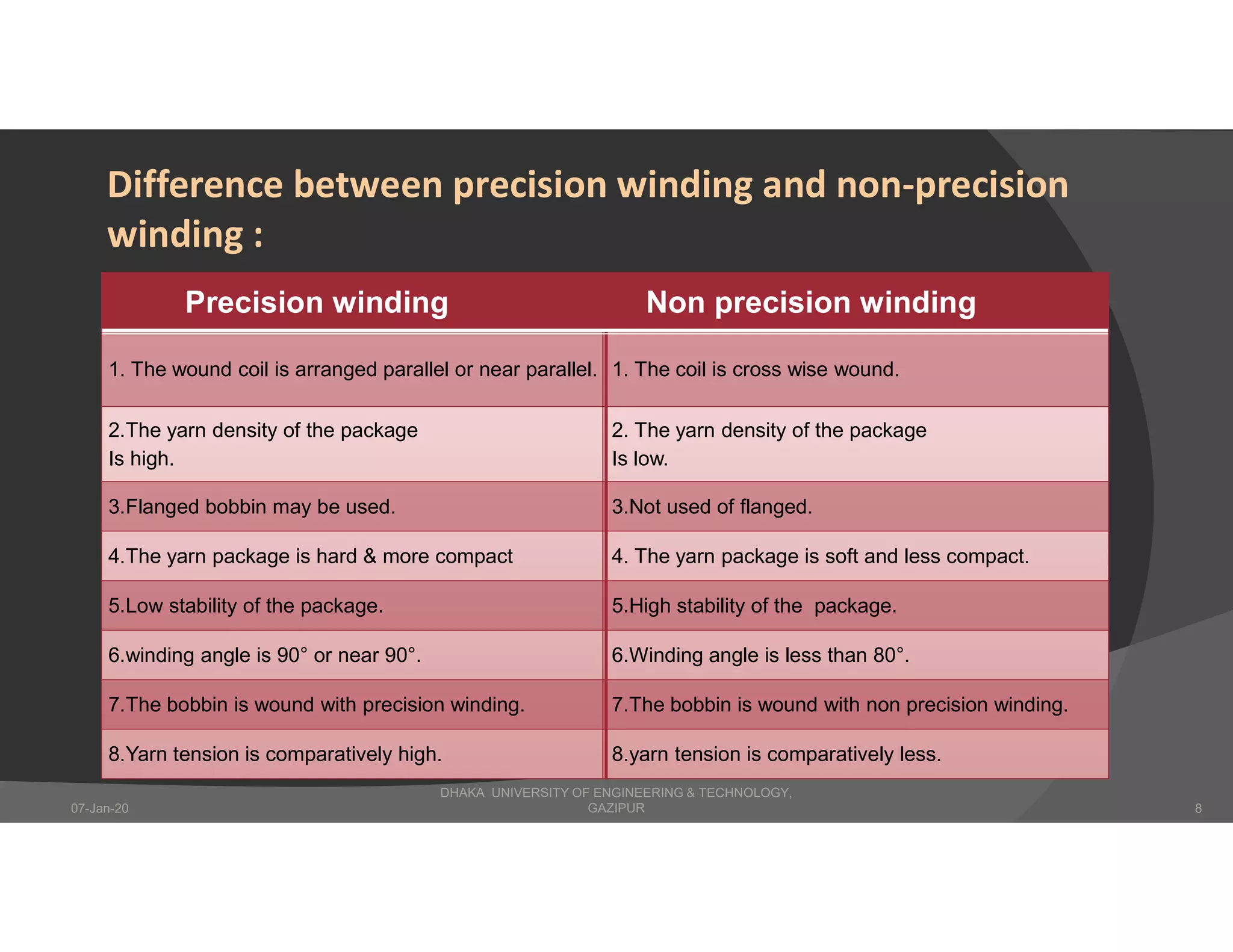
Precision winding Non precision winding
1. The wound coil is arranged parallel or near parallel. 1. The coil is cross wise wound.
2.The yarn density of the package
Is high.
2. The yarn density of the package
Is low.
3.Flanged bobbin may be used. 3.Not used of flanged.
4.The yarn package is hard & more compact 4. The yarn package is soft and less compact.
5.Low stability of the package. 5.High stability of the package.
6.winding angle is 90° or near 90°. 6.Winding angle is less than 80°.
7.The bobbin is wound with precision winding. 7.The bobbin is wound with non precision winding.
8.Yarn tension is comparatively high. 8.yarn tension is comparatively less.
Difference between precision winding and non-precision
winding :
DHAKA UNIVERSITY OF ENGINEERING & TECHNOLOGY,
GAZIPUR07-Jan-20 8
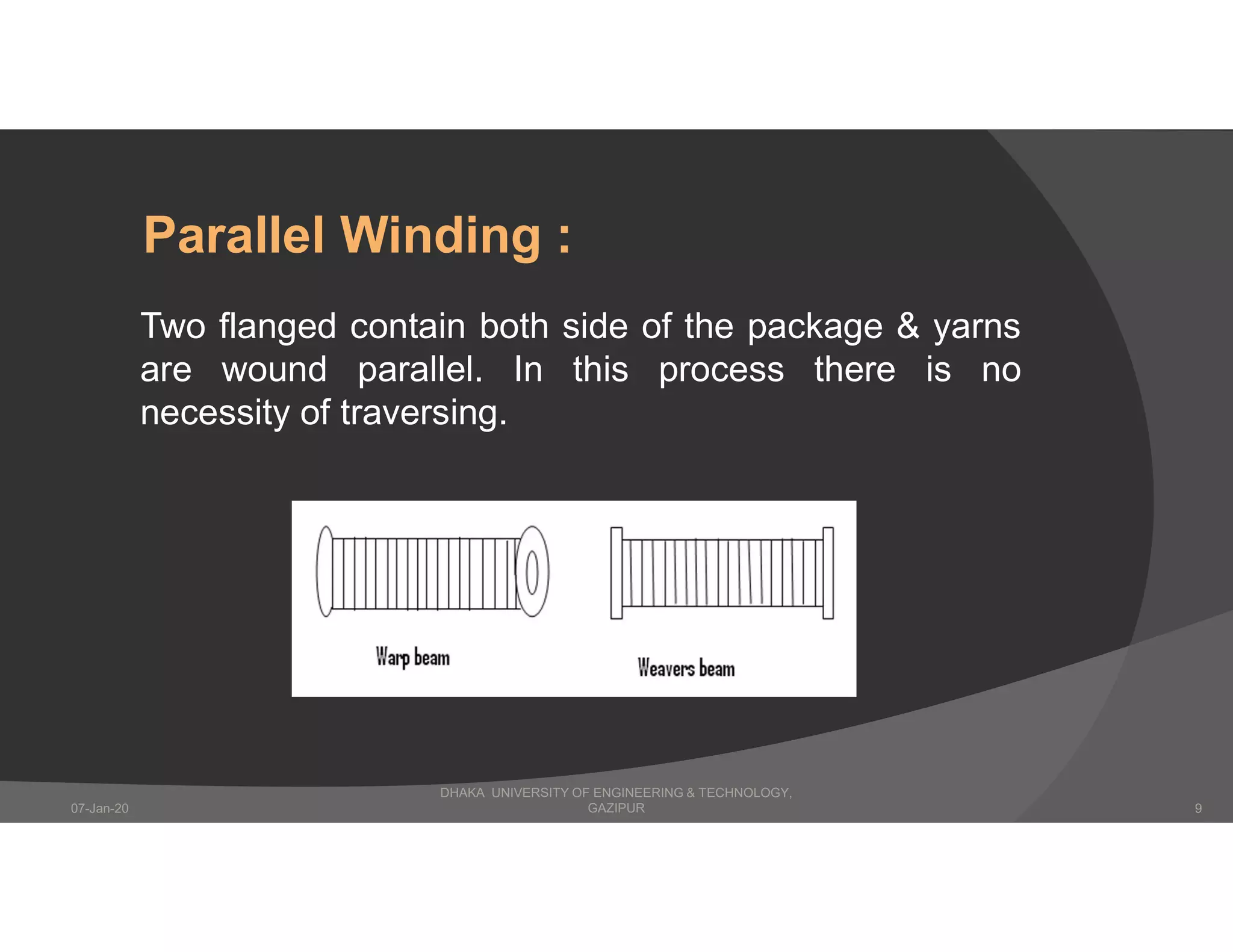
Two flanged contain both side of the package & yarns
are wound parallel. In this process there is no
necessity of traversing.
Parallel Winding :
DHAKA UNIVERSITY OF ENGINEERING & TECHNOLOGY,
GAZIPUR07-Jan-20 9
Advantages :
 Many yarns can be wound at a time.
 No need of traversing mechanism.
 Side withdrawal is possible.
 The density of yarn is more.
 No change of number of turns per
inch.
Disadvantages:
 Two sides of the package need
flanged.
 For yarn unwinding, need
separate mechanism.
 Can not be over withdrawal.
Advantages & Disadvantages of Parallel Wound
Package
DHAKA UNIVERSITY OF ENGINEERING & TECHNOLOGY,
GAZIPUR07-Jan-20 10
Near parallel winding :
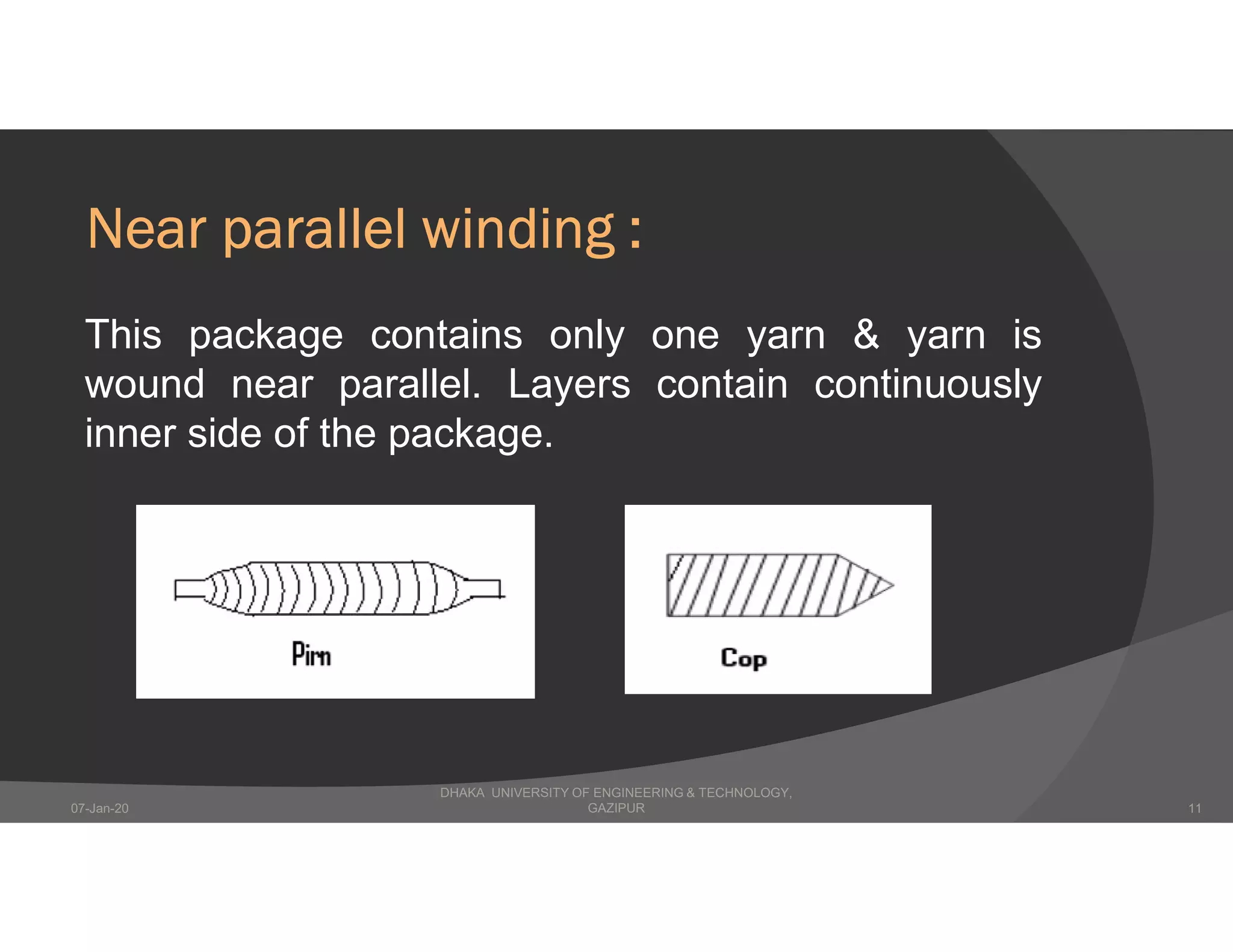
This package contains only one yarn & yarn is
wound near parallel. Layers contain continuously
inner side of the package.
DHAKA UNIVERSITY OF ENGINEERING & TECHNOLOGY,
GAZIPUR07-Jan-20 11
Advantages & Disadvantages of Near Parallel
Wound Package
Advantages:
 No need of flanged
 Can be side withdrawal.
 No change of number of yarn turns
per inch during winding.
Disadvantages:
 Need of traversing mechanism.
 Can not be side withdrawal.
DHAKA UNIVERSITY OF ENGINEERING & TECHNOLOGY,
GAZIPUR07-Jan-20 12
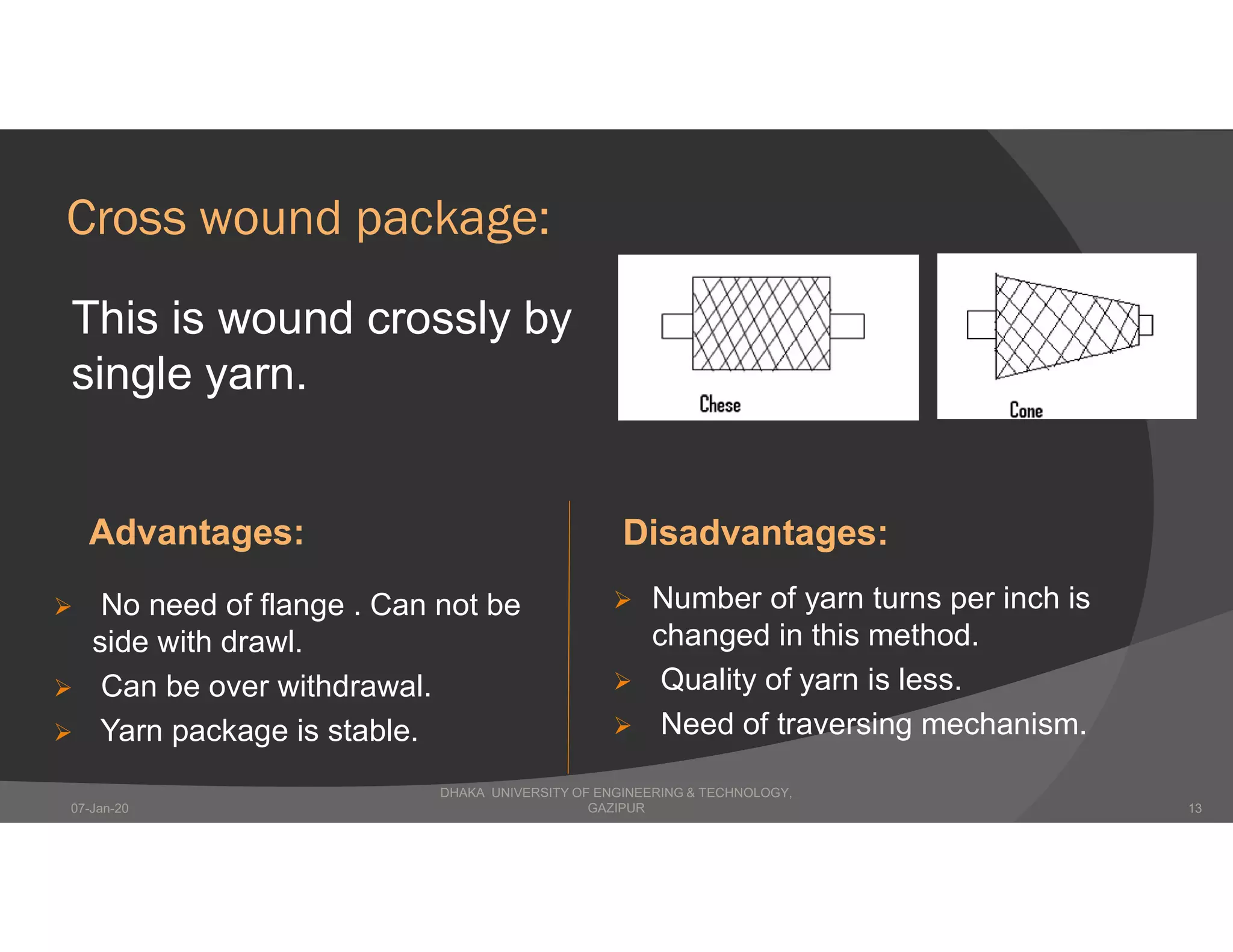
Cross wound package:
This is wound crossly by
single yarn.
Advantages: Disadvantages:
 No need of flange . Can not be
side with drawl.
 Can be over withdrawal.
 Yarn package is stable.
 Number of yarn turns per inch is
changed in this method.
 Quality of yarn is less.
 Need of traversing mechanism.
DHAKA UNIVERSITY OF ENGINEERING & TECHNOLOGY,
GAZIPUR07-Jan-20 13
Various types of tension device
(According to working principle) :
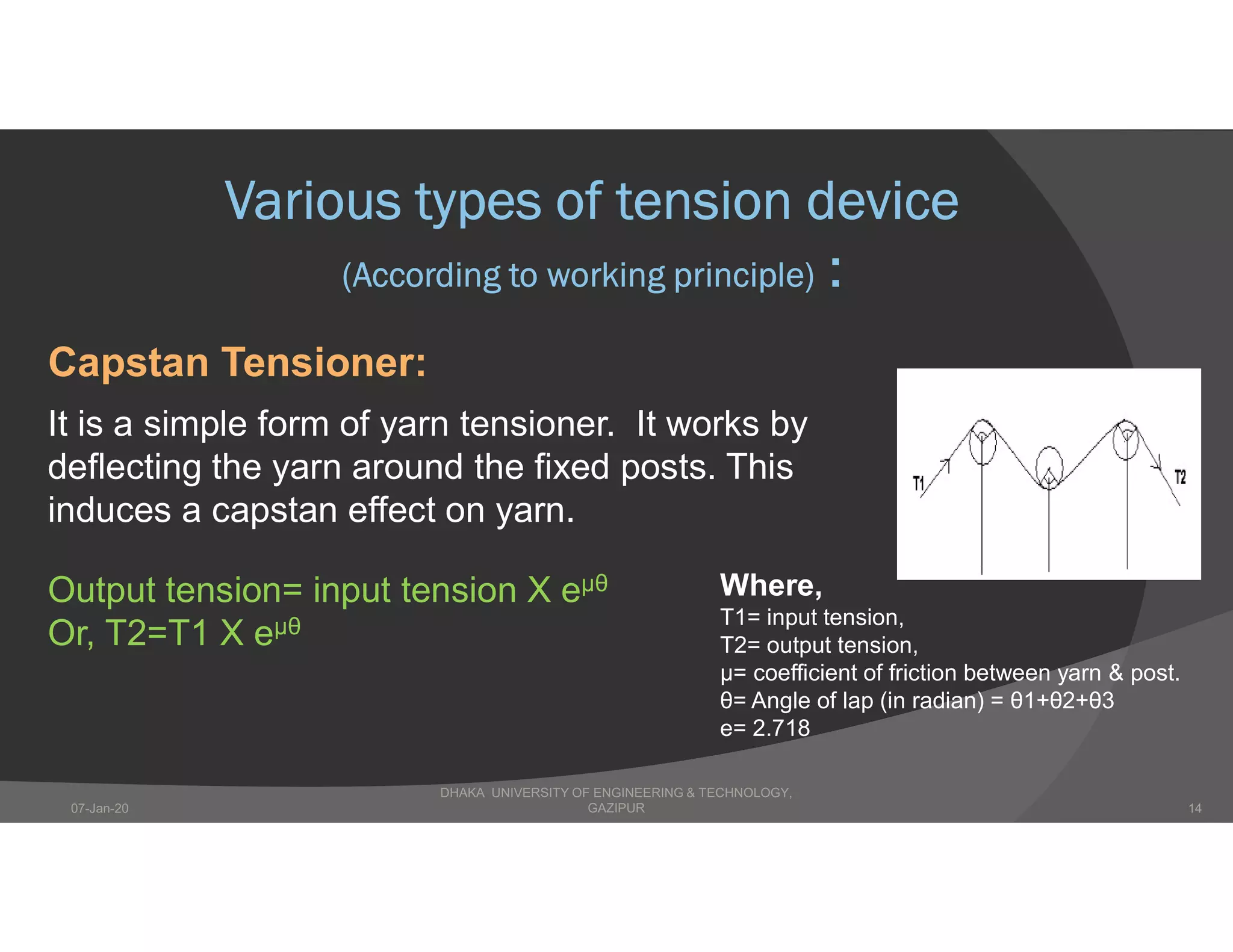
It is a simple form of yarn tensioner. It works by
deflecting the yarn around the fixed posts. This
induces a capstan effect on yarn.
Capstan Tensioner:
Output tension= input tension X eµθ
Or, T2=T1 X eµθ
Where,
T1= input tension,
T2= output tension,
μ= coefficient of friction between yarn & post.
θ= Angle of lap (in radian) = θ1+θ2+θ3
e= 2.718
DHAKA UNIVERSITY OF ENGINEERING & TECHNOLOGY,
GAZIPUR07-Jan-20 14
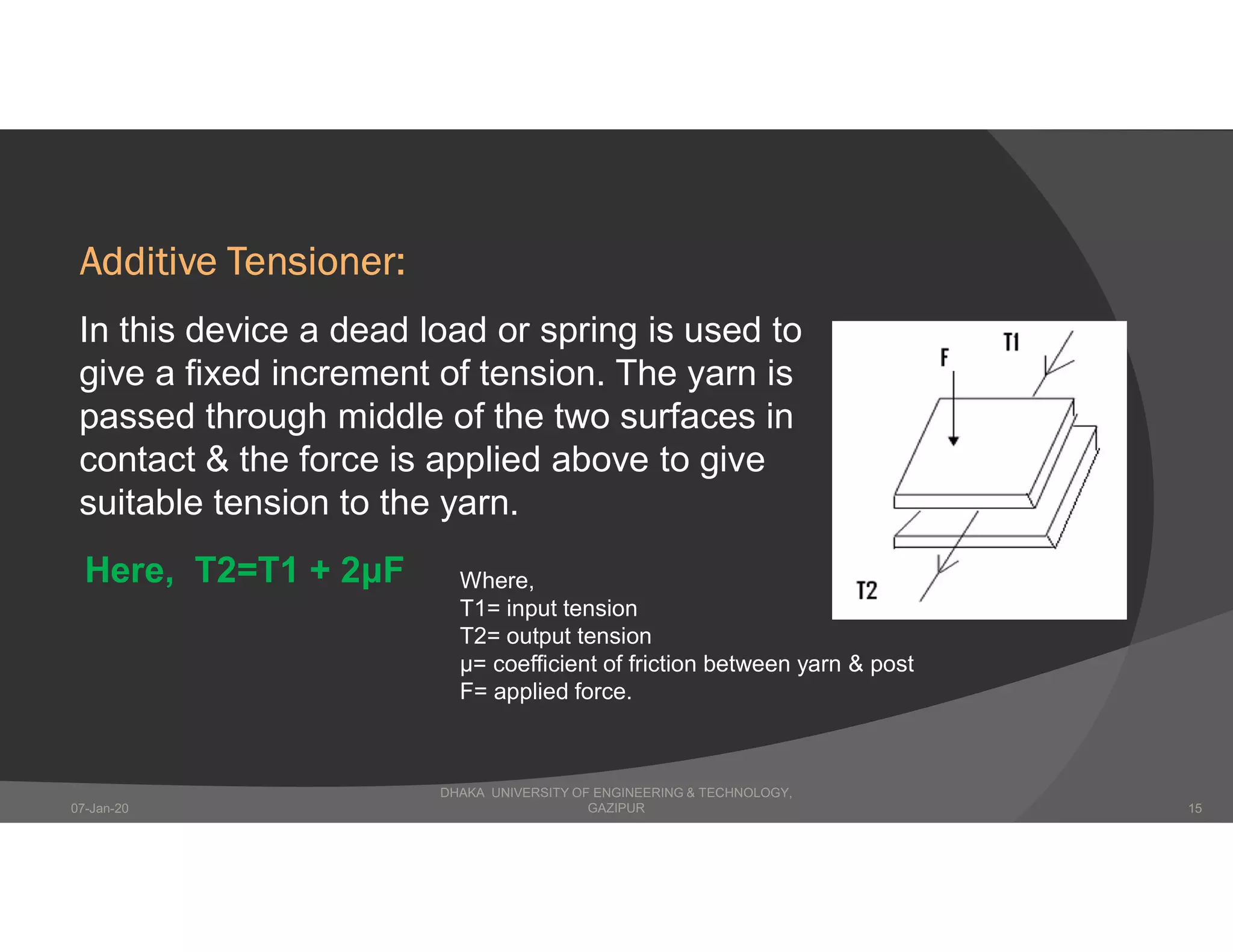
Additive Tensioner:
In this device a dead load or spring is used to
give a fixed increment of tension. The yarn is
passed through middle of the two surfaces in
contact & the force is applied above to give
suitable tension to the yarn.
Here, T2=T1 + 2μF Where,
T1= input tension
T2= output tension
μ= coefficient of friction between yarn & post
F= applied force.
DHAKA UNIVERSITY OF ENGINEERING & TECHNOLOGY,
GAZIPUR07-Jan-20 15
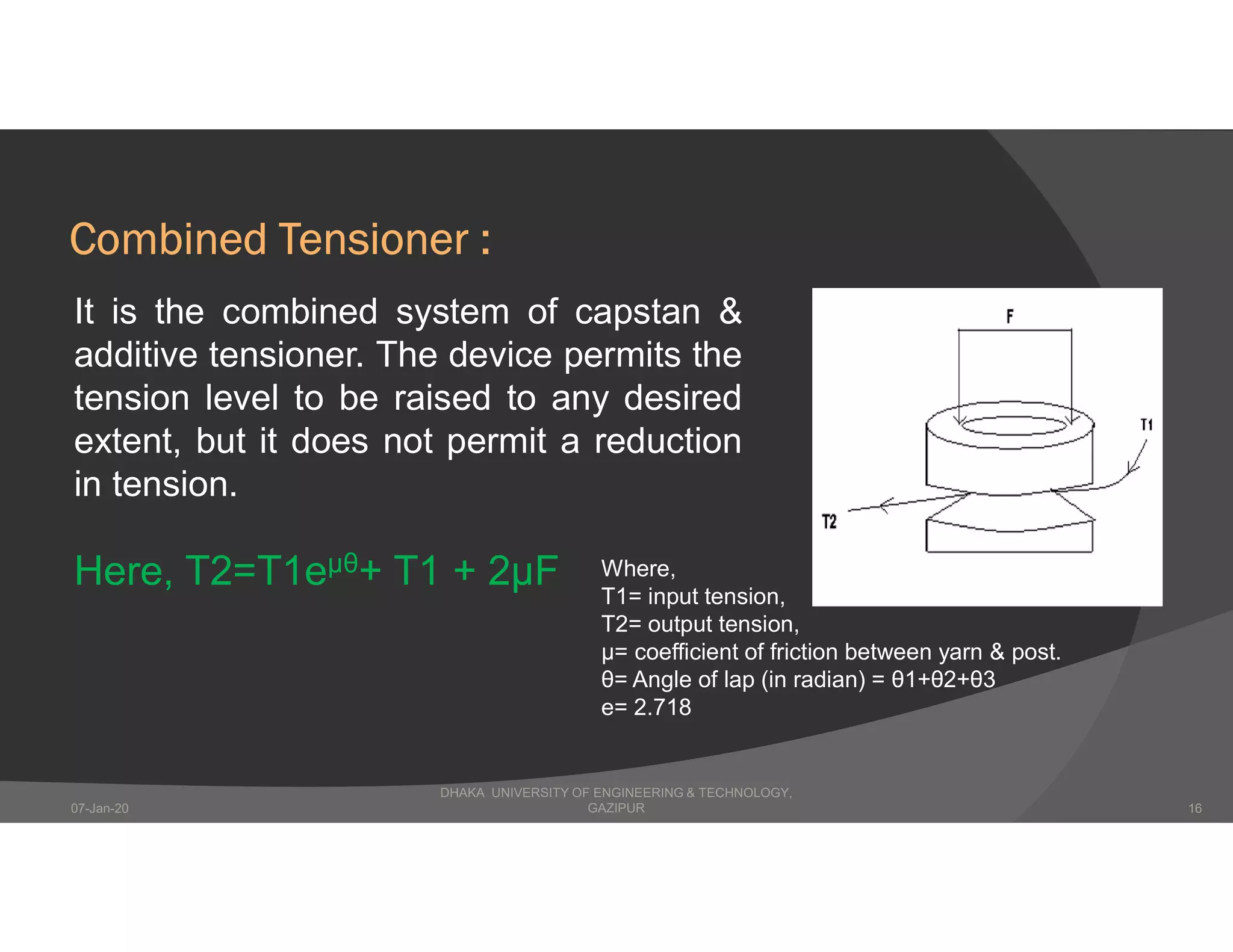
Combined Tensioner :
It is the combined system of capstan &
additive tensioner. The device permits the
tension level to be raised to any desired
extent, but it does not permit a reduction
in tension.
Here, T2=T1eµθ+ T1 + 2μF Where,
T1= input tension,
T2= output tension,
μ= coefficient of friction between yarn & post.
θ= Angle of lap (in radian) = θ1+θ2+θ3
e= 2.718
DHAKA UNIVERSITY OF ENGINEERING & TECHNOLOGY,
GAZIPUR07-Jan-20 16
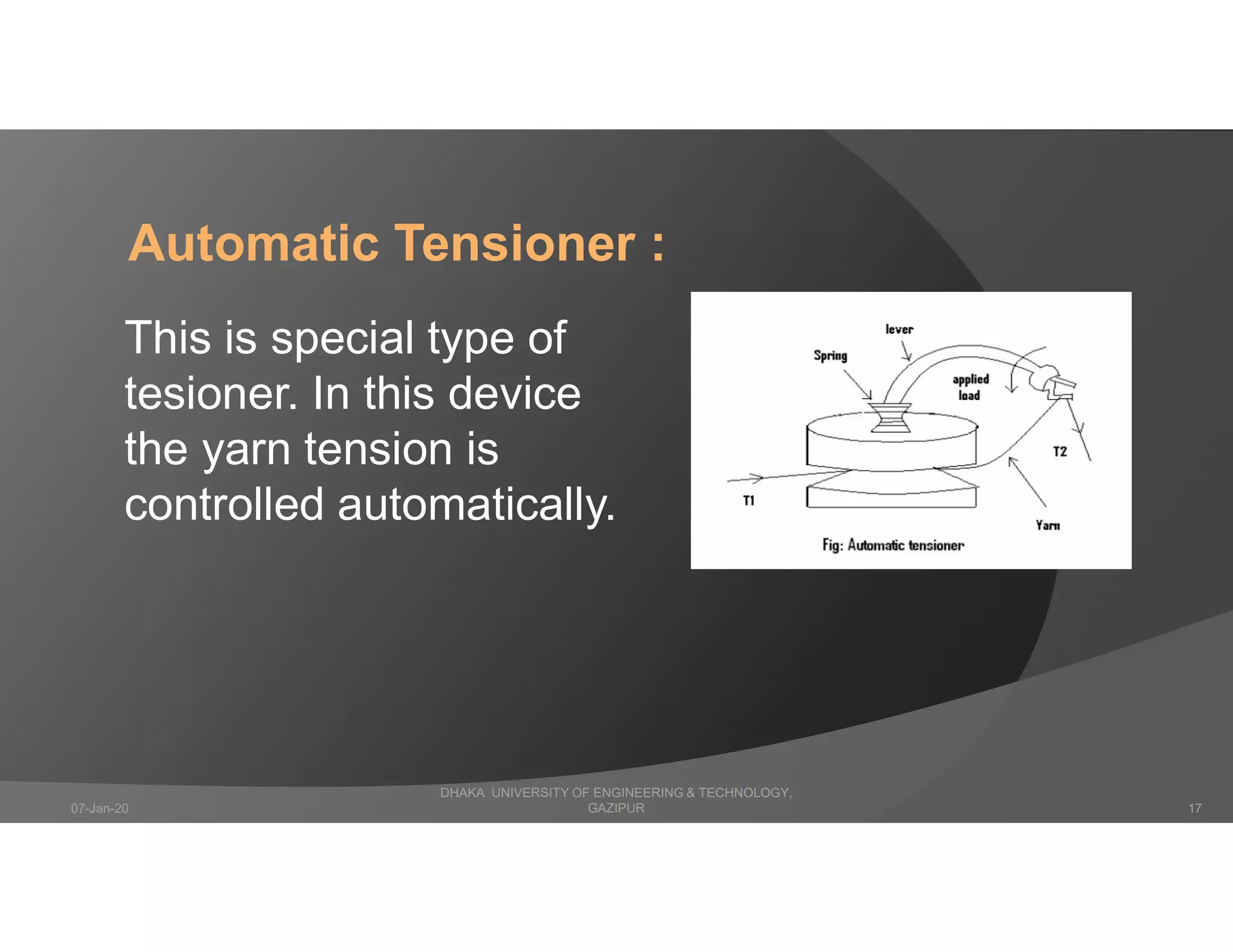
Automatic Tensioner :
This is special type of
tesioner. In this device
the yarn tension is
controlled automatically.
DHAKA UNIVERSITY OF ENGINEERING & TECHNOLOGY,
GAZIPUR07-Jan-20 17
Factor influences for selection of tensioner :
 The device must be reliable to control uniform tension.
 It must be easily threaded.
It must not introduce differences in twist.
 It must not be affected by the presence of oil & dirt.
 It must be easily adjustable.
It must be capable of easy cleaning.
 The operating surfaces must be smooth.
 It must be cheap.
 It must be simple in design & operation.
 It must not damage for yarn.
DHAKA UNIVERSITY OF ENGINEERING & TECHNOLOGY,
GAZIPUR07-Jan-20 18
Depending On the type of the working
member acting on the yarn :
 Ball type
 Washer type
 Disc type
 Roller type
 Comb type
 Two zone type
DHAKA UNIVERSITY OF ENGINEERING & TECHNOLOGY,
GAZIPUR07-Jan-20 19
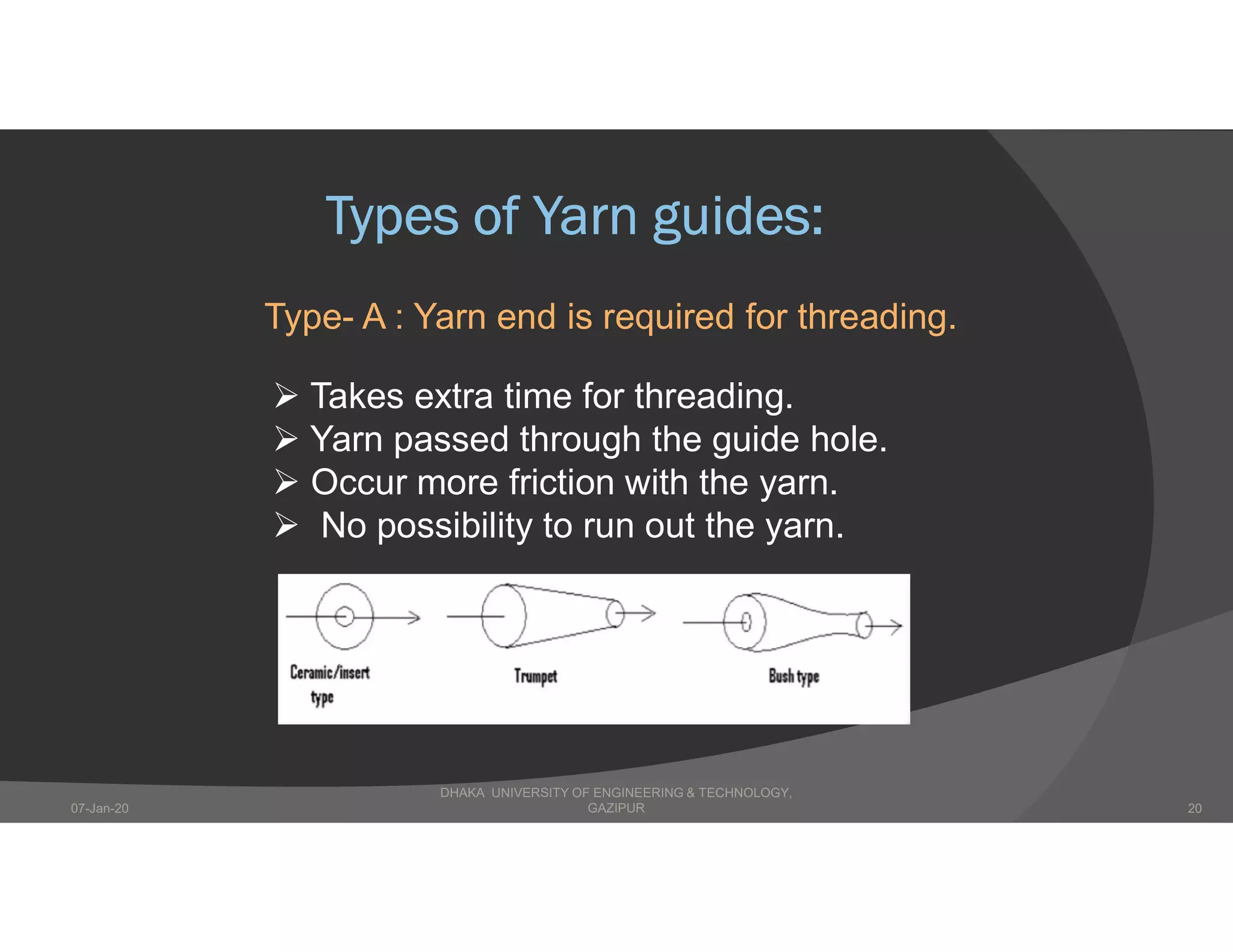
Types of Yarn guides:
Type- A : Yarn end is required for threading.
 Takes extra time for threading.
 Yarn passed through the guide hole.
 Occur more friction with the yarn.
 No possibility to run out the yarn.
DHAKA UNIVERSITY OF ENGINEERING & TECHNOLOGY,
GAZIPUR07-Jan-20 20
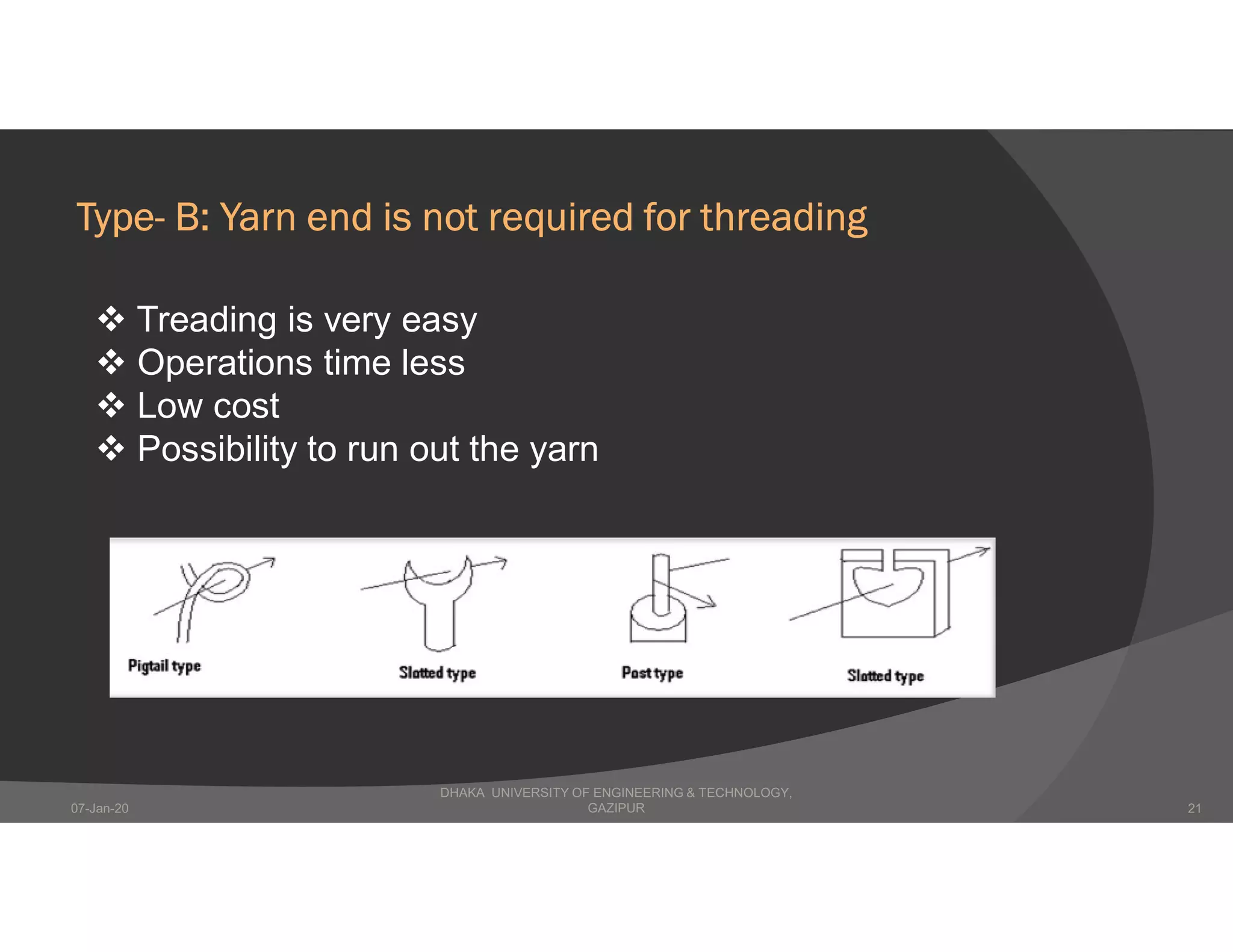
Type- B: Yarn end is not required for threading
 Treading is very easy
 Operations time less
 Low cost
 Possibility to run out the yarn
DHAKA UNIVERSITY OF ENGINEERING & TECHNOLOGY,
GAZIPUR07-Jan-20 21
Yarn withdrawal or Unwinding:
Unwinding process of yarn from a package is called
withdrawal of yarn.
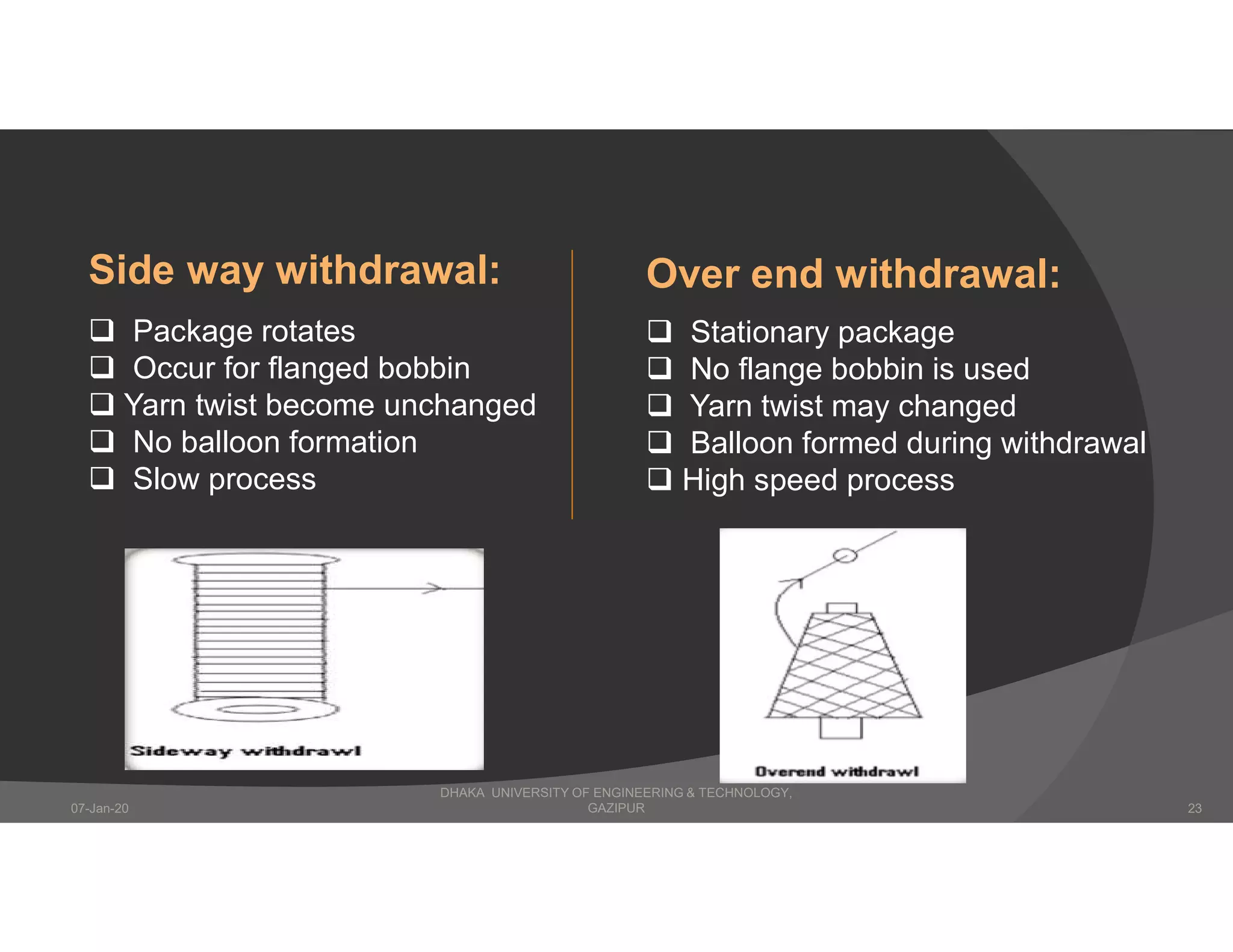
There are two types of withdrawal:
1. Sideway withdrawal.
2. Over end withdrawal.
DHAKA UNIVERSITY OF ENGINEERING & TECHNOLOGY,
GAZIPUR07-Jan-20 22
Side way withdrawal:
 Package rotates
 Occur for flanged bobbin
 Yarn twist become unchanged
 No balloon formation
 Slow process
Over end withdrawal:
 Stationary package
 No flange bobbin is used
 Yarn twist may changed
 Balloon formed during withdrawal
 High speed process
DHAKA UNIVERSITY OF ENGINEERING & TECHNOLOGY,
GAZIPUR07-Jan-20 23
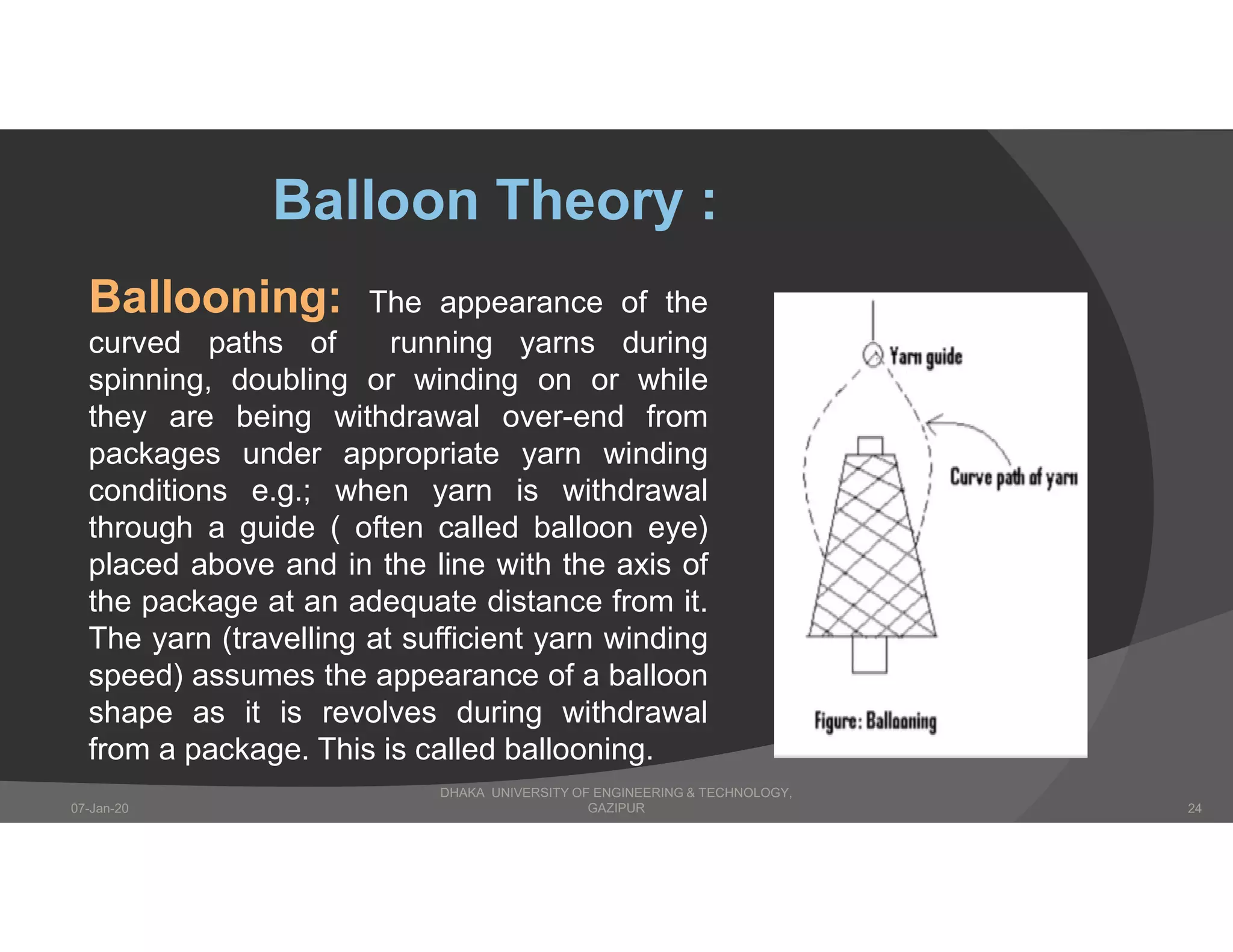
Ballooning: The appearance of the
curved paths of running yarns during
spinning, doubling or winding on or while
they are being withdrawal over-end from
packages under appropriate yarn winding
conditions e.g.; when yarn is withdrawal
through a guide ( often called balloon eye)
placed above and in the line with the axis of
the package at an adequate distance from it.
The yarn (travelling at sufficient yarn winding
speed) assumes the appearance of a balloon
shape as it is revolves during withdrawal
from a package. This is called ballooning.
Balloon Theory :
DHAKA UNIVERSITY OF ENGINEERING & TECHNOLOGY,
GAZIPUR07-Jan-20 24
WINDING EFFICIENCY :
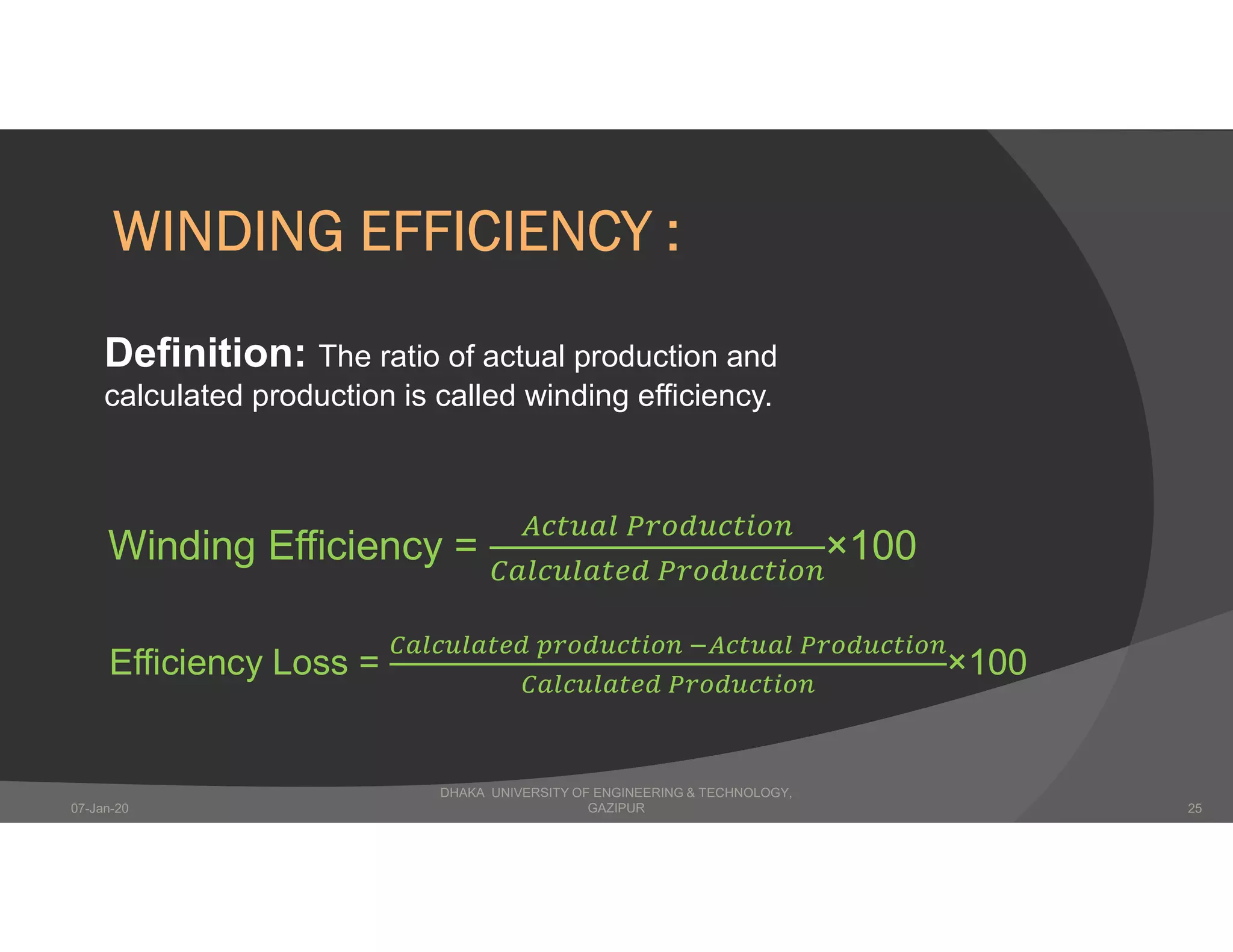
Definition: The ratio of actual production and
calculated production is called winding efficiency.
Winding Efficiency = ×100
Efficiency Loss = ×100
DHAKA UNIVERSITY OF ENGINEERING & TECHNOLOGY,
GAZIPUR07-Jan-20 25
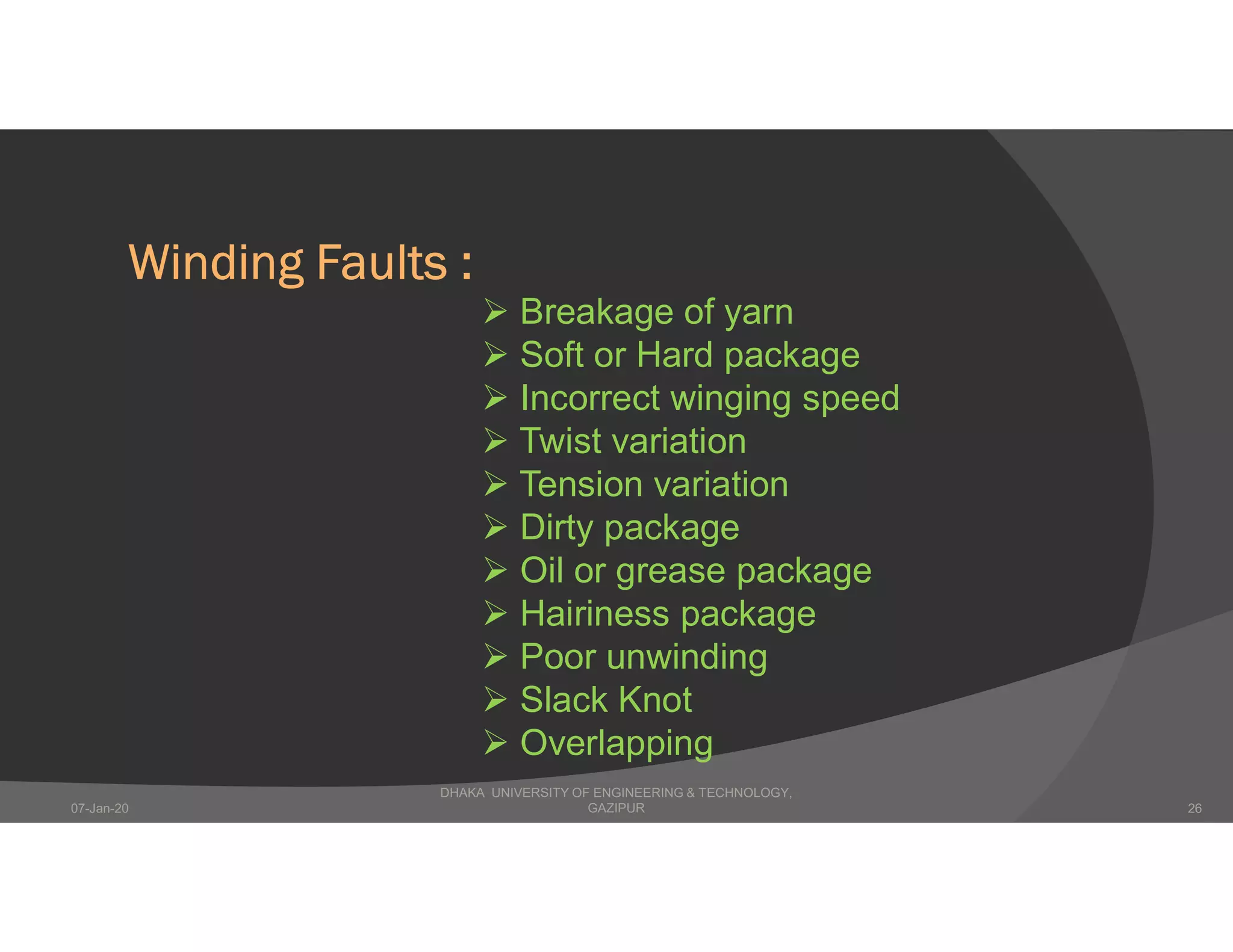
Winding Faults :
 Breakage of yarn
 Soft or Hard package
 Incorrect winging speed
 Twist variation
 Tension variation
 Dirty package
 Oil or grease package
 Hairiness package
 Poor unwinding
 Slack Knot
 Overlapping
DHAKA UNIVERSITY OF ENGINEERING & TECHNOLOGY,
GAZIPUR07-Jan-20 26
DHAKA UNIVERSITY OF ENGINEERING & TECHNOLOGY,
GAZIPUR07-Jan-20 27

Study on Winding Process

  • 1.
    Our Presentation Topics FABRIC MANUFACTURING ENGINEERING-1 Welcometo My Presentation WINDING Presented By : Md. Ariful Islam (Arif) ID : 175002 Department of Textile Engineering Email : arif.duet.te@gmail.com Presented To: Mr. Shamsuzzaman Sheikh Assistant Professor Department of Textile Engineering DUET, Gazipur DHAKA UNIVERSITY OF ENGINEERING & TECHNOLOGY, GAZIPUR
  • 2.
    DHAKA UNIVERSITY OFENGINEERING & TECHNOLOGY, GAZIPUR07-Jan-20 2
  • 3.
    ABOUT WINDING MACHINE WHATIS WINDING?  Definition: The process of transferring yarn from small packages like hank, bobbing etc to a large package such as cones, pirns, cheese etc, containing considerable length of yarn is called winding.  Example: From hanks to bobbins, bobbins to cone, cone to pirn etc. DHAKA UNIVERSITY OF ENGINEERING & TECHNOLOGY, GAZIPUR07-Jan-20 3
  • 4.
    Objectives :  Totransfer yarn from one package to another suitable package, this can be conveniently used for weaving purpose.  To remove yarn faults like hairiness, neps, slubs and foreign matters.  To clean yarn.  To improve the quality of yarn.  To get a suitable package.  To store the yarn.  To make easier the next process.  To preparing soft package of yarn dyeing. DHAKA UNIVERSITY OF ENGINEERING & TECHNOLOGY, GAZIPUR07-Jan-20 4
  • 5.
    A BASIC DIAGRAMOF WINDING M/C: It has three sections: I. The unwinding zone. II. The tension & clearing zone. III.The winding zone. DHAKA UNIVERSITY OF ENGINEERING & TECHNOLOGY, GAZIPUR07-Jan-20 5
  • 6.
    Types of Winding Precision Winding Machine  Non Precision Winding M/C According to Drive  Direct Drive  Indirect Drive According to WindingAccording to the package  Pirn Winding Machine  Cop Winding Machine  Spool Winding Machine  Cone Winding Machine  Cheese Winding Machine  Warp Winding Machine  Flange Bobbin Winding M/C DHAKA UNIVERSITY OF ENGINEERING & TECHNOLOGY, GAZIPUR07-Jan-20 6
  • 7.
    Types of WindingPackages  Pirn  Cop  Flanged bobbin Cross Wound Package  Cone  Cheese Near Parallel Wound PackageParallel wound package  Warp beam Weavers beam DHAKA UNIVERSITY OF ENGINEERING & TECHNOLOGY, GAZIPUR07-Jan-20 7
  • 8.
    Precision winding Nonprecision winding 1. The wound coil is arranged parallel or near parallel. 1. The coil is cross wise wound. 2.The yarn density of the package Is high. 2. The yarn density of the package Is low. 3.Flanged bobbin may be used. 3.Not used of flanged. 4.The yarn package is hard & more compact 4. The yarn package is soft and less compact. 5.Low stability of the package. 5.High stability of the package. 6.winding angle is 90° or near 90°. 6.Winding angle is less than 80°. 7.The bobbin is wound with precision winding. 7.The bobbin is wound with non precision winding. 8.Yarn tension is comparatively high. 8.yarn tension is comparatively less. Difference between precision winding and non-precision winding : DHAKA UNIVERSITY OF ENGINEERING & TECHNOLOGY, GAZIPUR07-Jan-20 8
  • 9.
    Two flanged containboth side of the package & yarns are wound parallel. In this process there is no necessity of traversing. Parallel Winding : DHAKA UNIVERSITY OF ENGINEERING & TECHNOLOGY, GAZIPUR07-Jan-20 9
  • 10.
    Advantages :  Manyyarns can be wound at a time.  No need of traversing mechanism.  Side withdrawal is possible.  The density of yarn is more.  No change of number of turns per inch. Disadvantages:  Two sides of the package need flanged.  For yarn unwinding, need separate mechanism.  Can not be over withdrawal. Advantages & Disadvantages of Parallel Wound Package DHAKA UNIVERSITY OF ENGINEERING & TECHNOLOGY, GAZIPUR07-Jan-20 10
  • 11.
    Near parallel winding: This package contains only one yarn & yarn is wound near parallel. Layers contain continuously inner side of the package. DHAKA UNIVERSITY OF ENGINEERING & TECHNOLOGY, GAZIPUR07-Jan-20 11
  • 12.
    Advantages & Disadvantagesof Near Parallel Wound Package Advantages:  No need of flanged  Can be side withdrawal.  No change of number of yarn turns per inch during winding. Disadvantages:  Need of traversing mechanism.  Can not be side withdrawal. DHAKA UNIVERSITY OF ENGINEERING & TECHNOLOGY, GAZIPUR07-Jan-20 12
  • 13.
    Cross wound package: Thisis wound crossly by single yarn. Advantages: Disadvantages:  No need of flange . Can not be side with drawl.  Can be over withdrawal.  Yarn package is stable.  Number of yarn turns per inch is changed in this method.  Quality of yarn is less.  Need of traversing mechanism. DHAKA UNIVERSITY OF ENGINEERING & TECHNOLOGY, GAZIPUR07-Jan-20 13
  • 14.
    Various types oftension device (According to working principle) : It is a simple form of yarn tensioner. It works by deflecting the yarn around the fixed posts. This induces a capstan effect on yarn. Capstan Tensioner: Output tension= input tension X eµθ Or, T2=T1 X eµθ Where, T1= input tension, T2= output tension, μ= coefficient of friction between yarn & post. θ= Angle of lap (in radian) = θ1+θ2+θ3 e= 2.718 DHAKA UNIVERSITY OF ENGINEERING & TECHNOLOGY, GAZIPUR07-Jan-20 14
  • 15.
    Additive Tensioner: In thisdevice a dead load or spring is used to give a fixed increment of tension. The yarn is passed through middle of the two surfaces in contact & the force is applied above to give suitable tension to the yarn. Here, T2=T1 + 2μF Where, T1= input tension T2= output tension μ= coefficient of friction between yarn & post F= applied force. DHAKA UNIVERSITY OF ENGINEERING & TECHNOLOGY, GAZIPUR07-Jan-20 15
  • 16.
    Combined Tensioner : Itis the combined system of capstan & additive tensioner. The device permits the tension level to be raised to any desired extent, but it does not permit a reduction in tension. Here, T2=T1eµθ+ T1 + 2μF Where, T1= input tension, T2= output tension, μ= coefficient of friction between yarn & post. θ= Angle of lap (in radian) = θ1+θ2+θ3 e= 2.718 DHAKA UNIVERSITY OF ENGINEERING & TECHNOLOGY, GAZIPUR07-Jan-20 16
  • 17.
    Automatic Tensioner : Thisis special type of tesioner. In this device the yarn tension is controlled automatically. DHAKA UNIVERSITY OF ENGINEERING & TECHNOLOGY, GAZIPUR07-Jan-20 17
  • 18.
    Factor influences forselection of tensioner :  The device must be reliable to control uniform tension.  It must be easily threaded. It must not introduce differences in twist.  It must not be affected by the presence of oil & dirt.  It must be easily adjustable. It must be capable of easy cleaning.  The operating surfaces must be smooth.  It must be cheap.  It must be simple in design & operation.  It must not damage for yarn. DHAKA UNIVERSITY OF ENGINEERING & TECHNOLOGY, GAZIPUR07-Jan-20 18
  • 19.
    Depending On thetype of the working member acting on the yarn :  Ball type  Washer type  Disc type  Roller type  Comb type  Two zone type DHAKA UNIVERSITY OF ENGINEERING & TECHNOLOGY, GAZIPUR07-Jan-20 19
  • 20.
    Types of Yarnguides: Type- A : Yarn end is required for threading.  Takes extra time for threading.  Yarn passed through the guide hole.  Occur more friction with the yarn.  No possibility to run out the yarn. DHAKA UNIVERSITY OF ENGINEERING & TECHNOLOGY, GAZIPUR07-Jan-20 20
  • 21.
    Type- B: Yarnend is not required for threading  Treading is very easy  Operations time less  Low cost  Possibility to run out the yarn DHAKA UNIVERSITY OF ENGINEERING & TECHNOLOGY, GAZIPUR07-Jan-20 21
  • 22.
    Yarn withdrawal orUnwinding: Unwinding process of yarn from a package is called withdrawal of yarn. There are two types of withdrawal: 1. Sideway withdrawal. 2. Over end withdrawal. DHAKA UNIVERSITY OF ENGINEERING & TECHNOLOGY, GAZIPUR07-Jan-20 22
  • 23.
    Side way withdrawal: Package rotates  Occur for flanged bobbin  Yarn twist become unchanged  No balloon formation  Slow process Over end withdrawal:  Stationary package  No flange bobbin is used  Yarn twist may changed  Balloon formed during withdrawal  High speed process DHAKA UNIVERSITY OF ENGINEERING & TECHNOLOGY, GAZIPUR07-Jan-20 23
  • 24.
    Ballooning: The appearanceof the curved paths of running yarns during spinning, doubling or winding on or while they are being withdrawal over-end from packages under appropriate yarn winding conditions e.g.; when yarn is withdrawal through a guide ( often called balloon eye) placed above and in the line with the axis of the package at an adequate distance from it. The yarn (travelling at sufficient yarn winding speed) assumes the appearance of a balloon shape as it is revolves during withdrawal from a package. This is called ballooning. Balloon Theory : DHAKA UNIVERSITY OF ENGINEERING & TECHNOLOGY, GAZIPUR07-Jan-20 24
  • 25.
    WINDING EFFICIENCY : Definition:The ratio of actual production and calculated production is called winding efficiency. Winding Efficiency = ×100 Efficiency Loss = ×100 DHAKA UNIVERSITY OF ENGINEERING & TECHNOLOGY, GAZIPUR07-Jan-20 25
  • 26.
    Winding Faults : Breakage of yarn  Soft or Hard package  Incorrect winging speed  Twist variation  Tension variation  Dirty package  Oil or grease package  Hairiness package  Poor unwinding  Slack Knot  Overlapping DHAKA UNIVERSITY OF ENGINEERING & TECHNOLOGY, GAZIPUR07-Jan-20 26
  • 27.
    DHAKA UNIVERSITY OFENGINEERING & TECHNOLOGY, GAZIPUR07-Jan-20 27