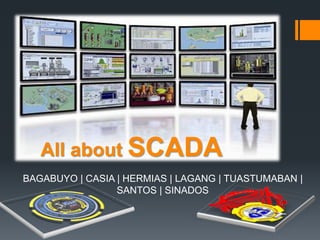
All about SCADA
BAGABUYO | CASIA | HERMIAS | LAGANG | TUASTUMABAN |
SANTOS | SINADOS
All about SCADA topics:
What is SCADA?
What are the advantages of SCADA over HMI?
System Concept of SCADA
RTU
Future trends in SCADA.
Process involving SCADA.
SCADA stands for:
Supervisory
Control
And
Data
Acquisition
generally refers to an industrial control
system(ICS).
It is a production automation and control system
based on PCs.
SCADA
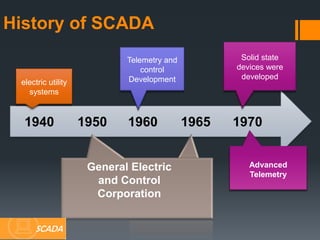
History of SCADA
1940 1950 1960 1965 1970
electric utility
systems
Telemetry and
control
Development
General Electric
and Control
Corporation
Solid state
devices were
developed
Advanced
Telemetry
SCADA
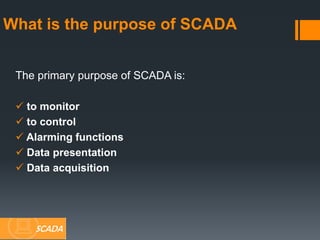
What is the purpose of SCADA
The primary purpose of SCADA is:
 to monitor
 to control
 Alarming functions
 Data presentation
 Data acquisition
SCADA
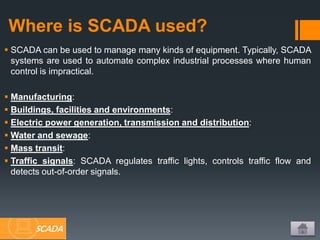
Where is SCADA used?
 SCADA can be used to manage many kinds of equipment. Typically, SCADA
systems are used to automate complex industrial processes where human
control is impractical.
 Manufacturing:
 Buildings, facilities and environments:
 Electric power generation, transmission and distribution:
 Water and sewage:
 Mass transit:
 Traffic signals: SCADA regulates traffic lights, controls traffic flow and
detects out-of-order signals.
SCADA
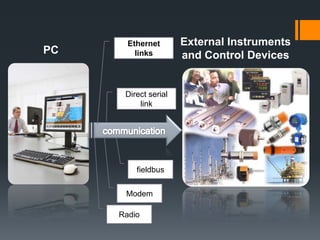
PC
External Instruments
and Control Devices
Direct serial
link
Radio
Modem
fieldbus
Ethernet
links
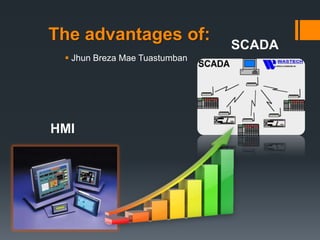
The advantages of:
 Jhun Breza Mae Tuastumban
HMI
SCADA
SCADA/HMI building automation
system advantages
Using SCADA platforms for your building automation
system allows you to get exactly the features and
capabilities you want now and in the future as your
needs grow.
SCADA systems are powerful, robust and flexible.
SCADA is robust Manufacturers, water treatment and
other operations have been relying for decades on
SCADA systems to control their processes.
Integratability
 Over the years, users have demanded that SCADA system developers
enable connectivity with the unlike systems and networks with their
plants.
 This openness is highly beneficial for building automation systems with
the many diverse component systems to be integrated.
Flexibility
 SCADA systems are scalable and upgradeable.
Reporting
 Which reports do you want where at what time? Want to see status on
all your systems from any web browser anywhere, even from your
smartphone?
 With SCADA, you can do it. As you can also, if you chose, enable
control over remote connections.
SCADA Alarms and Phone Dialer
Advantage has built in SCADA alarm manager and phone
dialer. Remote notification
Key Alarm Features
Support for three alarm levels: Notice, Warning, and Critical
Alarms are displayed on the flashing Alarm banner on the
toolbar, regardless of user's current view
Individual alarm messages can be configured on specific graphic
displays
Alarms can also be configured to produce an audio alert
Alarms are stored on a historical alarm page and can also be
logged to files and/or sent to a printer
System Concepts of SCADA
Riz Jayro Lagang
Stella Amor Hermias
System Concept of SCADA
SCADA
 is a kind of software application
program used for the process
control and gather real time from
remote locations for exercising this
control on equipment and conditions.
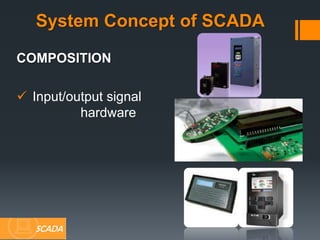
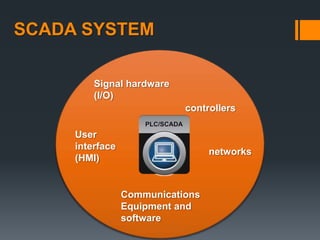
COMPOSITION
 Input/output signal
hardware
System Concept of SCADA
SCADA
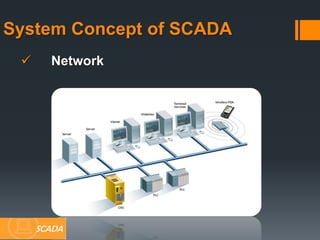
 Network
System Concept of SCADA
SCADA
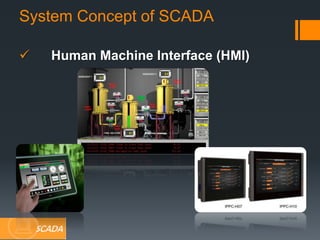
 Human Machine Interface (HMI)
System Concept of SCADA
SCADA
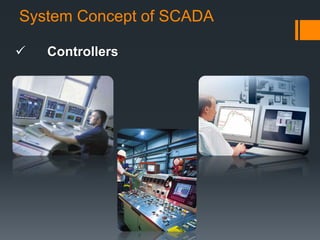
•Controllers
System Concept of SCADA
 Controllers
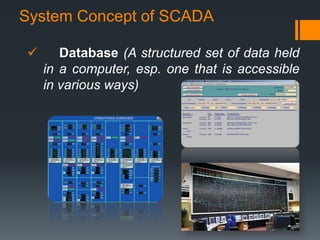
 Database (A structured set of data held
in a computer, esp. one that is accessible
in various ways)
System Concept of SCADA
Communication and software
 The SCADA consist of Hardware and
Software components.
 The hardware collects and feed data into a
computer with SCADA software installed.
 The data is then processed by the computer
before presenting it in a timely manner.
System Concept of SCADA
SCADA
SCADA SYSTEM
Signal hardware
(I/O)
controllers
networks
User
interface
(HMI)
Communications
Equipment and
software
CONTROL/ MONITOR FUNCTION
 A system or the complete site is usually
spread over a long geographical
distance, SCADA is the central
system for control and monitor of such a
site or system.
System Concept of SCADA
SCADA
 A Programmable Logic Controller
(PLC) or Remote Terminal Unit
automatically performs the main site
control process.
 The host control functions in most
cases are limited to the capability of
supervisory level or site override.
System Concept of SCADA
SCADA
SCADA SUBSYSTEM
 HMI-is the apparatus which presents the
process data to a human operator, and
through this, the human operator
monitors and control the process.
 a supervisory(computer) system,
gathering (acquiring) data on the process
and sending commands(control) to the
process.
System Concept of SCADA
SCADA
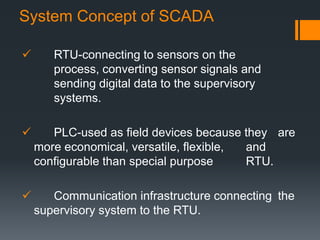
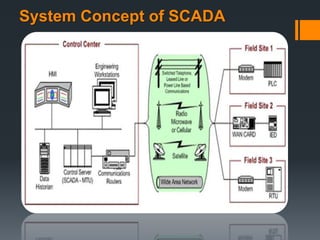
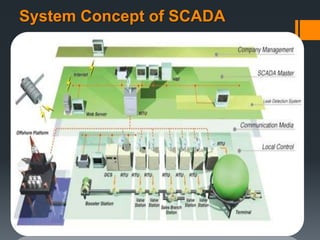
 RTU-connecting to sensors on the
process, converting sensor signals and
sending digital data to the supervisory
systems.
 PLC-used as field devices because they are
more economical, versatile, flexible, and
configurable than special purpose RTU.
 Communication infrastructure connecting the
supervisory system to the RTU.
System Concept of SCADA
 Data Acquisition begins at the RTU or PLC level
and includes meter readings and equipment status
reports that are communicated to SCADA as
required.
 Data is then compiled and formatted in such a way
that a control room operator using the HMI can
make supervisory decisions to adjust or override
normal RTU (PLC) controls.
System Concept of SCADA
SCADA
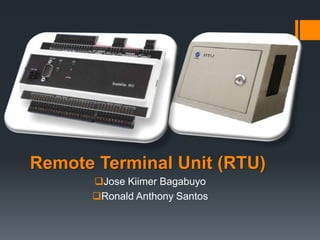
Remote Terminal Unit (RTU)
Jose Kiimer Bagabuyo
Ronald Anthony Santos
What is RTU?
Remote
Terminal
Unit
What is RTU?
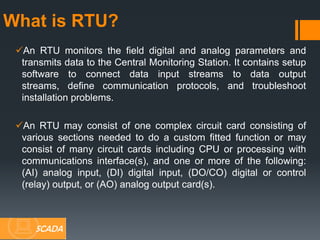
An RTU monitors the field digital and analog parameters and
transmits data to the Central Monitoring Station. It contains setup
software to connect data input streams to data output
streams, define communication protocols, and troubleshoot
installation problems.
An RTU may consist of one complex circuit card consisting of
various sections needed to do a custom fitted function or may
consist of many circuit cards including CPU or processing with
communications interface(s), and one or more of the following:
(AI) analog input, (DI) digital input, (DO/CO) digital or control
(relay) output, or (AO) analog output card(s).
SCADA
RTU
 a microprocessor-controlled electronic device that
interfaces objects in the physical world to a distributed
control system or SCADA (supervisory control and data
acquisition) system by transmitting telemetry data to a
master system, and by using messages from the master
supervisory system to control connected objects.
 Another term that may be used for RTU is remote
telemetry unit, the common usage term varies with the
application area generally.
Two basic types of RTU:
1. Single board RTU
2. Modular RTU
SCADA
Single board RTU
which is compact, and contains all I/O on
a single board. The single board RTU
normally has fixed I/O (eg.16 digital inputs, 8
digital outputs, 8 analogue inputs, and say 4
analogue outputs).
Modular RTU
which has a separate CPU module, and can
have other modules added, normally by
plugging into a common "backplane" (a bit like a
PC motherboard and plug in peripheral cards) is
designed to be expanded by adding additional
modules.
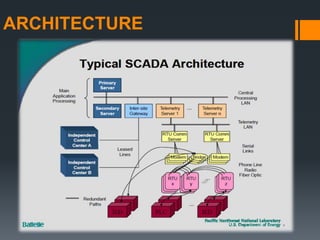
ARCHITECTURE
Architecture
1.1 Power supply
1.2 Digital or Status inputs
1.3 Analog inputs
1.4 Digital (control) outputs
1.5 Analog outputs
1.6 Software and logic control
1.7 Communications
1.7.1 IED communications
1.7.2 Master communications
SCADA
 RTUs differ from programmable logic controllers (PLCs) in that
RTUs are more suitable for wide geographical telemetry.
 RTUs, PLCs and DCS are increasingly beginning to overlap in
responsibilities, and many vendors sell RTUs with PLC-like
features and vice versa.
 In addition, some vendors now supply RTUs with comprehensive
functionality pre-defined, sometimes with PLC extensions and/or
interfaces for configuration.
 Some suppliers of RTUs have created simple graphical user
interfaces GUI to enable customers to configure their RTUs easily.
In some applications data loggers are used in similar applications.
Comparison with other control
systems
SCADA
Remote monitoring of functions and instrumentation for:
 Oil and gas (offshore platforms, onshore oil wells).
 Networks of pump stations (wastewater collection, or for water
supply).
 Environmental monitoring systems
(pollution, air quality, emissions monitoring).
 Mine sites.
 Air traffic equipment such as navigation aids.
Applications of RTU
SCADA
Remote monitoring and control of functions and
instrumentation for:
 Hydro-graphic (water supply, reservoirs, sewerage systems).
 Electrical power transmission networks and associated
equipment.
 Natural gas networks and associated equipment.
 Outdoor warning sirens.
Applications of RTU
SCADA
FUTURE TRENDS IN SCADA
Julius Jay Sinados
FUTURE TRENDS IN SCADA
First generation: "Monolithic“
Second generation: "Distributed“
Third generation: "Networked"
First generation: "Monolithic"
 In the first generation, computing was done by mainframe computers.
 Networks did not exist at the time SCADA was developed.
 Thus SCADA systems were independent systems with no
connectivity to other systems. Wide Area Networks were later
designed by RTU vendors to communicate with the RTU.
 The first-generation SCADA system was redundant since a back-up
mainframe system was connected at the bus level and was used in
the event of failure of the primary mainframe system.
FUTURE TRENDS IN SCADA
SCADA
Second generation: "Distributed"
The processing was distributed across multiple stations which were
connected through a LAN and they shared information in real time.
Each station was responsible for a particular task thus making the
size and cost of each station less than the one used in First
Generation.
FUTURE TRENDS IN SCADA
SCADA
Third generation: "Networked"
Due to the usage of standard protocols and the fact
that many networked SCADA systems are accessible
from the Internet, the systems are potentially vulnerable
to remote attack.
FUTURE TRENDS IN SCADA
SCADA
PICTURES DAPAT
SAMPLE PROCESS INVOLVING
SCADA
TEAM SCADA
Thank You

All about scada

  • 1.
    All about SCADA BAGABUYO| CASIA | HERMIAS | LAGANG | TUASTUMABAN | SANTOS | SINADOS
  • 2.
    All about SCADAtopics: What is SCADA? What are the advantages of SCADA over HMI? System Concept of SCADA RTU Future trends in SCADA. Process involving SCADA.
  • 3.
  • 4.
    generally refers toan industrial control system(ICS). It is a production automation and control system based on PCs. SCADA
  • 5.
    History of SCADA 19401950 1960 1965 1970 electric utility systems Telemetry and control Development General Electric and Control Corporation Solid state devices were developed Advanced Telemetry SCADA
  • 6.
    What is thepurpose of SCADA The primary purpose of SCADA is:  to monitor  to control  Alarming functions  Data presentation  Data acquisition SCADA
  • 7.
    Where is SCADAused?  SCADA can be used to manage many kinds of equipment. Typically, SCADA systems are used to automate complex industrial processes where human control is impractical.  Manufacturing:  Buildings, facilities and environments:  Electric power generation, transmission and distribution:  Water and sewage:  Mass transit:  Traffic signals: SCADA regulates traffic lights, controls traffic flow and detects out-of-order signals. SCADA
  • 8.
    PC External Instruments and ControlDevices Direct serial link Radio Modem fieldbus Ethernet links
  • 9.
    The advantages of: Jhun Breza Mae Tuastumban HMI SCADA
  • 10.
    SCADA/HMI building automation systemadvantages Using SCADA platforms for your building automation system allows you to get exactly the features and capabilities you want now and in the future as your needs grow. SCADA systems are powerful, robust and flexible. SCADA is robust Manufacturers, water treatment and other operations have been relying for decades on SCADA systems to control their processes.
  • 11.
    Integratability  Over theyears, users have demanded that SCADA system developers enable connectivity with the unlike systems and networks with their plants.  This openness is highly beneficial for building automation systems with the many diverse component systems to be integrated. Flexibility  SCADA systems are scalable and upgradeable. Reporting  Which reports do you want where at what time? Want to see status on all your systems from any web browser anywhere, even from your smartphone?  With SCADA, you can do it. As you can also, if you chose, enable control over remote connections.
  • 12.
    SCADA Alarms andPhone Dialer Advantage has built in SCADA alarm manager and phone dialer. Remote notification Key Alarm Features Support for three alarm levels: Notice, Warning, and Critical Alarms are displayed on the flashing Alarm banner on the toolbar, regardless of user's current view Individual alarm messages can be configured on specific graphic displays Alarms can also be configured to produce an audio alert Alarms are stored on a historical alarm page and can also be logged to files and/or sent to a printer
  • 13.
    System Concepts ofSCADA Riz Jayro Lagang Stella Amor Hermias
  • 14.
    System Concept ofSCADA SCADA  is a kind of software application program used for the process control and gather real time from remote locations for exercising this control on equipment and conditions.
  • 15.
  • 16.
  • 17.
     Human MachineInterface (HMI) System Concept of SCADA SCADA
  • 18.
    •Controllers System Concept ofSCADA  Controllers
  • 19.
     Database (Astructured set of data held in a computer, esp. one that is accessible in various ways) System Concept of SCADA
  • 20.
    Communication and software The SCADA consist of Hardware and Software components.  The hardware collects and feed data into a computer with SCADA software installed.  The data is then processed by the computer before presenting it in a timely manner. System Concept of SCADA SCADA
  • 21.
  • 22.
    CONTROL/ MONITOR FUNCTION A system or the complete site is usually spread over a long geographical distance, SCADA is the central system for control and monitor of such a site or system. System Concept of SCADA SCADA
  • 23.
     A ProgrammableLogic Controller (PLC) or Remote Terminal Unit automatically performs the main site control process.  The host control functions in most cases are limited to the capability of supervisory level or site override. System Concept of SCADA SCADA
  • 24.
    SCADA SUBSYSTEM  HMI-isthe apparatus which presents the process data to a human operator, and through this, the human operator monitors and control the process.  a supervisory(computer) system, gathering (acquiring) data on the process and sending commands(control) to the process. System Concept of SCADA SCADA
  • 25.
     RTU-connecting tosensors on the process, converting sensor signals and sending digital data to the supervisory systems.  PLC-used as field devices because they are more economical, versatile, flexible, and configurable than special purpose RTU.  Communication infrastructure connecting the supervisory system to the RTU. System Concept of SCADA
  • 26.
  • 27.
  • 28.
     Data Acquisitionbegins at the RTU or PLC level and includes meter readings and equipment status reports that are communicated to SCADA as required.  Data is then compiled and formatted in such a way that a control room operator using the HMI can make supervisory decisions to adjust or override normal RTU (PLC) controls. System Concept of SCADA SCADA
  • 29.
    Remote Terminal Unit(RTU) Jose Kiimer Bagabuyo Ronald Anthony Santos
  • 30.
  • 31.
    What is RTU? AnRTU monitors the field digital and analog parameters and transmits data to the Central Monitoring Station. It contains setup software to connect data input streams to data output streams, define communication protocols, and troubleshoot installation problems. An RTU may consist of one complex circuit card consisting of various sections needed to do a custom fitted function or may consist of many circuit cards including CPU or processing with communications interface(s), and one or more of the following: (AI) analog input, (DI) digital input, (DO/CO) digital or control (relay) output, or (AO) analog output card(s). SCADA
  • 32.
    RTU  a microprocessor-controlledelectronic device that interfaces objects in the physical world to a distributed control system or SCADA (supervisory control and data acquisition) system by transmitting telemetry data to a master system, and by using messages from the master supervisory system to control connected objects.  Another term that may be used for RTU is remote telemetry unit, the common usage term varies with the application area generally.
  • 33.
    Two basic typesof RTU: 1. Single board RTU 2. Modular RTU SCADA
  • 34.
    Single board RTU whichis compact, and contains all I/O on a single board. The single board RTU normally has fixed I/O (eg.16 digital inputs, 8 digital outputs, 8 analogue inputs, and say 4 analogue outputs).
  • 35.
    Modular RTU which hasa separate CPU module, and can have other modules added, normally by plugging into a common "backplane" (a bit like a PC motherboard and plug in peripheral cards) is designed to be expanded by adding additional modules.
  • 36.
  • 37.
    Architecture 1.1 Power supply 1.2Digital or Status inputs 1.3 Analog inputs 1.4 Digital (control) outputs 1.5 Analog outputs 1.6 Software and logic control 1.7 Communications 1.7.1 IED communications 1.7.2 Master communications SCADA
  • 38.
     RTUs differfrom programmable logic controllers (PLCs) in that RTUs are more suitable for wide geographical telemetry.  RTUs, PLCs and DCS are increasingly beginning to overlap in responsibilities, and many vendors sell RTUs with PLC-like features and vice versa.  In addition, some vendors now supply RTUs with comprehensive functionality pre-defined, sometimes with PLC extensions and/or interfaces for configuration.  Some suppliers of RTUs have created simple graphical user interfaces GUI to enable customers to configure their RTUs easily. In some applications data loggers are used in similar applications. Comparison with other control systems SCADA
  • 39.
    Remote monitoring offunctions and instrumentation for:  Oil and gas (offshore platforms, onshore oil wells).  Networks of pump stations (wastewater collection, or for water supply).  Environmental monitoring systems (pollution, air quality, emissions monitoring).  Mine sites.  Air traffic equipment such as navigation aids. Applications of RTU SCADA
  • 40.
    Remote monitoring andcontrol of functions and instrumentation for:  Hydro-graphic (water supply, reservoirs, sewerage systems).  Electrical power transmission networks and associated equipment.  Natural gas networks and associated equipment.  Outdoor warning sirens. Applications of RTU SCADA
  • 41.
    FUTURE TRENDS INSCADA Julius Jay Sinados
  • 42.
    FUTURE TRENDS INSCADA First generation: "Monolithic“ Second generation: "Distributed“ Third generation: "Networked"
  • 43.
    First generation: "Monolithic" In the first generation, computing was done by mainframe computers.  Networks did not exist at the time SCADA was developed.  Thus SCADA systems were independent systems with no connectivity to other systems. Wide Area Networks were later designed by RTU vendors to communicate with the RTU.  The first-generation SCADA system was redundant since a back-up mainframe system was connected at the bus level and was used in the event of failure of the primary mainframe system. FUTURE TRENDS IN SCADA SCADA
  • 44.
    Second generation: "Distributed" Theprocessing was distributed across multiple stations which were connected through a LAN and they shared information in real time. Each station was responsible for a particular task thus making the size and cost of each station less than the one used in First Generation. FUTURE TRENDS IN SCADA SCADA
  • 45.
    Third generation: "Networked" Dueto the usage of standard protocols and the fact that many networked SCADA systems are accessible from the Internet, the systems are potentially vulnerable to remote attack. FUTURE TRENDS IN SCADA SCADA
  • 46.
  • 47.
  • 48.