Intrauterine Insemination
UPDATE
DR. SHARDA JAIN
DR. JYOTI AGARWAL
DR. JYOTI BHASKAR
Over 350 ppts are available on
slideshare.net ***for use of public/Doctors
www.slideshare.net / Lifecarecentre
OVERVIEW
• Aim
• Definition
• Prerequisites
• Individualisation of patient.
• Ohss free IUI. Clinic
{Strict cancellation of cycle if OHSS is suspected}
• Newer trends
• Sucess Rates in IUI with COH
• PROGNOTIC FACTORS to increase
Pregnancy Rates..& discussion
Singleton
live birth
at term
;
Multiple
Pregnan
cy
10- 15%
Cycle
Cancellati
on
2-8%
Bcz of
Risk of
OHSS
OHSS
Severe
0%
Moderate
3-8%
.
Our Aim
Minimize Risks
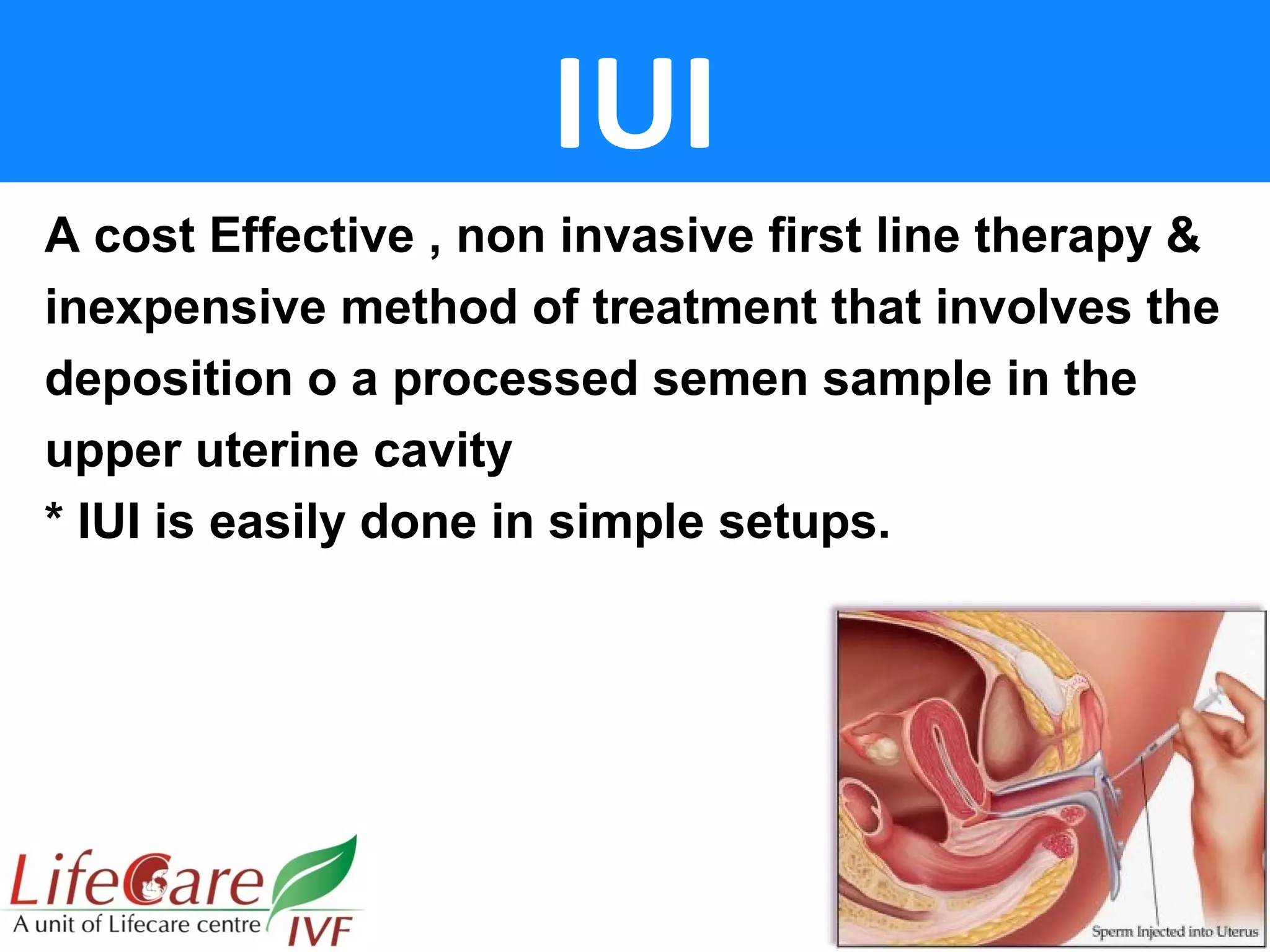
A cost Effective , non invasive first line therapy &
inexpensive method of treatment that involves the
deposition o a processed semen sample in the
upper uterine cavity
* IUI is easily done in simple setups.
IUI
PRE REQUISITES FOR IUI
• Atleast one patent functional tube
• Evidence of ovulation
• Adequate sperm count
• Responsive endometrium
INDIVIDUALISING
TREATMENT PROTOCOL
is the key
STRICT CANCELLATION POLICY in
Gonadotrophic stimulation protocol
to limit MULTI- FOLLICULAR development
may help to avoid OHSS as OHSS is not
acceptable.
NEWER TRENDS
Though the technique of I.U.I. has remained same.
Several advances in
• TYPE OF STIMULATION protocols,
• wider USE OF GONADOTROPHINS,
• SPERM PREPARATION techniques tailored to
every specimen
• Meticulous ULTRASOUND monitoring
has led to improve success rates with I.U.I.
PREGNANCY RATE IN A.R.T.
million dollar information
Method Pregnancy Rate (%)
Intercourse (Timed) 4
IUI 6
CC 6
CC+IUI 8
FSH / HMG 7.7
CC / FSH /IUI 9-12
FSH/ HMG/IUI 17 – 20 %
In vitro fertilization 20 to maximum 40% [self cycle]
50 to 60 % donor cycle
CONTROLLED OVARIAN
HYPERSTIMULATION..Is the key
COH, particularly with CC,LETROZOLE, LOW
DOSE GONADOTROPHINS,with IUI offers
significant benefit in terms of PREGNANCY
OUTCOMES compared with NATURAL cycle or
TIMED INTERCOURSE,while reducing
associated COH complications such as
MULTIPLE PREGNANCIES & OHSS
IMPOTANT PROGNOSTIC
INDICATORS OF SUCCESS with I.U.I.
• >35 YRS of AGE OF FEMALE PATIENT
• DURATION OF INFERTILITY
• STIMULATION PROTOCOL[review in slideshare.net 2017]
• INFERTILITY ETIOLOGY
• NUMBER OF IUI CYCLES
• TIMING OF INSMINATION
• TECHNIQUE OF IUI
• NUMBER OF PREOVULATORY FOLLICLES ON THE DAY OF
HCG
• SEMEN QUALITY & FEW OBSERVATION ON MALE FACTOR
ADVANCED MATERNAL AGE
≥ 35 YEARS
is the most important factor
AGE OF WOMAN is The
Biggest Factor
Substantial decline in
fertility occurs at 35 .
Decrease in ovarian reserve in
Indian women is observed 6 to
7 years earlier
As Age Advances, Number Of Eggs
Decline
Faddy et al., 1992
Likelihood of Getting Pregnant
by Age
The likelihood of infertility dramatically increases for women after
Miscarriages Increase with
Age
The likelihood of miscarrying increases with age.
• Ovarian response declines rapidly after 35 years of age
• HFEA data for AID – 2008 confirms women age factor
Women Age is most important
& has a direct correlation
with probability of success of IUI
Our experience - no success in IUI after 40 year
Age of lady No of IUI Live birth rate
40-42 yrs 492 23/492 = 4.7%
43 – 44 172 2/172 = 1.2%
>44 46 0/46 = 0%
INDICATION of IUI (Aetiology)
CPR in IUI—8 to 20 %
depending upon indication & Protocols
• Anovulatory infertility
• Cervical infertility
• Azoospermia [AID]
• unexplained infertility
• Immunological abnormalities
• Mild degrees of male factor infertility
• Non-consummation of marriage due to –
ED/vaginismus
Grading of Success & Indication
for IUI
• Anovulatory infertility
• Cervicalfactor infertility
• Azoospermia
• Unexplained Infertility Age over 35
•Endometriosis
•Immunological infertility
•Male factor – poor TMSC
Best Outcome
Good
Outcome
Poor Outcome
Good Result
: - Cervical Factor I
: - Anovulatory I
: - Unexplained I
: - Donor IUI
Poor Results :- severe male infertility
tubal factor/
pelvic adhesions
severe endometriosis
Direct referral to IVF/ICSI is to be
done earlier than LATE
• ADVANCED MATERNAL AGE
• SEVERE MALE FACTOR INFERTILITY
• TUBAL PATHOLOGY
• SEVERE ENDOMETRIOSIS
As IUI IS OF NO BENEFIT
IN THESE CASES
Who are
GOOD or BAD RESPONDERS
Good Responders :- young
:- Good Crop of
Preovulatory follicles
:- Good ET (> 7 mm)
:- Good PWS count
Poor Responders
:- Older self / partner,
:- ↑ duration infertility (> 5 yrs)
:- Poor Ovarian Responce
:- Poor Endometrial Thickness
:- Poor Sperm Quality
Semen & Male Factors
AGE < 45 yrs
>10 million prewash count
Over 5 million Post Wash Count
Normal morphology – 5 % (Krugers)
DNA fragmentation -< 15 %
Sperm survival (24 hours) - ↑ 70 %
Male-good prognosis factors
Male Factor & SEMEN PARAMETERS –
which impact IUI Outcome
• Oligospermia [ 10 million ]
• SEMEN PROCESSING TIME
• Pre wash TOTAL MOTILE SPERM COUNT
• Post Wash Sperm MOTILITY AFTER PROCESSING.
• SPERM MORFOLOGY
• Critical IUI INSEMINATION TIME [from sample production to
INSEMINATION
• 24-H SPERM SURVIVAL
Pre wash MOTILE SPERM COUNT
An average total motile sperm count of 10x106
may
be a
USEFUL THRESHOLD VALUE
for decisions about treating a couple with IUI or
IVF.
When initial values are lower, IUI has little
chance of success
Effect of the total motile sperm count on the efficacy and cost-effectiveness of intrauterine
insemination and in vitro fertilization. Van Voorhis BJ, et al. Fertil Steril 2001 Apr;75(4):661-8
Comparison of the sperm quality necessary for successful intrauterine insemination with World
Health Organization threshold values for normal sperm. Dickey RP, et al. Fertil Steril 1999
Apr;71(4):684-9
The post wash total motile sperm
count ≥ 5 X 10⁶
is critical
Total motile sperm count – TMS count
> 5 mil associated with good outcome while
TMS < 1 mil has very poor outcome
Van weert et al. performance of the postwash total motile sperm count as a
predictor of pregnancy at the time of intrauterine insemination : a meta – analysis .
Fertil steril . 2004 ; 82:612
Patients with more than 60% normal
sperm morphology (NSM) had higher
pregnancy rate than those with less
than 60% NSM (24.3% vs. 7.7%,
P=0.0052).
IMPACT OF
SPERM MORPHOLOGY
Intrauterine insemination: pregnancy rate and its associated factors in a university
hospital in Iran Zahra Rezaie, et al. Middle East Fertility Society Journal,Vol. 11, No. 1,
2006, pp.59-63
Sperm Morphology
Now krugers criteria is followed
Sperm morpholgy – best outcome are seen with
4-14 % normal sperm morphology with strict
kruger’s criteria
Predictive value of normal sperm morphology in intrauterine
insemination (IUI): a structured literature reviw Hum Reprod, 7 (2001), pp 495 - 500
WHO GIVES LOT EMPHASIS ON KRUGERS CRITERIA---BUT NO LAB
IN INDIA GIVES REPORT USING KRUGERS CRITERIA
Effects of high sperm DNA
fragmentations are
•Infertility
•Recurrent pregnancy loss
•Poor outcomes in IUI and IVF
Men with poor semen parameters
are more likely to have high DNA
fragmentations
The term DNA fragmentation refers to
Damaged sperm DNA that can not be repaired
Sperm DNA fragmentation
index-DFI >30% correlates with poor
pregnancy rate & high
rate of miscarriage
24 – hours SPERM SURVIVAL -
HIGHLY PREDICTIVE OF IUI SUCCESS
24 - hours
Survival Rate….>70 %
Advanced semen analysis: a simple screening test to predict intrauterine
insemination success. Branigan EF, et al. Fertil Steril 1999 Mar;71(3):547-51
Easy test
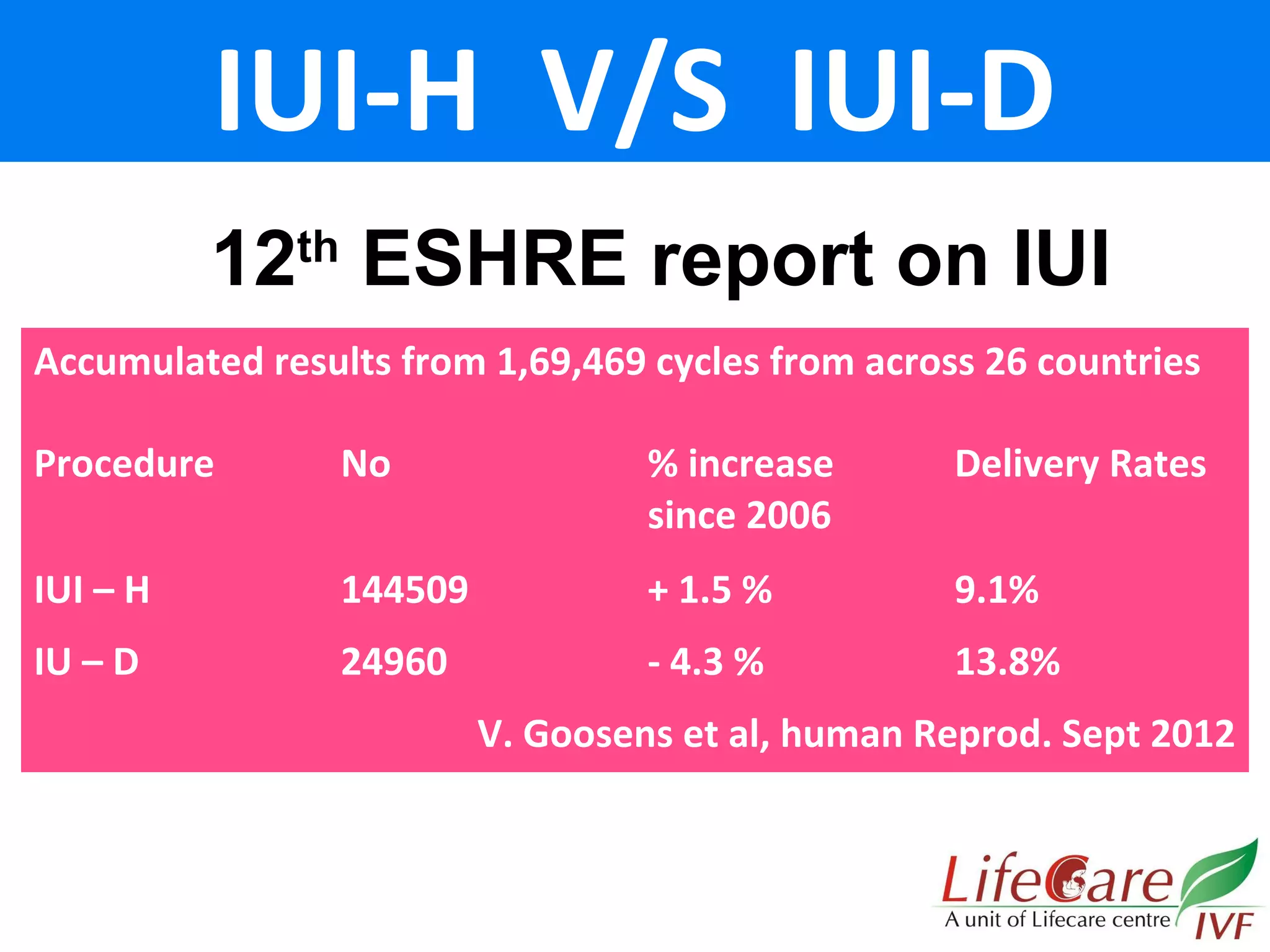
IUI-H V/S IUI-D
12th
ESHRE report on IUI
Accumulated results from 1,69,469 cycles from across 26 countries
Procedure No % increase
since 2006
Delivery Rates
IUI – H 144509 + 1.5 % 9.1%
IU – D 24960 - 4.3 % 13.8%
V. Goosens et al, human Reprod. Sept 2012
SEMEN EJACULATION,
PROCESSING & INSEMINATION TIME
Very very important
most of the gynaecologist donor know and follow
IDEAL TIME..Is less than 90 mts DELAYING
SEMEN PROCESSING FROM 30 min Upto one
hour.
• Delaying I.U.I. insemination FROM 90 min upto
2 hour after collection -
compromises the PREGNANCY OUTCOME in
COH - I.U.I. CYCLES
SPERM-PREPARATION
TECHNIQUES- IUI RESULTS
•ABNORMAL SEMEN ANALYSES.
–Density gradient is superior to the swim-up technique in
improving Pregnancy rates.
• NORMAL SEMEN ANALYSES.
–When only nuclear maturity rate is taken into account, the
swim-up technique seems to be sufficient for selecting
spermatozoa.
Sperm-preparation techniques for men with normal and abnormal semen analysis.- A comparison.
Erel CT, et al. J Reprod Med 2000 Nov;45(11):917-22
Strict criteria no longer valid . In IUI we can
use either technique
Normal sample: Pellet swim up
Low VOLUME : pool samples, simple WASH
Low COUNT : pool samples, simple WASH
Low MOTILITY : simple WASH or Gradient
Highly ABNORMALS :Gradient (80-90%)
High DEBRIS : Gradient (80-90%)
FLAKES : Allow to settle, remove
flakes, Gradient (80-90 %)
SUM UP of SeMen SaMPle for IUI
Counselling Tips in
MALE FACTOR INFERTILITY
• Prewash Sperm COUNT has been independently associated with
PR in MALE FACTOR INFERTILITY.
• P REWASH Sperm Count should be >10 MILLION for IUI..if less
I.V.F. Is desirable.
• 24 – SPERM SURVIVAL OF > 70 %---good prognosis
• NORMAL MORPHOLOGY before sperm separation > 4 -15 %
• RAPID PROGRESSIVE MOTILITY >25.% After sperm washing
• CURVILINEAR VELOCITY after sperm separation >102.65 um/s
Independently predict pregnancy outcome in patients with
MALE FACTOR infertility.
STIMULATION PROTOCOLS
already reviewed in
SUMMARY
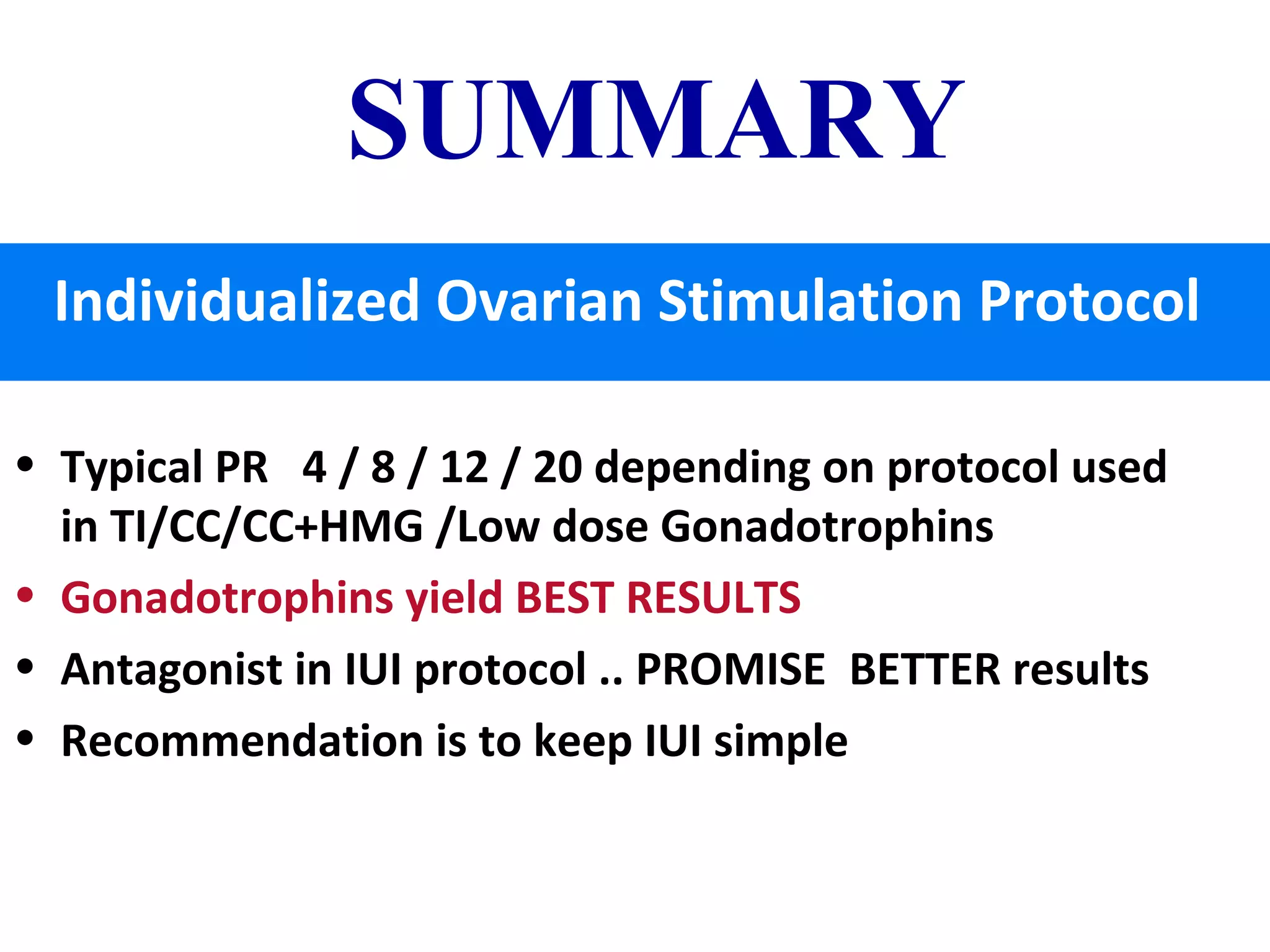
• Typical PR 4 / 8 / 12 / 20 depending on protocol used
in TI/CC/CC+HMG /Low dose Gonadotrophins
• Gonadotrophins yield BEST RESULTS
• Antagonist in IUI protocol .. PROMISE BETTER results
• Recommendation is to keep IUI simple
Individualized Ovarian Stimulation Protocol
S
• CC – is known to have negative effect on ET –
EV -effectiveness ?
Delay hcg trigger –in CC cycles
• GT cycle has better ET
• Scratching of Endometrium—Is now used routinely
• ↑Endo Vascularity
(Aspirin/ Viagra / Sidnafil) ---many drugs but NO clear answer … .so we do not
use
. GCSF..offers promise
Poor Endometrial Thickness
<7 mm has negative impact on PR
TWO PPTS ON THIN ENDOMETRIUM.
ALREADY ON SLIDESHARE.NET
• Thin Endometrium Granulocyte Colony Stimulating
Factor (GCSF)- What, How and When to use in IUI
• Thin Endometrium & Infertility
• Ultrasound monitoring – Allows follicle & endometrial
evaluation in IUI,
• Dose of gonadotrophin & EV can be adjusted in same & if
necessary in subsequent cycles
• Assessment for the risk of OHSS
• Time HCG Trigger
Ultrasound Monitoring
Do it your self
endometrial appearance/thickness is more important than follicle size
for hCG administration
AIM is to have 2-3 Follicles of >16 mm size
in Gonadotrophin cycle in IUI
• Higher risk of OHSS development
If there are more than 4 follicles larger than 16 mm or more than 8
follicles larger than 12 mm
• If need arises Serum.E2 should be measured along with
ULTRASOUND to rule out OHSS
• If >1500 pg/ml…councel patient for OHSS &Consider cancelling
the cycle.
NUMBER OF FOLLICLES &
Pregnancy Rate
No of follicles Pregnancy Rate
1 5.7%
2 13.6%
3 16.3%
4 OR MORE Risk of OHSS & multiple
pregnancies – cancel cycle
Huttenen et al (1999)
Trigger time change with COH
GT – 17-18 mm
CC -24 -25 mm
Doppler - Perifollicular perfusion 50 – 70 %
HCG - should use HCG 5000 iu to trigger
S/C HCG - (BMI)…5 or 10 K
Agonist trigger –not recommended as it causes
luteolysis,which leads to poor pregnancy rate
OVULATION TRIGGER
SINGLE v/s DOUBLE IUI
Single IUI IS GOOD Enough - if there is No Male
Factor
Double IUI recommended in Male factor
1st
18- 24 hrs
2nd
36 – 40 hrs [post-ovul]
• Single insemination : 36 – 38 hrs post HCG
• Double insemination :
- 1st
:24 hrs. post HCG
- 2nd
: 48 hrs. Post HCG
IF + LH surge - Give HCG trigger immediately
- IUI 24 hrs
Time of Inseminations
But we all feel IUI should be done post
ovulatory or go for two IUI
Pre VS Post Ovulation IUI : No Consensus
Kucuk (2008) – found better (25% compared to 8%) pregnancy rates when IUI was postponed till follicle
rupture was observed
Mohd. E Ghanm et al (2010) – found better pregnancy rates (11.7% vs 6.7%) when IUI done post
ovulation
• Labeling.. of specimen
• Regular IC as long Abstinance
not good (<3 V/S > 10 days)
• Semen collection in House
• Semen preparation IN house
.. SPERM preparation … One size does not fit all
• High quality Consumables & media
in
infertility
centre
IN-HOUSE
IUI
Should be
done
From Sperm deposition to – sperm
Ovum interaction :
4 steps take place in cervix ,uterus & FT
1. Capacitation
2. Acrosome Reaction
3. Hyperactivation
4. Sperm- Oocyte binding
I.U.I. Takes away step I & II
in
infertility
centre
IN-HOUSE
IUI
Should be
done
Reminding
you
again
EASY IUI
GIVES BEST RESULTS
ss
• Partially Full Bladder
• Lithotomy position
• Cx mucus aspiration
• Target time - 90 minutes
• Type of Catheter—soft v/s rigid
• Insemination volume—0.3 -0.5 ml/insemination
• Load – when ready
TECHNIQUE OF I.U.I.
Success lies in looking into
details of techniques
ss
• No free space
• Atromatic entry..
• No last word still as to hold cervix or not
• Inject sample beyond intrnal os but 1.5 cm below from
fundus
• Rest 10 mints/post procedure rest –not necessary.
• For difficult cases—do it under ULTRASOUND guidance
• Emergency trey
TECHNIQUE OF I.U.I.
Success lies in looking into
details of techniques
• Progesterone is the best
• Vaginal progesterone is 6 times more potent
than oral medication
LUTEAL SUPPORT
Luteal support & Antagonist Protocol
• Agonist trigger 0.1 mg decapepty1 if more tan
10 follicles.
• Micronized progesterone 200 mg bid in case
of hCG trigger
• Micronized progesterone 400 mg bid in case
of agonist trigger.
• hCG 1500 IU on day of IUI & after 4 days to
rescue luteal phase in case of agonist without
aggravating the risk of OHSS
Number of IUI cycles
• Most pregnancies occur in the first 3 attempts
• IUI treatment is not usually recommended for more
than a maximum of 4-6 cycles
• If the reason for infertility is anovulation, then also
NO MORE THAN 6 cyces.
Plosker SM, et al. Predicting and optimizing success in an intra-uterine
insemination programme. Hum Reprod. 1994 Nov; 9(11): 2014-21
Thumb Rule
• COS+IUI is effective
it works in FIRST 3 to 4 cycles.
• Don’t repeat IUI again and again
IVFafter three failed IUI cycles is advised.
3 IUI = 1 IVF
Don’t waste time!
ALL DOCTORS PRACTICING INFERTILITY/DOING I.U.I.in
INDIA NEED TO HAVE
INFERTILITY REGISTRATION
IVF..... REGISTRATION is already the practice
The effect of patient and semen characteristics on live birth
rates following intrauterine insemination : A Retrospective
study HENDIN B. N.et al. Journal of assisted reproduction
and genetics ; 2000, vol. 17, no
5, pp. 245-252
• Advanced female age
• Poor postwash sperm motility count<5 million
• History of corrective pelvic surgery
Poor postwash sperm motility in combination with
either of these other two risk factors resulted in no
successful pregnancies
RECAP
RISK FACTORS FOR POOR OUTCOME WITH IUI
DOCUMENTATION/REPUTATION OF
TEAM
• Integrity of Team
• Right documentation
• Analysis of Result what works
& what does not work
To DECIDE -WHEN TO MOVE FROM IUI TO
IV For Adoption?
• Each centre should define its policy when to switch
for IVF, which takes into account
• AGE OF WOMEN
• Selection of Indication & protocol
• Pregnancy rates achieved by IUI clinic
TAKE HOME MESSAGES
• IUI should be offered to younger age couples with shorter
duration of infertility
• Semen parameters should be assessed before putting a
couple for IUI
• There is no point in repeating IUI beyond 3 - 4 well planned
attempts
• Mild induction protocols should be preferred
• Patient education on what to expect before starting
treatment helps set correct expectations
ADDRESS
11 Gagan Vihar, Near
Karkari Morh Flyover,
Delhi - 51
CONTACT US
9650588339
9599044257
011-22414049
WEBSITE :
www.lifecareivf.in
www.lifecarecentre.in
www.lifecareabs.in
ISO 14001:2004 (EMS)
…..Caring hearts, healing hands
ISO 9001:2008
Helpline : 9599044257
Web.www.lifecareivf.in
Helpline : 9910081484
27
Year
In
your
servic
e
27
Year
In
your
servic
e

Intrauterine Insemination UPDATE 2018

  • 1.
    Intrauterine Insemination UPDATE DR. SHARDAJAIN DR. JYOTI AGARWAL DR. JYOTI BHASKAR
  • 2.
    Over 350 pptsare available on slideshare.net ***for use of public/Doctors www.slideshare.net / Lifecarecentre
  • 3.
    OVERVIEW • Aim • Definition •Prerequisites • Individualisation of patient. • Ohss free IUI. Clinic {Strict cancellation of cycle if OHSS is suspected} • Newer trends • Sucess Rates in IUI with COH • PROGNOTIC FACTORS to increase Pregnancy Rates..& discussion
  • 4.
    Singleton live birth at term ; Multiple Pregnan cy 10-15% Cycle Cancellati on 2-8% Bcz of Risk of OHSS OHSS Severe 0% Moderate 3-8% . Our Aim Minimize Risks
  • 5.
    A cost Effective, non invasive first line therapy & inexpensive method of treatment that involves the deposition o a processed semen sample in the upper uterine cavity * IUI is easily done in simple setups. IUI
  • 6.
    PRE REQUISITES FORIUI • Atleast one patent functional tube • Evidence of ovulation • Adequate sperm count • Responsive endometrium
  • 7.
    INDIVIDUALISING TREATMENT PROTOCOL is thekey STRICT CANCELLATION POLICY in Gonadotrophic stimulation protocol to limit MULTI- FOLLICULAR development may help to avoid OHSS as OHSS is not acceptable.
  • 8.
    NEWER TRENDS Though thetechnique of I.U.I. has remained same. Several advances in • TYPE OF STIMULATION protocols, • wider USE OF GONADOTROPHINS, • SPERM PREPARATION techniques tailored to every specimen • Meticulous ULTRASOUND monitoring has led to improve success rates with I.U.I.
  • 9.
    PREGNANCY RATE INA.R.T. million dollar information Method Pregnancy Rate (%) Intercourse (Timed) 4 IUI 6 CC 6 CC+IUI 8 FSH / HMG 7.7 CC / FSH /IUI 9-12 FSH/ HMG/IUI 17 – 20 % In vitro fertilization 20 to maximum 40% [self cycle] 50 to 60 % donor cycle
  • 10.
    CONTROLLED OVARIAN HYPERSTIMULATION..Is thekey COH, particularly with CC,LETROZOLE, LOW DOSE GONADOTROPHINS,with IUI offers significant benefit in terms of PREGNANCY OUTCOMES compared with NATURAL cycle or TIMED INTERCOURSE,while reducing associated COH complications such as MULTIPLE PREGNANCIES & OHSS
  • 11.
    IMPOTANT PROGNOSTIC INDICATORS OFSUCCESS with I.U.I. • >35 YRS of AGE OF FEMALE PATIENT • DURATION OF INFERTILITY • STIMULATION PROTOCOL[review in slideshare.net 2017] • INFERTILITY ETIOLOGY • NUMBER OF IUI CYCLES • TIMING OF INSMINATION • TECHNIQUE OF IUI • NUMBER OF PREOVULATORY FOLLICLES ON THE DAY OF HCG • SEMEN QUALITY & FEW OBSERVATION ON MALE FACTOR
  • 12.
    ADVANCED MATERNAL AGE ≥35 YEARS is the most important factor
  • 13.
    AGE OF WOMANis The Biggest Factor Substantial decline in fertility occurs at 35 . Decrease in ovarian reserve in Indian women is observed 6 to 7 years earlier
  • 14.
    As Age Advances,Number Of Eggs Decline Faddy et al., 1992
  • 15.
    Likelihood of GettingPregnant by Age The likelihood of infertility dramatically increases for women after
  • 16.
    Miscarriages Increase with Age Thelikelihood of miscarrying increases with age.
  • 17.
    • Ovarian responsedeclines rapidly after 35 years of age • HFEA data for AID – 2008 confirms women age factor Women Age is most important & has a direct correlation with probability of success of IUI Our experience - no success in IUI after 40 year Age of lady No of IUI Live birth rate 40-42 yrs 492 23/492 = 4.7% 43 – 44 172 2/172 = 1.2% >44 46 0/46 = 0%
  • 18.
    INDICATION of IUI(Aetiology)
  • 19.
    CPR in IUI—8to 20 % depending upon indication & Protocols • Anovulatory infertility • Cervical infertility • Azoospermia [AID] • unexplained infertility • Immunological abnormalities • Mild degrees of male factor infertility • Non-consummation of marriage due to – ED/vaginismus
  • 20.
    Grading of Success& Indication for IUI • Anovulatory infertility • Cervicalfactor infertility • Azoospermia • Unexplained Infertility Age over 35 •Endometriosis •Immunological infertility •Male factor – poor TMSC Best Outcome Good Outcome Poor Outcome
  • 21.
    Good Result : -Cervical Factor I : - Anovulatory I : - Unexplained I : - Donor IUI Poor Results :- severe male infertility tubal factor/ pelvic adhesions severe endometriosis
  • 22.
    Direct referral toIVF/ICSI is to be done earlier than LATE • ADVANCED MATERNAL AGE • SEVERE MALE FACTOR INFERTILITY • TUBAL PATHOLOGY • SEVERE ENDOMETRIOSIS As IUI IS OF NO BENEFIT IN THESE CASES
  • 23.
    Who are GOOD orBAD RESPONDERS
  • 24.
    Good Responders :-young :- Good Crop of Preovulatory follicles :- Good ET (> 7 mm) :- Good PWS count Poor Responders :- Older self / partner, :- ↑ duration infertility (> 5 yrs) :- Poor Ovarian Responce :- Poor Endometrial Thickness :- Poor Sperm Quality
  • 25.
    Semen & MaleFactors
  • 26.
    AGE < 45yrs >10 million prewash count Over 5 million Post Wash Count Normal morphology – 5 % (Krugers) DNA fragmentation -< 15 % Sperm survival (24 hours) - ↑ 70 % Male-good prognosis factors
  • 27.
    Male Factor &SEMEN PARAMETERS – which impact IUI Outcome • Oligospermia [ 10 million ] • SEMEN PROCESSING TIME • Pre wash TOTAL MOTILE SPERM COUNT • Post Wash Sperm MOTILITY AFTER PROCESSING. • SPERM MORFOLOGY • Critical IUI INSEMINATION TIME [from sample production to INSEMINATION • 24-H SPERM SURVIVAL
  • 29.
    Pre wash MOTILESPERM COUNT An average total motile sperm count of 10x106 may be a USEFUL THRESHOLD VALUE for decisions about treating a couple with IUI or IVF. When initial values are lower, IUI has little chance of success Effect of the total motile sperm count on the efficacy and cost-effectiveness of intrauterine insemination and in vitro fertilization. Van Voorhis BJ, et al. Fertil Steril 2001 Apr;75(4):661-8 Comparison of the sperm quality necessary for successful intrauterine insemination with World Health Organization threshold values for normal sperm. Dickey RP, et al. Fertil Steril 1999 Apr;71(4):684-9
  • 30.
    The post washtotal motile sperm count ≥ 5 X 10⁶ is critical Total motile sperm count – TMS count > 5 mil associated with good outcome while TMS < 1 mil has very poor outcome Van weert et al. performance of the postwash total motile sperm count as a predictor of pregnancy at the time of intrauterine insemination : a meta – analysis . Fertil steril . 2004 ; 82:612
  • 31.
    Patients with morethan 60% normal sperm morphology (NSM) had higher pregnancy rate than those with less than 60% NSM (24.3% vs. 7.7%, P=0.0052). IMPACT OF SPERM MORPHOLOGY Intrauterine insemination: pregnancy rate and its associated factors in a university hospital in Iran Zahra Rezaie, et al. Middle East Fertility Society Journal,Vol. 11, No. 1, 2006, pp.59-63
  • 32.
    Sperm Morphology Now krugerscriteria is followed Sperm morpholgy – best outcome are seen with 4-14 % normal sperm morphology with strict kruger’s criteria Predictive value of normal sperm morphology in intrauterine insemination (IUI): a structured literature reviw Hum Reprod, 7 (2001), pp 495 - 500
  • 33.
    WHO GIVES LOTEMPHASIS ON KRUGERS CRITERIA---BUT NO LAB IN INDIA GIVES REPORT USING KRUGERS CRITERIA
  • 34.
    Effects of highsperm DNA fragmentations are •Infertility •Recurrent pregnancy loss •Poor outcomes in IUI and IVF Men with poor semen parameters are more likely to have high DNA fragmentations
  • 35.
    The term DNAfragmentation refers to Damaged sperm DNA that can not be repaired
  • 36.
    Sperm DNA fragmentation index-DFI>30% correlates with poor pregnancy rate & high rate of miscarriage
  • 37.
    24 – hoursSPERM SURVIVAL - HIGHLY PREDICTIVE OF IUI SUCCESS 24 - hours Survival Rate….>70 % Advanced semen analysis: a simple screening test to predict intrauterine insemination success. Branigan EF, et al. Fertil Steril 1999 Mar;71(3):547-51 Easy test
  • 38.
    IUI-H V/S IUI-D 12th ESHREreport on IUI Accumulated results from 1,69,469 cycles from across 26 countries Procedure No % increase since 2006 Delivery Rates IUI – H 144509 + 1.5 % 9.1% IU – D 24960 - 4.3 % 13.8% V. Goosens et al, human Reprod. Sept 2012
  • 39.
    SEMEN EJACULATION, PROCESSING &INSEMINATION TIME Very very important most of the gynaecologist donor know and follow IDEAL TIME..Is less than 90 mts DELAYING SEMEN PROCESSING FROM 30 min Upto one hour. • Delaying I.U.I. insemination FROM 90 min upto 2 hour after collection - compromises the PREGNANCY OUTCOME in COH - I.U.I. CYCLES
  • 40.
    SPERM-PREPARATION TECHNIQUES- IUI RESULTS •ABNORMALSEMEN ANALYSES. –Density gradient is superior to the swim-up technique in improving Pregnancy rates. • NORMAL SEMEN ANALYSES. –When only nuclear maturity rate is taken into account, the swim-up technique seems to be sufficient for selecting spermatozoa. Sperm-preparation techniques for men with normal and abnormal semen analysis.- A comparison. Erel CT, et al. J Reprod Med 2000 Nov;45(11):917-22
  • 41.
    Strict criteria nolonger valid . In IUI we can use either technique Normal sample: Pellet swim up Low VOLUME : pool samples, simple WASH Low COUNT : pool samples, simple WASH Low MOTILITY : simple WASH or Gradient Highly ABNORMALS :Gradient (80-90%) High DEBRIS : Gradient (80-90%) FLAKES : Allow to settle, remove flakes, Gradient (80-90 %) SUM UP of SeMen SaMPle for IUI
  • 42.
    Counselling Tips in MALEFACTOR INFERTILITY • Prewash Sperm COUNT has been independently associated with PR in MALE FACTOR INFERTILITY. • P REWASH Sperm Count should be >10 MILLION for IUI..if less I.V.F. Is desirable. • 24 – SPERM SURVIVAL OF > 70 %---good prognosis • NORMAL MORPHOLOGY before sperm separation > 4 -15 % • RAPID PROGRESSIVE MOTILITY >25.% After sperm washing • CURVILINEAR VELOCITY after sperm separation >102.65 um/s Independently predict pregnancy outcome in patients with MALE FACTOR infertility.
  • 43.
  • 44.
    SUMMARY • Typical PR4 / 8 / 12 / 20 depending on protocol used in TI/CC/CC+HMG /Low dose Gonadotrophins • Gonadotrophins yield BEST RESULTS • Antagonist in IUI protocol .. PROMISE BETTER results • Recommendation is to keep IUI simple Individualized Ovarian Stimulation Protocol
  • 45.
    S • CC –is known to have negative effect on ET – EV -effectiveness ? Delay hcg trigger –in CC cycles • GT cycle has better ET • Scratching of Endometrium—Is now used routinely • ↑Endo Vascularity (Aspirin/ Viagra / Sidnafil) ---many drugs but NO clear answer … .so we do not use . GCSF..offers promise Poor Endometrial Thickness <7 mm has negative impact on PR
  • 46.
    TWO PPTS ONTHIN ENDOMETRIUM. ALREADY ON SLIDESHARE.NET • Thin Endometrium Granulocyte Colony Stimulating Factor (GCSF)- What, How and When to use in IUI • Thin Endometrium & Infertility
  • 47.
    • Ultrasound monitoring– Allows follicle & endometrial evaluation in IUI, • Dose of gonadotrophin & EV can be adjusted in same & if necessary in subsequent cycles • Assessment for the risk of OHSS • Time HCG Trigger Ultrasound Monitoring Do it your self endometrial appearance/thickness is more important than follicle size for hCG administration
  • 48.
    AIM is tohave 2-3 Follicles of >16 mm size in Gonadotrophin cycle in IUI • Higher risk of OHSS development If there are more than 4 follicles larger than 16 mm or more than 8 follicles larger than 12 mm • If need arises Serum.E2 should be measured along with ULTRASOUND to rule out OHSS • If >1500 pg/ml…councel patient for OHSS &Consider cancelling the cycle.
  • 49.
    NUMBER OF FOLLICLES& Pregnancy Rate No of follicles Pregnancy Rate 1 5.7% 2 13.6% 3 16.3% 4 OR MORE Risk of OHSS & multiple pregnancies – cancel cycle Huttenen et al (1999)
  • 50.
    Trigger time changewith COH GT – 17-18 mm CC -24 -25 mm Doppler - Perifollicular perfusion 50 – 70 % HCG - should use HCG 5000 iu to trigger S/C HCG - (BMI)…5 or 10 K Agonist trigger –not recommended as it causes luteolysis,which leads to poor pregnancy rate OVULATION TRIGGER
  • 51.
    SINGLE v/s DOUBLEIUI Single IUI IS GOOD Enough - if there is No Male Factor Double IUI recommended in Male factor 1st 18- 24 hrs 2nd 36 – 40 hrs [post-ovul]
  • 52.
    • Single insemination: 36 – 38 hrs post HCG • Double insemination : - 1st :24 hrs. post HCG - 2nd : 48 hrs. Post HCG IF + LH surge - Give HCG trigger immediately - IUI 24 hrs Time of Inseminations
  • 53.
    But we allfeel IUI should be done post ovulatory or go for two IUI Pre VS Post Ovulation IUI : No Consensus Kucuk (2008) – found better (25% compared to 8%) pregnancy rates when IUI was postponed till follicle rupture was observed Mohd. E Ghanm et al (2010) – found better pregnancy rates (11.7% vs 6.7%) when IUI done post ovulation
  • 54.
    • Labeling.. ofspecimen • Regular IC as long Abstinance not good (<3 V/S > 10 days) • Semen collection in House • Semen preparation IN house .. SPERM preparation … One size does not fit all • High quality Consumables & media
  • 55.
  • 56.
    From Sperm depositionto – sperm Ovum interaction : 4 steps take place in cervix ,uterus & FT 1. Capacitation 2. Acrosome Reaction 3. Hyperactivation 4. Sperm- Oocyte binding
  • 57.
    I.U.I. Takes awaystep I & II
  • 58.
  • 59.
  • 60.
    ss • Partially FullBladder • Lithotomy position • Cx mucus aspiration • Target time - 90 minutes • Type of Catheter—soft v/s rigid • Insemination volume—0.3 -0.5 ml/insemination • Load – when ready TECHNIQUE OF I.U.I. Success lies in looking into details of techniques
  • 61.
    ss • No freespace • Atromatic entry.. • No last word still as to hold cervix or not • Inject sample beyond intrnal os but 1.5 cm below from fundus • Rest 10 mints/post procedure rest –not necessary. • For difficult cases—do it under ULTRASOUND guidance • Emergency trey TECHNIQUE OF I.U.I. Success lies in looking into details of techniques
  • 62.
    • Progesterone isthe best • Vaginal progesterone is 6 times more potent than oral medication LUTEAL SUPPORT
  • 63.
    Luteal support &Antagonist Protocol • Agonist trigger 0.1 mg decapepty1 if more tan 10 follicles. • Micronized progesterone 200 mg bid in case of hCG trigger • Micronized progesterone 400 mg bid in case of agonist trigger. • hCG 1500 IU on day of IUI & after 4 days to rescue luteal phase in case of agonist without aggravating the risk of OHSS
  • 64.
    Number of IUIcycles • Most pregnancies occur in the first 3 attempts • IUI treatment is not usually recommended for more than a maximum of 4-6 cycles • If the reason for infertility is anovulation, then also NO MORE THAN 6 cyces. Plosker SM, et al. Predicting and optimizing success in an intra-uterine insemination programme. Hum Reprod. 1994 Nov; 9(11): 2014-21
  • 65.
    Thumb Rule • COS+IUIis effective it works in FIRST 3 to 4 cycles. • Don’t repeat IUI again and again IVFafter three failed IUI cycles is advised. 3 IUI = 1 IVF Don’t waste time!
  • 66.
    ALL DOCTORS PRACTICINGINFERTILITY/DOING I.U.I.in INDIA NEED TO HAVE INFERTILITY REGISTRATION IVF..... REGISTRATION is already the practice
  • 67.
    The effect ofpatient and semen characteristics on live birth rates following intrauterine insemination : A Retrospective study HENDIN B. N.et al. Journal of assisted reproduction and genetics ; 2000, vol. 17, no 5, pp. 245-252 • Advanced female age • Poor postwash sperm motility count<5 million • History of corrective pelvic surgery Poor postwash sperm motility in combination with either of these other two risk factors resulted in no successful pregnancies RECAP RISK FACTORS FOR POOR OUTCOME WITH IUI
  • 68.
    DOCUMENTATION/REPUTATION OF TEAM • Integrityof Team • Right documentation • Analysis of Result what works & what does not work
  • 69.
    To DECIDE -WHENTO MOVE FROM IUI TO IV For Adoption? • Each centre should define its policy when to switch for IVF, which takes into account • AGE OF WOMEN • Selection of Indication & protocol • Pregnancy rates achieved by IUI clinic
  • 70.
    TAKE HOME MESSAGES •IUI should be offered to younger age couples with shorter duration of infertility • Semen parameters should be assessed before putting a couple for IUI • There is no point in repeating IUI beyond 3 - 4 well planned attempts • Mild induction protocols should be preferred • Patient education on what to expect before starting treatment helps set correct expectations
  • 71.
    ADDRESS 11 Gagan Vihar,Near Karkari Morh Flyover, Delhi - 51 CONTACT US 9650588339 9599044257 011-22414049 WEBSITE : www.lifecareivf.in www.lifecarecentre.in www.lifecareabs.in ISO 14001:2004 (EMS) …..Caring hearts, healing hands ISO 9001:2008 Helpline : 9599044257 Web.www.lifecareivf.in Helpline : 9910081484 27 Year In your servic e 27 Year In your servic e