IInnttrraaUUtteerriinnee IInnsseemmiinnaattiioonn 
10/28/14 1
Advantage 
•Easy to perform 
•Training is easy 
•Less invasive 
•Risks are minimal 
•Quality control possible 
•Costs are minimal 
10/28/14 2
Items Addressed 
• What is IUI. 
•Indications. 
•Effectiveness. 
•Cost Effectiveness. 
• Factors affecting success rate. 
•Advantages and complications. 
10/28/14 3
The rationale is bypassing the 
cervical-mucus barrier and increasing 
the number of motile spermatozoa 
with a high proportion of normal 
forms at the site of fertilization. 
10/28/14 4
Semen Preparation Techniques 
-Swim up. 
-Albumin 
-Percoll 
-Minipercoll 
10/28/14 5
The washing procedures are 
necessary to remove 
prostaglandins, infectious agents, 
antigenic proteins, non-motile 
spermatozoa, leucocytes and 
immature germ cells. 
10/28/14 6
Timing of IUI 
• Basal Body Temperature 
• LH Surge ( urine/serum) 
• US
Sites of insemination 
• Intrauterine (IUI) 
• Intracervical (ICI)
Indications 
• Male factor subfertility 
• Unexplained infertility 
• Endometriosis. 
• Combined ovulatory and ♂ factor 
infertility. 
• Cervical and immunological infertility 
• Sexual dysfunction infertility.
Male Factor Subfertility 
In long standing infertility caused 
by reduced sperm quality 
expectant treatment seems to be 
disappointing with a spontaneous 
conception rate of only 2% per 
cycle. 
Collins J A et al. Fertil Steril; 1995, 64:22-28 
10/28/14 10
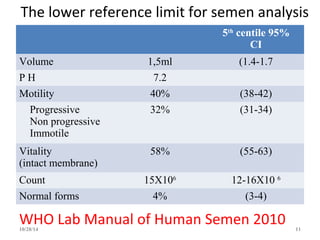
The lower reference limit for semen analysis 
5th centile 95% 
CI 
Volume 1,5ml (1.4-1.7 
P H 7.2 
Motility 40% (38-42) 
Progressive 
32% (31-34) 
Non progressive 
Immotile 
Vitality 
(intact membrane) 
58% (55-63) 
Count 15X106 12-16X10 6 
Normal forms 4% (3-4) 
WHO Lab Manual of Human Semen 2010 
10/28/14 11
Male factor Infertility (OAT) 
-Oligozoospermia (O) 
-Asthenozoospermia (A) 
-Tratozoospermia (T) 
10/28/14 12
Male subfertility 
In male subfertility IUI with 
or without COH a pregnancy 
rate of 10-18% per cycle has 
been reported. 
-Stone BA et al 1999. Am. J Obstet Gynecol, 180:1522-1534 
- Ombelet W et al 1995,Hum. Reprod. 10 (Suppl. 1):90-120 
- Ombelet W et al 1997. Hum. Reprod. 12:1458-1463 
10/28/14 13
Male subfertility 
A Cochrane review showed 
that IUI is superior to TI, 
both in natural and in cycles 
with CoH. 
Cohlen BJ et al 2000. (Cochrane Review) 
Cochrane library, issue 4, update software, Oxford. 
10/28/14 14
(cumulative ongoing PR of 21.9% 
after three IUI cycles). 
-Centole GM 1997. J. Androl; 18:448-453 
10/28/14 15
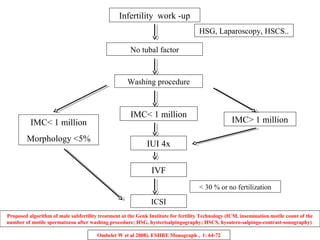
Infertility work -up 
No tubal factor 
HSG, Laparoscopy, HSCS.. 
Washing procedure 
IMC< 1 million IMC> 1 million 
IMC< 1 million 
Morphology <5% 
IUI 4x 
IVF 
< 30 % or no fertilization 
ICSI 
Proposed algorithm of male subfertility treatment at the Genk Institute for fertility Technology (ICM, insemination motile count of the 
number of motile spermatozoa after washing procedure; HSG, hysterisalpingography; HSCS, hysatero-salpingo-contrast-sonography) 
Ombelet W et al 2008). ESHRE Monograph , 1: 64-72
Unexplained infertility 
Meta –analysis comparing IUI and TI 
in natural cycles showed no difference 
in results; therefore, IUI in natural 
cycles seems ineffective in case of 
unexplained infertility. 
Cohen BJ. Gyn. Obst. Invest; 2005,59:3-13 
10/28/14 17
Sexual Dysfunction infertility 
• Retrograde ejaculation 
• Vaginismus 
• Hypospadius 
• Impotence 
• Infrequent Intercourse during fertile 
period.
ESHRE Capri Workshop Group 
IUI in stimulated cycles may be 
considered while waiting for 
IVF or when in women with 
patent tubes IVF is not 
affordable. 
ESHRE - Hum Reprod. Update, 2009 
Vol,15, No. 3, 265-277 
10/28/14 19
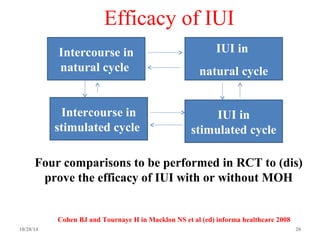
Efficacy of IUI 
Intercourse in 
natural cycle 
IUI in 
natural cycle 
Intercourse in 
stimulated cycle 
IUI in 
stimulated cycle 
Four comparisons to be performed in RCT to (dis) 
prove the efficacy of IUI with or without MOH 
Cohen BJ and Tournaye H in Macklon NS et al (ed) informa healthcare 2008 
10/28/14 20
Factors affecting IUI success 
• Age of the female. 
• Natural cycle versus O.I 
• Number of IUI treatment cycles. 
• Site of insemination 
• Exact timing of IUI
Complications 
• Relatively low success rate / cycle. 
• PID 0.01-0.2%.* 
• MP 
• Prematurity & low birth weight.** 
* Dodson and Haney, 1991 
*Ombelet et al 1995 
**Wong et al 2002, Gaudoin et al 2003, Ombelet et al 2006.

Intrauterine insemination (iui)

  • 1.
  • 2.
    Advantage •Easy toperform •Training is easy •Less invasive •Risks are minimal •Quality control possible •Costs are minimal 10/28/14 2
  • 3.
    Items Addressed •What is IUI. •Indications. •Effectiveness. •Cost Effectiveness. • Factors affecting success rate. •Advantages and complications. 10/28/14 3
  • 4.
    The rationale isbypassing the cervical-mucus barrier and increasing the number of motile spermatozoa with a high proportion of normal forms at the site of fertilization. 10/28/14 4
  • 5.
    Semen Preparation Techniques -Swim up. -Albumin -Percoll -Minipercoll 10/28/14 5
  • 6.
    The washing proceduresare necessary to remove prostaglandins, infectious agents, antigenic proteins, non-motile spermatozoa, leucocytes and immature germ cells. 10/28/14 6
  • 7.
    Timing of IUI • Basal Body Temperature • LH Surge ( urine/serum) • US
  • 8.
    Sites of insemination • Intrauterine (IUI) • Intracervical (ICI)
  • 9.
    Indications • Malefactor subfertility • Unexplained infertility • Endometriosis. • Combined ovulatory and ♂ factor infertility. • Cervical and immunological infertility • Sexual dysfunction infertility.
  • 10.
    Male Factor Subfertility In long standing infertility caused by reduced sperm quality expectant treatment seems to be disappointing with a spontaneous conception rate of only 2% per cycle. Collins J A et al. Fertil Steril; 1995, 64:22-28 10/28/14 10
  • 11.
    The lower referencelimit for semen analysis 5th centile 95% CI Volume 1,5ml (1.4-1.7 P H 7.2 Motility 40% (38-42) Progressive 32% (31-34) Non progressive Immotile Vitality (intact membrane) 58% (55-63) Count 15X106 12-16X10 6 Normal forms 4% (3-4) WHO Lab Manual of Human Semen 2010 10/28/14 11
  • 12.
    Male factor Infertility(OAT) -Oligozoospermia (O) -Asthenozoospermia (A) -Tratozoospermia (T) 10/28/14 12
  • 13.
    Male subfertility Inmale subfertility IUI with or without COH a pregnancy rate of 10-18% per cycle has been reported. -Stone BA et al 1999. Am. J Obstet Gynecol, 180:1522-1534 - Ombelet W et al 1995,Hum. Reprod. 10 (Suppl. 1):90-120 - Ombelet W et al 1997. Hum. Reprod. 12:1458-1463 10/28/14 13
  • 14.
    Male subfertility ACochrane review showed that IUI is superior to TI, both in natural and in cycles with CoH. Cohlen BJ et al 2000. (Cochrane Review) Cochrane library, issue 4, update software, Oxford. 10/28/14 14
  • 15.
    (cumulative ongoing PRof 21.9% after three IUI cycles). -Centole GM 1997. J. Androl; 18:448-453 10/28/14 15
  • 16.
    Infertility work -up No tubal factor HSG, Laparoscopy, HSCS.. Washing procedure IMC< 1 million IMC> 1 million IMC< 1 million Morphology <5% IUI 4x IVF < 30 % or no fertilization ICSI Proposed algorithm of male subfertility treatment at the Genk Institute for fertility Technology (ICM, insemination motile count of the number of motile spermatozoa after washing procedure; HSG, hysterisalpingography; HSCS, hysatero-salpingo-contrast-sonography) Ombelet W et al 2008). ESHRE Monograph , 1: 64-72
  • 17.
    Unexplained infertility Meta–analysis comparing IUI and TI in natural cycles showed no difference in results; therefore, IUI in natural cycles seems ineffective in case of unexplained infertility. Cohen BJ. Gyn. Obst. Invest; 2005,59:3-13 10/28/14 17
  • 18.
    Sexual Dysfunction infertility • Retrograde ejaculation • Vaginismus • Hypospadius • Impotence • Infrequent Intercourse during fertile period.
  • 19.
    ESHRE Capri WorkshopGroup IUI in stimulated cycles may be considered while waiting for IVF or when in women with patent tubes IVF is not affordable. ESHRE - Hum Reprod. Update, 2009 Vol,15, No. 3, 265-277 10/28/14 19
  • 20.
    Efficacy of IUI Intercourse in natural cycle IUI in natural cycle Intercourse in stimulated cycle IUI in stimulated cycle Four comparisons to be performed in RCT to (dis) prove the efficacy of IUI with or without MOH Cohen BJ and Tournaye H in Macklon NS et al (ed) informa healthcare 2008 10/28/14 20
  • 21.
    Factors affecting IUIsuccess • Age of the female. • Natural cycle versus O.I • Number of IUI treatment cycles. • Site of insemination • Exact timing of IUI
  • 22.
    Complications • Relativelylow success rate / cycle. • PID 0.01-0.2%.* • MP • Prematurity & low birth weight.** * Dodson and Haney, 1991 *Ombelet et al 1995 **Wong et al 2002, Gaudoin et al 2003, Ombelet et al 2006.