Benha University Hospital, Egypt
Aboubakr Elnashar
CONTENTS
1. TYPES OF OVARIAN STIMULATION FOR IVF
2. DRUGS
3. GNRHa PROTOCOLS
4. GNRHan PROTOCOLS
5. TRIGGERING OF OVULATION
6. CYCLE CANCELLATION
7. INDIVIDUALIZATION OF COS
Aboubakr Elnashar
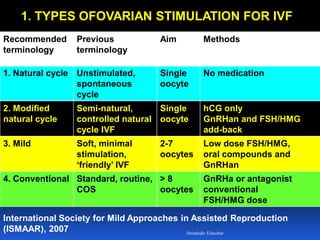
MethodsAimPrevious
terminology
Recommended
terminology
No medicationSingle
oocyte
Unstimulated,
spontaneous
cycle
1. Natural cycle
hCG only
GnRHan and FSH/HMG
add-back
Single
oocyte
Semi-natural,
controlled natural
cycle IVF
2. Modified
natural cycle
Low dose FSH/HMG,
oral compounds and
GnRHan
2-7
oocytes
Soft, minimal
stimulation,
‘friendly’ IVF
3. Mild
GnRHa or antagonist
conventional
FSH/HMG dose
> 8
oocytes
Standard, routine,
COS
4. Conventional
International Society for Mild Approaches in Assisted Reproduction
(ISMAAR), 2007
1. TYPES OFOVARIAN STIMULATION FOR IVF
Aboubakr Elnashar
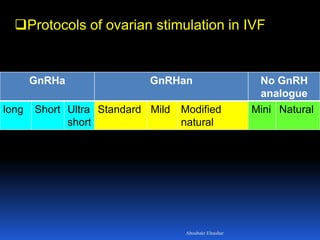
GnRHa GnRHan No GnRH
analogue
long Short Ultra
short
Standard Mild Modified
natural
Mini Natural
Protocols of ovarian stimulation in IVF
Aboubakr Elnashar
2. DRUGS
Gonadtrophins
GnRha
GnRhan
Aboubakr Elnashar
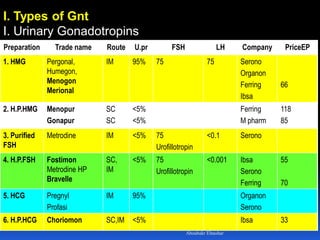
Preparation Trade name Route U.pr FSH LH Company PriceEP
1. HMG Pergonal,
Humegon,
Menogon
Merional
IM 95% 75 75 Serono
Organon
Ferring
Ibsa
66
2. H.P.HMG Menopur
Gonapur
SC
SC
<5%
<5%
Ferring
M pharm
118
85
3. Purified
FSH
Metrodine IM <5% 75
Urofillotropin
<0.1 Serono
4. H.P.FSH Fostimon
Metrodine HP
Bravelle
SC,
IM
<5% 75
Urofillotropin
<0.001 Ibsa
Serono
Ferring
55
70
5. HCG Pregnyl
Profasi
IM 95% Organon
Serono
6. H.P.HCG Choriomon SC,IM <5% Ibsa 33
I. Types of Gnt
I. Urinary Gonadotropins
Aboubakr Elnashar
Aboubakr Elnashar
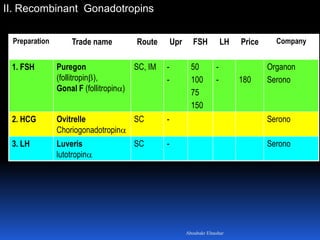
II. Recombinant Gonadotropins
Preparation Trade name Route Upr FSH LH Price Company
1. FSH Puregon
(follitropin),
Gonal F (follitropin)
SC, IM -
-
50
100
75
150
-
- 180
Organon
Serono
2. HCG Ovitrelle
Choriogonadotropin
SC - Serono
3. LH Luveris
lutotropin
SC - Serono
Aboubakr Elnashar
Aboubakr Elnashar
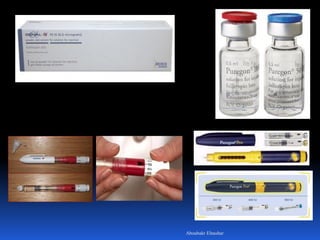
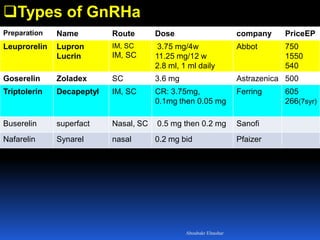
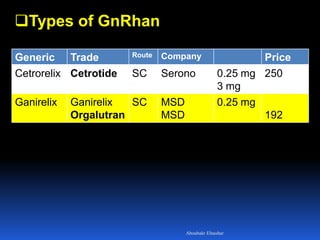
Types of GnRHa
PriceEPcompanyDoseRouteNamePreparation
750
1550
540
Abbot3.75 mg/4w
11.25 mg/12 w
2.8 ml, 1 ml daily
IM, SC
IM, SC
Lupron
Lucrin
Leuprorelin
500Astrazenica3.6 mgSCZoladexGoserelin
605
266(7syr)
FerringCR: 3.75mg,
0.1mg then 0.05 mg
IM, SCDecapeptylTriptolerin
Sanofi0.5 mg then 0.2 mgNasal, SCsuperfactBuserelin
Pfaizer0.2 mg bidnasalSynarelNafarelin
Aboubakr Elnashar
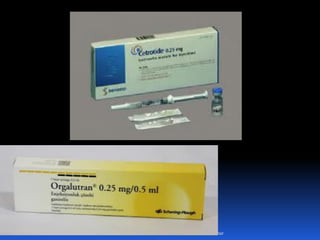
PriceCompanyRouteTradeGeneric
2500.25 mg
3 mg
SeronoSCCetrotideCetrorelix
192
0.25 mgMSD
MSD
SCGanirelix
Orgalutran
Ganirelix
Types of GnRhan
Aboubakr Elnashar
Aboubakr Elnashar
3. GNRHa PROTOCOLS
GnRHa
Produced by
Modification of the native GnRH decapeptide at 6 &
10 positions
Aboubakr Elnashar
Effects of GnRha
Flare effect: Within 12 h and lasting 24-48 h
: 5 fold increase of FSH
10 fold rise in LH &
4 fold elevation in E2.
Continuous administration
: opposite effects:
internalization of the agonist /receptor complex & decrease in
the number of receptors
(down-regulation).
: paradoxical suppression of the pituitary Gnt synthesis &
liberation
(desensitization).
Aboubakr Elnashar
The decreased levels of FSH & LH:
1. Arrest of follicular development
2. Decrease in sex steroid levels to castrate levels.
The pituitary blockade persist during agonist tt but it
is reversible after therapy.
Aboubakr Elnashar
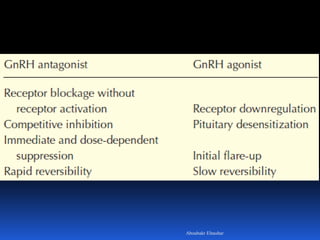
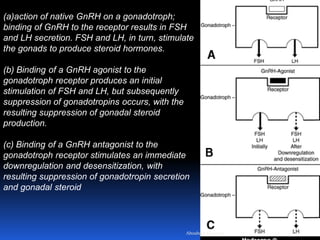
(a)action of native GnRH on a gonadotroph;
binding of GnRH to the receptor results in FSH
and LH secretion. FSH and LH, in turn, stimulate
the gonads to produce steroid hormones.
(b) Binding of a GnRH agonist to the
gonadotroph receptor produces an initial
stimulation of FSH and LH, but subsequently
suppression of gonadotropins occurs, with the
resulting suppression of gonadal steroid
production.
(c) Binding of a GnRH antagonist to the
gonadotroph receptor stimulates an immediate
downregulation and desensitization, with
resulting suppression of gonadotropin secretion
and gonadal steroid
Aboubakr Elnashar
Protocols
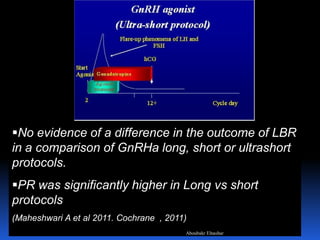
Ultra-short (sequential):
Based on
initial stimulatory effect of GnRHa on Gnt secretion
[flare- up effect]
lasts for 1-2 days
promotes simultaneous maturation of several
follicles.
GnRHa: from the 1st to 3rd day of the cycle.
Gnt: from the 3rd day of the cycleAboubakr Elnashar
No evidence of a difference in the outcome of LBR
in a comparison of GnRHa long, short or ultrashort
protocols.
PR was significantly higher in Long vs short
protocols
(Maheshwari A et al 2011. Cochrane , 2011)
Aboubakr Elnashar
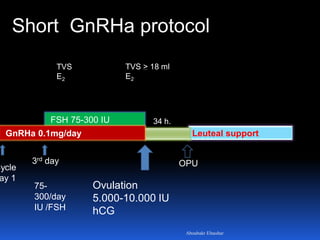
Short (Flare):
GnRHa: from the 1st day of the cycle until the day of
ovulation induction.
Gnt: from the 3rd day of the cycle.
Aboubakr Elnashar
Leuteal support
FSH 75-300 IU
Ovulation
5.000-10.000 IU
hCG
Short GnRHa protocol
75-
300/day
IU /FSH
34 h.
OPU
TVS > 18 ml
E2
Cycle
ay 1
GnRHa 0.1mg/day
3rd day
TVS
E2
Aboubakr Elnashar
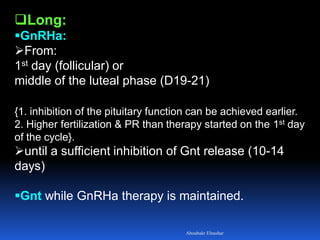
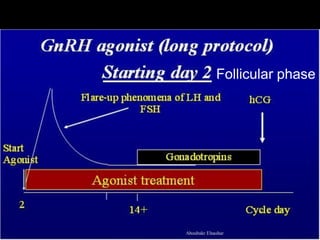
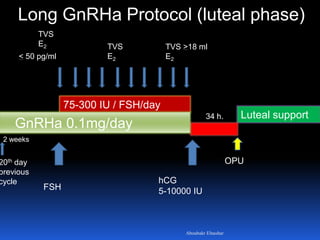
Long:
GnRHa:
From:
1st day (follicular) or
middle of the luteal phase (D19-21)
{1. inhibition of the pituitary function can be achieved earlier.
2. Higher fertilization & PR than therapy started on the 1st day
of the cycle}.
until a sufficient inhibition of Gnt release (10-14
days)
Gnt while GnRHa therapy is maintained.
Aboubakr Elnashar
Follicular phase
Aboubakr Elnashar
Luteal support
hCG
5-10000 IU
75-300 IU / FSH/day
Long GnRHa Protocol (luteal phase)
TVS
E2
34 h.
OPU20th day
previous
cycle
TVS >18 ml
E2
GnRHa 0.1mg/day
< 50 pg/ml
TVS
E2
FSH
2 weeks
Aboubakr Elnashar
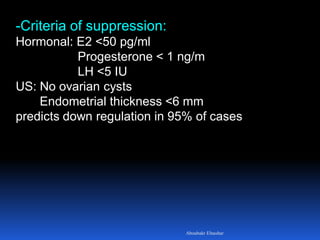
-Criteria of suppression:
Hormonal: E2 <50 pg/ml
Progesterone < 1 ng/m
LH <5 IU
US: No ovarian cysts
Endometrial thickness <6 mm
predicts down regulation in 95% of cases
Aboubakr Elnashar
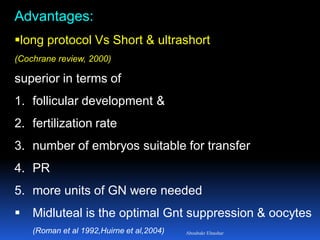
Advantages:
long protocol Vs Short & ultrashort
(Cochrane review, 2000)
superior in terms of
1. follicular development &
2. fertilization rate
3. number of embryos suitable for transfer
4. PR
5. more units of GN were needed
 Midluteal is the optimal Gnt suppression & oocytes
(Roman et al 1992,Huirne et al,2004) Aboubakr Elnashar
,rFSH Vs other GN (HMG, hp-FSH, p-FSH), no
evidence of difference in LBR or OHSS
 42 trials, 9606 couples
 Further research on these comparisons is unlikely
to identify substantive differences in effectiveness or
safety
(Cochrane Database Syst Rev. 2011, Wely et al)
 Use either u or rec Gnt for ovarian stimulation
(NICE, 2013)
Aboubakr Elnashar
Depot Vs daily
No differences PR.
Depot:
longer duration
higher doses of Gnt
more luteal support depot
(Cochrane review 2002)
Aboubakr Elnashar
4. GNRHan PROTOCOLS
GnRHan
Produced by
Modification at 6, 10, & 1, 2, 3, 8 positions
Effects
Inhibition of LH & FSH immediately without the initial
flare up effect of the Gnta.
Mechanism of action
Competitive receptor blockade.
The suppression of LH is dose related.
Larger doses of antagonist is associated with marked
reduction of pregnancy rate in IVF cycles
Aboubakr Elnashar
Aboubakr Elnashar
Protocols
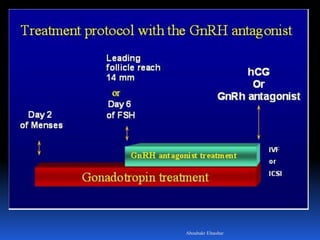
1. Small daily dose (LubecK):
HMG or FSH:
From day 2 or 3 of the cycle &
Cetrorelix or Ganirelix: 0.25 mg daily SC: from
stimulation day 5 or 6 (fixed protocol) or
leading follicle14 mm (Flexible protocol) onwards until
the day of HCG (Diedrich et al,1994).
Advantages:
1. Prevents premature LH surge
2. effective in terms of CPR/cycle & /ET (22% &
27%).
3. safe in terms of a low incidence of patients
hospitalized due to OHSS. Aboubakr Elnashar
Aboubakr Elnashar
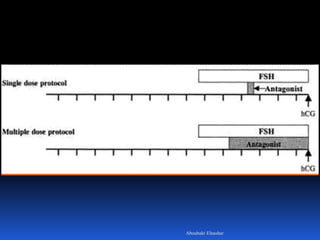
2. Single dose(French):
HMG or FSH:
from day 2 or 3 of the cycle
Cetrorelix:
single dose, 3 mg SC, on stimulation day 7
(Olivennes et al,1998).
HCG is given when the follicles are mature by U/S
&/or E2.
GnRha single dose can be given instead of HCG to
reduce incidence of OHSS {shorter half life of the
agonist compared to HCG}.
Aboubakr Elnashar
Aboubakr Elnashar
Single Vs multiple (Olivennes et al,2003)
Similar efficacy & safety
Recommendations of GnRHan Consensus
Workshop Group)
No increase starting dose of Gnt
Fixed antagonist appears superior to flexible.
Optimal timing for HCG administration
Agonist for triggering
Luteal phase supplementation is required
Aboubakr Elnashar
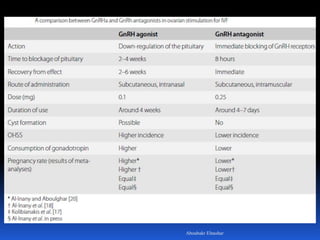
Agonists Vs Antagonists
 LBR after COS for IVF does not depend on the
type of analogue used for pituitary suppression
(SR: Kolibianakis et al,2006)
 Antagonist protocol:
 short, simple with significant decrease in severe
OHSS & amount of GN.
 CPR, OPR/LBR were lower in antagonist group
(Cochrane Database Systematic Review Al-Inany et al., 2006)
 No evidence of a difference in LBR
(Cochrane Database Syst Rev. 2011, Al-Inany et al, 2011)
Aboubakr Elnashar
Aboubakr Elnashar
5. TRIGGERING OF OVULATION
1. HCG
Rational:
The structure & action of HCG are very similar to
those of LH.
HCG induces final follicular maturation.
Ovulation follow:
IM injection of HCG at 37 h.
Accordingly follicular puncture is performed earlier i.e.
32-34 h or 35 h after hCG administration.
Aboubakr Elnashar
Usual dose:
10,000 IU administered 34-36 h before the scheduled
time of oocyte retrieval.
When:
. At least 3 follicles >18 mm
. E2: 150 pg/ml per >15mm follicles.
. Endometrium: Thickness >8mm, Triple line
Aboubakr Elnashar
Risk: OHSS
long half life (30 H) with serum hCG detectable up
to 14 days after the injection.
:prolonged luteotrophic effect:
multiple corpora lutea and
supraphysiologic levels of VEGF
(McClure et al., 1994).
development of OHSS via the enhancement of
capillary leak
(Lesterhuis et al., 2009).
Aboubakr Elnashar
Do not trigger ovulation with the intention of fresh
ET in women who have:
E2>3500 pm/l or
>20 follicles on US
(NICE, 2013)
Aboubakr Elnashar
2. GnRHa in antagonist cycles
: pituitary endogenous LH surge which is enough to
cause a trigger but does not last enough to result in
OHSS.
Itskovitz-Eldor et al., 2000
8 patients: an increased risk for OHSS
(>20 follicles 11 mm and/or E2 3000 pg/ml).
0.2 mg triptorelin (Decapeptyl) to trigger ovulation
None of the patients developed OHSS.
Four clinical pregnancies
A new treatment option
reducing
risk of developing OHSS in high responders
cycle cancellation. Aboubakr Elnashar
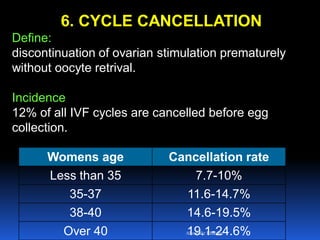
6. CYCLE CANCELLATION
Define:
discontinuation of ovarian stimulation prematurely
without oocyte retrival.
Incidence
12% of all IVF cycles are cancelled before egg
collection.
Womens age Cancellation rate
Less than 35 7.7-10%
35-37 11.6-14.7%
38-40 14.6-19.5%
Over 40 19.1-24.6%Aboubakr Elnashar
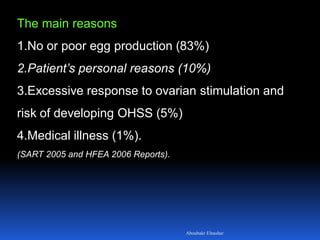
The main reasons
1.No or poor egg production (83%)
2.Patient’s personal reasons (10%)
3.Excessive response to ovarian stimulation and
risk of developing OHSS (5%)
4.Medical illness (1%).
(SART 2005 and HFEA 2006 Reports).
Aboubakr Elnashar
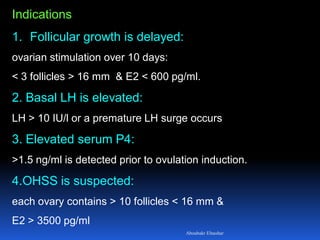
Indications
1. Follicular growth is delayed:
ovarian stimulation over 10 days:
< 3 follicles > 16 mm & E2 < 600 pg/ml.
2. Basal LH is elevated:
LH > 10 IU/l or a premature LH surge occurs
3. Elevated serum P4:
>1.5 ng/ml is detected prior to ovulation induction.
4.OHSS is suspected:
each ovary contains > 10 follicles < 16 mm &
E2 > 3500 pg/ml
Aboubakr Elnashar
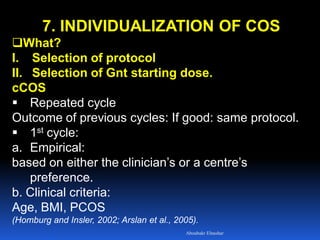
7. INDIVIDUALIZATION OF COS
What?
I. Selection of protocol
II. Selection of Gnt starting dose.
cCOS
 Repeated cycle
Outcome of previous cycles: If good: same protocol.
 1st cycle:
a. Empirical:
based on either the clinician’s or a centre’s
preference.
b. Clinical criteria:
Age, BMI, PCOS
(Homburg and Insler, 2002; Arslan et al., 2005).
Aboubakr Elnashar
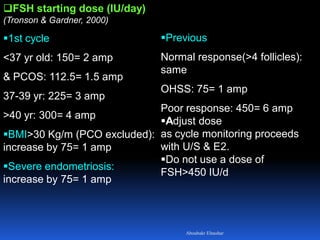
FSH starting dose (IU/day)
(Tronson & Gardner, 2000)
1st cycle
<37 yr old: 150= 2 amp
& PCOS: 112.5= 1.5 amp
37-39 yr: 225= 3 amp
>40 yr: 300= 4 amp
BMI>30 Kg/m (PCO excluded):
increase by 75= 1 amp
Severe endometriosis:
increase by 75= 1 amp
Previous
Normal response(>4 follicles):
same
OHSS: 75= 1 amp
Poor response: 450= 6 amp
Adjust dose
as cycle monitoring proceeds
with U/S & E2.
Do not use a dose of
FSH>450 IU/d
Aboubakr Elnashar
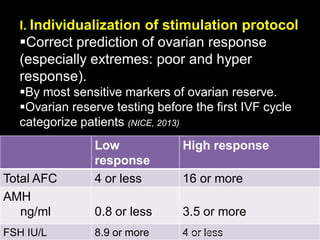
I. Individualization of stimulation protocol
Correct prediction of ovarian response
(especially extremes: poor and hyper
response).
By most sensitive markers of ovarian reserve.
Ovarian reserve testing before the first IVF cycle
categorize patients (NICE, 2013)
High responseLow
response
16 or more4 or lessTotal AFC
3.5 or more0.8 or less
AMH
ng/ml
4 or less8.9 or moreFSH IU/L Aboubakr Elnashar
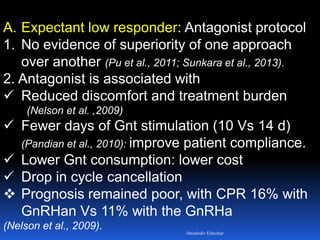
A. Expectant low responder: Antagonist protocol
1. No evidence of superiority of one approach
over another (Pu et al., 2011; Sunkara et al., 2013).
2. Antagonist is associated with
 Reduced discomfort and treatment burden
(Nelson et al. ,2009)
 Fewer days of Gnt stimulation (10 Vs 14 d)
(Pandian et al., 2010): improve patient compliance.
 Lower Gnt consumption: lower cost
 Drop in cycle cancellation
 Prognosis remained poor, with CPR 16% with
GnRHan Vs 11% with the GnRHa
(Nelson et al., 2009).
Aboubakr Elnashar
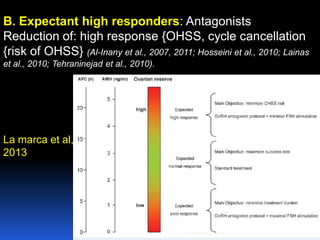
B. Expectant high responders: Antagonists
Reduction of: high response {OHSS, cycle cancellation
{risk of OHSS} (Al-Inany et al., 2007, 2011; Hosseini et al., 2010; Lainas
et al., 2010; Tehraninejad et al., 2010).
La marca et al,
2013
Aboubakr Elnashar
II. Individualization of Gnt Starting Dose:
A. Simple models
One or 2 parameters
1. AMH
2. AFC and age
3. AFC
B. Complex models: > 2 parameters
Aboubakr Elnashar
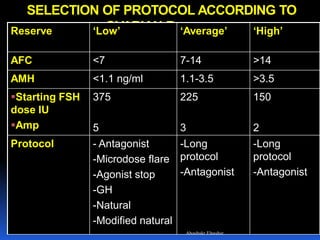
SELECTION OF PROTOCOL ACCORDING TO
OVARIAN ReserveReserve ‘Low’ ‘Average’ ‘High’
AFC <7 7-14 >14
AMH <1.1 ng/ml 1.1-3.5 >3.5
Starting FSH
dose IU
Amp
375
5
225
3
150
2
Protocol - Antagonist
-Microdose flare
-Agonist stop
-GH
-Natural
-Modified natural
-Long
protocol
-Antagonist
-Long
protocol
-Antagonist
Aboubakr Elnashar
Benha University Hospital
E-mail: elnashar53@hotmail.com
Aboubakr Elnashar

Controlled ovarian stimulation in IVF

  • 1.
    Benha University Hospital,Egypt Aboubakr Elnashar
  • 2.
    CONTENTS 1. TYPES OFOVARIAN STIMULATION FOR IVF 2. DRUGS 3. GNRHa PROTOCOLS 4. GNRHan PROTOCOLS 5. TRIGGERING OF OVULATION 6. CYCLE CANCELLATION 7. INDIVIDUALIZATION OF COS Aboubakr Elnashar
  • 3.
    MethodsAimPrevious terminology Recommended terminology No medicationSingle oocyte Unstimulated, spontaneous cycle 1. Naturalcycle hCG only GnRHan and FSH/HMG add-back Single oocyte Semi-natural, controlled natural cycle IVF 2. Modified natural cycle Low dose FSH/HMG, oral compounds and GnRHan 2-7 oocytes Soft, minimal stimulation, ‘friendly’ IVF 3. Mild GnRHa or antagonist conventional FSH/HMG dose > 8 oocytes Standard, routine, COS 4. Conventional International Society for Mild Approaches in Assisted Reproduction (ISMAAR), 2007 1. TYPES OFOVARIAN STIMULATION FOR IVF Aboubakr Elnashar
  • 4.
    GnRHa GnRHan NoGnRH analogue long Short Ultra short Standard Mild Modified natural Mini Natural Protocols of ovarian stimulation in IVF Aboubakr Elnashar
  • 5.
  • 6.
    Preparation Trade nameRoute U.pr FSH LH Company PriceEP 1. HMG Pergonal, Humegon, Menogon Merional IM 95% 75 75 Serono Organon Ferring Ibsa 66 2. H.P.HMG Menopur Gonapur SC SC <5% <5% Ferring M pharm 118 85 3. Purified FSH Metrodine IM <5% 75 Urofillotropin <0.1 Serono 4. H.P.FSH Fostimon Metrodine HP Bravelle SC, IM <5% 75 Urofillotropin <0.001 Ibsa Serono Ferring 55 70 5. HCG Pregnyl Profasi IM 95% Organon Serono 6. H.P.HCG Choriomon SC,IM <5% Ibsa 33 I. Types of Gnt I. Urinary Gonadotropins Aboubakr Elnashar
  • 7.
  • 8.
    II. Recombinant Gonadotropins PreparationTrade name Route Upr FSH LH Price Company 1. FSH Puregon (follitropin), Gonal F (follitropin) SC, IM - - 50 100 75 150 - - 180 Organon Serono 2. HCG Ovitrelle Choriogonadotropin SC - Serono 3. LH Luveris lutotropin SC - Serono Aboubakr Elnashar
  • 9.
  • 10.
    Types of GnRHa PriceEPcompanyDoseRouteNamePreparation 750 1550 540 Abbot3.75mg/4w 11.25 mg/12 w 2.8 ml, 1 ml daily IM, SC IM, SC Lupron Lucrin Leuprorelin 500Astrazenica3.6 mgSCZoladexGoserelin 605 266(7syr) FerringCR: 3.75mg, 0.1mg then 0.05 mg IM, SCDecapeptylTriptolerin Sanofi0.5 mg then 0.2 mgNasal, SCsuperfactBuserelin Pfaizer0.2 mg bidnasalSynarelNafarelin Aboubakr Elnashar
  • 11.
    PriceCompanyRouteTradeGeneric 2500.25 mg 3 mg SeronoSCCetrotideCetrorelix 192 0.25mgMSD MSD SCGanirelix Orgalutran Ganirelix Types of GnRhan Aboubakr Elnashar
  • 12.
  • 13.
    3. GNRHa PROTOCOLS GnRHa Producedby Modification of the native GnRH decapeptide at 6 & 10 positions Aboubakr Elnashar
  • 14.
    Effects of GnRha Flareeffect: Within 12 h and lasting 24-48 h : 5 fold increase of FSH 10 fold rise in LH & 4 fold elevation in E2. Continuous administration : opposite effects: internalization of the agonist /receptor complex & decrease in the number of receptors (down-regulation). : paradoxical suppression of the pituitary Gnt synthesis & liberation (desensitization). Aboubakr Elnashar
  • 15.
    The decreased levelsof FSH & LH: 1. Arrest of follicular development 2. Decrease in sex steroid levels to castrate levels. The pituitary blockade persist during agonist tt but it is reversible after therapy. Aboubakr Elnashar
  • 16.
    (a)action of nativeGnRH on a gonadotroph; binding of GnRH to the receptor results in FSH and LH secretion. FSH and LH, in turn, stimulate the gonads to produce steroid hormones. (b) Binding of a GnRH agonist to the gonadotroph receptor produces an initial stimulation of FSH and LH, but subsequently suppression of gonadotropins occurs, with the resulting suppression of gonadal steroid production. (c) Binding of a GnRH antagonist to the gonadotroph receptor stimulates an immediate downregulation and desensitization, with resulting suppression of gonadotropin secretion and gonadal steroid Aboubakr Elnashar
  • 17.
    Protocols Ultra-short (sequential): Based on initialstimulatory effect of GnRHa on Gnt secretion [flare- up effect] lasts for 1-2 days promotes simultaneous maturation of several follicles. GnRHa: from the 1st to 3rd day of the cycle. Gnt: from the 3rd day of the cycleAboubakr Elnashar
  • 18.
    No evidence ofa difference in the outcome of LBR in a comparison of GnRHa long, short or ultrashort protocols. PR was significantly higher in Long vs short protocols (Maheshwari A et al 2011. Cochrane , 2011) Aboubakr Elnashar
  • 19.
    Short (Flare): GnRHa: fromthe 1st day of the cycle until the day of ovulation induction. Gnt: from the 3rd day of the cycle. Aboubakr Elnashar
  • 20.
    Leuteal support FSH 75-300IU Ovulation 5.000-10.000 IU hCG Short GnRHa protocol 75- 300/day IU /FSH 34 h. OPU TVS > 18 ml E2 Cycle ay 1 GnRHa 0.1mg/day 3rd day TVS E2 Aboubakr Elnashar
  • 21.
    Long: GnRHa: From: 1st day (follicular)or middle of the luteal phase (D19-21) {1. inhibition of the pituitary function can be achieved earlier. 2. Higher fertilization & PR than therapy started on the 1st day of the cycle}. until a sufficient inhibition of Gnt release (10-14 days) Gnt while GnRHa therapy is maintained. Aboubakr Elnashar
  • 22.
  • 23.
    Luteal support hCG 5-10000 IU 75-300IU / FSH/day Long GnRHa Protocol (luteal phase) TVS E2 34 h. OPU20th day previous cycle TVS >18 ml E2 GnRHa 0.1mg/day < 50 pg/ml TVS E2 FSH 2 weeks Aboubakr Elnashar
  • 24.
    -Criteria of suppression: Hormonal:E2 <50 pg/ml Progesterone < 1 ng/m LH <5 IU US: No ovarian cysts Endometrial thickness <6 mm predicts down regulation in 95% of cases Aboubakr Elnashar
  • 25.
    Advantages: long protocol VsShort & ultrashort (Cochrane review, 2000) superior in terms of 1. follicular development & 2. fertilization rate 3. number of embryos suitable for transfer 4. PR 5. more units of GN were needed  Midluteal is the optimal Gnt suppression & oocytes (Roman et al 1992,Huirne et al,2004) Aboubakr Elnashar
  • 26.
    ,rFSH Vs otherGN (HMG, hp-FSH, p-FSH), no evidence of difference in LBR or OHSS  42 trials, 9606 couples  Further research on these comparisons is unlikely to identify substantive differences in effectiveness or safety (Cochrane Database Syst Rev. 2011, Wely et al)  Use either u or rec Gnt for ovarian stimulation (NICE, 2013) Aboubakr Elnashar
  • 27.
    Depot Vs daily Nodifferences PR. Depot: longer duration higher doses of Gnt more luteal support depot (Cochrane review 2002) Aboubakr Elnashar
  • 28.
    4. GNRHan PROTOCOLS GnRHan Producedby Modification at 6, 10, & 1, 2, 3, 8 positions Effects Inhibition of LH & FSH immediately without the initial flare up effect of the Gnta. Mechanism of action Competitive receptor blockade. The suppression of LH is dose related. Larger doses of antagonist is associated with marked reduction of pregnancy rate in IVF cycles Aboubakr Elnashar
  • 29.
  • 30.
    Protocols 1. Small dailydose (LubecK): HMG or FSH: From day 2 or 3 of the cycle & Cetrorelix or Ganirelix: 0.25 mg daily SC: from stimulation day 5 or 6 (fixed protocol) or leading follicle14 mm (Flexible protocol) onwards until the day of HCG (Diedrich et al,1994). Advantages: 1. Prevents premature LH surge 2. effective in terms of CPR/cycle & /ET (22% & 27%). 3. safe in terms of a low incidence of patients hospitalized due to OHSS. Aboubakr Elnashar
  • 31.
  • 32.
    2. Single dose(French): HMGor FSH: from day 2 or 3 of the cycle Cetrorelix: single dose, 3 mg SC, on stimulation day 7 (Olivennes et al,1998). HCG is given when the follicles are mature by U/S &/or E2. GnRha single dose can be given instead of HCG to reduce incidence of OHSS {shorter half life of the agonist compared to HCG}. Aboubakr Elnashar
  • 33.
  • 34.
    Single Vs multiple(Olivennes et al,2003) Similar efficacy & safety Recommendations of GnRHan Consensus Workshop Group) No increase starting dose of Gnt Fixed antagonist appears superior to flexible. Optimal timing for HCG administration Agonist for triggering Luteal phase supplementation is required Aboubakr Elnashar
  • 35.
    Agonists Vs Antagonists LBR after COS for IVF does not depend on the type of analogue used for pituitary suppression (SR: Kolibianakis et al,2006)  Antagonist protocol:  short, simple with significant decrease in severe OHSS & amount of GN.  CPR, OPR/LBR were lower in antagonist group (Cochrane Database Systematic Review Al-Inany et al., 2006)  No evidence of a difference in LBR (Cochrane Database Syst Rev. 2011, Al-Inany et al, 2011) Aboubakr Elnashar
  • 36.
  • 37.
    5. TRIGGERING OFOVULATION 1. HCG Rational: The structure & action of HCG are very similar to those of LH. HCG induces final follicular maturation. Ovulation follow: IM injection of HCG at 37 h. Accordingly follicular puncture is performed earlier i.e. 32-34 h or 35 h after hCG administration. Aboubakr Elnashar
  • 38.
    Usual dose: 10,000 IUadministered 34-36 h before the scheduled time of oocyte retrieval. When: . At least 3 follicles >18 mm . E2: 150 pg/ml per >15mm follicles. . Endometrium: Thickness >8mm, Triple line Aboubakr Elnashar
  • 39.
    Risk: OHSS long halflife (30 H) with serum hCG detectable up to 14 days after the injection. :prolonged luteotrophic effect: multiple corpora lutea and supraphysiologic levels of VEGF (McClure et al., 1994). development of OHSS via the enhancement of capillary leak (Lesterhuis et al., 2009). Aboubakr Elnashar
  • 40.
    Do not triggerovulation with the intention of fresh ET in women who have: E2>3500 pm/l or >20 follicles on US (NICE, 2013) Aboubakr Elnashar
  • 41.
    2. GnRHa inantagonist cycles : pituitary endogenous LH surge which is enough to cause a trigger but does not last enough to result in OHSS. Itskovitz-Eldor et al., 2000 8 patients: an increased risk for OHSS (>20 follicles 11 mm and/or E2 3000 pg/ml). 0.2 mg triptorelin (Decapeptyl) to trigger ovulation None of the patients developed OHSS. Four clinical pregnancies A new treatment option reducing risk of developing OHSS in high responders cycle cancellation. Aboubakr Elnashar
  • 42.
    6. CYCLE CANCELLATION Define: discontinuationof ovarian stimulation prematurely without oocyte retrival. Incidence 12% of all IVF cycles are cancelled before egg collection. Womens age Cancellation rate Less than 35 7.7-10% 35-37 11.6-14.7% 38-40 14.6-19.5% Over 40 19.1-24.6%Aboubakr Elnashar
  • 43.
    The main reasons 1.Noor poor egg production (83%) 2.Patient’s personal reasons (10%) 3.Excessive response to ovarian stimulation and risk of developing OHSS (5%) 4.Medical illness (1%). (SART 2005 and HFEA 2006 Reports). Aboubakr Elnashar
  • 44.
    Indications 1. Follicular growthis delayed: ovarian stimulation over 10 days: < 3 follicles > 16 mm & E2 < 600 pg/ml. 2. Basal LH is elevated: LH > 10 IU/l or a premature LH surge occurs 3. Elevated serum P4: >1.5 ng/ml is detected prior to ovulation induction. 4.OHSS is suspected: each ovary contains > 10 follicles < 16 mm & E2 > 3500 pg/ml Aboubakr Elnashar
  • 45.
    7. INDIVIDUALIZATION OFCOS What? I. Selection of protocol II. Selection of Gnt starting dose. cCOS  Repeated cycle Outcome of previous cycles: If good: same protocol.  1st cycle: a. Empirical: based on either the clinician’s or a centre’s preference. b. Clinical criteria: Age, BMI, PCOS (Homburg and Insler, 2002; Arslan et al., 2005). Aboubakr Elnashar
  • 46.
    FSH starting dose(IU/day) (Tronson & Gardner, 2000) 1st cycle <37 yr old: 150= 2 amp & PCOS: 112.5= 1.5 amp 37-39 yr: 225= 3 amp >40 yr: 300= 4 amp BMI>30 Kg/m (PCO excluded): increase by 75= 1 amp Severe endometriosis: increase by 75= 1 amp Previous Normal response(>4 follicles): same OHSS: 75= 1 amp Poor response: 450= 6 amp Adjust dose as cycle monitoring proceeds with U/S & E2. Do not use a dose of FSH>450 IU/d Aboubakr Elnashar
  • 47.
    I. Individualization ofstimulation protocol Correct prediction of ovarian response (especially extremes: poor and hyper response). By most sensitive markers of ovarian reserve. Ovarian reserve testing before the first IVF cycle categorize patients (NICE, 2013) High responseLow response 16 or more4 or lessTotal AFC 3.5 or more0.8 or less AMH ng/ml 4 or less8.9 or moreFSH IU/L Aboubakr Elnashar
  • 48.
    A. Expectant lowresponder: Antagonist protocol 1. No evidence of superiority of one approach over another (Pu et al., 2011; Sunkara et al., 2013). 2. Antagonist is associated with  Reduced discomfort and treatment burden (Nelson et al. ,2009)  Fewer days of Gnt stimulation (10 Vs 14 d) (Pandian et al., 2010): improve patient compliance.  Lower Gnt consumption: lower cost  Drop in cycle cancellation  Prognosis remained poor, with CPR 16% with GnRHan Vs 11% with the GnRHa (Nelson et al., 2009). Aboubakr Elnashar
  • 49.
    B. Expectant highresponders: Antagonists Reduction of: high response {OHSS, cycle cancellation {risk of OHSS} (Al-Inany et al., 2007, 2011; Hosseini et al., 2010; Lainas et al., 2010; Tehraninejad et al., 2010). La marca et al, 2013 Aboubakr Elnashar
  • 50.
    II. Individualization ofGnt Starting Dose: A. Simple models One or 2 parameters 1. AMH 2. AFC and age 3. AFC B. Complex models: > 2 parameters Aboubakr Elnashar
  • 51.
    SELECTION OF PROTOCOLACCORDING TO OVARIAN ReserveReserve ‘Low’ ‘Average’ ‘High’ AFC <7 7-14 >14 AMH <1.1 ng/ml 1.1-3.5 >3.5 Starting FSH dose IU Amp 375 5 225 3 150 2 Protocol - Antagonist -Microdose flare -Agonist stop -GH -Natural -Modified natural -Long protocol -Antagonist -Long protocol -Antagonist Aboubakr Elnashar
  • 52.
    Benha University Hospital E-mail:elnashar53@hotmail.com Aboubakr Elnashar