

AN IDEAL OVULATION
INDUCTION REGIMEN
Types of ovarian stimulation
• Ovulation induction
• Superovulation
• Controlled ovarian hyperstimulation
OVULATION INDUCTION
The goal
to develop follicles in anovulatory cycles as in PCOS and in
hypogonadotrophic hypogonadism
PCOS-aim for monofollicular development
SUPEROVULATION
Intentional production of more(≤ 4 ) mature follicles in a patient
with:
• unexplained infertility
• Minimal and mild endometriosis
• Mild male factor infertility
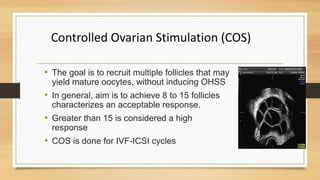
Controlled Ovarian Stimulation (COS)
• The goal is to recruit multiple follicles that may
yield mature oocytes, without inducing OHSS
• In general, aim is to achieve 8 to 15 follicles
characterizes an acceptable response.
• Greater than 15 is considered a high
response
• COS is done for IVF-ICSI cycles
Drugs In Ovarian Stimulation
• Clomiphene citrate and Tamoxifen
• Letrozole/Anastrozole
• Gonadotropins
• GnRH analogues
• GnRH agonists
• GnRH antagonists
Protocols in COS
• AGONIST PROTOCOLS
- Long Protocol/ Stop Protocol/ Short Protocol/ Ultrashort Protocol/
Microflare
• ANTAGONIST PROTOCOL -Fixed/ Flexible
• Mild Stimulation Protocol / Softer protocols
• Special Cases
- Endometriosis- Ultra Long Protocol
- Poor ovarian reserve- double stimulation Protocols
-PCOS- Stair Step and Chronic Low dose Step up Protocols
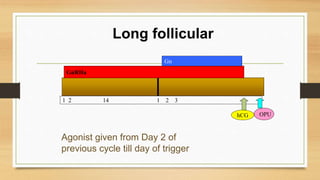
Long follicular
GnRHa
1 2 14 1 2 3
hCG OPU
Gn
Agonist given from Day 2 of
previous cycle till day of trigger
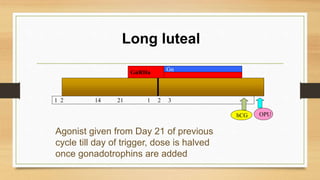
Long luteal
GnRHa
1 2 14 21 1 2 3
hCG OPU
Gn
Agonist given from Day 21 of previous
cycle till day of trigger, dose is halved
once gonadotrophins are added
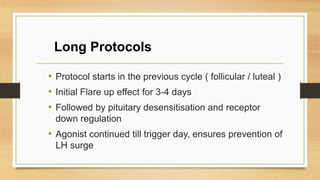
Long Protocols
• Protocol starts in the previous cycle ( follicular / luteal )
• Initial Flare up effect for 3-4 days
• Followed by pituitary desensitisation and receptor
down regulation
• Agonist continued till trigger day, ensures prevention of
LH surge
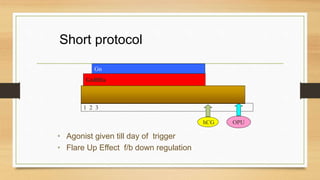
Short protocol
GnRHa
1 2 3
hCG OPU
Gn
• Agonist given till day of trigger
• Flare Up Effect f/b down regulation
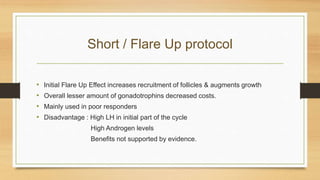
Short / Flare Up protocol
• Initial Flare Up Effect increases recruitment of follicles & augments growth
• Overall lesser amount of gonadotrophins decreased costs.
• Mainly used in poor responders
• Disadvantage : High LH in initial part of the cycle
High Androgen levels
Benefits not supported by evidence.
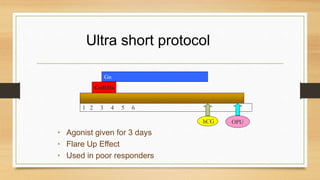
Ultra short protocol
GnRHa
1 2 3 4 5 6
hCG OPU
Gn
• Agonist given for 3 days
• Flare Up Effect
• Used in poor responders
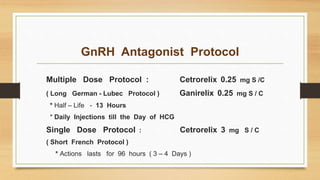
GnRH Antagonist Protocol
Multiple Dose Protocol : Cetrorelix 0.25 mg S /C
( Long German - Lubec Protocol ) Ganirelix 0.25 mg S / C
* Half – Life - 13 Hours
* Daily Injections till the Day of HCG
Single Dose Protocol : Cetrorelix 3 mg S / C
( Short French Protocol )
* Actions lasts for 96 hours ( 3 – 4 Days )
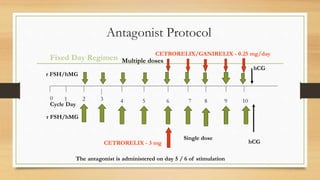
Antagonist Protocol
0 1 2 3 4 5 6 7 8 9 10
Fixed Day Regimen Multiple doses
Single dose
CETRORELIX - 3 mg
CETRORELIX/GANIRELIX - 0.25 mg/day
r FSH/hMG
r FSH/hMG
hCG
hCG
Cycle Day
The antagonist is administered on day 5 / 6 of stimulation
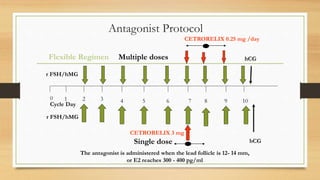
Antagonist Protocol
0 1 2 3 4 5 6 7 8 9 10
Flexible Regimen
Single dose
CETRORELIX 3 mg
CETRORELIX 0.25 mg /day
r FSH/hMG
r FSH/hMG
hCG
hCG
Cycle Day
Multiple doses
The antagonist is administered when the lead follicle is 12- 14 mm,
or E2 reaches 300 - 400 pg/ml
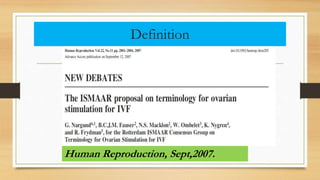
Definition
Human Reproduction, Sept,2007.
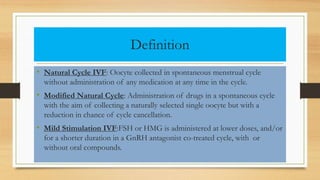
Definition
• Natural Cycle IVF: Oocyte collected in spontaneous menstrual cycle
without administration of any medication at any time in the cycle.
• Modified Natural Cycle: Administration of drugs in a spontaneous cycle
with the aim of collecting a naturally selected single oocyte but with a
reduction in chance of cycle cancellation.
• Mild Stimulation IVF:FSH or HMG is administered at lower doses, and/or
for a shorter duration in a GnRH antagonist co-treated cycle, with or
without oral compounds.
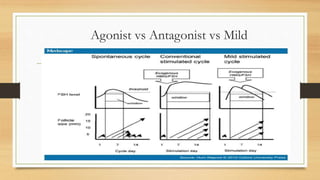
Agonist vs Antagonist vs Mild
150 150150
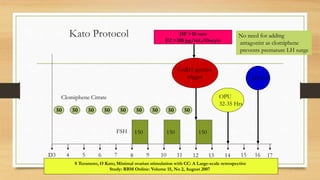
Kato Protocol
D2 ET
50 50 50 5050
D3 4 5 6 7 8 9 10 11 12 13 14 15
Clomiphene Citrate
FSH
OPU
32-35 Hrs
GnRH agonist
trigger
50 50 5050
16
S Teramoto, O Kato; Minimal ovarian stimulation with CC: A Large-scale retrospective
Study: RBM Online: Volume 15, No 2, August 2007
17
DF >18 mm
E2 >300 pg/mL/Oocyte
No need for adding
antagonist as clomiphene
prevents premature LH surge
150 150
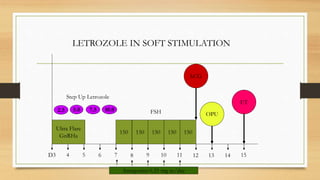
Ultra Flare
GnRHa
150150
hCG
2.5 5.0 7.5 10.0
D3 4 5 6 7 8 9 10 11 12 13 14 15
Step Up Letrozole
FSH
Antagonist 0.25 mg sc/day
OPU
ET
LETROZOLE IN SOFT STIMULATION
150
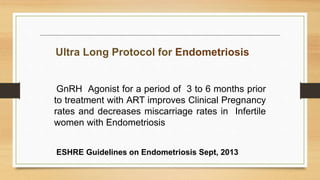
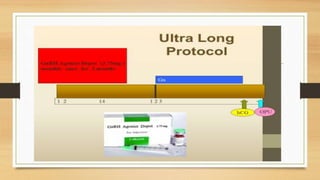
GnRH Agonist for a period of 3 to 6 months prior
to treatment with ART improves Clinical Pregnancy
rates and decreases miscarriage rates in Infertile
women with Endometriosis
Ultra Long Protocol for Endometriosis
ESHRE Guidelines on Endometriosis Sept, 2013
ENDOMETRIOSIS
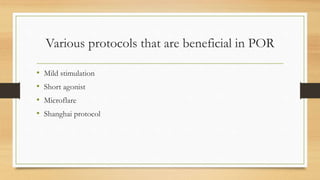
Various protocols that are beneficial in POR
• Mild stimulation
• Short agonist
• Microflare
• Shanghai protocol
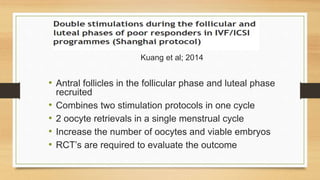
Kuang et al; 2014
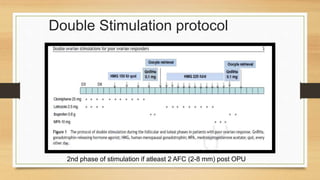
• Antral follicles in the follicular phase and luteal phase
recruited
• Combines two stimulation protocols in one cycle
• 2 oocyte retrievals in a single menstrual cycle
• Increase the number of oocytes and viable embryos
• RCT’s are required to evaluate the outcome
Double Stimulation protocol
2nd phase of stimulation if atleast 2 AFC (2-8 mm) post OPU
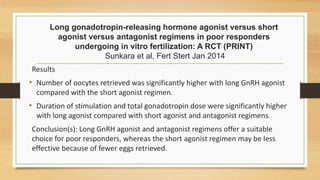
Long gonadotropin-releasing hormone agonist versus short
agonist versus antagonist regimens in poor responders
undergoing in vitro fertilization: A RCT (PRINT)
Sunkara et al, Fert Stert Jan 2014
Results
• Number of oocytes retrieved was significantly higher with long GnRH agonist
compared with the short agonist regimen.
• Duration of stimulation and total gonadotropin dose were significantly higher
with long agonist compared with short agonist and antagonist regimens.
Conclusion(s): Long GnRH agonist and antagonist regimens offer a suitable
choice for poor responders, whereas the short agonist regimen may be less
effective because of fewer eggs retrieved.
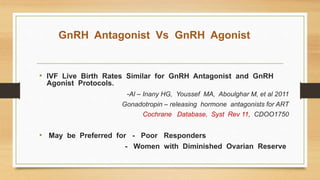
GnRH Antagonist Vs GnRH Agonist
• IVF Live Birth Rates Similar for GnRH Antagonist and GnRH
Agonist Protocols.
-Al – Inany HG, Youssef MA, Aboulghar M, et al 2011
Gonadotropin – releasing hormone antagonists for ART
Cochrane Database, Syst Rev 11, CDOO1750
• May be Preferred for - Poor Responders
- Women with Diminished Ovarian Reserve
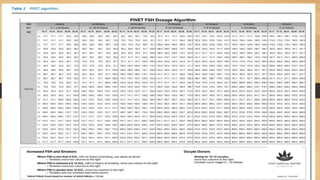
Individualised COS (ICOS)
The main objective of individualisation of treatment in IVF is to
offer every single woman the best treatment
• Tailored to her unique characteristics
• Maximizing success
• Eliminating iatrogenic risks, such as OHSS
• Minimizing the risk of cycle cancellation
Individualised controlled ovarian stimulation (iCOS):
maximising success rates for assisted reproductive
technology patients
Bosch E, Ezcurra D; Reprod Biol Endocrinol; 2011 Jun
• COS in IVF - significantly improved outcomes, but current stimulation protocols are
not optimal for all patient groups.
• Alternatives to standard COS protocols, including mild and natural cycles, have
shown some success, but no single approach is appropriate for all patients in a
given population.
• Treatment should be adapted for individual patients through iCOS and that,
together with the further development of objective biomarkers of response, will be an
important first step towards implementing personalised medicine in reproductive
science
AN IDEAL OVULATION INDUCTION REGIMEN

AN IDEAL OVULATION INDUCTION REGIMEN

  • 1.
  • 2.
    Types of ovarianstimulation • Ovulation induction • Superovulation • Controlled ovarian hyperstimulation
  • 3.
    OVULATION INDUCTION The goal todevelop follicles in anovulatory cycles as in PCOS and in hypogonadotrophic hypogonadism PCOS-aim for monofollicular development
  • 4.
    SUPEROVULATION Intentional production ofmore(≤ 4 ) mature follicles in a patient with: • unexplained infertility • Minimal and mild endometriosis • Mild male factor infertility
  • 5.
    Controlled Ovarian Stimulation(COS) • The goal is to recruit multiple follicles that may yield mature oocytes, without inducing OHSS • In general, aim is to achieve 8 to 15 follicles characterizes an acceptable response. • Greater than 15 is considered a high response • COS is done for IVF-ICSI cycles
  • 6.
    Drugs In OvarianStimulation • Clomiphene citrate and Tamoxifen • Letrozole/Anastrozole • Gonadotropins • GnRH analogues • GnRH agonists • GnRH antagonists
  • 7.
    Protocols in COS •AGONIST PROTOCOLS - Long Protocol/ Stop Protocol/ Short Protocol/ Ultrashort Protocol/ Microflare • ANTAGONIST PROTOCOL -Fixed/ Flexible • Mild Stimulation Protocol / Softer protocols • Special Cases - Endometriosis- Ultra Long Protocol - Poor ovarian reserve- double stimulation Protocols -PCOS- Stair Step and Chronic Low dose Step up Protocols
  • 8.
    Long follicular GnRHa 1 214 1 2 3 hCG OPU Gn Agonist given from Day 2 of previous cycle till day of trigger
  • 9.
    Long luteal GnRHa 1 214 21 1 2 3 hCG OPU Gn Agonist given from Day 21 of previous cycle till day of trigger, dose is halved once gonadotrophins are added
  • 10.
    Long Protocols • Protocolstarts in the previous cycle ( follicular / luteal ) • Initial Flare up effect for 3-4 days • Followed by pituitary desensitisation and receptor down regulation • Agonist continued till trigger day, ensures prevention of LH surge
  • 11.
    Short protocol GnRHa 1 23 hCG OPU Gn • Agonist given till day of trigger • Flare Up Effect f/b down regulation
  • 12.
    Short / FlareUp protocol • Initial Flare Up Effect increases recruitment of follicles & augments growth • Overall lesser amount of gonadotrophins decreased costs. • Mainly used in poor responders • Disadvantage : High LH in initial part of the cycle High Androgen levels Benefits not supported by evidence.
  • 13.
    Ultra short protocol GnRHa 12 3 4 5 6 hCG OPU Gn • Agonist given for 3 days • Flare Up Effect • Used in poor responders
  • 14.
    GnRH Antagonist Protocol MultipleDose Protocol : Cetrorelix 0.25 mg S /C ( Long German - Lubec Protocol ) Ganirelix 0.25 mg S / C * Half – Life - 13 Hours * Daily Injections till the Day of HCG Single Dose Protocol : Cetrorelix 3 mg S / C ( Short French Protocol ) * Actions lasts for 96 hours ( 3 – 4 Days )
  • 15.
    Antagonist Protocol 0 12 3 4 5 6 7 8 9 10 Fixed Day Regimen Multiple doses Single dose CETRORELIX - 3 mg CETRORELIX/GANIRELIX - 0.25 mg/day r FSH/hMG r FSH/hMG hCG hCG Cycle Day The antagonist is administered on day 5 / 6 of stimulation
  • 16.
    Antagonist Protocol 0 12 3 4 5 6 7 8 9 10 Flexible Regimen Single dose CETRORELIX 3 mg CETRORELIX 0.25 mg /day r FSH/hMG r FSH/hMG hCG hCG Cycle Day Multiple doses The antagonist is administered when the lead follicle is 12- 14 mm, or E2 reaches 300 - 400 pg/ml
  • 17.
  • 18.
    Definition • Natural CycleIVF: Oocyte collected in spontaneous menstrual cycle without administration of any medication at any time in the cycle. • Modified Natural Cycle: Administration of drugs in a spontaneous cycle with the aim of collecting a naturally selected single oocyte but with a reduction in chance of cycle cancellation. • Mild Stimulation IVF:FSH or HMG is administered at lower doses, and/or for a shorter duration in a GnRH antagonist co-treated cycle, with or without oral compounds.
  • 19.
  • 20.
    150 150150 Kato Protocol D2ET 50 50 50 5050 D3 4 5 6 7 8 9 10 11 12 13 14 15 Clomiphene Citrate FSH OPU 32-35 Hrs GnRH agonist trigger 50 50 5050 16 S Teramoto, O Kato; Minimal ovarian stimulation with CC: A Large-scale retrospective Study: RBM Online: Volume 15, No 2, August 2007 17 DF >18 mm E2 >300 pg/mL/Oocyte No need for adding antagonist as clomiphene prevents premature LH surge
  • 21.
    150 150 Ultra Flare GnRHa 150150 hCG 2.55.0 7.5 10.0 D3 4 5 6 7 8 9 10 11 12 13 14 15 Step Up Letrozole FSH Antagonist 0.25 mg sc/day OPU ET LETROZOLE IN SOFT STIMULATION 150
  • 22.
    GnRH Agonist fora period of 3 to 6 months prior to treatment with ART improves Clinical Pregnancy rates and decreases miscarriage rates in Infertile women with Endometriosis Ultra Long Protocol for Endometriosis ESHRE Guidelines on Endometriosis Sept, 2013
  • 23.
  • 24.
    Various protocols thatare beneficial in POR • Mild stimulation • Short agonist • Microflare • Shanghai protocol
  • 25.
    Kuang et al;2014 • Antral follicles in the follicular phase and luteal phase recruited • Combines two stimulation protocols in one cycle • 2 oocyte retrievals in a single menstrual cycle • Increase the number of oocytes and viable embryos • RCT’s are required to evaluate the outcome
  • 26.
    Double Stimulation protocol 2ndphase of stimulation if atleast 2 AFC (2-8 mm) post OPU
  • 27.
    Long gonadotropin-releasing hormoneagonist versus short agonist versus antagonist regimens in poor responders undergoing in vitro fertilization: A RCT (PRINT) Sunkara et al, Fert Stert Jan 2014 Results • Number of oocytes retrieved was significantly higher with long GnRH agonist compared with the short agonist regimen. • Duration of stimulation and total gonadotropin dose were significantly higher with long agonist compared with short agonist and antagonist regimens. Conclusion(s): Long GnRH agonist and antagonist regimens offer a suitable choice for poor responders, whereas the short agonist regimen may be less effective because of fewer eggs retrieved.
  • 28.
    GnRH Antagonist VsGnRH Agonist • IVF Live Birth Rates Similar for GnRH Antagonist and GnRH Agonist Protocols. -Al – Inany HG, Youssef MA, Aboulghar M, et al 2011 Gonadotropin – releasing hormone antagonists for ART Cochrane Database, Syst Rev 11, CDOO1750 • May be Preferred for - Poor Responders - Women with Diminished Ovarian Reserve
  • 29.
    Individualised COS (ICOS) Themain objective of individualisation of treatment in IVF is to offer every single woman the best treatment • Tailored to her unique characteristics • Maximizing success • Eliminating iatrogenic risks, such as OHSS • Minimizing the risk of cycle cancellation
  • 31.
    Individualised controlled ovarianstimulation (iCOS): maximising success rates for assisted reproductive technology patients Bosch E, Ezcurra D; Reprod Biol Endocrinol; 2011 Jun • COS in IVF - significantly improved outcomes, but current stimulation protocols are not optimal for all patient groups. • Alternatives to standard COS protocols, including mild and natural cycles, have shown some success, but no single approach is appropriate for all patients in a given population. • Treatment should be adapted for individual patients through iCOS and that, together with the further development of objective biomarkers of response, will be an important first step towards implementing personalised medicine in reproductive science