


.
OOCYTE PICKUP
ESHRE 2019
Prof. ABOUBAKR ELNASHAR
Benha university, Egypt
ABOUBAKR ELNASHAR
CONTENTS
1. BASIC PRINCIPLES OF THE OPU TECHNIQUE
2. PRIOR TO OPU CHECK LIST
3. TROUBLESHOOTING DURING OPU
4. AFTER OPU CHECKLIST
5. COMPLICATIONS
6. ASSESSING COMPTENCY
7. FUTURE DEVELOPMENTS
ABOUBAKR ELNASHAR
1. BASIC PRINCIPLES OF THE OPU TECHNIQUE
1. The pivot movement of the transvaginal transducer is
easier when
 patient places her buttocks at the edge of the
gynaecological couch
 operator is standing or sitting in between the
patient’s abducted and supported legs.
ABOUBAKR ELNASHAR
2. Holding the transvaginal transducer in a correct way is
advisable
{allow better vision of the proximity of the different
tissues and organs on the monitor}.
 Placing the transducer parallel to the hand of the
operator:
 better tactile perception
{the transducer becomes an extension of the
operator’s fingers}.
ABOUBAKR ELNASHAR
3. The left side of the patient is often represented at the
right part of the monitor.
 The probe is represented at
 the top or
 the bottom of the monitor depending on the
operator's preference.
ABOUBAKR ELNASHAR
4. Avoid contaminating the needle tip of the probe when
introducing it in the vagina, by
keeping the needle inside the needle guide until
ready to pierce the vagina.
5. The ovary should be lined up to the most accessible
position on the screen.
ABOUBAKR ELNASHAR
6. The transducer should be against the ovary (through
the vaginal wall).
Carefully insert the needle inside the follicle.
7. Ideally the needle should be inserted in the middle of
the ovary
{prevent the ovary from moving and needle to cause
injury to adjacent organs}.
ABOUBAKR ELNASHAR
8. The echogenic tip of the needle should be identified
during all manoeuvres.
The needle guide seen on the monitor can facilitate
safer insertion as it projects where the needle tip will
progress.
9. It is advised to keep the needle in the centre of the
follicle during aspiration and observe the follicle walls to
collapse around the tip.
ABOUBAKR ELNASHAR
10. The needle tip markers must be
 observed at all times as it is manoeuvred within
the ovaries and into each follicle
 never be advanced if not visible.
11. Aspirate the follicular fluid containing the
oocyte/cumulus complex by application of suction.
ABOUBAKR ELNASHAR
12. The walls of the follicle collapse as the fluid is
aspirated; before moving the needle to the next follicle,
the operator should ensure that all the follicular fluid is
withdrawn.
13. The needle can be
 advanced into an adjacent follicle or
 withdrawn to the edge of the ovary;
 realignment is needed to advance into another
follicle.
 Minimize as far as possible repetitive puncture
through the vaginal wall.
ABOUBAKR ELNASHAR
14. Avoid lateral movements of the needle to reduce the
risk of vascular damage.
15. Do not move the transducer with the needle in the
advanced position.
16. Puncture all follicles, especially if there is a high risk
of OHSS.
17. Flush the needle between the two ovaries to avoid
any potential blockage caused by blood clots.
ABOUBAKR ELNASHAR
2. BEFORE OPU-CHECKLIST
✓ The entire system is tested by aspirating some culture
medium (Null Aspiration).
✓ Make sure that the
 suction pump is turned on and
 suction pedal is functioning
 (many aspiration pumps have a light flashed, and
some have audible signals, when the pump is
activated).
ABOUBAKR ELNASHAR
✓ Check the setting of the suction pressure taking into
account the maximum pressure limit of the suction
pump.
✓ Check the needle connection with the tubing system
and ensure that they are tightly connected with no air
leakage
ABOUBAKR ELNASHAR
✓ Ensure that the suction tubing system is
 new, or
 undamaged (when the system is re-used)
✓ Exclude any cracks in the aspiration test tube.
✓ Ensure that the collection tubing is not kinked or
damaged.
ABOUBAKR ELNASHAR
✓Check the needle and the connection of the needle
with the tubing system.
✓ Ensure that the needle guide is
 appropriately placed on the ultrasound probe with
no gaps
 the protective probe sheath is not on the way of
the needle projection.
✓ Ensure that the needle guide is well applied on the
probe and not loose.
ABOUBAKR ELNASHAR
3. TROUBLESHOOTING DURING OPU
 What to do when the needle tip is not visualized?
 Withdraw the needle
 ensure that the needle director/gauge is in place
allowing the needle to move in the same sector as
the ultrasound beam
ABOUBAKR ELNASHAR
 What to do when suction fails?
 Rotate the needle within the follicle to ensure that
it is not blocked by follicular wall tissue.
 If there is still no suction, remove the needle and
perform a “retrograde flush” to clear any blockage.
 Before re-inserting the needle, re-check by
aspirating some culture medium.
 In case of a double-lumen needle, the needle can
be flushed without taking it out of the ovary
ABOUBAKR ELNASHAR
 What to do when no oocytes are retrieved?
 When no oocytes are discovered, or if the fluid
collected is very clear and devoid of (granulosa
and cumulus) cells after aspiration of the first
follicles, suspicion may be raised that the patient
has not had her trigger.
In case of hCG trigger
 Before follicles from the second ovary are
aspirated,
 a urinary pregnancy test or beta-hCG serum
test can be performed.
 Alternatively, follicular fluid can be tested with a
urinary pregnancy test strip
(Enien et al., 1995).
ABOUBAKR ELNASHAR
 In case of agonist trigger (triptorelin).
✓ An ovulation test can be performed.
✓ The serum LH levels can be checked.
- If the test shows that the patient did not receive the
trigger:
- a new dose may be administered and the OPU
repeated after 36 h. If the time interval since OPU
was too short, OPU can be delayed.
- If premature ovulation is suspected,
- peritoneal fluid can be aspirated to recover some
oocytes.
ABOUBAKR ELNASHAR
 In case of agonist trigger (triptorelin).
✓ An ovulation test can be performed.
✓ The serum LH levels can be checked.
- If the test shows that the patient did not receive the
trigger:
- a new dose may be administered and the OPU
repeated after 36 h. If the time interval since OPU
was too short, OPU can be delayed.
 If premature ovulation is suspected,
- peritoneal fluid can be aspirated to recover some
oocytes.
ABOUBAKR ELNASHAR
4. AFTER OPU CHECKLIST
 Monitor general status
 be alert for complications.
 Provide patients with a leaflet with
 written information and
 a 24 h emergency number.
ABOUBAKR ELNASHAR
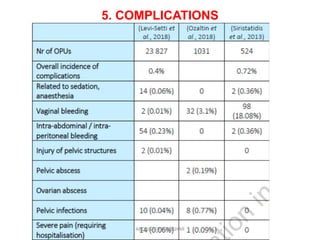
5. COMPLICATIONS
ABOUBAKR ELNASHAR
6. ASSESSING COMPETENCY
(Dessolle et al., 2014, Panayotidis, 2017)
1. the number of oocytes collected
2. the number of ovarian punctures
3. the ratio of number of oocytes retrieved to the
number of follicles aspirated
4. any complications from the procedure, in the short or
long term
5. the duration of the OPU procedure
ABOUBAKR ELNASHAR
7. FUTURE RESEARCH IN OPU
✓ Value of FBC or any additional test (microbiology)
before OPU for prevention of complications
✓ Value of antibiotic prophylaxis in low-risk patients
✓ Value of flushing to increase number of eggs
retrieved
✓ Effect of different aspiration pressures on oocyte yield
✓ Number of OPUs necessary for proficiency and for
maintaining skills
✓ Complications rates related to the OPU performance
under sedation versus general anaesthesia
ABOUBAKR ELNASHAR

oocyte pickup ESHRE2019

  • 1.
    . OOCYTE PICKUP ESHRE 2019 Prof.ABOUBAKR ELNASHAR Benha university, Egypt ABOUBAKR ELNASHAR
  • 2.
    CONTENTS 1. BASIC PRINCIPLESOF THE OPU TECHNIQUE 2. PRIOR TO OPU CHECK LIST 3. TROUBLESHOOTING DURING OPU 4. AFTER OPU CHECKLIST 5. COMPLICATIONS 6. ASSESSING COMPTENCY 7. FUTURE DEVELOPMENTS ABOUBAKR ELNASHAR
  • 3.
    1. BASIC PRINCIPLESOF THE OPU TECHNIQUE 1. The pivot movement of the transvaginal transducer is easier when  patient places her buttocks at the edge of the gynaecological couch  operator is standing or sitting in between the patient’s abducted and supported legs. ABOUBAKR ELNASHAR
  • 4.
    2. Holding thetransvaginal transducer in a correct way is advisable {allow better vision of the proximity of the different tissues and organs on the monitor}.  Placing the transducer parallel to the hand of the operator:  better tactile perception {the transducer becomes an extension of the operator’s fingers}. ABOUBAKR ELNASHAR
  • 5.
    3. The leftside of the patient is often represented at the right part of the monitor.  The probe is represented at  the top or  the bottom of the monitor depending on the operator's preference. ABOUBAKR ELNASHAR
  • 6.
    4. Avoid contaminatingthe needle tip of the probe when introducing it in the vagina, by keeping the needle inside the needle guide until ready to pierce the vagina. 5. The ovary should be lined up to the most accessible position on the screen. ABOUBAKR ELNASHAR
  • 7.
    6. The transducershould be against the ovary (through the vaginal wall). Carefully insert the needle inside the follicle. 7. Ideally the needle should be inserted in the middle of the ovary {prevent the ovary from moving and needle to cause injury to adjacent organs}. ABOUBAKR ELNASHAR
  • 8.
    8. The echogenictip of the needle should be identified during all manoeuvres. The needle guide seen on the monitor can facilitate safer insertion as it projects where the needle tip will progress. 9. It is advised to keep the needle in the centre of the follicle during aspiration and observe the follicle walls to collapse around the tip. ABOUBAKR ELNASHAR
  • 9.
    10. The needletip markers must be  observed at all times as it is manoeuvred within the ovaries and into each follicle  never be advanced if not visible. 11. Aspirate the follicular fluid containing the oocyte/cumulus complex by application of suction. ABOUBAKR ELNASHAR
  • 10.
    12. The wallsof the follicle collapse as the fluid is aspirated; before moving the needle to the next follicle, the operator should ensure that all the follicular fluid is withdrawn. 13. The needle can be  advanced into an adjacent follicle or  withdrawn to the edge of the ovary;  realignment is needed to advance into another follicle.  Minimize as far as possible repetitive puncture through the vaginal wall. ABOUBAKR ELNASHAR
  • 11.
    14. Avoid lateralmovements of the needle to reduce the risk of vascular damage. 15. Do not move the transducer with the needle in the advanced position. 16. Puncture all follicles, especially if there is a high risk of OHSS. 17. Flush the needle between the two ovaries to avoid any potential blockage caused by blood clots. ABOUBAKR ELNASHAR
  • 12.
    2. BEFORE OPU-CHECKLIST ✓The entire system is tested by aspirating some culture medium (Null Aspiration). ✓ Make sure that the  suction pump is turned on and  suction pedal is functioning  (many aspiration pumps have a light flashed, and some have audible signals, when the pump is activated). ABOUBAKR ELNASHAR
  • 13.
    ✓ Check thesetting of the suction pressure taking into account the maximum pressure limit of the suction pump. ✓ Check the needle connection with the tubing system and ensure that they are tightly connected with no air leakage ABOUBAKR ELNASHAR
  • 14.
    ✓ Ensure thatthe suction tubing system is  new, or  undamaged (when the system is re-used) ✓ Exclude any cracks in the aspiration test tube. ✓ Ensure that the collection tubing is not kinked or damaged. ABOUBAKR ELNASHAR
  • 15.
    ✓Check the needleand the connection of the needle with the tubing system. ✓ Ensure that the needle guide is  appropriately placed on the ultrasound probe with no gaps  the protective probe sheath is not on the way of the needle projection. ✓ Ensure that the needle guide is well applied on the probe and not loose. ABOUBAKR ELNASHAR
  • 16.
    3. TROUBLESHOOTING DURINGOPU  What to do when the needle tip is not visualized?  Withdraw the needle  ensure that the needle director/gauge is in place allowing the needle to move in the same sector as the ultrasound beam ABOUBAKR ELNASHAR
  • 17.
     What todo when suction fails?  Rotate the needle within the follicle to ensure that it is not blocked by follicular wall tissue.  If there is still no suction, remove the needle and perform a “retrograde flush” to clear any blockage.  Before re-inserting the needle, re-check by aspirating some culture medium.  In case of a double-lumen needle, the needle can be flushed without taking it out of the ovary ABOUBAKR ELNASHAR
  • 18.
     What todo when no oocytes are retrieved?  When no oocytes are discovered, or if the fluid collected is very clear and devoid of (granulosa and cumulus) cells after aspiration of the first follicles, suspicion may be raised that the patient has not had her trigger. In case of hCG trigger  Before follicles from the second ovary are aspirated,  a urinary pregnancy test or beta-hCG serum test can be performed.  Alternatively, follicular fluid can be tested with a urinary pregnancy test strip (Enien et al., 1995). ABOUBAKR ELNASHAR
  • 19.
     In caseof agonist trigger (triptorelin). ✓ An ovulation test can be performed. ✓ The serum LH levels can be checked. - If the test shows that the patient did not receive the trigger: - a new dose may be administered and the OPU repeated after 36 h. If the time interval since OPU was too short, OPU can be delayed. - If premature ovulation is suspected, - peritoneal fluid can be aspirated to recover some oocytes. ABOUBAKR ELNASHAR
  • 20.
     In caseof agonist trigger (triptorelin). ✓ An ovulation test can be performed. ✓ The serum LH levels can be checked. - If the test shows that the patient did not receive the trigger: - a new dose may be administered and the OPU repeated after 36 h. If the time interval since OPU was too short, OPU can be delayed.  If premature ovulation is suspected, - peritoneal fluid can be aspirated to recover some oocytes. ABOUBAKR ELNASHAR
  • 21.
    4. AFTER OPUCHECKLIST  Monitor general status  be alert for complications.  Provide patients with a leaflet with  written information and  a 24 h emergency number. ABOUBAKR ELNASHAR
  • 22.
  • 23.
    6. ASSESSING COMPETENCY (Dessolleet al., 2014, Panayotidis, 2017) 1. the number of oocytes collected 2. the number of ovarian punctures 3. the ratio of number of oocytes retrieved to the number of follicles aspirated 4. any complications from the procedure, in the short or long term 5. the duration of the OPU procedure ABOUBAKR ELNASHAR
  • 24.
    7. FUTURE RESEARCHIN OPU ✓ Value of FBC or any additional test (microbiology) before OPU for prevention of complications ✓ Value of antibiotic prophylaxis in low-risk patients ✓ Value of flushing to increase number of eggs retrieved ✓ Effect of different aspiration pressures on oocyte yield ✓ Number of OPUs necessary for proficiency and for maintaining skills ✓ Complications rates related to the OPU performance under sedation versus general anaesthesia ABOUBAKR ELNASHAR