1
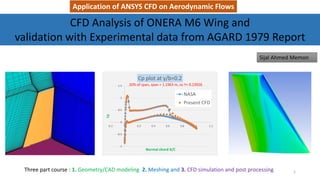
Application of ANSYS CFD on Aerodynamic Flows
CFD Analysis of ONERA M6 Wing and
validation with Experimental data from AGARD 1979 Report
-1
-0.5
0
0.5
1
1.5
-0.2 0 0.2 0.4 0.6 0.8 1 1.2
Cp
Normal chord X/C
Cp plot at y/b=0.2
NASA
Present CFD
20% of span, span = 1.1963 m, so Y= 0.23926
Three part course : 1. Geometry/CAD modeling 2. Meshing and 3. CFD simulation and post processing
Sijal Ahmed Memon
Course outcomes
• Learn how to get high quality CFD data for Validation (ONERA M6 wing)
• Learning the best practices for geometry modelling, meshing, simulation and post processing for conducting high
quality, accurate CFD analysis of any case in general and wing in particular.
• Interpreting aerodynamics data for creating high quality CAD model from scratch in solidworks
• Creating high quality mesh for wing and similar geometries.
• Comparing lift and drag coefficients and also Cp plots at different span locations.
2
Problem Description
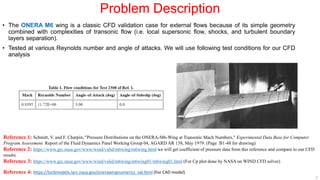
• The ONERA M6 wing is a classic CFD validation case for external flows because of its simple geometry
combined with complexities of transonic flow (i.e. local supersonic flow, shocks, and turbulent boundary
layers separation).
• Tested at various Reynolds number and angle of attacks. We will use following test conditions for our CFD
analysis
3
Reference 1: Schmitt, V. and F. Charpin, "Pressure Distributions on the ONERA-M6-Wing at Transonic Mach Numbers," Experimental Data Base for Computer
Program Assessment. Report of the Fluid Dynamics Panel Working Group 04, AGARD AR 138, May 1979. (Page B1-48 for drawing)
Reference 2: https://www.grc.nasa.gov/www/wind/valid/m6wing/m6wing.html we will get coefficient of pressure data from this reference and compare to our CFD
results.
Reference 3: https://www.grc.nasa.gov/www/wind/valid/m6wing/m6wing01/m6wing01.html (For Cp plot done by NASA on WIND CFD solver)
Reference 4: https://turbmodels.larc.nasa.gov/onerawingnumerics_val.html (For CAD model)
Geometry of ONERA M6 Wing
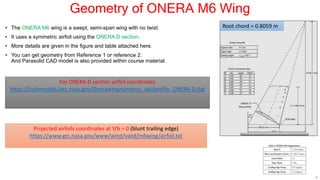
• The ONERA M6 wing is a swept, semi-span wing with no twist.
• It uses a symmetric airfoil using the ONERA D section.
• More details are given in the figure and table attached here.
• You can get geometry from Reference 1 or reference 2.
And Parasolid CAD model is also provided within course material.
4
For ONERA D section airfoil coordinates
https://turbmodels.larc.nasa.gov/Onerawingnumerics_val/profile_ONERA-D.dat
Projected airfoils coordinates at Y/b = 0 (blunt trailing edge)
https://www.grc.nasa.gov/www/wind/valid/m6wing/airfoil.txt
Root chord = 0.8059 m
Geometry of ONERA M6 Wing
5
For ONERA M6 CAD model (with sharp trailing edge/created later)
https://turbmodels.larc.nasa.gov/Onerawingnumerics_grids/AileM6_with_sharp_TE.x_t
• We will also create same wing from scratch in solidworks as per given schematic
diagram, airfoil coordinates and aerodynamics data.
For ONERA M6 CAD model (with blunt trailing edge, used in this course)
https://turbmodels.larc.nasa.gov/onerawingnumerics_val.html or
https://turbmodels.larc.nasa.gov/Onerawingnumerics_grids/AileM6_with_thick_TE.igs
Geometry of ONERA M6 Wing
6
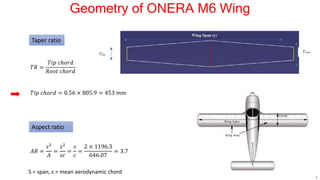
Taper ratio
𝑇𝑅 =
𝑇𝑖𝑝 𝑐ℎ𝑜𝑟𝑑
𝑅𝑜𝑜𝑡 𝑐ℎ𝑜𝑟𝑑
𝑇𝑖𝑝 𝑐ℎ𝑜𝑟𝑑 = 0.56 × 805.9 = 453 𝑚𝑚
𝐴𝑅 =
𝑠2
𝐴
=
𝑠2
𝑠𝑐
=
𝑠
𝑐
=
2 × 1196.3
646.07
= 3.7
Aspect ratio
S = span, c = mean aerodynamic chord
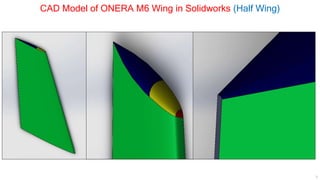
CAD Model of ONERA M6 Wing in Solidworks (Half Wing)
7
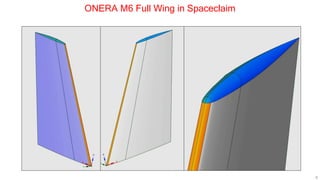
ONERA M6 Full Wing in Spaceclaim
8
9
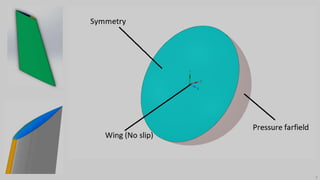
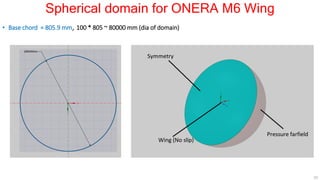
Spherical domain for ONERA M6 Wing
• Base chord = 805.9 mm, 100 * 805 ~ 80000 mm (dia of domain)
10
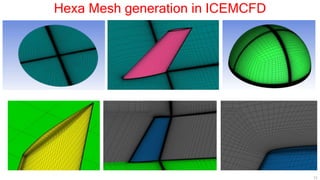
Hexa Mesh generation in ICEMCFD
11
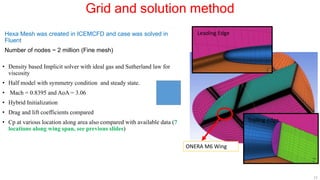
Grid and solution method
Hexa Mesh was created in ICEMCFD and case was solved in
Fluent
Number of nodes ~ 2 million (Fine mesh)
12
ONERA M6 Wing
• Density based Implicit solver with ideal gas and Sutherland law for
viscosity
• Half model with symmetry condition and steady state.
• Mach = 0.8395 and AoA = 3.06
• Hybrid Initialization
• Drag and lift coefficients compared
• Cp at various location along area also compared with available data (7
locations along wing span, see previous slides)
Leading Edge
Trailing edge
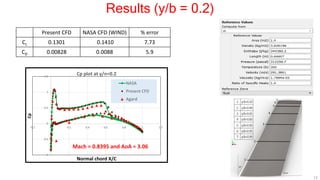
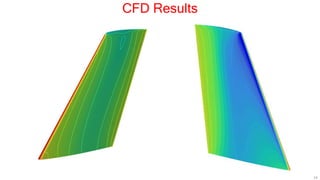
Results (y/b = 0.2)
Present CFD NASA CFD (WIND) % error
CL 0.1301 0.1410 7.73
CD 0.00828 0.0088 5.9
13
-1
-0.5
0
0.5
1
1.5
-0.2 0 0.2 0.4 0.6 0.8 1 1.2
Cp
Normal chord X/C
Cp plot at y/n=0.2
NASA
Present CFD
Agard
Mach = 0.8395 and AoA = 3.06
CFD Results
14

Onera M6 Wing CFD.pptx

  • 1.
    1 Application of ANSYSCFD on Aerodynamic Flows CFD Analysis of ONERA M6 Wing and validation with Experimental data from AGARD 1979 Report -1 -0.5 0 0.5 1 1.5 -0.2 0 0.2 0.4 0.6 0.8 1 1.2 Cp Normal chord X/C Cp plot at y/b=0.2 NASA Present CFD 20% of span, span = 1.1963 m, so Y= 0.23926 Three part course : 1. Geometry/CAD modeling 2. Meshing and 3. CFD simulation and post processing Sijal Ahmed Memon
  • 2.
    Course outcomes • Learnhow to get high quality CFD data for Validation (ONERA M6 wing) • Learning the best practices for geometry modelling, meshing, simulation and post processing for conducting high quality, accurate CFD analysis of any case in general and wing in particular. • Interpreting aerodynamics data for creating high quality CAD model from scratch in solidworks • Creating high quality mesh for wing and similar geometries. • Comparing lift and drag coefficients and also Cp plots at different span locations. 2
  • 3.
    Problem Description • TheONERA M6 wing is a classic CFD validation case for external flows because of its simple geometry combined with complexities of transonic flow (i.e. local supersonic flow, shocks, and turbulent boundary layers separation). • Tested at various Reynolds number and angle of attacks. We will use following test conditions for our CFD analysis 3 Reference 1: Schmitt, V. and F. Charpin, "Pressure Distributions on the ONERA-M6-Wing at Transonic Mach Numbers," Experimental Data Base for Computer Program Assessment. Report of the Fluid Dynamics Panel Working Group 04, AGARD AR 138, May 1979. (Page B1-48 for drawing) Reference 2: https://www.grc.nasa.gov/www/wind/valid/m6wing/m6wing.html we will get coefficient of pressure data from this reference and compare to our CFD results. Reference 3: https://www.grc.nasa.gov/www/wind/valid/m6wing/m6wing01/m6wing01.html (For Cp plot done by NASA on WIND CFD solver) Reference 4: https://turbmodels.larc.nasa.gov/onerawingnumerics_val.html (For CAD model)
  • 4.
    Geometry of ONERAM6 Wing • The ONERA M6 wing is a swept, semi-span wing with no twist. • It uses a symmetric airfoil using the ONERA D section. • More details are given in the figure and table attached here. • You can get geometry from Reference 1 or reference 2. And Parasolid CAD model is also provided within course material. 4 For ONERA D section airfoil coordinates https://turbmodels.larc.nasa.gov/Onerawingnumerics_val/profile_ONERA-D.dat Projected airfoils coordinates at Y/b = 0 (blunt trailing edge) https://www.grc.nasa.gov/www/wind/valid/m6wing/airfoil.txt Root chord = 0.8059 m
  • 5.
    Geometry of ONERAM6 Wing 5 For ONERA M6 CAD model (with sharp trailing edge/created later) https://turbmodels.larc.nasa.gov/Onerawingnumerics_grids/AileM6_with_sharp_TE.x_t • We will also create same wing from scratch in solidworks as per given schematic diagram, airfoil coordinates and aerodynamics data. For ONERA M6 CAD model (with blunt trailing edge, used in this course) https://turbmodels.larc.nasa.gov/onerawingnumerics_val.html or https://turbmodels.larc.nasa.gov/Onerawingnumerics_grids/AileM6_with_thick_TE.igs
  • 6.
    Geometry of ONERAM6 Wing 6 Taper ratio 𝑇𝑅 = 𝑇𝑖𝑝 𝑐ℎ𝑜𝑟𝑑 𝑅𝑜𝑜𝑡 𝑐ℎ𝑜𝑟𝑑 𝑇𝑖𝑝 𝑐ℎ𝑜𝑟𝑑 = 0.56 × 805.9 = 453 𝑚𝑚 𝐴𝑅 = 𝑠2 𝐴 = 𝑠2 𝑠𝑐 = 𝑠 𝑐 = 2 × 1196.3 646.07 = 3.7 Aspect ratio S = span, c = mean aerodynamic chord
  • 7.
    CAD Model ofONERA M6 Wing in Solidworks (Half Wing) 7
  • 8.
    ONERA M6 FullWing in Spaceclaim 8
  • 9.
  • 10.
    Spherical domain forONERA M6 Wing • Base chord = 805.9 mm, 100 * 805 ~ 80000 mm (dia of domain) 10
  • 11.
    Hexa Mesh generationin ICEMCFD 11
  • 12.
    Grid and solutionmethod Hexa Mesh was created in ICEMCFD and case was solved in Fluent Number of nodes ~ 2 million (Fine mesh) 12 ONERA M6 Wing • Density based Implicit solver with ideal gas and Sutherland law for viscosity • Half model with symmetry condition and steady state. • Mach = 0.8395 and AoA = 3.06 • Hybrid Initialization • Drag and lift coefficients compared • Cp at various location along area also compared with available data (7 locations along wing span, see previous slides) Leading Edge Trailing edge
  • 13.
    Results (y/b =0.2) Present CFD NASA CFD (WIND) % error CL 0.1301 0.1410 7.73 CD 0.00828 0.0088 5.9 13 -1 -0.5 0 0.5 1 1.5 -0.2 0 0.2 0.4 0.6 0.8 1 1.2 Cp Normal chord X/C Cp plot at y/n=0.2 NASA Present CFD Agard Mach = 0.8395 and AoA = 3.06
  • 14.