ONE SAMPLE RUNS TEST
Milind Gokhale
Nilesh Kataria
Kiran Itagi
Pratik Sharma
Rohit Murari
1
AGENDA
 Purpose of test and terminology
 Understanding Basic
 Formulae
 Problem
 Problem Analysis
 Requirements for One sample runs test
 Advantages
 Other applications
2
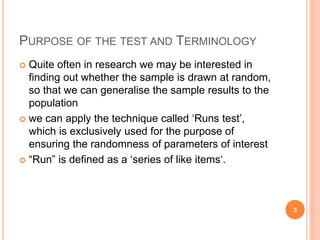
PURPOSE OF THE TEST AND TERMINOLOGY
 Quite often in research we may be interested in
finding out whether the sample is drawn at random,
so that we can generalise the sample results to the
population
 we can apply the technique called ‘Runs test’,
which is exclusively used for the purpose of
ensuring the randomness of parameters of interest
 “Run” is defined as a ‘series of like items‘.
3
UNDERSTANDING
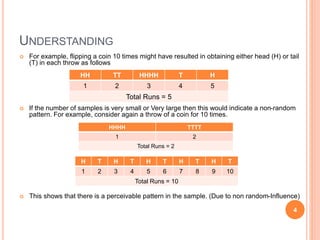
 For example, flipping a coin 10 times might have resulted in obtaining either head (H) or tail
(T) in each throw as follows
 If the number of samples is very small or Very large then this would indicate a non-random
pattern. For example, consider again a throw of a coin for 10 times.
 This shows that there is a perceivable pattern in the sample. (Due to non random-Influence)
HH TT HHHH T H
1 2 3 4 5
Total Runs = 5
HHHH TTTT
1 2
Total Runs = 2
H T H T H T H T H T
1 2 3 4 5 6 7 8 9 10
Total Runs = 10
4
FORMULAE
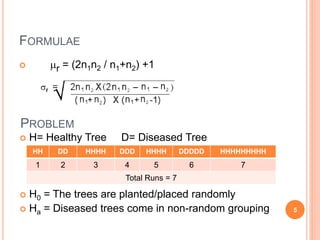
 mr = (2n1n2 / n1+n2) +1
PROBLEM
 H= Healthy Tree D= Diseased Tree
 H0 = The trees are planted/placed randomly
 Ha = Diseased trees come in non-random grouping
HH DD HHHH DDD HHHH DDDDD HHHHHHHHH
1 2 3 4 5 6 7
Total Runs = 7
5
PROBLEM ANALYSIS
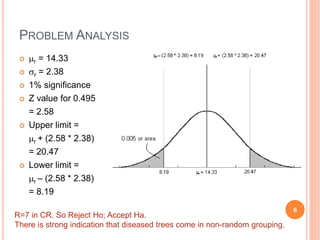
 mr = 14.33
 sr = 2.38
 1% significance
 Z value for 0.495
= 2.58
 Upper limit =
mr + (2.58 * 2.38)
= 20.47
 Lower limit =
mr – (2.58 * 2.38)
= 8.19
R=7 in CR. So Reject Ho; Accept Ha.
There is strong indication that diseased trees come in non-random grouping.
6
REQUIREMENTS
 This checks for randomness of the sample
selected.
 It is highly useful in checking the randomness of
residuals in regression or time series and
forecasting models.
ADVANTAGES
 This test checks for randomness of the sample
selected.
 It is highly useful in checking the randomness of
residuals in regression or time series and
forecasting models. 7
OTHER APPLICATIONS
 Thus a runs test is used to test the randomness
dichotomous observations like head/tail, yes/no,
men/women, married/single, high/low,
increasing/decreasing
 Possibly in stock market technical analyses or
Forecasting and Analyses.
 In time series analyses finding out whether the errors
(residuals) of the models are randomly distributed
 finding out the randomness of defective items in the
quality control process 8

One sample runs test

  • 1.
    ONE SAMPLE RUNSTEST Milind Gokhale Nilesh Kataria Kiran Itagi Pratik Sharma Rohit Murari 1
  • 2.
    AGENDA  Purpose oftest and terminology  Understanding Basic  Formulae  Problem  Problem Analysis  Requirements for One sample runs test  Advantages  Other applications 2
  • 3.
    PURPOSE OF THETEST AND TERMINOLOGY  Quite often in research we may be interested in finding out whether the sample is drawn at random, so that we can generalise the sample results to the population  we can apply the technique called ‘Runs test’, which is exclusively used for the purpose of ensuring the randomness of parameters of interest  “Run” is defined as a ‘series of like items‘. 3
  • 4.
    UNDERSTANDING  For example,flipping a coin 10 times might have resulted in obtaining either head (H) or tail (T) in each throw as follows  If the number of samples is very small or Very large then this would indicate a non-random pattern. For example, consider again a throw of a coin for 10 times.  This shows that there is a perceivable pattern in the sample. (Due to non random-Influence) HH TT HHHH T H 1 2 3 4 5 Total Runs = 5 HHHH TTTT 1 2 Total Runs = 2 H T H T H T H T H T 1 2 3 4 5 6 7 8 9 10 Total Runs = 10 4
  • 5.
    FORMULAE  mr =(2n1n2 / n1+n2) +1 PROBLEM  H= Healthy Tree D= Diseased Tree  H0 = The trees are planted/placed randomly  Ha = Diseased trees come in non-random grouping HH DD HHHH DDD HHHH DDDDD HHHHHHHHH 1 2 3 4 5 6 7 Total Runs = 7 5
  • 6.
    PROBLEM ANALYSIS  mr= 14.33  sr = 2.38  1% significance  Z value for 0.495 = 2.58  Upper limit = mr + (2.58 * 2.38) = 20.47  Lower limit = mr – (2.58 * 2.38) = 8.19 R=7 in CR. So Reject Ho; Accept Ha. There is strong indication that diseased trees come in non-random grouping. 6
  • 7.
    REQUIREMENTS  This checksfor randomness of the sample selected.  It is highly useful in checking the randomness of residuals in regression or time series and forecasting models. ADVANTAGES  This test checks for randomness of the sample selected.  It is highly useful in checking the randomness of residuals in regression or time series and forecasting models. 7
  • 8.
    OTHER APPLICATIONS  Thusa runs test is used to test the randomness dichotomous observations like head/tail, yes/no, men/women, married/single, high/low, increasing/decreasing  Possibly in stock market technical analyses or Forecasting and Analyses.  In time series analyses finding out whether the errors (residuals) of the models are randomly distributed  finding out the randomness of defective items in the quality control process 8