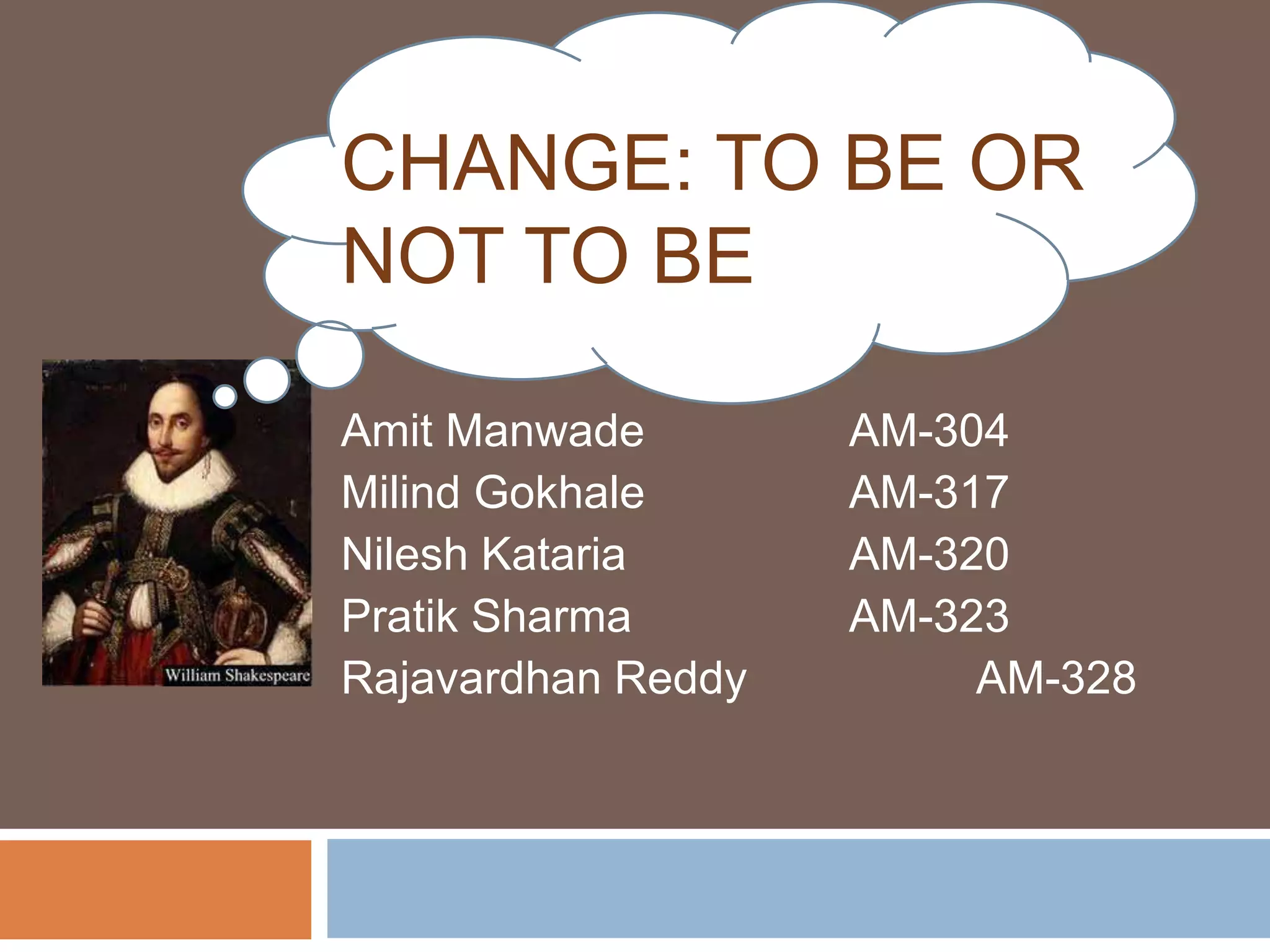
CHANGE: TO BE OR
NOT TO BE
Amit Manwade AM-304
Milind Gokhale AM-317
Nilesh Kataria AM-320
Pratik Sharma AM-323
Rajavardhan Reddy AM-328
Agenda
 Case
 Facts and Interpretations
 Unknowns and assumptions
 Problem Statement
 Probable Solutions
 Best Solution and justification
 Learnings / Takeaways
Overview
Entities in the case :
 Mebrisk India – An FMCG Company
 Adip Arya – Assistant Manager (commercial)
 Kevin Mathais – New Director of operations of
Mebrisk India
 Hemant Trivedi – Adip’s boss and GM
(commercial)
 Parthiv Vyas – Old Director of Operations and
Finance of Mebrisk India before Kevin
Overview
Scenes:
 Adip and Kevin debated and argued for 3 days
over why “Plan Revamp” was done and was it
worth?
 Adip meets Hemant for guidance
 Hemant starts explaining the need for Plan
Revamp then
 Adip also remembers last 3 years and his effort in
implementing “Plan Revamp” initialised by old
director of Mebrisk – Parthiv Vyas
 Hemant explains to Adip the need for Change and
Company Conditions
 Before Parthiv Vyas (Before 1997):
 Tug-of-war between sales and production
 The Performance parameters of the company include – Man hrs per
tonne, Machine hrs per tonne, idle capacity reduction.
 Factories produced what they desired irrespective of what market
needed, giving more focus to performance indicators.
 Difference between sales forecasts and actual sales used to be 60%.
 Unsold stock pile up in company’s inventories.
 Closing stock of large packs while demand is unmet for smaller pack
sizes of products.
 Commercial dept. playing as a mute moron in the company.
 Working capital was 33% of turnover.
 There was no flow of information between teams and lack of a system for
faster data collection.
Company Conditions
 1997 – 1999 [Changes during Parthiv Vyas]
 Zero/negative working capital
 JIT inventory at all factory locations and vendor supplied
management
 Putting in place an information system to collect and report daily
sales, daily stocks, supplier positions in real-time.
 Wiring the entire company (Costly V-Sat connections).
 Daily production planning.
 Establishment of ZSPs (Zonal Stock Points) and managing ad-
hoc sales requirement.
 Disadvantages:
 It increased management cost
 The IT implementation and wiring was very costly during the time
when it was undertaken.
Company Conditions
 2000 and onwards [Kevin Mathais point of view]
 The Plan Revamp was indeed very costly and
unnecessary.
 With working capital reduction, space should also be
reduced.
 No need of stockpiling items at ZSPs. Move it to
stockiests or factories.
 Move production planning back to the factory.
 Sales should not tell manufacturing, what to produce
and how much to produce.
Facts and Interpretations
 The company had spent 17 Crores on the plan revamp
 Parthiv vyas came from a company which had commercially driven
environment (Delaware)
 Tug-of-War every year between sales and production depts. -
Interpretation Commercial dept needed to be active.
 The production and sales plans not in sync
 Performance parameters followed in the company in factories : man
hours per tonne, machine hrs per tonne and idle
 capacity reduction. - Interpretation - The focus was on man hrs per
tonne in the factory and thus the factory produced what they wanted
irrespective of the market need. [Performance indicators were given
more preference over stocks/inventory Reduction]
 Things implemented by Parthiv vyas in Plan Revamp were : Zero or
negative working capital, - JIT inventory management, connect
everyone (factories, depots, regional offices, head office) for the
faster data flow. through VSat connections, Daily Production
Planning.
Ground Realities - Unknowns and
Assumptions
 Who will be managing the zonal offices –
Company itself or some intermediary party.
Assumption is that the ZSPs were managed by
company.
 When Kevin suggested to move all stocks
directly to Stockiest (who is a third party
person), it was assumed that they will simply
accept it to keep a big chunk of stocks.
Problem Statement
 How to achieve the co-ordination between
suppliers, production unit and sales in a
dynamic environment?
Was Plan revamp undertaken by the company, a
complete waste?
To change or not to change further to the
revamps put in with great efforts?
Solution: Auto Replenishment
 Have the stocks stored at distributors.
 Production unit will be aware of the inventory
position at the stockists.
 Sales will forecast the requirement in details
like packaging, product sizing, product
variances demand and provide it to the
production team.
 On the basis of above production team will
prepare the production plan.
 This can be achieved through end-to-end
communication using IT.
Top 3 learning / takeaways
 Business strategy should be market driven.
 Change is inevitable in order to adapt to the
changing environment.
 Transition from one state to another should be
smooth.
Thank You
Amit
Manwade
AM-304
Milind
Gokhale
AM-317
Pratik
Sharma
AM-323
Nilesh
Kataria
AM-320
Rajavardhan
Reddy
AM-328

Change: to be or not to be

  • 1.
    CHANGE: TO BEOR NOT TO BE Amit Manwade AM-304 Milind Gokhale AM-317 Nilesh Kataria AM-320 Pratik Sharma AM-323 Rajavardhan Reddy AM-328
  • 2.
    Agenda  Case  Factsand Interpretations  Unknowns and assumptions  Problem Statement  Probable Solutions  Best Solution and justification  Learnings / Takeaways
  • 3.
    Overview Entities in thecase :  Mebrisk India – An FMCG Company  Adip Arya – Assistant Manager (commercial)  Kevin Mathais – New Director of operations of Mebrisk India  Hemant Trivedi – Adip’s boss and GM (commercial)  Parthiv Vyas – Old Director of Operations and Finance of Mebrisk India before Kevin
  • 4.
    Overview Scenes:  Adip andKevin debated and argued for 3 days over why “Plan Revamp” was done and was it worth?  Adip meets Hemant for guidance  Hemant starts explaining the need for Plan Revamp then  Adip also remembers last 3 years and his effort in implementing “Plan Revamp” initialised by old director of Mebrisk – Parthiv Vyas  Hemant explains to Adip the need for Change and
  • 5.
    Company Conditions  BeforeParthiv Vyas (Before 1997):  Tug-of-war between sales and production  The Performance parameters of the company include – Man hrs per tonne, Machine hrs per tonne, idle capacity reduction.  Factories produced what they desired irrespective of what market needed, giving more focus to performance indicators.  Difference between sales forecasts and actual sales used to be 60%.  Unsold stock pile up in company’s inventories.  Closing stock of large packs while demand is unmet for smaller pack sizes of products.  Commercial dept. playing as a mute moron in the company.  Working capital was 33% of turnover.  There was no flow of information between teams and lack of a system for faster data collection.
  • 6.
    Company Conditions  1997– 1999 [Changes during Parthiv Vyas]  Zero/negative working capital  JIT inventory at all factory locations and vendor supplied management  Putting in place an information system to collect and report daily sales, daily stocks, supplier positions in real-time.  Wiring the entire company (Costly V-Sat connections).  Daily production planning.  Establishment of ZSPs (Zonal Stock Points) and managing ad- hoc sales requirement.  Disadvantages:  It increased management cost  The IT implementation and wiring was very costly during the time when it was undertaken.
  • 7.
    Company Conditions  2000and onwards [Kevin Mathais point of view]  The Plan Revamp was indeed very costly and unnecessary.  With working capital reduction, space should also be reduced.  No need of stockpiling items at ZSPs. Move it to stockiests or factories.  Move production planning back to the factory.  Sales should not tell manufacturing, what to produce and how much to produce.
  • 8.
    Facts and Interpretations The company had spent 17 Crores on the plan revamp  Parthiv vyas came from a company which had commercially driven environment (Delaware)  Tug-of-War every year between sales and production depts. - Interpretation Commercial dept needed to be active.  The production and sales plans not in sync  Performance parameters followed in the company in factories : man hours per tonne, machine hrs per tonne and idle  capacity reduction. - Interpretation - The focus was on man hrs per tonne in the factory and thus the factory produced what they wanted irrespective of the market need. [Performance indicators were given more preference over stocks/inventory Reduction]  Things implemented by Parthiv vyas in Plan Revamp were : Zero or negative working capital, - JIT inventory management, connect everyone (factories, depots, regional offices, head office) for the faster data flow. through VSat connections, Daily Production Planning.
  • 9.
    Ground Realities -Unknowns and Assumptions  Who will be managing the zonal offices – Company itself or some intermediary party. Assumption is that the ZSPs were managed by company.  When Kevin suggested to move all stocks directly to Stockiest (who is a third party person), it was assumed that they will simply accept it to keep a big chunk of stocks.
  • 10.
    Problem Statement  Howto achieve the co-ordination between suppliers, production unit and sales in a dynamic environment? Was Plan revamp undertaken by the company, a complete waste? To change or not to change further to the revamps put in with great efforts?
  • 11.
    Solution: Auto Replenishment Have the stocks stored at distributors.  Production unit will be aware of the inventory position at the stockists.  Sales will forecast the requirement in details like packaging, product sizing, product variances demand and provide it to the production team.  On the basis of above production team will prepare the production plan.  This can be achieved through end-to-end communication using IT.
  • 12.
    Top 3 learning/ takeaways  Business strategy should be market driven.  Change is inevitable in order to adapt to the changing environment.  Transition from one state to another should be smooth.
  • 13.

Editor's Notes

  • #4 Basic story of case study : People / Actors in the case study: Mebrisk India – Company Adip Arya – Kevin Mathais – New Director of operations of Mebrisk India Hemant Trivedi – Adip’s boss and GM (commercial) Parthiv Vyas – Old Director of Operations and Finance of Mebrisk India Scene: Adip and Kevin debated and argued for 3 days over why plan revamp was done and was it worth? Adip meets hemant for guidance Hemant starts explaining the change process Adip also remembers last 3 years and his effort in implementing plan revamp initialised by old director of mebrisk – Parthiv Vyas