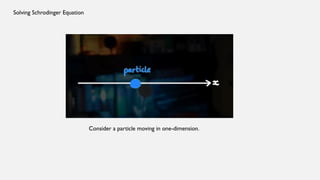
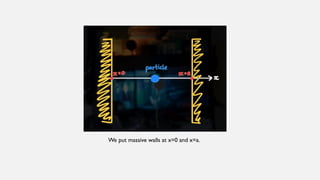
Intro:
In thecase of nonrelativistic quantum physics, the basic equation to be
solved is a second-order differential equation known as the Schrodinger equation.
Like Newton’s laws, the Schrodinger equation is written for a particle interacting
with its environment, although we describe the interaction in terms of the
potential energy rather than the force.
Unlike Newton’s laws, the Schrodinger equation does not give the trajectory of
the particle; instead, its solution gives the wave function of the particle, which
carries information about the particle’s wavelike behavior.
3.
BEHAVIOR OF AWAVE AT A BOUNDARY
In studying wave motion, we often must analyze what occurs when a wave moves from one
region or medium to a different region or medium in which the properties of the wave may
change.
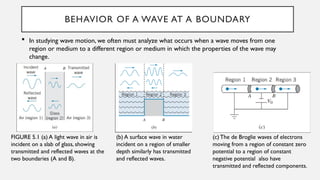
FIGURE 5.1 (a) A light wave in air is
incident on a slab of glass, showing
transmitted and reflected waves at the
two boundaries (A and B).
(b) A surface wave in water
incident on a region of smaller
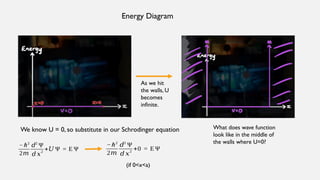
depth similarly has transmitted
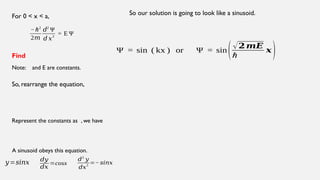
and reflected waves.
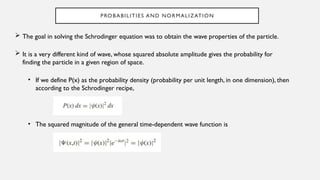
(c)The de Broglie waves of electrons
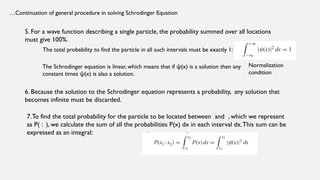
moving from a region of constant zero
potential to a region of constant
negative potential also have
transmitted and reflected components.
4.
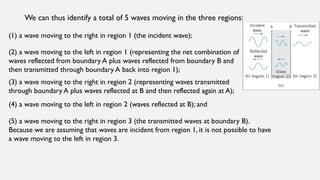
We can thusidentify a total of 5 waves moving in the three regions:
(1) a wave moving to the right in region 1 (the incident wave);
(2) a wave moving to the left in region 1 (representing the net combination of
waves reflected from boundary A plus waves reflected from boundary B and
then transmitted through boundary A back into region 1);
(3) a wave moving to the right in region 2 (representing waves transmitted
through boundary A plus waves reflected at B and then reflected again at A);
(4) a wave moving to the left in region 2 (waves reflected at B); and
(5) a wave moving to the right in region 3 (the transmitted waves at boundary B).
Because we are assuming that waves are incident from region 1, it is not possible to have
a wave moving to the left in region 3.
5.
PENETRATION OF THEREFLECTED WAVE
(FORBIDDEN REGION)
When a light wave is completely reflected from a boundary, an exponentially decreasing
wave called the evanescent wave penetrates into the second medium. Because 100% of
the light wave intensity is reflected, the evanescent wave carries no energy and so
cannot be directly observed in the second medium. But if we make the second medium
very thin (perhaps equal to a few wavelengths of light) the light wave can emerge on the
opposite side of the second medium.
Like light waves, de Broglie waves can also penetrate into the forbidden region with
exponentially decreasing amplitudes. However, because de Broglie waves are associated
with the motion of electrons, that means that electrons must also penetrate a short
distance into the forbidden region.
One explanation for the penetration of the electrons into the forbidden region relies on
the uncertainty principle— because we can’t know exactly the energy of the incident
electrons, we can’t say with certainty that they don’t have enough kinetic energy to
penetrate into the forbidden region.
6.
CONTINUITY AT THEBOUNDARIES
When a wave such as a light wave or a water wave crosses a boundary, the mathematical
function that describes the wave must have two properties at each boundary:
1.The wave function must be
continuous.
2.The slope of the wave
function must be continuous,
except when the boundary
height is infinite.
FIGURE 5.2
(a) A discontinuous wave.
(b) A continuous wave with a
discontinuous slope.
(c)Two sine waves join
smoothly
(d) A sine wave and an exponential
join smoothly.
7.
Across anynon-infinite boundary, the wave must be smooth—no gaps in the function and no
sharp changes in slope.
When we solve for the mathematical form of a wave function, there are usually
undetermined parameters, such as the amplitude and phase of the wave. In order to
make the wave smooth at the boundary, we obtain the values of those coefficients by
applying the two boundary conditions to make the function and its slope continuous.
Several properties of classical waves that also apply to quantum waves:
1. When a wave crosses a boundary between two regions, part of the wave intensity is
reflected and part is transmitted.
2. When a wave encounters a boundary to a region from which it is forbidden, the wave
will penetrate perhaps by a few wavelengths before reflecting.
3. At a finite boundary, the wave and its slope are continuous.At an infinite boundary, the
wave is continuous but its slope is discontinuous.
8.
CONFINING A PARTICLE
A free particle is by definition not confined, so it can be located anywhere. It has a
definite wavelength, momentum, and energy.
A confined particle, on the other hand, is represented by a wave packet that makes it
likely to be found only in a region of space of size x.We construct such a wave packet
by adding together different sine or cosine waves to obtain the desired mathematical
shape.
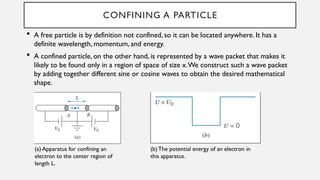
(a) Apparatus for confining an
electron to the center region of
length L.
(b)The potential energy of an electron in
this apparatus.
9.
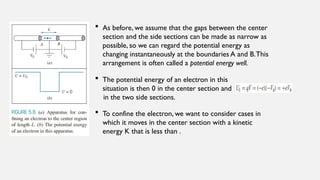
As before,we assume that the gaps between the center
section and the side sections can be made as narrow as
possible, so we can regard the potential energy as
changing instantaneously at the boundaries A and B.This
arrangement is often called a potential energy well.
The potential energy of an electron in this
situation is then 0 in the center section and
in the two side sections.
To confine the electron, we want to consider cases in
which it moves in the center section with a kinetic
energy K that is less than .
10.
In contrastto the free particle for which the wavelength could have any value, only certain values of the
wavelength are allowed to confined particle.The de Broglie relationship then tells us that only certain
values of the momentum are allowed, and consequently only certain values of the energy are allowed.
The energy is not a continuous variable, free to take on any arbitrary value; instead, the energy is a
discrete variable that is restricted to a certain set of values.This is known as quantization of energy.
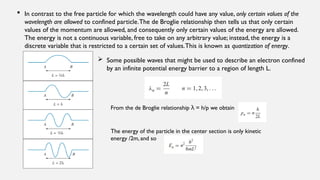
Some possible waves that might be used to describe an electron confined
by an infinite potential energy barrier to a region of length L.
From the de Broglie relationship = h/p we obtain
λ
The energy of the particle in the center section is only kinetic
energy /2m, and so
11.
Applying The UncertaintyPrinciple To A Confined Particle
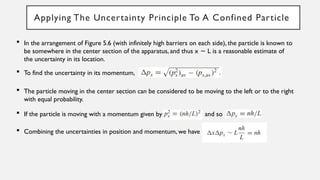
In the arrangement of Figure 5.6 (with infinitely high barriers on each side), the particle is known to
be somewhere in the center section of the apparatus, and thus x L is a reasonable estimate of
∼
the uncertainty in its location.
To find the uncertainty in its momentum,
The particle moving in the center section can be considered to be moving to the left or to the right
with equal probability.
If the particle is moving with a momentum given by and so
Combining the uncertainties in position and momentum, we have
12.
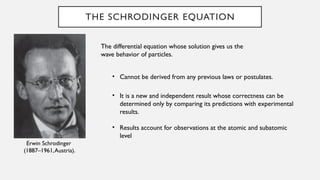
THE SCHRODINGER EQUATION
ErwinSchrodinger
(1887–1961,Austria).
The differential equation whose solution gives us the
wave behavior of particles.
• Cannot be derived from any previous laws or postulates.
• It is a new and independent result whose correctness can be
determined only by comparing its predictions with experimental
results.
• Results account for observations at the atomic and subatomic
level
13.
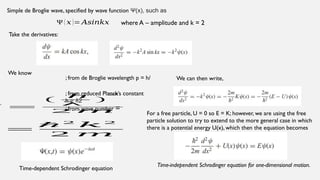
Simple de Brogliewave, specified by wave function Ψ(x), such as
Ψ ( 𝑥 )= 𝐴𝑠𝑖𝑛𝑘𝑥 where A – amplitude and k = 2
Take the derivatives:
We know
; from de Broglie wavelength p = h/
=
(
h
λ
)
2
2 𝑚
; from reduced Planck’s constant
h = 2
ℏ
; from wave number =
=
ℏ 2
𝑘2
2 𝑚
We can then write,
For a free particle, U = 0 so E = K; however, we are using the free
particle solution to try to extend to the more general case in which
there is a potential energy U(x), which then the equation becomes
Time-independent Schrodinger equation for one-dimensional motion.
Time-dependent Schrodinger equation
14.
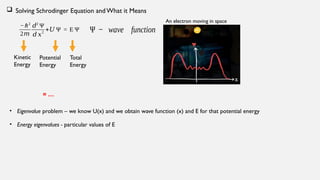
Solving SchrodingerEquation andWhat it Means
−ℏ2
2𝑚
𝑑2
Ψ
𝑑 𝑥
2
+𝑈 Ψ = E Ψ Ψ − wave function
An electron moving in space
Kinetic
Energy
Potential
Energy
Total
Energy
= …
• Eigenvalue problem – we know U(x) and we obtain wave function (x) and E for that potential energy
• Energy eigenvalues - particular values of E
15.
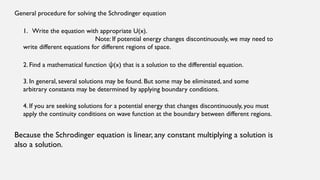
General procedure forsolving the Schrodinger equation
1. Write the equation with appropriate U(x).
Note: If potential energy changes discontinuously, we may need to
write different equations for different regions of space.
2. Find a mathematical function (x) that is a solution to the differential equation.
ψ
3. In general, several solutions may be found. But some may be eliminated, and some
arbitrary constants may be determined by applying boundary conditions.
4. If you are seeking solutions for a potential energy that changes discontinuously, you must
apply the continuity conditions on wave function at the boundary between different regions.
Because the Schrodinger equation is linear, any constant multiplying a solution is
also a solution.
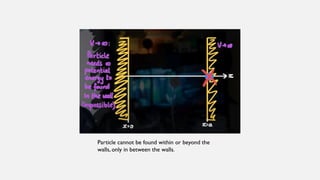
Particle cannot befound within or beyond the
walls, only in between the walls.
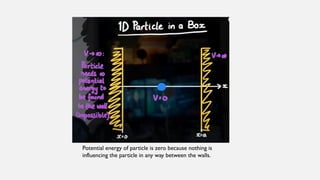
19.
Potential energy ofparticle is zero because nothing is
influencing the particle in any way between the walls.
20.
Energy Diagram
As wehit
the walls, U
becomes
infinite.
We know U = 0, so substitute in our Schrodinger equation
−ℏ2
2𝑚
𝑑2
Ψ
𝑑 𝑥
2
+𝑈 Ψ = E Ψ
−ℏ2
2𝑚
𝑑2
Ψ
𝑑 𝑥
2
+0 = E Ψ
(if 0<x<a)
What does wave function
look like in the middle of
the walls where U=0?
21.
For 0 <x < a,
−ℏ2
2𝑚
𝑑2
Ψ
𝑑 𝑥
2
= E Ψ
Find
Note: and E are constants.
So, rearrange the equation,
Represent the constants as , we have
A sinusoid obeys this equation.
𝑑𝑦
𝑑𝑥
=cosx
𝑦=𝑠𝑖𝑛𝑥
𝑑2
𝑦
𝑑𝑥
2
=− 𝑠𝑖𝑛𝑥
So our solution is going to look like a sinusoid.
Ψ = sin ( kx ) or Ψ = sin(√𝟐 𝒎𝑬
ℏ
𝒙)
22.
PROBABILITIES AND NORMALIZATION
The goal in solving the Schrodinger equation was to obtain the wave properties of the particle.
It is a very different kind of wave, whose squared absolute amplitude gives the probability for
finding the particle in a given region of space.
• If we define P(x) as the probability density (probability per unit length, in one dimension), then
according to the Schrodinger recipe,
• The squared magnitude of the general time-dependent wave function is
23.
…Continuation of generalprocedure in solving Schrodinger Equation
5. For a wave function describing a single particle, the probability summed over all locations
must give 100%.
The total probability to find the particle in all such intervals must be exactly 1:
The Schrodinger equation is linear, which means that if (x) is a solution then any
ψ
constant times (x) is also a solution.
ψ
Normalization
condition
6. Because the solution to the Schrodinger equation represents a probability, any solution that
becomes infinite must be discarded.
7.To find the total probability for the particle to be located between and , which we represent
as P( : ), we calculate the sum of all the probabilities P(x) dx in each interval dx.This sum can be
expressed as an integral:
24.
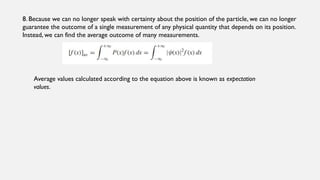
8. Because wecan no longer speak with certainty about the position of the particle, we can no longer
guarantee the outcome of a single measurement of any physical quantity that depends on its position.
Instead, we can find the average outcome of many measurements.
Average values calculated according to the equation above is known as expectation
values.