The Schrödinger equation
Dr. MD KHORSHED ALAM
ASSISTANT PROFESSOR
DEPARTMENT OF PHYSICS
UNIVERSITY OF BARISHAL
 TAYABA TAKBIR ORNILA
 ROLL:19 PHY 007
 DEPARTMENT OF PHYSICS
 UNIVERSITY OF BARISHAL
 SESSION: 2018-19
2
2
Try
t x

  

 
2 2
2
i
2
t m x
  
 
 
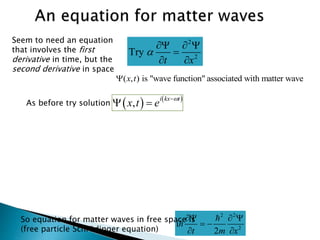
Seem to need an equation
that involves the first
derivative in time, but the
second derivative in space
( , ) is "wave function" associated with matter wave
x t

   
,
i kx t
x t e


 
As before try solution
So equation for matter waves in free space is
(free particle Schrödinger equation)
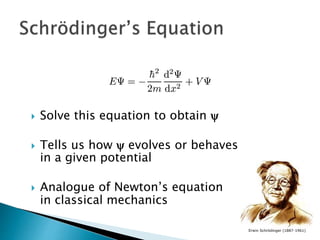
 Solve this equation to obtain y
 Tells us how y evolves or behaves
in a given potential
 Analogue of Newton’s equation
in classical mechanics
Erwin Schrödinger (1887-1961)
• This was a plausibility argument, not a derivation. We
believe the Schrödinger equation not because of this argument,
but because its predictions agree with experiment.
• There are limits to its validity. In this form it applies only to
a single, non-relativistic particle (i.e. one with non-zero rest
mass and speed much less than c)
• The Schrödinger equation is a partial differential equation in
x and t (like classical wave equation). Unlike the classical wave
equation it is first order in time.
• The Schrödinger equation contains the complex number i.
Therefore its solutions are essentially complex (unlike classical
waves, where the use of complex numbers is just a
mathematical convenience).
9
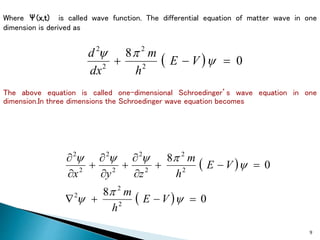
Where Ψ(x,t) is called wave function. The differential equation of matter wave in one
dimension is derived as
  0
8
2
2
2
2


 y

y
V
E
h
m
dx
d
The above equation is called one-dimensional Schroedinger’s wave equation in one
dimension.In three dimensions the Schroedinger wave equation becomes
 
  0
8
0
8
2
2
2
2
2
2
2
2
2
2
2















y

y
y

y
y
y
V
E
h
m
V
E
h
m
z
y
x
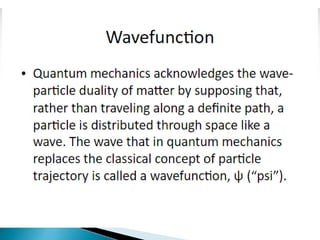
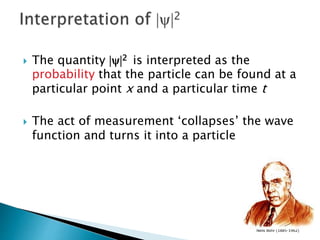
 The quantity |y|2 is interpreted as the
probability that the particle can be found at a
particular point x and a particular time t
 The act of measurement ‘collapses’ the wave
function and turns it into a particle
Neils Bohr (1885-1962)
2
( , )
2
p
E V x t
m
 
2 2
2
i ( , )
2
V x t
t m x
  
   
 
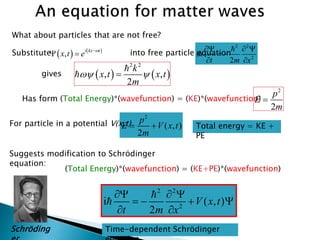
For particle in a potential V(x,t)
Suggests modification to Schrödinger
equation:
Time-dependent Schrödinger
Total energy = KE +
PE
Schröding
What about particles that are not free?
   
2 2
, ,
2
k
x t x t
m
y y

Has form (Total Energy)*(wavefunction) = (KE)*(wavefunction)
2 2
2
i
2
t m x
  
 
 
   
,
i kx t
x t e


 
Substitute into free particle equation
2
2
p
E
m

(Total Energy)*(wavefunction) = (KE+PE)*(wavefunction)
gives
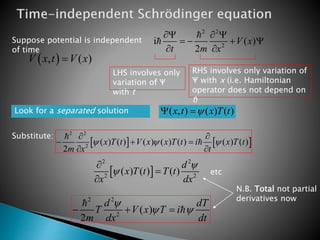
Suppose potential is independent
of time
2 2
2
i ( )
2
V x
t m x
  
   
 
LHS involves only
variation of Ψ
with t
RHS involves only variation of
Ψ with x (i.e. Hamiltonian
operator does not depend on
t)
Look for a separated solution ( , ) ( ) ( )
x t x T t
y
 
Substitute:
 
, ( )
V x t V x

   
2 2
2
( ) ( ) ( ) ( ) ( ) ( ) ( )
2
x T t V x x T t i x T t
m x t
y y y
 
  
 
 
2 2
2 2
( ) ( ) ( )
d
x T t T t
x dx
y
y



2 2
2
( )
2
d dT
T V x T i
m dx dt
y
y y
  
N.B. Total not partial
derivatives now
etc
2 2
2
1 1
( )
2
d dT
V x i
m dx T dt
y
y
  
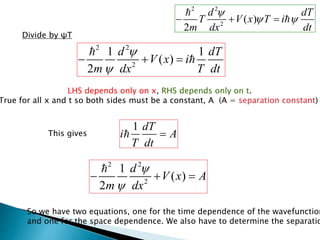
Divide by ψT
LHS depends only on x, RHS depends only on t.
True for all x and t so both sides must be a constant, A (A = separation constant)
2 2
2
( )
2
d dT
T V x T i
m dx dt
y
y y
  
1 dT
i A
T dt

2 2
2
1
( )
2
d
V x A
m dx
y
y
  
So we have two equations, one for the time dependence of the wavefunction
and one for the space dependence. We also have to determine the separatio
This gives
/
( ) iEt
T t ae

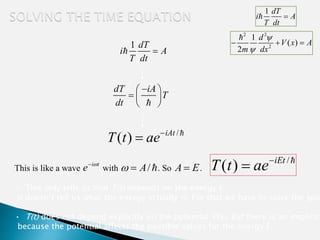
This is like a wave
i t
e 

with /
A
  . So A E
 .
1 dT
i A
T dt

dT iA
T
dt

 
  
 
/
( ) iAt
T t ae

1 dT
i A
T dt

2 2
2
1
( )
2
d
V x A
m dx
y
y
  
• This only tells us that T(t) depends on the energy E.
It doesn’t tell us what the energy actually is. For that we have to solve the spac
• T(t) does not depend explicitly on the potential V(x). But there is an implicit
because the potential affects the possible values for the energy E.
15
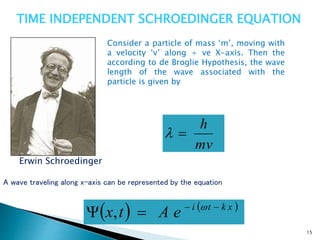
TIME INDEPENDENT SCHROEDINGER EQUATION
Erwin Schroedinger
Consider a particle of mass ‘m’, moving with
a velocity ‘v’ along + ve X-axis. Then the
according to de Broglie Hypothesis, the wave
length of the wave associated with the
particle is given by
mv
h


A wave traveling along x-axis can be represented by the equation
   
x
k
t
i
e
A
t
x 


 
,
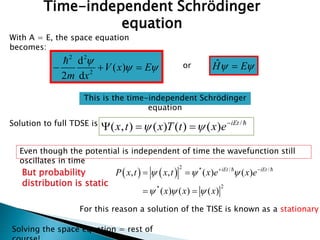
2 2
2
d
( )
2 d
V x E
m x
y
y y
  
With A = E, the space equation
becomes:
This is the time-independent Schrödinger
equation
Ĥ E
y y

Solving the space equation = rest of
Time-independent Schrödinger
equation
or
But probability
distribution is static
   
2 * / /
2
*
, , ( ) ( )
( ) ( ) ( )
iEt iEt
P x t x t x e x e
x x x
y y y
y y y
 
 
 
/
( , ) ( ) ( ) ( ) iEt
x t x T t x e
y y 
  
Solution to full TDSE is
Even though the potential is independent of time the wavefunction still
oscillates in time
For this reason a solution of the TISE is known as a stationary

Welcome to the presentation.pptx

  • 1.
  • 2.
    Dr. MD KHORSHEDALAM ASSISTANT PROFESSOR DEPARTMENT OF PHYSICS UNIVERSITY OF BARISHAL
  • 3.
     TAYABA TAKBIRORNILA  ROLL:19 PHY 007  DEPARTMENT OF PHYSICS  UNIVERSITY OF BARISHAL  SESSION: 2018-19
  • 6.
    2 2 Try t x       2 2 2 i 2 t m x        Seem to need an equation that involves the first derivative in time, but the second derivative in space ( , ) is "wave function" associated with matter wave x t      , i kx t x t e     As before try solution So equation for matter waves in free space is (free particle Schrödinger equation)
  • 7.
     Solve thisequation to obtain y  Tells us how y evolves or behaves in a given potential  Analogue of Newton’s equation in classical mechanics Erwin Schrödinger (1887-1961)
  • 8.
    • This wasa plausibility argument, not a derivation. We believe the Schrödinger equation not because of this argument, but because its predictions agree with experiment. • There are limits to its validity. In this form it applies only to a single, non-relativistic particle (i.e. one with non-zero rest mass and speed much less than c) • The Schrödinger equation is a partial differential equation in x and t (like classical wave equation). Unlike the classical wave equation it is first order in time. • The Schrödinger equation contains the complex number i. Therefore its solutions are essentially complex (unlike classical waves, where the use of complex numbers is just a mathematical convenience).
  • 9.
    9 Where Ψ(x,t) iscalled wave function. The differential equation of matter wave in one dimension is derived as   0 8 2 2 2 2    y  y V E h m dx d The above equation is called one-dimensional Schroedinger’s wave equation in one dimension.In three dimensions the Schroedinger wave equation becomes     0 8 0 8 2 2 2 2 2 2 2 2 2 2 2                y  y y  y y y V E h m V E h m z y x
  • 10.
     The quantity|y|2 is interpreted as the probability that the particle can be found at a particular point x and a particular time t  The act of measurement ‘collapses’ the wave function and turns it into a particle Neils Bohr (1885-1962)
  • 11.
    2 ( , ) 2 p EV x t m   2 2 2 i ( , ) 2 V x t t m x          For particle in a potential V(x,t) Suggests modification to Schrödinger equation: Time-dependent Schrödinger Total energy = KE + PE Schröding What about particles that are not free?     2 2 , , 2 k x t x t m y y  Has form (Total Energy)*(wavefunction) = (KE)*(wavefunction) 2 2 2 i 2 t m x            , i kx t x t e     Substitute into free particle equation 2 2 p E m  (Total Energy)*(wavefunction) = (KE+PE)*(wavefunction) gives
  • 12.
    Suppose potential isindependent of time 2 2 2 i ( ) 2 V x t m x          LHS involves only variation of Ψ with t RHS involves only variation of Ψ with x (i.e. Hamiltonian operator does not depend on t) Look for a separated solution ( , ) ( ) ( ) x t x T t y   Substitute:   , ( ) V x t V x      2 2 2 ( ) ( ) ( ) ( ) ( ) ( ) ( ) 2 x T t V x x T t i x T t m x t y y y          2 2 2 2 ( ) ( ) ( ) d x T t T t x dx y y    2 2 2 ( ) 2 d dT T V x T i m dx dt y y y    N.B. Total not partial derivatives now etc
  • 13.
    2 2 2 1 1 () 2 d dT V x i m dx T dt y y    Divide by ψT LHS depends only on x, RHS depends only on t. True for all x and t so both sides must be a constant, A (A = separation constant) 2 2 2 ( ) 2 d dT T V x T i m dx dt y y y    1 dT i A T dt  2 2 2 1 ( ) 2 d V x A m dx y y    So we have two equations, one for the time dependence of the wavefunction and one for the space dependence. We also have to determine the separatio This gives
  • 14.
    / ( ) iEt Tt ae  This is like a wave i t e   with / A   . So A E  . 1 dT i A T dt  dT iA T dt         / ( ) iAt T t ae  1 dT i A T dt  2 2 2 1 ( ) 2 d V x A m dx y y    • This only tells us that T(t) depends on the energy E. It doesn’t tell us what the energy actually is. For that we have to solve the spac • T(t) does not depend explicitly on the potential V(x). But there is an implicit because the potential affects the possible values for the energy E.
  • 15.
    15 TIME INDEPENDENT SCHROEDINGEREQUATION Erwin Schroedinger Consider a particle of mass ‘m’, moving with a velocity ‘v’ along + ve X-axis. Then the according to de Broglie Hypothesis, the wave length of the wave associated with the particle is given by mv h   A wave traveling along x-axis can be represented by the equation     x k t i e A t x      ,
  • 16.
    2 2 2 d ( ) 2d V x E m x y y y    With A = E, the space equation becomes: This is the time-independent Schrödinger equation Ĥ E y y  Solving the space equation = rest of Time-independent Schrödinger equation or But probability distribution is static     2 * / / 2 * , , ( ) ( ) ( ) ( ) ( ) iEt iEt P x t x t x e x e x x x y y y y y y       / ( , ) ( ) ( ) ( ) iEt x t x T t x e y y     Solution to full TDSE is Even though the potential is independent of time the wavefunction still oscillates in time For this reason a solution of the TISE is known as a stationary