University of Halabja
College Of Science
Department Of Physics
3rd Stage
[Schrodinger equation]
Prepared by : Supervised :
Shene Aziz Mr.Yousif Hussein
Gyabnd qubad
Outline
• Introduction
• Definition
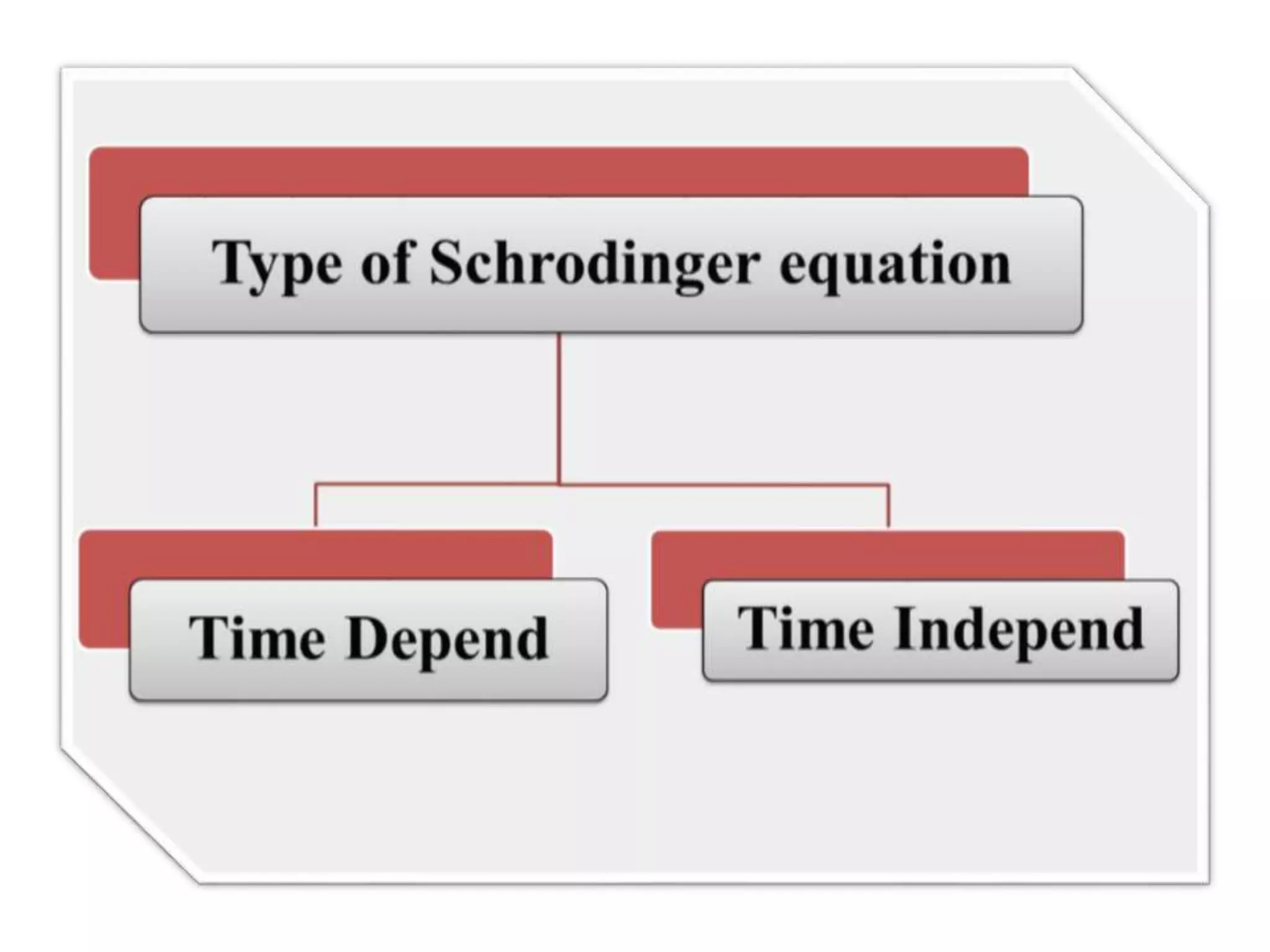
• Type
• Time Depend
• Time Independent
• Property
• Application
• Reference
Definition of Schrodinger Equation
The Schrödinger equation, sometimes called the
Schrödinger wave equation, is a partial differential
equation. It uses the concept of energy conservation
(Kinetic Energy + Potential Energy = Total Energy) to
obtain information about the behavior of an electron
bound to a nucleus.
Time Depend
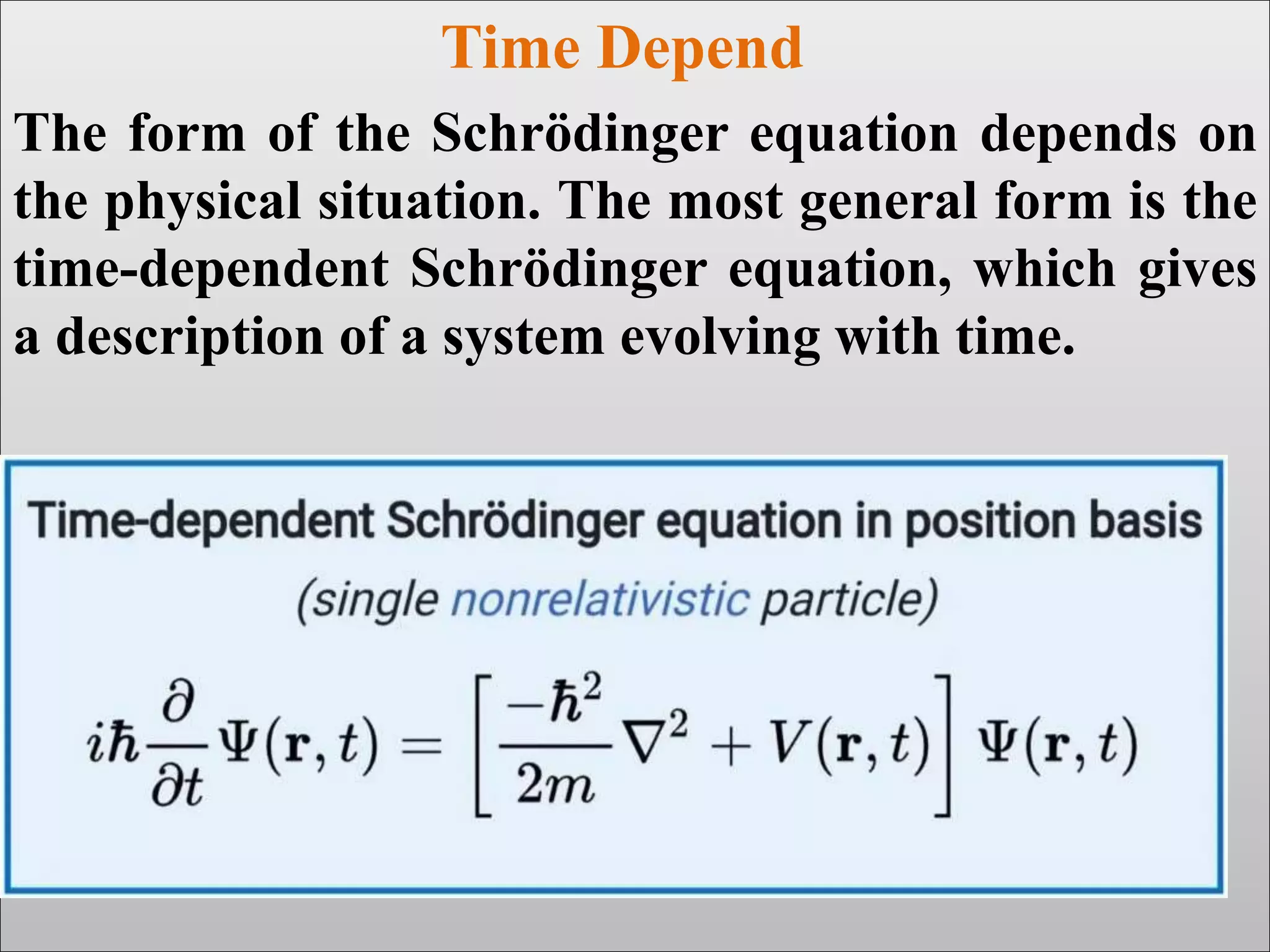
The form of the Schrödinger equation depends on
the physical situation. The most general form is the
time-dependent Schrödinger equation, which gives
a description of a system evolving with time.
Time Independent of Schrodinger Equation
The time-dependent Schrödinger equation described above
predicts that wave functions can form standing waves,
called stationary states.
Property
Linearity
Probability
current
Unitary
Separation of
Variable
Application
• Schrodingar equation is widely used in chemistry
and physics to solve problems based on the
atomic structure of matter.
• Helps in studying the structure of the atom
• Schrodinger equation is used to find the allowed
energy level of quantum mechanical systems.
https://www.uou.ac.in/lecturenotes/science/MSCPHY-
17/PHy502unit14-15,.pdf
Shankar, R. (1994). Principles of Quantum Mechanics
(2nd ed.). Kluwer Academic/Plenum Publishers. ISBN
978-0-306-44790-7.
Rieffel, Eleanor G.; Polak, Wolfgang H. (4 March 2011).
Quantum Computing: A Gentle Introduction. MIT
Press. ISBN 978-0-262-01506-6This reference is used
twice on this page

Schrodinger equation.pptx

  • 1.
    University of Halabja CollegeOf Science Department Of Physics 3rd Stage [Schrodinger equation] Prepared by : Supervised : Shene Aziz Mr.Yousif Hussein Gyabnd qubad
  • 2.
    Outline • Introduction • Definition •Type • Time Depend • Time Independent • Property • Application • Reference
  • 4.
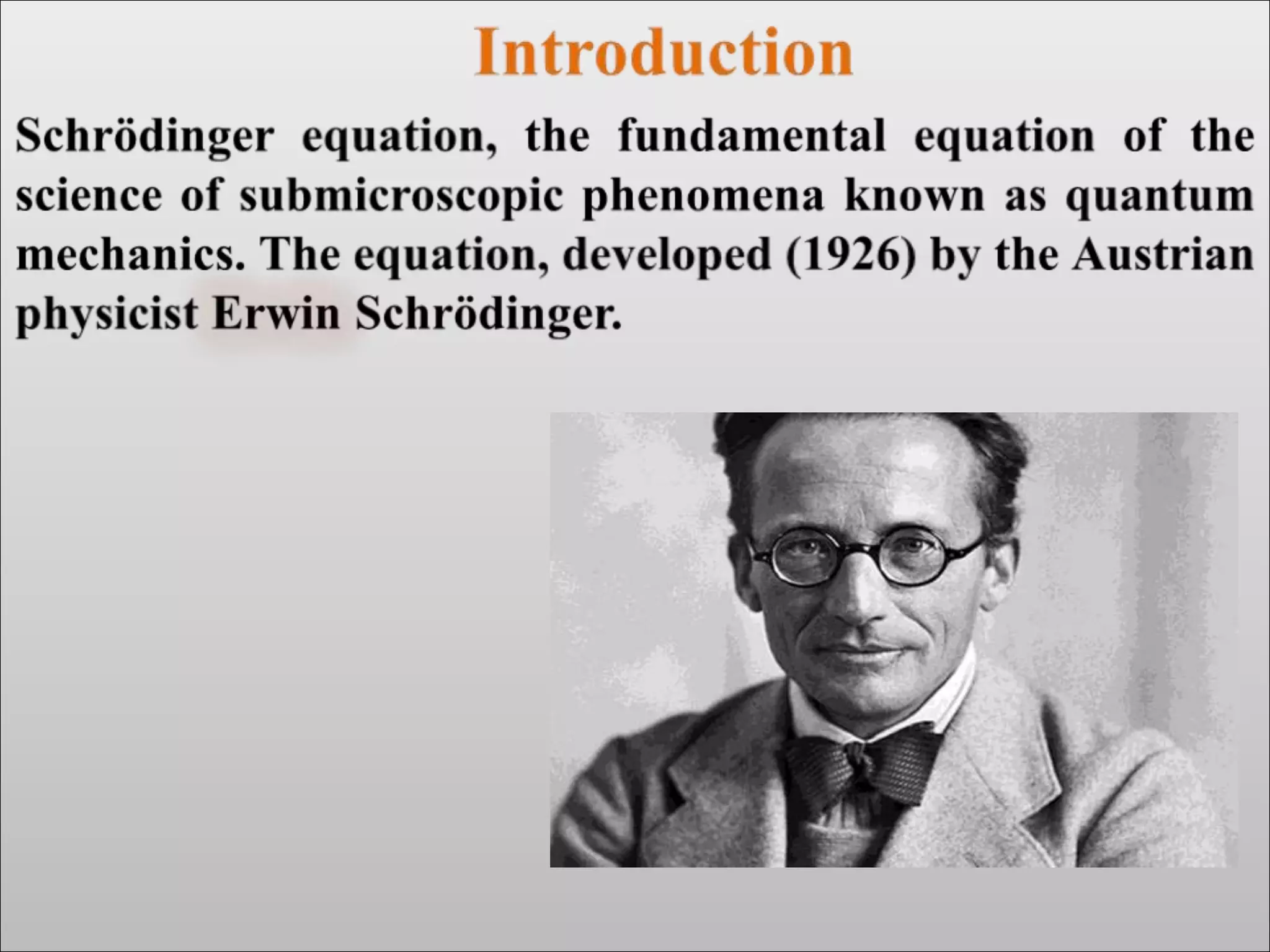
    Definition of SchrodingerEquation The Schrödinger equation, sometimes called the Schrödinger wave equation, is a partial differential equation. It uses the concept of energy conservation (Kinetic Energy + Potential Energy = Total Energy) to obtain information about the behavior of an electron bound to a nucleus.
  • 6.
    Time Depend The formof the Schrödinger equation depends on the physical situation. The most general form is the time-dependent Schrödinger equation, which gives a description of a system evolving with time.
  • 7.
    Time Independent ofSchrodinger Equation The time-dependent Schrödinger equation described above predicts that wave functions can form standing waves, called stationary states.
  • 8.
  • 9.
    Application • Schrodingar equationis widely used in chemistry and physics to solve problems based on the atomic structure of matter. • Helps in studying the structure of the atom • Schrodinger equation is used to find the allowed energy level of quantum mechanical systems.
  • 10.
    https://www.uou.ac.in/lecturenotes/science/MSCPHY- 17/PHy502unit14-15,.pdf Shankar, R. (1994).Principles of Quantum Mechanics (2nd ed.). Kluwer Academic/Plenum Publishers. ISBN 978-0-306-44790-7. Rieffel, Eleanor G.; Polak, Wolfgang H. (4 March 2011). Quantum Computing: A Gentle Introduction. MIT Press. ISBN 978-0-262-01506-6This reference is used twice on this page