Review of Degumming and Refining
Technolog
Presented by
Angad singh (1316651005)
1. Extraction of oil from seed
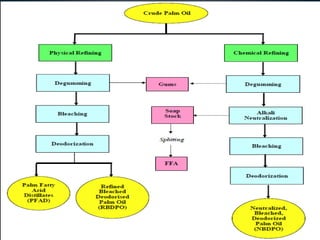
2. Degumming & Neutralization
3. Bleaching process
4. Filtration Process
5. Deodorization process
6. Crystallization process
7. Dewaxing & Dry fractionation process (olien & sterin )
8. Hydrogenation of oil
9. Deodorization process
10.Packaging process
• Refining is a process to remove impurities
found in the oil which includes physical
impurities, FFA (Free Fatty Acids), coloring
pigments, Aldehydes, Ketoses, Waxes (if
present), gums etc.
REFININ
G
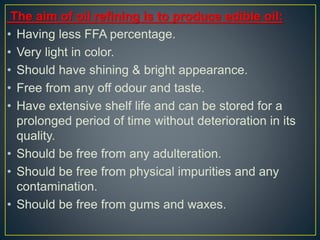
The aim of oil refining is to produce edible oil:
• Having less FFA percentage.
• Very light in color.
• Should have shining & bright appearance.
• Free from any off odour and taste.
• Have extensive shelf life and can be stored for a
prolonged period of time without deterioration in its
quality.
• Should be free from any adulteration.
• Should be free from physical impurities and any
contamination.
• Should be free from gums and waxes.
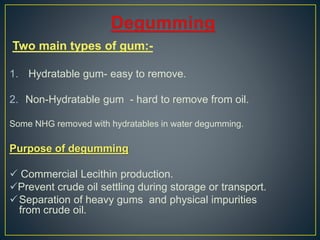
Two main types of gum:-
1. Hydratable gum- easy to remove.
2. Non-Hydratable gum - hard to remove from oil.
Some NHG removed with hydratables in water degumming.
Purpose of degumming
 Commercial Lecithin production.
Prevent crude oil settling during storage or transport.
Separation of heavy gums and physical impurities
from crude oil.
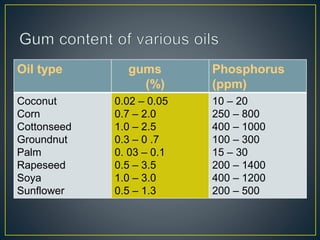
Oil type gums
(%)
Phosphorus
(ppm)
Coconut
Corn
Cottonseed
Groundnut
Palm
Rapeseed
Soya
Sunflower
0.02 – 0.05
0.7 – 2.0
1.0 – 2.5
0.3 – 0 .7
0. 03 – 0.1
0.5 – 3.5
1.0 – 3.0
0.5 – 1.3
10 – 20
250 – 800
400 – 1000
100 – 300
15 – 30
200 – 1400
400 – 1200
200 – 500
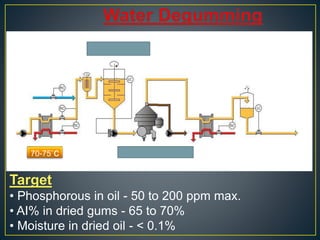
70-75˚c
Target
• Phosphorous in oil - 50 to 200 ppm max.
• AI% in dried gums - 65 to 70%
• Moisture in dried oil - < 0.1%
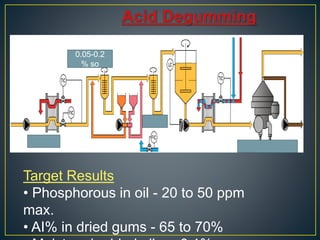
0.05-0.2
% so
Target Results
• Phosphorous in oil - 20 to 50 ppm
max.
• AI% in dried gums - 65 to 70%
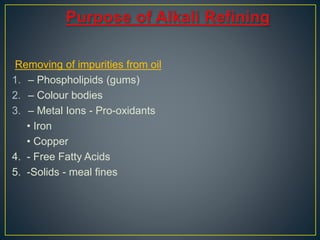
Removing of impurities from oil
1. – Phospholipids (gums)
2. – Colour bodies
3. – Metal Ions - Pro-oxidants
• Iron
• Copper
4. - Free Fatty Acids
5. -Solids - meal fines
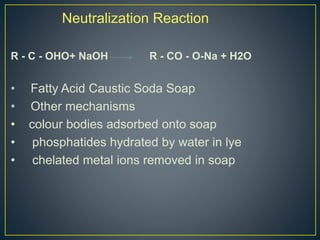
Neutralization Reaction
R - C - OHO+ NaOH R - CO - O-Na + H2O
• Fatty Acid Caustic Soda Soap
• Other mechanisms
• colour bodies adsorbed onto soap
• phosphatides hydrated by water in lye
• chelated metal ions removed in soap
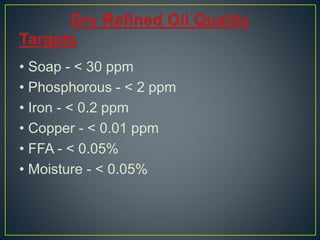
• Soap - < 30 ppm
• Phosphorous - < 2 ppm
• Iron - < 0.2 ppm
• Copper - < 0.01 ppm
• FFA - < 0.05%
• Moisture - < 0.05%
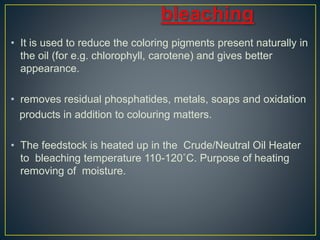
• It is used to reduce the coloring pigments present naturally in
the oil (for e.g. chlorophyll, carotene) and gives better
appearance.
• removes residual phosphatides, metals, soaps and oxidation
products in addition to colouring matters.
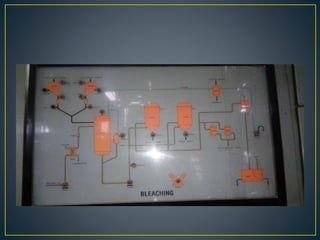
• The feedstock is heated up in the Crude/Neutral Oil Heater
to bleaching temperature 110-120˚C. Purpose of heating
removing of moisture.
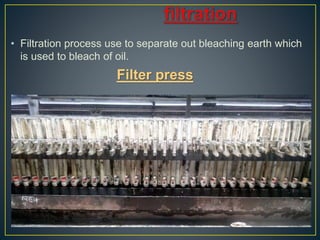
• Filtration process use to separate out bleaching earth which
is used to bleach of oil.
Filter press
• This is used to filter the bleached oil and then separate
the bleaching earth which has already absorbed the
coloring pigments. It consist 2-6 mesh screen
• This earth then collected in a sump and will be known as
“spent earth”. It operating pressure be below 2 Kg/cm2 .
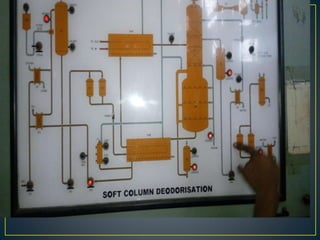
• The purpose of this process is making the oil suitable for
human consumption by removing substances, which give it
undesirable acidity, odor, color.
• The odorous and flavoring matters, which are mainly
aldehydes, ketones, alcohols, and hydrocarbons, are
removed at the same time as the free fatty acids (FFA).
taste.
• Citric acid used for odorisation process to increase shinning
of oil.
• Free fatty compounds removed in Vaccume distillation at
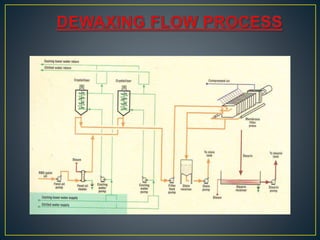
Dewaxing:
• Separation of waxes, esters of long chain fatty
acids and long chain primary alcohols present in
mainly sunflower and maize oil.
• Most of the oils do not need dewaxing as they
contain little or no waxes. Only sunflower oil & Rice
Bran oil contain appreciable quantities of wax to give
a hazy appearance at low temperature.
• The oil is heated at 50ºC to make sure oil is liquid
only.
• The oil is cooled slowly at 7-8ºC and crystal are
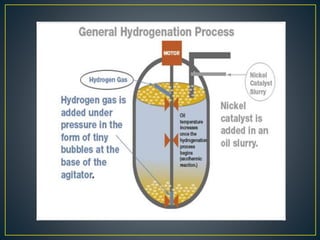
• Hydrogenation of oil are used to remove double bond
present in fatty acid.
• Hydrogenation are increase the stability of oil.
• Hydrogenation of oil increase the melting point.
SPECIFIED CONDITION:-
Temperature 150℃
Catalyst Ni (4.5 kg cat/ 20 ton of oil )
H2 5.5 m3/20 ton of oil
THANK YOU
FOR BEING
HERE

Industrial summer training presentation new

  • 1.
    Review of Degummingand Refining Technolog Presented by Angad singh (1316651005)
  • 3.
    1. Extraction ofoil from seed 2. Degumming & Neutralization 3. Bleaching process 4. Filtration Process 5. Deodorization process 6. Crystallization process 7. Dewaxing & Dry fractionation process (olien & sterin ) 8. Hydrogenation of oil 9. Deodorization process 10.Packaging process
  • 4.
    • Refining isa process to remove impurities found in the oil which includes physical impurities, FFA (Free Fatty Acids), coloring pigments, Aldehydes, Ketoses, Waxes (if present), gums etc. REFININ G
  • 5.
    The aim ofoil refining is to produce edible oil: • Having less FFA percentage. • Very light in color. • Should have shining & bright appearance. • Free from any off odour and taste. • Have extensive shelf life and can be stored for a prolonged period of time without deterioration in its quality. • Should be free from any adulteration. • Should be free from physical impurities and any contamination. • Should be free from gums and waxes.
  • 7.
    Two main typesof gum:- 1. Hydratable gum- easy to remove. 2. Non-Hydratable gum - hard to remove from oil. Some NHG removed with hydratables in water degumming. Purpose of degumming  Commercial Lecithin production. Prevent crude oil settling during storage or transport. Separation of heavy gums and physical impurities from crude oil.
  • 8.
    Oil type gums (%) Phosphorus (ppm) Coconut Corn Cottonseed Groundnut Palm Rapeseed Soya Sunflower 0.02– 0.05 0.7 – 2.0 1.0 – 2.5 0.3 – 0 .7 0. 03 – 0.1 0.5 – 3.5 1.0 – 3.0 0.5 – 1.3 10 – 20 250 – 800 400 – 1000 100 – 300 15 – 30 200 – 1400 400 – 1200 200 – 500
  • 9.
    70-75˚c Target • Phosphorous inoil - 50 to 200 ppm max. • AI% in dried gums - 65 to 70% • Moisture in dried oil - < 0.1%
  • 10.
    0.05-0.2 % so Target Results •Phosphorous in oil - 20 to 50 ppm max. • AI% in dried gums - 65 to 70%
  • 11.
    Removing of impuritiesfrom oil 1. – Phospholipids (gums) 2. – Colour bodies 3. – Metal Ions - Pro-oxidants • Iron • Copper 4. - Free Fatty Acids 5. -Solids - meal fines
  • 12.
    Neutralization Reaction R -C - OHO+ NaOH R - CO - O-Na + H2O • Fatty Acid Caustic Soda Soap • Other mechanisms • colour bodies adsorbed onto soap • phosphatides hydrated by water in lye • chelated metal ions removed in soap
  • 13.
    • Soap -< 30 ppm • Phosphorous - < 2 ppm • Iron - < 0.2 ppm • Copper - < 0.01 ppm • FFA - < 0.05% • Moisture - < 0.05%
  • 14.
    • It isused to reduce the coloring pigments present naturally in the oil (for e.g. chlorophyll, carotene) and gives better appearance. • removes residual phosphatides, metals, soaps and oxidation products in addition to colouring matters. • The feedstock is heated up in the Crude/Neutral Oil Heater to bleaching temperature 110-120˚C. Purpose of heating removing of moisture.
  • 16.
    • Filtration processuse to separate out bleaching earth which is used to bleach of oil. Filter press
  • 17.
    • This isused to filter the bleached oil and then separate the bleaching earth which has already absorbed the coloring pigments. It consist 2-6 mesh screen • This earth then collected in a sump and will be known as “spent earth”. It operating pressure be below 2 Kg/cm2 .
  • 18.
    • The purposeof this process is making the oil suitable for human consumption by removing substances, which give it undesirable acidity, odor, color. • The odorous and flavoring matters, which are mainly aldehydes, ketones, alcohols, and hydrocarbons, are removed at the same time as the free fatty acids (FFA). taste. • Citric acid used for odorisation process to increase shinning of oil. • Free fatty compounds removed in Vaccume distillation at
  • 20.
    Dewaxing: • Separation ofwaxes, esters of long chain fatty acids and long chain primary alcohols present in mainly sunflower and maize oil. • Most of the oils do not need dewaxing as they contain little or no waxes. Only sunflower oil & Rice Bran oil contain appreciable quantities of wax to give a hazy appearance at low temperature. • The oil is heated at 50ºC to make sure oil is liquid only. • The oil is cooled slowly at 7-8ºC and crystal are
  • 22.
    • Hydrogenation ofoil are used to remove double bond present in fatty acid. • Hydrogenation are increase the stability of oil. • Hydrogenation of oil increase the melting point. SPECIFIED CONDITION:- Temperature 150℃ Catalyst Ni (4.5 kg cat/ 20 ton of oil ) H2 5.5 m3/20 ton of oil
  • 24.