OIT
Project Management Day 1
Kevin R. Thomas
Manager, Training & Development
x3542
Kevin.R.Thomas@williams.edu
Program Outline: Day 1
Planning
• Definitions and Success Factors
• Project Plans
• Stakeholder Management
• Work Analysis
Program Outline Day 2:
Project Implementation and Closure
• Implementation Tools
• Interpersonal skills during implementation
• Closure:
– Post project review
– Celebrations
DEFINITIONS AND SUCCESS
FACTORS
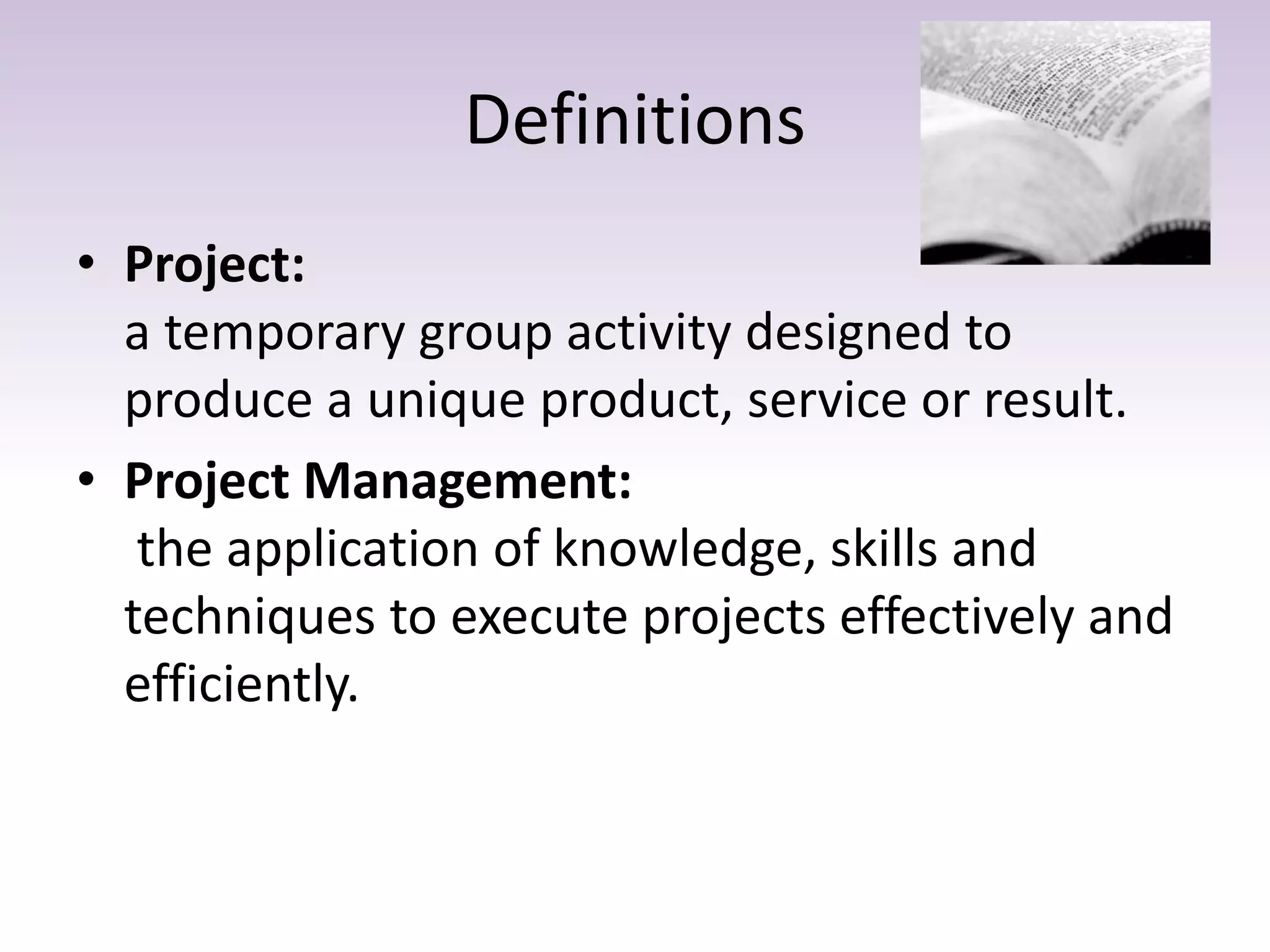
Definitions
• Project:
a temporary group activity designed to
produce a unique product, service or result.
• Project Management:
the application of knowledge, skills and
techniques to execute projects effectively and
efficiently.
Project Successes and Disasters
• Pair up
• Take turns sharing project disaster stories
• What factors led to their failure?
• Now share project success stories
• What factors led to their success?
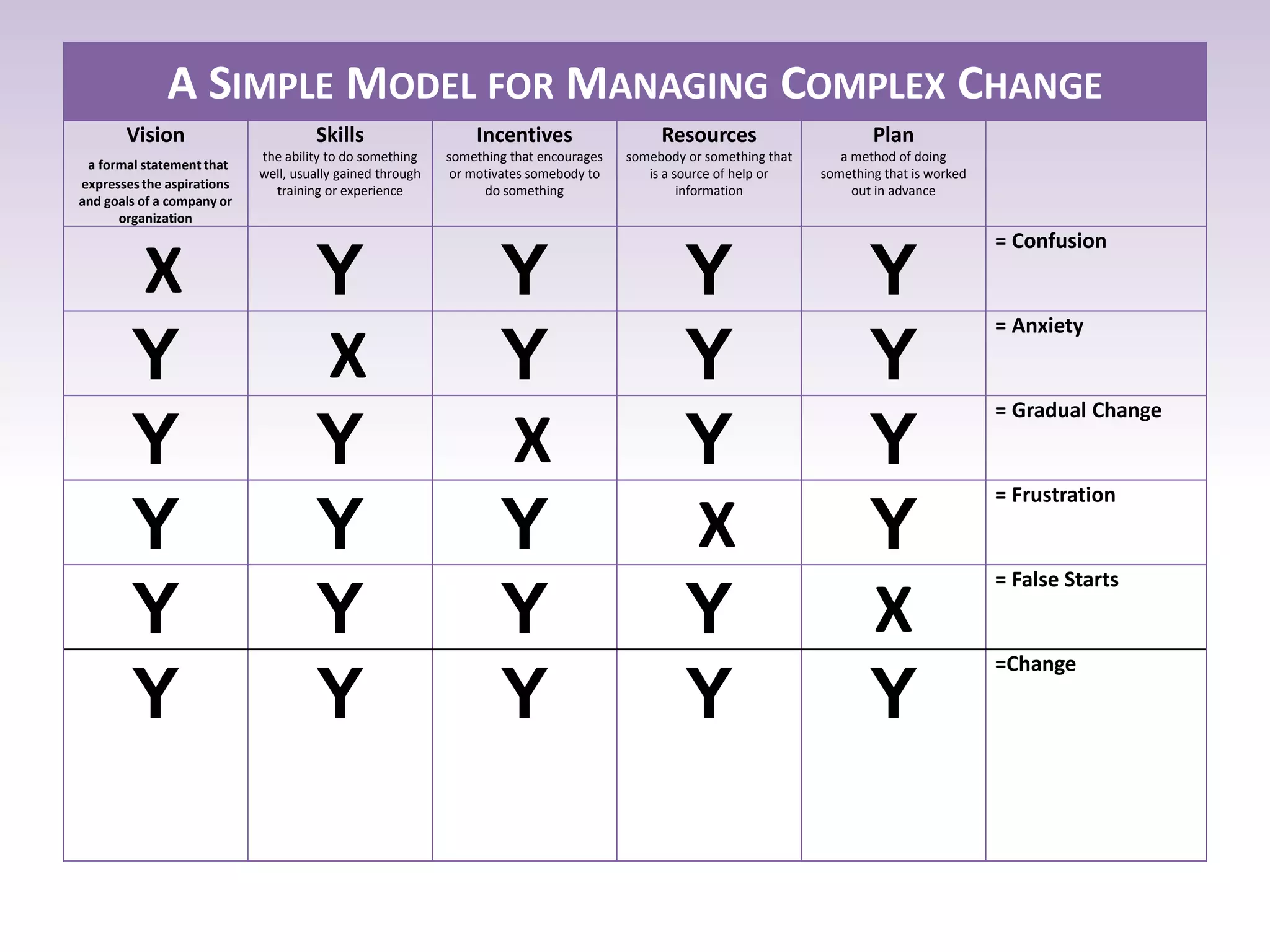
A SIMPLE MODEL FOR MANAGING COMPLEX CHANGE
Vision
a formal statement that
expresses the aspirations
and goals of a company or
organization
Skills
the ability to do something
well, usually gained through
training or experience
Incentives
something that encourages
or motivates somebody to
do something
Resources
somebody or something that
is a source of help or
information
Plan
a method of doing
something that is worked
out in advance
X Y Y Y Y
= Confusion
Y X Y Y Y
= Anxiety
Y Y X Y Y
= Gradual Change
Y Y Y X Y
= Frustration
Y Y Y Y X
= False Starts
Y Y Y Y Y
=Change
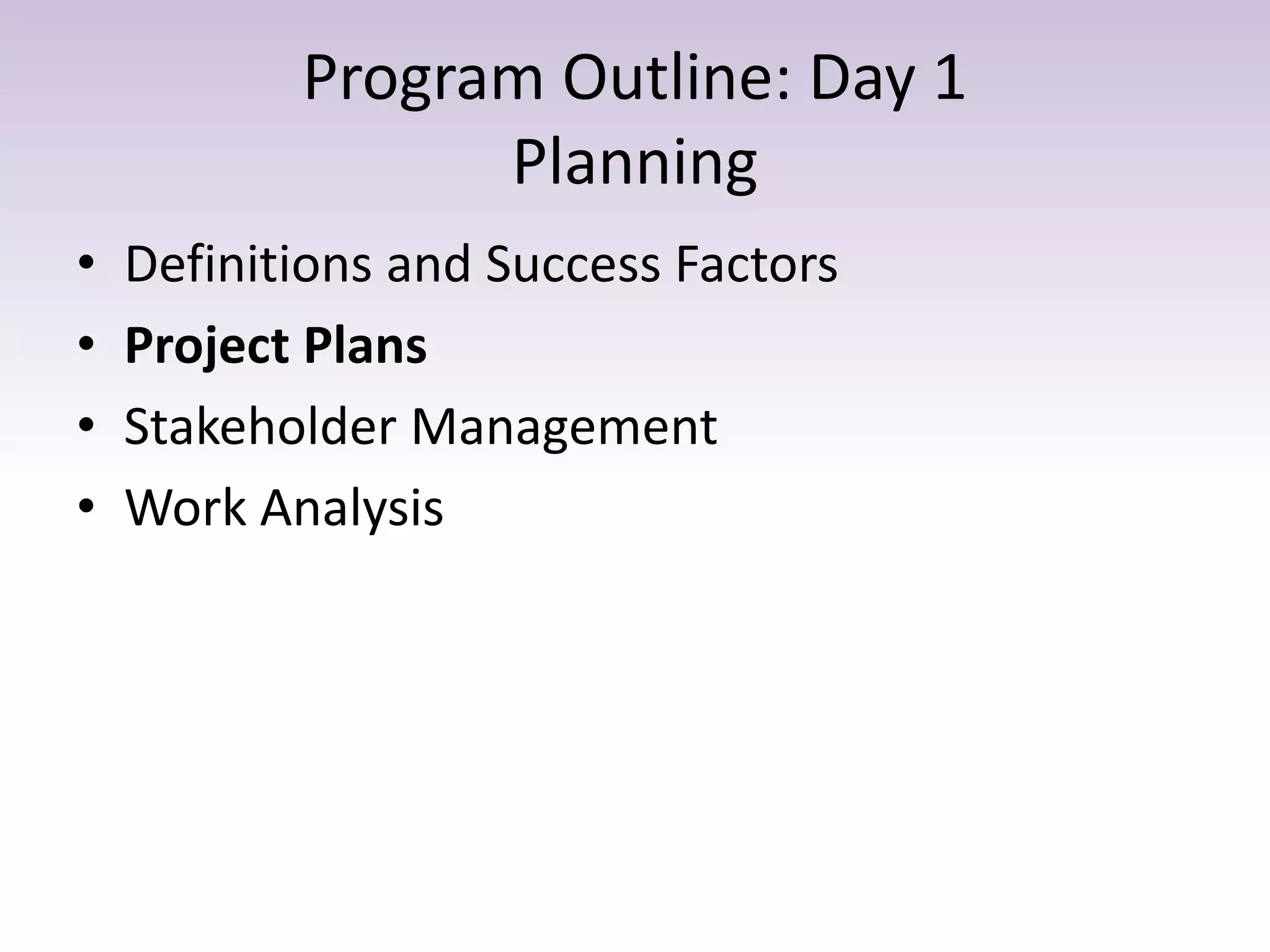
Program Outline: Day 1
Planning
• Definitions and Success Factors
• Project Plans
• Stakeholder Management
• Work Analysis
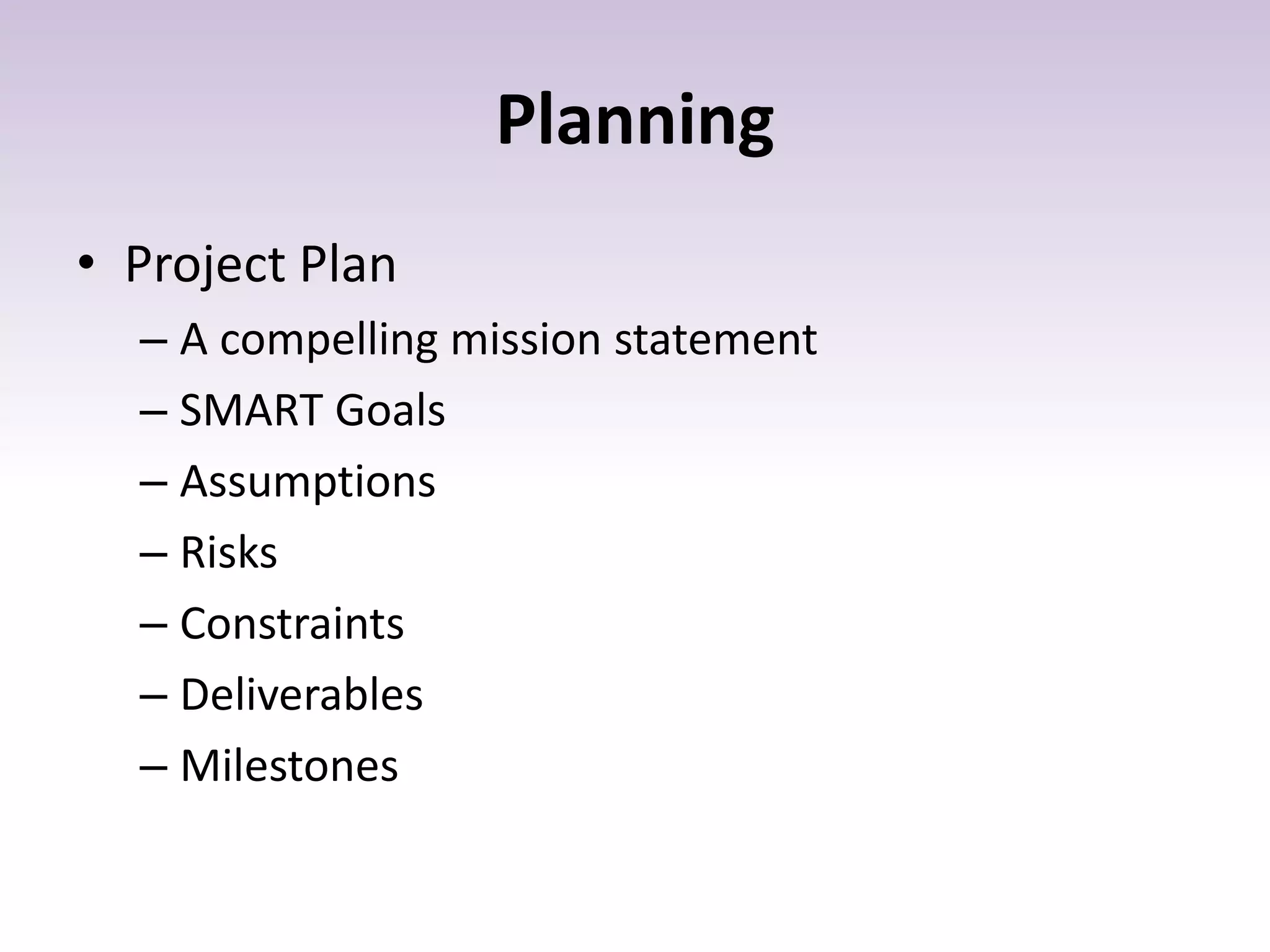
Planning
• Project Plan
– A compelling mission statement
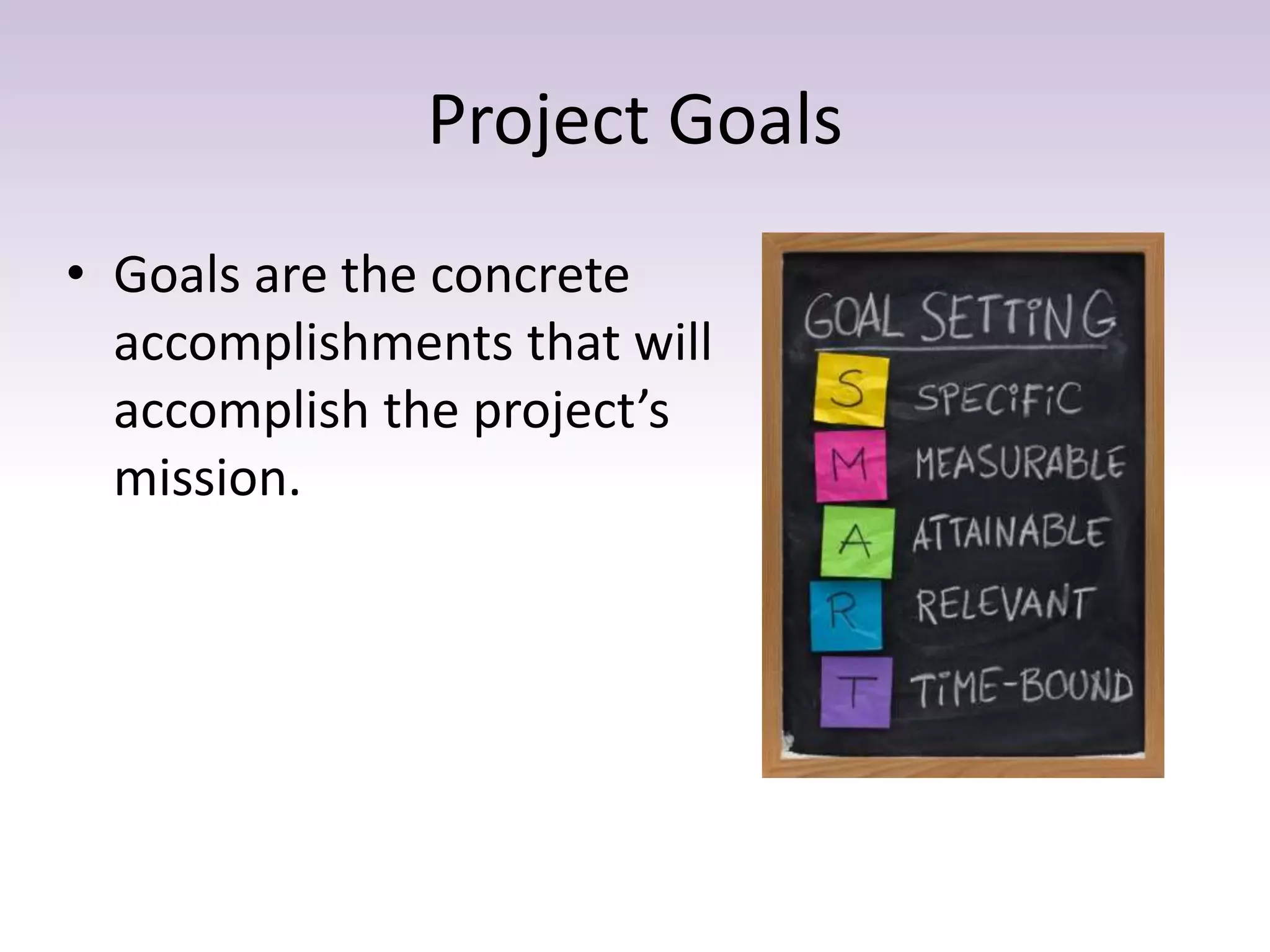
– SMART Goals
– Assumptions
– Risks
– Constraints
– Deliverables
– Milestones
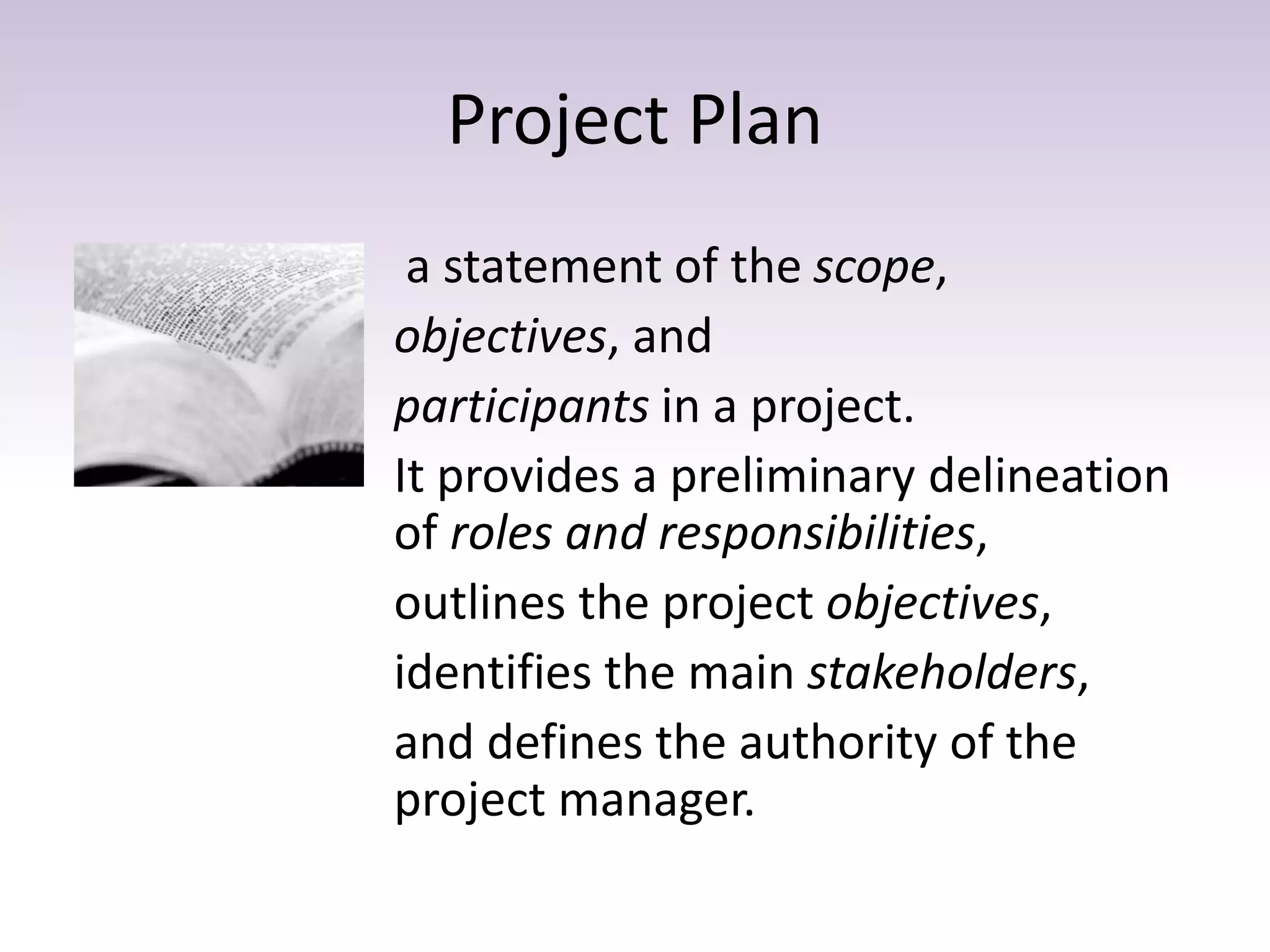
Project Plan
a statement of the scope,
objectives, and
participants in a project.
It provides a preliminary delineation
of roles and responsibilities,
outlines the project objectives,
identifies the main stakeholders,
and defines the authority of the
project manager.
Project Plan Components
• Mission
• Scope/Goals
• Assumptions
• Risks
• Constraints
• Deliverables
Project Mission
• Describes why the project is being
undertaken, and the benefits it hopes to
achieve.
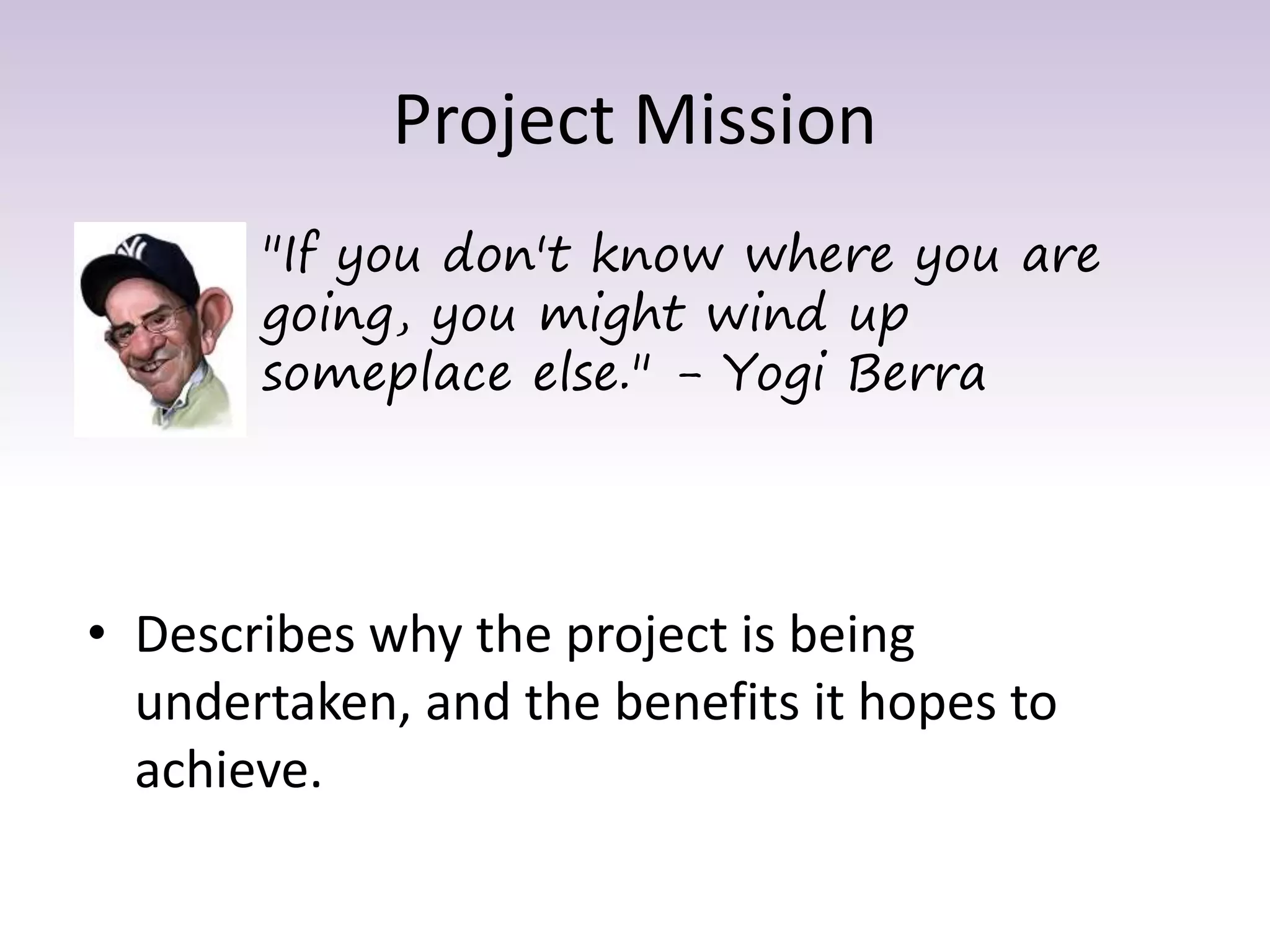
"If you don't know where you are
going, you might wind up
someplace else." - Yogi Berra
Example: Performance Development
Mission Statement
• Employees need to have:
– clear guidance about what is needed for success in
their roles,
– honest feedback about how they are performing in
them, and
– concrete plans for professional development.
• A structured performance development program
can play an essential role in insuring the
consistency and quality of this guidance,
feedback, and planning.
Your Turn!
• Write a mission statement for your project.
• Pair up and share your statement with your
partner.
• Get feedback on your mission statement from
your partner (strengths, opportunities for
improvement)
Project Plan Components
• Mission
• Scope/Goals
• Assumptions
• Risks
• Constraints
• Deliverables
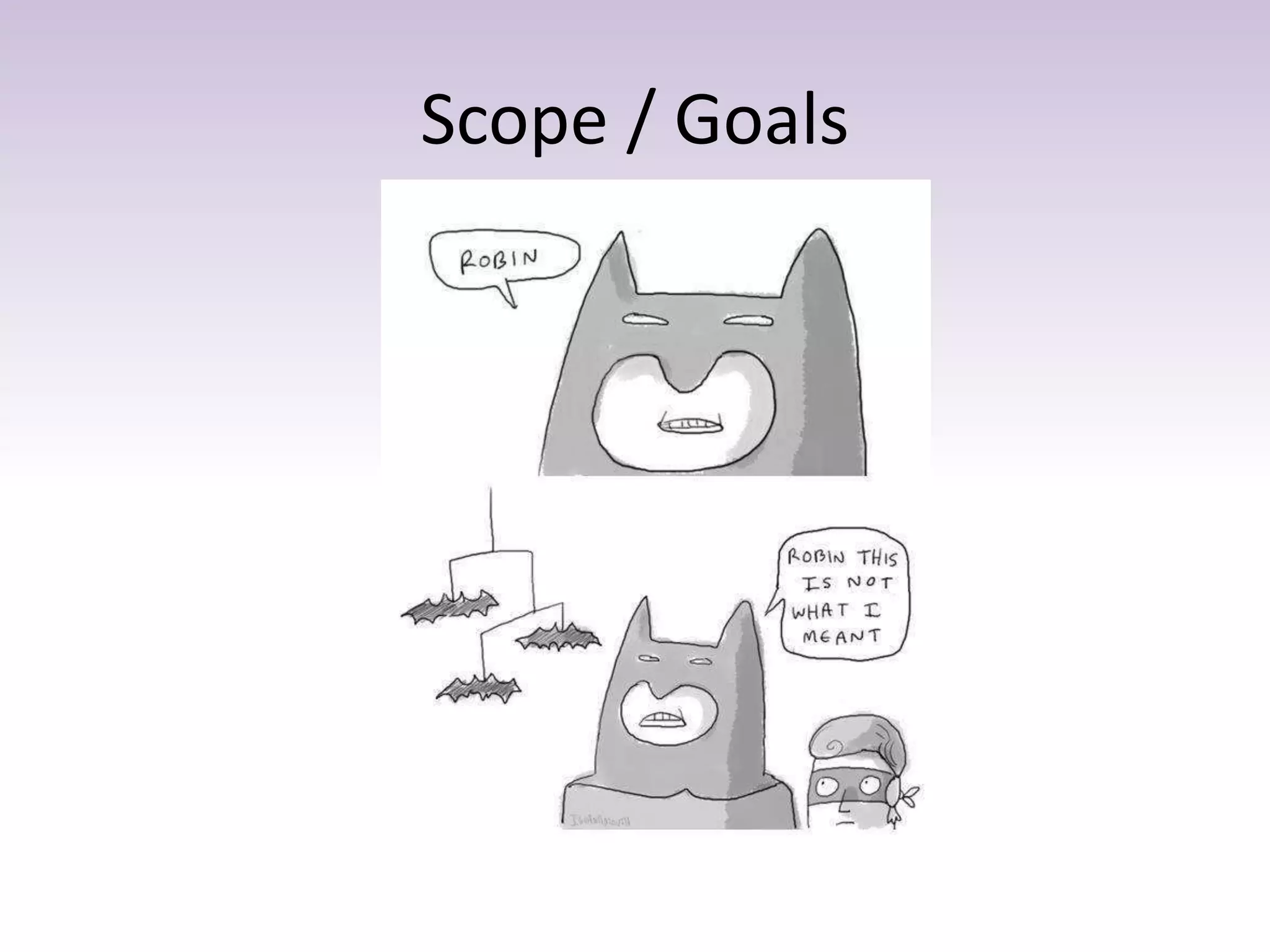
Scope / Goals
Project Goals
• Goals are the concrete
accomplishments that will
accomplish the project’s
mission.
Project Goal Example
• "upgrade the helpdesk telephone system by
December 31 to achieve average client wait
times of no more than two minutes"
Your Turn!
• Write one of the goals for your project. Make
sure it meets all of the SMART criteria.
• Pair up with someone else, and share the goal
you’ve written.
• Get feedback from your partner.
Project Plan Components
• Mission
• Scope/Goals
• Assumptions
• Risks
• Constraints
• Deliverables
Assumptions
• Project assumptions are important conditions
of the project environment that are
considered to be fundamental. Essentially,
project assumptions are low probability risks.
Assumptions: Examples
• Current staffing levels will continue for the
duration of the project.
• The project has the full support of the project
sponsor.
• The legal office will be available to review and
assist in finalizing contract language.
Assumptions: Your Turn
• Read the announcement about the Weston
Field renovation project.
• If you were the project manager, what would
you list as assumptions on the project plan?
Project Plan Components
• Mission
• Scope/Goals
• Assumptions
• Risks
• Constraints
• Deliverables
Risks
• Risk: An event that would have significant
consequences for the project if it were to
occur.
• Risk Analysis: The identification, assessment,
and prioritization of risks that may impact the
project, in order to inform action planning.
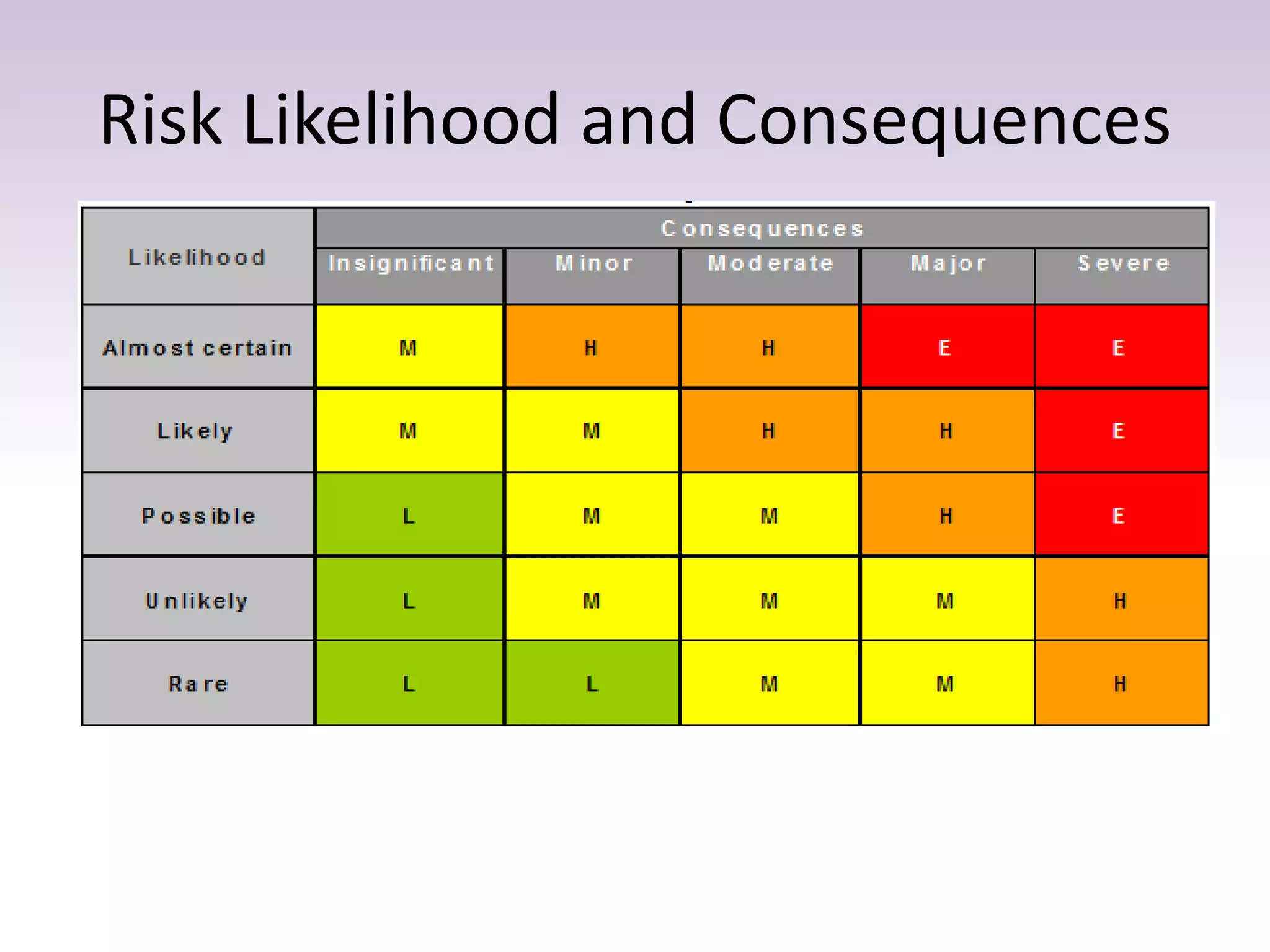
Risk Likelihood and Consequences
Risks: Example
• Obamacare
– States may not accept the subsidized expansion of
Medicaid that is a key component of guaranteeing
universal insurance for all Americans.
– States may not create their own health insurance
exchanges, greatly increasing the load on the
national exchange website.
Risks: Your Turn
• Complete the risk worksheet for your project.
Project Plan Components
• Mission
• Scope/Goals
• Assumptions
• Risks
• Constraints
• Deliverables
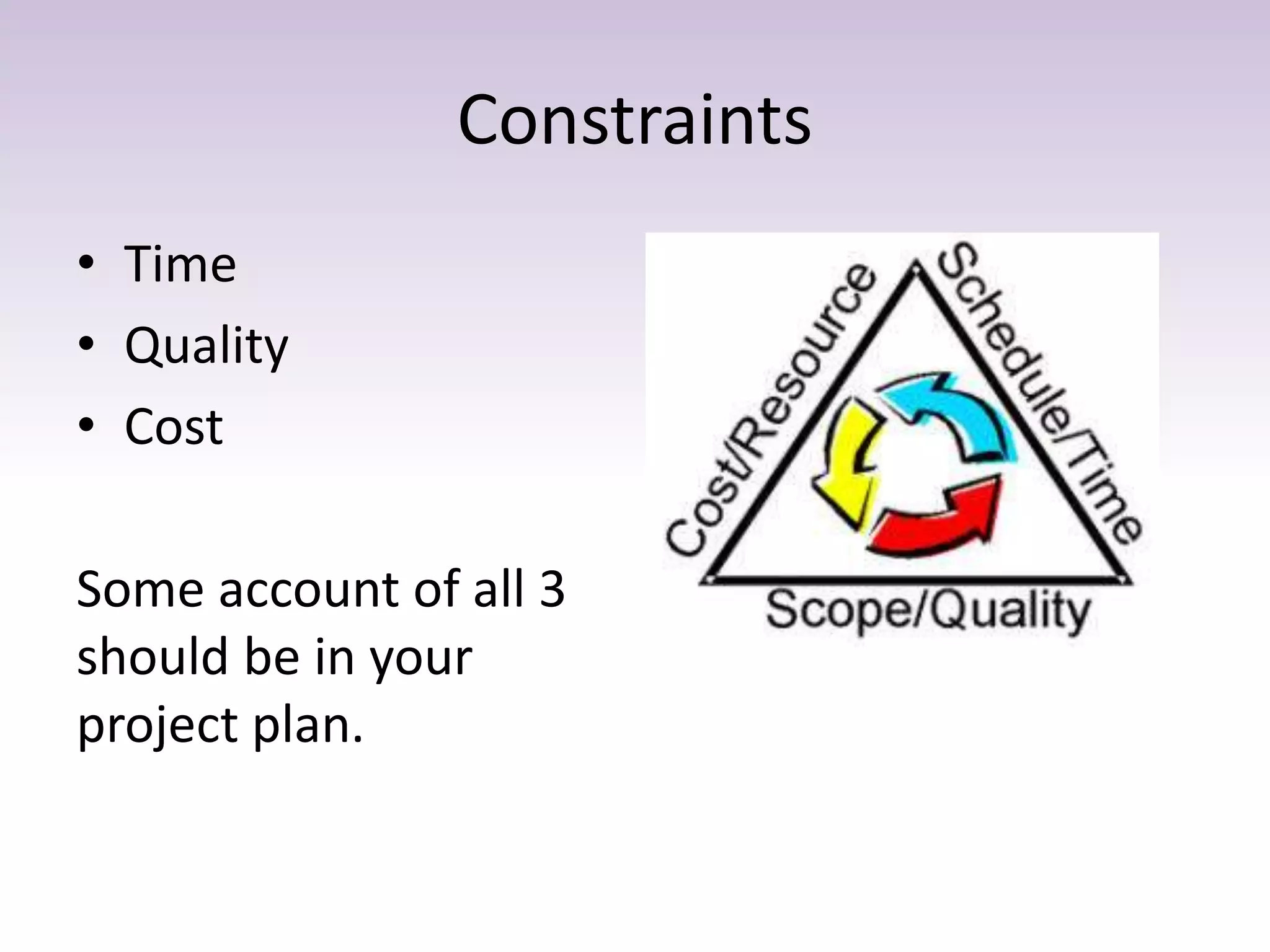
Constraints
• Time
• Quality
• Cost
Some account of all 3
should be in your
project plan.
Constraints: Example
• Weston Field
Time Project must be completed in time for the first
football game of 2014.
Cost $22 million
Quality [inspection requirements]
Constraints: Your Turn
• Using the worksheet, specify what you know
about the triple constraint for your project.
Project Plan Components
• Mission
• Scope/Goals
• Assumptions
• Risks
• Constraints
• Deliverables
Deliverables
• A tangible, measurable, and specific product
or service delivered from the project team to a
client or project sponsor.
Deliverables: Examples
• Software releases
• A program evaluation report on a training
program.
• Increase profitability of a product by 3% as
indicated on the company balance sheet.
Deliverables: Your Turn
• What are the deliverables for your project?
Program Outline: Day 1
Planning
• Definitions and Success Factors
• Project Plans
• Stakeholder Management
• Work Analysis
STAKEHOLDER MANAGEMENT
Stakeholders
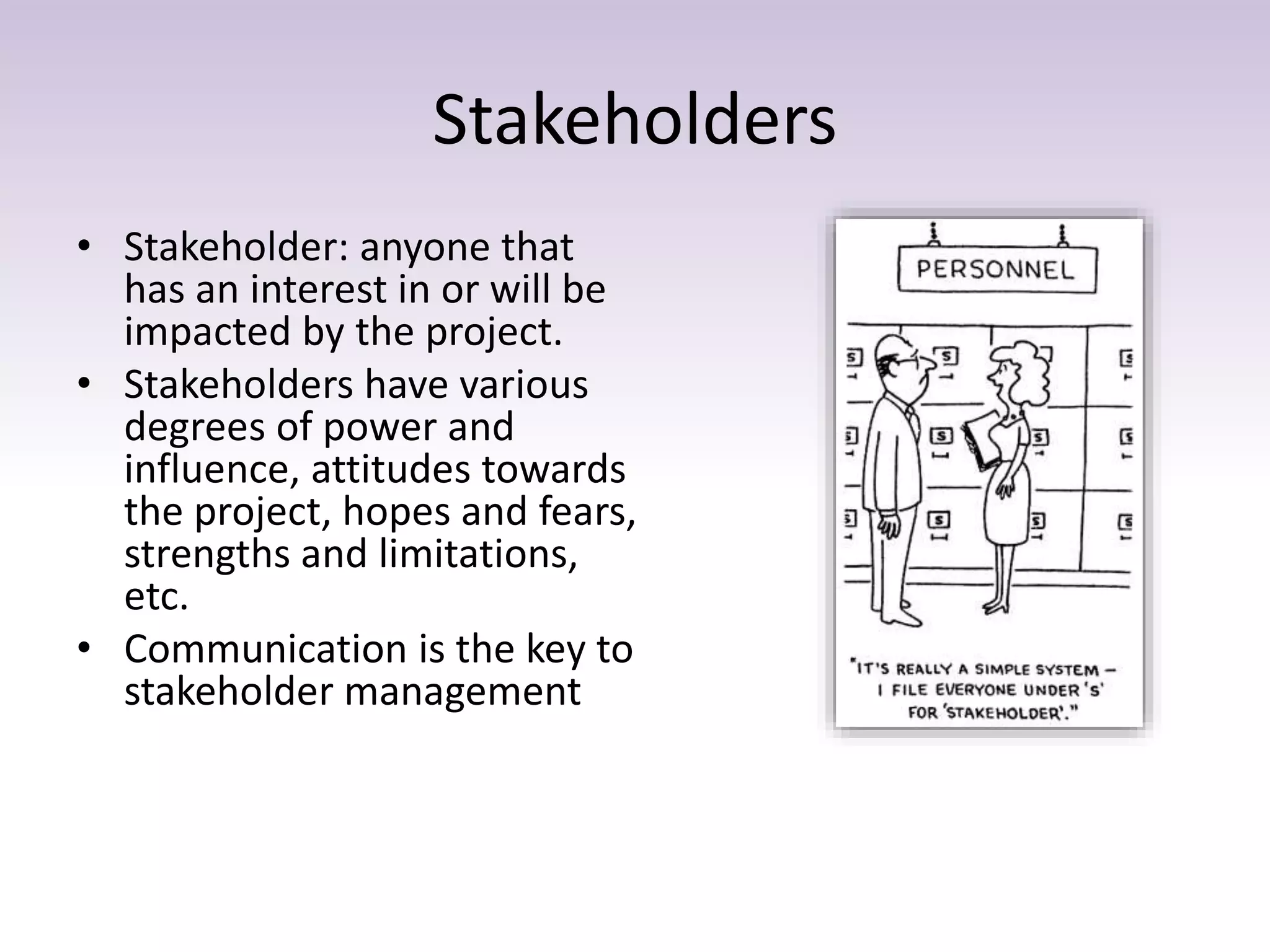
• Stakeholder: anyone that
has an interest in or will be
impacted by the project.
• Stakeholders have various
degrees of power and
influence, attitudes towards
the project, hopes and fears,
strengths and limitations,
etc.
• Communication is the key to
stakeholder management
The Project Sponsor: A Key
Stakeholder
• Ultimately accountable for the project’s
success.
• Authorizes the resources used for the project
• Makes important decisions about the project
along the way.
Stakeholders: Other Examples
Stakeholders: Your Turn
• Choose a stakeholder for your project and
complete the stakeholder analysis.
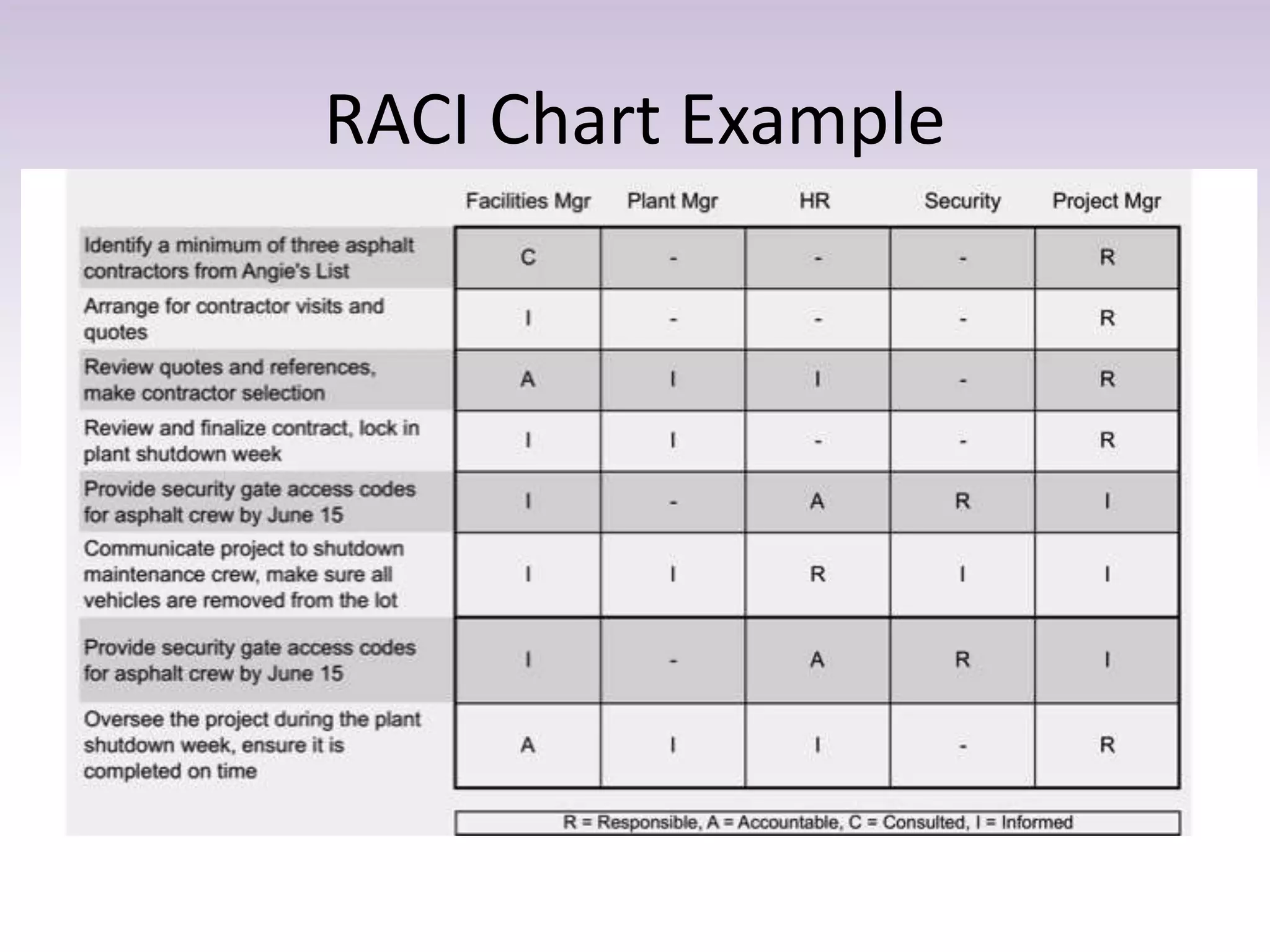
RACI Chart
• Divides stakeholders into 4 types:
– Responsible: The doers of the project, and
especially the project lead.
– Accountable: The buck stops here. Often the
project sponsor.
– Consulted: Stakeholders whose expertise is
required or whose needs must be understood.
– Informed: Stakeholders who are not directly
involved in the project activity, but need to know
what is going on.
RACI Chart Example
RACI Chart: Your Turn
• In the left column, fill in the main phases of
your project.
• In the top row, fill in at least 3 key
stakeholders of your project.
• Complete the RACI chart.
Communications Plan
• Key Principle:
– Take the maximum amount of communication you
think is necessary in any situation.
– Multiply by 10.
– That’s the minimum.
• If you’re wondering whether someone might
need to know something, they probably do.
• Plan how frequently you’ll communicate with
each stakeholder.
Communications Plan: Your Turn
• Complete the communications plan
worksheet.
Program Outline: Day 1
Planning
• Definitions and Success Factors
• Project Plans
• Stakeholder Management
• Work Analysis
WORK ANALYSIS
Work Analysis
• Milestones
• Planning Fallacy
• Work Breakdown Structure
• Dependencies
• Gantt Chart
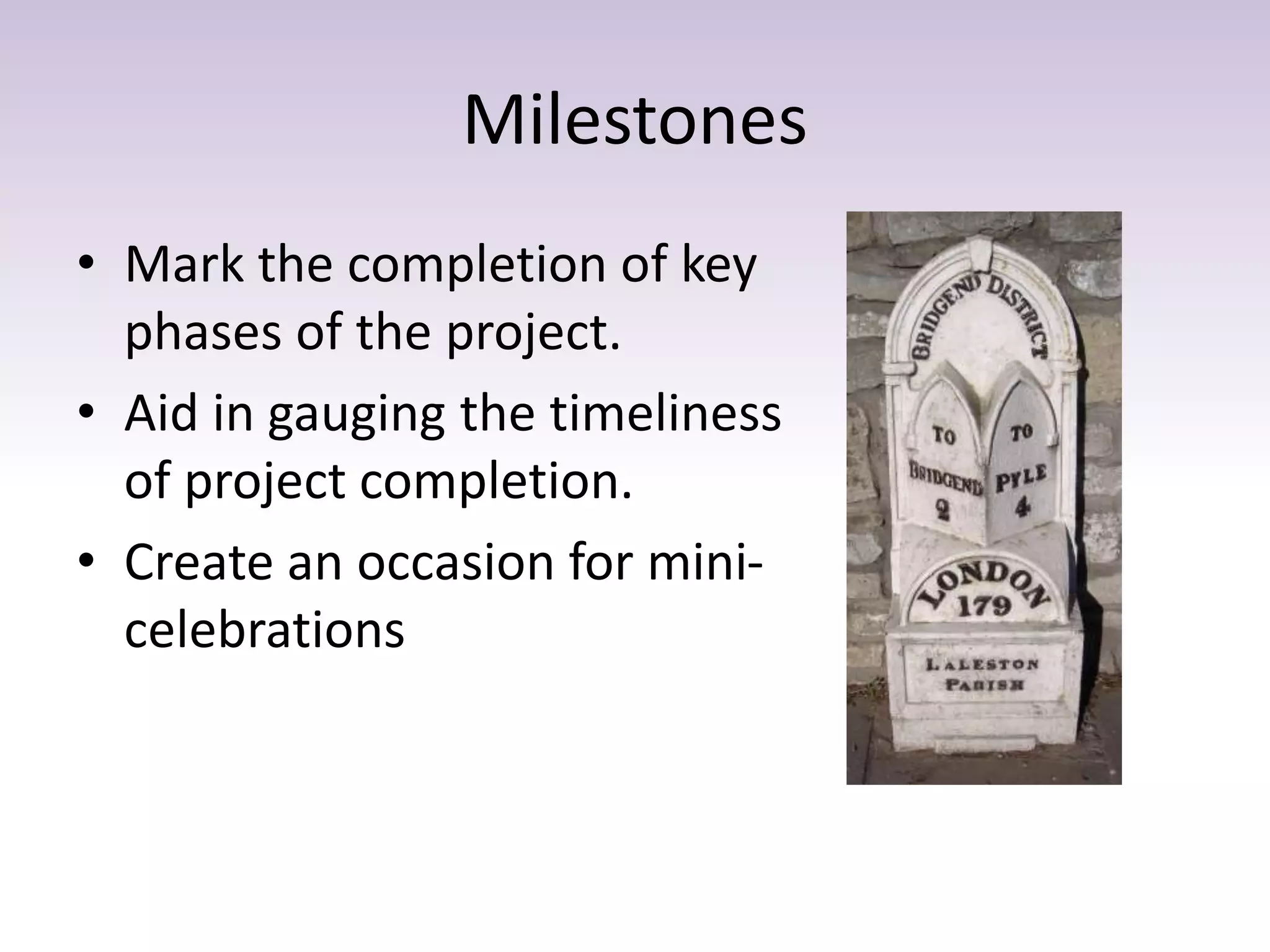
Milestones
• Mark the completion of key
phases of the project.
• Aid in gauging the timeliness
of project completion.
• Create an occasion for mini-
celebrations
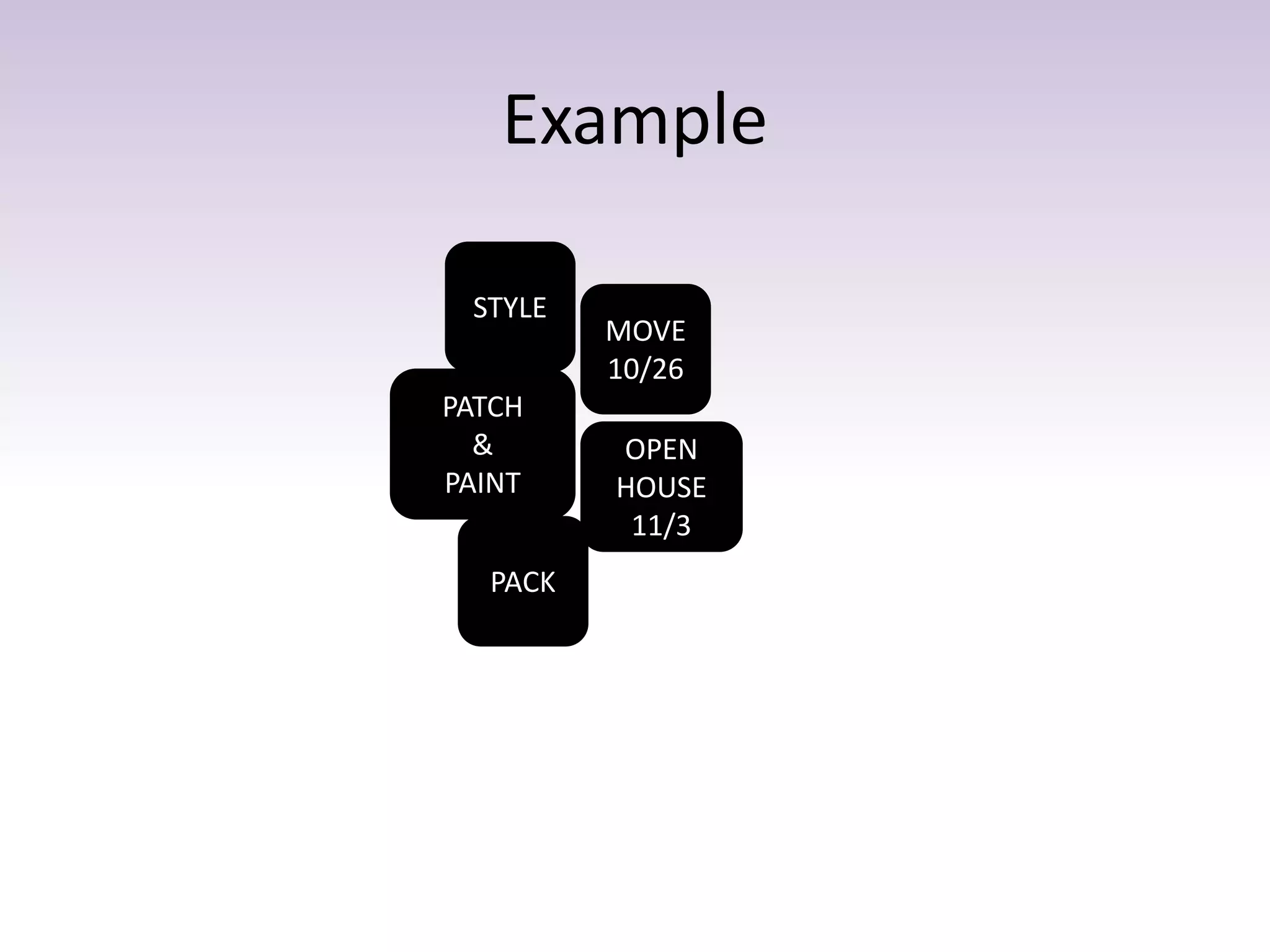
Example
PACK
PATCH
&
PAINT
MOVE
10/26
STYLE
OPEN
HOUSE
11/3
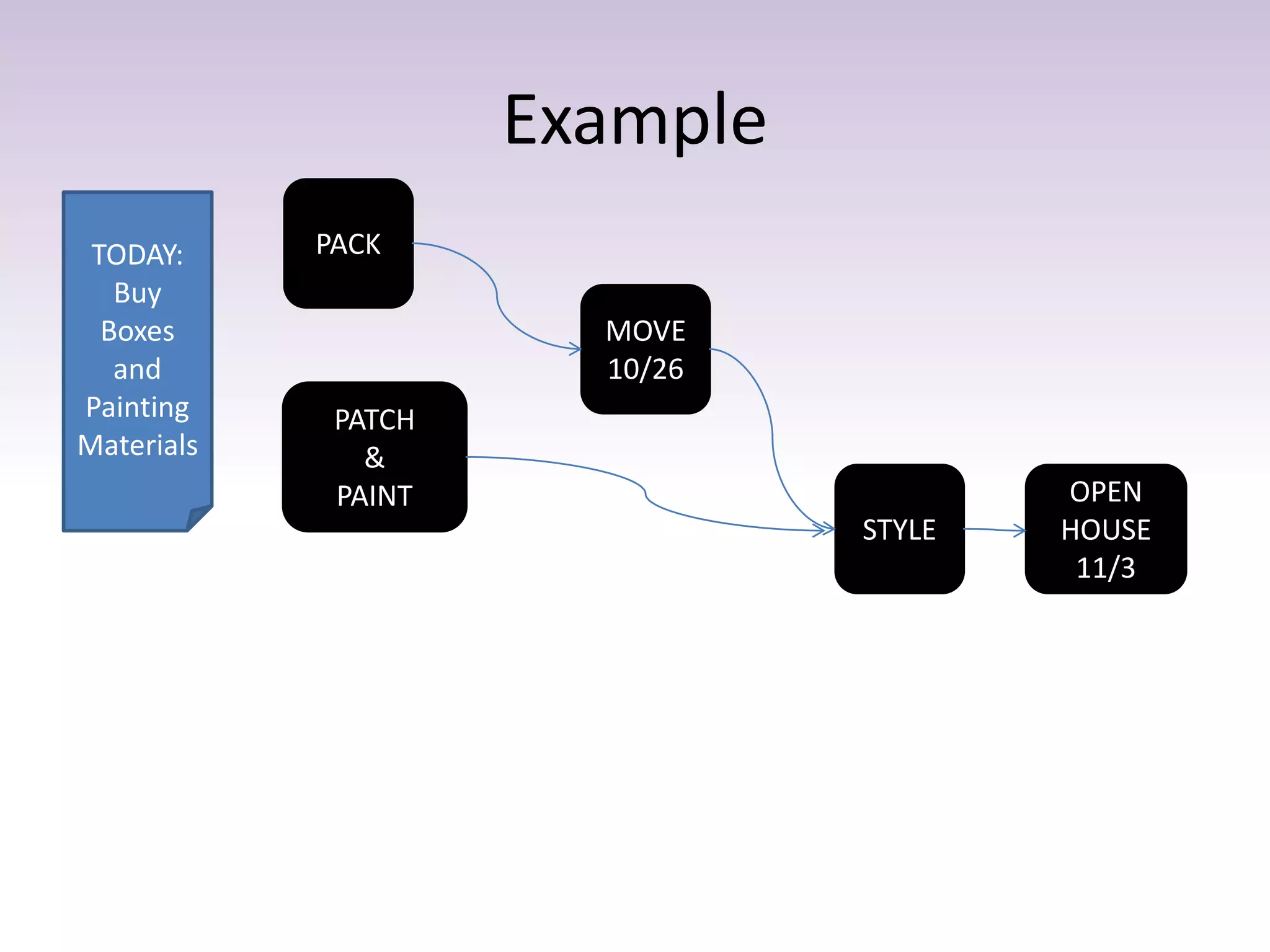
Example
PACK
PATCH
&
PAINT
MOVE
10/26
STYLE
OPEN
HOUSE
11/3
TODAY:
Buy
Boxes
and
Painting
Materials
Milestones: Your Turn
• What are the key milestones of your project,
and the deadlines associated with them?
Work Analysis
• Milestones
• Planning Fallacy
• Work Breakdown Structure
• Dependencies
• Gantt Chart
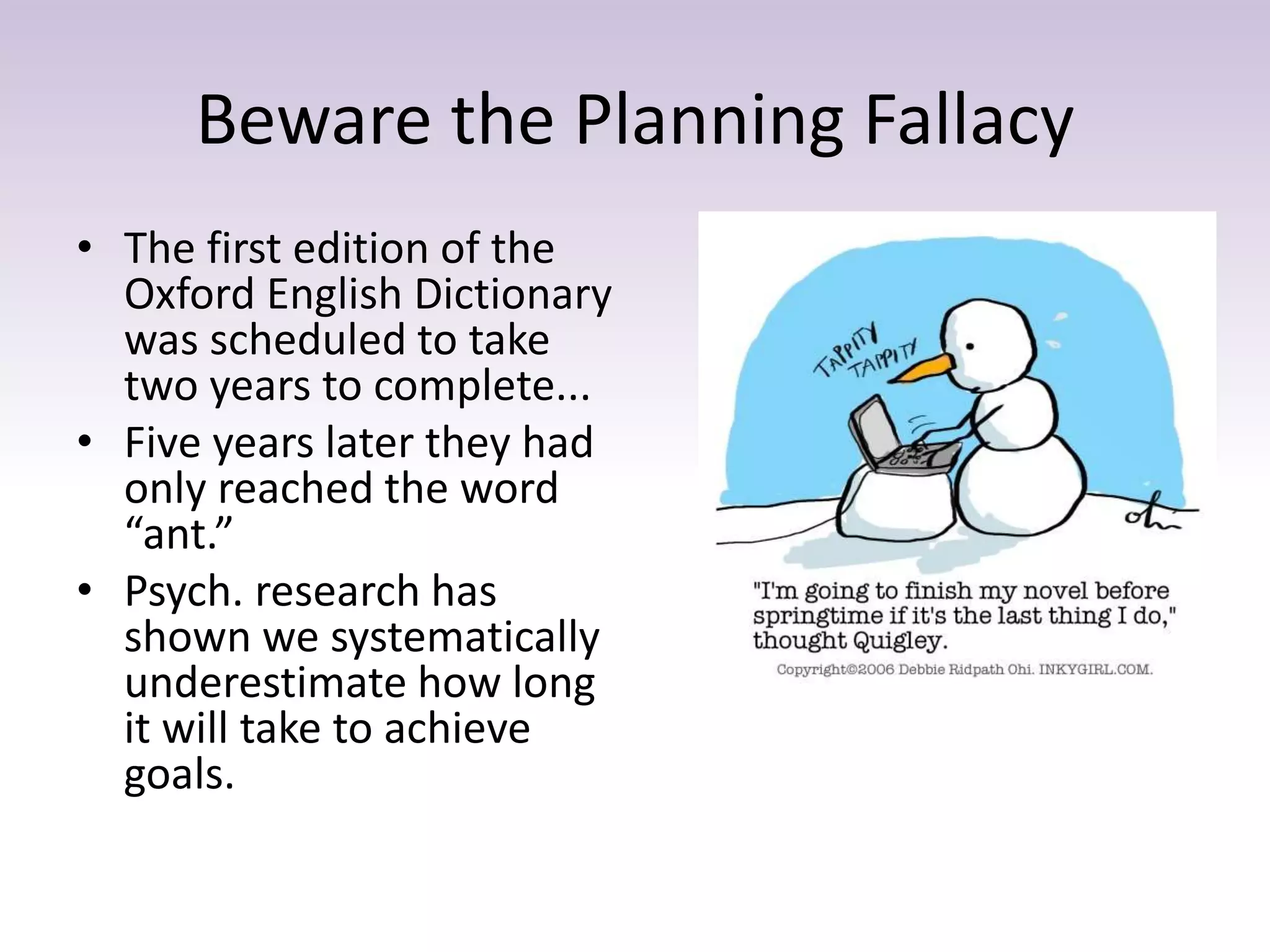
Beware the Planning Fallacy
• The first edition of the
Oxford English Dictionary
was scheduled to take
two years to complete...
• Five years later they had
only reached the word
“ant.”
• Psych. research has
shown we systematically
underestimate how long
it will take to achieve
goals.
Addressing the Planning Fallacy
• Others are more accurate at predicting than
we are ourselves, so ask a colleague for a time
estimate.
• Or:
– Make a prediction now, later see how accurate it
was.
– In the future, multiply your time estimate by your
personal planning fallacy multiple.
Work Analysis
• Milestones
• Planning Fallacy
• Work Breakdown Structure
• Dependencies
• Gantt Chart
Work Breakdown Structure
• Work Breakdown Structure
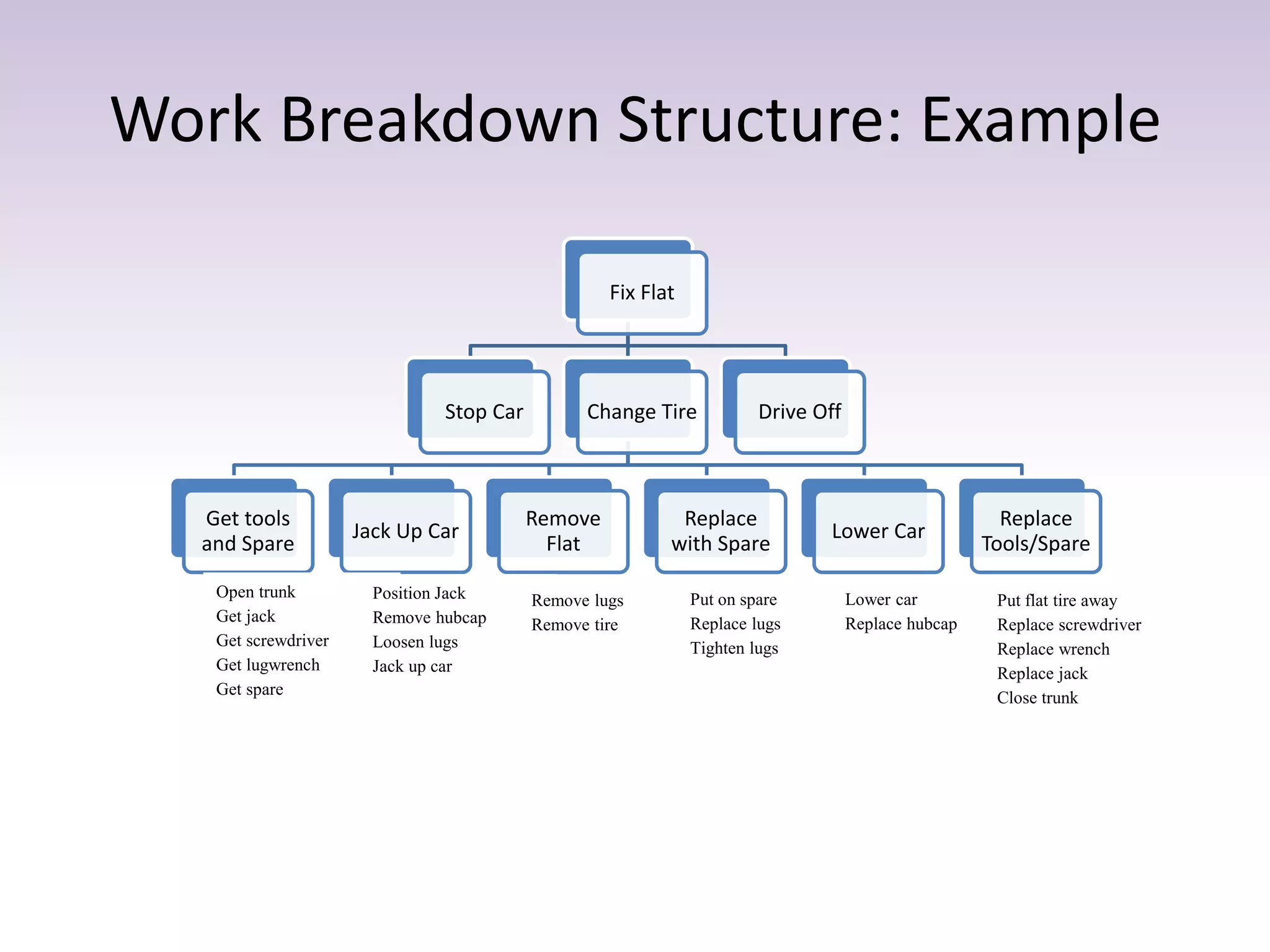
Work Breakdown Structure: Example
Fix Flat
Stop Car Change Tire
Get tools
and Spare
Jack Up Car
Remove
Flat
Replace
with Spare
Lower Car
Replace
Tools/Spare
Drive Off
Open trunk
Get jack
Get screwdriver
Get lugwrench
Get spare
Position Jack
Remove hubcap
Loosen lugs
Jack up car
Remove lugs
Remove tire
Put on spare
Replace lugs
Tighten lugs
Lower car
Replace hubcap
Put flat tire away
Replace screwdriver
Replace wrench
Replace jack
Close trunk
Work Breakdown Structure: Your Turn
• Create a work breakdown structure for your
project.
Work Analysis
• Milestones
• Planning Fallacy
• Work Breakdown Structure
• Dependencies
• Gantt Chart
Dependencies
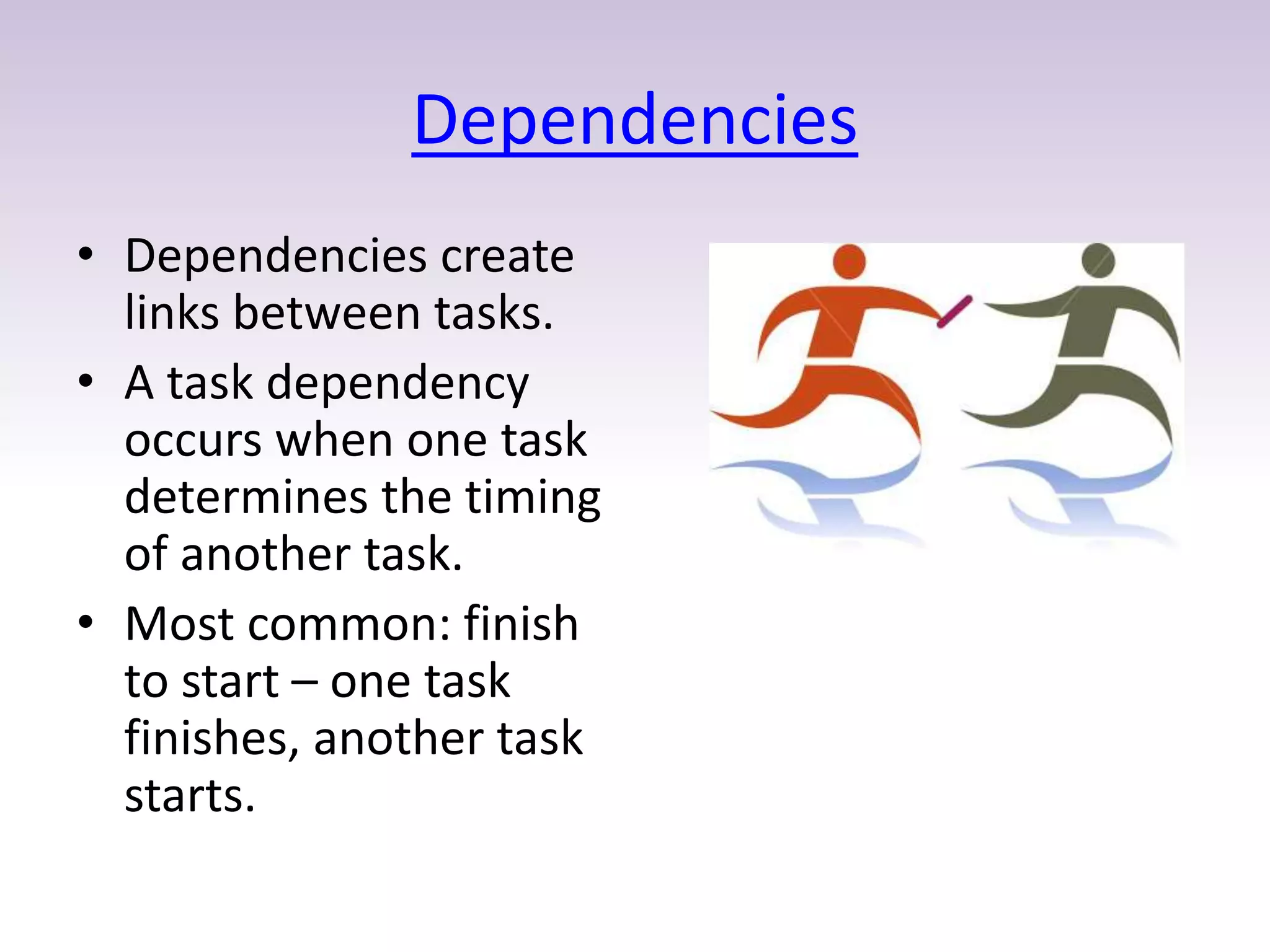
• Dependencies create
links between tasks.
• A task dependency
occurs when one task
determines the timing
of another task.
• Most common: finish
to start – one task
finishes, another task
starts.
Work Analysis
• Milestones
• Planning Fallacy
• Work Breakdown Structure
• Dependencies
• Gantt Chart
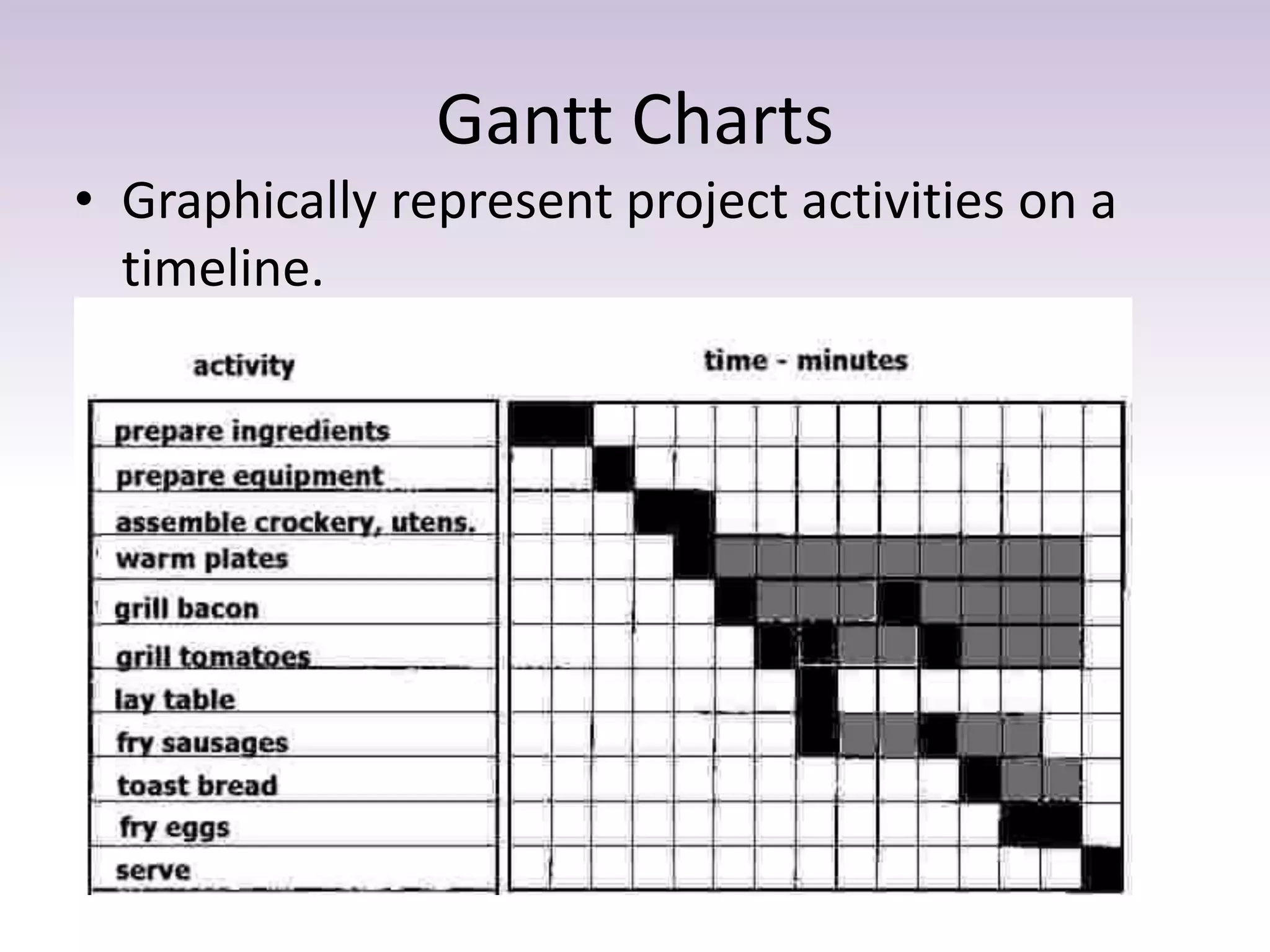
Gantt Charts
• Graphically represent project activities on a
timeline.
Homework 1
• By the end of the day, you’ll receive a link to a
playlist of Project Management tutorials on
Lynda.com.
• Spend at least 30 minutes watching videos
that are most interesting to you.
• Be prepared to share what you learned at the
next session.
Homework 2
– Prepare a document identifying all of the projects
you are involved in, and giving at a minimum:
• The mission of each project
• The deliverables associated with the project
• Milestones associated with the project.
– Discuss the document with your supervisor

OIT Project Management - Day 1

  • 1.
    OIT Project Management Day1 Kevin R. Thomas Manager, Training & Development x3542 Kevin.R.Thomas@williams.edu
  • 2.
    Program Outline: Day1 Planning • Definitions and Success Factors • Project Plans • Stakeholder Management • Work Analysis
  • 3.
    Program Outline Day2: Project Implementation and Closure • Implementation Tools • Interpersonal skills during implementation • Closure: – Post project review – Celebrations
  • 4.
  • 5.
    Definitions • Project: a temporarygroup activity designed to produce a unique product, service or result. • Project Management: the application of knowledge, skills and techniques to execute projects effectively and efficiently.
  • 6.
    Project Successes andDisasters • Pair up • Take turns sharing project disaster stories • What factors led to their failure? • Now share project success stories • What factors led to their success?
  • 7.
    A SIMPLE MODELFOR MANAGING COMPLEX CHANGE Vision a formal statement that expresses the aspirations and goals of a company or organization Skills the ability to do something well, usually gained through training or experience Incentives something that encourages or motivates somebody to do something Resources somebody or something that is a source of help or information Plan a method of doing something that is worked out in advance X Y Y Y Y = Confusion Y X Y Y Y = Anxiety Y Y X Y Y = Gradual Change Y Y Y X Y = Frustration Y Y Y Y X = False Starts Y Y Y Y Y =Change
  • 8.
    Program Outline: Day1 Planning • Definitions and Success Factors • Project Plans • Stakeholder Management • Work Analysis
  • 9.
    Planning • Project Plan –A compelling mission statement – SMART Goals – Assumptions – Risks – Constraints – Deliverables – Milestones
  • 10.
    Project Plan a statementof the scope, objectives, and participants in a project. It provides a preliminary delineation of roles and responsibilities, outlines the project objectives, identifies the main stakeholders, and defines the authority of the project manager.
  • 11.
    Project Plan Components •Mission • Scope/Goals • Assumptions • Risks • Constraints • Deliverables
  • 12.
    Project Mission • Describeswhy the project is being undertaken, and the benefits it hopes to achieve. "If you don't know where you are going, you might wind up someplace else." - Yogi Berra
  • 13.
    Example: Performance Development MissionStatement • Employees need to have: – clear guidance about what is needed for success in their roles, – honest feedback about how they are performing in them, and – concrete plans for professional development. • A structured performance development program can play an essential role in insuring the consistency and quality of this guidance, feedback, and planning.
  • 14.
    Your Turn! • Writea mission statement for your project. • Pair up and share your statement with your partner. • Get feedback on your mission statement from your partner (strengths, opportunities for improvement)
  • 15.
    Project Plan Components •Mission • Scope/Goals • Assumptions • Risks • Constraints • Deliverables
  • 16.
  • 17.
    Project Goals • Goalsare the concrete accomplishments that will accomplish the project’s mission.
  • 18.
    Project Goal Example •"upgrade the helpdesk telephone system by December 31 to achieve average client wait times of no more than two minutes"
  • 19.
    Your Turn! • Writeone of the goals for your project. Make sure it meets all of the SMART criteria. • Pair up with someone else, and share the goal you’ve written. • Get feedback from your partner.
  • 20.
    Project Plan Components •Mission • Scope/Goals • Assumptions • Risks • Constraints • Deliverables
  • 21.
    Assumptions • Project assumptionsare important conditions of the project environment that are considered to be fundamental. Essentially, project assumptions are low probability risks.
  • 22.
    Assumptions: Examples • Currentstaffing levels will continue for the duration of the project. • The project has the full support of the project sponsor. • The legal office will be available to review and assist in finalizing contract language.
  • 23.
    Assumptions: Your Turn •Read the announcement about the Weston Field renovation project. • If you were the project manager, what would you list as assumptions on the project plan?
  • 24.
    Project Plan Components •Mission • Scope/Goals • Assumptions • Risks • Constraints • Deliverables
  • 25.
    Risks • Risk: Anevent that would have significant consequences for the project if it were to occur. • Risk Analysis: The identification, assessment, and prioritization of risks that may impact the project, in order to inform action planning.
  • 26.
    Risk Likelihood andConsequences
  • 27.
    Risks: Example • Obamacare –States may not accept the subsidized expansion of Medicaid that is a key component of guaranteeing universal insurance for all Americans. – States may not create their own health insurance exchanges, greatly increasing the load on the national exchange website.
  • 28.
    Risks: Your Turn •Complete the risk worksheet for your project.
  • 29.
    Project Plan Components •Mission • Scope/Goals • Assumptions • Risks • Constraints • Deliverables
  • 30.
    Constraints • Time • Quality •Cost Some account of all 3 should be in your project plan.
  • 31.
    Constraints: Example • WestonField Time Project must be completed in time for the first football game of 2014. Cost $22 million Quality [inspection requirements]
  • 32.
    Constraints: Your Turn •Using the worksheet, specify what you know about the triple constraint for your project.
  • 33.
    Project Plan Components •Mission • Scope/Goals • Assumptions • Risks • Constraints • Deliverables
  • 34.
    Deliverables • A tangible,measurable, and specific product or service delivered from the project team to a client or project sponsor.
  • 35.
    Deliverables: Examples • Softwarereleases • A program evaluation report on a training program. • Increase profitability of a product by 3% as indicated on the company balance sheet.
  • 36.
    Deliverables: Your Turn •What are the deliverables for your project?
  • 37.
    Program Outline: Day1 Planning • Definitions and Success Factors • Project Plans • Stakeholder Management • Work Analysis
  • 38.
  • 39.
    Stakeholders • Stakeholder: anyonethat has an interest in or will be impacted by the project. • Stakeholders have various degrees of power and influence, attitudes towards the project, hopes and fears, strengths and limitations, etc. • Communication is the key to stakeholder management
  • 40.
    The Project Sponsor:A Key Stakeholder • Ultimately accountable for the project’s success. • Authorizes the resources used for the project • Makes important decisions about the project along the way.
  • 41.
  • 42.
    Stakeholders: Your Turn •Choose a stakeholder for your project and complete the stakeholder analysis.
  • 43.
    RACI Chart • Dividesstakeholders into 4 types: – Responsible: The doers of the project, and especially the project lead. – Accountable: The buck stops here. Often the project sponsor. – Consulted: Stakeholders whose expertise is required or whose needs must be understood. – Informed: Stakeholders who are not directly involved in the project activity, but need to know what is going on.
  • 44.
  • 45.
    RACI Chart: YourTurn • In the left column, fill in the main phases of your project. • In the top row, fill in at least 3 key stakeholders of your project. • Complete the RACI chart.
  • 46.
    Communications Plan • KeyPrinciple: – Take the maximum amount of communication you think is necessary in any situation. – Multiply by 10. – That’s the minimum. • If you’re wondering whether someone might need to know something, they probably do. • Plan how frequently you’ll communicate with each stakeholder.
  • 47.
    Communications Plan: YourTurn • Complete the communications plan worksheet.
  • 48.
    Program Outline: Day1 Planning • Definitions and Success Factors • Project Plans • Stakeholder Management • Work Analysis
  • 49.
  • 50.
    Work Analysis • Milestones •Planning Fallacy • Work Breakdown Structure • Dependencies • Gantt Chart
  • 51.
    Milestones • Mark thecompletion of key phases of the project. • Aid in gauging the timeliness of project completion. • Create an occasion for mini- celebrations
  • 52.
  • 53.
  • 54.
    Milestones: Your Turn •What are the key milestones of your project, and the deadlines associated with them?
  • 55.
    Work Analysis • Milestones •Planning Fallacy • Work Breakdown Structure • Dependencies • Gantt Chart
  • 56.
    Beware the PlanningFallacy • The first edition of the Oxford English Dictionary was scheduled to take two years to complete... • Five years later they had only reached the word “ant.” • Psych. research has shown we systematically underestimate how long it will take to achieve goals.
  • 57.
    Addressing the PlanningFallacy • Others are more accurate at predicting than we are ourselves, so ask a colleague for a time estimate. • Or: – Make a prediction now, later see how accurate it was. – In the future, multiply your time estimate by your personal planning fallacy multiple.
  • 58.
    Work Analysis • Milestones •Planning Fallacy • Work Breakdown Structure • Dependencies • Gantt Chart
  • 59.
    Work Breakdown Structure •Work Breakdown Structure
  • 60.
    Work Breakdown Structure:Example Fix Flat Stop Car Change Tire Get tools and Spare Jack Up Car Remove Flat Replace with Spare Lower Car Replace Tools/Spare Drive Off Open trunk Get jack Get screwdriver Get lugwrench Get spare Position Jack Remove hubcap Loosen lugs Jack up car Remove lugs Remove tire Put on spare Replace lugs Tighten lugs Lower car Replace hubcap Put flat tire away Replace screwdriver Replace wrench Replace jack Close trunk
  • 61.
    Work Breakdown Structure:Your Turn • Create a work breakdown structure for your project.
  • 62.
    Work Analysis • Milestones •Planning Fallacy • Work Breakdown Structure • Dependencies • Gantt Chart
  • 63.
    Dependencies • Dependencies create linksbetween tasks. • A task dependency occurs when one task determines the timing of another task. • Most common: finish to start – one task finishes, another task starts.
  • 64.
    Work Analysis • Milestones •Planning Fallacy • Work Breakdown Structure • Dependencies • Gantt Chart
  • 65.
    Gantt Charts • Graphicallyrepresent project activities on a timeline.
  • 66.
    Homework 1 • Bythe end of the day, you’ll receive a link to a playlist of Project Management tutorials on Lynda.com. • Spend at least 30 minutes watching videos that are most interesting to you. • Be prepared to share what you learned at the next session.
  • 67.
    Homework 2 – Preparea document identifying all of the projects you are involved in, and giving at a minimum: • The mission of each project • The deliverables associated with the project • Milestones associated with the project. – Discuss the document with your supervisor