
Generations in the Workplace 
Kevin R. Thomas 
Manager, Training & Development 
x3542 
kevin.r.thomas@williams.edu
Objectives 
• Learn how workplace attitudes, beliefs and 
behaviors are impacted by when we grew up. 
• Use a generational lens to gain insight into 
interactions: 
– Among staff 
– Between staff and students 
• Discover new choices for working with people 
from different generations. 
• Make generational differences a source of 
strength for the Williams.
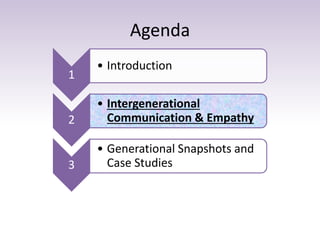
Agenda 
1 
• Introduction 
2 
• Intergenerational 
Communication & Empathy 
3 
• Generational Snapshots and 
Case Studies
Agenda 
1 
• Introduction 
2 
• Intergenerational 
Communication & Empathy 
3 
• Generational Snapshots and 
Case Studies
Disclaimer 
• There are vast differences between people 
we’ll categorize as being part of the same 
generation. 
• Good social science research on this topic is 
hard to come by … blog entries by self-appointed 
“experts” abound.
Generational Differences: 
Why Do They Matter? 
– Things that happen around us when we’re growing up 
make a big difference 
• Example: People brought up during the depression don’t like 
to spend money 
– For centuries, our lives were pretty much the same. 
– Now, dramatic changes are happening to our lives in 
just a few decades. 
• Examples? 
– Four generations are working side by side with each 
other, with very different stories 
– Those differences matter in how we work with each 
other
Agenda 
1 
• Introduction 
2 
• Intergenerational 
Communication & Empathy 
3 
• Generational Snapshots and 
Case Studies
Generational Empathy 
• What value is the person aiming for? 
– Stability or Innovation? 
– Discipline or Flexibility? 
– Live to work or work to live? 
– A wired world or face to face interactions? 
• How can you communicate respect for that 
value? 
• What are your common interests? 
– Getting the job done 
– Service 
– Creating a positive workplace
Facilitating Conversations Across 
Generations 
• Listen and reflect back the value the other 
person is aiming for 
• Everyone contributes to a pool of shared 
meaning 
• Emphasize common ground
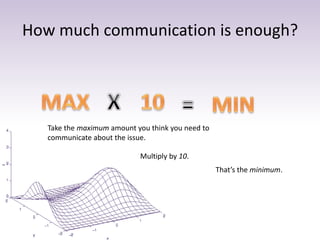
How much communication is enough? 
Take the maximum amount you think you need to 
communicate about the issue. 
Multiply by 10. 
That’s the minimum.
Agenda 
1 
• Introduction 
2 
• Intergenerational 
Communication & Empathy 
3 
• Generational Snapshots and 
Case Studies
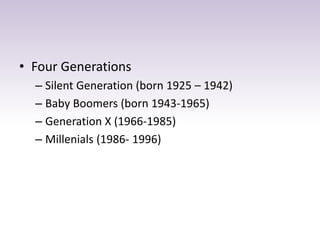
• Four Generations 
– Silent Generation (born 1925 – 1942) 
– Baby Boomers (born 1943-1965) 
– Generation X (1966-1985) 
– Millenials (1986- 1996)
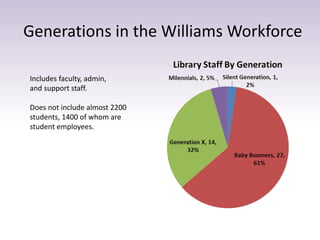
Generations in the Williams Workforce 
Includes faculty, admin, 
and support staff. 
Does not include almost 2200 
students, 1400 of whom are 
student employees.
Millennials 
(1986-1996) 
• Work and life merged with smartphones 
• Self-esteem generation 
• Impatient for recognition and increased 
responsibilities
Famous Millennials 
(1986-1996) 
• Mark Zuckerberg (well, ok, 1984) 
• Malala Yousafszai 
• Kim Kardashian 
• Jessica Simpson 
• Beyonce Knowles 
• Britney Spears 
• Justin Timberlake
Millennials – Memorable Events 
(1986-1996) 
• 2008 Recession and Occupy Wall Street 
• Dawn of Social Media, Telecommuting, 
Paperless Office
Millennial Case Study 
• Read the case study 
• Discuss: 
– What are your immediate reactions to this person? 
• Likes/dislikes 
• Judgments 
– What values might be important to this person? 
– How might they define “a job”? 
– Discuss strategies for interacting with this coworker: 
• If you were their manager 
• If you were their peer 
• If you were their customer
Generation X 
(1966-1985) 
• Latchkey Kids 
• Skeptical, ironic 
• Values freedom and flexibility 
• Comfortable hopping from job to job 
• Values work/life balance 
• Mission driven 
• Breakfast Club, Ferris Bueller’s Day Off
A Few Famous Members of 
Generation X 
(1966-1985) 
• Rand Paul 
• Charlie Sheen 
• Ben Stiller 
• Sarah Jessica Parker 
• Rand Paul 
• Gordon Ramsay 
• Ted Cruz 
• Marco Rubio 
• Winona Ryder and Ethan Hawke
Generation X – Memorable Events 
(1966-1985) 
• Threat of Nuclear Holocaust 
• 9/11 
• Dawn of the Internet 
• .com Boom and Bust
Generation X Case Study 
• Read the case study 
• Discuss: 
– What are your immediate reactions to this person? 
• Likes/dislikes 
• Judgments 
– What values might be important to this person? 
– How might they define “a job”? 
– Discuss strategies for interacting with this coworker: 
• If you were their manager 
• If you were their peer 
• If you were their customer
Baby Boomers 
(born 1943-1965) 
• Largest generational group in the workplace 
• Driven for upward mobility, willing to work 
long hours 
• Less comfortable with advances in tech. 
• Providing care to both parents and children 
• 2008 Financial Crisis postponed retirement for 
many
A Few Famous Baby Boomers 
(born 1943-1965) 
– Steve Jobs 
– Bill & Melinda Gates 
– Sylvester Stallone 
– Bill Clinton 
– Hillary Clinton 
– Condoleeza Rice 
– Ellen DeGeneris 
– Sonia Gandhi 
– Arianna Huffington 
– George W Bush 
– Sonia Sotomayor 
– Elton John 
– Oprah Winfrey
Baby Boomers: Memorable Events 
(born 1943-1965) 
• Baby Boomer cohort #1 (born from 1946 to 1954) 
– Memorable events: assassinations of JFK, Robert Kennedy, and Martin 
Luther King, political unrest, walk on the moon, Vietnam War, anti-war 
protests, social experimentation, sexual freedom, civil rights 
movement, environmental movement, women's movement, protests 
and riots, experimentation with various intoxicating recreational 
substances 
– Key characteristics: experimental, individualism, free spirited, social 
cause oriented 
• Baby Boomer cohort #2 (born from 1955 to 1964) 
– Memorable events: Watergate, Nixon resigns, the cold war, the oil 
embargo, raging inflation, gasoline shortages 
– Key characteristics: less optimistic, distrust of government, general 
cynicism
Baby Boomer Case Study 
• Read the case study 
• Discuss: 
– What are your immediate reactions to this person? 
• Likes/dislikes 
• Judgments 
– What values might be important to this person? 
– How might they define “a job”? 
– Discuss strategies for interacting with this coworker: 
• If you were their manager 
• If you were their peer 
• If you were their customer
Silent Generation 
(born 1925 – 1942) 
• Sometimes called “The Lucky Few” 
• Respect for employers 
• Job security 
• Loyal to employers
A Few Famous Members of the 
Silent Generation 
(born 1925 – 1942) 
• Lenny Bruce 
• Malcolm X 
• Andy Warhol 
• Shirley Temple 
• Warren Buffett 
• Woody Allen 
• Garrison Keillor 
• MLK 
• Churchill 
• Roosevelt
Silent Generation: Memorable Events 
(born 1925 – 1942) 
• Grew up in the shadow of the “Greatest 
Generation” 
• Korean War 
• Cold War 
• Birth control
Silent Generation Case Study 
• Read the case study 
• Discuss: 
– What are your immediate reactions to this person? 
• Likes/dislikes 
• Judgments 
– What values might be important to this person? 
– How might they define “a job”? 
– Discuss strategies for interacting with this coworker: 
• If you were their manager 
• If you were their peer 
• If you were their customer
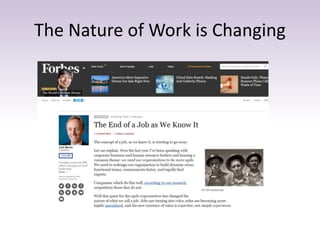
The Nature of Work is Changing
• Program evaluation link will be sent by email. 
• You’ll get a link to a course page with all the materials. 
Kevin R. Thomas 
Manager, Training & Development 
x3542 
Kevin.R.Thomas@williams.edu

Generations in the workplace

  • 1.
    Generations in theWorkplace Kevin R. Thomas Manager, Training & Development x3542 kevin.r.thomas@williams.edu
  • 2.
    Objectives • Learnhow workplace attitudes, beliefs and behaviors are impacted by when we grew up. • Use a generational lens to gain insight into interactions: – Among staff – Between staff and students • Discover new choices for working with people from different generations. • Make generational differences a source of strength for the Williams.
  • 3.
    Agenda 1 •Introduction 2 • Intergenerational Communication & Empathy 3 • Generational Snapshots and Case Studies
  • 4.
    Agenda 1 •Introduction 2 • Intergenerational Communication & Empathy 3 • Generational Snapshots and Case Studies
  • 5.
    Disclaimer • Thereare vast differences between people we’ll categorize as being part of the same generation. • Good social science research on this topic is hard to come by … blog entries by self-appointed “experts” abound.
  • 6.
    Generational Differences: WhyDo They Matter? – Things that happen around us when we’re growing up make a big difference • Example: People brought up during the depression don’t like to spend money – For centuries, our lives were pretty much the same. – Now, dramatic changes are happening to our lives in just a few decades. • Examples? – Four generations are working side by side with each other, with very different stories – Those differences matter in how we work with each other
  • 7.
    Agenda 1 •Introduction 2 • Intergenerational Communication & Empathy 3 • Generational Snapshots and Case Studies
  • 8.
    Generational Empathy •What value is the person aiming for? – Stability or Innovation? – Discipline or Flexibility? – Live to work or work to live? – A wired world or face to face interactions? • How can you communicate respect for that value? • What are your common interests? – Getting the job done – Service – Creating a positive workplace
  • 9.
    Facilitating Conversations Across Generations • Listen and reflect back the value the other person is aiming for • Everyone contributes to a pool of shared meaning • Emphasize common ground
  • 10.
    How much communicationis enough? Take the maximum amount you think you need to communicate about the issue. Multiply by 10. That’s the minimum.
  • 11.
    Agenda 1 •Introduction 2 • Intergenerational Communication & Empathy 3 • Generational Snapshots and Case Studies
  • 12.
    • Four Generations – Silent Generation (born 1925 – 1942) – Baby Boomers (born 1943-1965) – Generation X (1966-1985) – Millenials (1986- 1996)
  • 13.
    Generations in theWilliams Workforce Includes faculty, admin, and support staff. Does not include almost 2200 students, 1400 of whom are student employees.
  • 14.
    Millennials (1986-1996) •Work and life merged with smartphones • Self-esteem generation • Impatient for recognition and increased responsibilities
  • 15.
    Famous Millennials (1986-1996) • Mark Zuckerberg (well, ok, 1984) • Malala Yousafszai • Kim Kardashian • Jessica Simpson • Beyonce Knowles • Britney Spears • Justin Timberlake
  • 16.
    Millennials – MemorableEvents (1986-1996) • 2008 Recession and Occupy Wall Street • Dawn of Social Media, Telecommuting, Paperless Office
  • 17.
    Millennial Case Study • Read the case study • Discuss: – What are your immediate reactions to this person? • Likes/dislikes • Judgments – What values might be important to this person? – How might they define “a job”? – Discuss strategies for interacting with this coworker: • If you were their manager • If you were their peer • If you were their customer
  • 18.
    Generation X (1966-1985) • Latchkey Kids • Skeptical, ironic • Values freedom and flexibility • Comfortable hopping from job to job • Values work/life balance • Mission driven • Breakfast Club, Ferris Bueller’s Day Off
  • 19.
    A Few FamousMembers of Generation X (1966-1985) • Rand Paul • Charlie Sheen • Ben Stiller • Sarah Jessica Parker • Rand Paul • Gordon Ramsay • Ted Cruz • Marco Rubio • Winona Ryder and Ethan Hawke
  • 20.
    Generation X –Memorable Events (1966-1985) • Threat of Nuclear Holocaust • 9/11 • Dawn of the Internet • .com Boom and Bust
  • 21.
    Generation X CaseStudy • Read the case study • Discuss: – What are your immediate reactions to this person? • Likes/dislikes • Judgments – What values might be important to this person? – How might they define “a job”? – Discuss strategies for interacting with this coworker: • If you were their manager • If you were their peer • If you were their customer
  • 22.
    Baby Boomers (born1943-1965) • Largest generational group in the workplace • Driven for upward mobility, willing to work long hours • Less comfortable with advances in tech. • Providing care to both parents and children • 2008 Financial Crisis postponed retirement for many
  • 23.
    A Few FamousBaby Boomers (born 1943-1965) – Steve Jobs – Bill & Melinda Gates – Sylvester Stallone – Bill Clinton – Hillary Clinton – Condoleeza Rice – Ellen DeGeneris – Sonia Gandhi – Arianna Huffington – George W Bush – Sonia Sotomayor – Elton John – Oprah Winfrey
  • 24.
    Baby Boomers: MemorableEvents (born 1943-1965) • Baby Boomer cohort #1 (born from 1946 to 1954) – Memorable events: assassinations of JFK, Robert Kennedy, and Martin Luther King, political unrest, walk on the moon, Vietnam War, anti-war protests, social experimentation, sexual freedom, civil rights movement, environmental movement, women's movement, protests and riots, experimentation with various intoxicating recreational substances – Key characteristics: experimental, individualism, free spirited, social cause oriented • Baby Boomer cohort #2 (born from 1955 to 1964) – Memorable events: Watergate, Nixon resigns, the cold war, the oil embargo, raging inflation, gasoline shortages – Key characteristics: less optimistic, distrust of government, general cynicism
  • 25.
    Baby Boomer CaseStudy • Read the case study • Discuss: – What are your immediate reactions to this person? • Likes/dislikes • Judgments – What values might be important to this person? – How might they define “a job”? – Discuss strategies for interacting with this coworker: • If you were their manager • If you were their peer • If you were their customer
  • 26.
    Silent Generation (born1925 – 1942) • Sometimes called “The Lucky Few” • Respect for employers • Job security • Loyal to employers
  • 27.
    A Few FamousMembers of the Silent Generation (born 1925 – 1942) • Lenny Bruce • Malcolm X • Andy Warhol • Shirley Temple • Warren Buffett • Woody Allen • Garrison Keillor • MLK • Churchill • Roosevelt
  • 28.
    Silent Generation: MemorableEvents (born 1925 – 1942) • Grew up in the shadow of the “Greatest Generation” • Korean War • Cold War • Birth control
  • 29.
    Silent Generation CaseStudy • Read the case study • Discuss: – What are your immediate reactions to this person? • Likes/dislikes • Judgments – What values might be important to this person? – How might they define “a job”? – Discuss strategies for interacting with this coworker: • If you were their manager • If you were their peer • If you were their customer
  • 30.
    The Nature ofWork is Changing
  • 31.
    • Program evaluationlink will be sent by email. • You’ll get a link to a course page with all the materials. Kevin R. Thomas Manager, Training & Development x3542 Kevin.R.Thomas@williams.edu

Editor's Notes

  • #2 http://youtu.be/09q04Dlh7r8