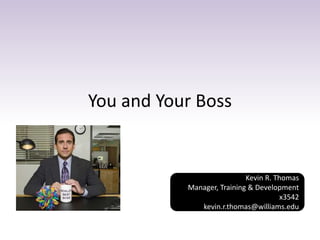
You and Your Boss 
Kevin R. Thomas 
Manager, Training & Development 
x3542 
kevin.r.thomas@williams.edu
Objectives 
• Broaden your range of 
options for working with 
your supervisor, and 
know how to skillfully 
apply them. 
• Develop an action plan 
for improving your 
relationship with your 
supervisor. 
• Learn strategies for 
dealing with typical boss 
issues.
Norms 
• Confidentiality 
• Listening 
• Self-care
Agenda 
1 
• Introduction and Warm Up 
2 
• Improving Your Relationship with Your Boss 
• Research 
• Action Planning 
• Action 
• Evaluation 
3 
• Special Cases
Agenda 
1 
• Introduction and Warm Up 
2 
• Improving Your Relationship with Your Boss 
• Research 
• Action Planning 
• Action 
• Evaluation 
3 
• Special Cases
Key Principles 
• Your boss is always going to be 
your #1 customer. 
• Your boss has more power and 
status than you. 
• Confident, pro-active, assertive 
employees are more valuable to 
bosses than the reverse. 
• You cannot change someone 
else; you can only experiment by 
changing your own behavior. 
• You are responsible for 
protecting your physical and 
emotional health. 
• Help is available.
How much communication is enough? 
Take the maximum amount you think you need to 
communicate about the issue. 
Multiply by 10. 
That’s the minimum.
Warm Up 
• Imagine a new employee asked you for one tip 
about how to work with your boss. What 
would you say?
Agenda 
1 
• Introduction and Warm Up 
2 
• Improving Your Relationship with Your Boss 
• Research 
• Action Planning 
• Action 
• Evaluation 
3 
• Special Cases
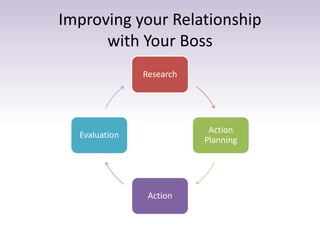
Improving your Relationship 
with Your Boss 
Research 
Action 
Planning 
Action 
Evaluation
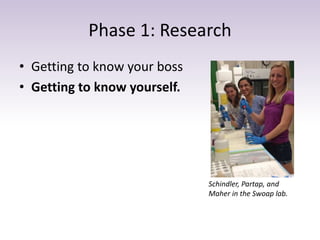
Phase 1: Research 
• Getting to know your boss 
• Getting to know your self. 
Schindler, Partap, and 
Maher in the Swoap lab.
Phase 1: Research 
• Getting to know your boss 
• Getting to know your self. 
Schindler, Partap, and 
Maher in the Swoap lab.
Boss Research Questionnaire 
• You know more than 
you think about your 
boss. 
• Fill out the Boss 
Questionnaire
Listening as Research 
• Increasing Empathy and Trust 
lynda.com, Communication 
Fundamentals, John Ullment 
– Get the person 
– Get their situation 
– Get their path to progress
Listening as Research 
• Minimal Encouragements 
– Non verbal cues that you are listening 
– Verbal cues that you are listening “Oh?”, “Mm hmm”, “Right.” 
etc. 
• Paraphrasing 
• Emotional Labeling 
– I get the sense that you are feeling X. Am I right about that? 
• Mirroring (or Reflecting) 
– Echoing words or phrases 
• Open-ended questions 
• Pauses
Listening As Research 
• When your boss is giving you feedback, you’re 
getting information about them: 
– Their priorities 
– Their values 
– Their emotional state 
– Their attitude towards conflict
Listening as Research 
• I hear you saying X. Am I getting that? 
• Is there more you want to say about that? 
• I hear your frustration/disappointment. I can 
tell this is really important to you, and I want 
to turn it around. 
• What specifically would you like me to do 
differently in the future?
Phase 1: Research 
• Getting to know your boss 
• Getting to know yourself. 
Schindler, Partap, and 
Maher in the Swoap lab.
Getting to Know Yourself 
• Your thoughts and feelings 
about your boss give you 
information about you, not 
your boss: 
– Strong emotions 
– Judgments 
– Imaginary conversations
The Identity Conversation 
• This conversation 
happens inside you: 
– Am I competent? 
– Am I a good or worthy 
person? 
– Am I acceptable or 
likable? 
• Other people may trigger 
this conversation inside 
us, but it is between us 
and us.
Change Your Questions, 
Change Your Life
Listening Exercise 
• Pair Up 
• Remember Norms: Confidentiality and Self-Care 
• Take turns describing your relationship with your 
boss 
• Listener: Practice listening skills. Avoid giving 
advice. 
• Speaker: Be aware that you are describing the 
world of your own perceptions. Are you on the 
learner or the judger path?
Improving your Relationship 
with Your Boss 
Research 
Action 
Planning 
Action 
Evaluation
Action Planning 
• Change involves risk 
• Adopt an 
experimental attitude 
• Reward yourself 
before and after 
trying a new behavior 
• Process your 
emotions
Action Menu 
• Use positive feedback 
• Create a Learning 
Conversation 
• Make a request 
• Offer feedback 
• Set a boundary
Action Menu 
• Use positive feedback 
• Create a Learning 
Conversation 
• Make a request 
• Offer feedback 
• Set a boundary
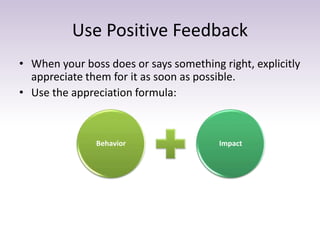
Use Positive Feedback 
• When your boss does or says something right, explicitly 
appreciate them for it as soon as possible. 
• Use the appreciation formula: 
Behavior Impact
Use Positive Feedback 
• Example: 
– “Thanks a lot for sending us the agenda before the 
meeting. Because I had it in advance, I was able 
to do some research to prepare. As a result I think 
our meeting was very effective and we were able 
to make some good decisions together.”
Action Menu 
• Use positive feedback 
• Create a Learning 
Conversation 
• Make a request 
• Offer feedback 
• Set a boundary
Create a Learning Conversation 
– Goal: 
• To share your perspective and learn about the other 
person’s perspective 
• Map the contribution system 
• Share the facts as you know them 
• Share the feelings you have, without blame or apology 
• http://seemeaning.ca/sites/default/files/A%20Learning 
%20Conversation.jpg 
• Save solutions until you’ve thoroughly explored both 
sides
Create a Learning Conversation 
• Example: 
– “I’d like to talk to you about X. I’d like to share my 
perspective and I’d be interested in hearing your 
perspective. Would you be open to setting aside 
some time for that?”
Action Menu 
• Use positive feedback 
• Create a Learning 
Conversation 
• Make a request 
• Offer feedback 
• Set a boundary
Making a Request 
• Understand from the beginning the answer 
may be “no”. Are there alternatives that 
would work just as well? What will you do if 
you can’t reach agreement? 
• Lay out relevant facts that support your 
request. 
• Make the request explictly: Show the 
connection between your request and your 
boss’s goals.
Making a Request 
• Example: 
– “In the last 6 months my job duties have 
expanded considerably and I’ve made some really 
valuable contributions like x and y. I’d like you to 
consider giving me a raise. This 
acknowledgement of my extra responsibilities 
would remove a distraction for me and make me 
even more enthusiastic for our work together.”
Action Menu 
• Use positive feedback 
• Create a Learning 
Conversation 
• Make a request 
• Offer feedback 
• Set a boundary
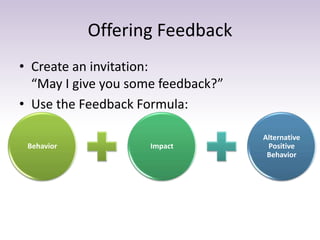
• Create an invitation: 
“May I give you some feedback?” 
• Use the Feedback Formula: 
Behavior Impact 
Alternative 
Positive 
Behavior 
Offering Feedback
Offering Feedback 
• Example: 
– “I’ve noticed that you’ve canceled 3 out of our last 
4 regularly scheduled meetings. As a result I 
haven’t been able to get your input on some key 
projects. I’m concerned that as a result we are 
falling behind. I’d like it if you could find a way to 
keep those appointments so that I can make more 
progress on the projects you’ve assigned me.”
Action Menu 
• Use positive feedback 
• Create a Learning 
Conversation 
• Make a request 
• Offer feedback 
• Set a boundary
Setting a Boundary 
• Demonstrate you understand the boss’s point 
of view. 
• Spell out the context (your values, college 
policies, your job description, etc.) 
• Describe the boundary 
• Adopt a problem solving orientation
Setting a Boundary 
• Example: 
– “I understand that assigning me personal errands 
like picking up your dry cleaning helps you to 
focus on work tasks that are more important to 
you. However, it’s important that my work for you 
be focused on work for the college as described in 
my job description, and I don’t feel comfortable 
using my own car for errands like this. Are there 
other ways that I could help you so that you have 
more time to do your important work?”
WOOP It Up 
Wish, Outcome, Obstacle, Plan 
• Wish – What you hope will come from this 
session. 
• Outcome – the best outcome you can imagine 
for your meetings 
• Obstacle – what might get in the way? 
• Plan – make a plan to make it happen
Improving your Relationship 
with Your Boss 
Research 
Action 
Planning 
Action 
Evaluation
Implementation 
“In theory there’s no difference between theory 
and practice. In practice, there is.” 
-Yogi Beara
Improving your Relationship 
with Your Boss 
Research 
Action 
Planning 
Action 
Evaluation
Evaluation 
• After every big step, take some time to reflect: 
– By writing in your journal 
– Talking with someone you trust: 
• Friend 
• Colleague 
• Family member
After Action Review 
• What were you goals? Did you accomplish 
them? 
• What emotions came up? 
• What are you most proud of? 
• What would you do differently? 
• What did you learn?
Agenda 
1 
• Introduction and Warm Up 
2 
• Improving Your Relationship with Your Boss 
• Research 
• Action Planning 
• Action 
• Evaluation 
3 
• Special Cases
Special Cases 
• Unavailable Manager 
• Manager You’ll Never Like 
• Self-important Manager 
• Less competent manager 
• Mean or inappropriate manager
Help is at Hand 
• Human Resources x2681 
• EAP, LifeScope where there’s more to life 
http://www.lifescopeEAP.com 
Username: williams college 
Password: guest 
• Harassment and Discrimination Advisors: 
http://diversity.williams.edu/discrimination-harassment/sexual-harassment- 
discrimintation-advisors/ 
• Campus Safety and Security x4444
• Program evaluation link will be sent by email. 
• You’ll get a link to a course page with all the materials. 
Kevin R. Thomas 
Manager, Training & Development 
x3542 
Kevin.R.Thomas@williams.edu

You and Your Boss

  • 1.
    You and YourBoss Kevin R. Thomas Manager, Training & Development x3542 kevin.r.thomas@williams.edu
  • 2.
    Objectives • Broadenyour range of options for working with your supervisor, and know how to skillfully apply them. • Develop an action plan for improving your relationship with your supervisor. • Learn strategies for dealing with typical boss issues.
  • 3.
    Norms • Confidentiality • Listening • Self-care
  • 4.
    Agenda 1 •Introduction and Warm Up 2 • Improving Your Relationship with Your Boss • Research • Action Planning • Action • Evaluation 3 • Special Cases
  • 5.
    Agenda 1 •Introduction and Warm Up 2 • Improving Your Relationship with Your Boss • Research • Action Planning • Action • Evaluation 3 • Special Cases
  • 6.
    Key Principles •Your boss is always going to be your #1 customer. • Your boss has more power and status than you. • Confident, pro-active, assertive employees are more valuable to bosses than the reverse. • You cannot change someone else; you can only experiment by changing your own behavior. • You are responsible for protecting your physical and emotional health. • Help is available.
  • 7.
    How much communicationis enough? Take the maximum amount you think you need to communicate about the issue. Multiply by 10. That’s the minimum.
  • 8.
    Warm Up •Imagine a new employee asked you for one tip about how to work with your boss. What would you say?
  • 9.
    Agenda 1 •Introduction and Warm Up 2 • Improving Your Relationship with Your Boss • Research • Action Planning • Action • Evaluation 3 • Special Cases
  • 10.
    Improving your Relationship with Your Boss Research Action Planning Action Evaluation
  • 11.
    Phase 1: Research • Getting to know your boss • Getting to know your self. Schindler, Partap, and Maher in the Swoap lab.
  • 12.
    Phase 1: Research • Getting to know your boss • Getting to know your self. Schindler, Partap, and Maher in the Swoap lab.
  • 13.
    Boss Research Questionnaire • You know more than you think about your boss. • Fill out the Boss Questionnaire
  • 14.
    Listening as Research • Increasing Empathy and Trust lynda.com, Communication Fundamentals, John Ullment – Get the person – Get their situation – Get their path to progress
  • 15.
    Listening as Research • Minimal Encouragements – Non verbal cues that you are listening – Verbal cues that you are listening “Oh?”, “Mm hmm”, “Right.” etc. • Paraphrasing • Emotional Labeling – I get the sense that you are feeling X. Am I right about that? • Mirroring (or Reflecting) – Echoing words or phrases • Open-ended questions • Pauses
  • 16.
    Listening As Research • When your boss is giving you feedback, you’re getting information about them: – Their priorities – Their values – Their emotional state – Their attitude towards conflict
  • 17.
    Listening as Research • I hear you saying X. Am I getting that? • Is there more you want to say about that? • I hear your frustration/disappointment. I can tell this is really important to you, and I want to turn it around. • What specifically would you like me to do differently in the future?
  • 18.
    Phase 1: Research • Getting to know your boss • Getting to know yourself. Schindler, Partap, and Maher in the Swoap lab.
  • 19.
    Getting to KnowYourself • Your thoughts and feelings about your boss give you information about you, not your boss: – Strong emotions – Judgments – Imaginary conversations
  • 20.
    The Identity Conversation • This conversation happens inside you: – Am I competent? – Am I a good or worthy person? – Am I acceptable or likable? • Other people may trigger this conversation inside us, but it is between us and us.
  • 21.
    Change Your Questions, Change Your Life
  • 22.
    Listening Exercise •Pair Up • Remember Norms: Confidentiality and Self-Care • Take turns describing your relationship with your boss • Listener: Practice listening skills. Avoid giving advice. • Speaker: Be aware that you are describing the world of your own perceptions. Are you on the learner or the judger path?
  • 23.
    Improving your Relationship with Your Boss Research Action Planning Action Evaluation
  • 24.
    Action Planning •Change involves risk • Adopt an experimental attitude • Reward yourself before and after trying a new behavior • Process your emotions
  • 25.
    Action Menu •Use positive feedback • Create a Learning Conversation • Make a request • Offer feedback • Set a boundary
  • 26.
    Action Menu •Use positive feedback • Create a Learning Conversation • Make a request • Offer feedback • Set a boundary
  • 27.
    Use Positive Feedback • When your boss does or says something right, explicitly appreciate them for it as soon as possible. • Use the appreciation formula: Behavior Impact
  • 28.
    Use Positive Feedback • Example: – “Thanks a lot for sending us the agenda before the meeting. Because I had it in advance, I was able to do some research to prepare. As a result I think our meeting was very effective and we were able to make some good decisions together.”
  • 29.
    Action Menu •Use positive feedback • Create a Learning Conversation • Make a request • Offer feedback • Set a boundary
  • 30.
    Create a LearningConversation – Goal: • To share your perspective and learn about the other person’s perspective • Map the contribution system • Share the facts as you know them • Share the feelings you have, without blame or apology • http://seemeaning.ca/sites/default/files/A%20Learning %20Conversation.jpg • Save solutions until you’ve thoroughly explored both sides
  • 31.
    Create a LearningConversation • Example: – “I’d like to talk to you about X. I’d like to share my perspective and I’d be interested in hearing your perspective. Would you be open to setting aside some time for that?”
  • 32.
    Action Menu •Use positive feedback • Create a Learning Conversation • Make a request • Offer feedback • Set a boundary
  • 33.
    Making a Request • Understand from the beginning the answer may be “no”. Are there alternatives that would work just as well? What will you do if you can’t reach agreement? • Lay out relevant facts that support your request. • Make the request explictly: Show the connection between your request and your boss’s goals.
  • 34.
    Making a Request • Example: – “In the last 6 months my job duties have expanded considerably and I’ve made some really valuable contributions like x and y. I’d like you to consider giving me a raise. This acknowledgement of my extra responsibilities would remove a distraction for me and make me even more enthusiastic for our work together.”
  • 35.
    Action Menu •Use positive feedback • Create a Learning Conversation • Make a request • Offer feedback • Set a boundary
  • 36.
    • Create aninvitation: “May I give you some feedback?” • Use the Feedback Formula: Behavior Impact Alternative Positive Behavior Offering Feedback
  • 37.
    Offering Feedback •Example: – “I’ve noticed that you’ve canceled 3 out of our last 4 regularly scheduled meetings. As a result I haven’t been able to get your input on some key projects. I’m concerned that as a result we are falling behind. I’d like it if you could find a way to keep those appointments so that I can make more progress on the projects you’ve assigned me.”
  • 38.
    Action Menu •Use positive feedback • Create a Learning Conversation • Make a request • Offer feedback • Set a boundary
  • 39.
    Setting a Boundary • Demonstrate you understand the boss’s point of view. • Spell out the context (your values, college policies, your job description, etc.) • Describe the boundary • Adopt a problem solving orientation
  • 40.
    Setting a Boundary • Example: – “I understand that assigning me personal errands like picking up your dry cleaning helps you to focus on work tasks that are more important to you. However, it’s important that my work for you be focused on work for the college as described in my job description, and I don’t feel comfortable using my own car for errands like this. Are there other ways that I could help you so that you have more time to do your important work?”
  • 41.
    WOOP It Up Wish, Outcome, Obstacle, Plan • Wish – What you hope will come from this session. • Outcome – the best outcome you can imagine for your meetings • Obstacle – what might get in the way? • Plan – make a plan to make it happen
  • 42.
    Improving your Relationship with Your Boss Research Action Planning Action Evaluation
  • 43.
    Implementation “In theorythere’s no difference between theory and practice. In practice, there is.” -Yogi Beara
  • 44.
    Improving your Relationship with Your Boss Research Action Planning Action Evaluation
  • 45.
    Evaluation • Afterevery big step, take some time to reflect: – By writing in your journal – Talking with someone you trust: • Friend • Colleague • Family member
  • 46.
    After Action Review • What were you goals? Did you accomplish them? • What emotions came up? • What are you most proud of? • What would you do differently? • What did you learn?
  • 47.
    Agenda 1 •Introduction and Warm Up 2 • Improving Your Relationship with Your Boss • Research • Action Planning • Action • Evaluation 3 • Special Cases
  • 48.
    Special Cases •Unavailable Manager • Manager You’ll Never Like • Self-important Manager • Less competent manager • Mean or inappropriate manager
  • 49.
    Help is atHand • Human Resources x2681 • EAP, LifeScope where there’s more to life http://www.lifescopeEAP.com Username: williams college Password: guest • Harassment and Discrimination Advisors: http://diversity.williams.edu/discrimination-harassment/sexual-harassment- discrimintation-advisors/ • Campus Safety and Security x4444
  • 50.
    • Program evaluationlink will be sent by email. • You’ll get a link to a course page with all the materials. Kevin R. Thomas Manager, Training & Development x3542 Kevin.R.Thomas@williams.edu

Editor's Notes

  • #18 http://www.lynda.com/Business-Business-Skills-tutorials/Responding-feedback/157140/178306-4.html
  • #22 http://www.youtube.com/watch?v=NIvGonLyRCM