Project Management Briefing
Background BSME, Masters Organizational Development, PMP Quality improvement instructor  Adjunct professor at Keller and Franklin 20 years industry experience in PM Customer facing Internal customers Director – Applications Delivery Progressive Medical Organizer – Central Ohio PMO leaders forum
Agenda Introductions/expectations PM101 What is a project and project management? Roles and responsibilities The project process Teamwork Communication Managing Expectations Key Decision Points The Change Equation Feedback Survey Data Analysis and action planning
Introductions/expectations What do you want to get out of today? Quick survey
What is a project ? Temporary endeavor undertaken to create a unique product or service Carried out by people to meet a specific objective  Schedule, resources, scope/quality
Objectives of a Project 3 Project Objectives: Performance Time Cost Expectations of clients are not an additional target,  but an inherent part of the project specifications
The Definition of a “Project” Must make a distinction between terms: Program  - an exceptionally large, long-range objective that is broken down into a set of projects Task  - set of activities comprising a project Work Packages  - division of tasks Work Units  - division of work packages In the broadest sense, a project is a specific, finite task to be accomplished
Characteristics of a Project Have a purpose Have a life cycle Interdependencies Uniqueness Conflict
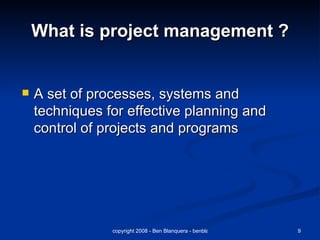
What is project management ? A set of processes, systems and techniques for effective planning and control of projects and programs
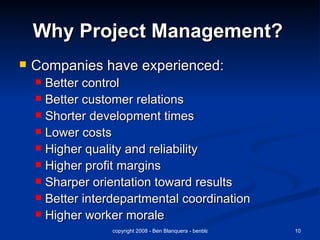
Why Project Management?   Companies have experienced: Better control Better customer relations Shorter development times Lower costs Higher quality and reliability Higher profit margins Sharper orientation toward results Better interdepartmental coordination Higher worker morale
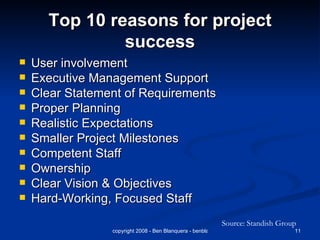
Top 10 reasons for project success User involvement Executive Management Support  Clear Statement of Requirements  Proper Planning  Realistic Expectations  Smaller Project Milestones  Competent Staff  Ownership  Clear Vision & Objectives  Hard-Working, Focused Staff  Source: Standish Group
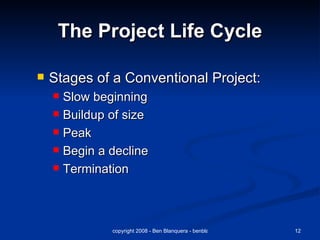
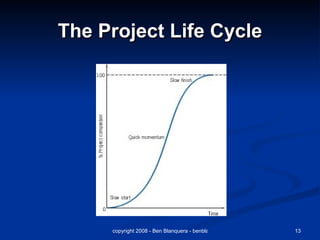
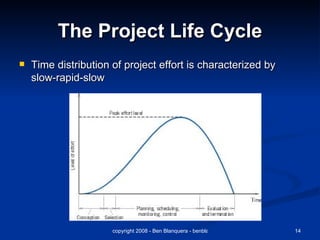
The Project Life Cycle Stages of a Conventional Project: Slow beginning Buildup of size Peak Begin a decline Termination
The Project Life Cycle
The Project Life Cycle Time distribution of project effort is characterized by slow-rapid-slow
The Project Life Cycle Risk during project life cycle With most projects there is some uncertainty about the ability to meet project goals Uncertainty of outcome is greatest at the start of a project Uncertainty decreases as the project moves toward completion
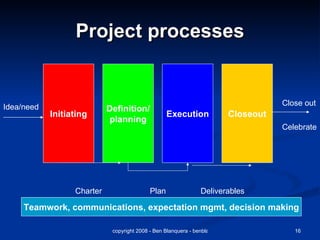
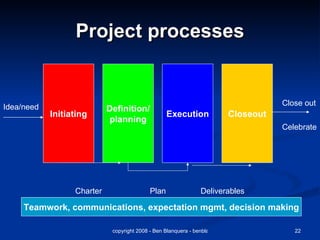
Project processes Initiating Definition/ planning Execution Closeout Idea/need Close out Celebrate Charter Plan Deliverables Teamwork, communications, expectation mgmt, decision making
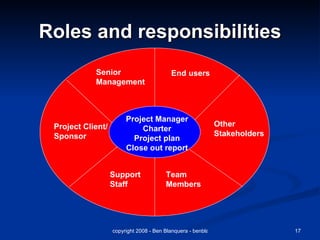
Roles and responsibilities Project Manager Charter Project plan Close out report Senior Management Team  Members Other Stakeholders End users Project Client/ Sponsor Support Staff
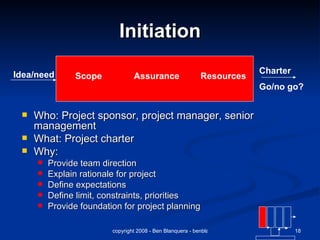
Initiation Who: Project sponsor, project manager, senior management What: Project charter Why: Provide team direction Explain rationale for project Define expectations Define limit, constraints, priorities Provide foundation for project planning Assurance Resources Scope Idea/need Charter Go/no go?
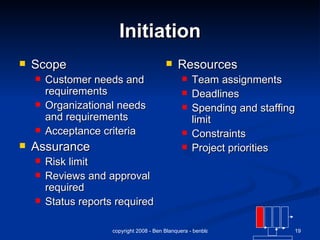
Initiation Scope Customer needs and requirements Organizational needs and requirements Acceptance criteria Assurance Risk limit Reviews and approval required Status reports required Resources Team assignments Deadlines Spending and staffing limit Constraints Project priorities
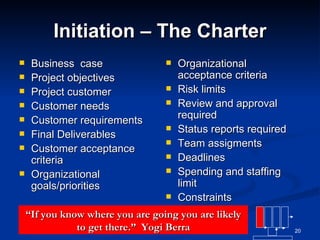
Initiation – The Charter Business  case Project objectives Project customer Customer needs Customer requirements Final Deliverables Customer acceptance criteria Organizational goals/priorities Organizational acceptance criteria Risk limits Review and approval required Status reports required Team assigments Deadlines Spending and staffing limit Constraints “ If you know where you are going you are likely to get there.”  Yogi Berra
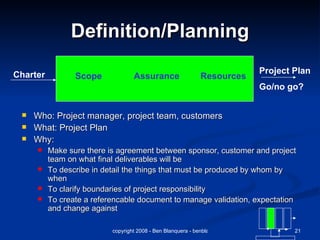
Definition/Planning Who: Project manager, project team, customers What: Project Plan Why: Make sure there is agreement between sponsor, customer and project team on what final deliverables will be To describe in detail the things that must be produced by whom by when To clarify boundaries of project responsibility To create a referencable document to manage validation, expectation and change against Assurance Resources Scope Charter Project Plan Go/no go?
Project processes Initiating Definition/ planning Execution Closeout Idea/need Close out Celebrate Charter Plan Deliverables Teamwork, communications, expectation mgmt, decision making
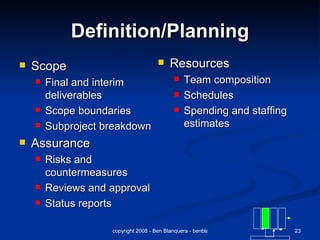
Definition/Planning Scope Final and interim deliverables Scope boundaries Subproject breakdown Assurance Risks and countermeasures Reviews and approval  Status reports  Resources Team composition Schedules Spending and staffing estimates
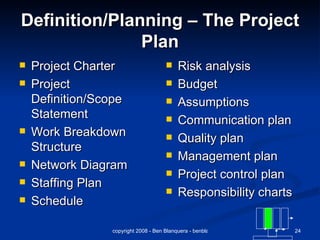
Definition/Planning – The Project Plan Project Charter Project Definition/Scope Statement Work Breakdown Structure Network Diagram Staffing Plan Schedule Risk analysis  Budget Assumptions Communication plan Quality plan Management plan Project control plan Responsibility charts
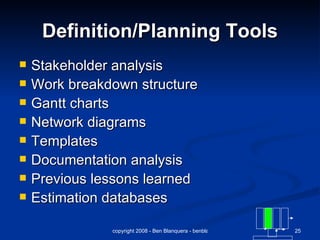
Definition/Planning Tools Stakeholder analysis Work breakdown structure Gantt charts Network diagrams Templates Documentation analysis Previous lessons learned Estimation databases
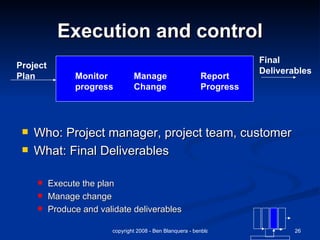
Execution and control Who: Project manager, project team, customer What: Final Deliverables  Execute the plan Manage change Produce and validate deliverables Manage Change Report Progress Monitor  progress Project  Plan Final  Deliverables
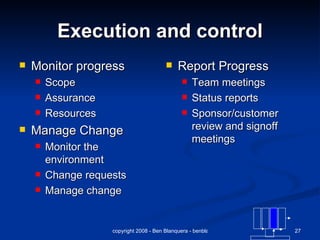
Execution and control Monitor progress Scope Assurance Resources Manage Change Monitor the environment Change requests  Manage change Report Progress Team meetings Status reports Sponsor/customer review and signoff meetings
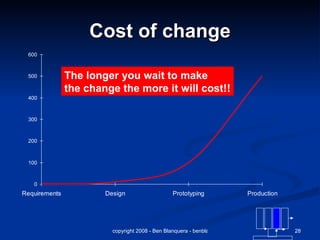
Cost of change The longer you wait to make  the change the more it will cost!!
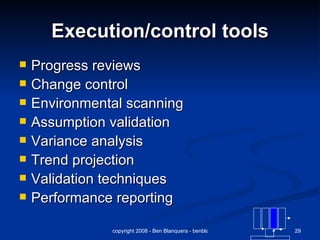
Execution/control tools Progress reviews Change control Environmental scanning  Assumption validation Variance analysis Trend projection Validation techniques Performance reporting
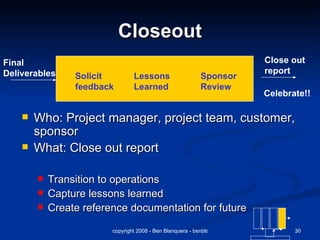
Closeout Who: Project manager, project team, customer, sponsor What: Close out report  Transition to operations Capture lessons learned Create reference documentation for future Lessons   Learned Sponsor Review Solicit   feedback Close out report Final  Deliverables Celebrate!!
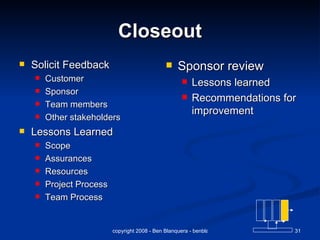
Closeout Solicit Feedback Customer Sponsor Team members Other stakeholders Lessons Learned Scope Assurances  Resources Project Process Team Process Sponsor review Lessons learned Recommendations for improvement
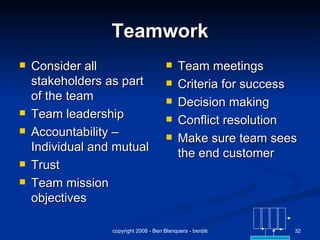
Teamwork Consider all stakeholders as part of the team Team leadership Accountability – Individual and mutual Trust Team mission objectives Team meetings Criteria for success Decision making Conflict resolution Make sure team sees the end customer
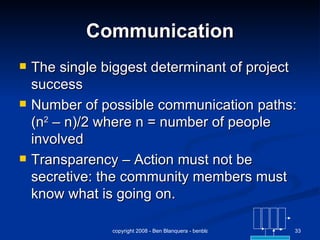
Communication The single biggest determinant of project success Number of possible communication paths: (n 2  – n)/2 where n = number of people involved Transparency – Action must not be secretive: the community members must know what is going on.
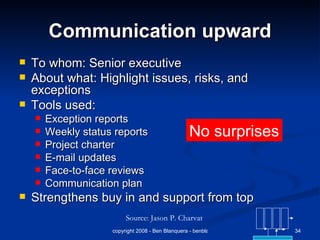
Communication upward To whom: Senior executive About what: Highlight issues, risks, and exceptions Tools used: Exception reports Weekly status reports Project charter E-mail updates Face-to-face reviews Communication plan Strengthens buy in and support from top Source: Jason P. Charvat No surprises
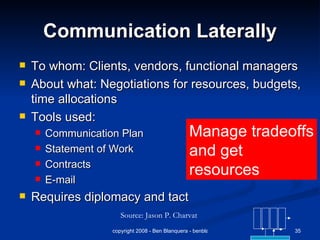
Communication Laterally To whom: Clients, vendors, functional managers About what: Negotiations for resources, budgets, time allocations Tools used: Communication Plan Statement of Work Contracts E-mail Requires diplomacy and tact  Source: Jason P. Charvat Manage tradeoffs and get  resources
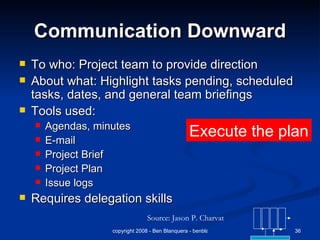
Communication Downward To who: Project team to provide direction About what: Highlight tasks pending, scheduled tasks, dates, and general team briefings Tools used: Agendas, minutes E-mail Project Brief Project Plan Issue logs Requires delegation skills Source: Jason P. Charvat Execute the plan
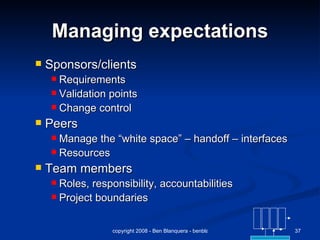
Managing expectations Sponsors/clients  Requirements Validation points Change control Peers Manage the “white space” – handoff – interfaces Resources Team members Roles, responsibility, accountabilities Project boundaries
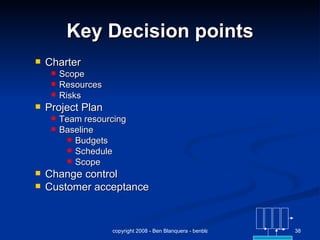
Key Decision points Charter Scope Resources Risks Project Plan Team resourcing Baseline Budgets Schedule Scope Change control Customer acceptance
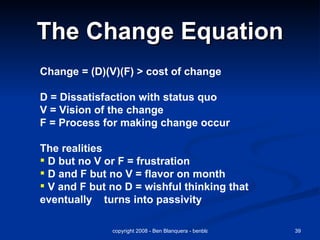
The Change Equation Change = (D)(V)(F) > cost of change D = Dissatisfaction with status quo V = Vision of the change F = Process for making change occur The realities D but no V or F = frustration D and F but no V = flavor on month V and F but no D = wishful thinking that eventually  turns into passivity
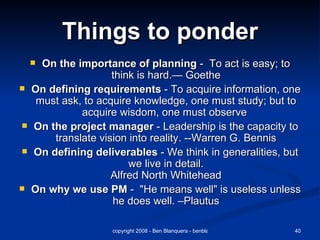
Things to ponder On the importance of planning  -  To act is easy; to think is hard.— Goethe On defining requirements  - To acquire information, one must ask, to acquire knowledge, one must study; but to acquire wisdom, one must observe  On the project manager  - Leadership is the capacity to translate vision into reality. --Warren G. Bennis On defining deliverables  - We think in generalities, but we live in detail. Alfred North Whitehead On why we use PM  -  "He means well" is useless unless he does well. –Plautus
Thank you

Project Management 101 Briefing

  • 1.
  • 2.
    Background BSME, MastersOrganizational Development, PMP Quality improvement instructor Adjunct professor at Keller and Franklin 20 years industry experience in PM Customer facing Internal customers Director – Applications Delivery Progressive Medical Organizer – Central Ohio PMO leaders forum
  • 3.
    Agenda Introductions/expectations PM101What is a project and project management? Roles and responsibilities The project process Teamwork Communication Managing Expectations Key Decision Points The Change Equation Feedback Survey Data Analysis and action planning
  • 4.
    Introductions/expectations What doyou want to get out of today? Quick survey
  • 5.
    What is aproject ? Temporary endeavor undertaken to create a unique product or service Carried out by people to meet a specific objective Schedule, resources, scope/quality
  • 6.
    Objectives of aProject 3 Project Objectives: Performance Time Cost Expectations of clients are not an additional target, but an inherent part of the project specifications
  • 7.
    The Definition ofa “Project” Must make a distinction between terms: Program - an exceptionally large, long-range objective that is broken down into a set of projects Task - set of activities comprising a project Work Packages - division of tasks Work Units - division of work packages In the broadest sense, a project is a specific, finite task to be accomplished
  • 8.
    Characteristics of aProject Have a purpose Have a life cycle Interdependencies Uniqueness Conflict
  • 9.
    What is projectmanagement ? A set of processes, systems and techniques for effective planning and control of projects and programs
  • 10.
    Why Project Management? Companies have experienced: Better control Better customer relations Shorter development times Lower costs Higher quality and reliability Higher profit margins Sharper orientation toward results Better interdepartmental coordination Higher worker morale
  • 11.
    Top 10 reasonsfor project success User involvement Executive Management Support Clear Statement of Requirements Proper Planning Realistic Expectations Smaller Project Milestones Competent Staff Ownership Clear Vision & Objectives Hard-Working, Focused Staff Source: Standish Group
  • 12.
    The Project LifeCycle Stages of a Conventional Project: Slow beginning Buildup of size Peak Begin a decline Termination
  • 13.
  • 14.
    The Project LifeCycle Time distribution of project effort is characterized by slow-rapid-slow
  • 15.
    The Project LifeCycle Risk during project life cycle With most projects there is some uncertainty about the ability to meet project goals Uncertainty of outcome is greatest at the start of a project Uncertainty decreases as the project moves toward completion
  • 16.
    Project processes InitiatingDefinition/ planning Execution Closeout Idea/need Close out Celebrate Charter Plan Deliverables Teamwork, communications, expectation mgmt, decision making
  • 17.
    Roles and responsibilitiesProject Manager Charter Project plan Close out report Senior Management Team Members Other Stakeholders End users Project Client/ Sponsor Support Staff
  • 18.
    Initiation Who: Projectsponsor, project manager, senior management What: Project charter Why: Provide team direction Explain rationale for project Define expectations Define limit, constraints, priorities Provide foundation for project planning Assurance Resources Scope Idea/need Charter Go/no go?
  • 19.
    Initiation Scope Customerneeds and requirements Organizational needs and requirements Acceptance criteria Assurance Risk limit Reviews and approval required Status reports required Resources Team assignments Deadlines Spending and staffing limit Constraints Project priorities
  • 20.
    Initiation – TheCharter Business case Project objectives Project customer Customer needs Customer requirements Final Deliverables Customer acceptance criteria Organizational goals/priorities Organizational acceptance criteria Risk limits Review and approval required Status reports required Team assigments Deadlines Spending and staffing limit Constraints “ If you know where you are going you are likely to get there.” Yogi Berra
  • 21.
    Definition/Planning Who: Projectmanager, project team, customers What: Project Plan Why: Make sure there is agreement between sponsor, customer and project team on what final deliverables will be To describe in detail the things that must be produced by whom by when To clarify boundaries of project responsibility To create a referencable document to manage validation, expectation and change against Assurance Resources Scope Charter Project Plan Go/no go?
  • 22.
    Project processes InitiatingDefinition/ planning Execution Closeout Idea/need Close out Celebrate Charter Plan Deliverables Teamwork, communications, expectation mgmt, decision making
  • 23.
    Definition/Planning Scope Finaland interim deliverables Scope boundaries Subproject breakdown Assurance Risks and countermeasures Reviews and approval Status reports Resources Team composition Schedules Spending and staffing estimates
  • 24.
    Definition/Planning – TheProject Plan Project Charter Project Definition/Scope Statement Work Breakdown Structure Network Diagram Staffing Plan Schedule Risk analysis Budget Assumptions Communication plan Quality plan Management plan Project control plan Responsibility charts
  • 25.
    Definition/Planning Tools Stakeholderanalysis Work breakdown structure Gantt charts Network diagrams Templates Documentation analysis Previous lessons learned Estimation databases
  • 26.
    Execution and controlWho: Project manager, project team, customer What: Final Deliverables Execute the plan Manage change Produce and validate deliverables Manage Change Report Progress Monitor progress Project Plan Final Deliverables
  • 27.
    Execution and controlMonitor progress Scope Assurance Resources Manage Change Monitor the environment Change requests Manage change Report Progress Team meetings Status reports Sponsor/customer review and signoff meetings
  • 28.
    Cost of changeThe longer you wait to make the change the more it will cost!!
  • 29.
    Execution/control tools Progressreviews Change control Environmental scanning Assumption validation Variance analysis Trend projection Validation techniques Performance reporting
  • 30.
    Closeout Who: Projectmanager, project team, customer, sponsor What: Close out report Transition to operations Capture lessons learned Create reference documentation for future Lessons Learned Sponsor Review Solicit feedback Close out report Final Deliverables Celebrate!!
  • 31.
    Closeout Solicit FeedbackCustomer Sponsor Team members Other stakeholders Lessons Learned Scope Assurances Resources Project Process Team Process Sponsor review Lessons learned Recommendations for improvement
  • 32.
    Teamwork Consider allstakeholders as part of the team Team leadership Accountability – Individual and mutual Trust Team mission objectives Team meetings Criteria for success Decision making Conflict resolution Make sure team sees the end customer
  • 33.
    Communication The singlebiggest determinant of project success Number of possible communication paths: (n 2 – n)/2 where n = number of people involved Transparency – Action must not be secretive: the community members must know what is going on.
  • 34.
    Communication upward Towhom: Senior executive About what: Highlight issues, risks, and exceptions Tools used: Exception reports Weekly status reports Project charter E-mail updates Face-to-face reviews Communication plan Strengthens buy in and support from top Source: Jason P. Charvat No surprises
  • 35.
    Communication Laterally Towhom: Clients, vendors, functional managers About what: Negotiations for resources, budgets, time allocations Tools used: Communication Plan Statement of Work Contracts E-mail Requires diplomacy and tact Source: Jason P. Charvat Manage tradeoffs and get resources
  • 36.
    Communication Downward Towho: Project team to provide direction About what: Highlight tasks pending, scheduled tasks, dates, and general team briefings Tools used: Agendas, minutes E-mail Project Brief Project Plan Issue logs Requires delegation skills Source: Jason P. Charvat Execute the plan
  • 37.
    Managing expectations Sponsors/clients Requirements Validation points Change control Peers Manage the “white space” – handoff – interfaces Resources Team members Roles, responsibility, accountabilities Project boundaries
  • 38.
    Key Decision pointsCharter Scope Resources Risks Project Plan Team resourcing Baseline Budgets Schedule Scope Change control Customer acceptance
  • 39.
    The Change EquationChange = (D)(V)(F) > cost of change D = Dissatisfaction with status quo V = Vision of the change F = Process for making change occur The realities D but no V or F = frustration D and F but no V = flavor on month V and F but no D = wishful thinking that eventually turns into passivity
  • 40.
    Things to ponderOn the importance of planning - To act is easy; to think is hard.— Goethe On defining requirements - To acquire information, one must ask, to acquire knowledge, one must study; but to acquire wisdom, one must observe On the project manager - Leadership is the capacity to translate vision into reality. --Warren G. Bennis On defining deliverables - We think in generalities, but we live in detail. Alfred North Whitehead On why we use PM - "He means well" is useless unless he does well. –Plautus
  • 41.